Andy Borowitz is a great humorist. He posted this on his blog today:

Stephen Maturen/Getty Images

PHILADELPHIA (The Borowitz Report)—Responding to Vice President Harris’s choice of Tim Walz as her running mate on Tuesday, Donald J. Trump claimed that the Minnesota governor  “was never white before.”

“I saw him on television many, many times, and, quite frankly, he was never white,” Trump said. “Then, he suddenly became white.”

Hinting that “there’s something going on,” Trump said that Walz’s “last-minute decision to become white” was “something that should be looked into.”

Asked what Walz was before he became white, Trump responded, “I think Walz is some kind of a dance. So what is he, white or a dance? I respect either one, but he obviously doesn’t

It was a thrilling moment when three Americans who had been held hostage in Russia emerged from their airplane about midnight, to be greeted in American soil by President Biden and Vice-President Harris. Almost all of their fellow citizens were thrilled, except for one: Donald Sourpuss Trump.

Trump was jealous that Biden got credit for negotiating the complicated deal involved multiple nations and hostages. It was really stung Trump when the Chancellor of Germany, who held the assassin that Putin wanted most, said that he agreed to the deal but “only for Biden.”

Trump congratulated Putin.

Josh Dawsey reported in The Washington Post:

ATLANTA — Former president Donald Trump congratulated Russian President Vladimir Putin over a prisoner swap that took place this week, saying the Russian strongman had outsmarted U.S. officials as part of the largest such deal since the end of the Cold War.

At a rally here on Saturday, Trump did not mention any of the American prisoners who were released in the deal — including Wall Street Journal reporter Evan Gershkovich, who was imprisoned for more than a year on charges the U.S. government has denounced as fabricated. In his previous comments on the deal, Trump has not mentioned any of the prisoners by name either, only criticized the U.S. government.

“I’d like to congratulate Vladimir Putin for having made yet another great deal. … We have 59 hostages; I never paid anything. … Boy, we make some horrible, horrible deals. It’s nice to say we got ’em back, but does that set a bad precedent?” Trump said…

In fact, Trump authorized an agreement to pay $2 million to North Korea for medical bills in the release of Otto Warmbier, the comatose University of Virginia student sent home from Pyongyang in 2017, The Washington Post reported. Trump claimed the bill was never paid. Warmbier died soon after his return.

National security adviser Jake Sullivan said this week that no money changed hands in the latest prisoner swap.

Trump had been reluctant to speak about Gershkovich for about the first year of the reporter’s detention but finally called for his release in May. The former president has repeatedly bragged about his close relationship with Putin, but also says that Putin respects him and would have never invaded Ukraine if Trump was president.

On several public occasions in recent months, Trump has said he would get Gershkovich released as soon as he was elected in November, and Putin would do it “for me, but not anyone else.”

The key to the swap was Germany, which held in prison a Russian agent who murdered a dissident in a park in broad daylight. Putin wanted him more than any other, to prove he could bring his killers home. Chancellor Olaf Scholz said publicly that he agreed because Biden asked him, and he said, “Yes, only for you.”

Biden said, “it’s good to have friends.”

This is wonderful news!

I heard it this morning and could not believe it. It seemed too good to be true, but it was true!

Kamala Harris chose Tim Walz to run with her on the Democratic ticket.

She intended to announce it at 5:30 pm today in Philadelphia. It leaked.

It’s a great choice.

Governor Walz is a strong supporter of public schools. He graduated from public school in Nebraska in a graduating class of 25.

He grew up in a rural area, and he is able to discuss complicated issues in plain language.

He has a way of speaking that is wise, smart, direct, and easy. He has a twinkle as he speaks.

He launched the word “weird” as a description of Trump and Vance.

He has a net worth of $13,500.

He taught social studies for 20 years.

His masters degree is in educational leadership.

He served from 2007-2019 as a member of Congress, where he headed the Committee on Veteran Affairs.

He served in the National Guard for 25 years.

Walz will be a great addition to the Harris campaign.

Hurrah!

Republicans were blindsided when President Biden announced that he was stepping down, and he endorsed his Vice President, Kamala Harris. All of their planning and strategy was targeted on Biden, who—they said—was too old, senile, sleepy, confused, and unable to lead the country. They had ads and video clips ready to roll. They were not at all happy to learn that Biden was taking himself out of the race. They had to redirect their slime machine to Harris, not Biden.

Sad, very sad, as Trump might say.

They quickly recalibrated their attack ads. First, they insisted that Biden could not leave the ticket. It wasn’t fair, they said. Then they said Harris could not have access to the money raised for the Biden-Harris ticket; they threatened to sue. Then they said it was undemocratic to put Harris at the top of the ticket because primary voters didn’t choose her. But of course they did vote for her. They voted for Biden and Harris.

They said that Kamala Harris was “a radical Communist.” They said she was the “worst Vice President in American history.”

None of these claims caught fire, so they settled on attacking Harris because she laughed too much. Really. They called her “a cackling hyena.”

It’s true, Kamala smiles a lot and flashes her joyous smile at crowds. And she laughs often. Her laugh is genuine and it is contagious. She makes people happy.

So the Republicans thought they could diminish her by denouncing her expressions of happiness.

They must have thought that people would recoil at the sight of Kamala Harris laughing.

But they haven’t, they didn’t, and they won’t.

People see Trump and they see him scowling and angry. He likes to look angry. When he had his mug shot taken in Atlanta, he posed with a dark scowl.

Have you ever seen him laugh or smile? I haven’t. Does he have a sense of humor. I think not.

Imagine if you were offered an hour with either Trump or Harris. Which would you choose? The angry one or the happy one? The one who was embittered by his grievances or the one who would take an interest in you? The one who was angry or the one who was joyful?

The Harris campaign made an ad that begins with Trump saying that he hates it when people laugh at him. Then there is about 60 seconds of clips showing Kamala laughing uproariously.

They cleverly took Trump’s sneering at her laugh and made a cartoon ad featuring her laugh.

Keep laughing, Kamala.

If you have ever wondered about Trump’s mental acuity, watch this video. Trump goes to Georgia and holds a rally, where he spends his time attacking Brian Kemp, the Republican governor of the state.

Kemp refused to overturn the election in 2020, and Trump has not forgiven him. The vote in Georgia was counted, recounted, recounted by hand, and every count showed that Biden won narrowly. But Trump insists that Kemp should have ignored the count and declared him the winner.

That’s what loyalty means to Trump. Ignore the facts and stick by Trump.

Trump is still outraged and angry, not only at Kemp but at his ungrateful wife!

Georgia is a swing state. Trump needs its votes. He needs Governor Kemp’s enthusiastic support.

Yet he spent his time in Atlanta bashing Kemp.

Is this normal behavior?

Chris Tomlinson, a columnist for The Houston Chronicle, explained the origins of Project 2025, the extremist agenda for Trump’s second term. It was born in Texas, where it merged Republican thought with the demands of rabid white Christian nationalism.

He wrote:

What starts here changes the world, the University of Texas at Austin’s motto says, and one Longhorn’s plan for a second American Revolution, known as Project 2025, offers a return to white supremacy, patriarchy and theocracy.

Before Kevin Roberts became president of the Heritage Foundation and the impresario behind a radical agenda for a second Trump administration, he was a doctoral student in the UT history department and later head of the Texas Public Policy Foundation. Many of the ideas found in Project 2025 originated in the Lone Star State.

TPPF, with backing from Christian nationalist billionaires such as Tim Dunn, has long called for defunding public schools, banning abortion, repealing climate change legislation, deporting undocumented immigrants and imposing burdensome voting restrictions.

The Austin-based think tank is an official contributor to Project 2025. Many policies pioneered by TPPF in Texas appear in the 900-page roadmap officially known as the “2025 Presidential Transition Project.”

Heritage, founded in 1973, radically changed when Roberts took over in 2021. Roberts transformed the traditional country club conservative organization into a group committed to “institutionalizing Trumpism,” he told the New York Times. Heritage under Roberts is much closer to TPPF’s Christian fundamentalist politics than former President Ronald Reagan’s.

Disclosure: Roberts used his perch at TPPF to convince Lt. Gov. Dan Patrick to cancel a scheduled appearance by Bryan Burrough and me to discuss our book “Forget the Alamo: The Rise and Fall of an American Myth” at the Bullock State History Museum. Roberts has since deleted his Twitter posts, but his quotes condemning us and praising Patrick’s acquiescence live on.

In addition to the hot-button, culture-war issues, the plan drafted by 140 former Trump administration officials would overhaul the Department of Commerce to privatize the National Weather Service, slash the Census Bureau’s economic data gathering and restrict economic development programs.

At the Treasury Department, Project 2025 calls for shutting down Fannie Mae and Freddie Mac, government agencies that make most mortgages possible. Conservatives also want to end programs to fight discrimination in the banking and securities industries and efforts to address climate change.

Of particular interest to Texas businesses is the abolition of the Export-Import Bank. The federal agency has helped 938 businesses export $16 billion in products and services over the past decade. The bank guarantees financing when commercial banks will not with an almost perfect success rate.

Lastly, the most radical economic proposal is to end the Federal Reserve’s dual mandate to set interest rates in a way that will maximize employment while limiting inflation. Project 2025 proposes limiting the central bank to limiting inflation with no regard for unemployment rates. The game plan also limits the Fed’s authority to prevent bank failures.

Conservative deregulation of the banking and financial industries led to the Great Recession. If repealing civil rights and raising the Social Security retirement age don’t frighten you, Project 2025 would remove many economic guardrails designed to avoid another Great Depression.

Project 2025’s radical ideas put off most Americans, which is why Trump has recently distanced himself from it. But he was there at the inception and welcomed Heritage’s help drafting an agenda for his first 180 days in office.

“This is a great group, and they’re going to lay the groundwork and detail plans for exactly what our movement will do and what you’re movement will do when the American people give us a colossal mandate to save America,” he told a Heritage fundraiser in April 2022.

Trump’s choice for vice president, J.D. Vance, also praised Heritage and Project 2025 before polling showed it was poisonous to their campaign. He wrote the forward to Roberts’ new book “Dawn’s Early Light: Taking Back Washington to Save America.”

“Never before has a figure with Roberts’s depth and stature within the American Right tried to articulate a genuinely new future for conservatism,” Vance wrote. “We are now all realizing that it’s time to circle the wagons and load the muskets. In the fights that lie ahead, these ideas are an essential weapon.”

Texas has become a workshop to test conservative ideas, and Roberts’ ascendancy to Heritage Foundation president is only one example. If Trump is reelected, what started here will undoubtedly change the world, but not necessarily for the better.

Veteran journalist Garry Rayno wrote a passionate editorial about the destructive voucher program in New Hampshire, promoted by out-of-state billionaires. Ninety percent of the students in the state attend public schools, but Republicans have diverted taxpayer dollars to private and religious schools. Their goal is a universal voucher program, where every student in the state is eligible for a voucher, with no income limits.

Rayno wrote at InDepthNH.org:

America’s traditional institutions, the foundation for the greatest political experiment in history, are under attack from the social safety net to food regulations, and from the court system to environmental protection.

The drive to create doubt and even rejection of these long-standing pillars of our society is to eventually destroy the underpinnings of government to create a new order where the rich will flourish even more with all the advantages, while everyone else will fight over the crumbs of the plutocrats.

The current large target in this fight to turn democracy into an oligarchy is the public school system.

The first blow to the public school system in New Hampshire was the push for charter schools, which are still public schools but without the regulations and requirements traditional public schools must meet.

Charter schools have had to ask the state for more and more per pupil money to stay afloat, about double the per pupil adequacy grant amount for traditional schools.

The charter schools that found a niche have been successful, but many have fallen by the wayside over the years even with federal grant money approved during the Trump administration for start-ups and expansions.

And until recently, they have not strayed into the Christian Nationalist area that has been widely promoted by Hinsdale College in Michigan and adopted by some states.

Then came the voucher push sold as a way of helping low-income families find a more suitable education environment for students who do not do well in the public-school setting.

After several unsuccessful attempts, proponents, who include Education Commissioner Frank Edelblut and State School Board Chairman Drew Cline, lawmakers successfully approved the Education Freedom Account program as a rider to the 2022-2023 biennial operating budget after it failed to pass the House and was retained.

Since then attempts to expand the eligibility of parents by raising the income cap passed two sessions ago, but failed in the recently completed session.

Instead of helping the low-income families with educational options the program has largely been a subsidy program for parents with children who were already in religious or private schools and homeschooling. 

Only about 10 to 15 percent of the increasingly expensive draw on the Education Trust Fund have left public schools for alternative education programs.

What proponents ultimately seek is a “universal program” which would be open to any New Hampshire student regardless of his or her parents’ income, although a similar program has nearly bankrupted Arizona and put public education at risk in Ohio, where it is being litigated.

New Hampshire is not alone in the push to do away with public education as we know it.

A letter from many national figures seeking to privatize education like Betsy DeVos and Edward Bennett; the CEOs of organizations pushing for privatization; former federal and state governors; sitting governors from almost all southern states; two state education commissioners including Edelblut, and state elected officials most from Republican controlled states was sent to Republican Congressional leaders saying, “The task before the next Congress is clear and unambiguous: bring education freedom to millions of students across America who desperately need it!”

The letter also touts the GOP’s platform approved at its recent national convention “to cultivate great K-12 schools, ensure safe learning environments free from political meddling, and restore Parental Rights. We commit to an Education System that empowers students, supports families, and promotes American Values… Republicans believe families should be empowered to choose the best Education for their children. We support Universal School Choice in every State in America.”

The political meddling the platform contends is that “Lessons about American values have been displaced by political or cultural trends of the day,” without noting several states have recently required the Bible be taught in public schools. 

Children whose faith is Muslim or Buddhism or are Native Americans may believe those state’s Biblical requirement is political meddling.

What the proponents of universal vouchers seek is to have Congress do what some state legislators, including Texas, have failed to do and that is approve universal private or religious education on the public’s dime.

This push to do away with public education has attempted to tarnish what has always been the great equalizer, by saying schools are failing, teachers are indoctrinating students and withholding information from parents. 

You would think public schools are a far-reaching conspiracy to destroy family values, while ignoring the fact that 90 percent of students are in public schools and many are very successful.

New Hampshire public schools ranked sixth in the nation this year, down from the number two spots five years ago.

The number ranking was before the push to privatize education became successful with the help of Gov. Chris Sununu who put both Edelblut and Cline where they are, in charge of the public education system in the state, although both seek to diminish its reach.

Edelblut focuses on the learning disparity between well to do school districts and the poorly performing ones that lack the property values to support schools in the same way property wealthy communities do as the reason to seek alternatives.

Yet when the state education funding system is raised as a possible culprit for the disparity, Edelblut is quick to dismiss that as a different issue when it isn’t.

One of the major concerns about the Education Freedom Program, the Business Tax Scholarship Program and charter schools, is the lack of accountability.

How do taxpayers know their money is being used wisely if there is no way to determine those students are receiving “an adequate education,” as the state Supreme Court ruled?
Attempts to bring more accountability have failed in the Republican controlled legislature.

At the same time, Cline this week in his column “The Broadside” touts the state as doing pretty well for educational entrepreneurs according to a recent ranking.

“There’s more that can be done to make New Hampshire a freer state for education entrepreneurs looking to start small, decentralized, and unconventional educational environments, but so far the state is doing better than most,” according to Cline.

He cites the Education Entrepreneur Freedom Index released by the yes.every kid.foundation for the ranking.

It shouldn’t be surprising that according to Wikipedia,  “Yes. every kid. (YEK) is a 501(c)(4) advocacy group that is a part of the Koch Network. Launched by the Charles Koch-funded Stand Together in June of 2019, YEK supports the privatization of education. The organization is a proponent of the school choice movement, advocating for subsidized private school vouchers and charter schools.”
The Koch Foundation has long advocated for ending public education and installing a private education system where you pay for what you get. Not exactly the great equalizer.

Cline argues New Hampshire should be looking to encourage more private education.

“States with more relaxed homeschool and nonpublic school laws/regulations score higher, as entrepreneurs have an easier time getting started in these states,” he notes.

Cline and the Koch organization suggest relaxing state requirements for non-public schools and also zoning regulations to make it easier to locate educational facilities including child care businesses by allowing education in all zoning districts in a municipality.

“Though New Hampshire lost a point for rules requiring state approval for non-public schools, the state could become much more friendly to education entrepreneurs, the study’s authors conclude, primarily by relaxing some child-care rules and local regulations,” Cline writes.

Supporters of Education Freedom Accounts are fond of saying the best accountability is if parents are satisfied with the education their children receive, which you would hope is the case or why would you leave your child in an unsatisfactory educational environment?

But that is not what the state Supreme Court said in its Claremont I decision. It said the state has a responsibility to provide an adequate education to every student in the state and to pay for it. Parents have choices but the state defines an adequate education.

The state legislature has yet to live up to its responsibility and allowing a bypass through religious and private schools and homeschooling is not constitutionally fair to those children.

If you believe public education is failing in this state, you should begin looking at the top: the governor, the commissioner and to the state board of education chair.

Their priority is not public education.

Garry Rayno may be reached at garry.rayno@yahoo.com.

Blogger Robert Hubbell was an enthusiastic supporter of Joe Biden and now he is enthusiastic supporter of Kamala Harris. Like me, he wants to stop Trump and his anarchist pals from retaking the White House and wreaking havoc on our society.

He knows that the media is currently amazed by the enthusiasm that Harris’s campaign unleashed. But he warns about what will happen next as journalists get bored and seek to burst the bubble of excitement she has generated:

We must shape the media narrative

By its nature, the political media is contrarian. It has been impossible for the media to ignore the outpouring of enthusiasm for Kamala Harris. Still, we should expect the media to turn on Kamala Harris and Democrats. It is just a question of when. Media outlets will begin featuring stories with random voters—likely young, diverse, female—who support Trump or are doubtful about Kamala. Such random interviews are worse than meaningless. They are efforts to distort reality and mislead readers about the true nature of the race.

When such stories begin to appear, recognize them for what they are: lazy reporting by journalists who can’t be bothered with the hard work of reporting the truth. Instead, they will default to the “Just asking questions” brand of false reporting. (“Is Kamala in trouble?” “Can she sustain the enthusiasm?”) I saw an article today from someone who wanted Biden to withdraw, asking, “Was Kamala the right choice?” Thankfully, he was being overwhelmed by negative comments from readers.

One way to fight the contrarian news cycle is to spread the good news of Kamala’s candidacy and the incredible energy of the Democratic base. For now, we have the upper hand; we are controlling the narrative and should be “flooding the zone” with positive messaging for Kamala Harris.

But this cannot be said enough: The election will be won on the ground in fifty states by ensuring a historic turnout of voters. That effort will take hundreds of thousands of volunteers. Be one of those volunteers. If you haven’t joined a grassroots group already, do so ASAP. If you already belong, recruit new volunteers and mentor new members. We have less than 100 days left to get this done, but we have every reason to be hopeful—and no reason to be complacent.

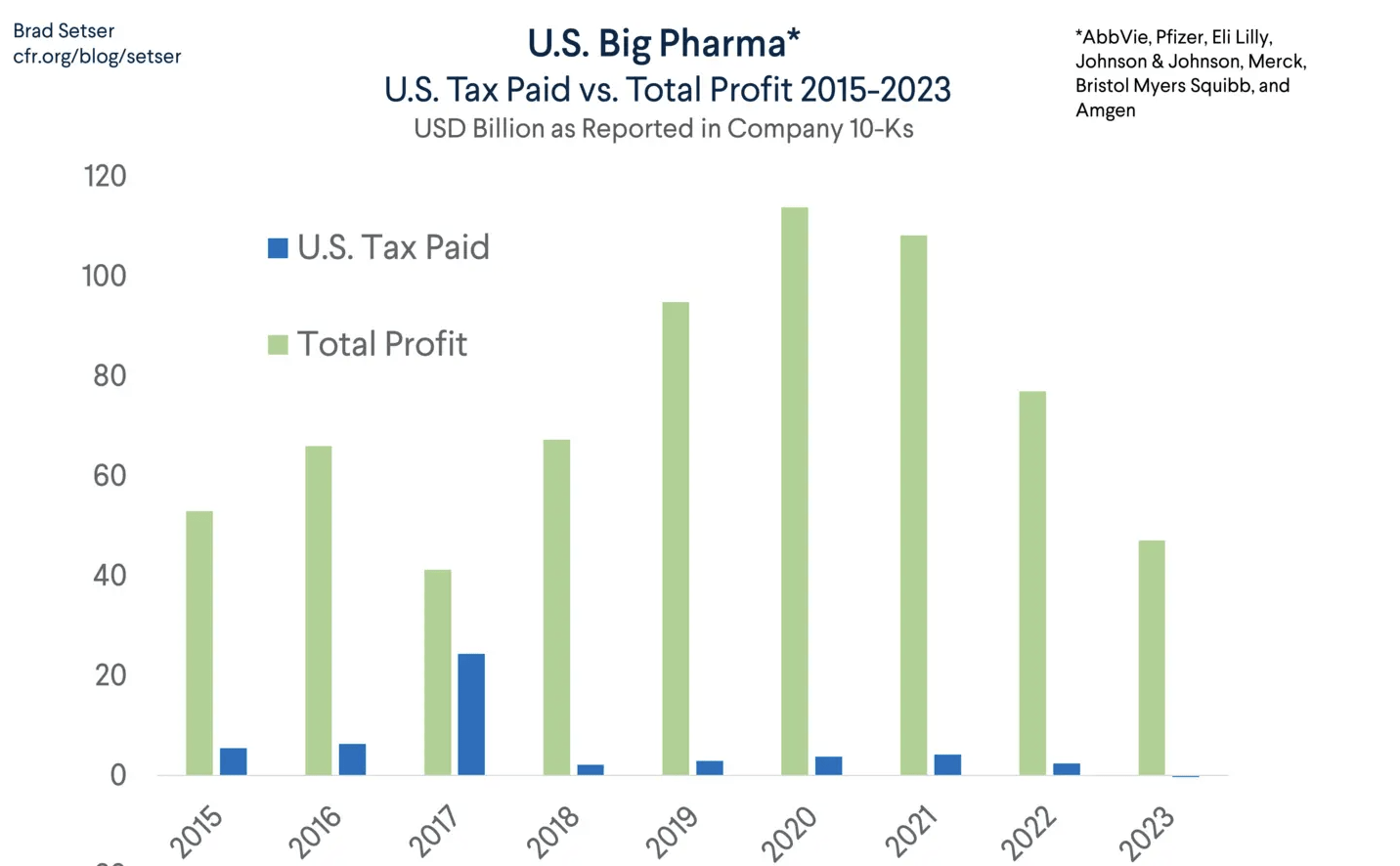
Big Pharma makes big profits in the U.S., but has mastered the accounting trick of paying little or no taxes. Thanks to Trump’s big corporate tax cut in 2017, most of these corporations are able to transfer their profits to other countries where the tax rates are lower.

Although they receive the bulk of revenue from sales in the U.S. and report large overall profits, most large U.S.-based pharmaceutical companies don’t pay any taxes in the country.

A new analysis of corporate taxes paid by the largest U.S. pharma companies by the Council on Foreign Relations found that in 2023, the top seven based on revenue had a combined U.S. tax obligation of (-)$250M.

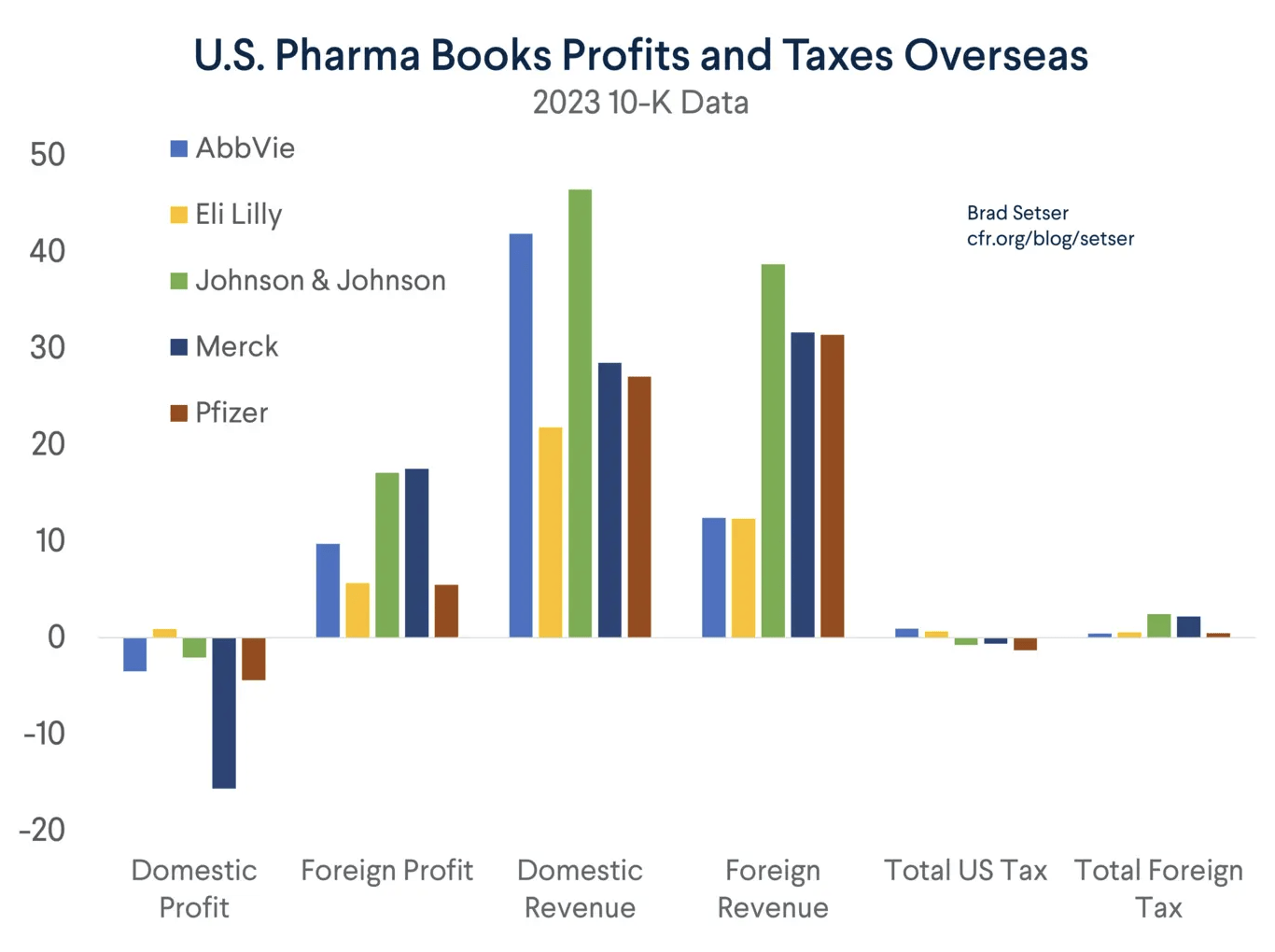
The duo also noted that, based on 10-K filings, many pharmas reported losses in the U.S. in 2023. Among them: Pfizer, $4.4B; AbbVie, $3.5B; Merck, $15.6B; and Johnson & Johnson $2B.

However, Setser and Weilandt estimated that Eli Lilly (LLY) reported a $0.9B U.S. profit.

Gilead Sciences (GILD) is an outlier among large biopharmas. It is the eighth largest U.S. biopharma by revenue, yet reported paying $3B in U.S. taxes in 2023.

Setser and Weilandt explain how pharmas can book U.S. profits overseas to save on paying U.S. taxes. The first reason is the Tax Cuts and Jobs Act of 2017, which the pair say provided for lower taxes on foreign profits than U.S. profits, providing an incentive for companies to book more profits overseas.

Second, since many drugs sold in the U.S. market are actually made abroad, pharma companies decide to book those profits in the country of manufacture.

Finally, many pharmas have moved their intellectual property to wholly owned subsidiaries in locations with more favorable tax rates than the U.S.

Open the link to read the rest of the article.

Scholars at Brown University and Stanford University recently released a study concluding that spending more on schools reduces child mortality.

The paper is titled “Priceless Benefits: Effects of School Spending on Child Mortality.”

The authors are: Emily Rauscher of Brown University; Greer Mellon, Postdoctoral Research Associate, Brown University; Susanna Loeb, Stanford University.

The authors’ summary:


The academic and economic benefits of school spending are well-established, but focusing on these outcomes may underestimate the full social benefits of school spending. Recent increases in U.S. child mortality are driven by injuries and raise questions about what types of social investments could reduce child deaths. We use
close school district tax elections and negative binomial regression models to estimate effects of a quasi-random increase in school spending on county child mortality. We find consistent evidence that increased school spending from passing a tax election reduces child mortality.

Districts that narrowly passed a proposed tax increase spent an additional $243 per pupil, mostly on instruction and salaries, and had 4% lower child mortality after spending increased (6-10 years after the election). This increased spending also reduced child deaths of despair (due to drugs, alcohol, or suicide) by 5% and child deaths due to accidents or motor vehicle accidents by 7%. Estimates predicting potential mechanisms suggest that lower child mortality could partly reflect increases in the number of teachers and counselors, higher teacher salaries, and improved student engagement.

Suggested citation: Rauscher, Emily, Greer Mellon, and Susanna Loeb. (2024). Priceless Benefits: Effects of School Spending on
Child Mortality. (EdWorkingPaper: 24-1008). Retrieved from Annenberg Institute at Brown University:
https://doi.org/10.26300/s7t7-j992

Emily Rauscher
Professor of Sociology
Brown University
Box 1916
Providence, RI 02912
emily_rauscher@brown.edu


Greer Mellon
Postdoctoral Research Associate
Population Studies and Training Center and Annenberg Institute
Brown University
greer_mellon@brown.edu


Susanna Loeb
Professor of Education
Stanford University
482 Galvez Mall
Stanford, CA 94305
sloeb@stanford.edu