Archives for category: Virtual Charter Schools

In choice-happy Indiana, where all choices are presumed to be good choices, Governor Eric Holcomb called for the state to do something about the woeful performance of the Indiana Virtual School. Be it noted that virtual schools have low performance everywhere, rake in millions of dollars, and buy political support. Will Indiana be any different from other states that have ignored the scandal of virtual charter performance?

In October, Chalkbeat reported that Indiana Virtual School, one of the state’s largest online charter schools, had received more than $20 million from the state while graduating about 61 students. And between at least 2011 and 2015, a for-profit company headed by Indiana Virtual’s founder, Thomas Stoughton, charged the school millions of dollars in management services and rent.

Wow! More than $20 million to graduate 61 students. A good haul for the school, not the taxpayers.

Indiana Virtual and its sister school that opened this year, Indiana Virtual Pathways Academy, together enroll 6,332 students. Across the state, more than 12,000 students are enrolled in online charters, most of which earned F grades this year. Two other major online charters, Hoosier Academies and Indiana Connections Academy, also opened new schools in the past year or so.

What will the state do? Certainly the state won’t close down this fraud.

At this point, Holcomb said he doesn’t see a need just yet for legislation addressing online schools, although he wouldn’t rule it out. He said his team has communicated with the state board that this area needs “immediate attention and action.” It’s not yet clear what measures they want to introduce, or how much authority the state board has to change charter school rules, but he indicated authorizing could be on the list.

David Harris, of the faux-liberal Mind Trust in Indianapolis, took time from privatizing public schools in Indianapolis, to suggest the need to change authorizers.

Ah, yes, change authorizers. That won’t help.

These scams should be closed. For-profit schools should be banned.

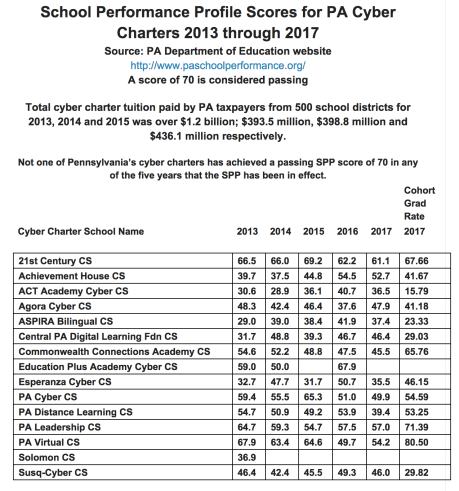
For the fifth year in a row, not one cybercharter in Pennsylvania achieved a passing school performance score of 70. When will these scams be held accountable for their poor performance? When will the State close down these failing schools? These “schools” drain hundreds of millions of dollars away from real schools and get poor results, year after year. Two different cybercharter operators were indicted for stealing millions from state taxpayers. One was convicted, the other was tried but the trial ended in a hung jury.

Screen Shot 2017-11-02 at 9.44.37 PM

I wrote a post yesterday about the “worst school in the nation.”

The school described in the post is INDIANA VIRTUAL SCHOOL, not Indiana Virtual Academy.

Indiana Virtual School is a Charter School that operates for profit. It graduates fewer than 10% of its students. Its teachers are assigned virtual classes of more than 200 students.

Indiana Virtual Academy is run by public school superintendents. It is not for-profit. It is not a charter school. It is a supplemental program, not a school. It partners with schools to provide virtual courses taught by certified teachers to schools that have difficulty finding teachers and to individual students who have scheduling conflicts.

Indiana Virtual Academy works for public schools to meet the needs of schools and students.

Indiana Virtual School is a for-profit charter. It may well be the Worst School in the Nation.

I mixed up their names because they look so similar.

I apologize for the error.

I think so.

It is located in Mike Pence’s Indiana.

It operates for profit.

It has a high school graduation rate of less than 10%.

It recruits and markets heavily to lure students.

It has 5,000 students.

There is one teacher for every 222 students.

The owner pockets millions of dollars in taxpayer money.

It is an online charter, a cybercharter, a virtual charter.

It is called the Indiana Virtual School.

Secretary of Education Betsy DeVos wants many more schools like this.

“Thomas Stoughton founded the school in 2011, taking advantage of a new law allowing Indiana charter schools to serve students exclusively over the internet, rather than in brick-and-mortar buildings.

“In recent years, students have signed up in droves, responding to social media advertising campaigns. The school they end up attending differs widely from other online charter schools emerging across the country, with far fewer teachers per student — 1 for every 222 students last school year, according to state data — and fewer students taking and passing state exams.

“As enrollment at Indiana Virtual School ballooned, so did the school’s state funding, which is distributed on a per-student basis. Some of that money has gone to AlphaCom Inc., a for-profit company also founded and led until 2016 by Stoughton. Since 2011, AlphaCom has held multiple contracts with Indiana Virtual School totaling about $6 million to provide management services and office space. A company run by Stoughton’s son also held a contract with the school.”

The school apparently has no oversight, no supervision.

Kudos to Shaina Cavazos of Chalkbeat for this terrific investigative reporting!

Free public money! Come and get it! Get rich quick on the taxpayer’s dimes and dollars!

NOTE: The Name of the institution is the Indiana Virtual School, a Charter School, NOT THE INDIANA VIRTUAL ACADEMY, which is run by public school superintendents as a nonprofit.

Lily Eskelsen Garcia forced herself to sit down and listen to Betsy DeVos’ speech at Harvard, where she thought she would be in a choice-friendly environment, surrounded by allies at the Program on Educational Policy and Governance, led by choice advocate Paul Peterson. As we now know, students in the audience rejected her message and unfurled banners expressing their opposition to her policies.

Lily has refused to meet with DeVos because of her well-known contempt for public schools and the teaching profession.

This is her reaction to DeVos’ remarks.

“At times, I felt like I was getting a root canal without novocaine from the dentist in “The Little Shop of Horrors.” When the pain subsided, I was more convinced than ever that DeVos knows little about public schools and even less about their mission.

“Here’s a summary:

“1. DeVos talked about her Rethink School tour, applauding the schools she visited for openly stating: “’We’re not for everybody and we don’t expect everybody to want to come here.’ I think all schools should have that attitude.”

“She doesn’t understand the concept of “public” schools—schools that are open to all students, no matter what language is spoken at home, what the family income is, what their religion or race is, what abilities or disabilities they have, whether they are gay, straight, or transgender. The mission of public schools is to provide opportunities for each and every student who walks through the door, not to roll up the welcome mat, bar the door, and declare: “Sorry, but we’re not for everybody.”

“I think we already went through that time in history. There was even a name for it: Segregation.

“2. When she mentioned the places she visited during her tour, there was one noticeable omission: Michigan, her home state. Who can blame her? She funded efforts in Michigan to siphon funds from students in public schools, allowing for-profit companies to operate schools with taxpayer money and no accountability. The result? Schools with shoddy academic records continued operating for years; no state standards focus on who operates or oversees charters; and schools routinely close without giving families or educators adequate notice.

“This, apparently, is her goal from coast to coast.”

Read on to understand Lily’s reaction.

The rightwing-funded Black Alliance for Educational Options is closing its doors. It was launched by Howard Fuller, who was superintendent of Milwaukee public schools in 2000. Fuller was radicalized by his inability to change the system and formed an alliance with the far-right Bradley Foundation, which funded vouchers and wanted to privatize public education. Over the years, BAEO has been funded by white conservative foundations including the Walton Foundation.

BAEO Sought to persuade African Americans that school choice, charters, and vouchers, and privatization were in their interest.

Southern legislatures, controlled by conservative white men, liked BAEO’s ideas.

Education Week credits BAEO with getting Alabama and Mississippi to pass charter laws, and Louisiana and D.C. to pass voucher legislation.

White segregationists embrace school choice readily, as they have wanted it since 1954. Fuller pushed on an open door. Now southern states can fund segregated schools and do it with a clear conscience. Sort of.

Fuller no doubt was following his conscience, but it would be better if he had done it without all that rightwing money.

In the era of Trump and DeVos, it is difficult to play the role of a progressive when their agenda and yours are the same. Especially when the NAACP is speaking out against charters and privatization.

In a related story, the former chairman of the BAEO board Kevin Chavous has been named president of K12 Inc.s Academics, Policy, and Schools. K12 Inc. was founded by junk bond king Michael Milken and his brother Lowell and is the nation’s largest virtual online charter corporation. It is listed on the New York Stock Exchange. Its schools have been notable for high attrition rates, low test scores, and low graduation rates. The NCAA withdrew accreditation from two dozen K12 schools a few years ago because of their poor quality. This is a choice strongly supported by DeVos. K12 Inc. is also known for paying lavish compensation, desite its poor academic results.

Earlier today, I posted the question: Whatever happened to the audit of the California Virtual Academies, which was supposed to be released in March 2017?

The California Department of Education contacted me to say that the audit was released two days ago, and CDE ordered the Virtual Academies to repay nearly $2 Million in misspent funds.

Let me be clear: I don’t think that for-profit Virtual Charters should be allowed to exist. If districts want to offer online instruction, not for profit, that is their prerogative.

But the for-profits, especially K12 Inc. (founded by Michael Milken and known for paying its executives multimillion dollar salaries) recruit students constantly, have high attrition, and get poor results.

In light of Jesse Calefati’s stunning expose of K12 Inc. in the San Jose Mercury-News, I am surprised that these scam online academies got by with a tap on the hand. According to Calefati, the Virtual Academies have collected hundreds of millions from California taxpayers to run low-performing, ineffectual “schools.” ECOT in Ohio was audited and required to pay more than $60 Million. Excuse me, but a fine of less than $2 Million is trivial for these corporations. Chicken feed.

I hope that the fine of “less than $2 Million” is the beginning and not the end of the Audits. The for-profits are notorious for inflating enrollments and collecting money for phantom students.

Here is the audit.

Here are the articles that CDE sent.

CDE: Online Charter Schools Must Repay Misused State Dollars

By Richard Bammer

State Superintendent of Public Instruction Tom Torlakson on Monday said a pair of online charter schools must pay back nearly $2 million of improperly used Common Core education funds.

In a press release, he cited California Virtual Academies and three Insight Schools (together forming CAVA) must remit the dollars to the California Department of Education.

This latest among several other actions stems directly from an audit by the State Controller’s Office and commissioned by the CDE.

The Vacaville Reporter
http://www.thereporter.com/article/NG/20171010/NEWS/171019986

Former Lodi Virtual Academy Fined $2M

By Jennifer Bonnett

A virtual academy that once had a key role in the Lodi Unified School District has been fined close to $2 million by the state for falsifying enrollment figures.

State Superintendent of Public Instruction Tom Torlakson has announced that the California Virtual Academies and three Insight Schools (together CAVA) must remit nearly $2 million to the California Department of Education in improperly used Common Core education funds.

Lodi News-Sentinel
http://www.lodinews.com/news/article_a8ab29bc-ae42-11e7-8ded-03b98ff003ed.html

Virtual Charter Academies In California Must Refund Nearly $2 Million To State

By Louis Freedberg

As a result of a just released state audit, the California Department of Education says a network of virtual charter schools must refund nearly $2 million in improperly used state funds that were intended for implementation of the Common Core standards in English and math.

In addition, the department will require the schools to conduct a new audit of its average daily attendance records and a number of other actions.

“The California Department of Education is committed to ensuring public schools follow the laws and regulations that safeguard taxpayer funds,” said State Superintendent of Public Instruction Tom Torlakson. “It’s critical that our students receive the resources they need to succeed.”

EdSource

Virtual charter academies in California must refund nearly $2 million to state

California Fines Charter School Chain $2 Million

By Sharon Noguchi

In long-awaited results of a 1½-year investigation, California’s finance and education chiefs on Monday issued a critical audit of the online charter-school chain California Virtual Academies, finding several contractual violations and irregularities and imposing a nearly $2 million fine.

The report ordered the charter firm to provide documentation around student progress, student-teacher ratios and excess oversight fees, among other things. It also demanded California Virtual Academies produce an audited opinion on the accuracy of its average daily attendance — on which California bases its payments to public schools, including charters — and to pay the California Department of Education $1,995,148 for improperly handled funds.

Mercury News

California fines charter school chain $2 million

In June 2016, California State Superintendent Tom Torlakson called for an official audit of the for-profit K-12 Inc. virtual charter school after an expose of its shoddy results in the San Jose Mercury News by investigative reporter Jessica Calefati. See here for all her reports on K-12.

Where is that audit?

Did it happen? Does it exist?

The audit was supposed to be completed by March 2017.

“State Superintendent of Public Instruction Tom Torlakson announced Thursday that the California Department of Education has contracted with the State Controller’s Office to conduct an audit of California Virtual Academies (CAVA) and related charter schools because of serious questions raised about a number of their practices.

“The goal of the audit is to make sure these schools are spending public education funds properly and serving their students well,” said Torlakson.

“In 2015, CAVA’s corporate parent K12 paid its CEO Nathaniel Davis $5.3 million and CFO James Rhyu was making $3.6 million. Their base salaries were $700,000 and $478,500, respectively, which were dwarfed by additional pay and stock for their “performance.”

“In all, K12’s five highest paid executives received a total of more than $12 million in compensation last year. That’s one of the reasons Center for Media and Democracy has called K12 Inc.’s former CEO, Ron Packard, the highest paid elementary and secondary school educator in the nation.

“Nearly 90% of K12’s revenues–and thus its huge pay for executives–comes from Americans’ state or federal tax dollars.”

Should California taxpayers shell out $12 Million for executive compensation in a low-performing charter school?

If anyone knows the whereabouts of the missing audit, please let me know.

There were also supposed to be two separate investigations of CAVA (K-12 Inc), one by the State Attorney General, the other by the Legislature. What happened to them?

Oklahoma has an online charter school that is growing “at breakneck speed,” but producing pathetic results for students. This is not unusual. It is typical for online charter schools to recruit students, experience high attrition, and produce crummy results.

Oklahoma’s largest online charter school is on a track of explosive growth, nearly tripling its enrollment over three years, to almost 8,500.

That pursuit of lightning growth by Epic Charter Schools – a goal affirmed by its co-founder – shows no signs of letting up. Epic officials predict enrollment will near 10,000 by mid-school year.

But the trend is raising concerns from one top online charter-school regulator about whether there is too much turnover of students. And at least one national report warns that rapid expansion at virtual charter schools can compromise academic achievement.

Epic’s unconventional efforts to drive enrollment also have raised eyebrows. Among other tactics, it gives out concert tickets, vacations and other prizes to students’ families as rewards for referrals of students. The school also spurs referrals by depositing bonus money into “learning fund” accounts that families can use to buy their curriculum or computers or defray fees for extracurricular activities such as dancing or club sports. Epic told state officials the rewards are not paid for with state funds.

Epic administrators say their system is growing rapidly because parents and students love it. Parents of some students applaud the program, saying it gives them the freedom of home-schooling with some of the benefits of a public school.

“Clearly, we’re providing a quality of service and education that families are enjoying and appreciate, or we wouldn’t be continuing to grow year after year,” said Superintendent David Chaney.

But Epic’s academic performance is average or low, as measured by the state’s standard assessment tools. Just over a quarter of Epic’s students last year graduated within four years, compared with 82 percent statewide. Its elementary, middle and high schools received a C-, D and C on the state A-F report cards.

Those marks contrast with Epic’s posting a 100 percent attendance rate for the 2015-2016 school year, achieved by only one other school in the state – ABLE Charter School, a virtual school the state is trying to close.

“There is a good place for virtual charter schools,” said Rebecca Wilkinson, executive director of the Statewide Virtual Charter School Board, which oversees all of the state’s online schools. “I’ve got lots of stories from individual families and students that it’s the right choice for. But more than anything, these large numbers of kids coming in – it’s disturbing, and overshadows the good it (Epic) can do.”

Epic co-founder Ben Harris said the school is working on improving its graduation rates and A-F letter grades. He added the number that matters most to him is enrollment.

Yes, indeed! Enrollment translates into dollars! For every dollar spent by an ineffective online school, there is a dollar less for a real public school.

Study after study has shown that virtual schools are not good schools. Kids may turn on the computer–or not. They may turn on the computer and learn nothing. The bad results are consistent.

Betsy DeVos doesn’t care about results. She loves online charter schools (like her mentor, Jeb Bush, co-author of that classic Digital Education NOW!, which urged expansion of digital classes and schools with no accountability whatever). In Pennsylvania, which is overrun with virtual charter schools, the graduation rate is 48%. That’s high compared to the graduation rate at ECOT in Ohio, which hovers around 20%. The founder of Pennsylvania’s biggest virtual charter school pleaded guilty to tax fraud and is awaiting sentencing, having been convicted of siphoning off millions of dollars. The founder of another virtual charter skimmed $6.5 million dollars for herself but was not charged with a crime because of her age.

Education Week investigated the online charter industry and reported numerous cases of fraud. It is a fraudulent industry. Why do we need more of it?

Steven Singer was blocked by Facebook for a week because of the post you are about to read. This post “violated community standards.” Steven Singer was censored by an algorithm. Or, Steven Singer was censored by the Political Defense team that tries to prevent any criticism of charter schools and TFA. This team swarms Facebook and other social media and complains that a post or tweet is “offensive” and the machine blocks the offending post.

This is the post by Steven Singer that has been blocked. This is the lie about “school choice” that DeVos and ALEC and charter promoters don’t want you to read.

He writes:

Neoliberals and right-wingers are very good at naming things.

Doing so allows them to frame the narrative, and control the debate.

Nowhere is this more obvious than with “school choice” – a term that has nothing to do with choice and everything to do with privatization.

It literally means taking public educational institutions and turning them over to private companies for management and profit.

He adds:

There are two main types: charter and voucher schools.

Charter schools are run by private interests but paid for exclusively by tax dollars. Voucher schools are run by private businesses and paid for at least in part by tax dollars.

Certainly each state has different laws and different legal definitions of these terms so there is some variability of what these schools are in practice. However, the general description holds in most cases. Voucher schools are privately run at (at least partial) public expense. Charter schools are privately run but pretend to be public. In both cases, they’re private – no matter what their lobbyists or marketing campaigns say to the contrary.

They take money from public schools that serve all students and give it to privatized schools that choose their students and expel those they don’t want.

Charters and vouchers are the Walmartization of public education. They introduce corporate chains to run what used to be neighborhood public schools. The only difference is that everyone may shop at Walmart, but not everyone who applies will be accepted at a choice school. The school does the choosing, not the family.

Steven reinforces what I wrote in Reign of Error: The Hoax of the Privatization Movement and the Danger to America’s Public Schools. “School choice” is a hoax, a lie. It is promoted by rightwing ideologues and by Democratic politicians hungry for funding by the financial sector, which sees schools as an emerging industry. Don’t be fooled.

School choice is privatization. And privatization is very bad for those who are not chosen. And very bad for our democracy.