Archives for category: Unions

Karen Lewis is the inspiration for today’s teacher’s strikes.

She is one of a kind.

She is a hero, a woman of courage, character, integrity, intellect, and steel.

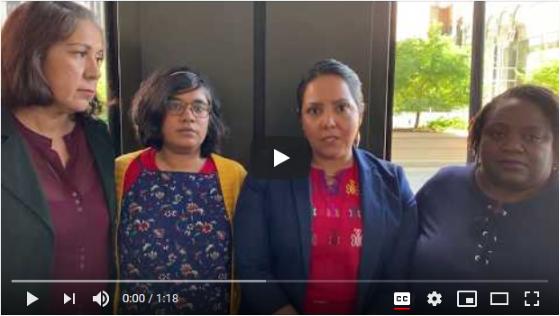
The Chicago Teachers Union just released this video tribute to Karen.

Karen is a product of the Chicago Public Schools. She went to elite Ivy League colleges, first to Mount Holyoke, then transferred to Dartmouth College, where she was the only African American female in the class of 1974.

Karen returned to Chicago and became a chemistry teacher in the Chicago Public Schools, where she taught for 22 years.

In 2010, an upstart group of unionists called the Caucus of Rank and File Educators (CORE) ousted the leadership of the Chicago Teachers Union and elected Karen Lewis as its president. The new leadership cut its own salaries and began building relationships with community organizations and parents.

The city’s political and financial elite rewrote state law in hopes of preventing the union from striking. Assisted by Jonah Edelman of the turncoat “Stand for Children,” the city’s financial elite hired the state’s top lobbyists (so that none would be available to help the union), raised millions of dollars (outspending the unions), and passed a state law saying that teachers could not strike unless they had the approval of 75% of their members. They thought this was an impossible threshold. Jonah Edelman, seated alongside James Schine Crown, one of Chicago’s wealthiest financiers, boasted of their feat at the Aspen Institute in 2011. Surrounded by their union-hating peers from other cities at the Aspen Ideas Festival, Edelman said “If It Could Happen Here, It Could Happen Anywhere,” meaning that with enough financial and political clout, unions could be crushed. (The event was transcribed by Parents Across America and blogger Fred Klonsky copied the video before the Aspen Institute took it down). Edelman subsequently apologized for his candid remarks, but Stand for Children has continued to act as a proxy for philanthrocapitalists. (The Aspen video and Edelman’s apology is here on Fred Klonsky’s blog).

Needless to say, the elites were shocked when Karen Lewis and her team called for authorization to strike and won the support of more than 90% of the union’s membership.

In 2012, the union struck for 10 days and won important concessions, including protections for teachers laid off when Rahm Emanuel closed schools, prevention of merit pay (which she knew has failed everywhere), and changes in the teacher evaluation system. The union had carefully built relationships with parents and communities, and the strike received broad public support.

In 2014, Karen Lewis was urged to challenge Rahm Emanuel in the 2015 mayoral election. She set up an exploratory committee, and early polls showed she was likely to win. But in the fall of 2014, Karen was afflicted with a cancerous brain tumor. She was 61 years old. She stepped down as president of the CTU. She is cared for by her devoted husband, John Lewis, who was a physical education teacher in the Chicago Public Schools.

Karen Lewis exemplified courage, fearlessness, Resistance, leadership, and concern for teachers and children.

Every teacher who took the bold step of striking to improve the conditions of teaching and learning in their school  stands on the shoulders of Karen Lewis. Every teacher and parent who wears Red for Ed is in the debt of this great woman.

She is our hero. She should be the hero of everyone who cares about the rights of children and the eventual triumph of the common good.

Watch here to see Karen Lewis before her illness, speaking at the first annual conference of the Network for Public Education in Austin Texas on March 1, 2024. Her speech was preceded by that of John Kuhn, superintendent of a school district in Texas. Karen starts speaking about the 14-minute mark. Both are worth watching.

I interviewed Karen Lewis at the second annual conference of the Network for Public Education in Chicago in 2015. You can see it here. 

And this is my account of how I met Karen for the first time and why I love her.

She inspires me every day. I miss her very much.


Max Brantley, the editor of the Arkansas Times, is a journalist who fearlessly stands up to the all-powerful Walton Family in the state they think they own. Brantley is a hero of the Resistance in my forthcoming book SLAYING GOLIATH.

In this post, Brantley describes the Waltons’ efforts to destroy the Little Rock School District and to crush the Little Rock Education Association.

He writes:

They are doing to Little Rock schools what the foundation of the family fortune did to small towns all across America — hollowing them out. It’s a years-long, billion-dollar effort that favors “choice” — privately run charter schools, vouchers for private schools, taxpayer support for homeschoolers and a diminishment of the role of elected school boards.  Parents know best, the Walton acolytes assert, even when the studies show little proof that the various choices beat conventional public schools. They are still searching for the magic bullet for the grinding reality of the impact of poverty on standardized test scores, the misleading standard by which “failure” is determined…

Little Rock teachers are…complaining of a mass e-mail from the anti-union Arkansas State Teachers Association last night warning teachers against striking. This group had a $362,000 startup grant from the Walton Family Foundation, no surprise given how notoriously anti-union Walmart has always been. ASTA also has ties to a national anti-union organization founded by like-minded billionaires.  Teachers weren’t too happy to be spammed by the group. ASTA also has been peppering state newspapers with op-eds touting their anti-union views. Its leader, Michele Linch, was the lone public voice on the other side of an outpouring of public opposition to the attack on the LRSD and its union by the state Board of Education.

Teachers in Little Rock ARE talking strike. I confess misgivings. There’s not a readily attainable goal as seen in other states, such as a pay increase. Nor is there any realistic hope for a change of heart in the Asa Hutchinson- (and thus Walton-) controlled education hierarchy. As Ernie Dumas wrote this week, racial discrimination and union hatred (tied historically with racist thinking) have always been with us in Arkansas. The recent LRSD takeover was nothing more than a combination of both by the white male business ruling class, with the primary immediate goal of union wreckage.

The Waltons collectively have a fortune in excess of $100 billion. They buy people, they create organizations to implement their evil schemes, they think they can squelch democracy by the power of money.

Those with the courage to stand up to them—journalists like Max Brantley, the teachers of the Little Rock Education Association, the parents and activists of Grassroots Arkansas—are the heroes of our time. They oppose autocracy, plutocracy, and a vast conspiracy to destroy democracy.


Day 2 of CTU strike will bring educators, allies to City Hall at 1:30 pm

Some movement at bargaining table Thursday, but no agreement on special ed needs, classroom overcrowding, salary floor for low-wage teaching assistants, staffing shortages.

CHICAGO—Educators and frontline staff will hit the picket lines for a second day today, as rank and file union members attempt to bargain a fair contract for 25,000 CTU teachers, clinicians, teaching assistants and support staff. While some progress was made at the bargaining table Thursday, the union and CPS ramain far apart on efforts to reign in exploding class sizes and find a path to remedying dire shortages of school nurses, social workers, special education teachers and other critical staff.

Late this afternoon, CPS refused to discuss a proposal on special education needs with the expert special education teachers and clinicians at the table who had crafted the proposal, because not every CTU officer was present. The CTU’s 40+ member rank and file bargaining team must sign off on any tentative agreement to be sent to members for approval.

Today’s schedule: Thursday, Oct. 17


  • 1:30 p.m.: Mass rally and march, City Hall, 121 N. LaSalle St. with CTU rank and file, grassroots community groups, CTU officers, elected officials, allies.

Fast facts:

  • The State’s new equity-based school funding formula is sending a billion-plus additional dollars each year to CPS to reduce sizes of chronically overcrowded classes, support students in poverty and increase services to special education students and English language learners.
  • CPS passed the largest budget in its history this year: $7.7 billion. Yet CPS cut the amount of dollars it is spending in school communities this year.
  • Juarez High School in Pilsen, which enrolls over 1,300 overwhelmingly low-income Latinx students, saw its school budget cut this year by $840,000, costing the school nine teaching and staff positions.
  • CPS cut the budgets of more than 200 CPS schools by at least $100,000, and cut the budgets of more than 40 schools by more than half a million dollars for this school year.
  • CTU educators are fighting for better wages, smaller class sizes, adequate staffing, and educational justice for students and their families. They want the additional state revenue CPS receives to increase equity to go to school communities and student needs.
  • Almost half of CPS’ students are Latinx. Yet the district has acute shortages of ELL teachers—teachers for English language learners—and is severely short of bilingual social workers. Bilingual education services are chronically short of both educators and resources—a key issue at the bargaining table.
  • CPS is desperately short of school nurses, social workers, librarians, special education teachers, ELL teachers and more. CPS has staffing ratios three to five times higher than those recommended by national professional organizations and best practices. Fewer than 115 school nurses serve over 500 schools. Most schools have a nurse only one day a week.
  • One out of four schools has a librarian—and that number falls to barely one in ten for Black-majority schools. A decade ago, most schools had a librarian.
  • CPS is desperately short of social workers and special education teachers, even as CPS is under the oversight of a state monitor for shortchanging its diverse learners.
  • This year, more than 1,300 CPS classes are overcrowded under CPS’ own high class caps, up from more than a thousand overcrowded classrooms last year.
  • Almost 25% of elementary students attend overcrowded classes, with some kindergarten classes topping 40 students. Roughly 35% of high school students are enrolled in overcrowded classes; at schools like Simeon, virtually every core class is overcrowded, with math, social studies and world language classes topping 39 students.
  • The CTU’s school clerks and teaching assistants earn wages as low as $28,000/year—so low the children of two-thirds qualify for free and reduced lunch under federal poverty guidelines. Over 1,100 cannot afford to rent a two-bedroom apartment at prevailing rent rates in ANY zip code in the city. In year 5 of the mayor’s proposed contract, most of those workers would still be earning poverty wages. And in the last ten years, NO CTU member’s wages have kept pace with the inflation rate.
  • Candidate Lightfoot ran on a platform calling for equity and educational justice—including a nurse, a social worker and a librarian in every school—all proposals her negotiating team has rejected at the table. She also ran in support of an elected, representative school board—but moved to stall that legislation in the Illinois Senate after she was elected.
  • CPS has said it has budgeted to improve staffing shortages, but refuses to put those commitments in writing in an enforceable contract. The union wants those promises in writing, in an enforceable contract—the only way we have to hold CPS and the 5th floor to their promises.


Mike Klonsky just posted this as he was leaving to bring coffee and donuts to striking teachers, including his daughter.

I hope this strike has a good outcome for both the teachers and the new mayor. She is not Rahm Emanuel. She inherited the debt for Rahm’s two terms of hostility to the city’s public schools and their teachers.

Mike included this quote:

Yesterday, the parent group, Raise Your Hand, issued a statement on the strike which made a lot of sense.

Please remember to be good to each other out there. At the end of this contract negotiation, we are all parts of school communities that are part of a larger community, the Chicago Public Schools. Our children need all of us working together.


Randi Weingarten, who is both president of the American Federation of Teachers and a veteran lawyer, describes the AFT’s efforts to save the pensions and benefits and dignity of teachers in Puerto Rico as the Island faced bankruptcy and predatory lenders.


The Chicago Teachers Union announced that it would begin a strike on Thursday.

Mayor Lori Lightfoot is paying the price for years of neglect under Mayor Rahm Emanuel and Mayor Richard Daley.

Teachers in Chicago announced Wednesday evening that they would go on strike, forcing the cancellation of classes for more than 300,000 public school students in the nation’s third-largest district starting Thursday.

The strike threatened to upend life in the city, as parents raced to make arrangements for child care and as city officials began to activate a contingency plan for supervising and feeding students in school buildings.

The strike in Chicago is the latest in a string of more than a dozen major walkouts by teachers across the country since early last year. It is an important early test for Mayor Lori Lightfoot, who was elected this year after a campaign in which she called for more nurses and social workers in the city’s schools — some of the very changes Chicago’s teachers are seeking now.

The city and the Chicago Teachers Union, which represents more than 20,000 educators, had been in tense contract negotiations for months, and there had been signs of progress in recent days. But as a midnight deadline approached on Wednesday with no deal, Ms. Lightfoot canceled Thursday classes and both sides signaled that a walkout was inevitable.

The split between the city and the union stretches beyond traditional debates over pay and benefits, though representatives for each side disputed details of what had been offered during negotiations and what the exact points of contention were now.

The city said that it has offered teachers pay raises totaling 16 percent over a five-year contract, while union leaders have called for increases of 15 percent over a shorter three-year term. More pressing, union leaders say, are their calls for a promise — in writing — of smaller class sizes, more paid time to prepare lessons and the hiring of more school nurses, social workers, librarians and counselors. Other issues, including affordable housing provisions and protections for immigrant students, have also been raised.

The strike is the first for Chicago’s school system since 2012, when teachers walked out for seven days as part of a defining battle with the city’s previous administration.

About 7,500 school support employees represented by a different union also rejected a contract offer and planned to go on strike Thursday. Those workers include security officers, bus aides, custodians and special education classroom assistants.


Yesterday the Arkansas State Board of Education voted to return control of the Little Rock School District to the people of Little Rock. This followed massive demonstrations and demands by the citizenry. At the same meeting, the board voted unanimously to deny recognition to the Little Rock Educators Association, which represents 60% of the teachers in the district.

Rev/Dr. Anika Whitfield, an activist in Grassroots Arkansas, was outraged by the latter decision. She is a podiatrist and an ordained minister. For her volunteer fight for public schools and democracy, she is one of the heroes in my new book SLAYING GOLIATH.

She wrote the following response to the board’s stripping of the teachers’ right to join as a union.

October 10, 2019 will be a day marked in Arkansas history as the enslavement of LRSD teachers and educators, a day when democracy and liberation was denied to them.
 
The Auditorium in the Arkansas Department of Education was overflowing with concerned community members from the LRSD.  People who took leave from work to lend their voices for a people’s democracy to a nine member board appointed by a republic/empire run by billionaires and millionaires who maintain their wealth primarily from the economy of persons who earn the lowest compensation.  With the help of Gov. Asa Hutchinson, the Walton Family Foundation, Stephen’s, Inc. and Walter Hussman have been siphoning money from the people in our state who are the most vulnerable, our children.  And, to add insult to injury, they are targeting our children who primarily come from homes were their families are the lowest income earners in our state. The wealthy are maintaining their riches by stealing from the poor.  This a model of capitalism that traces back to the origins of this nation that we call the United States of America. 
 
Yesterday, we witnessed the nine appointed members of the state board of education unanimously remove the collective bargaining power of teachers and educators.  Their coup of sorts was made deliverable through a myriad of chaotic twists and turns of the worst type of confusion and violations of Robert’s Rules of Order.  And, after reflecting on the manner in which the state board of education directors conducted themselves on yesterday, it has become more evident that their goal was to be deceitful and underhanded, to ward off any opportunities for the public to call their hand and stop their votes. 
 
Dr. Sarah Moore, one of the nine appointed directors of the Arkansas State Board of Education, who worked as a Doctoral Academy Fellow at the Office of Education Policy (funded by the Walton Family Foundation) at the University of Arkansas at Fayetteville, made the initial motion to no longer recognize the Little Rock Educators Association (LREA) at the end of their call meeting on September 27, 2019. Yesterday, Atty Chad Pekron, who was appointed by Gov. Asa Hutchinson to the state board of education in July 2019, made and rescinded two or three motions to overturn, table, and then to vote on Dr. Moore’s tabled motion from the September 27th meeting.
 
After all of the smoke was clear, and the confusion was never resolved, the public realized that the state board of education voted to unanimously deny the Little Rock school teachers and educators the recognition of their union.  What a sad day in Little Rock and in Arkansas history. Justice, Liberation, Equity and Democracy continue to be lawfully denied by the Empire of the Republic of wealth, greed, and fear that is being unjustifiably marketed as a great America.  


NEWS RELEASE:
For Immediate Release
| ctulocal1.org

CONTACT: Ronnie Reese 312-329-6235, RonnieReese@ctulocal1.org

Ninety-four percent of CTU members vote to authorize strike for schools Chicago’s students deserve

Chicago Teachers Union House of Delegates governing body will set strike date at Wednesday, Oct. 2, meeting.

CHICAGO, September 26, 2019—The Chicago Teachers Union this evening released totals of the Sept. 24-26 strike authorization vote. The CTU Rules and Election Committee reported that as of 9:30 p.m., the Union passed the 75 percent threshold of members voting “yes.” Ninety-four percent of teachers, clinicians, PSRPs, nurses, librarians voted to authorize a strike to win the schools Chicago’s students deserve.

The vote stands as a mandate from CTU members for Chicago Public Schools to uphold promises of equity and educational justice made by Mayor Lori Lightfoot, and that those promises must be in writing in an enforceable contract. This is the only way to hold the district to its word after decades of austerity, budget cuts, understaffing, school closings and privatization.

The CTU House of Delegates will convene for its next scheduled meeting on Wednesday, Oct. 2, to set a strike date. The earliest the Union could strike is Oct. 7. The work stoppage would be the third since 2011 and the first under Lightfoot.

“Our school communities are desperately short of nurses, social workers, psychologists, counselors and other support staff, even as our students struggle with high levels of trauma driven by poverty and neighborhood violence,” CTU President Jesse Sharkey said. “This vote represents a true mandate for change.”

“And all of our members vote, not just 30 percent of the electorate,” Sharkey said.

Facebook live stream

Bargaining Update

Rank-and-file members met with the district today to negotiate over early childhood and bilingual education provisions. They were sorely disappointed at the non-engagement from the other side. Watch their explanation in this video:

###

The Chicago Teachers Union represents nearly 25,000 teachers and educational support personnel working in schools funded by City of Chicago School District 299, and by extension, the nearly 400,000 students and families they serve. The CTU is an affiliate of the American Federation of Teachers and the Illinois Federation of Teachers and is the third-largest teachers local in the United States. For more information please visit the CTU website at www.ctulocal1.org.

Steven Singer has written recently about the origins of charter schools. He insists that Albert Shanker, president of the AFT, was not their father.

The real fathers of this first big step towards privatization, he writes, were Ted Kolderie and Joe Nathan of Minnesota, who wrote the nation’s first charter school law and opened the door wide for entrepreneurs, grifters, and attacks on unions.

Singer is a flame-thrower in this post, because he has come to see that behind the “progressive” facade of charters lurks Betsy DeVos, the Walton Family, the Koch brothers, ALEC, and a galaxy of public school haters.

He begins:

If bad ideas can be said to have fathers, then charter schools have two.

And I’m not talking about greed and racism.

No, I mean two flesh and blood men who did more than any others to give this terrible idea life – Minnesota ideologues Ted Kolderie, 89, and Joe Nathan, 71.

In my article “Charter Schools Were Never a Good Idea. They Were a Corporate Plot All Along,” I wrote about Kolderie’s role but neglected to mention Nathan’s.

And of the two men, Nathan has actually commented on this blog.

He flamed on your humble narrator when I dared to say that charter schools and voucher schools are virtually identical.

I guess he didn’t like me connecting “liberal” charters with “conservative” vouchers. And in the years since, with Trump’s universally hated Billionaire Education Secretary Betsy Devos assuming the face of both regressive policies, he was right to fear the public relations nightmare for his brainchild, the charter school.

It’s kind of amazing that these two white men tried to convince scores of minorities that giving up self-governance of their children’s schools is in their own best interests, that children of color don’t need the same services white kids routinely get at their neighborhood public schools and that letting appointed bureaucrats decide whether your child actually gets to enroll in their school is somehow school choice!

But now that Nathan and Kolderie’s progeny policy initiative is waning in popularity, the NAACP and Black Lives Matter are calling for moratoriums on new charters and even progressive politicians are calling for legislative oversight, it’s important that people know exactly who is responsible for this monster.

And more than anyone else, that’s Kolderie and Nathan.

Over the last three decades, Nathan has made a career of sabotaging authentic public schools while pushing for school privatization.

He is director of the Center for School Change, a Minneapolis charter school cheerleading organization, that’s received at least $1,317,813 in grants to undermine neighborhood schools and replace them with fly-by-night privatized monstrosities.

He’s written extensively in newspapers around the country and nationwide magazines and Websites like the Huffington Post.

Read it all. Joe Nathan has frequently commented on this blog, defending charters as just a different kind of public school. I disagree vigorously because it is obvious by now that charters have become vehicles for busting unions (more than 90% are non-union), charters are more segregated than public schools (especially in Minnesota, where there are charters specifically for children of different ethnic and racial groups), and they remove democratic control in communities of color. The proliferation of corporate charter chains adds to their reputation as destroyers of democracy.

Bottom line is that Walton money, Koch money, DeVos money is not meant to advance public education but to eliminate it.

There is a reason that the Democratic candidates for president are distancing themselves from the charter idea. They understand that they can’t support the DeVos agenda. Betsy did us all a favor by removing the mask.

Caleb Crain has written a wonderful essay-book review in the current issue of The New Yorker about the state of unions today, referring to several recent books about unions. Where once they were part of the fabric of American society, they have increasingly been marginalized since the Reagan era, as big bosses, automation, and a hostile political climate combined to reduce their membership dramatically.

Do you have rights at work? Franklin Delano Roosevelt thought you did. In 1936, while trying to haul America’s economy out of the bog that the free market had driven it into, Roosevelt argued that workers needed to have a say, declaring it unjust that

a small group had concentrated into their own hands an almost complete control over other people’s property, other people’s money, other people’s labor—other people’s lives. For too many of us throughout the land, life was no longer free; liberty no longer real; men could no longer follow the pursuit of happiness.

For Roosevelt, a system in which bosses could unilaterally decide “the hours men and women worked, the wages they received, the conditions of their labor” amounted to “dictatorship.” He hoped that the New Deal would bring workers and managers together in a new form of workplace governance.

New Dealers drew on an idea known as industrial democracy, developed, in the late nineteenth century, by English socialist thinkers who saw workplace rights as analogous to civil rights such as due process and the freedoms of speech and assembly. Senator Robert Wagner, who wrote the National Labor Relations Act of 1935—also known as the Wagner Act—made the point explicitly: “Democracy in industry means fair participation by those who work in the decisions vitally affecting their lives and livelihood.” In their efforts to civilize the workplace, however, Roosevelt and his allies didn’t set up a new institution for workers to speak through. They relied on an existing one: the union.

Whenever the rate of unionization in America has risen in the past hundred years, the top one per cent’s portion of the national income has tended to shrink. After Roosevelt signed the Wagner Act and other pro-union legislation, a generation of workers shared deeply in the nation’s prosperity. Real wages doubled in the two decades following the Second World War, and, by 1959, Vice-President Richard Nixon was able to boast to Nikita Khrushchev that “the United States comes closest to the ideal of prosperity for all in a classless society.”

America’s unions and workers haven’t been faring quite as well lately. Where labor is concerned, recent decades strongly resemble the run-up to the Great Depression. Both periods were marked by extreme concentrations of personal wealth and corporate power. In both, the value created by workers decoupled from the pay they received: during the nineteen-twenties, productivity grew forty-three per cent while wages stagnated; between 1973 and 2016, productivity grew six times faster than compensation. And unions were in decline: between 1920 and 1930, the proportion of union members in the labor force dropped from 12.2 per cent to 7.5 per cent, and, between 1954 and 2018, it fell from thirty-five per cent to 10.5 per cent. In “Beaten Down, Worked Up” (Knopf), a compact, pointed new account of unions in America, Steven Greenhouse, a longtime labor reporter for the Times, writes that “the share of national income going to business profits has climbed to its highest level since World War II, while workers’ share of income (employee compensation, including benefits) has slid to its lowest level since the 1940s.”

“Beaten Down” updates Greenhouse’s book “The Big Squeeze” (2008), in which he portrayed a “broad decline in the status and treatment of American workers,” with such details as fingers chopped off in a yogurt-container factory, stockers locked inside a Sam’s Club overnight, and a Walmart cashier who “menstruated on herself,” as a colleague put it, after being denied bathroom breaks. (The colleague was disciplined for buying the woman sanitary napkins and a washcloth on company time.) “Beaten Down” adds new outrages to the list, including the shuttering of the Web sites Gothamist and DNAinfo by their owner after staff writers unionized, but Greenhouse’s emphasis this time is on remedy rather than indictment. A General Motors employee recalls the union legacy she inherited from her great-grandfather, who participated in a strike at the company in 1936 and 1937 that helped launch the golden age of American labor. “Nobody realizes that all that we have is because of what was done before,” she says. The book is a kind of primer for the woman’s peers, explaining how “the eight-hour workday, employer-backed health coverage, paid vacations, paid sick days, safe workplaces” arose—and what the prospects are for keeping them.

One of the earliest heroes in Greenhouse’s book is a Ukrainian immigrant named Clara Lemlich, a dressmaker and a union organizer, who, in 1909, hopped onstage during a rally at Cooper Union to call, in Yiddish, for a strike against New York’s garment industry. Carried out mostly by women, the strike became known as the Uprising of the Twenty Thousand. At the time, there was little to stop bosses from dialling clocks back to steal time, or from charging employees for the water they drank, but the women won holidays, raises, a shorter workweek, and, at many factories, the recognition of their union, the International Ladies’ Garment Workers’ Union. Among the holdouts was the Triangle Waist Company, which had a factory near Washington Square. In 1911, a bin of cotton scraps there caught fire, and a hundred and forty-six workers died, most of them women and almost half of them teen-agers, trapped because an exit door had been locked to prevent pilfering and unauthorized breaks.

One witness to the disaster was Frances Perkins, the head of the New York Consumers League, whose job involved lobbying against fire hazards, child labor, and overlong hours. “People who had their clothes afire would jump,” she later recalled. Outrage about the fire inspired a reform movement, and Perkins pushed New York legislators to institute a new fire code. By the time Roosevelt was elected governor of New York, in 1928, Perkins was chairing a board that oversaw industrial safety in the state. After the stock market crashed, in 1929, she urged Roosevelt to set up a public-works program, unemployment insurance, and a workers’-compensation program—and he did. When he rose to the White House, a few years later, Roosevelt invited her to be Secretary of Labor; Perkins was the first woman ever named to a Cabinet position. Before accepting, she warned him that she expected the same programs for the whole nation, plus a federal minimum wage, a shorter workday, and pensions….

Emily Guendelsberger gives a sense of just how far we are from that dream in “On the Clock” (Little, Brown), a jaunty but dispiriting memoir of her work at three low-rung jobs: at a call center, a McDonald’s, and an Amazon warehouse. At the call center, she finds that her fellow-workers, caught between unpredictable customers and eavesdropping managers, suffer panic attacks so often that the local paramedic asks “Okay, who is it this time?” when he gets out of the ambulance. Chronic stress also predominates during Guendelsberger’s stint at McDonald’s. There are always too many customers waiting in line, and she constantly fears that their impatience may at any moment tip over into rage. Eventually, she realizes that the staffing shortfall has been carefully calibrated: “Understaffing is the new staffing.” The resulting stress, Guendelsberger warns, thwarts “logic, patience, paying attention, resisting temptation, long-term thinking, remembering things, empathy”—in short, all the faculties necessary for responsible citizenship.

At Amazon, a handheld scanner tells Guendelsberger what to do at every moment and tracks her even into the rest room. A training video warns of the work’s physical demands—“This is going to hurt”—and she’s disconcerted that painkillers are dispensed for free. But soon, she writes, “I pop Advil like candy all day.” Her shifts last eleven and a half hours, and she gets home too drained to even think of writing or reading. One day, slumped in front of “The Muppet Christmas Carol,” she finds herself “laughing almost involuntarily” at the realization that “Scrooge literally has a better time-off policy than Amazon.”

Crain gives hopeful examples of working uniting to claim rights in the workplace, one example being the educators’ “red for ed” movement, another being the well-targeted demand for a base pay of $15 an hour.

See if you can read the article online. It is worth your time.