The confirmation of Todd Blanche as Attorney General of the United States has been kabuki theater of sorts. We were hopeful that three Republicans had the backbone to turn down this man who has broken the Department of Justice. Surely, the Senate would not confirm a man who is so subservient to Trump. The DOJ is supposed to be at arms’-length from the President. Blanche is under Trump’s thumb.
Blanche is the one who negotiated a deal to create a $1.776 billion slush fund for insurrectionists and Trump allies as well as a sweet deal for Trump, his sons, and their business NOT to be audited by the IRS, a gift to them of at least $100 million, probably more.
I imagined that there would be outrage towards the man who refused to release the Epstein files. The guy who spent two days interviewing sexual predator Ghislaine Maxwell, then arranged for her transfer to a minimum security prison where she received special treatment, as if she were a privileged guest, not a convicted pedophile.
Senators Susan Collins and Lisa Murkowski will vote against confirming Blanche. In Collins’ case, this is a pattern. She votes against her party only when her vote is not needed.
Most shocking are the “yes” votes of Senator Thom Tillis of North Carolina, John Cornyn of Texas, and–today–Bill Cassidy of Louisiana. All three were driven out of the senate by Trump. Till is resigned because Trump threatened to primary him. The other two were primaried by Trump choices and lost.
They had reason to stand against Trump, and they had reason to have a spine. But in the end, all three caved.
And Todd Blanche will head the nation’s Justice Department, where he will continue Trump’s agenda and his vendettas.
We live in strange and dangerous times. For the first time in memory, maybe ever, the rule of law itself is under attack. Our Dear Leader has threatened judges who rule against his wishes. He and his lawless administration ignore decisions they don’t like. He installed a Supreme Court majority who were vetted by the far-right Federalist Society. That majority proceeded to overturn Roe v. Wade, despite their repeated pledges not to do so, and to gut the Voting Rights Act, terminating guarantees of equal rights for Black Americans.
At this time when the rule of law itself is disregarded by the President, who is himself ruled only by whim and self-aggrandizement, two retired judges expressed their concern in The Guardian.
Judge Michael P. Connelly and Judge Robert F. Orr wrote:
Last October, US lawyers, judges and rule-of-law advocates traveled to Warsaw as guests of the Carter Center. Neither of us was among them. But when our colleagues returned, their stories inspired us.
They told us about judges and lawyers across central Europe who had been surveilled, smeared, prosecuted and sometimes jailed for standing between political power and courts meant to remain independent.
And they kept going.
Poland’s example was especially compelling. When its government sought greater control over the judiciary, Polish judges put on their robes and marched through Warsaw. Judges from across Europe joined them in what became the March of 1,000 Robes.
Then they left their courthouses and traveled through towns and villages, explaining what an independent judiciary means to a farmer, shopkeeper, parent or business owner. They talked about law not as an abstraction, but as protection against arbitrary power.
They understood a truth Americans can no longer overlook: judicial independence cannot survive merely because judges believe in it. The public must understand why it matters.
That lesson brought us on to a bus.
Last month, shortly after the United States celebrated its 250th birthday, the Justice in Motion tour traveled from western Pennsylvania through Ohio and into Michigan. Thirty sitting and retired judges, lawyers and advocates handed out pocket constitutions, met students and asked a question Americans do not consider often enough: what does the rule of law mean in everyday life, and what happens when we take it for granted?
In Columbus, we did something neither of us imagined during our years on the bench. We put on our robes and marched from the federal courthouse toward the supreme court of Ohio, carrying purple flowers, an international symbol of judicial independence.
American judges do not ordinarily march in the streets. Nor should they. The judiciary derives much of its legitimacy from restraint. Judges do not campaign for particular outcomes or answer criticism with press conferences. They speak through their decisions. But these are no ordinary times.
And our Polish colleagues taught us that silence can carry its own risk.
Our march was not about Democrats or Republicans, nor about defending particular judges or decisions. It was about defending the system that allows legal disagreements to be resolved according to law rather than political power.
One of us was elected to the supreme court of Ohio as a Democrat. The other was elected to the supreme court of North Carolina as a Republican and is now an independent. Through two long careers, we have disagreed about plenty.
That is precisely the point.
The rule of law is not a partisan possession.
Both sides enter a courtroom with the right to be heard. Judges must apply the law to the facts without regard to which party is more powerful, popular or politically useful.
Sometimes judges get it wrong. That is why we have appellate courts. Sometimes courts issue decisions that elected officials or citizens strongly dislike. That is unavoidable in a constitutional democracy.
The answer is appeal, legislation where constitutionally permissible, or constitutional amendment. It cannot be intimidation, retaliation for unpopular rulings or the suggestion that compliance with lawful court orders is optional.
Once adherence to judicial decisions depends upon whether the politically powerful agree with them, we have left the rule of law behind.
In Wooster, Ohio, about 150 people gathered across from the historic courthouse. The discussion was not about red America or blue America. It was about ordinary life.
The rule of law is why you can deposit money in a bank and expect it to be there tomorrow. It is why contracts mean something, property can be protected and an individual citizen can enter a courthouse and challenge the government.
These protections seem ordinary only because generations before us built institutions strong enough to make them ordinary. When the rule of law works, it is almost invisible.
Judges are trained – rightly – to exercise restraint. During our years on the bench, we spoke through our rulings. That tradition is essential to maintaining confidence in an impartial judiciary.
But restraint should not be confused with silence about the survival of the institution itself.
When judges are threatened because of their rulings; when an adverse decision is answered not with an appeal but with demands for retaliation; when courts are judged legitimate only when they produce politically desired outcomes, those who understand the system have an obligation to explain what is being lost.
Our Polish friends understood this before we did. Their circumstances differ from ours, and comparisons should be made carefully. But the lesson travels well.
The rule of law does not defend itself. Neither does an independent judiciary. Constitutions are pieces of paper unless citizens and public officials possess the courage and habits necessary to honor them.
Four days on a bus will not persuade a nation. The purpose was more modest: to begin conversations, one community and one citizen at a time, about institutions Americans have been fortunate enough to take for granted.
That work belongs not only to judges and lawyers, but to all of us.
The rule of law is not something judges possess. It is something citizens inherit.
And every generation must decide whether to preserve it.
What’s giving us hope now
Justice Robert F Orr (retired): What gives me hope is the scope of individuals and groups now focusing and talking about the rule of law and the independence of our judiciary. Our bus trip had a great mix of backgrounds and experience both in the judges participating and meeting us at stops as well as the young people who amplified the message across various media platforms. It’s genuinely a national movement.
Justice Michael P Donnelly (retired): What gives me hope is the genuine appreciation we encountered during the bus tour for the role of an independent judiciary in protecting individual rights and civil liberties. The people we met understood that these freedoms, defended at great sacrifice throughout our history, cannot be taken for granted – and that each generation must be willing to stand up for them.
Michael P Donnelly is a retired justice of the supreme court of Ohio
Robert F Orr is a retired justice of the supreme court of North Carolina. Both participated in the Justice in Motion tour organized by the Democracy Rising Collaborative and Keep Our Republic
Robert Kuttner of The American Prospect is disgusted by the capitulation of Senators Cornyn and Tillis on their vote for Todd Blanche. The two held out until Blanche gave them a signed piece of paper that is utterly meaningless.
There are many reasons to oppose Blanche: he has utterly politicized the Department of Justice, making it totally subservient to Trump. He has continued to act as Trump’s personal lawyer, not as the nation’s chief defender of the rule of law.
Blanche was ordered by Congress last December to release all the Epstein files. He released about half of them, heavily redacted to protect the names of the predators. He has conspired with Trump to free the Insurrectionists of January 6, 2021. He reacted to Trump’s absurd lawsuit seeking $10 billion from the Treasury Department by signing off on a $1.776 billion fund for Trump’s allies, friends, and insurrectionists. More consequentially, he signed an agreement with Trump in which he pledged that Trump, his sons, the Trump Organization, and various Trump friends would not be audited by the Internal Revenue Service. Since Trump owes the IRS about $100 million, this is a sweetheart deal for him.
Trump collected over $2.2 billion in income in 2025, but his avarice is never satisfied.
Kuttner writes about the collapse of opposition by Senators Cornyn and Tillis.
Blanche’s nomination will be voted in by the Senate next Tuesday. Senator Susan Collins of Maine has said she will vote no; her Senate race in a blue state needs a boost. Senator Lisa Murkowski of Alaska has not said how she will vote. It takes only two votes to sink Blanche.
The problem is that Trump will find someone even worse!
Over the weekend, it looked as if President Trump had backed himself into a corner in his efforts to get Todd Blanche confirmed as attorney general. Texas Sen. John Cornyn, who was recently primaried by Trump ally Ken Paxton yet remains a key vote on the Senate Judiciary Committee for the rest of the year, wasn’t budging in his insistence that Blanche commit in writing to killing the corrupt deal in which the government set up a $1.776 billion slush fund to compensate supposed victims of government violence and Trump personally got immunity from IRS audits.
Trump himself poured oil on the flames in a series of comments and social media posts in which he walked back his previous commitment to end the slush fund and further insulted Cornyn and Thom Tillis of North Carolina, who was following Cornyn’s lead.
Tillis, who had previously signaled his support for Blanche, then posted a withering comment on X: “Despite comments as late as yesterday that the fund is dead, President Trump clearly intends to resurrect the payout pot for punks …”
The two holdout senators had little to lose. Both are leaving Congress this year. Both were dispatched in part by Trump’s hostility. Trump made clear that he would not support Tillis’s re-election, so Tillis decided to retire. Trump explicitly endorsed Cornyn’s challenger, despite Cornyn’s decade-long record of dogged loyalty to Trumpism.
So quite apart from principled objections to the deal, there is little love lost between the two lame-duck senators and Trump. But then, Sunday night, the waves parted. After extended conversations with Blanche, Cornyn agreed to support his nomination. And the details of the deal reeked.
Though Blanche posted on social media a signed memo formally rescinding the order that created the so-called “anti-weaponization fund,” he left most of the IRS deal intact. Trump still gets full immunity from IRS audits of past tax returns, and the scope of the immunity is narrowed to protect “only” Trump, the Trump Organization, and two of his sons. And once Blanche is confirmed, some version of the slush fund could be resurrected at any time.
Somehow, disgracefully, this satisfied Cornyn and Tillis. It’s far from clear, however, that it will satisfy U.S. District Court Judge Kathleen Williams. Back in May, Judge Williams voided an earlier version of the IRS deal. In a scathing ruling on July 13, she threatened a formal ethics complaint against Blanche for conflicts of interest and misrepresentations. “In sum,” she wrote, “the facts before this Court demonstrate there was never adverseness between the Parties; there was never a case or controversy; and there was never a question as to who would prevail.”
The Judiciary Committee has now scheduled a vote Tuesday to advance Blanche’s nomination to the Senate floor. But this isn’t quite over.
I remember, a time long ago, when Republicans believed in small government. Except for public health, they believed in allowing localities and states to make their own decisions.
Trump Republicans, however, believe in imposing their beliefs on everyone else . They use the power of the federal government to enforce their views.
We have seen this with the executive orders that Trump has signed, making programs in “diversity,equity, and inclusion” a reason to defund research grants at institutions of higher education. I can’t imagine President Eisenhower or President Bush (either of them) wielding that stick. And I haven’t forgotten that President Nixon initiated affirmative action, which the Trump administration considers illegal and “racist.”
Similarly, we have seen the Trump administration demanding tribute from law firms, major media, and universities, in exchange for freedom from federal harassment. It vigorously fought the right of women to control their own bodies. It demanded that transgender members of the military be fired, without regard to their years of service or commendations from superior officers.
When the Trump administration issued its February 2025 Dear Colleague letter attacking diversity, equity, and inclusion in education, I responded nationally on Democracy Now! I warned that higher education had not faced political interference this serious since McCarthyism and asked whether universities would “surrender or resist.”
That Dear Colleague letter went down in flames. Federal courts blocked the directive, finding serious constitutional and procedural problems. In August 2025, a federal court vacated both the letter and its associated certification requirement. The administration eventually abandoned its appeal. Now the Trump administration is trying again.
On August 3, 2026, Secretary of Education Linda McMahon issued “A National Call to Action to University Presidents and Governing Boards.” It calls on every college and university to publish a statement by the end of 2026 explaining how it will address admissions, faculty hiring, academic viewpoints, grading, artificial intelligence, foreign influence, research, affordability, and national priorities.
This letter is more carefully written than its failed Dear Colleague predecessor. It does not explicitly threaten universities with the loss of federal funding. It presents itself as an invitation to restore public trust and even acknowledges that there is “no single template for academic excellence.”
But universities should recognize the pattern. When the courts stop one attempt at political control, the administration repackages the same objective and returns through another channel. Expect more legal battles. If the administration tries to transform this ostensibly voluntary letter into funding conditions, investigations, accreditation pressure, or binding institutional obligations, expect it to lose again.
Red States Will Likely Embrace the Letter
In Republican-controlled states, many governing boards and university presidents will likely treat McMahon’s letter as federal permission to intensify attacks on faculty work, tenure, diversity programs, student expression, and academic freedom.
The letter gives presidents and boards a ready-made list of questions. Are academic departments sufficiently “pluralistic”? Are faculty hiring and evaluation practices considering the “right” perspectives? Is research sufficiently aligned with the “national interest”? Are universities placing American priorities ahead of global commitments? These questions sound reasonable until politicians begin supplying the answers.
A board, president, provost, or dean that wants to target a professor, academic department, research center, or student organization can now point to the secretary of education and claim that Washington has demanded action. The letter could become a pretext for investigations, curriculum reviews, program closures, hiring interference, and ideological screening. It does not create those powers. But it may embolden political officials to exercise powers they do not legally possess.
In blue states, many university presidents and boards will probably roll their eyes. They will recognize the document as political theater written by officials with limited understanding of university teaching, research, and shared governance. But they cannot safely dismiss it. The Trump administration has already demonstrated its willingness to use federal funding to reward allies and punish perceived opponents.
Political Retaliation Is Not Hypothetical
The administration acknowledged in court that it canceled approximately $7.6 billion in grants based on whether the affected states voted for Donald Trump in 2024. The canceled projects were concentrated in 16 states that supported Kamala Harris. A federal judge concluded that the politically selective cancellations violated constitutional equal-protection requirements. The Associated Press reported on the ruling.
That episode should concern every university president. If an administration will cancel billions of dollars in congressionally authorized grants based on how a state voted, universities must consider whether this new letter identifies the new political tests that could later determine which institutions receive grants, face investigations, or become targets of federal enforcement.
This is more of the same. Political loyalty is being substituted for neutral governance for all. Red-state institutions may be rewarded for adopting the administration’s agenda. Blue-state institutions may be punished for resisting it. In both cases, federal power becomes an illegal tool for encouraging political conformity.
Please open the link, which shows that Secretary of Education Linda McMahon may well be the least qualified person to serve as Secretary of Education.
Yet, here they are, Trump and McMahon, trying to use their political leverage to reshape higher education.
They are not Republicans. They are not libertarians. They are authoritarians.
When Donald Trump sued the Internal Revenue Service for $10 billion, it was a breathtaking display of arrogance and greed. An independent contractor leaked Trump’s tax returns in 2019, along with the returns of other very wealthy people.
A few things to know about this event: the individual who leaked tax returns was convicted and sent to prison. The leaking of tax returns occurred while Trump was President. Trump was expected to release his tax returns as other presidents had done since —, but he never did.
Federal Judge Kathleen Williams made clear that she found the lawsuit fishy, since it was not an adversarial proceeding. As she pointed out, when Trump sued the IRS, he was essentially suing himself since he was in charge of the department he was suing. She was coming close to the conclusion that the lawsuit had no adversary and was possibly a fraud on the court.
Before she issued a ruling, Blanche and Trump announced that they had reached a settlement: Trump would drop his suit in exchange for the Justice Departnent agreeing to set up a fund of $1.776 billion to pay people who had been unfairly targeted and harmed by the federal government. They also agreed that the IRS would not audit Trump or his family (it was never clear whether the agreement covered audits up until 2026 or audits past and present.) Since Trump owed the IRS about $100 million, this piece was very important to him.
Judge Williams issued a ruling and declared the entire agreement void. She said that Blanche and Trump could not even call what they had done a “settlement,” because the terms they agreed to had no legal force.
Senators from both parties were outraged by the slush fund, which they believed would give payouts to the January 6 insurrectionists, as well as Trump friends such as Rudy Giuliani and others who helped his efforts to overturn the 2020 election. Acting Attorney General Blanche assured them that the slush fund was dead but he refused to put it in writing.
When Trump nominated Blanche to be the Attorney General of the United States, two Republican senators said they would block him unless he produced a letter revoking his agreement with Trump.
Friday’s dismissal of the Department of Justice case against David Hearn for vandalism of the Lincoln Memorial Reflecting Pool came days after Hearn’s lawyers asked for transcripts of the grand jury proceedings that led to the indictment. The lawyers noted that the government’s only witness testified that the pool was already damaged before Hearn went near it, and that the witness could not quantify the cost of any damage Hearn might have done over and above the cost of repairing the existing damage. The lawyers told the court there were “irregularities in the government’s presentation of the evidence to the grand jury” that “call into question whether the grand jury was misled.”
The Department of Justice has been caught repeatedly misleading grand juries or committing misconduct in getting indictments. Hearn’s lawyers were suggesting that the Department of Justice engaged in the same misconduct in the indictment of David Hearn for damaging the bottom of the reflecting pool.
In their filing, they noted that a judge and former federal prosecutor in the District of Columbia had recently stated that “[g]enerations of presidential administrations and public officials” have reinforced the idea, called the “presumption of regularity,” that public officials do their jobs properly, operate in good faith, and follow correct procedures. But, the judge noted, “In just six months, the President of the United States may have forfeited the right to such a presumption.”
On July 28, J. David McSwane, Pratheek Rebala, and Carla Astudillo of ProPublica reported that judges across the country are calling out lawyers for the Department of Justice, questioning whether they can be trusted to tell the truth and whether they are operating according to centuries-old norms. Judges have called behavior by Department of Justice lawyers “unlawful,” “unethical,” “unseemly,” and otherwise dishonest.
The degradation of the Department of Justice, which is charged with defending the rule of law for the American people, into an instrument of Trump’s political wrath has been illustrated in the fight over the confirmation of Acting Attorney General Todd Blanche to attorney general.
Before going to the Department of Justice, Blanche was Trump’s personal attorney. He led Trump’s criminal defense team in the case of falsifying records to cover up hush-money payments to adult film actress Stormy Daniels, as well as his defense against the two cases brought by special counsel Jack Smith: the one indicting him for trying to overturn the results of the 2020 presidential election and the one indicting him for retaining classified documents after leaving office.
Since he took over for former attorney general Pam Bondi, Blanche has openly flouted the law in order to do Trump’s bidding. He secured indictments against people Trump perceives to be enemies, including former FBI director James Comey for posting on Instagram a picture of seashells arranged to form the number “8647.”
On July 29, Devlin Barrett and Alan Feuer of the New York Times reported that the Secret Service agents who interviewed Comey in May 2025 were told to send a summary of that interview as quickly as possible to Trump on Air Force One. Trump’s close involvement in the case, the authors wrote, “is one of the most glaring examples to date of the degree to which Mr. Trump now directs federal law enforcement actions.”
On July 28, Comey’s lawyers filed motions to throw out on the grounds of vindictive and selective prosecution the federal charges Blanche brought against him. They noted that Trump had repeatedly made it clear he wanted Comey indicted, even going so far as to put his former special assistant Lindsey Halligan into office as the U.S. attorney for the Eastern District of Virginia, where she indicted Comey just four days later. (That appointment was later found to be invalid.) The filings from Comey’s lawyers appear to show that FBI officers engaged in warrantless surveillance of Comey.
Like the lawyers in the Hearn case, Comey’s lawyers suggested that “irregularities in the grand jury process influenced the grand jury to return an indictment.” Like Hearn’s lawyers, they asked the court to “disclose the transcripts and audio recordings of all proceedings before the grand jury in this case” or to review them himself to make sure they followed the law. In a previous case against Comey, they note, Magistrate Judge William Fitzpatrick found that the government’s actions raised “genuine issues of misconduct” that were “inextricably linked to the government’s grand jury presentation.”
Blanche’s indictment of Comey to please Trump colors another of his actions: he backed the deal Trump made with the Department of Justice to establish a $1.776 billion slush fund to pay off those convicted of committing crimes surrounding Trump’s attempt to overturn the results of the 2020 election, including storming the U.S. Capitol on January 6, 2021.
Blanche put his name to the second half of that deal that seems to be being eclipsed by the slush fund but is clearly Trump’s main interest: an agreement between Trump and the Department of Justice promising to drop any pending claims against Trump, his oldest sons, or the Trump Organization for past illegalities in tax returns, and promising not to conduct audits of Trump’s tax returns.
That slush fund/nonprosecution deal has been a sticking point for Blanche’s Senate confirmation to attorney general, as two Republican senators—John Cornyn of Texas and Thom Tillis of North Carolina—want him to put in writing that the deal is as dead as he claimed it is in his confirmation hearing before they agree to support his nomination. But he has refused to do so. On Thursday, Trump suggested he was willing to withdraw Blanche’s nomination until Cornyn and Tillis are out of office, leaving him as acting attorney general.
Then, at 7:03 Friday morning, Trump threw a monkey wrench into this fight by posting that in fact, he emphatically supports the slush fund. He appears to reject the idea that it is dead, and seems to be counting on Todd Blanche to implement it, exactly as critics have said.
Trump seems to have been thwarted from getting his way quietly by putting Blanche in as attorney general without any promise to kill the slush fund and its accompanying promise not to prosecute Trump or his associates for crimes associated with their tax filings. And so, on Friday, Trump filed notice that he and the rest of the parties to the “agreement” will appeal the July 13 ruling by U.S. District Judge Kathleen Williams. She said that the suit that led to the $1.776 billion slush fund and the accompanying nonprosecution promise was filed to “manipulate the judicial process.” Williams said the Justice Department could not claim the deal it made with the Trumps was a judicial agreement.
At 7:32 Saturday morning, Trump posted: “If Senators Cornyn and Tillis, both upset because I wouldn’t Endorse them (they lost, and quit, respectively!), aren’t going to approve Todd Blanche, one of the most respected professionals, according to everybody, in the Country, to be the United States Attorney General, then I will keep Todd as Acting A.G., and push hard to get the Anti-Weaponization Bill, which takes care of those who have been so badly treated by the Crooked Joe Biden (and Obuma!) Administration (I get nothing, although I was treated horribly!), PASSED. Todd Blanche was a voice of reason! It will immediately be back on the table, and I will get it done. Thank you for your attention to this matter! President DJT”
After Richardson had posted her commentary, near midnight last night, CNN reported that Todd Blanche released a written statement declaring that he was rescinding the slush fund. This was what Senators Cornyn and Tillis had demanded, and it appeared that they are likely to vote to confirm him tomorrow.
The document released Sunday also limits the addendum to that agreement that offers the president and members of his family immunity from tax investigations — a sticking point for Cornyn. The senator wanted Blanche to explicitly acknowledge that it applies only to past tax investigations against the president and those listed in the IRS lawsuit.
The Sunday order says the measure “applies by its terms only retroactively” and that it applies only to “the named parties in the lawsuit” referenced in the agreement.
Bottom line: Blanche abandons the slush fund but reaffirms that the IRS will not audit Trump or his family or the Trump Organization for any tax cheating in the past. As Heather Cox Richardson wrote, this was Trump’s main interest, not the slush fund.
So if Cornyn and Tillis are satisfied, Trump gets what he wanted: freedom from having his tax returns audited retroactively. This saves him at least $100 million, possibly much more.
And if Blanche is confirmed, Trump gets what he’s always wanted; his Roy Cohn in charge of the Department of Justice, pursuing his enemies and defending Trump’s actions.
The story of the John F.Kennedy Center for the Performing Arts is tragic. It was one of the nation’s finest venues for the arts. It contained an opera company, an orchestra, performances of all kind, and a beautiful art collection.
Soon after he was elected, Trump decided to impose his ideas, his board, his leadership on the Kennedy Center.
He quickly replaced the board, his board made him its president, and installed his own people. He fired the professional arts administrators and named Richard Grennell as its executive director, despite his lack of any experience in arts management.
Grennell laid off hundreds of employees. The board voted to add Trump ‘s name to the facade of the Center. Overnight, it became the Donald J. Trump and John F. Kennedy Center for the Performing Arts.
The rank politicization of the Center’s programming was deeply polarizing. Ticket sales plummeted. Artists cancelled their performances.
Where once the Kennedy Center was proudly nonpartisan, Trump purged anyone not aligned with his views and his cult.
Faced with a dwindling audience and boycotts by artists, the board announced that the Center would close for two years for”renovations.” Observers worried that Trump intended to tear the building down.
In response to a lawsuit followed by a Congressionally appointed member of the board, a federal judge ordered the board to remove Trump’s name from the facade, the signage, and everything else.
Today, the once vibrant Kennedy Center is mostly empty. The opera left. The symphony has no schedule. Few people visit.
Trump gutted the Kennedy Center. Did he do it on purpose or was it the result of incompetence? Was he envious of John F. Kennedy? Or did he miscalculate his ability to manage a performing arts center?
This article is an interview with long-serving volunteer tour guide. After it appeared, the Kennedy Center suspended the tours.
Heather Cox Richardson wrote about the GOP hearings on Dr. Anthony Fauci, led by Senator Rand Paul. Why attack Dr. Fauci? It’s a useful distraction from pressing issues of this day: Trump’s flailing war on Iran; rising inflation; the Epstein files; cuts to Medicaid and Medicare.
During the pandemic, Dr. Fauci was the voice of reason and the voice of science.
What were Republicans doing during the pandemic? Trump was their voice, and he told people to relax, COVID would simply disappear on its own. He suggested that people could protect themselves by injecting bleach or taking Ivermectin pills. He is as qualified to offer medical advice as Robert F. Kennedy Jr.
Trump deserves credit for investing in the development of a vaccine for COVID. Dr. Fauci oversaw the race to create an effective vaccine.
Once available, Dr. Fauci urged people to get the shot. Trump, instead of taking credit for the rapid production of the vaccine, allied himself with anti-Vaxxers. Be it noted, however, that Trump and his family received the vaccine.
In this post, Richardson wrote about Trump’s plummeting poll numbers and the military quagmire in Iran, then wrote about the attacks on Dr. Fauci:
And so, Republicans are devoting themselves to serving red meat to their MAGA base, ginning up sound bites for distribution on social media.
On the menu today was Dr. Anthony Fauci, the 85-year-old former director of the National Institute of Allergy and Infections Diseases who, serving in that capacity for 38 years, advised seven different presidents of both parties. President George W. Bush awarded Fauci the Presidential Medal of Freedom for his work in creating the President’s Emergency Plan for AIDS Relief (PEPFAR), which has saved an estimated 26 million lives. Trump named Fauci to the President’s Coronavirus Task Force in January 2020.
But, as Savannah Behrmann and Jeanine Santucci of USA Today reported in October 2020, Trump turned on Fauci as he cautioned against Trump’s confident predictions that the disease would disappear quickly. By February 28, Trump insisted that Democrats were “politicizing” covid, and by April 26, news broke that Trump wanted to sideline Fauci, although Fauci was considered trustworthy and viewed favorably by a 3:1 margin.
By the summer, as Trump’s panic over how the economic crisis caused by the pandemic might hurt his reelection prospects, he turned on Fauci, who continued to support measures to stop the spread of the disease. Trump worked to undermine Fauci’s warnings, saying that the doctors and the Centers for Disease Control and Prevention were “lying” about covid.
By July, he mused about why Fauci had a high approval rating and he didn’t. When Fauci testified to Congress that U.S. cases were spiking while European countries were seeing sharp drops in covid cases because European countries had shut down 95% of their economies while the U.S. had shut down only 50%, Trump posted: “Wrong! We have more cases because we have tested far more than any other country…. If we tested less, there would be less cases.”
As Trump continued to criticize Fauci and yet ran a campaign ad suggesting Fauci endorsed his reelection, the doctor continued to emphasize that he was “not a political person.” He added: “And I have never—either directly or indirectly—endorsed a political candidate.” In October he dismissed Trump’s attacks, saying: “They don’t bother me. I know what my job is, and I’ve gotta do it and I’m going to do it. So that kind of—whatever you want to call it—is to me, I just, it’s noise.”
As Aaron Rupar reminded us today, Trump himself awarded a presidential commendation to Fauci “in recognition of [his] exceptional effort on Operation Warp Speed.”
But with the arrival of a vaccine that helped to put the worst of the pandemic behind us, MAGA Republicans began to demonize Dr. Fauci not only as the source of the mask mandates and school shutdowns they hated, but also as the source of the virus itself, alleging—without evidence—that the disease had escaped from a lab in Wuhan, China, for which the U.S. National Institutes of Health provided funding.
After voters reelected Trump to the presidency in 2024, he and his loyalists vowed to prosecute Fauci. Trump ally Steve Bannon called for “rough Roman justice” for Fauci, as well as special counsel Jack Smith and former chairman of the Joint Chiefs of Staff Mark Milley. Before he left office, former president Joe Biden issued a preemptive pardon for Fauci—and others—to protect them from political prosecution, saying: “The issuance of these pardons should not be mistaken as an acknowledgment that any individual engaged in any wrongdoing, nor should acceptance be misconstrued as an admission of guilt for any offense.”
But Republicans have continued to demonize Fauci, ginning up anger against him in their base even as the rest of the country has moved on. Now, with the political tides running so strongly against the Republicans before the 2026 midterm elections, they are clearly trying to rekindle the fury of the last presidential election.
As the Associated Press reported today, for years, Senator Rand Paul (R-KY) has accused Fauci of lying about the origins of covid, an accusation Fauci has called “preposterous” in testimony before Congress. Paul has repeatedly called for Fauci’s arrest and imprisonment and, in 2023, published a book with Fauci on the cover, explicating what he called the “Great Covid Cover-Up.”
The Trump administration has fed Paul’s crusade, with Secretary of Health and Human Services Robert F. Kennedy Jr. searching for eight months to find Fauci’s private diary on government computers, then handing the files over to Paul and to Senator Ron Johnson (R-WI). Neither Kennedy, Paul, nor Johnson told Fauci they had obtained his 1,000-page diary before they published it, in full, last week.
In July 2021, Fauci wrote in his diary that an analysis of the viruses used in the Wuhan lab “clearly indicate(s) that it is molecularly impossible for the viruses under the auspices of the NIH grant to have been manipulated into or evolved into” the covid virus.
Now chair of the Homeland Security and Governmental Affairs Committee, Paul subpoenaed Fauci in June to appear before the committee. Unwillingly, as his lawyers noted Paul’s many statements calling for Fauci to be jailed, Fauci did so today.
In an opening statement, Fauci said that he believed “the sole reason [Paul] is calling me before this committee is to get me to say something—anything—that could vindicate his repeated public pledges that I end up, in his words, quote, behind bars, unquote.”
“Any reasonable person who has followed his unhinged obsession with me would readily come to the same conclusion,” he said. “Therefore, although it pains me to do so because of the respect I have for the legislative branch of government and my decades-long record of cooperating with Congress, under the advice of my attorneys, I will invoke my right under the 5th Amendment of the Constitution to refrain from answering your questions.”
More than 100 times he did exactly that as Republicans berated him, calling him “a narcissist and a megalomaniac and a liar,” mocking him, and asking him, “Do you feel like you’re in deep sh*t?” What Republicans did not do is introduce any evidence that the 85-year-old lifelong public servant had broken any laws.
More to the point was Senator Bernie Moreno (R-OH) yelling at Fauci about closings during the pandemic, blustering: “Who the f*ck do you think you were?” F-bombs are rare on the Senate floor, and the outburst has gotten significant media attention.
That attention has distracted from the other reason Moreno is in the news. As Abby Vesoulis of Mother Jones reported, Moreno has said nothing as his daughter’s ex-husband, Representative Max Miller (R-OH), has been credibly charged with the violent abuse of her and their 2-year-old daughter. As the Republicans struggle to hold on to their congressional majorities, Republican leaders have refused to call for Miller, who is running for a third term, to resign.
What is life like for a military veteran who is transgender, caring for her Trump-loving relatives, living in Trump country? The Washington Post recently featured this interview of Cassandra Williamson, who lives a life of contradictions and faces it with equanimity.
It begins:
The day that a gunman killed Charlie Kirk in Utah, Cassandra Williamson was at home in rural Kentucky, washing laundry and checking her mom’s vital signs. Williamson, 66, is a veteran of both the Marine Corps and the Navy, and for the last few years, she has been the primary caregiver for her mother and two siblings. Williamson is also transgender — a fact that has put her at odds with her Trump-loving family and a growing network of conservatives who want to strip trans people of rights.
When prosecutors and public officials said Kirk’s alleged shooter was in a romantic relationshipwith a person who is transitioning from male to female, prominent Republicans called for trans activists to be institutionalized and labeled terrorists. For Williamson, the suggestion felt ludicrous. How could she be a threat to the nation she fought to protect?
Williamson started a satirical blog called “A Day in the Life of a Transgender Terrorist” in which she recounts the activities of her daily life as a caretaker. (Video: Cassandra Williamson)
She decided to start a satirical blog.
In “A Day in the Life of a Transgender Terrorist,’ Williamson recounts in intimate and often humorous detail the chores and conversations that make up her days. She changes soiled bedsheets. She deploys “a full-scale tactical assault on the laundry pile with extreme prejudice (and a little bit of OxiClean).” She pushes Ensure on her ailing mom, and she makes sure her sister’s Trump hat sits just right on her head as she watches Fox News. In one entry, Williamson writes, “Good to know the best and brightest minds in D.C. are focused on the real threat: a veteran from coal country who can operate a glucometer and a washing machine. Sometimes simultaneously.”
The Washington Post interviewed Williamson about her life, this tumultuous political moment and what she sees as the way forward in an increasingly divided nation. This conversation has been edited for clarity and length.
What were you thinking when you heard Charlie Kirk had been shot?
The first thought that occurred to me when Charlie Kirk had been shot was that I hoped this was not in any way associated with transgender people. I was really sad about it all because I hate seeing someone killed over their political beliefs. It just goes against everything I believe in. And even though he and I would disagree on everything, I don’t want to see people killed over their beliefs. He has a family, he’s got children, he’s got a wife, he’s got a sister. And it pains me enormously the loss that they are feeling now.. Those are all the things that went through my head all within a matter of a couple of seconds.
Why were you scared that it might have a connection to the trans community?
I didn’t want there to be an association because I knew that it would be weaponized against the entire community. And they already have a bull’s eye on our back, essentially, without this.
You posted a video the day after Kirk was shot, and you called for a moment of silence for him, his family and his supporters. Tell me about that.
He’s an American. His family is American. And in that moment of tragedy, it was important for me to show my community, my part of this American community, another life had been lost. I think that we needed to have that moment of silence, recognizing that there are people who do agree with him. We don’t agree with him or them, but they’re still Americans and they deserve that respect.
And you’re someone who has served this country.
I served for everyone, even the ones I disagree with, even the ones who want to kill me, even the ones who see me as less than. And I would go to the grave defending their right to believe those things. They might not do that for me, but that’s on them, not on me.
Republican lawmakers Nancy Mace and Ronny Jackson have called for trans people to be treated as “terrorists” and institutionalized. You decided to start a blog called “A Day in the Life of a Transgender Terrorist.” Why?
Well, I didn’t know how else to address what they were trying to say. I know that I cannot persuade people to come along with anything that I’m trying to tell them. I can give them numbers. They don’t care. I can give them a mountain of evidence. They don’t care. The only thing left is trying to find some humor in all of this, at least, satirically.
You’re calling me a terrorist and here I am, getting up at 7 a.m., making sure my mom gets her shots and her medicine and breakfast, making sure my brother’s all right, sister’s all right. And then mom pees in the bed.
Look, there’s a lot of humor in what I’m doing here. I mean, there’s a lot that can be used to show people we can laugh even though you want to traumatize us. I can let this thing beat me up. But I decided that somebody’s got to be the example that says there is a way through this, and here it is.
Tell me what’s going on with your family.
Mom is almost 87 years old. She’s been losing the battle with her cognitive abilities. She can’t see real well. She can’t hear real well. And her mobility is extremely limited. Brother has COPD, very severe. He worked in the coal mines for all of his life. And it’s difficult for him to breathe. And he has to keep oxygen around. He’s very weak. My sister has some physical mobility issues, as well as educational deficiencies. She doesn’t have the ability to talk in any way that you can understand her. You really have to listen closely to the sounds that she makes to kind of interpret what she wants to eat.
You have posted some pictures of them wearing Trump hats.
This whole area is Trump country. This whole region of Pike County, eastern Kentucky, it is Trump country, period. And when I came here, the first thing I noticed is that Fox News was on all the time in every room and loud.
I had to go to my granddaughter’s graduation in Texas this past year. So I stopped at this place down in Tennessee on the way back. It’s called the Trump Superstore. I go in and buy [my sister] Irma a pair of short pants that says Trump. And I got my brother a shirt that says Trump, and I got my sister one of those gold-plated $50 bills for five bucks. And it has Trump on it. They’re entitled to believe what they want, and it does not hurt me or offend me in any way, even though I know that what they are supporting is harmful to me and those like me. I can’t demand that they treat me another way from how they’ve always done things. So I don’t worry about all of that. If I did, I would be one sour person. I wouldn’t be able to exist here. So you have to find a way to survive.
Do you all talk about transgender issues?
My brother and I had a good conversation just a couple days ago. He had seen what was going on with Jackson and Mace and the Heritage Foundation wanting to institutionalize all of us. And he knows that it doesn’t apply to me. Right now, I am the one who represents all transgender people. And he noticed that I’m not like any of those things that he hears. He puts more faith in what they’re saying about it in a broader perspective. And I’m not gonna change his mind on a lot of that. We can have those conversations, but it’s a very slow process. The more they get to interact with me as just being a normal person, like anyone else here in this community, the more they see that we’re just as real as they are.
You came out in 2016. You were in your mid-50s. How did you decide it was time?
I was living with this girl. She had this tube of Premarin in her bathroom. The warning label said men should not touch this thing because it can cause breast development. I think I passed out. I saw that and I went, “Oh, my God, there’s a way.” That was in 2004. It took me another five years to study and think through all these things. And then in 2009, I decided I’m going to order this stuff from overseas. I would get that stuff in. I’d get scared. I’d flush it down the toilet. I’d go buy more.
I have known who I am for a long, long, long, long, long time. But that little box with that warning label was the key that said, “There is a way.”
I ended up taking a picture with family, and I’m in a big, baggy shirt, trying to scrunch. I’d been hiding completely. I decided then that I couldn’t hide anymore. I went to my therapist and they said, “You’re gonna have to help me write a letter.” I took the letter, gave it to all my kids, my ex-wife. I posted it on Facebook. The kids came to me within like four hours and said, “What do you want us to call you?” And I said, “Whatever you want. I’m good with it.” My ex-wife, it took her about 12 hours.
So, I’d sent that letter to my brothers and sisters. I’m the oldest of six. And they let me know that they didn’t want mom to know. They thought it would probably kill her. And so, I waited, but then on a Monday, I called mom, and I said, “Mom, I’ve got something to tell you, but, but I’m not going to tell you today. I want you to go into your prayer closet and pray. And then I’m going to call you back in a couple of days.” So I called back Wednesday and said, “Mom, have you prayed? You ready?” She’s Southern Baptist. And she said, “I think I’m ready.” And I said, “So I’m one of those transgender people you’ve heard of, Mom.” She said, “Oh, I thought it was worse than that.” And we just carried on a conversation after that. And she didn’t die, thank goodness.
Did she accept you?
No, she did not accept me. Her faith wouldn’t allow for that. And even today, she gets confused sometimes because I’ll come through in a really low-cut dress. And she’s asked me, “So, who are you?” And I said, “I’m Cassandra, your oldest child.”
But I’m good with that. I am really thrilled to be able to spend time with my mom, brother and sister here. That’s important to me, regardless of how they feel.
How do things feel for you now compared to when you first came out?
If I take a global perspective, we’ve come a long way. But we’ve also experienced a lot more difficulties since then, too. When [former defense secretary] Ash Carter announced [in 2016] that he was lifting the trans ban for service in the military, it was like a whole new world was in front of us. It was exciting. Little did we know, in just a few months, Trump would take office and send out his infamoustweets on trans people serving in the military. It was really devastating when he started trying to strip trans military people of their rights.
This year has been horrendous on a global scale for rights for every minority in the country and the world, really. This is a conservative reset. And through history, you can actually see that in the 50s, they got tired of all of the LGB people in federal government. They kicked 20,000 people out of the federal government in the 50s for security reasons. Same argument they used today for the military.
You have sent your blog to many prominent right-wing pundits and officials. Have you heard back from any of the politicians like Nancy Mace or anyone else that you’ve tweeted at?
No, and I’m not going to. You know why? They don’t want to be Loomered. Laura Loomer, she’s the one who will go, “You talked to a trans person. We want you fired now.” Or LibsofTikTok: “We want you fired because you had a picture of a trans person standing beside you. We don’t want that.” I know people in the military have been chased out. People will send it to Pete Hegseth for their removal. They’re not going to talk to me because they don’t want the ire of their base raised up against them.
Do you think Charlie Kirk would have talked to you?
Charlie probably would have. That’s the thing that he actually believed in. But I do think that he would have tried to bully me with his vast knowledge. He was a very smart person. I will talk to anyone, whether you agree with me or not.
And that makes me the biggest “terrorist” in the world to people like Trump and Jackson and Mace and the Heritage Foundation. Because I’m changing minds here at the local level. I’m affecting their base in a way they don’t want their base to move. It’s one person at a time, one greeter at Walmart at a time.
When I worked in the federal government during the administration of President George W. Bush, I learned a lot about how the civil service functions. I was Assistant Secretary for Education Research and Innovation in the U.S. Department of Education. A small number of people in my office were political appointees. The vast number were civil servants.
The highest ranking civil servants were designated SES–Senior Executive Service. Only the very best civil servants reached that rank. These are people with long and distinguished careers. They are the best of the best. Like most civil servants, they are nonpartisan and they have lifetime tenure.
Miles Taylor informs us that Trump has just turned these top civil servants into at-will employees. He can fire them for any reason or no reason.
This is part of his Project 2025 plan to remove resistance to his total control of the government.
Miles Taylor was Chief Of Staff in the Department of Homeland Security during Trump’s first term. He famously wrote an op-d for The New York Times with the byline “Anonymous,” describing his role in “the resistance” inside the Trump administration.
The president did something yesterday that almost no one noticed. He signed an order that will allow him to fully hijack (and politicize) the federal government, like never before.
While the country was looking elsewhere, Donald Trump signed an executive order on Wednesday to convert roughly 8,000 of the federal government’s most senior career officials into employees he can fire for any reason, or no reason at all.
The order is called “Implementing Schedule Policy/Career in the Excepted Service,” a name obviously engineered to be skimmed past. And surprisingly, almost everyone obliged. The coverage that followed dutifully reported that thousands of workers are now “easier to fire,” which is true and also misses the point entirely.
The point is that these are the top lieutenants across the federal government. In other words, these are the people serving right under Trump’s political appointees (the ones he assigns to run federal departments and agencies). Presidents get “their people” to reshape policy priorities. And Americans count on the rest of the government staff, the career officials, to carry out the workings of those agencies and follow the law faithfully and impartially. Trump has just upended that centuries-old system.
His executive order would, in effect, triple the number of people inside of government who he can personally toss out on a whim, as easily as his own top henchmen. It’s a breathtaking takeover of the machinery of state. And if it’s not challenged in the courts, it will make it easier for Trump to weaponize almost every agency under his purview.
The number of “political appointees” in the executive branch hovers around 4,000. Think of these as the top jobs. Each president comes in and spins up an HR operation to bring in ideologically-aligned folks to fill those roles, most of which are in charge of running key departments, agencies, boards, and commissions across the federal government. You can see them all here in what’s called the “Plum Book.” They serve at the pleasure of the president and can be hired and dismissed at will.
That was the kind of role I was in as DHS chief of staff in the first Trump administration. I wasn’t protected by anything other than the president’s favor. That’s why — when you make a decision to speak out about wrongdoing — you’ve got to be prepared to quit or be fired. You have no protections if you fall out of favor with the president. Unfortunately, that’s why you see so many Pam Bondis and Todd Blanches, eagerly doing whatever Trump wants. They know how easy it is to lose their job.
That four thousand number is important. It’s the practical measure of a president’s direct grip on the executive branch. Everyone underneath those positions, some two million civil servants, has historically been insulated from political whim by removal protections dating to the reforms that ended the spoils system back in the 1800s. Those protections are the entire reason a new president inherits a functioning government, rather than giant shell of a machine to reconfigure each time we have a national election.
Yet Trump just took 8,000 of those highest-ranking career officials and effectively turned them into potential shock troops. They are no longer protected workforce. The office directors, deputy directors, chiefs of staff, senior advisers, and people who draft regulations and decide who receives federal grants have been stripped of their protections, which means Trump can dispose of them whenever he wants and for whatever reason. Add that to the 4,000 appointees he already controls, and the universe of executive-branch officials who now serve entirely at his pleasure has, in functional terms, roughly tripled.
The White House disputes this with a smirk. These remain “career” positions, they insist. They are not technically political appointments. Strictly speaking, this is correct. But as the nonpartisan Partnership for Public Service put it, that’s “a distinction without a difference.” It’s now just a meaningless category. The president can toss them out as easily as his own, hand-picked loyalists. And surely the White House is already thinking about how they’ll short-circuit the “merit” process to restock those vacant roles with campaign aides and January 6 rioters.
The chilling effect has begun either way, before any of these 8,000 people have been replaced. An official who can now be fired this very afternoon for “subversion of presidential directives” — the order’s own language — does not need to be hand-picked to understand what is now expected of him or her. The threat does all the work. And the result is that Donald Trump has expanded the ranks of his political army almost instantly.
What just happened is almost certainly illegal. A coalition of federal employees unions are, I hope, prepared to fight hard. There already have been against similar orders. Here’s why they need to take this one down.
The president’s authority to pull positions out of the protected civil service comes from a provision of Title 5 that lets him make only “necessary exceptions” from the competitive service. That word, “necessary,” was something government managers were keenly aware of when I was in the executive branch. Job categories could only be reclassified in extenuating circumstances — basically where it was urgently necessary to create a position that wasn’t selected through the normal competitive service system.
Reclassifying 8,000 senior careerists to make them fireable at will is not “necessary” for good administration. It’s the total opposite of the merit-based system the laws exist to protect in the first place. Indeed, the rights being stripped away are supposed to be written in stone, e.g. the right to notice before firing, the right to appeal to an independent board, etc.. A president cannot use a magic wand to erase the very protections Congress wrote into law. They were put in place for this exact reason, that is, to prevent presidents from either party from simply firing all the top people across government and stuffing agencies with inexperienced, political bootlickers.
Upon reading it, I found the most revealing detail to be how the order was seemingly written to escape scrutiny. A rule this consequential would normally have to go through what’s called the Administrative Procedure Act, requiring a period of public comment, a reasoned justification, and review by a court that can strike it down as arbitrary, if needed. But Trump didn’t want that. He wanted to wave his wand. So the White House performed a quiet bit of engineering. They wrote the rule to make the president himself (not the Office of Personnel Management) the official who formally moves positions into this new category because the president, unlike an agency, is not technically bound by that Act. They might as well have admitted their goal was to break the law.
The famously brutal English king Henry VIII didn’t need to appoint every man in his court to make every man in his court afraid. All he had to do is make them aware that he might swing the axe at any time. In America, we’ve spent more than a century building a civil service so that the people who enforce our laws answer to the law and not to the mood of one man. Yesterday afternoon, Donald Trump tried to change that.
All I can tell you now is this: we’re going to help fight it. Stay tuned.
The person who is elected President usually says on election night that he will govern on behalf of the American people. He makes a point of obligation to be respectful for all Governors, to send FEMA to any state that has suffered from natural disasters, regardless of whether they vote for him or his rival.
Trump has said frankly that he hates his enemies. He sometimes doesn’t pretend to care about states that did not vote for him.
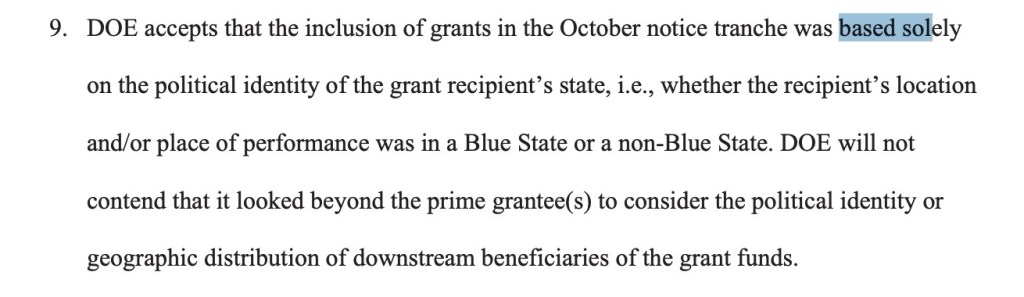
Aaron Parnas of the Parnas Perspective points outthat the Trump administrative made decisions about environmental grants based solely on whether the states supported him in the 2024 elections. This involved billions of dollars in grants.
Parnas wrote:
A major constitutional violation, confirmed in court. The Trump administration admitted in court filings this month that it canceled 284 Biden era clean energy grants worth billions of dollars based solely on whether the recipient state voted for Kamala Harris in 2024 and had two Democratic senators. A lawyer for the Energy Department conceded that none of the terminations were based on any programmatic, statutory, cost reduction, or performance related factor, directly contradicting Energy Secretary Chris Wright’s June congressional testimony that no decisions were made on politics. The Energy Department disputes any contradiction, saying Wright was distinguishing between the review process and the timing of the cancellations, but hundreds of additional grants the department had itself recommended for cancellation were left untouched simply because they sat in states that backed Trump.
Real projects and real money were caught in the fallout. The politically targeted cancellations halted funding for hundreds of energy projects, including electrical grid upgrades in California and Oregon, methane leak reduction efforts in Colorado, and clean hydrogen fuel hubs in California and the Pacific Northwest. The cuts came in October alongside a broader White House push to pressure Democratic lawmakers during a government funding standoff, with Trump publicly threatening to slash what he called Democrat agencies. Some grant recipients have since sued to try to recover their funding, and this is not the first time the Energy Department has admitted politics played a role, since a federal judge already ruled in two earlier cases that more than a dozen grants were improperly canceled for political reasons, though this latest admission is far broader and more detailed.
Democrats say it exposes a dangerous pattern with more to come. Senator Patty Murray and Representative Marcy Kaptur called the cancellations an outright un-American weaponization of government and accused the administration of corruptly abusing its power to punish states over how they voted. The controversy lands as the administration finalizes new rules, expected by October, that would give Trump’s political appointees direct control to review, block, or revoke federal grants across the entire government, worth more than a trillion dollars annually. Budget office director Russell Vought has defended the changes as necessary to ensure democratic control of spending, but critics, including antipoverty groups, scientists, and city leaders, have flooded the government with comments warning the rules would let the administration extend this kind of political targeting far beyond energy grants. Center on Budget and Policy Priorities fellow Devin O’Connor said the willingness to be this blatant in court should be taken as a serious warning about what the new framework could enable nationwide.