Archives for category: Trump

Timothy Snyder, professor of history at Yale University, explains why Trump cannot run for President. Doing so violates the clear language of the Constitution.

He writes:

If you pick up your copy of the Constitution, as I have just done, you can see that its plain language forbids Donald Trump from running for office. Section Three of the Fourteenth Amendment is as clear as can be on this point. Anyone who has taken an oath as an officer of government, and then taken part in an insurrection, may not hold any office thereafter.


I have been travelling in places where Trump has support, reading letters to the editor and editorials in local newspapers, and listening to what people have to say. The three arguments that I hear seem to be pretty much the same ones made by lawyers and in the broader media. I just can’t find any argument that would incline me to ignore what the Constitution clearly states.


The first move people make is to change the subject. It is not the Constitution. It is “the Democrats” who are just trying to keep Trump off the ballot.

The very best text I have read on the topic of Trump’s eligibility for office, the one that initiated this discussion at a level no one else has yet attained, was written by the legal scholars William Baude and Michael Stokes Paulsen. Though I do not know them, I will say with some confidence that these men are not registered Democrats.

This is only worthy of mention, though, because it affirms the hopeful proposition that people who hold various political views can agree about the fundamentals of the Constitution and about the desirability of constitutional rule.

We are all subject to the Constitution and we can all claim rights under it, regardless of those political commitments. To say that we can discard the Constitution because “the Democrats” or “the Republicans” or any other group appeal to it is to defy the document itself and to ignore what it means to have constitutional rule.

The second thing I hear is that in a democracy everyone can run for president.

Certainly one can have a debate about who should be able to run for office. In our constitutional system, however, a candidate for president must be a U.S. citizen, born in the United States, of a certain age, who has resided in the U.S. for a certain period, and who has not previously been an officer of government and taken part in an insurrection (directly or by giving aid and comfort).

Of those five limitations (citizenship, place of birth, age, residence, lack of insurrectionary past), surely the last is the least constricting. The citizenship requirement rules out more than 95% of the people in the world. Place of birth seems a bit unfair. It is not something that people choose. And it excludes people who have actually chosen America by becoming citizens. There are foreign-born citizens who want to run for president, and who would be strong candidates. Age might or might not be reasonable as a limitation — should we really exclude people under 35? And if we do, perhaps we should also exclude people over a certain age?

Compared to these limitations, the ban on insurrectionists seems the least debatable. It involves very few people, has to do with choices they themselves have made, and is motivated more clearly than the other limitations by the protection of constitutional rule as such.

The prior three paragraphs are me debating the merits of what the Constitution says. We can all do this. And perhaps the Constitution should be altered. What we all have to acknowledge, though, is that in our system, not everyone can run for the office of president.

The third point people make is that Trump is not an insurrectionist because he has not been convicted as such in court. I don’t think that this is an argument made in good faith. Trump himself does not contest the facts. Indeed, his purported campaign for president right now is based precisely on his participation in an insurrection, which he advertises in public appearances and in social media.

There are deeper points to be made, though. To read the Constitution in this way, as not executing itself, is to deny it of its basic dignity and purpose. There is also some political common sense to be applied here. When a high officer of the United States takes part in an insurrection, it would be expected that he (in this case it is “he”) would then try to alter lower-court decisions (as Trump in fact has).

In the specific case of section three of the Fourteenth Amendment, the insurrection clause that we are discussing here, it is quite clear that the purpose was to establish a qualification for running for office, not to define a criminal offense. An insurrectionist might or might not also be a convict at the time of an election; either way, he is not eligible to run.

If we believe in the Constitution and in constitutional rule, the issue is clear. Donald Trump cannot run for any federal or state office. We might have strong feelings about this; but the reason we have a Constitution in the first place (and the rule of law in general) is to avoid government by strong feelings.

a large building with a flag on top of it

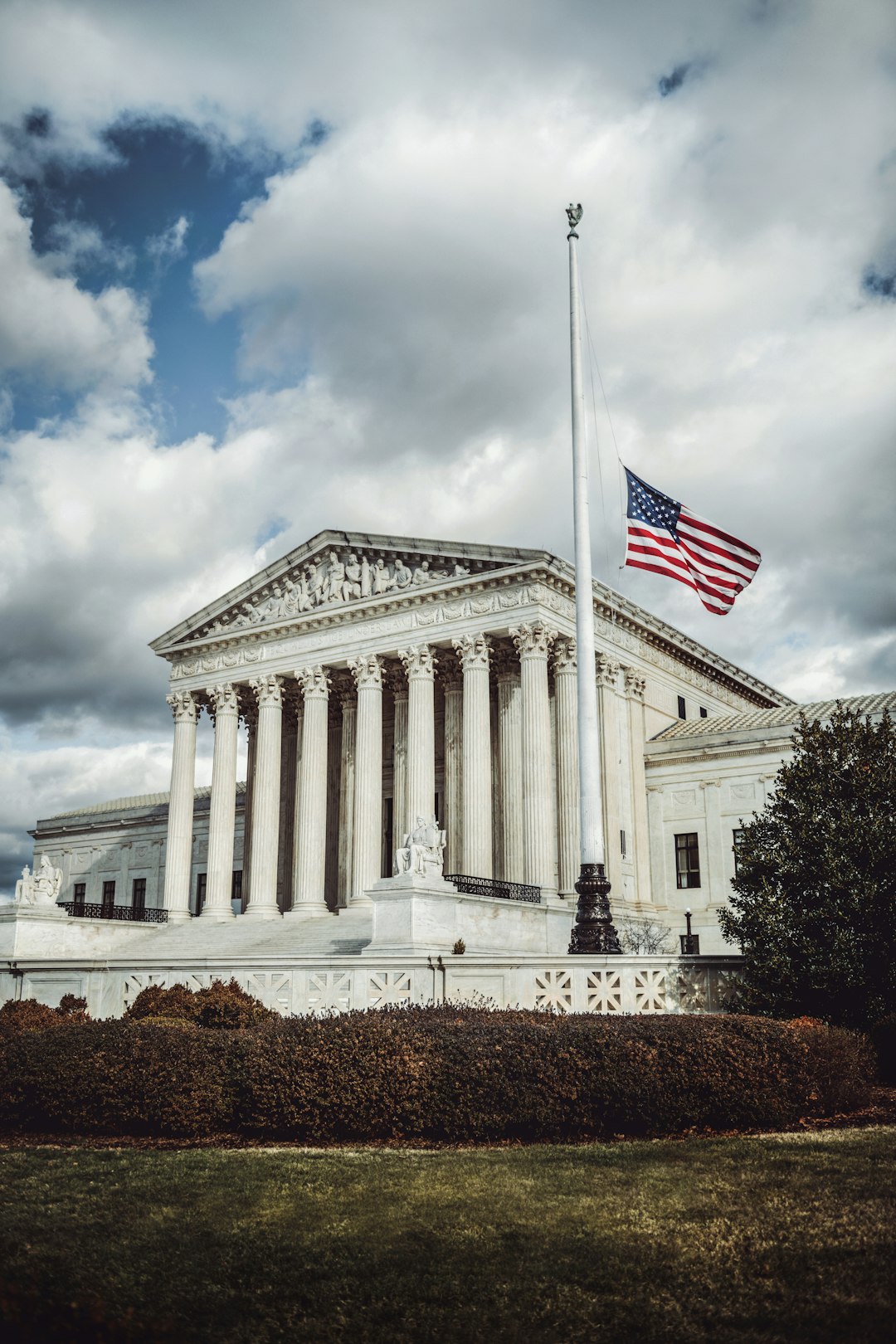
Our Supreme Court is dominated now by justices who claim to care about the plain reading of the Constitution, or the intent of the people who wrote its provisions. This should make this case particularly easy for them.

It is possible, of course, that these justices are simply politicians who espouse their textualism and originalism only when it suits them, in the service of supporting other politicians. Should this prove to be the case, their own office, and indeed the Constitution itself, would be in grave danger (a subject for another article).

We are about to find out.

The following story was published by The Denver Post:

A man shot through a window and broke into the Colorado Supreme Court building early Tuesday morning and caused “significant and extensive” damage in several areas of the building before surrendering to police, according to the Colorado State Patrol.

The man was involved in a crash about 1:15 a.m. near 13th Avenue and Lincoln Street a short time before he forced his way into the Ralph L. Carr Colorado Judicial Center, which houses the Colorado Supreme Court, the Colorado Court of Appeals and several other state agencies, according to a Colorado State Patrol news release.

This comes two weeks to the day after the state Supreme Court ruled Donald Trump cannot appear on the state’s primary ballot based on his actions surrounding the Jan. 6, 2021, U.S. Capitol breach and riot by his supporters, Jacob Factor reports.

A few days ago, the New York Times published an article that claimed that Trump is actually a political moderate—not an extremist— whose successes were attributable to the negotiating skills and insight that he learned as a successful businessman. The article was written by Matthew Schmitz, founder and editor of Compact, an online magazine, and a contributing editor to The American Conservative. The title of the article was “The Secret of Trump’s Success Isn’t Authoritarianism.”

At first, I thought the article was satire since Trump has recently been using Hitleresque language, referring to his enemies as “vermin” and warning that the current wave of migrants was “poisoning the blood of our country.” Even Mike Godwin, the guy who coined “Godwin’s Law” —about invoking an analogy with Hitler as a cheap rhetorical trick— said in an interview with Politico that “Trump is actively seeking to evoke the parallel” by his choice of language.

But then I wondered if the Times’ opinion page was responding to an article by James Bennett in The Economist, who was fired as the editor of the editorial pages for running a controversial article by conservative Arkansas Senator Tom Cotton. Bennett complained that the Times’ staff was scornful of conservatives and had become increasingly illiberal and intolerant of hearing from the other side.

Maybe the decision to publish Schmitz’s article was a response to Bennett’s critique.

For me, I can think of a long list of reasons why Trump is no moderate. Here are a few: How is it “moderate” to incite a mob to attack the U.S. Capitol as it was voting to certify the results of an election he lost? What kind of “moderate” would devote four years to denying that he lost an election? What kind of “moderate” would undermine the most democratic of our institutions: the elections? As for Mr. Schmitz, it is indeed ironic that he ends his defense of Trump’s “moderation” with an appeal to the free and fair electoral process that Trump has belittled and besmirched. In Trump’s telling, every election is “rigged” unless he wins.

Judge for yourself.

If the presidential election were held today, Donald Trump could very well win it. Polling from several organizations shows him gaining ground on Joe Biden, winningfive of six swing states and drawing the support of about 20 percent of Black and roughly 40 percent of Hispanic voters in those states.

For some liberal observers, Mr. Trump’s resilience confirms that many Americans aren’t wedded to democracy and are tempted by extreme ideologies. Hillary Clinton has described Mr. Trump as a “threat” to democracy, and Mr. Biden has called him “one of the most racist presidents we’ve had in modern history.”

In a different spirit, some on the right also take Mr. Trump’s success as a sign that Americans are open to more radical forms of politics. After Mr. Trump’s win in 2016, the Russian philosopher Aleksandr Dugin crowed that the American people had “started the revolution” against political liberalism itself. Richard Spencer declaredhimself and his fellow white nationalists “the new Trumpian vanguard.”

But both sides consistently misread Mr. Trump’s success. He isn’t edging ahead of Mr. Biden in swing states because Americans are eager to submit to authoritarianism, and he isn’t attracting the backing of significant numbers of Black and Hispanic voters because they support white supremacy. His success is not a sign that America is prepared to embrace the ideas of the extreme right. Mr. Trump enjoys enduring support because he is perceived by many voters — often with good reason — as a pragmatic if unpredictable kind of moderate.

To be sure, Mr. Trump’s wild rhetoric, indifference to protocol and willingness to challenge expertise have been profoundly unsettling to people of both political parties. His term in office was frequently chaotic, and the chaos seemed to culminate in the Capitol riot of Jan. 6, 2021. In the current presidential campaign, Mr. Trump has promised to appoint a special prosecutor to “go after” Mr. Biden; he continues to argue that the 2020 election was stolen and that America does not have “much of a democracy right now”; his fondness for incendiary language has not abated.

But it is worth remembering that during his presidency, Mr. Trump’s often intemperate rhetoric and erratic behavior ended up accompanying a host of moderate policies. On matters ranging from health care and entitlements to foreign policy and trade, Mr. Trump routinely rejected the most unpopular ideas of both political parties. Voters seem to have noticed this reality: When asked whether Mr. Trump was too conservative, not conservative enough or “not too far either way,” 57 percent of voters in a recent poll picked “not too far either way.” Only 27 percent of voters regarded him as too conservative.

Such characterizations may baffle Mr. Trump’s detractors. But even his most provocative comments since leaving the White House — that he would be a “dictator” for the first day of his second term; that Mark Milley, the former chairman of the Joint Chiefs of Staff, deserves to be executed for “a treasonous act” — likely matter less to many voters than how he governed while in office. Inured to his braggadocio, they see him now as he was then: less an ideological warrior than a flexible-minded businessman who favors negotiation and compromise.

This understanding of Mr. Trump, more than any other factor, may explain why so many voters have stuck with him, and why, a year from now, we may be looking ahead to a second Trump administration.

Mr. Trump’s moderation can be easy to miss, because he is not a stylistic centrist — the sort who calls for bipartisan budget-cutting and a return to civility. His moderation is closer to that of Richard Nixon, who combined a combative personality and pronounced resentments with a nose for political reality and a willingness to negotiate with his ideological opposites. Mr. Nixon, an ardent anti-Communist, displayed his pragmatism most memorably by going to China. But his pragmatic nature was evident also in his acceptance of the New Deal order, which many conservatives continue to reject.

Likewise with Mr. Trump. Start with his stance on health care, which defies Democratic and Republican positions alike. When asked in 2015 whether he supported universal health care, he said, “Everybody’s got to be covered” and “The government’s going to pay for it.” In office, he proposed an alternative to Obamacare that conservative congressmen denouncedas a “Republican welfare entitlement.” Last month, when he again attacked Obamacare, he emphasized that he didn’t want to “terminate” the program but rather “replace it with much better health care.”

Mr. Trump’s views on Medicare and Social Security have a similar middle-of-the-road quality. “He and I fought about Medicare and entitlement reform all the time,” the former Republican House speaker Paul Ryan complained last year. “It became clear to me there was no way he wanted to embrace that.” In the current Republican primary race, Mr. Trump has attacked Ron DeSantis, the governor of Florida, as a “wheelchair-over-the-cliff kind of guy,” citing votes that Mr. DeSantis cast as a congressman for proposals to replace Medicare with vouchers for private insurance and to raise the eligibility age for Social Security.

On trade, Mr. Trump broke with the free-market orthodoxy popular among Democratic and Republican elites — but out of favor with much of Middle America. Accusing China of unfair trade practices, he placed tariffs on more than $300 billion worth of Chinese goods. Mr. Biden has maintained these tariffs, lending Mr. Trump’s act bipartisan legitimacy. Mr. Trump also pulled the United States out of the Trans-Pacific Partnership, the free-trade agreement supported by the Obama administration. Mr. Trump’s economic record is now his main selling point in 2024. Voters may regard his businessman’s instincts as preferable to the formal training of economists, especially in the face of inflationary pressures that many economists understated.

On foreign policy Mr. Trump displayed a prudence and a willingness to negotiate that was at odds with the strident post-Sept. 11 tendencies of both parties. In 2019, for example, he defied hawks such as Mike Pompeo, his secretary of state, and John Bolton, his national security adviser, by calling off a planned missile strike in response to Iran’s destruction of a U.S. drone. Mr. Trump argued that an attack that could kill 150 people wasn’t “proportionate to shooting down an unmanned drone.”

Among Democrats and Republicans alike, the imperative of condemning adversaries as war criminals and terrorists has increasingly overtaken the conventional art of diplomacy. Mr. Trump, with his love of deal-making, has attempted to buck this trend. In July he rejected calls to prosecute Vladimir Putin as a war criminal, warning that politicians who endorsed this effort increased the risk of escalation by making it “impossible to negotiate peace.”

On social issues, Mr. Trump has also positioned himself as a kind of moderate. Though he championed the overturning of Roe v. Wade and has charged Democrats with supporting laws that make it legal to “rip the baby out of the womb” in the ninth month of pregnancy, he has also broken with abortion opponents. After Mr. DeSantis signed Florida’s ban on abortions after six weeks, Mr. Trump called the move “a terrible mistake.” Mr. Trump’s critics on the right often accuse him of being insufficiently committed to conservative social views. That may be true — but it is hardly an electoral liability. By criticizing both late-term abortions and the most comprehensive restrictions on access, Mr. Trump has managed to reflect the muddled views held by much of the electorate.

Consider, too, controversies over gender and sexuality. Mr. Trump did not hesitate to approve limits on transgender people in the military. But no one mistakes him for a Bible-believing evangelical or Midwestern moralist. His irreverent demeanor and promises to “protect our L.G.B.T.Q. citizens” are a reminder that life in New York’s real-estate and media worlds taught him a rough form of tolerance, however politically incorrect he may be. (Senator Ted Cruz of Texas was pointing to this reality in 2016 when he accused Mr. Trump of embodying “New York values.”) In this way, Mr. Trump represents a conservatism that has come to terms with the fact of diversity, even as it resists the left’s understanding of everything “diversity” should mean.

People on both sides of the political aisle, overlooking Mr. Trump’s moderation, have assumed incorrectly that his rise has been powered by appeals to fringe ideologies. The presidential campaign of Mr. DeSantis offers a vivid example of this mistake.

The campaign has boasted of Mr. DeSantis’s uncompromising conservatism and sought to deploy the quasi-ironic aesthetic radicalism of the online right. One video it created this year criticized Mr. Trump for promising to protect L.G.B.T.Q. people, and bragged that Mr. DeSantis had signed “extreme” and “draconian” laws. Another video made by a campaign aide superimposed a sonnenrad, a symbol associated with neo-Nazis, over Mr. DeSantis’s face. Mr. DeSantis’s subsequent slide in the polls reflects a host of factors, including his reserved personality, but his dead-on-arrival attempt to channel the energy of the online right suggests that its “meme magic” isn’t the reason for Mr. Trump’s success.

To be sure, Mr. Trump has had contacts with members of the bizarre right-wing fringe, most famously in a dinner last year to which the performer Kanye West (now known as Ye) brought Nick Fuentes, an outspoken racist and antisemite. But Mr. Trump differs in significant ways from the extremists with whom he is sometimes identified. For example, he has pushed for criminal justice reform, signing the First Step Act — a bipartisan measure denounced by Mr. DeSantis as a “jailbreak bill” — and explicitly promoting it as part of his outreach to Black Americans.

More recently, Mr. Trump shared on social media the results of a Reuters investigationthat found he was the only living American president who wasn’t descended from slaveholders. (“I hope that every African American in our country is reading this right now,” he wrote. “Remember!”) In the eyes of some conservative critics, Mr. Trump had lent credence to the case for reparations. It is well known that the left objects to Mr. Trump’s record on race, but — more quietly — so does the right. This underappreciated fact may help to explain why Mr. Trump has increased his support among Black voters.

How does one square Mr. Trump’s moderation with his frequent rhetorical excesses? In his 1987 book, “The Art of the Deal,” he offers a clue. He describes his approach to negotiation with a story about preventing a bank from foreclosing on a widow’s farm. When Mr. Trump’s initial pleas are ignored, he threatens to accuse the bank of causing the suicide of the widow’s late husband. Faced with this unpleasant prospect, the bank relents. Mr. Trump observes, “Sometimes it pays to be a little wild.” Whether or not this story is perfectly factual, it illustrates what Mr. Trump aspires to be: a canny negotiator whose outrageous statements help to achieve reasonable settlements.

Of course, Mr. Trump has not been moderate at every moment or on every issue. Looking ahead to a second term, he and his policy team promise to use the U.S. military to attack drug cartels in Mexico and overhaul civil-service rules to allow him to aggressively reshape the federal bureaucracy. His vow to appoint “a real special prosecutor to go after” Mr. Biden should prompt a more serious consideration of the arguments some have made that special prosecutors are inconsistent with our legal traditions.

Claims from Trump campaign officials that some of the most ambitious of these proposals are “purely speculative” and “merely suggestions” may be an attempt to obscure the full extent of Mr. Trump’s ambitions. Or perhaps those proposals reflect his longstanding negotiating strategy of talking big before making more modest deals. A second Trump term may indeed be more radical and less pragmatic than the first; it’s a possibility voters can’t dismiss, but also one that his first term gives them reason to discount.

Immigration is the issue on which the promise and limits of Mr. Trump’s form of moderation will be put to the test. He now pledges a more comprehensive and effective crackdown on illegal immigrants than he achieved in his first term, including the construction of detention camps. According to a recent survey, 53 percent of registered voters trust Mr. Trump more than Mr. Biden on immigration, with only 41 percent preferring Mr. Biden.

Perhaps that disparity reflects a lack of knowledge about the extent of Mr. Trump’s plans. Or it may indicate widespread dissatisfaction with the present state of affairs. In October, staff members from Customs and Border Protection interactedwith more than 240,000 people who attempted to enter the United States along the southern border, and between October 2022 and September of this year, 169 people whose names matched those on the terrorist watch list were arrested while trying to cross.

Indeed, it is easy to overstate how radical Mr. Trump’s record is on immigration. Mr. Biden kept in place Title 42, a Covid-era measure that Mr. Trump had used to speed deportations, and expanded its use before ending it this year. In 2021, Mr. Biden declared that “building a massive wall that spans the entire southern border is not a serious policy solution,” but he has nonetheless extended Mr. Trump’s signature policy. Alejandro Mayorkas, Mr. Biden’s homeland security secretary, acknowledged in October “an acute and immediate need to construct physical barriers” so as to “prevent unlawful entries.” Even Mr. Trump’s promise to construct detention camps is not entirely at odds with current policy: This fall, the Biden administration reopened two camps to house minors who have crossed the border.

It is also worth considering that many voters may not consider Mr. Trump’s excesses to be as unusual as his opponents do. They may regard the events of Jan. 6, for example, as comparable to the violence that occurred after the death of George Floyd (when protests outside the White House resulted in the injury of more than 60 Secret Service agents and more than 50members of the U.S. Park Police). They may regard Mr. Trump’s effort to overturn the 2020 election results as not altogether unlike Mrs. Clinton’s statement that she “would not” rule out questioning the legitimacy of the 2016 election over claims of Russian collusion. Whether or not such equivalences are warranted, they are available to voters who remain angry that Mr. Trump’s opponents, including elected officials, challenged the legitimacy of his presidency even before he first took office — and seem no less committed to the project today.

The idea that Mr. Trump poses an existential threat to democracy is now closely intertwined with taking certain extraordinary legal steps against him. Though the legal merits of the four criminal cases brought against Mr. Trump vary, their political effect, given their timing and Mr. Trump’s continued popularity, is the same: They imply that defending democracy requires burdening, shutting up or even jailing one of the two highest-polling candidates. This is also true of lawsuits filed in several states arguing that Mr. Trump is ineligible to hold office.

If support for Mr. Trump really did indicate an incipient radicalism in the American electorate, such legal actions would be more understandable. Their political costs, however grave, would be easier to justify. But even those who think that some of the indictments of Mr. Trump are well grounded might conclude that the costs of prosecution, given the possible appearance of a partisan motive, are too high — that they pose the sort of threat to democratic norms that they purport to guard against.

For those sincerely concerned to preserve our democratic traditions, there is no need to take such drastic measures. As disruptive as Mr. Trump can be, his success testifies to American voters’ desire for moderation and skepticism of extremist ideologies. In November, Americans may well decide that they again prefer Joe Biden to Donald Trump. But if the United States really is a democracy, they will be permitted to make that choice freely.
Robert Hubbell wrote about two women who refused to be intimidated by the MAGA cult: Ruby Freeman and her daughter Shaye Moss. Despite death threats and harassments, they stood their ground. Guiliani will appeal the verdict.

He writes:

Jury Awards Ruby Freemen and Shaye Moss $148 million in damages against Rudy Giuliani for defamation.

The damages award of $148 million against Rudy Giuliani encapsulates the madness, frustration, and perseverance that define the lives of millions of activists during the American era of The Big Lie. It is tempting to characterize Giuliani’s defamation of Ruby Freeman and Shaye Moss and their hard-won victory as a metaphor for Trump’s political arc over the last seven years.

But what happened to Freeman and Moss is not a metaphor. It is the cold, hard reality that slaps each of us in the face every day as we are assaulted by lies heaped upon lies. Not everyone is a direct victim of the lies like Freeman and Moss, but we are all victims, nonetheless.

The point of the lies is not (only) to injure Trump’s enemies, it is to erode trust in the system until there are no guardrails left—hoping to create chaos in which the most depraved believe they have an advantage over those still ruled by conscience, decency, and fealty to the rule of law.

Trump and his enablers tell outlandish lies because they know that media outlets will dutifully repeat the lies in headlines and news alerts, reserving tepid skepticism for paragraphs buried deep in their coverage. 

Direct victims like Freeman and Moss are viewed as expendable collateral damage. Their names and addresses are shared in dark corners of the web so Trump’s followers can make threats even he dares not voice (in public).

The full weight of Trump’s malevolent organization was directed at Freeman and Moss. But they did not buckle. Two women who were motivated to help fellow Georgians vote in a free and fair election stood their ground. 

Their reputations were smeared by the sitting President of the United States, the Georgia legislature, Fox News, One America Network, Steve Bannon, Rudy Giuliani, and millions of users on Twitter, Facebook, and other social media platforms. 

A preacher and a rap star’s publicist teamed up to urge them to falsely confess to non-existent crimes—saying it was the only way to stop the ugly death threats. The FBI’s unhelpful response was to advise them to “Move out of your homes.”Despite tens of thousands of vile threats, no one was arrested, investigated, charged with crimes, or sued for defamation.

At least not at first.

But the guardrails held. Because Ruby Freeman and Shaye Moss stood their ground. 

Because they stood their ground, Democrats on the January 6 Committee allowed them to tell their story to the nation.

Because they stood their ground, the rap star’s publicist and the preacher were indicted in Fulton County, Georgia for “solicitation of false statements and influencing witnesses.

Because they stood their ground, the former president was indicted for lying about the 2020 election. The indictment specifically alleged that the former president was responsible for the campaign to smear Freeman and Moss—lies that were part of his conspiracy to defraud the United States. (See indictment, ¶ 26.)

Then, Freeman and Moss sued Rudy Giuliani for defamation. He did his best to derail and delegitimize the civil claim for damages. But he failed. The guardrails held. All because Ruby Freeman and Shaye Moss stood their ground.

Two women who wanted to help people vote in Georgia stood their ground against fancy lawyers and paid liars, a depraved president and corrupt legislators, and a news ecosystem determined to sell as much soap for as long as possible by repeating the baseless claims about Freeman and Moss.

Two women who stood their ground. That is all it took for the guardrails to hold.

It was not easy. Their stance took courage and faith. They suffered mightily. But they persevered. They are heroes of American democracy.

There can be nothing more hopeful than their example—and their victory—to remind us of the power within each of us to maintain the guardrails of democracy. Those who sow chaos in the hope that the most depraved among us will win by brute force are wrong.

People are drawn to those who promote conscience, decency, and fealty to the rule of law—especially during times of turbulence and distress.

Ruby Freeman and Shaye Moss prevailed over Giuliani (and Trump) the moment they reported for work on November 3, 2020—because they joined tens of thousands of other Americans in becoming the guardrails of democracy that ensured a free and fair election.


Concluding Thoughts.

Every American who is taking action to defend democracy is like Ruby Freeman and Shaye Moss. The work may not seem glamorous. But counting ballots in Georgia on November 3, 2020, was tedious work—until it became a nation-defining moment that tipped the balance of a contested election.

We will never know which letter, text, door knock, or donation will become a tipping point. But some of them surely will. Indeed, because a tipping point always sits atop every action that preceded it, every letter, text, door knock, or donation contributes to the tipping point. Like Ruby Freeman and Shaye Moss, you are part of the guardrails of democracy.


S

Heather Cox Richardson reflects on the latest mystery of the chaotic Trump administration. A top-secret file is missing. It was not at Mar-a-Lago. Where did it go? Who took it? Meanwhile, in Florida, Federal Judge Aileen Cannon is slow-walking the trial about the numerous classified documents that Trump refused to relinquish to the National Archives.

She writes:

CNN reporters today pulled together evidence from a number of sources to explain how “a binder containing highly classified information related to Russian election interference went missing at the end of Donald Trump’s presidency.” The missing collection of documents was ten inches thick and contained 2,700 pages of information from U.S. intelligence and that of North Atlantic Treaty Organization (NATO) allies about Russian efforts to help Trump win the 2016 presidential election. 

The binder went missing in the last days of the Trump presidency and has not been recovered. Its disappearance has raised “alarms among intelligence officials that some of the most closely guarded national security secrets from the US and its allies could be exposed.”

Reporters Jeremy Herb, Katie Bo Lillis, Natasha Bertrand, Evan Perez, and Zachary Cohen have pieced together the story of how in his last days in office, Trump tried to declassify most of the information in the binder in order to distribute copies to Republican members of Congress and right-wing media outlets. According to an affidavit by reporter John Solomon, who was shown a copy of the binder, the plan was to begin releasing information from it on the morning of January 20, 2021, so that it would hit the news after President Joe Biden had been sworn in. 

But late on January 19, while Solomon was copying the documents, White House lawyers recalled the copies to black out, or redact, sensitive information, worrying that while most of the facts in the binder were apparently already public, the methods of collection and persons involved were not. At some point in that process, an unredacted copy of the binder disappeared. 

A former aide to Trump chief of staff Mark Meadows, Cassidy Hutchinson, told the House Select Committee to Investigate the January 6th Attack on the U.S. Capitol last year that she thought Meadows took the unredacted binder with him. 

Today, in statements that seemed very carefully worded, Meadows’s lawyer, George Terwilliger, told CNN: “Mr. Meadows was keenly aware of and adhered to requirements for the proper handling of classified material, any such material that he handled or was in his possession has been treated accordingly and any suggestion that he is responsible for any missing binder or other classified information is flat wrong.” Terwilliger told the New York Times: “Mark never took any copy of that binder home at any time.” 

The missing binder was not among the material the Federal Bureau of Investigation recovered from Mar-a-Lago last year, and intelligence officials briefed the Senate Intelligence Committee about the missing information (the CNN story does not say that the House Intelligence Committee has been briefed). In April 2021, Trump allegedly offered to let the author of a book about him see the binder, saying “I would let you look at them if you wanted…. It’s a treasure trove…it would be sort of a cool book for you to look at.” 

The story of yet more missing classified information highlights that Judge Aileen Cannon, who was confirmed to her position after Trump lost the 2020 election, has permitted Trump to slow down United States of America v. Donald J. Trump, Waltine Nauta, and Carlos De Oliveira, the pending criminal case in which he and two aides are accused of mishandling classified documents under the Espionage Act as well as making false statements and engaging in a conspiracy to obstruct justice.

Perhaps even more strongly, at a time when House Republicans have declined to fund Ukraine’s war against Russia’s 2022 invasion, the story serves as a reminder of the role Russia played in Trump’s 2016 election and how, during Trump’s time in office, he continued to cultivate a relationship with Russia’s authoritarian president Vladimir Putin and to turn his back on America’s traditional democratic allies, including those in NATO. (At one point, he told National Security Advisor John Bolton, “I don’t give a sh*t about NATO.”) 

Indeed, Trump has suggested he would take the U.S. out of NATO if he returns to office, breaking the coalition that held first the Soviet Union and then Russia at bay since World War II. Such a betrayal would weaken all of the security alliances of the United States, according to Eastern European specialist Anne Applebaum, exposing the U.S. as an unreliable ally. As democracies ceased to work together, they would have to work with authoritarian governments, and after American political influence declined, so would the economic influence that has protected our economy. Authoritarian leaders like Putin would be the winners.

News about the missing binder also highlights just how hard Trump worked to convince his loyalists that that connection was a hoax. Although all U.S. intelligence services and the Republican-dominated Senate Intelligence Committee assessed that, in fact, Russia didintervene in the election to get Trump into the White House, many Trump loyalists continue to believe Trump’s lie that such interference did not happen. 

Trump’s determination to convince his followers that “Russia, Russia, Russia” was a hoax was in part an attempt to get out from under the legal implications of working with a foreign country to win an election but also, perhaps more profoundly, an attempt to make his followers believe his lies over reality. If he could make them believe him, rather than the conclusions of the U.S. intelligence community and the Senate, they would be his to command.

Russia, Russia, Russia was an important precursor to the Big Lie that Trump, rather than Joe Biden, won the 2020 presidential election. The Big Lie has failed at every test of evidence, and yet Trump loyalists still say they believe it. 

Today, former Trump ally Rudy Giuliani continued to defend the idea that the 2020 election had been stolen, even after a jury of eight Americans said he must pay the eye-popping sum of $148,169,000 to Georgia election workers Shaye Moss and Ruby Freeman for defaming them by saying they had participated in election fraud—he made that up—and for emotional distress. Freeman and Moss had asked for $24 million each.

Of that verdict, $75,000,000 was for punitive damages, illustrating that spreading Trump’s lies so that they hurt individuals comes at a whopper of a cost. Giuliani had refused to cooperate in the case, although he admitted to the truth of the underlying facts, and he had continued to attack Moss and Freeman to reporters during the trial. 

Trump’s election lies that hurt companies are also costly, as the Fox News Corporation found when it settled with Dominion Voting Systems for $787 million over the media company’s lies about the 2020 election. 

Senators Tim Kaine (D-VA) and Marco Rubio (R-FL) tried to address Trump’s attack on our democracy when this week they inserted into the National Defense Authorization Act a provision saying that no president can withdraw from NATO without approval from the Senate or from Congress as a whole. 

“NATO has held strong in response to Putin’s war in Ukraine and rising challenges around the world,” Kaine said. He added that the legislation “to prevent any U.S. President from unilaterally withdrawing from NATO reaffirms U.S. support for this crucial alliance that is foundational for our national security. It also sends a strong message to authoritarians around the world that the free world remains united.” 

Rubio added, “The Senate should maintain oversight on whether or not our nation withdraws from NATO. We must ensure we are protecting our national interests and protecting the security of our democratic allies.”

Ruth Ben-Ghiat is a professor at New York University and an authority on fascism and dictatorship. Here, she analyzes the shocking decision by Mike Johnson, the House Spraker, to release the tapes of the January 6 insurrection with the faces of participants blurred so they can’t be identified and prosecuted. If they are releasing tapes of criminal activity, why are they blurring the faces of criminals? To protect them.

She writes:

Authoritarianism revolves around the power to commit crimes with impunity. That is why protecting and promoting criminals and turning violent and corrupt activities into patriotic and necessary actions are always priorities of authoritarian parties and governments. The statement by Speaker of House Mike Johnson (R-LA) that House Republicans will blur footage from the Jan. 6 attack to help participants avoid being brought to justice is symptomatic.

When autocratic forces triumph, the rule of law becomes rule by the lawless. If Donald Trump returns to the White House, this will be the situation in the United States.

The party took a big step forward in the process of normalizing impunity when they made the methods and philosophy of the Jan. 6 attempted coup into party dogma. A 2022 GOP resolution decreed the assault on the Capitol to be “legitimate political discourse.” This rhetorical defense provides an “intellectual” rationale for the overturning of our democracy.

Normalizing impunity also means actively shielding participants in the coup attempt from being brought to justice and discrediting democratic institutions of justice in the eyes of the public. This is what keeper of the MAGA cult Johnson sought to do with his statement. “We have to blur some faces of persons who participated in the events of that day because we don’t want them to be retaliated against and to be charged by the DOJ,” he said.

As with everything Johnson says and does, this declaration was meant for an audience of one. It was a loyalty performance meant to reassure Trump that the GOP will defend those who tried to save him from the awful fate of accepting democratic precedent and leaving office when he was voted out.

Johnson’s statement also sends a strong message to MAGA thugs and fanatics that the Republican party will defend them if they engage in acts of political violence going forward. And it reduces the DOJ’s actions to hold criminals accountable to “retaliation.”

Crime, and the law, have a different meaning for authoritarians and their enablers. In the amoral and transactional world of leaders such as Trump, all means are justified to get to power and stay there. So, actions that might be defined as criminal in a democracy take on a different meaning in an autocracy. Elites and foot soldiers are rewarded for engaging in corruption, lying, and violence.

Creating an environment propitious to such violence is a key element of preparing for and managing autocracy. Spouting dehumanizing and violence-inciting rhetoric is not enough: you have to give people incentives to engage in corrupt and violent acts.

The promise and reality of pardons plays a role here. MAGA loyalist Rep. Paul Gosar (R-AZ) used the idea of a ” blanket pardon” to get people to participate in the insurrection. Trump has deployed this ever since. “If I run, and if I win, we will treat those people from January 6 fairly,” the former president stated at a Jan. 2022 rally. “And if it requires pardons, we will give them pardons, because they are being treated so unfairly.”

As I observed in an earlier Lucid essay, illiberal leaders have long used pardons to corrupt people, discourage dissent in and outside of the party, hide their crimes, and free up the most criminal and unscrupulous elements of society for service to the party and the state.

Benito Mussolini inaugurated this strategy. In 1925, soon after he declared himself dictator, he pardoned all “political criminals,” meaning the Blackshirts whose violence had helped him come to power in 1922 and intimated and killed people ever since. Murderers, specialists in torture, and more were now available to serve in Il Duce’s new militia or take jobs in the party and the state bureaucracy.

Five years after the 1973 coup destroyed Chilean democracy, dictator Augusto Pinochet amnestied all political criminals. Tellingly, the junta pardoned not just “authors” and “accomplices” of crimes, but also “concealers” of those crimes, so that military and security service agents who had committed human rights abuses now had their service records cleansed of incriminating evidence.

In blurring the faces of those who engaged in violent actions on behalf of an autocrat, and stating that they do not want those who assaulted the Capitol to be brought to justice, Johnson and the GOP place themselves in authoritarian tradition. They are releasing the altered footage because they need to consolidate a revisionist narrative about Jan. 6 for campaign purposes.

The DOJ has the unaltered footage, and living in a democracy means evidence of actions that incriminate those who commit violence on behalf of the powerful cannot easily be destroyed. The GOP intends to cleanse the DOJ if they return to power and likely scrub all such evidence. In the meantime, they must settle for blurring the faces of those they want to use for future anti-democratic actions. “We don’t want them…to be charged by the DOJ,” Johnson said. This is why.

If Trump and the GOP have their way, as of 2025 the DOJ would be remade to serve autocratic goals, protecting criminals rather than holding them accountable.

Max Boot left the Republican Party when Trump became President. He now contributes to the Washington Post. He recently wrote that the GOP is returning to its 1930s policy of isolationism, egged on by MAGA and Trump, who never faults Putin. He is outraged that the Republicans are now blocking aid to Ukraine, using it as a chip to barter for a new border policy. Spending for Ukraine weapons is spent in the United States. More important, cutting Ukraine adrift would be a huge victory for Putin.

He writes:

It’s not often that I feel ashamed to be an American. But I was ashamed this week when the Senate refused to support a supplemental spending bill that would provide about $61 billion in urgently needed aid for Ukraine (along with $14 billion for Israel and $20 billion for border security). All of the Senate Republicans, even those who have previously supported Ukraine funding, voted to filibuster the bill. Their stated position: They won’t provide a penny for Ukraine unless Democrats agree to a sweeping, draconian overhaul of the United States’ immigration laws.


I’m sorry, that’s not how a serious political party — or a serious country — behaves during a world crisis. It’s like saying to President Franklin D. Roosevelt in 1941: We won’t support aid to Britain as it battles the Nazis unless Democrats repeal the Social Security Act or rewrite the labor laws.


Of course, most Republicans in those days were opposed to aiding Britain: A majority of Republicans in both houses voted against the Lend-Lease Act, enacted in early 1941, which allowed the U.S. government to provide critically needed war supplies to Britain and other nations deemed “vital to the defense of the United States” without demanding payment in cash. Thank goodness that in those days both houses were controlled by Democrats — and Senate rules did not require a 60-vote supermajority to get anything done.


Most Republicans abandoned their isolationism after the Japanese attack on Pearl Harbor on Dec. 7, 1941. The GOP commitment to internationalism was renewed after 1945 because of postwar Soviet aggression and then, after the end of the Cold War, by the 9/11 terrorist attacks. But since the end of the Iraq and Afghanistan wars, Republicans have been increasingly returning to their pre-Pearl Harbor roots.

The party’s leader, former president Donald Trump, has even embraced the “America First” slogan used by the original isolationists. And, just as so many of the 1930s isolationists, such as Charles Lindbergh, were sympathetic to Nazi Germany, Trump is sympathetic to Vladimir Putin’s Russia. Public opinion surveys have reflected a sharp drop-off in Republican support for Ukraine: In a Gallup poll published on Nov. 2, 62 percent of Republicans said the United States was doing too much to aid Ukraine, up from 50 percent in June.
Yet I confess that, until last week, I had remained naively hopeful that Congress would still do the right thing. After all, strong majorities in both houses had supported Ukraine funding bills in the past. Moreover, the current aid request is a pittance in the context of a $6.1 trillion federal budget (0.98 percent, to be exact), and most of the funds would be spent in the United States to support our own defense industry.


The new House speaker, Mike Johnson (R-La.), had initially voted for Ukraine aid before turning against it, but in recent weeks he sounded much more supportive of Ukraine, saying, “We can’t allow Vladimir Putin to march through Europe and we understand the necessity of assisting there.” Senate Minority Leader Mitch McConnell (R-Ky.), whose father was a U.S. Army soldier in Europe during World War II, has been a staunch supporter of Ukraine. “Honestly, I think Ronald Reagan would turn over in his grave if he saw we were not going to help Ukraine,” he said last month.


Yet now both leaders have taken the position that — as Johnson wrote this week — “supplemental Ukraine funding is dependent upon enactment of transformative change to our nation’s border security laws.” Good luck with that. The last time Congress enacted a major, bipartisan immigration bill was in 1986, when Reagan was in the White House. Lawmakers from both parties have been laboring for decades to craft another major bill. A decade ago, the bipartisan “Gang of Eight” thought they were close, only to have the deal fall apart. So it’s hard to take Republicans at face value when they insist on making aid to Ukraine dependent on breaking through decades of legislative logjams on immigration.

Why are they linking the two? The excuse heard from Republicans is that they can’t in good conscience support funding to defend Ukraine’s borders when our own borders are so insecure. They think that by invoking the common word “borders” they can pretend that the United States and Ukraine are in analogous situations. That would be true only if the Mexican Army were invading the southwestern United States to annex Arizona, New Mexico and Texas while announcing plans to march on Washington and destroy the United States as a sovereign country.


Needless to say, that hasn’t happened. What is happening is that millions of desperate immigrants are trying to enter the United States, legally and illegally, in pursuit of freedom and economic opportunity, just like the ancestors of most native-born Americans. The spike in undocumented immigration is a serious problem that needs to be addressed, but it can hardly be said to threaten the United States’ survival in the same way the Russian invasion threatens Ukraine’s.


By linking the two issues, Republicans are engaging in a bait-and-switch that gives them an excuse to do what their base wants — abandon Ukraine — while trying to blame Democrats for “jeopardizing security around the world,” as McConnell has charged.


As Sen. Brian Schatz (D-Hawaii) told the New York Times: “You can’t say ‘I’m for Ukraine, but only if I get this wholly unrelated policy enacted.’ You can’t be for stopping Putin from taking over a country by force and then vote against providing Ukraine the resources to do just that.”

It is still possible that Democrats and Republicans will reach agreement on Ukraine funding. But the odds of Ukraine aid being approved look dimmer today than at any point since the Russian invasion, even as the Office of Management and Budget warns that U.S. support for Kyiv is running out: “We are out of money — and nearly out of time.”

Ukrainians will fight on regardless, and they will look for help to Europe, which has already committed twice as much funding as the United States. But, even working together, Europe and the United States have struggled to keep up with Ukraine’s need for ammunition. There is no way that Europe alone can carry the whole load, especially not when Hungarian Prime Minister Viktor Orban — MAGA Republicans’ favorite foreign leader — is trying to block a $55 billion European Union aid package for Ukraine.


The United States has abandoned allies, such as South Vietnam and Afghanistan, before. But this time the costs of support are much lower (no U.S. soldiers are engaged in combat in Ukraine), and the stakes are far higher. Ukraine is fighting the largest war that Europe has seen since 1945. If it loses, Vladimir Putin may be emboldened to attack other neighboring states, such as the Baltic republics and even Poland, which are members of NATO. Other despots may be emboldened to aggression of their own, beginning with Chinese leader Xi Jinping in Taiwan. And then we really will be back to the pre-Pearl Harbor world — all thanks to the Republican Party returning to its isolationist roots.

Unless Congress reverses course, and soon, it could be consigning our democratic allies to slaughter — and making the world a far more dangerous place.

Florida blogger Billy Townsend agrees with me: Christian Ziegler should not resign as leader of the GOP in Florida. Sure, he was involved in a sex scandal. Sure, he’s a dictator. But he’s the perfect face for the party of Ron Ziegler (a wannabe dictator) and Trump (also a wannabe dictator who’s had his share of sex scandals).

We disagree about Bridget. He thinks she should resign from the Sarasota school board. I want her to stay so she can defend gay students.

Rudy Guiliani admitted that he defamed two Georgia election workers by accusing them of fraudulently switching ballots. The two are mother and daughter Ruby Freeman and Shaye Moss. As a result of his repeated accusations on national television, which were repeated by Trump, calling them out by name, the pair were subjected to continual threats, harassment, and intimidation. They are suing Guiliani for a sum between $15.5 million and $43.5 million. Jury selection begins today.

The showdown between the financially strapped Giuliani and the two temporary poll workers he baselessly accused of ballot tampering in 2020 will highlight a major court battle over false claims that became central to former president Donald Trump’s efforts to stay in power and is now at the heart of two criminal cases against him.


U.S. District Judge Beryl A. Howell has already found Giuliani liable for more than a dozen defamatory statements against Ruby Freeman and Wandrea ArShaye “Shaye” Moss, who are mother and daughter, leaving a jury of eight only to decide how much he should pay in damages for violent threats and harassment the pair received. Howell previously ordered Giuliani to pay the women $230,000 in legal fees and sanctions for failing to turn over relevant information. She said those failures, combined with Giuliani’s own admissions, compelled her to rule without a trial that he defamed both women, intentionally inflicted emotional distress on them as part of a civil conspiracy, and owes punitive damages.

If you want to hear the details of what happened to them, watch this clip from the Rachel Maddow show. In addition to hearing their story, you will also hear testimony from the #2 official at the Justice Department, Richard Donahue, who testified to the January 6 Commission that he met with Trump and told him that the Justice Department had investigated all his claims of election fraud and found no evidence for them.

Jim Jordan and his fellow MAGA-ts are determined to impeach President Biden as payback for Trump’s two impeachments. They have no reason for impeachment; Biden has committed no crime, unlike Trump, who invited an insurrection. Dana Milbank says that Jordan and his crew are the Three Stooges of American politics.

He writes:

After House Republicans’ caucus meeting in the Capitol basement this week, Speaker Mike Johnson gave the media an update on his release of thousands of hours of security footage of the Jan. 6, 2021, attack on the Capitol.


The release had been slowed, Johnson explained, because “we have to blur some of the faces of persons who participated in the events of that day, because we don’t want them to be retaliated against — and to be charged by the DOJ and to have other, you know, concerns and problems.”


It was as clear a statement as there could be on where the new speaker’s allegiance lies: protecting those who sacked the Capitol from being brought to justice for their crimes. Johnson (La.) was openly siding with the insurrectionists and against the United States government he swore an oath to defend.


The Justice Department already has the undoctored footage, as Johnson’s spokesman later acknowledged, so, presumably, the speaker is trying to prevent members of the public from identifying anyone in the violent mob (“persons who participated in the events of that day”) that law enforcement might have overlooked. Sure, they attacked the seat of government in their bloody attempt to overthrow a free and fair election, but let us respect their privacy! After all the yammering from the right about transparency, Johnson is manipulating the footage — not to protect the Capitol’s security but to protect the attackers.


Hours after aligning himself with the insurrectionists, Johnson went to break bread with the Christian nationalists. At the Museum of the Bible, he gave the keynote address to the National Association of Christian Lawmakers, a group whose founder and leader, Jason Rapert, has said, “I reject that being a Christian nationalist is somehow unseemly or wrong.”

At the group’s meeting in June, one of the speakers noted with approval that “the American colonies imposed the death penalty for sodomy.” Confirmed speakers and award recipients for the gathering Johnson addressed included: a man who proposed that gay people should wear “a label across their forehead, ‘This can be hazardous to your health’”; a woman who blames gay marriage for Noah’s flood; and, as the liberal watchdog Media Matters reported, various adherents of “dominionist” theology, which holds that the United States should be governed under biblical law by Christians.
Reporters were kicked out of this week’s event before Johnson spoke but, before the event, Rapert called Johnson “an answer to prayer,” the Arkansas Democrat-Gazette’s Alex Thomas reported.


Err, was that a prayer for the branding of gay people?


Rapert’s organization also promotes the pine-tree “Appeal to Heaven” flag, which has been embraced by Christian nationalists, was among the banners flown at the “Stop the Steal” rally on Jan. 6, 2021 — and, by total and remarkable coincidence, is proudly displayed outside Johnson’s congressional office.

Former speaker Kevin McCarthy this week became the 31st lawmaker in the House to announce his retirement, as members of both parties stampede to exit the woefully dysfunctional chamber. McCarthy, the California Republican who spent most of 2023 saying “I do not quit,” will quit this month, with a year left in his term.


Freshman Rep. Rich McCormick (R-Ga.) decried the “brain drain” in his party — veteran Republicans Patrick McHenry (N.C.), Michael Burgess (Tex.) and Brad Wenstrup (Ohio) are among those on the way out — although, in fairness, there wasn’t a whole lot of brain in the first place. Of more immediate concern to Republicans is a vote drain: After the expulsion of George Santos (N.Y.) and McCarthy’s resignation, the GOP, paralyzed with a four-vote majority throughout this year, will have just a two-vote majority.

McCarthy, announcing his departure in a Wall Street Journal op-ed, reflected: “It often seems that the more Washington does, the worse America gets.” By this standard, he should be delighted with the current Congress. Famously unproductive during his tenure as speaker, it is now doing almost nothing.


U.S. funds for Ukraine’s defense will run dry by the end of the month, leaving the invaded country vulnerable to a Russian takeover. But Johnson said he won’t take up Ukraine support in the House unless Democrats pay a ransom: a nonnegotiable demand that they swallow House Republicans’ entire wish list of border policies. That obstinance has blown up negotiations in the Senate, where Sen. James Lankford (R-Okla.) calls Johnson’s position “not rational,” Punchbowl News reported.
Johnson has likewise stalled military aid to Israel, which commands overwhelming bipartisan support, by making another unrelated ransom demand: Democrats must repeal legislation that gave the IRS more clout to go after wealthy tax cheats. Johnson has also bottled up attempts to fund the government after next month by failing to agree to the overall spending number that Senate Republicans and House and Senate Democrats have all accepted.


In rare cases when Johnson does try to do something productive, his fellow Republicans denounce him. After a double flip-flop, the speaker finally blessed a compromise with Senate Democrats on the annual National Defense Authorization Act, including a temporary extension of the 9/11-era FISA 702 surveillance authority. “Outrageous … a total sell-out,” protested Rep. Marjorie Taylor Greene (Ga.). Rep. Chip Roy (Tex.) told the Messenger’s Lindsey McPherson this was “strike two and a half — if not more” against Johnson.

The new speaker has even managed to divide the chamber on a matter where there had been virtually no disagreement: the need to denounce the recent rise in antisemitism. The House Education Committee held one of the best hearings of the year this week, in which the presidents of Harvard University, the University of Pennsylvania and MIT disgraced themselves by suggesting, in response to questions by Rep. Elise Stefanik (R-N.Y.) and others, that their students should feel free to run around calling for the genocide of Jews.


It was an entirely different picture on the House floor, where Republicans brought up the latest of several resolutions condemning antisemitism. This resolution, however, declared that “anti-Zionism is antisemitism,” a dubious proposition equating criticism of Israel with hatred of Jews. A group of Jewish Democrats, arguing that “the safety of Jewish lives is not a game,” urged colleagues to vote “present” in protest — and 92 of them did. But for Republicans, it was a game: After the vote, the National Republican Campaign Committee, the House GOP’s political arm, put out a statement saying “extreme House Democrats just refused to denounce the … drastic rise of antisemitism.”
Alas, for the NRCC, the one genuinely antisemitic act from the episode came from Republican Rep. Tom Massie (Ky.), who suggested in a post on X that Congress placed “Zionism” above “American patriotism.”


Still, it would be unfair to suggest that House Republicans have been entirely unproductive during Johnson’s tenure. They have continued to censure each other at a record-setting pace. This week, it was Rep. Jamaal Bowman’s turn. What grave constitutional offense had been committed this time? The New York Democrat had pulled a fire alarm in one of the House office buildings in September.

“If extreme MAGA Republicans are going to continue to try to weaponize the censure,” Democratic leader Hakeem Jeffries (N.Y.) said on the House floor on Wednesday, “going after Democrats repeatedly, week after week after week because you have nothing better to do, then I volunteer: Censure me next! … That’s how worthless your censure effort is.”


The race to censure has become a competitive sport among Republicans. After McCormick recently got a vote on his motion to censure Rep. Rashida Tlaib (D-Mich.) before Greene got a vote on her motion to censure Tlaib, Greene accused her fellow Georgian of “assault,” Politico’s Olivia Beavers reports. McCormick said he shook Greene by the shoulders in a “friendly” gesture.
And censure is just a warm-up for the main event. Next week, House Republicans plan to vote to authorize a formal impeachment inquiry into President Biden. You see, they believe they have finally found the smoking gun that proves Biden guilty of high crimes and misdemeanors: He helped his son buy a pickup truck in 2018.

They have become the Three Stooges of the House’s Biden investigations: Jim, Jason and James, stepping on rakes and getting hit by falling flowerpots as they try to make a case for their predetermined outcome of impeaching the president. Judiciary Committee Chairman Jim Jordan is Moe, thundering and blundering in his repeated failures to prove Biden’s “weaponization” of the government. Jason Smith, the in-over-his-head chairman of Ways and Means, is Larry, brainlessly reciting whatever script is in front of him. And Oversight Committee Chairman James Comer is Curly, perpetually getting a pie in the face when the “evidence” he produces is immediately debunked.

“BREAKING,” Comer announced on social media this week, with two siren emojis. “Hunter Biden’s business entity, Owasco PC, made direct monthly payments to Joe Biden.” This was evidence that the president “knew & benefitted from his family’s business schemes.” But it turned out the payments, for all of $1,380 each, were repayments for a 2018 Ford Raptor truck Biden helped his son Hunter buy at a time when the younger Biden was broke because of his drug addiction.


Their act is so weak that these stooges have already gone into reruns. Last week, Jordan’s “weaponization” panel held a hearing on supposed censorship at Twitter — the same topic of a hearing he had in March, with two of the same witnesses. This week, Smith’s committee had a hearing with the same two IRS “whistleblowers” who already testified about the Hunter Biden case before that panel, as well as before the Oversight Committee, earlier this year.


Comer, after seeing his allegations refuted in hearing after disastrous hearing, has said he doesn’t want to have any additional public sessions. He prefers the safety of closed-door depositions, from which he can selectively leak misleading tidbits.


Last week, Hunter Biden’s lawyer, Abbe Lowell, said his client would be happy to testify publicly before Congress. “We have seen you use closed-door sessions to manipulate, even distort the facts and misinform the public,” he wrote. “We therefore propose opening the door.” But Comer immediately rejected the offer, and he and Jordan are now threatening to hold Hunter Biden in contempt of Congress for insisting on public, rather than closed-door, testimony.

Their desire for secrecy is perfectly understandable, given the absence of evidence against the president. Last week, Fox Business Network’s Maria Bartiromo asked a Republican member of Comer’s Oversight panel, Lisa McClain (Mich.), whether investigators had been able to “identify any actual policy changes” that Biden made related to his family’s business dealings. “The short answer is no,” McClain replied.


Nyuk, nyuk, nyuk.


This week, the three stooges assembled in the echoey lobby of the Longworth House Office Building for a “media availability” on the impeachment inquiry. Smith alleged that the Bidens moved “an unimaginable sum of money” (actually, between $10 million and $20 million, compared with multiple billions of dollars similarly received by Trump family members from foreign interests). Comer repeated his allegation about the “monthly payments” made to Biden, again omitting that they were for Hunter’s pickup truck.


The three suddenly hustled away. “No questions?” Washington Examiner’s Reese Gorman called after them. “I thought this was a press conference.”
Smith then gaveled in the Ways and Means Committee to hear once more from his “whistleblowers.” His first order of business: to close the meeting to the public and the media.
The ranking Democrat, Richard Neal (Mass.), made a motion for the hearing to remain open to the public. “You’re not recognized,” Smith replied.
Rep. Lloyd Doggett (D-Tex.) asked to debate the Republicans’ motion to kick out the public. “It’s not debatable,” Smith shot back.

Republicans repelled the Democratic attempts at transparency in party-line votes; Smith ordered the room cleared of journalists and spectators. Republicans said they would release a transcript “upon completion of our meeting,” but it didn’t come out that day, or the next.


Their fevered efforts to hide from the public make it clear House Republicans have lost the plot in their attempt to implicate Biden. But will they impeach him anyway? Certainly! Woop, woop, woop, woop, woop, woop.