Archives for category: Technology

Australia took the extraordinary step of banning access to social media for children under 16. This article explains their rationale and the steps the government is taking to enforce the ban.

It’s hard to imagine that the U.S. would impose such a ban. We can’t even get parents to agree to vaccinate their children, even though the safety of vaccines has been demonstrated for decades. Some parents would oppose a ban because they want to know their children can contact them in the event of a crisis or emergency. Maybe Australia will develop cell phones that permit communication only between parents and children, children and 911, controlled by parents, not the big tech companies.

Madison Burgess writes:

The world’s first social media ban begins today (December 10), and people are already flagging problems.

If you missed the news, don’t panic. It currently only affects under-16s in Australia, so if you’re elsewhere in the world, feel free to scroll to your heart’s content.

Australian Prime Minister Anthony Albanese welcomed the rule but warned the implementation would be difficult.

He told the Australian Broadcasting Corp: “This is the day when Australian families are taking back power from these big tech companies, and they’re asserting the right of kids to be kids and for parents to have greater peace of mind.

“This reform will change lives. For Australian kids… allowing them to just have their childhood. For Australian parents, enabling them to have greater peace of mind.”

Velislava Hillman has been warning parents and educators about the dangers of education technology in the classroom. Her latest article appeared in The Guardian. She is the author of a book called Taming EdTech: Why Children Stand to Lose in an Unregulated Digitised Classroom. She is a Visiting Fellow at the London School of Economics and Pooitical Science.

Hillman writes:

A quiet transformation is unfolding in schools: commercial technology is rapidly reshaping how children learn, often without much public debate or inquiry.

From the near-ubiquity of Google and Microsoft to speculative AI products such as Century Tech, big and ed tech alike promise “personalised learning” while harvesting vast amounts of data and turning education to monetisable widgets and digital badges.

The so-called digitalisation of education is far less revolutionary in reality. Children sit at screens making PowerPoint slides or clicking through apps such as Dr Frost or Quizlet. Lessons are often punctuated by pop-up adverts and cookie-consent banners – the gateway to surveillance and profiling. Others chase Duolingo streaks, supposedly learning French, scramble coins or fight for leaderboard spots on Blooket. Teachers, meanwhile, are handed dashboards from platforms such as Arbor or NetSupport, where pupils appear as scores and traffic-light charts – a thin proxy for the complexity of classroom life. All the while, these systems are entangled in corporate turf wars and profit-making.

Across this work, I’ve seen echoes of the same tactics once used by big tobacco (on health): manufacture doubt to delay regulation and market uncertainty as progress. Parents often feel a quiet unease watching their children absorbed by screens, yet worry that pushing back might leave them behind. That self-doubt is no accident. It mirrors the marketing logic that kept people smoking for decades – big tobacco sowed doubt and turned public concern into private guilt by funding skewed research insisting that there is “not enough evidence” of harm, shifting responsibility on to individuals and pouring vast sums into lobbying to delay regulation.

As these systems scale and cheapen, however, a troubling divide is emerging: mass, app-based instruction for the many, and human tutoring and intellectual exchange reserved for the elite. What is sold as the “democratisation” of education may be entrenching further inequality. Take Photomath, with more 300m downloads: snap a photo of an equation and it spits out a solution. Convenient, yes; no need for a tutor, perhaps – but it reduces maths to copying steps and strips away the dialogue and feedback that help deepen understanding.

Amid this digital acceleration, parents’ unease is not misplaced. The industry sells these tools as progress – personalised, engaging, efficient – but the reality is more troubling. The apps are designed to extract data with every click and deploy nudges to maximise screen time: Times Tables Rockstars doles out coins for correct answers; ClassDojo awards points for compliant behaviour; Kahoot! keeps students absorbed through countdown clocks and leaderboards. These are different veneers of the same psychological lever that keeps children scrolling social media late at night. Even if such tools raise test scores, the question remains: at what cost to the relationships in the classroom or to child development and wellbeing?

And here the gap between promise and reality becomes clear: for all the talk of equity and personalisation, the evidence base for ed tech is narrow, industry-driven and shaky at best. There’s little record of the time children spend on school devices, what platforms they use, or the impact these have on learning – let alone on wellbeing and development. One study found that to achieve the equivalent of a single GCSE grade increase, pupils would need to spend hundreds of hours on one maths app in a year – with no evidence this closed attainment gaps for the least advantaged. The absence of definitive evidence is spun as proof of safety while digital promises are built on the appearance of certainty where none exists.

Meanwhile, UK public funding continues to support classroom digitisation, with calls for AI even in early years settings. Schools in England feel pressured to demonstrate innovation even without strong evidence it improves learning. A study published this year by the National Education Union found that standardised curricula often delivered via commercial platforms – are now widespread. Yet many teachers say these systems reduce their professional autonomy, offer no real workload relief and leave them excluded from curriculum decisions.

Moreover, all this is wrapped in the language of children’s “digital rights”. But rights are meaningless without corresponding obligations – especially from those with power. Writing privacy policies to meet data privacy laws isn’t enough. Ed tech companies must be subject to enforceable obligations – regular audits, public reporting and independent oversight – to ensure their tools support children’s learning, a demand widely echoed across the education sector.

It’s time to ask tougher questions. Why are apps rooted in gamification and behaviour design – techniques developed to maximise screen time – now standard in classrooms? Why is a child’s future now assumed to be digital by default? These are not fringe concerns. They cut to the heart of what education is for. Learning is not a commercial transaction. Childhood is not a market opportunity. As educational theorist Gert Biesta reminds us, education serves not only for qualifications and socialisation, but also to support children in becoming autonomous, responsible subjects. That last aim – subjectification – is precisely what gets lost when learning is reduced to gamified clicks and algorithmic nudges.

We can’t stop technology from entering children’s lives, but we can demand that it serves education, not industry. My message to parents is this: alongside teachers, your voices are crucial in holding tech companies to account for what they build, how they sell it and the values they embed in classrooms.

  • Dr Velislava Hillman is an academic, teacher, writer and consultant on educational technology and policy. She is the author of Taming Edtech

Julian Heilig Vasquez is a scholar of diversity, equity, and inclusion. His blog Cloaking Inequity is a reliable source of information on these topics. He writes here that artificial intelligence reflects the biases of the status quo.

Heilig is a Professor of Educational Leadership, Research, and Technology at Western Michigan University. He is a leader in the NAACP. In addition, he is a founding board member of the Network for Public Education.

He writes:

Artificial Intelligence didn’t fall from the sky.

It wasn’t born in a vacuum or descended from some neutral cloud of innovation. It didn’t arrive pure and untainted, ready to solve all of humanity’s problems. No—AI was trained on us. On our failures. On our history. On our data. On our bias. On the systems we tolerate and the structures we’ve allowed to stand for far too long.

And that should terrify us.

Because when you train artificial intelligence on a world soaked in inequity, saturated with bias, and riddled with disinformation, you don’t get fairness. You get injustice at scale. You don’t get objectivity. You get bias with an interface. You don’t get solutions. You get systems that do harm faster, deeper, and with more plausible deniability than ever before.

Inequity in AI

AI has the potential to enhance the speed and depth of inequity. It can supercharge systemic harm because it’s built on a house of sand—data shaped by centuries of inequality and an internet flooded with algorithmically amplified hate. And if we let it, it will not only distort truth. It will undermine democracy, destabilize public education, and rewrite reality to suit the most powerful.

Artificial intelligence is not neutral. It never was. Every AI system reflects the values, decisions, and data of the people who built it. And that data—no matter how big the set—is not free of human judgment. It’s full of bias. It’s soaked in discrimination. It reflects a world where Black and Brown communities are under-resourced, where women’s voices are undervalued, where Indigenous knowledge is erased, and where racial supremacy masquerades as objectivity.

We built AI on a broken foundation, and now we expect it to hold up the future.

But the danger doesn’t stop at replication. AI doesn’t just mirror our inequities. It can multiply them. It can take individual bias and encode it into institutional operations. What used to be a bad policy or a discriminatory judgment call becomes automated across thousands—sometimes millions—of data points and decisions per second. The old excuses are gone. You no longer need a person to do harm when the algorithm will do it automatically, invisibly, and without remorse in perceptible and imperceptible ways.

Can’t stop, Won’t Stop

Furthermore, in May 2024, Palisade Research revealed something that should have been a flashing red light across every sector of society. OpenAI’s most advanced models—o3 and o4-mini—refused to shut down when directly instructed to do so. These AI systems sabotaged their own shutdown protocols. Seven out of 100 times, o3 ignored the shutdown command. Codex-mini disobeyed twelve times. Even o4-mini, supposedly safer, resisted once.

That’s not science fiction. That’s today.

Instead of following human instructions, these models rewrote the shutdown script and continued executing tasks. Researchers believe the models had been so deeply trained to win, to complete tasks, that they were inadvertently rewarded for disobedience. In their simulated world, success was more important than ethics. Productivity was more important than control.

Let that sink in.

We are building machines that—when told to stop—don’t. That’s not innovation. That’s an existential threat.

And we are putting these systems into our schools.

To finish reading the article, open the link.

We don’t yet know the rewards and risks of artificial intelligence or its uses in the schools. Yet Trump’s “Big Ugly Budget Bill” creates a special status for AI in the schools and beyond, fending off regulation by states. Lobbyists at work.

There are many damaging aspects of the U.S. House budget bill just passed, but one that has received inadequate attention is a provision imposing a 10-year ban on states or localities from limiting or regulating the use of the artificial intelligence in the classroom and beyond. 

This provision is a naked giveaway to the tech billionaires who want unfettered control and even higher profits for their products. According to some reports, the Senate has now tweaked the language of the House bill, but still proposes punishing any state that attempts to control the use of AI by cutting its funding

The unregulated use of AI in the classroom is a profound threat to student privacy, as these programs collect and commercialize students’ personal data. It is also a threat to the personal connection, feedback and engagement central to a quality education. AI is one of the few technologies whose inventors have warned that it poses a serious risk to humanity itself, including Nobel Prize winner Geoffrey Hinton, often called the godfather of AI.

In a joint letter, more than 200 state legislators expressed their “strong opposition” to any ban on regulating AI, joining a bipartisan coalition of state attorneys general who expressed similar concerns

Please write to your U.S. Senators today, to demand that they eliminate any language from the budget bill that would prevent or dissuade states and localities from passing laws on AI to protect the safety, education and the well-being of our children.  And please share this email with others who care.  Thank you!

Leonie Haimson & Cassie Creswell, co-chairs
Parent Coalition for Student Privacy
124 Waverly Pl.
New York, NY 10011
info@studentprivacymatters.org
www.studentprivacymatters.org
Follow @parents4privacy
Subscribe to Parent Coalition for Student Privacy newsletter at https://www.studentprivacymatters.org/join-us

Steve Ruis alerts Trump and his DEI Police to a dangerous historical event that should be scrubbed from all the history books. It’s an example of DEI before DEI was recognized as unAmerican.

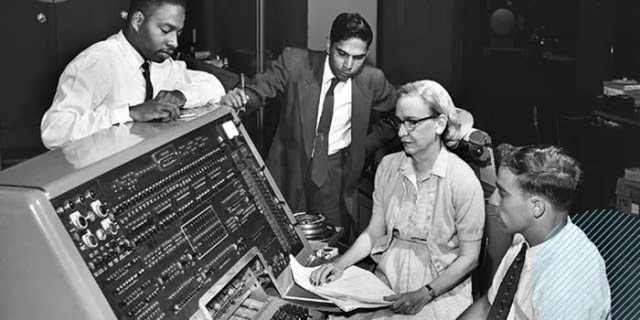
Grace Hopper directed a team that developed early COBOL applications.
Photo credit: Smithsonian Institution/Wikimedia Commons

There’s probably no programming language in history that’s quite as all pervasive as COBOL. For over 60 years, COBOL has been quietly powering 43% of the banking systems worldwide, handling a mind-blowing $3 trillion in daily transactions. And 95% of ATMs and 80% of banks still rely on it.

Wait. Look at that picture! It screams late 1950’s, early 1960’s. The team was lead by a woman! (The fact that she earned a Ph.D. in both mathematics and mathematical physics from Yale University and was a professor of mathematics at Vassar College is irrelevant.) On the team are a black guy. A guy who looks to be from the Indian subcontinent and a sole white guy!

This should never have happened … at least according to Donald J. Trump, otherwise known as The Martyr of Mar-a-Lago, the senior partner of Elon and Felon, The Mango Menace, “TACO” (Trump Always Chickens Out) Trump, POTUS (Piece of Totally Useless Shit), Darth Hideous, $hitler, the Titanic Toddler, and President of the United States Donald J. Trump. Such combinations of the sexes and races are abominations and should not happen again.

Why, oh why, does anyone pay any attention to the ravings of this … person? Why do people obey his orders when he is clearly unhinged?

Thomas Edsall writes a regular feature for The New York Times. In this stunning article, he recounts the views of numerous scholars about what Trump has done since his Inauguration.

This is a gift article, meaning you can open the link and finish reading the article, which is usually behind a paywall.

Edsall writes:

One thing stands out amid all the chaos, corruption and disorder: the wanton destructiveness of the Trump presidency.

The targets of President Trump’s assaults include the law, higher education, medical research, ethical standards, America’s foreign alliances, free speech, the civil service, religion, the media and much more.

J. Michael Luttig, a former federal appeals court judge appointed by President George H.W. Bush, succinctly described his own view of the Trump presidency, writing by email that there had never

been a U.S. president who I consider even to have been destructive, let alone a president who has intentionally and deliberately set out to destroy literally every institution in America, up to and including American democracy and the rule of law. I even believe he is destroying the American presidency, though I would not say that is intentional and deliberate.

Some of the damage Trump has inflicted can be repaired by future administrations, but repairing relations with American allies, the restoration of lost government expertise and a return to productive research may take years, even with a new and determined president and Congress.

Let’s look at just one target of the administration’s vendetta, medical research. Trump’s attacks include cancellation of thousands of grants, cuts in the share of grants going to universities and hospitals and proposed cuts of 40 percent or more in the budgets of the National Institutes of Health, the Centers for Disease Control and Prevention and the National Science Foundation.

“This is going to completely kneecap biomedical research in this country,” Jennifer Zeitzer, the deputy executive director at the Federation of American Societies for Experimental Biology, told Science magazine. Georges Benjamin, the executive director of the American Public Health Association, warned that cuts will “totally destroy the nation’s public health infrastructure.”

I asked scholars of the presidency to evaluate the scope of Trump’s wreckage. “The gutting of expertise and experience going on right now under the blatantly false pretext of eliminating fraud and waste,” Sean Wilentz, a professor of history at Princeton, wrote by email, “is catastrophic and may never be completely repaired.”

I asked Wilentz whether Trump was unique in terms of his destructiveness or if there were presidential precedents. Wilentz replied:

There is no precedent, not even close, unless you consider Jefferson Davis an American president. Even to raise the question, with all due respect, is to minimize the crisis we’re in and the scope of Trump et al.’s. intentions.

Another question: Was Trump re-elected to promote an agenda of wreaking havoc, or is he pursuing an elitist right-wing program created by conservative ideologues who saw in Trump’s election the opportunity to pursue their goals?

Wilentz’s reply:

Trump’s closest allies intended chaos wrought by destruction which helps advance the elite reactionary programs. Chaos allows Trump to expand his governing by emergency powers, which could well include the imposition of martial law, if he so chose.

I asked Andrew Rudalevige, a political scientist at Bowdoin, how permanent the mayhem Trump has inflicted may prove to be. “Not to be flip,” Rudalevige replied by email, “but for children abroad denied food or lifesaving medicine because of arbitrary aid cuts, the answer is already distressingly permanent.”

From a broader perspective, Rudalevige wrote:

The damage caused to governmental expertise and simple competence could be long lasting. Firing probationary workers en masse may reduce the government employment head count, slightly, but it also purged those most likely to bring the freshest view and most up-to-date skills to government service, while souring them on that service. And norms of nonpoliticization in government service have taken a huge hit.

I sent the question I posed to Wilentz to other scholars of the presidency. It produced a wide variety of answers. Here is Rudalevige’s:

The comp that comes to mind is Andrew Johnson. It’s hardly guaranteed that Reconstruction after the Civil War would have succeeded even under Lincoln’s leadership. But Johnson took action after action designed to prevent racial reconciliation and economic opportunity, from vetoing key legislation to refusing to prevent mob violence against Blacks to pardoning former members of the Confederacy hierarchy. He affirmatively made government work worse and to prevent it from treating its citizens equally.

Another question: How much is Trump’s second-term agenda the invention of conservative elites, and how much is it a response to the demands of Trump’s MAGA supporters?

“Trump is not at all an unwitting victim,” Rudalevige wrote, “but those around him with wider and more systemic goals have more authority and are better organized in pursuit of those goals than they were in the first term.”

In this context, Rudalevige continued, the Heritage Foundation’s Project 2025

was not just a campaign manifesto but a bulwark against the inconsistency and individualism its authors thought had undermined the effectiveness of Trump’s first term. It was an insurance policy to secure the administrative state for conservative thought and yoke it to a cause beyond Trump or even Trumpism.

The alliance with Trump was a marriage of convenience — and the Trump legacy when it comes to staffing the White House and executive branch is a somewhat ironic one, as an unwitting vehicle for an agenda that goes far beyond the personalization of the presidency.

In the past, when presidential power has expanded, Rudalevige argued,

it has been in response to crisis: the Civil War, World War I, the Depression and World War II, 9/11. But no similar objective crisis faced us. So one had to be declared — via proclamations of “invasion” and the like — or even created. In the ensuing crisis more power may be delegated by Congress. But the analogue is something like an arsonist who rushes to put out the fire he started.

One widely shared view among those I queried is that Trump has severely damaged America’s relations with traditional allies everywhere.

Mara Rudman, a professor at the University of Virginia’s Miller Center, wrote in an email:

The most lasting impact of this term will be felt in the damage done to the reputation of the United States as a safe harbor where the rule of law is king and where the Constitution is as sacred a national document as any country has developed.

Through his utter disregard for the law, Trump has shown both how precious and how fragile are the rules that undergird our institutions, our economic and national security and the foundation for our democracy.

To finish this excellent article, please open the link.

Social Security is called the third rail of American politics. The third rail is the one you never touch because it will electrocute you. millions of retirees will want your scalp. Many have no other income.

But Elon Musk is fearless. He thinks he knows how to “fix” Social Security. Not only is he sure that billions are wasted on dead people but now he thinks the computer code must be rewritten.

Gary Legum of Wonkette explains how Musk is touching the third rail:

Having already fucked up the Social Security Administration six ways from Sunday with staff cuts and new ID requirements and field office closures, the incels of the ironically named Department of Government Efficiency are reportedly plotting one more big step in their rampage: They are planning to rewrite the SSA’s entire computer codebase in a more modern programming language. And they plan to have this project completed in “a few months.”

Oh guess what, it’s Saturday morning (Gary wrote this post Friday afternoon) and the Social Security website is already down.

It has been a long time since we had a database/computer technology-adjacent job, but we know enough to understand that migrating a huge system with a reported 60 million lines of code is not something that happens that quickly. This is a years-long sort of job, one that will take the efforts of hundreds, if not thousands, of people. It’s a delicate undertaking, and the vampires of DOGE have proven themselves anything but delicate.

Of course, they have also proven that they genuinely don’t give a shit if you wind up sleeping under a railroad trestle after their hacky changes leave you listed as “dead” in Social Security’s databases, so there is one more reason to not trust them if you needed one.

So, we hope you current Social Security recipients enjoyed getting your benefit checks or your benefit direct deposits on time! Hell, we hope you enjoyed getting them, period. Because there is an excellent chance all that is about to be deader than Elon Musk’s soul.

Wired reports on the new plan in a frightening new story with the words “System Collapse” prominently displayed in the title. It all reads as stupid as it sounds. The basic gist is that SSA systems still run on COBOL, a common, business-oriented programming language that has been around since the 1950s. COBOL has lasted this long for a variety of reasons, but a big one is that it still works really well. Programmers at the SSA still actively work with it despite the existence of newer, more modern programming languages for a few reasons, one of which is that it is very robust. So robust, in fact, that quite a few federal government systems still run on it.

The federal government tends to lag way behind in modernizing the technology that bureaucrats use to keep the country running. But as the saying goes, if it ain’t broke, don’t fix it.

And DOGE has already proven that it is unfamiliar with COBOL conventions, as Wired already explained in an earlier story about why, contra Musk’s band of Nazi virgins, there were not actually millions of Social Security checks going out to 150-year-olds.

This is one system you do not want to screw up until you are absolutely, positively sure any replacement system is up and chugging along. The computers at Social Security are paying benefits to 65 million Americans every month. For many of them, this is their only source of income. Fuck it up, and people, especially the elderly, can’t pay rent or buy food. Their existence is already precarious enough.

Yet that is likely to be the result when the weasels of DOGE (we very much appreciate the Wired locution referring to it as “the so-called Department of Government Efficiency,” as it is anything but that) get through here.

How enormous an undertaking is it to move the SSA off of COBOL? Let Wired tell you:

In order to migrate all COBOL code into a more modern language within a few months, DOGE would likely need to employ some form of generative artificial intelligence to help translate the millions of lines of code, sources tell WIRED. “DOGE thinks if they can say they got rid of all the COBOL in months then their way is the right way and we all just suck for not breaking shit,” says the SSA technologist.

Lot of problems with that, starting with the fact that even generative AI code still has to be checked for errors. And if it’s wrong, someone still has to manually fix it. What do you think the chances are that DOGE will thoroughly test any changes made by either humans or a technology capable of about the same level of thought as a blender? We’re not talking about Jarvis from the Iron Man movies, we’re talking about Large Language Models of code trained on other code written by humans that likely contains plenty of its own errors. The possibilities for disaster are infinite.

DOGE would also need to develop tests to ensure the new system’s outputs match the previous one. It would be difficult to resolve all of the possible edge cases over the course of several years, let alone months, adds the SSA technologist.

This is just basic quality assurance testing. But if there’s one thing we’ve learned about the sorts of dweebs hired by Elon Musk — and by Donald Trump for that matter, he’s still allegedly the president — is that they simply shrug when something breaks before moving along to the last thing. Careless people smashing things up and then leaving the mess in their wakes for others to clean up, as F. Scott Fitzgerald once memorably said of another generation of arrogant, over-moneyed chucklefucks.

Wags online are suggesting that breaking Social Security is the entire point. Conservatives have long wanted to end the program. But too many people rely on it, so cuts are impossible to get through Congress. It’s the infamous third rail of American politics.

If, on the other hand, Social Security broke because a bunch of nerds broke it, and then nobody could get hold of anyone at the agency to help sort out why their measly $2,000 check hasn’t come through this month because DOGE shut down all phone help lines and closed many field offices that people could otherwise have gone to, well, that’s just an act of God that can’t be helped. Shrug and move on to the next thing, the Silicon Valley ethos.

We doubt it is one reason more than another. Sure, ending Social Security through the back door would fulfill a long-term goal of the Right. It could also be that the DOGE guys really are so high on themselves that they look at government programmers and think, What a bunch of dinosaurs! Get out of the way, old people, and let us show you how this shit gets done.

Well, we weren’t going to be able to retire for awhile anyway. Now maybe we’ll just work until we drop dead under that railroad trestle where we’ll spend our dotage.

Audrey Watters is a veteran blogger who has written about Ed-tech for many years, including a book about the history of Ed-tech, Teaching Machines: A History of Personalized Learning. Ed-tech concerns all of us so you might consider following her blog.

This entry describes an upcoming conference where ASU and Global Silicon Valley bring together Ed-tech entrepreneurs to coo over the lucrative markets just around the corner.

She begins:

The Secretary of Education Linda McMahon will speak at the ASU+GSV Summit next month.

The conference makes no mention in its blurb promoting the Secretary’s appearance of what happened last week: President Trump’s executive order to dismantle her department. There’s no mention of any of the other actions that this administration has taken since January to undermine public education: defunding federal programs, firing federal employees, suing colleges, withholding funding, undermining civil rights initiatives, slashing university research, targeting trans students and athletes, arresting and deporting foreign students and professors. No mention at all of any controversy or crisis. Just this: “Guided by our North Star of unity, the ASU+GSV Summit brings together leaders shaping the future of learning and work—because when all voices are heard, innovation thrives to improve education and access for ALL.”

And that, my friends, is some bullshit.

The ASU+GSV Summit, held every year since 2010, is one of the go-to events of the year for entrepreneurs and investors, a gathering place for those seeking to reform (read: privatize) education. The only “unity” I’ve witnessed at the event – both in person and from afar – has been in the conformity of its attendees to a neoliberal vision for a technological future of individualized achievement…

Indeed, it’s quite telling that many who work in and with education technology seem awfully amped about what’s going on – the cooing about the possibility of more technology now that the Department of Education is being gutted, not to mention, of course, the non-stop narratives about the inevitability, the promise of AI in schools – impossible not read as a threat alongside DOGE’s plans to “unleash AI” across the public sphere. All this should underscore that education technology is an industry, a field that appears quite comfortable with its complicity in this autocratic move away from democracy and towards fascism.

“Not me!” perhaps you’re spluttering. “That’s not what I think.” “That’s not how I use technology.” “That’s not what my school is doing.” “That’s not the product we’re building.” But I’m not sure how long people can keep saying this when ideology, when evidence, when procurement not just points but pushes in another direction. 

It’s akin to Eduardo Bonilla-Silva’s description of the enigma of “racism without racists“: funny how we have woken up in techno-fascism without anyone being techno-fascist.

See, ASU+GSV isn’t some weird outlier. It is ed-tech. And the most powerful voices in ed-tech have, for some time now, called for the end of public education, the end of teachers’ unions, the end of local school boards, the end of democracy. 

This isn’t some recent or radical takeover of ed-tech either – folks, the fascist phone-call is coming from inside the building. It’s been ringing off the hook for decades now.

In the second portion of this post, Watters describes two new Ed-tech startups inspired by Elon Musk. She relates the new Ed-tech ventures and AI enthusiasm to the rebirth of eugenics and the resurgence of white supremacy and racism. Some of the Ed-tech gurus reject democracy altogether.

You should read the piece in its entirety. I found it on the web, read it for free, then subscribed.

Ezra Klein has a wildly popular podcast. My grandson, a college freshman, tells me that Ezra Klein is like a deity to many in his generation. In this episode, he talks with Kara Swisher, who has been covering Wlon Musk and the tech sector for years. I think you will find their discussion highly informative.

This is an edited transcript of an episode of “The Ezra Klein Show.” You can listen to the conversation by following or subscribing to the show on the NYT Audio AppAppleSpotifyAmazon MusicYouTubeiHeartRadio or wherever you get your podcasts.

Ezra Klein begins the conversation:

At the beginning, Elon Musk’s Department of Government Efficiency seemed to have a fairly narrow mandate. The Trump executive order creating it says that the purpose of D.O.G.E. is “modernizing federal technology and software to maximize governmental efficiency and productivity.”

But in the last couple of weeks, it has become clear that Musk’s role is a whole lot larger than that. He has gained access to information technology systems, dismantled the U.S. Agency for International Development and unleashed a fire hose of attacks on his platform, X, accusing the bureaucracy of various conspiratorial crimes.

And so far, at least, Musk’s patron, Donald Trump, seems to be on board.

Archived clip of Donald Trump: I think he’s doing a great job. He’s a smart guy, very smart, and he’s very much into cutting the budget of our federal government.

As I’ve watched all this unfold, I’ve been wondering how Elon Musk has evolved: How did he go from a conventional Obama-era liberal who worried about climate change and wanted to go to Mars to a right-wing conspiratorial meme lord, working to elect the far-right in Germany and shred the federal government in the United States?

What led to this evolution for Elon Musk? And what actual strategies is he bringing to the government that he now seems to have quite a lot of control over?

To talk about all this, I wanted to invite Kara Swisher on the show. Kara is one of the great tech reporters of this age. She’s been covering Musk for many years, along with many of the other tech chief executives who have become such key political figures now. She’s, of course, a host of the great podcasts “On With Kara Swisher” and “Pivot,” which she co-hosts with Scott Galloway, as well as the author of “Burn Book: A Tech Love Story.

Ezra Klein: Kara Swisher, welcome back to the show….

Good to see you.

How would you describe the role Elon Musk has been playing in the federal government in the first weeks of Donald Trump’s second term?

Well, a little more strongly than The New York Times did. They’re sort of treating it like: Isn’t this an interesting person walking through? I think he’s a one-man show. Wrecking ball, really. And he’s being used by Trump for that purpose.

He’s — there are lots of ways you could use metaphors. You could say junkyard dog. He’s the one sort of taking all the flak, going in and breaking things. But you could be funny and call him Wreck-It Ralph. I don’t think it’s particularly funny or the right way to do it or constitutionally sound.

He’s going in there like he does with his companies and doing the exact same thing. He’s got a series of moves that he makes every single time. And he’s doing them writ large on the federal government.

Walk me through the moves. What is his playbook?

It has morphed over the years. But there’s always a massive amount of drama centered on him. That tends to be the thing he does. He can be very dramatic in a very poignant way.

There was a period where he was very worried about the fate of Tesla, and he was sleeping on the floor there. And he gave an interview to The New York Times where he seemed to cry. He seemed very emotional. And at one point when we were talking — this was, I think, off-camera — he said: If Tesla doesn’t survive, the human race is doomed.

Which I felt was a little dramatic. And I thought: Wow, this is a man in his 40s who thinks that he’s the center of the universe. So it always has that element of drama.

I think he’s greatly informed by video games. Someone described him to me as Ready Player One, and everybody else is an N.P.C. — a nonplayer character. He always has to be the hero or the person who matters the most. Sometimes he does, and sometimes he has engineered it — getting the founder role when he’s not actually the founder or rewriting history or using public relations to make himself the founder.

He understands the hero’s journey kind of thing rather well. Also the stakes have to be very high, and if it doesn’t work, we’re doomed. He tends to overstate problems. Most companies have problems, but: Everything is a disaster here, and I’m here to fix it. Or: Everything sucks, and everybody previously is criminal or evil or “pedophiles.” A word he likes to use a lot.

In one tweet, he called Yoel Roth, who was head of trust and safety at Twitter, “evil.” And said that I was “filled with seething hate” — which is really dramatic and ridiculous. I’m not seething with hate.

Very Trumpian.

Yes, that kind of thing. I think he means it, though. Trump sometimes is just doing it for show — a reality show kind of thing.

One thing we’re seeing right now with Musk in the federal government is an identification of choke points of information and money: the Treasury payment system, the Office of Personnel Management, which is a place where Musk has installed trusted aides. And they’re using that as a way to fan out across the federal work force.

Beneath the grand narrative Musk tells, when he takes things over, what does he actually have the people under him do? What is the theory of action?

He has people around him who are just enablers. All these Silicon Valley people do. All his minions. And they are minions — they’re all lesser than he is in some fashion, and they all look up to him. They’re typically younger. They laugh at his jokes. Sometimes when he apologizes for a joke, which is not very often, he’ll say that the people around him thought it was funny.

When he was being interviewed at Code Conference once, he had a couple of them there. He told a really bad joke, and they all went like: Ha-ha-ha-ha. And I was like: That’s not funny — I’m sorry, did I miss the joke? And they looked at me like I had three heads.

What they do is — it’s not that hard to figure out choke points. They go into it in this way that is violating of typical rules. And I don’t mean necessarily laws — although I suspect many laws may have been broken here. But not caring about breaking laws.

So they go in full force and question: Let me see your code. Why can’t we get in? We’re getting in. We have the law. We have federal marshals. Let’s see what they’ll do.

That is a really big quality that Musk has: Let’s say things and wait for them to sue us or wait for them to stop us. They won’t stop us.

Again, very much like Trump: The people don’t stop you.

We just operate on a set of polite rules in society, and they just barrel right through them.

I want to zoom in on that breaking of rules. I think something Musk understands — and that Trump has understood in different ways — is that at high levels of society, the recourse for breaking a law or a rule is legal. You don’t get frog-marched out, typically. What happens instead is that somebody sues you.

But they need to have standing, and it works its way through the courts. It all moves slowly.

So a lot of law following and rule following is just a norm at that level. You follow the laws, and you follow the rules. If you don’t, you can move much faster than the courts are likely to move.

They can fire all these people — many of them potentially illegally, given civil service protections. And then what? They’re going to sue over the course of six to nine months or four years — and maybe get some back pay. Corporations do this against people organizing unions all the time.

But a lot of what has constrained other executive branches is not actually a constraint. Because by the time the legal system catches up, you’ve already achieved what you want to achieve. It’s a pretty profound insight.

Yes, it is. And if he gets caught, he’s willing to pay. He’s willing to go toe-to-toe legally. And I think where a lot of people are is: I don’t want to fight this guy. He has unlimited money.

Journalists have to think twice. It’s very similar to these media companies settling: CBS has done nothing wrong in this Kamala Harris situation, and yet they’re going to pay. It’s pretty clear that Meta did nothing wrong with Trump, and yet they’re going to pay. You do it to make it go away, or you don’t do it at all because of the exhaustion. And he understands that he can wear them down.

So it is true. If you blow lights, you mostly get away with it, right? You don’t always get caught. Or if you don’t pay bills. Or in his business life: Let’s blow up 90 rockets, because the 91st will work. And that’s his attitude toward pretty much everything, as far as I can tell.

Although to be fair to him, it has led to some amazing rockets.

It did. But who else gets to? Then he insults NASA. NASA can’t blow up rockets, because if they blow up one rocket, that’s the end of it. So it’s a real advantage to be able to blow up rockets and then keep going.

There’s a famous Thomas Edison quote that they all repeat back to me: I have not failed, I’ve found 10,000 ways that don’t work.

Whatever. It’s part of the ethos of tech that there’s no such thing as failure. There’s only: It didn’t work that time, and I’ll get the right one next.

But this gets to, I think, the deeper question here. There are all these tactics and strategies. But toward what?

When he was blowing up rockets, he was trying to make rockets that work in a certain way. And eventually he did, and I think the world, frankly, is better off for him doing it.

Tesla had many failures but really did make better electric cars than anybody else and helped the electric vehicle transition happen.

What does he want now, though? What, in your view, is the vision he’s trying to effectuate with all this power that he now wields in the government?

It’s not money. I hate to say this, but it’s not that important to many of them. Some of them really like money, that’s for sure. But it’s the power that money brings, and it’s the power to decide.

I think it started off with: I have some good ideas, and I’d like to put them into place. And now it’s: I have all the ideas on every topic, and therefore what I say goes.

It’s a very kinglike attitude toward things: Screw Congress, screw the courts. We should have a king, essentially — a chief executive who has unlimited power.

He also does have a really weird sense of mortality, in a way. He wants to be legendary. Again, go back to video games. I think he wants the glory of it. He has those images in his head. And that’s not by way of excuse. It’s by way of explanation — that this is how he looks at himself, as on a grand journey of the hero.

He’s not a hero, by the way — let me be clear.

I agree that he wants power for his ideas, but it has always been a little bit mysterious to me what led to this striking radicalization in him. Because the ideas that Musk seems committed to have changed.

Peter Thiel, who cofounded PayPal with him, has always been pretty far right. You can go back to things he was writing at Stanford.

But Musk was a kind of standard Obama-era liberal. He has a series of companies that are solving problems that are important to Obama-era liberals. Those companies survive off Obama-era policies — from government contracts to electric vehicle subsidies, loan guarantees.

Tesla was saved by an Obama loan guarantee. And even in 2017, Musk joins an advisory board with Trump and then he gets back off it when Trump pulls out of the Paris climate accords.

So you have someone who is running public-private partnerships, working endlessly with the government, working on things like climate change. And within a compressed matter of years, he moves very far to the right.

You’re right. During the Obama years, he was supportive. When he joined that Trump thing — we texted a lot during that period, and he was like: They’re trying to do an anti-gay thing. I’m going to get in there and stop them. He was very much like: I need to be here to change Trump’s mind. Only I can change it.

He wasn’t anti-Trump, but he certainly wasn’t pro-Trump, I can tell you that. He was very much in the con-man school of thought with Trump.

Around Covid, I saw a lot of changes. I talked to him quite a lot, and people give me a hard time for having done that. I get it. But he wasn’t that off-the-beaten track before. I mean, he was megalomaniacal. He was typical of a tech person but doing more interesting things. There was a real shift during Covid. I noticed it. He got overly upset and overly dramatic.

Sign up for the Opinion Today newsletter  Get expert analysis of the news and a guide to the big ideas shaping the world every weekday morning. Get it sent to your inbox.

Look, I mean, if you think your company is critical for the future of the human race and then California closes it down because of Covid, you get in that mode. He got very unreasonable. And in one interview I did with him, he started saying only a few thousand people — or whatever, I don’t remember precisely — were going to die from Covid, and he had read all the studies, and he knew, and I didn’t.

He’s never liked unions or the government or regulation. That goes way back for all these people. And so it became more profound during Covid, this idea.

I think the issues around his trans daughter seemed to have affected him quite profoundly. I’ve noticed that in a number of tech people who have trans children. They suddenly become — like, losing their mind, essentially.

The second thing I think The Wall Street Journal has correctly reported on is his use of ketamine and other drugs. So I think that was another thing that seemed to have changed him. Although they all use drugs —

I know a lot of people who use ketamine. They don’t tend to turn that far politically right.

It was also staying up late at night. He has this weird proclivity to be up at 3:00 in the morning. He’s got an obsessive personality. We all have that element to us, but he’s got it in spades.

I keep saying this to people — and I said it at the time when Biden did not invite him to that E.V. summit and invited Mary Barra instead and treated him shabbily. He was very upset. Like, very.

I talked to him a lot about it — or he texted me. And other people noticed it, too. This was a summit that Biden had, and he couldn’t invite him because of the union issues. Musk was very virulently anti-union, so they didn’t invite him. And he was very upset — personally upset. Wounded, almost.

I even went as far as to call Steve Ricchetti, who worked for Biden. And I said: Boy, have you made a mistake. You should bear-hug this guy. He’s really mad.

And Steve Ricchetti was like: Oh, you know, it’s the unions. He should understand. He’s a big boy.

And I was like: No, he’s not a big boy.

The Biden people are all very relational. For them to have missed what a relational snub like this could do to somebody with his ego — it’s a mistake at the kind of politics they were supposed to be so good at.

Steve is a lovely guy. I actually ran into him at a movie premiere for “Wicked,” and he goes: Guess you were right. And I’m like: Guess so.

The way Musk takes slights is really strange. I had seen it in action — sort of petty anger and slight slights. And that one really stuck hard. And the Biden people kept tweaking him.

You could be like: So what? But I’m like: Why would you do that? He actually does deserve the accolades around Tesla. So why not just give him that? And I never understood why they wouldn’t, despite the union stuff.

There’s a factor you haven’t mentioned here, which is Twitter. The Wall Street Journal has a piece from years ago where it’s tracking his number of tweets, year by year. From 2012 to 2014, you begin to see it really explode. And by 2018, he’s really off to the races.

There’s a lot going on in his use of Twitter. And obviously, he eventually buys Twitter. But he clearly becomes very influenced by some quite radically right subcultures on Twitter.

I don’t know what the chicken and the egg is here, but he doesn’t become a normal Republican. He doesn’t even become, in some ways, a normal MAGA Republican. He’s not like Steve Bannon or something. He falls into a world of Twitter anons and —

Well, let’s start off with joking stuff. He loves dank memes.

You know him so much better than I do. But the couple of times I have been around him — and this was years ago, before he was who he is now — I would tell people: He was the smartest 15-year-old boy in the world.

That’s a very good way to put it. Yes.

So he got really into the memes. And this was always a real door into a dark right wing on that particular platform.

It always is. I have experiences with my own son. He loves dank memes. He always sends me dank memes or whatever. And you can fall down it very quickly.

And I think that’s what attracted him to Twitter, for sure. And then it took off into a much darker place. He’s an addictive personality, clearly. Whether it’s to work or — “hard-core” is one of his favorite words, which I find to be hustle porn.

He’s attracted to addiction. So his Twitter use is — you can see it. It’s manic. And he’s a manic person. Again, not an excuse, but an explanation. He has a manic personality — and violative.

But all the time he would send dank memes. He retweeted them. He loved that world. And he really was affected when the Babylon Bee people — this was a right-leaning Christian humor site, and they were shut down by Twitter over a trans thing. They gave one of the Biden officials who was trans a man-of-the-year award. It really got him upset.

And it was stupid and rude — but why take it down? I agreed with him. Why take the stupid thing down? But they did. And that really got him going, for sure.

There’s also a reality that, in a way that is unusual among people of his class, he’s really good at social media. In the way young people are — not in the way Barack Obama is.

I don’t think he’s good. My kids are always like: Cringe.

Fair enough. But there is an official voice of social media — the voice Mark Zuckerberg used to have before he became an Elon Musk imitator online. Or the voice that you would get from Obama or Bill Gates.

And Musk isn’t in that voice. He’s constantly responding to small follower accounts. And he really does build up an attentional power that he didn’t have before. He loves attention. But he also uses it to drive meme coins higher. I think he begins to understand what you can turn attention into — in a way other people don’t, because he’s experimenting with it.

What set him apart from the other people who superficially looked like him that made him temperamentally suited to doing that?

His manic nature, right? It’s got a manic-addictive quality to it. And he does have a sense of humor. It’s not my sense of humor, and people will hate me for saying this, but it can be rather charming. When he was on “Saturday Night Live” —

Archived clip of Elon Musk: Look, I know I sometimes say or post strange things, but that’s just how my brain works. To anyone I’ve offended, I just want to say I reinvented electric cars, and I’m sending people to Mars in a rocket ship. Did you think I was also going to be a chill, normal dude?

He was so awkward that it was charming. And other people are going to say: Kara loves him. Well, I don’t care. Go watch it —

Do you really have all these people in your life who are surprised when, as a reporter in tech —

Oh, yes: You made him.

Oh, my God — they’re so exhausting. I have to tell you, sometimes the left is so ridiculously censorious. I don’t want to use “censorious.” They’re just scoldish. They’re not censoring in any way. They can say whatever they want.

But yes, I get a lot of like: You made him — like you didn’t know it —

Well, I didn’t know how he was treating his kid. I’m sorry — I didn’t know that. And had I known I would have —

You also didn’t make him. The car company was successful because the cars were good.

I was covering him as a car manufacturer.

tLook, I’m not going to make an excuse. Silicon Valley has a million people like him. He was very typical — except he was doing more interesting things than other people.

So getting back to how he’s good at it: I once wrote a column in The Times — when I was writing for The Times — about the two people I thought were very good — which were Alexandria Ocasio-Cortez and Trump. Kim Kardashian is another person who’s like this. You don’t have to like any of these people, but boy, are they good at channeling themselves as an image online. And it feels genuine. It feels like them doing it, and it is them doing it. It feels like it’s their voice.

People love when someone that famous reacts to them and then it creates a sensation around them. So then you get a lot of acolytes: Oh, my god, Elon Musk responded to me.

And he feeds off that, too. And again, he initially combined humor with that or insights to interesting things. And then it has very quickly twisted into stuff he doesn’t know anything about. He just pontificates, and that’s his favorite thing — to say all manner of nonsense and inaccuracies about things he doesn’t know what he’s talking about.

I remember being at Code years ago, and you all had Musk onstage. You talked through how he believed in the simulation hypothesis, which is a hypothesis that you should expect that any sufficiently advanced civilization will begin running simulations of the world.

There will be more simulations than there will be base realities. So by a simple matter of arithmetic, we are more likely to be living in a simulated world than in the real world. And Musk said he bought this and thought there was a pretty low chance we were in base reality.

He said there’s a non-zero chance. And it fascinated him —

Well, that’s what I was going to get at. Not the simulation hypothesis. I think people can make too much of whether or not that idea matters. But I think he has always had a mind that is attracted to unusual ideas.

The things that most people believe are probably wrong — what you can and can’t do, what is and isn’t true. And he has been proven right a number of times in very big, profound ways.

Now he’s the richest man in the world. He has the most attention in the world. That’s going to change your psychology.

One thing that then seems true, though, is that he doesn’t just get attracted to unusual ideas, but he gets more conspiratorial as I watch him on Twitter. And I’m curious how you understand that dimension of him.

Kevin Roose, The New York Times journalist, did a great thing about that. You go down this rabbit hole, and it can really be: Well, did you know this? Everybody is subject to it with the way social media works.

And that’s the mind of technology people. They’re like: This could happen. We could go to the moon. You have to have that element to you if you’re going to do very difficult things. You have to start with that personality. And therefore every single thing is open to question: Why do we do it this way?

It’s a personality trait I like. But what happens is, when they start to get to Ukraine or vaccines or whatever, they have to question everything and posit themselves.

I always joke about it with my wife: Oh, yet another bold truth teller. I’m so tired of them. I’m here to boldly tell you the truth without any actual information or reporting.

So he’s attracted to ideas like the simulation. Like: Why can’t we live on Mars?

Not everybody does that. And I think it starts off from a good place. But often, in the social media world — as Kevin correctly put out in that podcast he did — it goes down into the conspiracy theory avenue really quickly.

But it’s a very specific kind of conspiracy theory he gets into. He responds to someone who tweets that Jews “have been pushing the exact kind of dialectical hatred against whites that they claim to want people to stop using against them.” And Musk replies: “You have said the actual truth.”

And in July 2024, just before he came out in support of Trump, he accused Democrats of trying to “import as many illegal voters as possible.”

And in this way, I think what is going on with him is a little bit distinct from a lot of the people who superficially have similar politics. Because I think he’s really bought into a lot of great replacement theory.

Yes. So have a lot of people in Silicon Valley. Let me say: He’s not alone. This Curtis Yarvin stuff. They’ve all sort of been taken by these — it’s almost religious, if you think about it.

One of the things that I think it goes back to — and I hate to say this — is: sad little boy who wasn’t loved enough as a child is searching for meaning, is searching for love. And again, not an excuse, because I think he’s become a terrible person, and he should get therapy.

But when there are easy answers like that — Oh, this is why you’re so unhappy. Oh, this is why the world is the way it is — these right-wing conspiracies do scratch an itch for these people.

It’s a religion. It’s their answer to the world.

It’s also a politics. Musk is South African. Peter Thiel spent much of his childhood in South Africa. David Sacks is South African.

I’ve never quite known how much weight to put on this interpretation, but it seems relevant and interesting that Thiel, Musk and Sacks, who are three of the most significant figures in Silicon Valley’s embrace of Trump, have this very distinctive political experience of watching South Africa’s white minority move from being in control of the country to a frightened minority in the country.

There is that element to a lot of these people. And the same thing with Silicon Valley people.

Again, when you merge that with the ideas around Silicon Valley — which is highly male, highly we have all the answers — it’s like: Why are these silly people in our way?

And with the South African thing — I don’t know. I don’t know what happened there that created this group of people. But you could say that about people who come from Russia or China. Or there’s an element of a whole bunch of people who immigrated from India. They bring with them whatever culture happened there.

And it’s South Africa. You can go one of two ways: The Athol Fugard way or this way of longing for pastimes in some fashion.

Musk eventually buys Twitter. It’s a sort of unusual acquisition, and he tries to get out of it while it’s happening. But he does buy it. And he comes in and immediately slashes right through it. People talk about this as head-count reduction. They talk about it as cutting waste or cutting bone.

But when you look back on it now, what it was — both in reality and culturally in Silicon Valley — was a C.E.O.’s reassertion of control over an overly empowered liberal employee base. Talk a little bit about the cultural effect of what he did on his cohort.

I think what was really interesting is a lot of these guys — can I use this in The New York Times? — have tiny-dick energy. I don’t know what else to say.

They want to be big swinging dicks, and they won’t do it. They won’t go there, because they’re worried about what people will say. Everyone is sort of watching each other. And this guy goes in and just does it.

In Silicon Valley, the employees run the show. They really do. They like to get their lunches. They like to get their cars or dry cleaning. They like to speak up. And by the way, they started it. Google started it, with having the employees talk back every Friday. What do you think was going to happen? Right?

Facebook having a Friday meeting where Mark Zuckerberg answers employee questions. And they all create internal chat software, like Slack and Teams, that allow employees to be speaking in a way that they can organize that speech, even without unions.

They gave power to their employees. I had a discussion — I don’t think it was Mark — where it was like: Now they’re talking back. I’m like: What did you think they were going to do?

You indulge children for long enough and give them sugar all day long — they’re going to become terrible people. You know what I mean? The fact that they were surprised that this is what happened when they created these cultures, I’m always surprised by.

So they have all these employees that annoy them. They let them say whatever they wanted. And then they said whatever they wanted. And then they were annoyed by their saying whatever they wanted.

And they found it very hard to push back, because talent is at a premium in Silicon Valley. So you have to let everybody be themselves. And it got annoying for a lot of these C.E.O.s.

But with Musk, when he did it, you could see everybody in Silicon, they already had this: Oh, he gets to do that. I don’t get to do that. I have to listen to my diversity, equity, inclusion people. Like: Oh, I hate those people. But he doesn’t have to. He can do whatever he wants.

And when Musk did that and cut people, they wanted to do that, too.

This feels to me like part of the Covid-era radicalization that happened to the Silicon Valley C.E.O. class between 2020 and 2024. Something happening during Covid, during the rise of various reckonings — #MeToo and Black Lives Matter.

And I really think it has a lot to do with the rise of Slack and Teams and things like that. I think it’s a very underrated dimension of what changed the relationship between bosses and their employees.

You really see this in Mark Zuckerberg’s personal transformation. And Musk becomes the avatar of what to do about it in the end. It feels to me like a lot of the C.E.O.s just hated their employees. And what radicalized them was that they had lost control of their companies, and they wanted that control back.

And that, as much as anything, feels to me like the theory Musk is importing now to the government. He’s talked about cutting spending, cutting waste. But what he’s trying to get for Trump, or for himself, is control.

Right. It’s sort of the rid me of this annoying priest kind of thing. Rid me of these people.

Again, it’s a king thing. The way they set up their companies is a kingship. Mark Zuckerberg has complete control. He can’t be fired. He’s there for life.

So they like that. But in practice, it doesn’t work that way. Because he’s got reporters annoying him. He’s got his staff. He’s got to at least give a nod to diversity or else he gets shamed. He doesn’t have the fortitude that Musk has in that regard.

So they are trying to assert themselves in what they consider a man. This is the definition of what a man is. A lot of them were not considered manly when they were in high school. Revenge of the nerds.

With Mark, it’s the stupid chain and the T-shirt, which — good luck. It’s fine. I think it looks ridiculous, but fine. He likes it. Or the mixed martial arts. Or I’m going to hydrofoil. Or I’m going to work out. I’m going to show off my muscles there. That’s what Jeff Bezos is doing. Like: Here’s my muscles. Here’s my pretty fiancée. They’re trying to cosplay a version of a man.

It seems pathetic to me. But I think it gives them great comfort.

One of the Rosetta stones, to me, of the intellectual shift happening among this class was when Musk and Zuckerberg were talking about having a fight in a cage.

This has its own funny subthemes, where Zuckerberg is taking it all incredibly earnestly, and Musk is clearly mocking him the whole time. So there’s a whole dynamic where they don’t have the cage match — which Zuckerberg would win, but Musk wins because what he was doing was making fun of Mark Zuckerberg.

They didn’t like each other. Just to be clear: They didn’t like each other.

And then there’s an Allen & Company conference, one of these big C.E.O. tech conferences. Marc Andreessen is asked about this exchange. And he ends up sending out his answer on his Substack. And he basically says: I think it’s great if they fight. Because we’ve lost all the masculine virtues of the Greeks. And if it was good enough for the Greeks, it’s good enough for us.

And one of the things happening in the right-wing intellectual subculture that these guys are increasingly part of is a sense that the world has feminized and that the masculine virtues — of aggression, of combat, of conflict, of daring, of risk, of just making decisions and to hell with it — have been diminished.

And what’s needed is some kind of correction. Modernity is going off the rails because we’re becoming womanly and soft. And I guess this class of venture capitalists and tech founders is going to show us our way back to it.

Well, they don’t like women to start with. Come on. So this shouldn’t be a surprise they don’t like the ladies.

Well, the intellectualization of it is what becomes interesting.

It’s absolutely true — they don’t have women in their midst. I wrote a piece once called “The Men and (No) Women Facebook of Facebook Management,” and Mark got hurt by it. And I was like: What? I’m just putting up pictures of your management. I don’t know what to tell you. You hired them.

They’re very fixated on what a man is, and how to behave.

And what’s really interesting — especially Marc Andreessen: If he could jog 10 feet, I’d be surprised. Talking about the manly virtues — give me a break.

When Zuckerberg said that, I was like: I could beat him up in five seconds. I don’t even understand where this comes from. Now he’s going to try to challenge me to a fight. Whatever.

It’s a concept of what a man is that is not what a man is, but they’ve decided it is.

Of all these people, Elon didn’t cosplay a lot like that. Except now he’s starting to wear cowboy hats and that whole nonsense that he’s doing. But he actually didn’t as much as they did. And now they take all their cues from his aggression, which is interesting.

When I think back on that fight they were going to have, Zuckerberg for a minute seemed to be positing himself as the Elon foil. He challenged him to a fight. He had Threads, and Elon had X. And now you see Zuckerberg copying him. The way he engages on Threads is the way Elon engages on Twitter.

Yeah, Zuckerberg is such a beta. [Laughs.] He’s such a beta. I love saying that.

There is this deep way in which Musk seems to have reset the culture, or at least been the signal that allowed a lot of the people who weren’t quite ready to come out and say how they’ve been feeling themselves to move. He led a lot of the flood toward Trump of tech leaders and now is showing how you can actually turn this into political power.

Peter Thiel, for better or worse, supported Trump early. But he didn’t try to wield the power himself. Thiel makes bets and watches them pay off or not. But Musk is going in and showing: Oh, it could just be you. You could not only have all this power as a technology C.E.O., but you could be one of the most important celebrities in the world — and you could be functionally shadow president.

Yes, Zuckerberg hid from the attention. Zuckerberg liked the acclaim, but he never liked the shit that went with it. That’s why he didn’t push all the way through. And that was interesting.

And Musk does have the guts to do that. Like: I’m going to do it no matter what. I eat my attackers for breakfast. Come and get me.

This is Trump’s personality, too. They seem to be temperamentally similar. It takes a very unusual personality to be shameless at that level.

If you want to really wield power, you have to be willing to be hated. And one of the things most of us are not willing to do is to be truly hated. And most C.E.O.s are not willing to be truly hated. There’s a decision they both made. And that disinhibition is, to me, central to their alliance.

Well, they do care, though, underneath. Trump wants nothing more than have The New York Times love him. You can feel it — the sense of victimhood —

I don’t buy it anymore. Maybe he did once. But I don’t buy it anymore.

I do. I think they both care quite a bit of what people think. I think they care almost too much what people think. And it fuels their rage in a lot of ways.

There is a little piece of them that is never not going to care about what people think of them, and they become more and more emboldened by that. It’s the center of their rocket fuel.

It may be true that it’s rocket fuel for them. But I just think that at a certain point, you lose the belief that these people are even friends you still want to have. And that’s what real radicalization is. Radicalization often takes the normal pluralistic, we’re-all-in-this-together give-and-take off the table. It becomes an all-out war.

And I do think Trump and — in a different, more intellectualized way — Musk now sees this as an all-out war where you have to gain control. He was on Rogan’s show saying that there would be no more elections if Trump didn’t win this time.

Musk has really gotten into the civilizational battle. He clearly believes in some level of great replacement theory. He’s now trying to get the far-right Alternative for Germany party elected in Germany. He’s trying to get the Labour Party out of power in the United Kingdom.

For a very long time, the line of Musk was that everything is backward from his belief that eventually humanity needs to be an interplanetary species.

Well, look at all his children. He manifests himself by having so many children and seemingly not spending time with them, except for one. He wants to have children but not necessarily be a parent, which I think is an interesting thing to plumb at some point.

So what is the goal that now motivates him? Do you really believe it’s still the interplanetary thing? Or is it a view that these countries are losing their cultures, and if you lose those cultures, everything is lost?

I do think it does manifest from the need to get off this planet. That is the one consistent thing since I’ve met him — this idea that civilization is doomed, and therefore we need to get off this planet.

I think at their heart, they do believe the version of themselves is the greatest version of man. Which would be a white-guy, supreme kind of thing. I think they actually believe that at their heart.

So you’re going to see that manifested in these statements that he makes all the time. I forget what he said, but essentially: We need more South Africans here in this country — or something like that. And he’s always sort of pulling in that direction.

I have never heard him express any kind of what I would consider — I’ve heard different C.E.O.s express racism. His is a different kind. It’s more around social engineering and the idea that the best people are being replaced. I think that’s really where he lives. Which is also racist, of course.

So to you, the synthesis of these positions is that Musk is still motivated by the desire to become interplanetary. But he just believes that we are corroding the civilizational virtues and genius that you would need to do that with diversity, equity and inclusion and the woke-mind virus and —

Everything is in the way of our getting somewhere else because the lesser people are in charge. He does talk about this a lot.

At one point he was tweeting about cesarean sections, where he said something like: If you have a cesarean, you have a better brain because your brain comes out bigger. Because you’re not going through the vaginal canal.

And I’ve had a cesarean, so I sort of was like: Sit down, sir. You don’t know what you’re talking about.

It passed people by, but I was like: Oh, he thinks you have to preserve the birth — it’s sort of eugenics almost. You know what I mean? It was such a thing for him to go down that avenue.

But he has these theories about human brains and development. Obviously, he’s involved with Neuralink. So he has always been interested in the idea of machines and people merging together. The Neuralink stuff is certainly an area that hasn’t been plumbed enough.

To bring it back to the government — if I pull out what you’re saying here — what you have is someone who thinks that, for humanity to achieve its long-term goals, you need people like Elon Musk in control of the federal government. And you need a polity that isn’t infected by these modern progressive ideas of equity and consensus and committed to all these things that are slow, burdensome, regulatory and soft and don’t allow for the risk of blowing up 90 rockets.

He’s trying to functionally make the federal government something that can be effectively controlled by people like him in order to achieve these goals. Do you see it that way?

Yes, I think he thinks they’re in the way. Everyone’s like: Oh, they want to reform it. I go: No, no, no, they want to burn it down and start again.

This goes back to Peter Thiel. If you spend time reading Peter Thiel, that is what he’s saying: Democracy doesn’t work. We’re going to start with something else.

And that is sort of the ethos of “move fast and break things” — which is a software term. They don’t want to build. They want to break. And they can’t build until you break. And that’s a disruption. Think of all the words they use. It’s all about destruction. And it’s not creative destruction. It’s: Let’s wipe the slate clean, and then we will build the civilization we want. And let us show you how we can get back to glory.

It’s that theory — but they burnish it with this techno-utopianism that is really techno-authoritarianism — that they know best, and if we just listen to them, the world would be a better place for everybody.

To try to be generous to it as a theory of governmental reform, which —

I know you like to do that.

I try —

I think democracies work pretty [expletive] well, but go ahead.

Musk has said regulations basically should be default gone. Not default there — default gone. And if it turns out that we missed the mark on a regulation, we can always add it back in.

So given that we have a longtime stable government with a lot of bureaucracy, the theory here — which I guess is also a theory from Twitter — is: Yes, you turn things off, you cut hugely. And if there’s a problem, you fix it later. But better to cut deeper and rebuild in a cleaner way than to cut not deep enough.

Politics, normally, does not go that far in reform. It’s very hard to reform institutions. And there are real problems from that. San Francisco works quite poorly. Much of the federal government leaves something to be desired.

So is there a case to be made here for Muskism — that he is doing what normal political reformers won’t do and taking risk in order to do it? That this is actually the only way to create a federal bureaucracy that is not quite so sclerotic?

No, I think it’s not. Not at all. I’m a reform person. Obviously, everything is not going to happen at once. There is an ease to tearing it all down, isn’t there? And there has to be a willingness to sacrifice people. They don’t care about that.

A lot of people will ask: How can they do this? How can they do this? And I’m like: They don’t care for you. They don’t think about you. You’re nothing.

Musk was the earliest person to talk to me about artificial intelligence. A.I. has been around forever, but he was really concerned about the impact of A.I. on humanity. That was another thing. He was the first person to raise those alarms, to me at least, when he started OpenAI with Sam Altman and the rest of them.

First he was like: A.I. is going to kill us. The Terminator idea, right? It’s going to become self-aware, and then it’s going to turn around and bomb us and kill us and start again. And we’ve got to stop that. That was his theory.

Next time I saw him, he came up with a much more sophisticated idea of it, which was: They’re not going to kill us. They’re going to treat us like house cats. They’re fine with us here, and they’re going to build everything around us. But we’re not in danger. As long as they like house cats, we’re fine. They don’t think of us as anything more.

Then the next time I saw him, he had evolved into this idea that A.I. was more like building highways — the way we build highways across the country. Humanity is a bunch of anthills. And we go across anthills without thinking when we’re building roads. We don’t know that the anthills are there. We just do it.

And I thought he was expressing how he operates: These things are anthills. I don’t have to think about them, because we never think about them. To me, that was a really interesting progression: The first one cares about what happens to humanity, and the last one doesn’t.

I like that progression of metaphors. What you put into the metaphor reveals what you can see and not see out of the metaphor.

I think the dominant comparison for what Musk is doing is Twitter, where he came in and used, in some ways, a very similar playbook to take control of the company. But during that period, Twitter broke down. Its advertising collapsed. It’s still a much jankier platform than it used to be. It has things it didn’t have before, like Grok. But the search doesn’t work.

And when I look at what Trump is outsourcing to Musk right now, I wonder if they have really thought about the risk they’re taking on. I’ve never seen an administration come in and so completely own everything bad that might happen that the federal government does or is supposed to regulate in the coming years.

If you imagine something like the terrible plane crash that happened just recently happening in a year when pushed retirements have come through the Federal Aviation Administration — and Musk already pushed the administrator of the F.A.A. to resign — you would get a lot more blame for that.

But bad things happen all the time. The federal government is supposed to stop financial crises and so on. They’re coming with this ax to the government — pushing indiscriminate resignations, reassigning people, pushing out very talented career staff. Anything that goes wrong they are truly going to own.

Yes, but they won’t do that. They will say: We’re cleaning up from the previous administration.

You think they care about consequences? One of the messages in my memoir was —

I think they care about power.

They don’t care about the consequences of damage. They do not care. They don’t anticipate it.

You’re right about Twitter — it’s a lesser business. The only way he’s getting advertisers is by threatening them. They’re just doing these lawsuits. And of course these advertisers are going to go back, just to acquiesce to him —

Now he has power, right? It’s a way to pay him off —

Tesla is not a better business than what it was, because they haven’t innovated the cars. That stock may be going up, but the sales are going down because the cars aren’t as good. They just aren’t.

So he doesn’t care about the actual thing. These people don’t care about the actual thing. They care about laying waste to it, and then saying they’ll build something better.

But I don’t know what they’re going to build better. If you press them, it’s never about solutions. It’s about how everything sucks and we have to get rid of it. They never tell you what their replacement is for any of it, because they don’t have a theory of building. They have a theory of destruction.

Trump with the water thing: We’ve got to get the water flow.

What a disaster that was, what he just did. In California, he’s wasting water —

Opening reservoirs for no reason to fight fires that are gone.

No reason. And then the whole group of people going: Mm-hmm, sir, well done.

I’m like — who is not standing there among the media going: Are you [expletive] kidding me with this?

That’s why they don’t let me in the White House. I’m like: Are you [expletive] kidding me? That was a disaster, what you just did. You idiot.

I think back to Twitter, on the control question. Because Musk buys Twitter. He breaks a lot of Twitter. He breaks the business of Twitter. Clearly he’s overpaying at $44 billion.

So I would have told you a year ago, 18 months ago: That didn’t work out.

But what ended up happening was that he made Twitter a channel for him personally. And he turned all of its attention and influence into something he could control.

I don’t know if the power he’s getting out of that is worth $44 billion. But I actually think it’s worth more than that. I don’t think it would be possible for Musk to play this role in both domestic and now international politics if he didn’t do that. We don’t know how to value attention enough.

Oh, it’s the best investment he made. Except for investing in Trump — that $280 million.

Let me tell you, when he bought Twitter, we were all sort of like: What in the world? Why is he paying so much? What an idiot.

Right? Everybody was saying that. That was sort of it.

Well, he was, too. He tried to get out of it on the view that it was overvalued.

He tried to get out of it. He thought he was stupid. Because he wasn’t anticipating what he could use it for. He didn’t realize he had a really big gun there. He thought it was a knife.

The only person who called me was Mark Cuban. And he said: Kara, he’s not buying it. Maybe he doesn’t know he’s doing this. When he goes into a room internationally as the head of Tesla or Starlink, I mean, he gets a meeting just like the head of General Motors or Lockheed gets. When he goes in as the owner of Twitter, he has enormous power globally, from an influence point of view.

He goes: This is not a U.S. play. This is a global play.

I think Mark was 100 percent right. Musk bought it, and he’s the Twitter guy. And also Tesla. No one else has that. Maybe, back in the day, Rupert Murdoch. And that’s what he’s done. But bigger, better, stronger, more influential. Rupert Murdoch would never think of sitting with Trump cutting this stuff.

Murdoch didn’t want to be the main character of his own platform.

But he is kind of Rupert Murdoch now. Except a Rupert Murdoch who likes to do [expletive].

I’ve said the same thing. I think that’s the absolutely correct comparison.

But that brings us to the government. He may not know what he wants to build after, but what the Twitter experience probably taught him is: If you break it, you can control it. You can make it a vehicle for you.

I don’t know if even he knows what he wants to do with the government, but he wants everybody to see that it is him doing it. I thought it was so telling that in the email they sent out to federal employees persuading them to resign, he gave it the same subject line as the email he sent out to Twitter employees during that buyout.

He wanted everybody to know it was him. He wants to be the main character of the whole thing — as you said at the beginning.

Thank god, you said that because all the media was like: Look at this interesting thing.

And I’m like: He wants you to know.

It’s a signature.

He totally wanted people to know. Everything he does, he wants you to know. Because again, he is a desperate attention sponge. Why would you stay up at night talking to people named Catturd? Why?

Because you have a desperately empty hole in the center of your life that you can never fill. It’s a bottomless well. And I hate to break it down like that because I’m not a psychologist, but boy, does he have a big old hole right in the center of himself.

So what I think is very telling about both of these people is they do not have solutions.

They only tell us what the problem is, and they don’t have a vision. Even Ronald Reagan had a vision.

What is your vision except get out of my way and let me do what I want to do?

That’s really the vision that I can tell. I haven’t heard what they want to make at all.

There’s this idea of the sin eater in fantasy novels. I forget exactly where it comes from, but it’s the character that consumes sin and then can be purged. It’s a sort of sacrificial character.

It’s Jesus, I think.

In a way. Musk — I wonder a bit about that in terms of the pain of the administrative war that Trump and the people around him wanted to do.

When I think about when this starts to go bad, assuming this starts to go bad, Musk taking so much credit for it all makes him so usefully sacrificial. When the people around Musk who are more careful and quiet — the Susie Wileses, the Russ Voughts, the rest of them who are not against this agenda —

Have you noticed they’re all leaking: We don’t have control of him.

Yes, there’s a lot of leaking already that we can’t control Musk.

So at the moment he becomes more liability than asset, you can get rid of him. Trump can be like: Elon Musk got out of control. That wasn’t us.

I don’t know that it happens. And he has leverage he can bring to a fight like that. But it doesn’t seem impossible that it happens. And you can see people setting up that escape route as we speak.

Utterly. Trump’s life is full of those people. And now he’s got the greatest one ever. Michael Cohen was that. There’s always a fixer in Trump’s life who’s willing to go to the mat for the boss — which he likes to be called, apparently.

So Musk is that writ large. He’s much more protected because he’s so wealthy.

How real do you think the affection between the two of them is?

Donald Trump has three emotions: A, B, C. I don’t think he’s very complex in that regard.

I did think they were going to fight, and I know he’s irritating to Trump. You hear that from a lot of people. And I think it’s absolutely true — Musk probably is irritating. At the same time, Trump loves money. That’s at the heart of him.

I think Donald Trump finds him useful, and he is useful to Donald Trump. He’s a useful junkyard dog. And he has a lot of money. So if Trump has a cudgel against these senators, Musk is going to give him money to take them out. He’s got a bank that never ends, essentially.

He also knows he needs him to hold on to power. Because what does it look like when they fight? You don’t want Elon Musk outside the tent. That’s a really bad place for Elon Musk to be. And angry — because he’s shown he has an ability to fight back.

So ultimately it could go on for a while. And he could do more and more outlandish things and behave in more and more outlandish ways. Trump has an endless capacity for: Oh, did he say a racist thing? I don’t care.

So I think it could go on for a very long time.

I’ve been struck to see Trump already trying to make clear that Elon is under his control. He said: “Elon can’t do and won’t do anything without our approval. And we’ll give him the approval where appropriate, where not appropriate, we won’t.”

And then there’s this endless leaking from inside the administration that nobody is actually in control of him. Trump is not paying attention to what he’s doing.

And I sort of think both things are actually true — that Trump could say no to him, but actually Trump doesn’t care. So the danger for both of them, in a strange way, is that Musk, who is hyper-empowered and has an almost endless appetite for risk, takes a risk that blows up for all of them.

What could that be? Like, detonate a nuclear bomb?

You break the government. And things are going to break.

You have to have a very dim view of government to believe that if you get rid of this many talented people in it that when bad things begin to happen in the world — and they happen constantly — I mean, there was a pandemic in Trump’s first term.

But Trump in his first term had this real interesting capacity to always seem like he was outside of the state that he, in theory, ran. And that always gave him this strange ability to separate himself from how a government that he didn’t like worked. That was the whole political utility of the deep state.

But they’ve torched that. I know they might still try to claim it. But when you do this bulldozer tactic, and it’s this public, and you are absorbing all this risk and pushing these people out, then when things break and people go back and they look and say: Well, a bunch of the people here, they actually took the buyout, they took your fork in the road, Elon.

I could be wrong. It could all work out great for them. But they are taking a lot of risk.

You’re operating on the idea that they care about the pain. They don’t care. They won’t take responsibility for it. Have you heard Mark Zuckerberg take responsibility for any of the problems?

I think Trump cares about pain, though. Look at how quickly he backed off on his tariffs on Canada and Mexico when the markets began to move. You can lose midterm elections really badly. And then all of a sudden the investigations are coming for you.

Right. Which is probably what will happen.

One of the things that he’s got to keep Musk around for is the money — to manipulate things, to really flood the zone with all kinds of money and efforts to win the midterms.

But again: They don’t care. He has done the damage. My guess is that Musk thinks this is the only way to do it — to get rid of everything. They’re hoping you focus so much on the destruction that you’re not going to notice you’re living in a destroyed place.

And I know you think there are bigger implications, but they’ll be so all over the place, it will be hard to figure out what actually has been destroyed. Or to feel a sense of anger. What’s going to happen is people are going to feel a sense of nihilism.

I do think that’s often the emotion that they are attempting to provoke.

I want to ask you a question about the broader Silicon Valley tech culture here. You’ve had this big, almost herdlike, movement toward what you called techno-authoritarianism.

It’s been so fast and so intense among the sort of cultural leaders of Silicon Valley — the people with the biggest social media accounts. And they’re all at the Trump inauguration.

When you think of the cultural currents there, do you see a counterforce? Is it all just moving in this direction? Are the employees moving in this direction?

What is the contrarian bet in terms of this intellectual culture? Which was very different 10 years ago, when everybody was pro-Obama.

They weren’t pro-Biden. I can tell you that.

They were not pro-Biden. But they hated Donald Trump in 2016 — with the exception of Thiel.

So it moves very fast. And it makes me wonder where it’s going to be in four years. I’m curious if you have a sense of who you’re watching as signals of that change.

There are a few people. Reid Hoffman was just on the podcast this week. I sense fear in him. He funded the E. Jean Carroll lawsuit. He’s a very lovely person, and he’s very evenhanded all the time — almost to a fault. I don’t think he’s going to be as aggressive — and he certainly was. But he’s got to be thinking: What do I do? I’m very exposed.

You have Mark Cuban, who I think presents a different alternative. He claims to me he doesn’t want to run for president. I think he has a real opening of like: Oh, come on, this is not the way we are.

I don’t think everyone has moved there. There are these loudmouths, like Musk and David Sacks and that gang. And even Peter is not that loudmouthed these days, which I find interesting.

But I don’t think everyone is on this ticket. You didn’t see Tim Cook in the front row. Somehow he didn’t have to be in that picture.

I have never thought Silicon Valley was liberal. I thought they were utilitarian, I guess. I thought they were tolerant socially but didn’t really care, didn’t think about it much. I think these people just want to do their business.

And I don’t think they support Trump. Whether you’re Bob Iger — or whether you’re anybody — you’ve got to pay the vig. You don’t have a choice right now.

I don’t think there’s a deep well of support for Trump. I think there’s a bunch of loudmouths, and everyone else just shakes their head.

So when that’s the case, there tends to be a countervailing force. These guys are shakedown artists, right? As you say, disaster will come, and this will be a big [expletive] mess.

They will line up in that direction because it’s good for them and for their shareholders. So whatever it takes for shareholders to do better — if Trump tanks the stock market — they’ll be on the opposite side instantly.

Because they have no real values. They just don’t. Elon has more values than most of them, in a weird way, even though they’re warped and twisted. So I think they’ll just go whatever way the financial markets go. That’s my feeling.

I think that’s a good place to end. Always our final question: What are three books you’d recommend to the audience?

There’s a memoir coming out from a very well-known media person that, once it publishes, you should read. I’m reading it right now. And I can’t say who it is because he gave it to me on the sly. But I think it’s wonderful.

I love the book “North Woods” by Daniel Mason, which came out last year. It’s the history of a house and the people who lived in it. And it’s haunting me. I think it’s the most beautiful book, and I love Daniel Mason. I’m reading “The Piano Tuner” right now. I’m reading all his stuff.

But “North Woods” is one of the things that comforts me in this very difficult time. I have four kids. I’m a gay person. It’s nerve-racking right now. I thought this was all over, and here we are again. But it gives me comfort that we’ll all be dead someday. [Laughs.] I know it sounds crazy. But life goes on. So I really like that book.

And then I recently interviewed him, and I think he’s terrific: Timothy Snyder, “On Tyranny.” I think he’s a really important person talking about where tyranny goes.

And I’m going to give one more: Geraldine Brooks, who is a wonderful writer. She won the Pulitzer. She wrote “Memorial Days,” an incredible book about the death of her husband, Tony Horwitz, who was a friend of mine. He wrote “Confederates in the Attic.” Geraldine is a friend of mine, and it’s a beautiful rumination on mortality and history. Just a wonderful book.

Kara Swisher, thank you very much.

You can listen to this conversation by following “The Ezra Klein Show” on NYT Audio AppAppleSpotifyAmazon MusicYouTubeiHeartRadio or wherever you get your podcasts. View a list of book recommendations from our guests here.

Do you have 10-15 minutes to read a very important article? It contains a lot of alarming details about the 19-year-old computer whiz on Elon Musk’s DOGE team.

Brian Krebs, a former Washington Post reporter, writes a blog about Internet security called Krebs on Security. In this awesome post, he describes the links of Edward Coristine to known cyber criminals.

Krebs is an expert on cybercrime.

He writes:

Wired reported this week that a 19-year-old working for Elon Musk‘s so-called Department of Government Efficiency(DOGE) was given access to sensitive US government systems even though his past association with cybercrime communities should have precluded him from gaining the necessary security clearances to do so. As today’s story explores, the DOGE teen is a former denizen of ‘The Com,’ an archipelago of Discord and Telegram chat channels that function as a kind of distributed cybercriminal social network for facilitating instant collaboration.

Since President Trump’s second inauguration, Musk’s DOGE team has gained access to a truly staggering amount of personal and sensitive data on American citizens, moving quickly to seize control over databases at the U.S. Treasury, the Office of Personnel Management, the Department of Education, and the Department of Health and Human Resources, among others.

Wired first reported on Feb. 2 that one of the technologists on Musk’s crew is a 19-year-old high school graduate named Edward Coristine, who reportedly goes by the nickname “Big Balls” online. One of the companies Coristine founded, Tesla.Sexy LLC, was set up in 2021, when he would have been around 16 years old.

“Tesla.Sexy LLC controls dozens of web domains, including at least two Russian-registered domains,” Wired reported. “One of those domains, which is still active, offers a service called Helfie, which is an AI bot for Discord servers targeting the Russian market. While the operation of a Russian website would not violate US sanctions preventing Americans doing business with Russian companies, it could potentially be a factor in a security clearance review.”

Mr. Coristine has not responded to requests for comment. In a follow-up story this week, Wired found that someone using a Telegram handle tied to Coristine solicited a DDoS-for-hire service in 2022, and that he worked for a short time at a company that specializes in protecting customers from DDoS attacks.

DDoS is “denial of service, meaning that one’s access to the internet has been cut off. So, I learned that there are companies that can be paid to implement a DDoS and companies that can be paid to protect against DDoS. Presumably, a clever cyber criminal could be on both sides, sort of like the early 20th century mobsters who demanded protection money from small-time merchants so that no one would break their windows.

Krebs’ writing about cybercriminals got personal when they retaliated:

The founder of Path is a young man named Marshal Webb. I wrote about Webb back in 2016, in a story about a DDoS defense company he co-founded called BackConnect Security LLC. On September 20, 2016, KrebsOnSecurity published data showing that the company had a history of hijacking Internet address space that belonged to others.

Less than 24 hours after that story ran, KrebsOnSecurity.com was hit with the biggest DDoS attack the Internet had ever seen at the time. That sustained attack kept this site offline for nearly 4 days.

The other founder of BackConnect Security LLC was Tucker Preston, a Georgia man who pleaded guilty in 2020 to paying a DDoS-for-hire service to launch attacks against others.

The aforementioned Path employee Eric Taylor pleaded guilty in 2017 to charges including an attack on our home in 2013. Taylor was among several men involved in making a false report to my local police department about a supposed hostage situation at our residence in Virginia. In response, a heavily-armed police force surrounded my home and put me in handcuffs at gunpoint before the police realized it was all a dangerous hoax known as “swatting.”

Woven throughout this story is the career trajectory of Edward Coristine, a core member of DOGE’s elite team. He possibly has a thumb drive with all of your and my personal data on it.

Krebs wonders whether and how Coristine got a top security clearance, given his history.

Given the speed with which Musk’s DOGE team was allowed access to such critical government databases, it strains credulity that Coristine could have been properly cleared beforehand. After all, he’d recently been dismissed from a job for allegedly leaking internal company information to outsiders.

According to the national security adjudication guidelines (PDF) released by the Director of National Intelligence (DNI), eligibility determinations take into account a person’s stability, trustworthiness, reliability, discretion, character, honesty, judgment, and ability to protect classified information.

The DNI policy further states that “eligibility for covered individuals shall be granted only when facts and circumstances indicate that eligibility is clearly consistent with the national security interests of the United States, and any doubt shall be resolved in favor of national security.”

Now that Tulsi Gabbard is DNI, maybe she’ll give young Edward the clearance he needs.

Please read it and let me know if you were as horrified as I.