Archives for category: Supporting public schools

Tim Slekar is an energetic, unstoppable fighter for public schools. In addition to serving as Dean at different colleges of education, he is a blogger and a broadcaster, always focused on defending the commons, the spaces that belong to all of us.

Tim wants you to join him on his show “BUSTED PENCILS.”

He wrote:

https://bustedpencils.blogspot.com/2024/03/bustedpencils-wants-you-to-give-it-all.html

BustEDpencils Wants YOU to Give it All!

It’s time to amplify our voices and take our fight for public education to the next level. We’re calling on all passionate advocates, educators, parents, grandparents, students, researchers, and anyone who believes in the power of public schools to join us on the airwaves of BustEDpencils Radio!

We’re on a mission to make BustEDpencils the go-to platform for unapologetic, no-holds-barred conversations about public education. But we can’t do it without YOU. We want to hear YOUR stories, YOUR struggles, and YOUR triumphs in the fight to protect and transform our public schools into true incubators of democracy and critical thought.

Teachers, we know you’re on the front lines, and your insights are invaluable. We want to hear your voices loud and clear, sharing the realities of the classroom, the challenges you face, and the victories you’ve won.

Parents and Grandparents, you’re the backbone of our school communities. Your perspective on what’s happening in our schools and how it’s affecting our kids is crucial. We want you to share your experiences and your unwavering support for public education.

Students, you’re the reason we’re all here. Your experiences, ideas, and dreams matter. We want to hear your voice, your perspective on education, and your vision for the future of our schools.

University and College Researchers, your expertise sheds light on the policies and practices shaping our schools. We need you to break down the research and help us understand what’s at stake and what we can do about it.

And here’s where it gets even more exciting – we’re also looking for volunteers to host BustEDpencils Listening Parties! Let’s boost our ratings, spread the word, and create a movement that the mainstream media can’t ignore. It’s time to make public education a national priority, and with your help, we can make it happen.

This is our moment, folks. It’s time to rally together, share our stories, and make our voices heard. If you’re ready to join the fight and be a part of something big, email me at timslekar@gmail.com to volunteer. Let’s take BustEDpencils mainstream and show the world that when it comes to public education, we mean business.

Together, we can save and transform our public schools. Let’s Give it All!

MacKenzie Scott received billions of dollars in Amazon stock when she divorced Jeff Bezos. Every year, she gives large awards to mostly worthy groups. Up to now, she has not made a gift to a group that supports public schools. She just gave $2 million to a great organization in Austin, Texas.

I confess that I washed my hands of MacKenzie Scott and her advisors in 2022 when I read that she gave $25 million to Teach for America. TFA undermines the teaching profession by sending in amateurs to teach for two years. Worse, TFA has no financial need. It has way more than $300 million in assets and a long list of overpaid executives. With so many worthy and penniless groups struggling to survive, why enrich a bloated TFA?

But here is a good grant, though much smaller than what Scott gave TFA:

Austin Voices for Education and Youth Receives $2 Million Gift From the Yield Giving Open Call


For Immediate Release


Contact: Allen Weeks, Executive Director, Austin Voices


March 19, 2024

Today, MacKenzie Scott’s Yield Giving announced Austin Voices for Education and Youth as one of the Yield Giving Open Call’s awardees working with people and in places
experiencing the greatest need in the United States.

Austin Voices received $2 million.


Founded in 2003, Austin Voices for Education and Youth creates community collaboration to
strengthen families, support kids and improve schools. We believe our public schools can serve
as powerful hubs for bringing neighborhoods, families and students together to increase equity
and achieve positive change.

More information about Austin Voices, including our most recent Impact Report, can be found at http://www.austinvoices.org.


In March 2023, Yield Giving launched an Open Call for community-led, community-focused
organizations whose explicit purpose is to enable individuals and families to achieve substantive
improvement in their well-being through foundational resources.


“Receiving this generous gift from MacKenzie Scott and Yield Giving will allow us to serve more families in Austin, help more kids succeed in schools, and expand the next generation of student and parent leaders. In a time when schools are squeezed for resources, this gift is tremendously helpful,” says Allen Weeks, Executive Director of Austin Voices for Education and Youth.


The Open Call received 6,353 applications and initially planned for 250 awards of $1 million
each. In the Fall of 2023, organizations top-rated by their peers advanced to a second round of
review by an external Evaluation Panel recruited for experience relevant to this cause, and
underwent a final round of due diligence. In light of the incredible work of these organizations,
as judged by their peers and external panelists, the donor team decided to expand the awardee
pool and the award amount.

“We are excited that our partnership with Yield Giving has resonated with so many organizations,” said Cecilia Conrad, CEO of Lever for Change. “In a world teeming with potential and talent, the Open Call has given us an opportunity to identify, uplift, and empower transformative organizations that often remain unseen.”


More information on the Yield Giving Open Call and other initiatives can be found at


http://www.leverforchange.org.


Yield Giving


Established by MacKenzie Scott to share a financial fortune created through the effort of
countless people, Yield Giving is named after a belief in adding value by giving up control. To
date, Yield’s network of staff and advisors has yielded over $16,500,000,000 to 1,900+ non-
profit teams to use as they see fit for the benefit of others.

To learn more, visit
http://www.yieldgiving.com.


Lever for Change


Lever for Change connects donors with bold solutions to the world’s biggest problems—
including issues like racial inequity, gender inequality, lack of access to economic opportunity, and climate change. Using an inclusive, equitable model and due diligence process, Lever for Change creates customized challenges and other tailored funding opportunities. Top-ranked teams and challenge finalists become members of the Bold Solutions Network—a growing global network that helps secure additional funding, amplify YIELD GIVING OPEN CALL AWARDEE TOOLKIT members’ impact, and accelerate social change. Founded in 2019 as a nonprofit affiliate of the John D. and Catherine T. MacArthur Foundation, Lever for Change has influenced over $1.7 billion in grants to date and provided support to more than 145
organizations. To learn more, visit http://www.leverforchange.org.

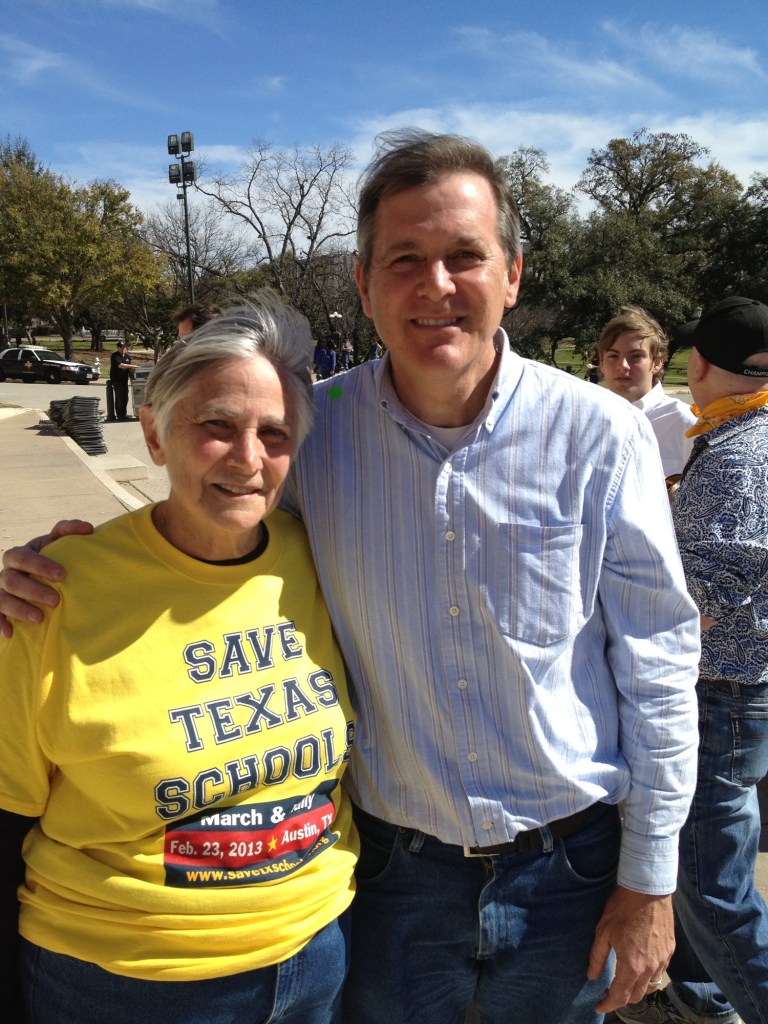
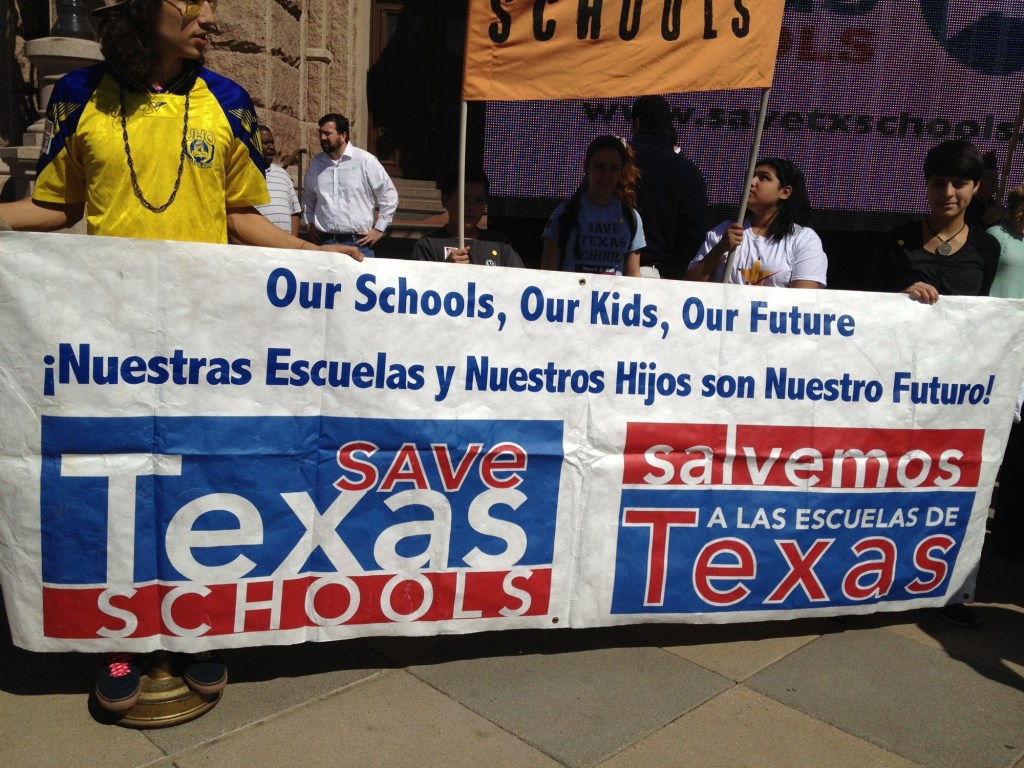
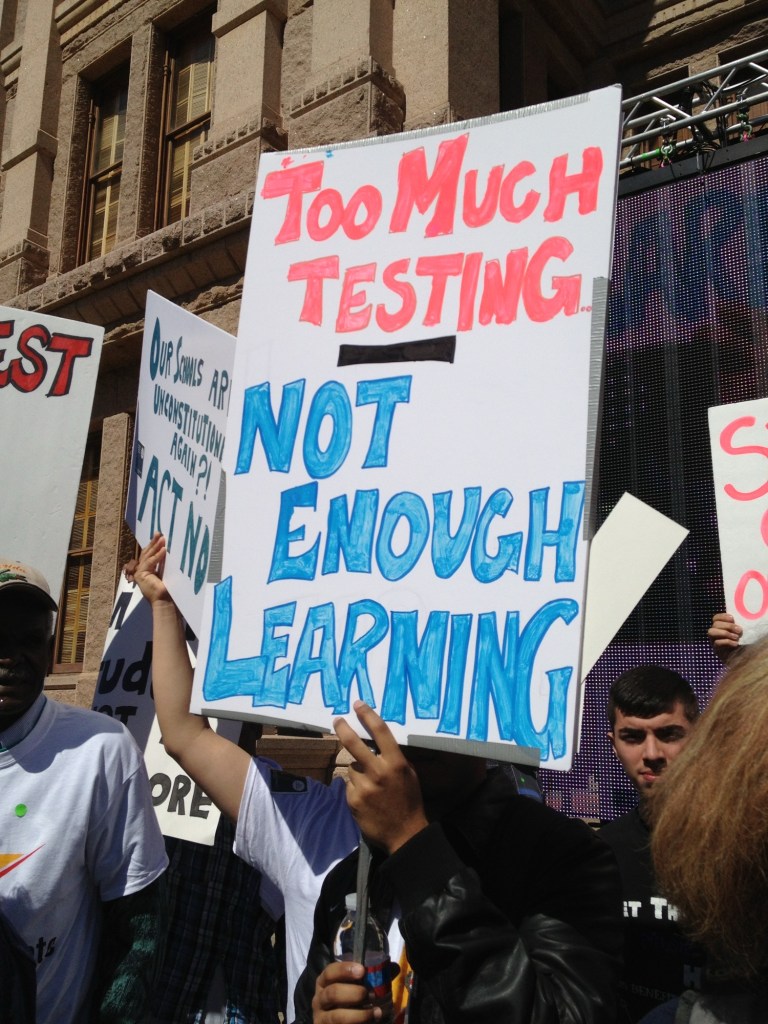
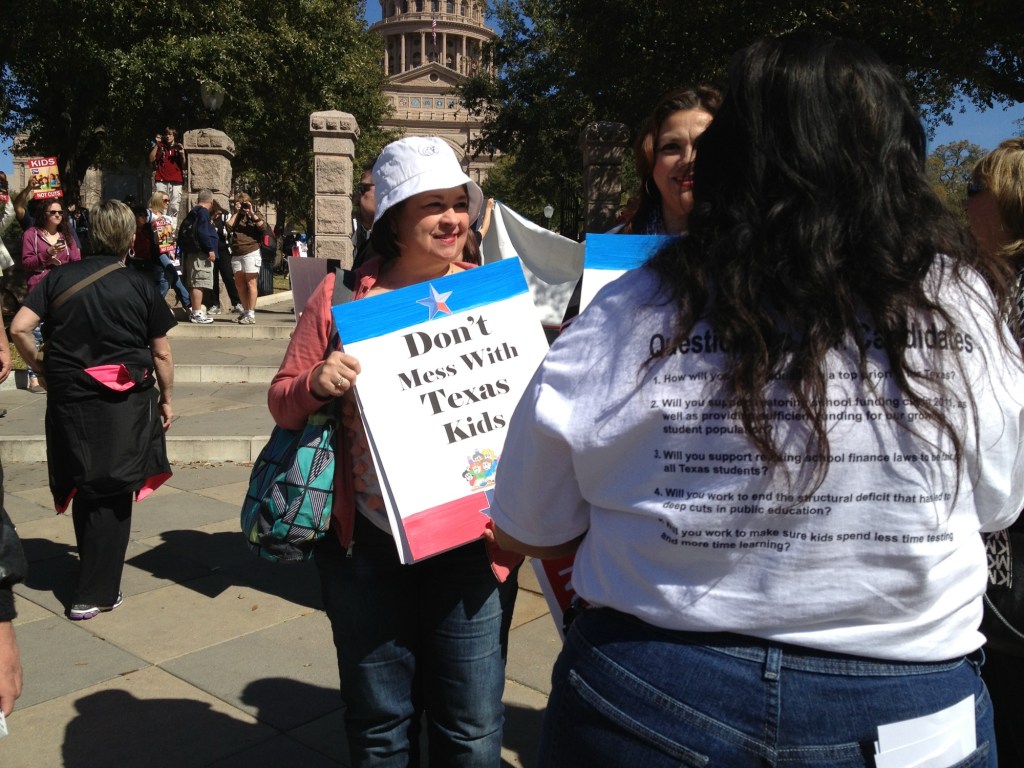
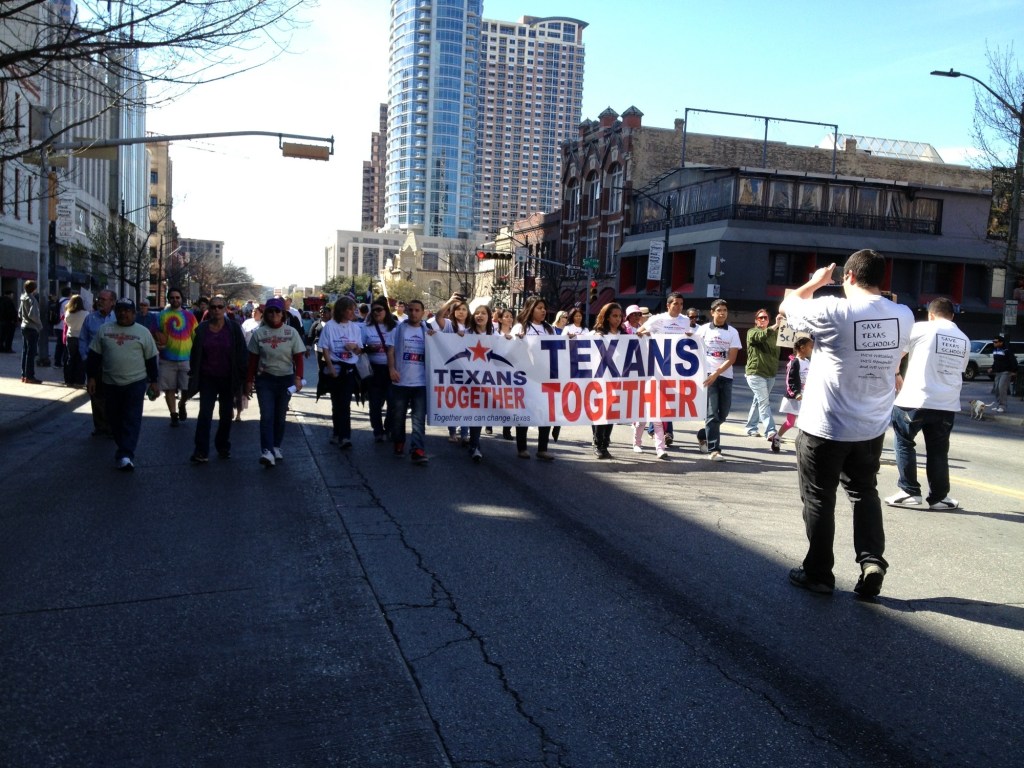
I spoke at Austin Voices for Education and Youth at a rally in front of the State Capitol in 2013
This is Allen Weeks

Mackenzie Scott should give $25 million to Austin Voices for Education and Youth and another $25 million to Community Coices for Education in ZHouston.

Cameron Vickrey is communications and development director for Fellowship Southwest; she previously worked for Pastors for Texas children. She is a pastor, her father was a pastor, her husband is a pastor. She believes in separation of church and state. She believes in the importance of public schools. She does not want to impose her views on others.

She wrote recently:

Any time you are quoted on Twitter, you have to brace yourself for the subsequent comments. Especially if Pastors for Children is the one quoting you.

Their Twitter account is a favorite of trolls (education reformers, neo-libertarians and Christian nationalists) who believe that God is not in the public schools and the only way forward is to tear it all down.

So, I knew there would be pushback when I said this, and it was referenced in a tweet: “If you can, send your children to public schools … because it’s not just about my kids, it’s about what’s good for all kids.”

The replies were predictable and entertaining, although plenty were also disturbing.

Some comments satirically quoted what Jesus definitely did not ever say, like: “‘Let Romans indoctrinate your children.’ – Jesus.” Or, “‘Send your kids to government schools so they will worship the state.’ – Jesus.”

These don’t bother me. Their absurdity speaks louder than any rebuttal would. But there were two Twitter comments that I do want to address.

This one, although asked in the manner of how the Pharisees questioned Jesus, warrants an honest reply: “What is your spiritual justification for this?”

Without knowing exactly to what this question refers, I’m going to assume it’s the claim that as Christians, we should send our children to public school.

Theologically, I believe that God loves every child equally and abundantly. We have denied some children their share of this abundant life by hoarding privileges like education.

If I really believe, and I do, that God loves other peoples’ children the same way that God loves my children and wants the same abundance for their lives, then I should make sure my desire for my children’s success doesn’t come at the expense of someone else’s children.

Now, how could where I send my kids to school ever affect another child’s success or opportunity?

Unfortunately, at least in Texas, public schools are paid for by property taxes and distributed largely by something called average daily attendance funding. So, if you live in a neighborhood with lower property tax rates and lower cost of housing, that school will receive a smaller share of the public education dollars from the state.

Now, there are work-arounds to this, called recapture (a.k.a Robin Hood). But there are many inequities that haven’t been addressed in our funding system, and it’s simply obvious to anyone driving around that the wealthier the neighborhood is, the nicer the school is.

If that school is lower-income, lower-performing or simply hasn’t had a renovation bond passed on their behalf in a few decades, then it’s likelier that families who are zoned there and can opt out will do so.

Because schools receive a certain number of dollars per child counted present each day (or an average of the days), if your child isn’t counted there, then the school is missing out on that money. And if, instead, your child is attending a different public or charter school, that money goes with them.

It’s especially tough for schools who see a mass exodus of students across a few years, like when a shiny new charter school opens nearby. The neighborhood public school might lose a few students from each of their classrooms, but not enough to consolidate classes or reduce any overhead costs.

Essentially, their income is reduced while their expenses stay the same, and they are financially pinched. When a school is financially pinched, it has to cut enrichment programming, the same programs the new charter schools often advertise — like fine arts, gardening or STEM — thereby lowering the quality of that schools’ education.

So, yes, it really does matter to other children which school you choose.

Let’s say you are now with me in supporting our neighborhood public schools. That brings me to the next tweet I want to address: “Any church that follows God doesn’t hesitate to call out the demonic forces within public education. Public Education seeks to separate children from God at almost every turn. Millstones for thy necks.”

Although it is very tempting to accept this challenge and call out the demonic forces within public education, which I absolutely can do [hint: candidates for school boards who don’t seem to care about education], I am going to try to follow Jesus and resist.

God is in all schools with all children. If you are wondering, here’s where I’ve specifically seen God in neighborhood public schools:

  • God is in the kindergarten teacher who nurtures the little ones and patiently listens to their endless commentary on life.
  • God is in the fifth-grade teachers who play guitar, build robots and order class snakes for their students who are otherwise not as engaged.
  • God is in the elementary school that also serves as the regional school for the deaf and hard of hearing, and in the hearing-kids who learn sign language to talk with their classmates.
  • God is in the schools when nearby church members participate in mentoring programs and form friendships with kids who don’t have very many adult role models.
  • God is in the schools when volunteers come to deliver food for the weekend to kids who can’t otherwise depend on food being in their home.
  • God is in the middle school girl who makes room for a new student at her lunch table.
  • God is in the discussions that happen in middle and high school English and history classes, where kids learn to listen to one another and respect each others’ opinions.
  • God is in the moment of silence observed at the beginning of each day after the pledges of allegiance, when many children bow their heads to pray.

If you still believe that God isn’t in the public schools, then maybe that’s exactly where God is calling you to go.

The Houston Chronicle’s editorial board excoriated Texas Governor Greg Abbott for making war on Republican legislators who opposed Abbott’s voucher proposal, and at the same time failing to meet his constitutional obligation to fund public schools.

The editorial board wrote:

Our own Captain Ahab, otherwise known as Gov. Greg Abbott, managed to plunge his harpoon into the belly of the great whale last week. After Super Tuesday, our public-school leviathan lists but is not dead yet. 

The captain’s uber-wealthy allies — lWest Texas oilmen who are avowed Christian nationalists — must be giving thanks to God for Super Tuesday’s results and preparing for the death blow the next time the Texas Legislature meets. In 2022, they funded Abbott’s primary opponent and now their obsession with school vouchers has become the governor’s. 

The aim of these “tycoon evangelicals” — to borrow Bekah McNeel’s label, writing in Texas Monthly — is to get their grappling hooks into our public schools, bleed them out and redirect public resources into private Christian education. So what if our hemorrhaging public school system washes ashore, a blanched skeleton left to the screeching gulls? As long as West Texas billionaires Tim Dunn of Midlandand the Wilks brothers from Cisco are for knocking down the wall — the one between church and state, that is, not the border between Texas and Mexico — how could their agent in the governor’s office be against it?

Abbott is more than halfway there already. Vowing revenge on members of his own party who helped deep-six school vouchers last fall, he relied on a $6 million donation from a Philadelphia billionaire, as well as overlapping donations from Dunn and Wilks, to knock off nine mostly rural representatives of his own party who opposed his obsession. More were forced into a runoff. Based on votes for the House voucher bill during multiple special sessions last fall, he needed to pick up 11 pro-voucher votes. The captain’s likely to reach his ocean’s 11 in the November general election.

“Republican primary voters have once again sent an unmistakable message that parents deserve the freedom to choose the best education pathway for their child,” Abbott said in a statement Tuesday evening. “We will continue to help true conservative candidates on the ballot who stand with the majority of their constituents in supporting education freedom for every Texas family.”

You’ll forgive dedicated public school teachers and administrators, as well as parents of school-age children, if they forgo standing. While Abbott exults, schools around the state — large and small, urban and rural — are grappling with massive budget deficits, thanks to Abbott’s voucher obsession and a Legislature diverted during four sessions last year from meeting its constitutional obligation to adequately fund public schools. 

Remember January of last year? Lawmakers convened in Austin for their regular session almost giddy with the prospect of writing the 2024-25 state budget with an astounding cash balance to work with of $33 billion. They staggered home nearly a year later, having for the most part stiffed the school children of Texas (and by extension, the state as a whole). Rather than using that massive surplus to increase base-level funding, they approved $18 billion in property tax cuts. Meanwhile, school districts were left to grapple with inflation, the loss of federal funding designed to help schools weather the COVID-19 pandemic and no new monies to increase teacher pay, hire additional teachers and make needed investments. 

Nearly every school district in Harris County is underfunded and in crisis, a recent Kinder Institute study determined. Cypress-Fairbanks ISD, for example, is facing a budget shortfall of $73.6 million. For Spring ISD, the budget gap is an estimated $25 million. Spring Branch ISD announced recently that it plans to close two schools and charter programs in the face of a $35 million budget deficit.

Meanwhile, lawmakers continued their streak of penury last year: The last time they increased education funding was in 2019. 

They had the best of intentions, it seems, setting aside nearly $4 billion for public education, but those dollars were never allocated. The school finance bill passed by the House ended up in the drink when the Senate added Abbott’s (and the tycoon evangelicals’) voucher scheme, a scheme that would benefit a relative handful of students around the state (and practically none in rural and small-town Texas).

To be clear, school choice or vouchers or education savings accounts — whatever the label of choice — is a legitimate policy issue. It deserves vigorous debate. But we’ve had that debate. Abbott lost on the merits. Wide-scale voucher programs in other states, such as Arkansas, have failed to produce strong academic improvements while draining public schools of funding.

What’s disturbing about the governor’s voucher obsession is his naked obeisance to wealthy special interests who manifestly do not have the best interests of the people of Texas at heart. Their ultimate aim, even if it’s not necessarily the governor’s, is to transform Texas into a Christian-dominated, biblically based state. Those 21 House Republicans who joined with 63 Democrats to block last year’s voucher proposal understood who benefited and who didn’t. And on Tuesday, many paid the political price. It’s of little consolation, we realize, but we salute their courage. 

There will come a time when Texans have had enough of the mean-spiritedness and ideological narrowness of the current governor and his far-right cohorts, Lt. Gov. Dan Patrick and Attorney Gen. Ken Paxton. There will come a time when they demand more from their elected public servants (emphasis on servants). 

Given our long history with Abbott, it’s hard to imagine that other states do have elected governors, Republicans and Democrats, who acknowledge that they represent every citizen of their state, not only those who voted for them, who seek to unite not divide. In the words of New York Times columnist Frank Bruni, “they focus intently on the practical instead of the philosophical, emphasizing issues of broad relevance and not venturing needlessly onto the most divisive terrain.” 

Bruni was writing about Democratic governors, among them Andy Beshear of Kentucky, Josh Shapiro of Pennsylvania and Gretchen “fix the damn roads” Whitmer of Michigan, but the inclination toward moderation and practicality describes a handful of Republican governors, as well. Phil Scott of Vermont and Spencer Cox of Utah come to mind. 

Of course, that’s not Texas — not today’s Texas, that is. Our obsessive Ahab remains at the helm, steering ever more to the starboard, ignoring the risk to his fellow Texans that he’ll one day run aground. We can do better.

The Network for Public Education was happy to see President Biden’s proposed education budget for the next year. In contrast to the Trump administration, which regularly tried to cut federal aid to education, especially to schools that enroll the neediest students, the Biden administration wants to strengthen the federal commitment to education.

I am especially delighted to see an increase in funding for full-service community schools.

NPE released the following statement:

For Immediate Release

The Network for Public Education Applauds President Biden’s FY 2025 Education Budget 

 Given the mandated fiscal restraints, the White House has presented a responsible budget with increases to programs that best serve American children.

Contact: Carol Burris

cburris@networkforpubliceducation.org

(646) 678-4477

The Network for Public Education (NPE) applauds President Biden’s Fiscal Year 2025 budget for the U.S. Department of Education.  At a time when all federal agencies are fiscally restrained, the budget adds welcome increases to programs that benefit American children.

According to NPE’s Executive Director Carol Burris, “This budget is the mirror opposite of budget proposals by the present House leadership that slash funding to children served by critical programs like Title I while proposing an increase to the already bloated Federal Charter School Programs.”

Highlights of the President’s Fiscal Year 2025 budget include:

  • An increase of $200 million for Title I, which provides supplemental financial assistance to schools with a high percentage of children from low-income families.
  • An increase of $200 million to IDEA to support the needs of students with disabilities.
  • An additional $50 million for grants to full-service Community Schools (FSCS).

Building on the recent State of the Union Address, the budget also includes more funding for high-quality learning time, such as high-dose tutoring, preschool grants, career and technical education, and mental health services in schools. It also includes additional funds for programs to increase the number of teachers at a time of unprecedented teacher shortages.

The Federal Charter School Program (CSP), which has seen a decrease in applications since 2016, was cut by $40 million. In its rationale, the Department notes that both State Entities and Charter Management Organizations did not deliver the number of schools promised in their applications.

The Network for Public Education fully supports the decreased funding for the CSP program, which has far outlived its usefulness. The growth in the demand for charter schools during the Bush and Obama years has ended. As the program rapidly expanded, so did the opportunity for grift and fraud. “The Department’s recent demand that the IDEA charter chain return $28 million is just the latest example of how the CSP has been abused,” said Burris. This is the first time an administration has recommended a decrease in the CSP since the program began.

We thank the President and Secretary Cardona for preparing a sound budget that puts students first in a time of fiscal restraint.

The Network for Public Education is a national advocacy group whose mission is to preserve, promote, improve, and strengthen public schools for current and future generations of students.

                                                                   ###

Glenn Rogers is a veterinarian and a rancher who lives in Graford, Texas. In addition to his duties as a vet and a rancher, he served on the school board of the Graham Independent School District. He was elected to represent District 60 in the Texas Legislature in 2021. He is a conservative, and he tries to represent his rural constituents faithfully. They don’t want vouchers. They want more funding for their local public schools and higher salaries for their teachers. People know their teachers. The teachers know their students and their families. The public schools are important for the local economy. The tradition of Friday night high school football games unifies the community; it’s known as “Friday night lights.”

When Representative Rogers voted against vouchers along with other rural Republicans, Governor Abbott unleashed an advertising blitz against them. The ads accused them of being “weak on security,” which was a lie. Money from billionaires poured into the district to smear Rep. Rogers. He lost.

Rep. Rogers released this statement, which was published in The Weatherford Democrat:

“I’ll Wear No Man’s Collar”

-Davy Crockett

First, I want to thank my supporters, those who voted for me and those who supported me prayerfully, financially, and in so many other ways. It has been the greatest honor to serve this district.

The corruption that exists at the highest level of Texas state government would have made Governor “Pa” Ferguson blush.

Governor Greg Abbott has defiled the Office of Governor by creating and repeating blatant lies about me and my House colleagues, those who took a stand for our public schools. I stood by the Governor on all his legislative priorities but just one, school vouchers. For just one disagreement, and for a $6 million check from Jeff Yass, a Pennsylvanian TikTok investor, and voucher vendor, Abbott went scorched earth against rural Texas and the Representatives who did their jobs-representing their districts.

My tenure in the Texas House included two general sessions, seven special sessions, redistricting, Covid, winter storm Uri, a Democrat quorum break, expulsion of a House member and the impeachment of Ken Paxton. It also includes a litany of conservative victories that made Texas safer, reigned in out-of-control government bureaucracy, lessened what had become a crushing tax burden on our families and businesses, and fostered economic growth.

I am not a good politician. I am just a Texas rancher who wanted to make a difference in my community. Who knew this simple mission would have resulted in three brutal campaigns?

Throughout my three campaigns, because of my unwillingness to be compliant with the two billionaire, “Christian” Nationalist, power brokers that run this state, I have been unmercifully slandered through the politics of unwarranted personal destruction on social media, radio, post mail, streaming sites, and cable television.

In my first race the opposition was the Wilks, Tim Dunn, Empower Texans, and the entire enterprise of dozens of PACs and “non-profits” they financed. The race ended in a hard fought Covid-delayed runoff victory against Farris Wilks’ son-in-law.

In my second race, my opposition was Wilks and Dunn, Empower Texans (rebranded to Defend Texas Liberty), and the Voucher Lobby, including the American Federation for Children and the School Freedom Fund (based in Virginia). In that race, we dealt with a runoff and an expensive, unnecessary recount.

In my third race the opposition was all the above, but now included a rebranded Defend Texas Liberty (Texans United for a Conservative Majority), vastly greater money from the Voucher Lobby, and Governor Greg Abbott.

This time the millions of dollars spent spreading lies about my record and the non-stop false impugning of my integrity were just too much to overcome. The real losers in this race are:

1) Texas public schools;

2) Rural Texas; and

3) Representative Government.

This morning, I have no regrets. I believe in the words of Sam Houston, “Do right and risk the consequences.”

History will prove Ken Paxton is a corrupt, sophisticated criminal. History will prove vouchers are simply an expensive entitlement program for the wealthy and a get rich scheme for voucher vendors. History will prove Governor Greg Abbott is a liar.

History will prove that our current state government is the most corrupt ever and is “bought” by a few radical dominionist billionaires seeking to destroy public education, privatize our public schools and create a Theocracy that is both un-American and un-Texan.

May God save Texas!

[Editors Note: the Wilks brothers and Tim Dunn are oil-and-gas billionaires who are evangelical Christians; they want vouchers, and they use their money to control state government. Ken Paxton is the State Attorney General who was impeached by the Texas House of Teprrsentatibes on multiple charges of corruption, based on whistleblower reports from his own staff. After Paxton’s billionaire friends came to the rescue, giving a campaign contribution of $2 million to Lt. Gov. Dan Patrick, who conducted the trial in the Srnate, Paxton was acquitted. In this week’s election, Attorney General Paxton and his wealthy friends ousted legislators and judges who tried to hold him accountable.]

I am a native Texan. I was born and raised in Houston. I attended Houston public schools from kindergarten until my high school graduation. The public schools of Texas gave me a strong foundation, and I will always be grateful to my teachers and my schools.

The public schools in Texas will be harmed by vouchers. Yet Governor Greg Abbott is demanding that the Legislature endorse vouchers, so that the public will subsidize every student who goes to private and religious schools. No wonder he campaigned for vouchers by visiting private and religious schools.

Some Republican legislators know that vouchers will hurt their public schools.

Governor Abbott has spent millions of dollars to defeat those brave Republican legislators who oppose vouchers.

The primary is March 5.

Funded by oil and gas billionaires and by Jeff Yass, a Pennsylvania billionaire, Abbott has tried and repeatedly failed to pass a voucher bill. He failed because these Republican legislators stood up for their communities and their public schools.

These legislators know their local teachers. They are friends and neighbors. The legislators know they are hard-working dedicated teachers. They teach the children; they don’t “indoctrinate” them, as Governor Abbott falsely claims. Many have taught in the same schools for decades, raising up the children in the way they should go.

The teachers are underpaid, and the school buildings need upgrades. But the Governor won’t put another penny into paying teachers and funding public schools unless he gets his vouchers.

In every state that has vouchers, most of them are used by students who never attended public schools. Vouchers are nothing more than a public subsidy for students already attending private and religious schools.

Voucher schools are free to discriminate and are excused from all accountability.

These heroic and principled legislators deserve your thanks and your vote on March 5:

  • Steve Allison, District 121, San Antonio
  • Ernest Bailes, District 18, Shepherd
  • Keith Bell, District 4, Forney;
  • DeWayne Burns, District 58, Cleburne;
  • Travis Clardy, District 11, Nacogdoches
  • Drew Darby, District 72, San Angelo
  • Jay Dean, District 7, Longview
  • Charlie Geren, District 99, Fort Worth
  • Justin Holland, District 33, Rockwall
  • Ken King, District 88, Canadian
  • John Kuempel, District 44, Seguin
  • Stan Lambert, District 71, Abilene
  • Glenn Rogers, District 60, Mineral Wells
  • Hugh Shine, District 55, Temple
  • Reggie Smith, District 62, Sherman
  • Gary VanDeaver, District 1, New Boston

For their courage in defending their community schools, their teachers, their parents, and their students, I place them on the blog’s Honor Roll.

Now get out there and vote for them!

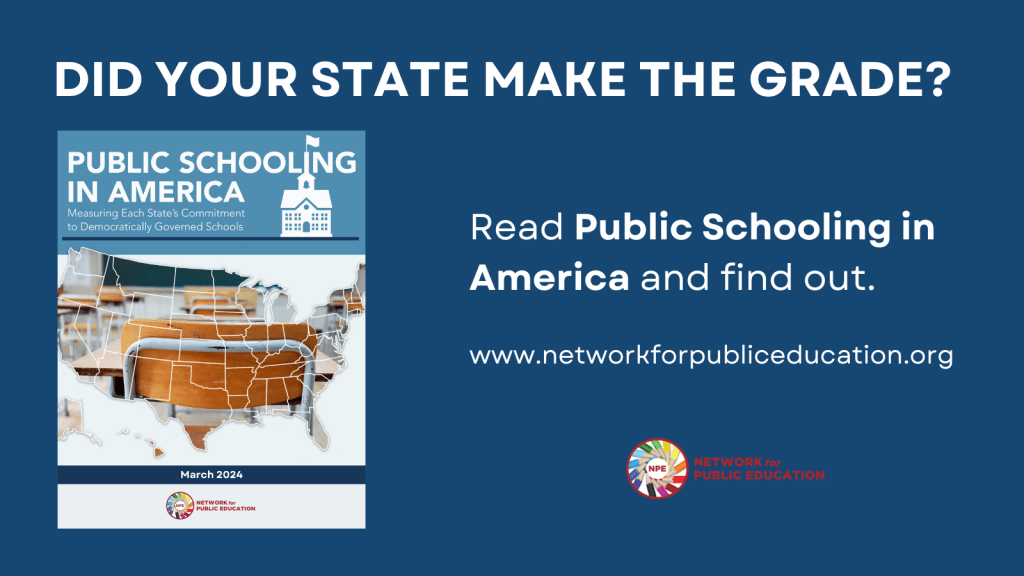
The Network for Public Education released a report card today grading the states on their support for democratically-governed public schools. Which states rank highest in supporting their public schools? Open the report to find out.

Measuring Each State’s Commitment to
Democratically Governed Schools

EXECUTIVE SUMMARY


Neighborhood public schools remain the first choice of the overwhelming majority of Ameri-
can families. Despite their popularity, schools, which are embedded in communities and gov-
erned by elected neighbors, have been the target of an unrelenting attack from the extreme
right. This has resulted in some state legislatures and governors defunding and castigating
public schools while funding alternative models of K-12 education.

This 2024 report, Public Schooling in America: Measuring Each State’s Commitment to
Democratically Governed Schools
, examines these trends, reporting on each state’s commit-
ment to supporting its public schools and the children who attend them.

What We Measure

We measure the extent of privatization in each state and whether charter and voucher laws
promote or discourage equity, responsibility, transparency, and accountability. We also rate
them on the strength of the guardrails they place on voucher and charter systems to protect
students and taxpayers from discrimination, corruption and fraud.

Recognizing that part of the anti-public school strategy is to defund public schools, we rate
states on how responsibly they finance their public schools through adequate and equitable
funding and by providing living wage salaries for teachers.

As the homeschool movement grows and becomes commercialized and publicly funded,
homeschooling laws deserve public scrutiny. Therefore, we rate states on laws that protect
children whose families homeschool.

Finally, we include a new expansive category, freedom to teach and learn, which rewards
states that reject book bans, and the use of unqualified teachers, intolerance of LGBTQ stu-
dents, corporal punishment, and other factors that impinge on teachers’ and students’ rights.

How does your state rank?

In the Public Interest is an excellent source of information about privatization in every sphere of life, wherever privatizers see a chance to turn a public service into private profit. Its latest post is about the citizens’ fight to overturn a new voucher plan in Nebraska.

Open the link to see the cost of vouchers in Arizona, New Hampshire, North Carolina, and Ohio. Count on costs to go up every year, as legislators expand eligibility and raise income limits.

In early 2023, the Nebraska legislature passed LB753, which created a new private school tax-credit voucher program. The bill allows a dollar-for-dollar tax credit to individuals and corporations that donate to a scholarship granting organization (SGO), which would issue the vouchers to families to pay for private school. Eligibility requirements are broad, allowing, for example, any child entering either kindergarten or 9th grade at a private school, or any student who has spent at least one semester in a public school to apply for a voucher. The bill would divert up to $25 million annually from the state, but that figure could go up to $100 million.

The bill includes a standard “hands off clause,” which prevents the state from exercising any authority over the school and how it operates.  It’s basically a license to discriminate.

Shortly after the bill was passed, public school supporters launched a referendum petition drive to put repeal of the new law on the November 2024 ballot. In fewer than 90 days, the repeal campaign gathered nearly double the number of required signatures from across the state. The effort was led by Support Our Schools Nebraska, a coalition that includes, among others, the Nebraska State Education Association, OpenSky Policy Institute, Parent-Teacher Association of Nebraska, Stand for Schools, League of Women Voters of Nebraska, Omaha NAACP, ARC of Nebraska, Nebraska Farmers Union, and the Nebraska Civic Engagement Table.

In Nebraska, 84% of private schools are religiously affiliated. Many, if not most of these schools are legally permitted to discriminate against applicants based on their gender orientation, religious affiliation, or other characteristics. The Nebraska OpenSky Policy Institute has estimated that state aid distributed to public schools could decrease by almost $12 million in response to the new voucher program.

Forces aligned against the repeal include the usual suspects, like the American Federation for Children, founded by anti-public-education zealot Betsy DeVos, which donated $583,000 along with $103,000 of in-kind services to the pro-voucher effort, on top of money DeVos spent to influence Nebraska state senate races in the last cycle. The Nebraska Catholic Conference, whose coffers stand to gain from LB753, has also thrown its weight and reach behind the anti-public education side. Jeremy Ekeler left his job as associate director of education policy at the Conference in November to become the executive director of Opportunity Scholarships of Nebraska, a state-approved scholarship granting organization helping to implement LB753. They’re not only working to defeat the ballot measure, they’re trying to keep it off the ballot entirely, following a playbook the right has used to subvert a variety of citizen-led, petition-driven initiatives around the country.

As we have pointed out before and as the chart above illustrates, vouchers bleed public school districts of needed funds, allow for discrimination, lower educational standards (by not necessarily having many), and lead to resegregation.

As if that weren’t enough, they turn out to be budget busters for states.

In the Public Interest will keep an eye on this fight because it may be the clearest indication that, while conservative politicians have thrown their support to various schemes that divert public funds from public schools, the public opposes these efforts and will show up at the polls to make their feelings felt.

Thom Hartmann continues to amaze me, with his steady production of powerful articles. This one is especially important for the readers of this blog, whose primary purpose is to strengthen and protect our public schools.

Thom Hartmann writes:

In 1776, British economist Adam Smith published The Wealth of Nations, a book that laid out the principles that modern economies have operated under for centuries (with the exception of the Reagan Revolution years of 1981-2021). In addition to arguing for a strong domestic manufacturing base and high taxes on the wealthy, Smith pointed out that one of the things that most directly constitutes the wealth of a nation is its educated workforce and well-informed populace (as a result of that education).

From Thomas Jefferson creating the first tuition-free American college (the University of Virginia), to Horace Mann’s advocacy of public schools in the late 19th century, right up until 1954, this was an uncontroversial position. It’s why every developed country on Earth has a vibrant public school system and — with the exception of the US since Reagan ended free college in California — most developed countries offer free or near-free college to their citizens.

But in 1954, the US Supreme Court upset the education apple cart by declaring in their Brown v Board case that “separate but equal” schools, segregated by race, were anything but “equal.” That decision fueled two movements that live on to this day.

The first was the rightwing anti-communist movement spearheaded by the John Birch Society, which was heavily funded back then by Fred Koch, the father of Charles and David Koch. They put up billboards across the country demanding that Americans rise up and “Impeach Earl Warren,” who was then the Chief Justice of the Supreme Court, for requiring “communist” racial integration of our schools.

The second was the private, all-white “academy” movement that has morphed over the years into charter schools and the “school choice” movement of today. It received a major boost when the white supremacist co-founder of neoliberalism, Milton Friedman, published a widely-read and influential article in 1955explicitly calling for what he called “education vouchers” to fund all-white private schools to “solve the national crisis” the Court had created.

In 1958 when the Virginia Supreme Court went along with the US Supreme Court’s Brown v Board decision and ordered that state’s schools desegregated, the governor shut downevery public school in the state. Prince Edward County’s schools were still closed in 1964, when they were finally ordered to open by the courts.

Hundreds of “segregation academies” opened across the South; in Mississippi, for example, 41,000 white students left public schools to attend these academies in just the one year of 1969. Parents had to pay the tuition themselves, but they were willing to do so to avoid their children having to interact with Black, Hispanic, or Asian kids.

The turning point for the Republican Party was 1964, when President Johnson and a Democratic Congress passed and signed into law the Civil Rights Act. Shortly thereafter, one Southern Democratic politician after another changed party affiliation to the GOP so they could continue to argue against “forced integration” of public schools.

The Republican war on public schools burst into the open with the Reagan Revolution, when Education Secretary Bill Bennett oversaw a 30 percent cut in federal aid to public schools following Reagan’s promise to abolish the Department altogether. Every Republican running for president since has made a similar promise or claimed the need to end the Education Department.

Bill Bennett wasn’t shy about explaining why it was necessary to gut public schools, after the Supreme Court had ordered they must be racially integrated. Bennett wanted to privatize public education — as did Trump’s former Education Secretary, billionaire Betsy DeVos — and is probably most famous for his statement that gives us a clue as to why this idea of ending public education is so persistent in the GOP:

“If you wanted to reduce crime,” Bennett said on the radio, “you could, if that were your sole purpose; you could abort every Black baby in this country, and your crime rate would go down.”

LISTEN NOW · 0:17

Could it be that it’s all about keeping white children away from Bennett’s Black babies? Is simple racism what’s animating the GOP’s antipathy toward public education?

One clue is that the idea of ending public education in America goes back even farther than Bennett or Reagan to a single moment and a single court decision. 

When I was born, in 1951, Republicans loved public schools. Republican President Dwight Eisenhower led the charge to build gleaming new public schools all across the United States: I attended one, as did perhaps a majority of my generation.

But then came the Supreme Court, with their Brown v Board decision.

In 1957, President Eisenhower ordered the Little Rock, Arkansas, public schools desegregated. The “Little Rock Nine” — nine Black children trying to desegregate Little Rock Central High School — became nationally famous when Governor Orval Faubus prevented them from entering the school that fall, provoking Eisenhower to call up federal troops to escort the children to class.

Faubus called a referendum — an election — and the good citizens of Little Rock voted 19,470 to 7,561 to shut down their entire school system rather than comply with Eisenhower’s order. That, in turn, led back to the Supreme Court, which, in the fall of 1958, ruled unanimously in Cooper v Aaron that the Brown v Board desegregation order was, in fact, now the law of the land for public education.

In response, whites-only private schools and “academies” began springing up across the nation, many run by all-white churches. (Jerry Falwell tried, in 1966, to open an all-white school; in 1980 he became Reagan’s main advisor on merging the white supremacist faction of evangelical Christians — also triggered by Brown v Board — into the GOP.)

Thus, in 1958 the governor of Virginia closed all the public schools in racially mixed Warren County, Norfolk, and Charlottesville; Prince Edward County’s public schools remained closed for a full five years.

While that’s the foundational history of what has become the GOP’s war on public education, for most of the past 40 years Republicans have merely claimed vague libertarian principles when they try to explain what they ironically call “school choice.”

It wasn’t until Donald Trump gave them permission — and showed them how politically potent it could be — to unleash their inner racists that the GOP went public with overt white supremacy as a core value for the party.

While Critical Race Theory (CRT) was a little-known 1993 analysis of structural racism pioneered by Kimberlé Crenshaw and Derrick Bell taught only in law school, rightwing influencer Christopher Rufo popularized the term with an appearance on Tucker Carlson’s Fox “News” show.

From there, it echoed around the GOP for a few months before catching fire across rightwing hate radio, podcasts, and Fox. Pretty soon white supremacist militia members were showing up at school board meetings threatening members that “we know where you live.”

Republicans anxious to stoke the fears of their white racist base began inveighing against teaching CRT in public schools — even though such a thing had never happened — and passing laws so loosely worded as to bar any meaningful teaching or classroom discussion of America’s racial history.

All-white private schools funded with taxpayer dollars have become the darlings of Republicans. In most cases these schools don’t need to flout the law by declaring their segregated status: Black, Asian, and Hispanic parents most often simply aren’t interested in enrolling their children in schools that proudly proclaim they will not allow a drop of “CRT,” true American history, or real science education in their classrooms.

The issue of privatizing public schools came up in Arizona in 2018 with a statewide ballot initiative that would extend free school vouchers to every student in the state: it was defeated by voters by a 2:1 ratio. Writing for The Arizona Republic, columnist Laurie Roberts was unambiguous in her description of the state’s voters’ horror at the ballot initiative:

“Actually, they didn’t just reject it. They stoned the thing, then they tossed it into the street and ran over it. Then they backed up and ran over it again.”

Republicans in the heavily gerrymandered state, though, didn’t much care about the will of the voters. Appealing exclusively to their white racist “Christian” base, they pushed what was essentially that same proposal through the GOP-controlled state legislature and it was signed into law last year by Republican then-Governor Doug Doocey.

In giving every student in the state the ability to opt out of public education with a taxpayer-funded voucher, Doocey established a new benchmark in the war against racially integrated public schools that was matched this year by Florida, Arkansas, Iowa, and Utah.

Legislation to gut public schools and replace them with vouchers for private schools have failed in six states so far (Georgia, Texas, IdahoVirginiaKentucky, and South Dakota), but Republicans are not letting go. This year voucher bills were introduced in at least 24 states.

The fact that most of the nation’s public school teachers are union members has given Republicans another good reason, in their minds, to do everything possible to destroy public schools. As Trump’s former Secretary of State Mike Pompeo claimedlast year, in the minds of Republicans the American Federation of Teachers’ President Randi Weingarten is “the most dangerous person in the world.”

Republicans also love the fact that voucher programs mostly subsidize upper-income families, while educationally ghettoizing the children of low-income parents. Vouchers almost never cover all the costs of attending a private school, so they primarily serve as a government handout to the mostly upper-middle-class white families who already wanted to send their kids to today’s version of the segregation academies.

Once the public schools are largely dead, Republicans will begin lobbying to “reduce spending” by cutting the amount allocated for the vouchers, locking the emerging two-tier status of publicly funded education into place.

For the moment, though, private schools are a booming industry as a result of the GOP’s embrace of Friedman’s vouchers. In Florida, for example, they have virtually no rules or standards for the over-one-billion-dollars the state shovels into its private schools: while public schools must disclose their graduation rates, how they spend their money, and let anybody examine their curriculum, private academies have no such rules in many Republican-controlled states, even though they’re receiving public monies.

Many private schools across the country operate with untrained and uncertified “teachers,” have no clear standards for graduation, and refuse to teach “controversial” subjects like evolution, climate science, and the racial history of America.

Which brings us to organized religion, the other recipient of big bucks because of the school voucher movement. Schools affiliated with churches are now raking in billions every month across the US, and Republicans — who continue to push for unconstitutional things like mandatory public school prayer — pander daily to fundamentalists who don’t want their kids exposed to science or history.

Six corrupt Republicans on the Supreme Court legalized this practice of shoveling taxpayer funds to churches and religious schools in their notorious Carson v Makin decision last year. As Justice Sonya Sotomayor wrote in her dissent:

[In just five short years this Court has] “shift[ed] from a rule that permits States to decline to fund religious organizations to one that requires States in many circumstances to subsidize religious indoctrination with taxpayer dollars.” This decison “continues to dismantle the wall of separation between church and state that the framers fought to build.”

Which is exactly what the GOP wants. As SenDem recently wrote for Daily Kos:

“Laura Ingraham claimed that ‘a lot of people are saying it’s time to defund government education or at least defund it by giving vouchers to parents.’ Fox’s Greg Gutfeld similarly declared that private school vouchers are needed because public schools are ‘a destructive system’ and described teachers as ‘KKK with summers off.’

“Sen. Marco Rubio of Florida has called public schools ‘a cesspool of Marxist indoctrination.’ Donald Trump declared, ‘public schools have been taken over by the radical left maniacs.’ And Rep. Marjorie Taylor Greene of Georgia called them taxpayer-funded indoctrination centers that need to end, which is a bit ironic since she is the poster child for the necessity of funding public education.”

Sweden has been flirting with libertarianism for a few decades and was the first developed country to offer American-style school vouchers to all kids so they could attend private, for-profit public schools. Just a month ago, their government proclaimed the experiment a disaster and is trying to figure out how to shut down the private schools and re-establish a public education system.

Public schools were the great social and economic leveler for the last century of American history; Republicans want to end that and instead advantage wealthy children over their lower-income peers, particularly those whose skin is darker than Trump’s spray tan.

Public schools (and free college) made it possible for America to produce an explosion of invention and innovation throughout the mid-20th century; now other countries are surpassing us, as the dumbing-down of our kids has become institutionalized in Red state after Red state.

And public schools gave many students their first experience of interacting with people who look different from them and grew up under different circumstances, awakening many young people to the discrimination and unfairness inherent in how America has historically treated minorities.

All of which explains why Republicans so badly want to put an end to public education in America.