Archives for category: Rural Schools

Yesterday was a crucial election for the future of public schools in Texas. The Republican primaries pitted civic-minded Republicans against challengers committed to vouchers and endorsed by Governor Greg Abbott.

Abbott received the biggest single contribution in state history from Pennsylvania billionaire Jeff Yass. The gift came with a purpose: pass a voucher law.

Governor Abbott has been in charge since 2015 and until now, he never cared much about vouchers. But the money came pouring in from evangelical oil-and-gas billionaires like Tim Dunn and Farris Wilks, as well as out-of-state billionaires like Yass and Betsy DeVos. Suddenly, vouchers was the Governor’s top priority. He toured Christian schools around the state to promote them.

When the vote came in the Legislature, a bloc of rural Republicans in the House opposed vouchers. They said their community loved their public schools; they didn’t want to undermine them. Their public schools are the heart of their community and their local economy.

Abbott offered new money for public schools and teacher pay raises, but only if the Legislature approved vouchers. The rural Republicans (and every Democrat) said no.

Abbott said he would call special sessions until the House passed a voucher bill and he did. He called four special sessions. They said no to vouchers. He threatened to run primaries against them and to replace them with legislators who supported vouchers. They stood firm.

Yesterday some of those rural Republicans were defeated by Abbott and about $100 million in billionaire money. Some prevailed. Some are in run-offs.

Pastor Charles Johnson of Pastors for Texas Children (PTC) is a stalwart friend of public schools. He and his network of pastors across the state understand the importance of well-funded public schools and well-paid teachers.

PTC just released this update on the Republican primaries.

https://www.pastorsfortexaschildren.com/

Election Results

Dear Friends,

We have mixed emotions as we reflect on last night’s outcomes of the Texas House of Representatives races. While we may not have achieved the sweeping results we had hoped for, we are grateful for the victories your work and witness achieved!


Of the 16 House Republican primary races we focused on, we enjoyed six victories and suffered six losses. Four of our Republican friends face runoff elections.


The path to positive change is often fraught with challenges, and setbacks are an inevitable part of any endeavor. Though we may not have won every race last night, we are grateful for the re-election of six of our strongest Republican allies in the House and look forward to working hard to re-elect four more in the runoffs.


We find hope and encouragement in the upcoming May runoffs. These runoffs are crucial to fighting taxpayer-funded vouchers here in Texas. We will continue to fight to ensure that the Texas Public Schools voice we advocate for is heard loud and clear. Your continued support is crucial, and together, we will forge a brighter future for the children of Texas.

We want to express our gratitude for your unwavering support throughout this journey. We remain steadfast in our commitment to championing our Texas public schools, teachers, parents, and, of course, the 5.5 million children in our Texas public schools.


Let us stand united, resilient in the face of these challenges, and hopeful for the positive outcomes that the runoffs may bring. The journey may be long, but with your dedication and support, we can make a lasting impact on the lives of children and families in our beloved community.


Rev. Charles Foster Johnson, Executive Director

Pastors for Children

Donate to PTC

Nebraska will have a voucher referendum this fall unless courts keep them off the ballot. Friends of public schools gathered way more than enough signatures to get a state referendum. The top state election official certified that they met the qualifications.

But Republican leaders are desperate to kill the referendum because they know it will pass. NO VOUCHER REFERENDUM HAS EVER PASSED.

Nebraska’s top election official has ruled that voters will get to decide this year whether to repeal a law that gives taxpayer money for private school scholarships. 

But both Nebraska Secretary of State Bob Evnen and state Sen. Lou Ann Linehan, who authored the school choice law and sought to have the repeal effort kept off the ballot, acknowledge that the courts will likely ultimately decide if the repeal question makes it onto November’s ballot.

Evnen said in a news release late Thursday that he consulted state law and previous state attorney general opinions before concluding that the referendum question is legal and will appear on the November ballot “unless otherwise ordered by a court of competent jurisdiction.”

Governor Kathy Hochul has fashioned a state budget that will profoundly damage rural schools in New York. She had to trim the budget somewhere but why cut foundation aid to the state’s most important function: the education of its children?

North Country Public Radio reported that nearly half the school districts in rural upstate New York face steep cuts. Hochul has proposed the elimination of a “hold harmless” requirement that requires each year’s state aid to be no less than in the previous year. This guarantee has provided stable funding but Governor Hochul says it’s obsolete. The cuts, however, will disrupt planning and inflict damage on the schools’ programs and staffing.

Educators and lawmakers on both sides of the aisle are outraged over the way Governor Kathy Hochul is funding schools in her new budget plan.

Her proposed 2024-2025 education budget is for $35.3 billion, including a record $825 million increase for public schools. But it’s being distributed differently than in the past, and for the first time in years, many schools would actually lose funding.

Dozens of North Country districts face that scenario if the legislature doesn’t make changes.

Christopher Clapper is the superintendent of Alexandria Central School, a district of about 460 kids in Alexandria Bay, in Jefferson County.

With increases in state aid over the last few years (they got a 3% increase for two years from Foundation Aid being fully funded, and money from the American Rescue Plan Act) he says they’ve been able to do a lot.  

“That has included buying all student supplies, so that burden isn’t on parents. We’ve had free school lunch for all students since 2021,” said Clapper. They’ve also increased the number of college credit classes in the high school, and expanded their Future Farmers of America (FFA) program. 

But Clapper says he and other superintendents knew they couldn’t count on more increases. “We all assumed that that we would be dropped down to zero and there’d be no growth in foundation aid for ‘hold harmless’ districts,” said Clapper, following the two years of 3% increases. “And that [scenario] is kind of what my colleagues and I around the North Country have been budgeting for.”

Then Governor Hochul released her 2024-25 budget proposal.

“When we saw the numbers that came out, I mean, it was drastically different than a 0% increase,” said Clapper. Instead, it was a 13.2% decrease in aid, a reduction of about $517,000.

Clapper was shocked. He says “if that did come to pass, it would be absolutely catastrophic for this district.” 

The state responds that the new budget reflects declining enrollments in many rural districts.

In a recent op-ed, Blake Washington, Hochul’s Division of Budget Director, wrote: “Instead of asking the question, “how much more money are our schools getting?”; it should be “why do we have a formula that forces us to pay for students that don’t exist?”

He’s referring to the fact that New York school enrollment has declined by about 10% since 2014.

In many North Country school districts, enrollment declines have been more dramatic, as high as a 50% decline in student populations over the last decade. 

In Alexandria Central School District, public enrollment data shows about a 25% decrease in the student population since 2014, from roughly 620 to 460 kids.

But educating students doesn’t happen on a per-pupil basis, said Superintendent Chris Clapper. “If you have a kindergarten class of 20 students, and then that kindergarten class decreases to 17 students, it’s not as though there’s less cost of maintaining a classroom.” 

He says you can’t hire 75% of a teacher, you can’t heat part of a room.

Kristen Barron wrote in the Hancock Herald about the fight against Governor Hochul’s proposed cuts.

Leaders of the New York State United Teachers (NYSUT) came to Hancock to meet with teachers and students. The Hancock Teachers Association (HTA) has been organizing the Hancock community to protest the cuts. There will be a protest rally in Hancock on March 8. The town, the teachers, the parents and the students are wearing blue to show their opposition to the cuts and their support for their schools.

HCS stands to lose $1.2 million dollars in state aid if the proposed cuts are adopted in the 2024-2025 budget, which is due by April 1. 

“You’ve really stepped up here, and you have the best organized response that we’ve seen,” said Tim O’Brien, who oversees the Southern Tier for the state union. He noted the sea of blue t-shirts which were worn by students and staff on Friday as a sign of unity against the proposed aid cuts.

The HTA has also reached out in support of other area organizations facing proposed cuts such as the Delaware County ARC.

Of the twelve schools in Delaware County, 10 are getting cuts amounting to a loss of $4,919,401.00, according to a fact sheet compiled by HCS. Hancock and Franklin school districts, the smallest districts in the county, will receive the deepest losses, said Asquith during Friday’s meeting. 

HCS has around 317 students. 

Of the $4.9 million cut from the ten county districts, Hancock is shouldering $1.2 million or 24%, says the fact sheet. 

The neighboring Deposit Central School District, which operates a merged sports program with HCS, is facing a 7.4% cut in aid. Downsville Central School District is facing a 33.8 % loss and Sullivan West in neighboring Sullivan County confronts a 17.1 % loss in aid, according to an Albany Times Union map based on data compiled by the New York State Education Department and New York State United Teachers.  

Opposition to the cuts is bipartisan.

In an education budget of $35.3 billion, the cuts to rural districts look like a rounding error. And yet each cut represents lost jobs, lost courses, lost opportunities for rural students.

I believe that a liberal arts education is the heart and soul of what it means to be an educated person. No matter what job or career or profession you aim for, you are not educated unless you have studied history, literature, the arts and sciences. These are the studies that prepare you for citizenship and for a full life. Can you understand the world if you know little about history? Can you understand political debates about medicine and health if you never studied science? Are you prepared to understand the breadth and depth of the human spirit if you have never learned about art and music?

I think not. Oddly, it seems to me, cutting the humanities is an elitist path, a decision that students in rural areas don’t need or deserve a full education that tends to their mind, their heart, and their soul.

Sadly, The Daily Yonder reports, public colleges and universities in rural areas are slashing courses and majors in the humanities, favoring instead the courses that prepare students for jobs and careers.

Part of the decision is based on declining enrollments, but the state budget for piublic higher education is being cut even wen the stat’s coffers are overflowing. Governors prefer to cut taxes—income taxes or property taxes—rather than invest in the future of their state.

Elaine C. Povich of Stateline reports:

MORGANTOWN, W.Va. — Taya Sullivan, 20, is a freshman at West Virginia University, double majoring in neuroscience and Spanish. She also has a campus job in a linguistics lab, building on her majors and earning money she needs to continue her studies.

Next semester, both her Spanish major and her job will be gone.

Sullivan has been caught up in the university’s decision to eliminate its foreign language majors. The school is axing 28 majors altogether, ranging from undergraduate languages such as French and Russian to graduate majors in math and higher education. It also is cutting 12% of its professors.

Administrators say they’re responding to a budget shortfall, declining enrollment, flagging student interest in humanities courses, and pressure from parents who want their kids to be prepared for good-paying jobs after graduation.

“Are we going to revert back to ‘normal?’ No, we will have a new normal,” said West Virginia University President Gordon Gee in an interview with Stateline. “We are going to be much more oriented toward listening to the people who pay our bills — parents, students, legislators and others. And they very much want to see universities, particularly land grant institutions like ours, become engines of creativity and economic development.”

Many lesser-known public colleges nationwide have begun cutting back on the humanities, but West Virginia University is the “tip of the spear” for flagship state universities, Gee said.

Similar reductions are only expected to grow across the country, particularly in rural areas where campus budgets are lower, enrollments are more likely to be falling, and where the pressure for career-oriented majors may be greater. But critics argue that such changes in emphasis will sap states of intellectual firepower, leaving them with fewer leaders and citizens who are well-rounded.

In West Virginia, the cuts have prompted student demonstrations, a faculty resolution and objections from some lawmakers. Gee is unmoved.

“The budget [deficit] was only an accelerant; it’s change or die,” he said. “We are the first to jump off the cliff. I could make a living from calls from other university presidents to ask, ‘How are you doing it?’ We are having to change. We can no longer be everything to everyone. We’ve got to make choices.”

Other state universities, especially rural ones, are making similar choices. Missouri Western State University has eliminated dozens of majors and minors including English, history, philosophy, political science, economics, sociology, art, Spanish and French. Eastern Kentucky University shut theater programs and economics. The State University of New York at Potsdam is also cutting degree programs, including in art history, dance, French, Spanish and theater.

More cuts could be coming. The Board of Regents for the University of Kansas system announced in June it is reviewing proposals to eliminate programs at the six state universities. The review is meant “to ensure that programs meet student demand, improve student affordability, support Kansas communities and help meet the state’s workforce needs.” A decision is expected in 2024 on which programs to cut or consolidate, said Matt Keith, spokesperson for the Kansas Board of Regents.

Humanities courses such as languages, history, arts and literature are particularly vulnerable nationwide. Schools are more inclined to emphasize business, science, math and technology studies, which could lead to more high-paying jobs.

Students also appear to be turning away from the humanities: Data from the U.S. Department of Education’s National Center for Education Statistics shows that the percentage of bachelor’s degrees conferred by four-year institutions in the humanities dropped from 16.8% of all degrees in the 2010-11 school year to 12.8% in 2020-2021.

State budget reductions and schools’ funding shortfalls also have contributed to cuts, particularly in rural states. State spending on higher education fell in 16 of the 20 most rural states between 2008 and 2018, when adjusted for inflation, according to a Hechinger Report analysis of data from the Center on Budget and Policy Priorities, a research and policy institute that advocates for left-leaning tax policies.

Higher education funding per student declined by more than 30% in Alabama, Louisiana, Mississippi, Oklahoma and Pennsylvania during that period. In Kansas, it went down by nearly 23%.

State budget problems accounted for some of the reductions, but in other cases lawmakers preferred to spend available dollars on roads or K-12 education.

Even when state budgets were flush following a huge outlay of federal funds during the Covid-19 pandemic, many states, including West Virginia, opted for tax cuts rather than investments in higher education. In March, West Virginia Republican Governor Jim Justice signed a law immediately reducing the income tax by an average of 21.25%…

WVU English professor Adam Komisaruk, who also directs graduate studies in the English department, says the larger question is what state universities want to be.

“Is our mission as a university simply to respond to market forces and popular prejudice, and to make educational decisions based on supply and demand? Or are we committed to providing a robust and diverse exposure to modes of thought that will allow our students to become knowledgeable, responsible, ethical engaged members of society?

“If we want to run a vocational training program, fine. But you can’t pretend you are a liberal arts full institution committed not only to our land grant mission to serve the people of the state but also committed to modern ideas of liberal education and broad-based knowledge. You can’t have it both ways.”

Rural students can be particularly affected by university cuts, said Andrew Koricich, executive director for the Alliance for Research on Regional Colleges and an associate professor at Appalachian State University in North Carolina. As West Virginia is a mostly rural state, a higher proportion of its students come from rural areas.

“A lot of states are shifting more toward looking at higher education not just as a public good but as a cost-benefit calculation. Then it becomes a value judgment whether rural students deserve the same education as urban institutions and students,” Koricich said.

The following post by Jess Piper was reposted by the Network for Public Education. Jess Piper is a fearless rural mom in Missouri who supports public schools.

New post on Network for Public Education.

Jess Piper: Poisoned Water in Missouri Public Schools? Let The Kids Eat Cake.

Jess Piper is a powerful defender of public education on TikTok and other social platforms. In this post, she talks about a recent run-in with Jean Evans, head of Betsy DeVos’s advocacy group in Missouri.

As a former public school teacher, with 16 years in the classroom, and an outspoken advocate for rural public schools, I have had more than my fair share of dealings with Jean. A few stand out in particular: one in which she said that “educational freedom” in rural Missouri is not a brick and mortar building staffed with certified teachers, but one in which rural kids could attend online schools and hire private tutors. That sure would free up some time for these kiddos to go to work, am I right?

Yes, she knows there is no school choice in rural Missouri, but our kids don’t deserve it anyway. I mean, we are just hayseeds out here and what do we expect?

That response is very indicative of the thought pattern for the grifters who want to privatize public schools…whose intentions are to siphon taxpayer money to private hands. But, what I loathe, yet enjoy, so much about Jean Evans is her ability — no, her insistence— on saying the quiet part out loud.

Yes, she works for a billionaire to defund Missouri schools. Yes, she is willing to say that defunding rural schools will displace children and close their schools.

But, what else is she willing to say publicly?

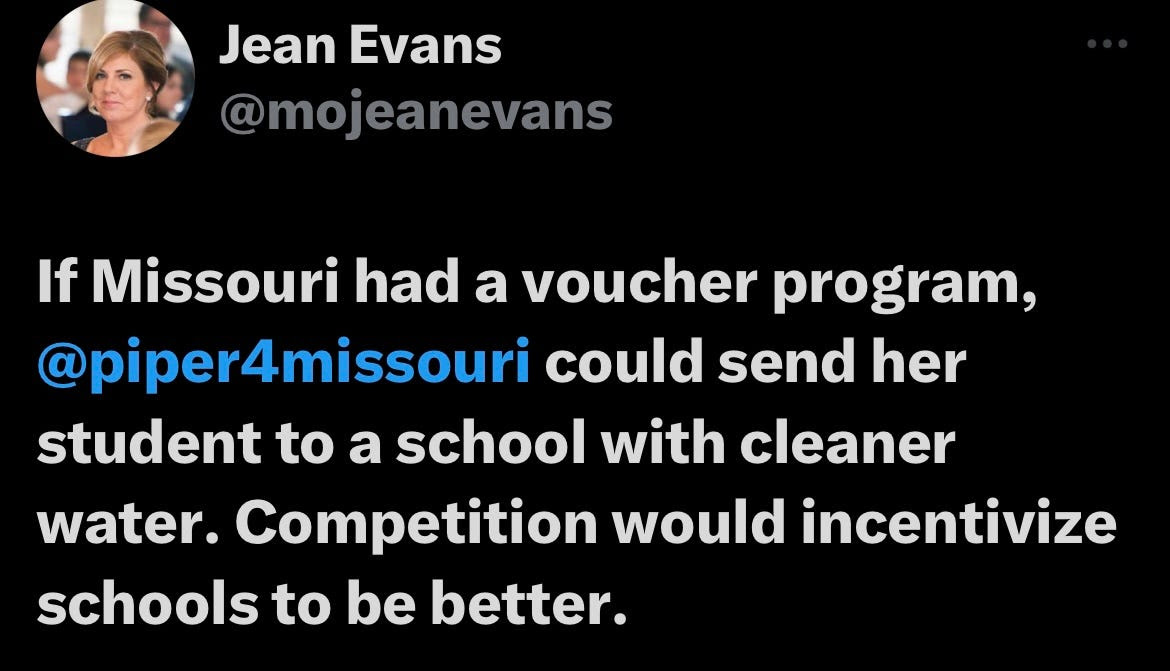
She was willing to tell me that the rural kids at my local public school would be deserving of clean drinking water if only Missouri would pass a voucher program. One may wonder if Jean herself snacked on too many lead paint chips as a child?

It all started with a letter from my local school reporting on the findings of lead in the water at the school. Most water sources were within EPA levels of lead in the water—not particularly great news, but I suspect most old schoolhouses reported much of the same. One faucet, in the nurse’s office, reported an elevated level more than four times the recommended limit. The school is addressing the water faucet and is attempting remediation. No children will drink this water.

I tweeted the findings and reminded my Twitter audience that over 80% of Missouri children test positive for lead in their blood. Jean responded by tweeting this:

Yes, if only we would expand Missouri’s current ESA scheme to defund schools and agree to a full-on voucher scheme, maybe the kids in my town wouldn’t be drinking poisoned water? If only rural folks would acquiesce to closing our schools and going along with the plan to keep our rural kids at home for online learning, and the occasional visit from a tutor, our kids wouldn’t be drinking lead.

Read the full post here.You can view the post at this link : https://networkforpubliceducation.org/blog-content/jess-piper-poisoned-water-in-missouri-public-schools-let-the-kids-eat-cake/

Peter Greene has been following the debate over voucher legislation in Wyoming, where they have failed until now. Surely some Republicans must be following what happened to vouchers in Texas, where a significant number of Republicans representing rural districts voted them down to protect their community public schools. They knew their schools needed funding, not competition. What states like Wyoming need is a public referendum on vouchers: let the public decide. Could it be that the politicians know that no state referendum on vouchers has ever passed?

Greene writes:

Attempts have been made to sell a school voucher bill in the Wyoming legislature, like the Wyoming Freedom Scholarship Act (because “scholarship” and “freedom” are more popular terms than “voucher”) earlier this year, but they have all failed. Now a new variation on the theme is aiming at a place on the 2024 schedule.

Oddly enough, the bill comes from Speaker of the House Albert Sommers, a Republican who actually helped block the Freedom Scholarship Act. But he thinks this alternate form will work better. Opponents disagree. Actually, some supporters disagreed, too– State Senator Bo Biteman said this new version was too watered down and was a “crap sandwich,” and so, as we’ll see, GOP reps managed to un-water the bill.

Some key features.

The bill runs on $40 million taken from the general fund. Of that $40 million, $12 million (30%) goes to fund preschool education. Because if there’s one technique that voucher proponents have learned, it’s to team up your unpopular voucher plan with something that people want.

The rest of the funding would go to ESA vouchers.
The bill uses the usual foot-in-the-door feature of an income cap for receiving the vouchers. This bill sets the cap at 250% of federal poverty limit, which adds up to $75,000 for a family of four. Median household income in Wyoming is $68,000. One legislator unsuccessfully tried to boost this up to 350% ($105K). At this point, nobody should be fooled by the “we’re just doing this to rescue the poor kids” line, as we have seen multiple states modify their program with ever-increasing caps or simply getting rid of the cap entirely.

With that expansion of eligibility, we keep seeing voucher program costs explode to budget-busting extremes.

Voucher amount would be up to $5,000. According to the website Private School Review, average private school tuition in Wyoming is $8,719 per year.

In one feature that is not common to voucher laws, the bill proposes that the Department of Education would certify vendors eligible to be paid with the taxpayer-funded vouchers. (That was not part of the Freedom Scholarship Act.) But a legislator successfully added an amendment, typical of current voucher law, that the state can’t interfere with the private school’s curriculum or admission policies, meaning that the school could teach religion, flat earth science, creationism, and racial supremacy if it so desired, as well as discriminating against whatever applicants it so desired.

In practice, what that means is that religious schools can accept vouchers while offering religious indoctrination and religion-based discrimination (e.g. the Illinois voucher school that requires families to be born-again Christians)
And another legislator successfully stripped the portion of the bill that voucher-using students had to take the same state tests as public school students. Rep. Karlee Provenza pretty well captured what all these changes mean.

“When we remove that testing standard, we are moving away from saying is government money being well spent?” Provenza said. “We’re not regulating choice, we’re regulating accountability of our state funds.”

True enough, but current voucher theory says that a voucher bill isn’t non-crappy unless it’s stripped of accountability and oversight. So if Wyoming is going to have school vouchers, they should be as unaccountable and unregulated as possible. Kiss those dollars goodbye, taxpayers, and don’t ask where they went or how effectively they were spent. Freedom!

The bill will still have to clear some hurdles, including a state constitution that prohibits the use of “any portion of any public school fund” for private schools (Article 7, Section 8).

Wyoming voucher advocates have struggled with this, and the argument seems to boil down to:

1) Once we hand the money over to the parents, it is transformed into private money and so there’s no problem!

2) Supreme Court thinks public money should absolutely finance the exercise of religion, so if this makes it all the way to SCOTUS, they will be on our side.

So we’ll see. There are unique features to a voucher initiative in Wyoming. For one, funding vouchers by having “the money follow the child” would never fly, because Wyoming schools have wildly different per pupil costs. In 2019-2020, Laramie #1 spent $14,582 per student, but the very rural Sheridan district (90 students) spent $41,176 per student. That means Wyoming is better inclined to fund vouchers separately from public education. They could, in fact, be the first legislature to be honest and say, “We believe in choice so much that we are going to raise your taxes to fund it.”

For another, there’s that state constitution, exactly the same sort of challenge that sank a voucher proposal in Kentucky.

Other state constitutions, such as Florida and Ohio, ban public funding for religious schools, but that has not been an obstacle to GOP politicians.

This story appeared in Commonweal, a progressive Catholic magazine of distinction. The author, Luke Mayville, has organized thus-far successful resistance to vouchers.

He writes:

Ever since Milton Friedman’s 1955 essay “The Role of Government in Education,” economic libertarians have dreamed of privatizing America’s system of public schools. In place of a school system that is publicly funded, democratically governed, and accessible to all, policy entrepreneurs have sought to transform American education into a commodity—something to be bought and sold in a free market.

In the push to privatize education, the tip of the spear has always been school vouchers—policies that extract funds from public schools in order to subsidize private-school tuition. Milwaukee established the nation’s first voucher program in 1990. In the following twenty-five years, voucher experiments were rolled out in fits and starts, often meeting with stiff public resistance. Voucher advocates gained significant footholds in Ohio, Washington D.C., Indiana, and elsewhere, but lacked the power to fundamentally transform the nation’s public-school system.

The cause has gained unprecedented momentum during the past five years. In their book A Wolf at the School House Door (2020), Jennifer Berkshire and Jack Schneider sounded the alarm about “an increasingly potent network of conservative state and federal elected officials, advocacy groups, and think tanks…backed by deep-pocketed funders,” all of them committed to dismantling public education as an institution. The new assault on public education intensified in the pandemic era, as voucher advocates seized the opportunity of mass school closures to propose—and in many cases enact—sweeping privatization schemes. In states across the country, the voucher agenda went hand in hand with efforts to sow distrust in public education by claiming, usually without evidence, that schools had become centers for critical race theory, “gender ideology,” and other forms of “social-justice indoctrination.” Meanwhile, voucher proponents were energized by landmark decisions of the United States Supreme Court, most notably Espinoza v. Montana in 2020 and Carson v. Makin in 2022, both of which appeared to remove constitutional obstacles to the use of public dollars for private religious education.

The nationally coordinated push to privatize public education is one of the most corrosive developments in American life. While Catholics and members of other faith communities have rightly cherished private parochial education, they, too, have strong reasons to support America’s public schools even if their own children do not attend them. It is an essential feature of the mission of public education to affirm the dignity of every child and to prepare each child to be a full participant in civic and economic life. As Berkshire and Schneider put it, public education “is our collective effort to realize for all young people their full human potential, regardless of circumstance.”

Fortunately, the coordinated attack on public education has met strong resistance from educators, students, parents, and citizens in several states across the country. During the 2023 legislative session here in Idaho, legislators presented a long series of voucher bills. One proposal sought to enact universal “education savings accounts” (ESAs) that would be available to every Idaho family—including the affluent. Other bills proposed tax-credit schemes or more targeted approaches. Every single proposal failed. Remarkably, Idaho remains voucher-free even as the voucher movement has enacted sweeping legislation in Arizona, Florida, West Virginia, Iowa, Arkansas, and elsewhere.

Grassroots organizing has been indispensable in Idaho’s fight against vouchers. A strong coalition of educators, parents, and advocacy organizations—including Reclaim Idaho, an organization I cofounded—has proved to be an effective counterweight to the voucher movement’s deep-pocketed lobbying efforts.

A recent poll by the Idaho Statesman found that public opinion in Idaho is dead set against vouchers, with 63 percent opposed and just 23 percent in support. The mission of organizers has been to translate widespread public opposition into effective political action. To that end, we’ve organized in communities across this vast state and helped citizens become defenders of public schools and sharp critics of voucher schemes. We’ve helped local advocates understand and articulate the arguments against vouchers that resonate most with the public: that vouchers are fiscally reckless, costing far more than advertised; that voucher programs tend to diminish student achievement and discriminate against students with disabilities; and that voucher programs are especially harmful for rural communities where no private-school options exist.

In local efforts to resist vouchers, grassroots organizing can harness the power of personal stories. The voucher movement has attempted to tell their own personalized story by evoking images of poor, marginalized children who’ve been “trapped” in failing public schools. The promise of “school choice” is to give struggling parents the choice to move their children into private schools that better fit their needs. However, as more states adopt voucher programs, the vast majority of voucher funds are flowing not to students who’ve left public schools but to private-school students who were never in public schools to begin with. A total of 89 percent of voucher funds in New Hampshire, 80 percent in Arizona, and 75 percent in Wisconsin have gone to students already enrolled in private schools, and these students disproportionately belong to affluent families living in suburban and urban areas.

The “school choice” story is mostly a fiction, and grassroots organizing can refocus the conversation on personal stories that paint the full picture. When people get organized on the voucher issue, the question can suddenly shift from “Do families deserve more choice?” to “Why would we pull scarce funds from our public schools—especially in rural areas—in order to subsidize tuition for affluent suburban families?” During testimony before the Idaho Senate Education Committee on a bill to create universal ESAs, a public-school supporter named Sheri Hughes phoned in to testify remotely from Challis—a mountain town of 922 people located 190 miles from the state capital. “I know the power and strength of consolidated public money for education, especially in rural Idaho,” Hughes said. She told the committee that her grandfather had served on the Challis school board and helped build the town’s first high school, that her mother—also a school-board member—helped get the high school rebuilt after the 1983 Challis earthquake. “Based on Arizona’s ESA Voucher experience,” Hughes went on, “the money proposed to be removed off the top of Idaho’s education funding budget would take an estimated 17–20 percent of funding away from Challis schools—in an area with no private alternative choices, and where home-school students still access public-school resources for proctoring, band, sports, special ed, and other extracurricular activities.”

Grassroots organizing can also help advocates expose the creative attempts by voucher proponents to present their policy agenda as something less threatening. With the American public skeptical of school vouchers and school privatization more generally, the privatization movement has aggressively sought to rebrand vouchers by means of convoluted policy schemes. Proponents of ESAs claim that they are not proposing vouchers but merely offering families money that can be used for a wide range of education services—including, but not limited to, private-school tuition. Similarly, proponents of “tax-credit scholarships” claim their proposals are distinct from vouchers because they do not directly spend public dollars on private schools but instead award tax credits to individuals who choose to fund private-school scholarships.

Grassroots organizing can expose these policies for what they are: vouchers by another name. In Idaho, we’ve invested time and energy in community meetings across the state where the goal is to share information with local public-education supporters about the mechanics of ESAs, tax-credit scholarships, and other policy schemes. Such meetings have prepared local citizens to speak out forcefully against thinly veiled attempts to siphon funds out of their public schools. Local advocates have written to their legislators, published op-eds and letters to the editor, spoken with friends and neighbors, and—most importantly—many have shown up to testify before the legislature. With so many grassroots advocates raising their voices and telling the truth about these policies, it’s been very difficult for privatizers to maintain the public narrative that they are promoting something other than a repackaged voucher scheme.

Please open the link and finish reading the rest of this excellent article.

Drew Darby is an elected state legislator who represents 10 rural counties in Texas. On most legislation, he’s a garden-variety Republican. On education, he breaks from the Republican majority. He is a friend of public schools and an opponent of vouchers. He was one of the most outspoken of the 21 rural Republicans who bucked Governor Greg Abbott and Lt. Governor Dan Patrick.

Darby explains in this article why he voted to reject vouchers.

“Editor’s Introduction: On Friday, Nov. 17, 2023, the Texas House voted to remove private school funding vouchers from the public education funding bill known as House Bill 1 against the wishes of the majority in the Texas Senate and Gov. Greg Abbott. The House voted 84-63 in favor of the amendment introduced by John Raney of College Station that removed the vouchers provision. Digging further, this means there were 21 Republicans and 63 Democrats in the House of 150 representatives (though one seat is currently vacant) who voted against vouchers.

State Rep. Drew Darby, who represents San Angelo and Big Spring in HD 72, was among those Republican representatives who voted against the implementation of school vouchers.

“This is a very important issue because it has many implications for funding for public school districts from now and into the future years as well as how our government in Texas will live up to the Texas Constitution, Article 7, Section 1, that reads:

  • A general diffusion of knowledge being essential to the preservation of the liberties and rights of the people, it shall be the duty of the Legislature of the State to establish and make suitable provision for the support and maintenance of an efficient system of public free schools.

Here are Darby’s own words as to why he voted against vouchers:

Since you elected me as your state representative, I have sworn a duty to the Constitution and House District 72 to protect public education, the separation of public and private institutions, and the millions of rural West Texas students, parents, and educators who want our communities to succeed. Today, I continue to uphold those same principles by voting to separate the discussion on Education Savings Accounts or vouchers from that of funding our public education system.

The structure proposed in House Bill 1 would have allowed a private institution to discriminate against students with special needs; reject eligible students based on their economic status, race, or religion; and balloon to a $2 billion expense to taxpayers in just two years. In states that have passed a voucher, almost 75% go to those already in private schools, leaving our rural communities to foot the bill.

In the coming weeks and months, various special interest groups and donors, some of whom you may believe you can trust, will flood your mailboxes and airwaves, attempting to argue that I do not support parental rights or school choice. The reality could not be further from the truth. I proudly support our private, public, charter, and homeschool options across West Texas and the Concho Valley. We are truly blessed to have tremendous educational opportunities, which parents already exercise their ability to choose from. Thousands of parents have already decided to send their kids to various schools in our communities, the schools that best suit their needs. I oppose, and have always fought, the taking of taxpayer dollars to be funneled toward institutions with no accountability, no requirement to accept all students, and no requirement to provide for our special education students.

Let me be clear: our teachers need raises, and our schools need more funding. I voted for both of those during the regular session. Now, they are being held hostage in an attempt to force through an unproven voucher program.

Throughout my tenure, my opposition to these programs has been a consistent effort to support a free public education system and uphold the values enshrined in the Texas Constitution. I have become a thorn in the side of the wealthy special interest groups, and I expect a solid attempt from them to install a puppet wholly beholden to the rich and out-of-touch with the needs of our rural communities.

I believe West Texas and the Concho Valley are worth more than 30 pieces of silver.

I am proud to advocate for our rural communities consistently and to have never switched my position or sold out our communities to gain votes, money, or win elected office. I shall happily take the fight to any Judas lurking in our communities and defend my record for as long as it takes against out-of-state interests seeking to buy my vote and distort my record.

I stand with students, parents, and teachers, and I stand against any attempts to rob our communities of our local schools and values.

Mothers Against Greg Abbott is celebrating because Governor Gregg Abbott’s voucher proposal—his highest priority—was defeated for the fifth time this year. Once, in the regular legislative session, then again and again and again and again in four special sessions.

Abbott offered bribes: more funding for public schools, a pay raise for teachers—but the bribes didn’t persuade the rural Republicans who saw vouchers as a threat to their small community public schools.

Abbott threatened to primary Republicans who didn’t vote for vouchers. That didn’t work either. Now the Moms (MAGA!) have to go back to work to get their public schools funded.

This is their message, issued within hours after vouchers went down for the fifth time:

From Mothers Against Greg Abbott:

The Texas House has just voted down school vouchers.

This is a huge victory for Texas public schools… and for mothers, and others, like us. Today’s victory  wouldn’t have been possible without the help you provided over the last several months. We asked you to help us support public schools, and you stepped up time and again.

Our hard work paid off. 

I don’t want to spike the football to celebrate our success. Not least because our public schools might not have a football to spike if the voucher plan had succeeded. (Yes, I know that spiking the football in a high school game is a 15-yard penalty, but let’s go with the metaphor...)

The same people who tried to strip our public schools of funding, and to give that money to rich private schools instead, aren’t going away. They will be back. 

And so will we: We defended our public schools today, and we will defend them again.

At Mothers Against Greg Abbott, we believe in high quality, free public education for our children. We support our public school teachers and our public school children. And we won’t let a handful of anti-school activists steal our children’s futures from us.

We’re here in support of public education, and we aren’t going anywhere. The next time public education is on the legislative table, we’ll be there to defend it. 

We won’t spike the football then either. We’ll celebrate because our public schools will still be there — to educate our children, to help them become our future leaders, to create the civic engagement that we all need.

And, yes, to give our kids a football, a softball, a volleyball, a tennis ball, a baseball, a basketball, arts programs, orchestra, school plays, reading specialists, school counselors, beloved school librarians, and so much more. 

With love for our public schools and our public school educators,

Nancy Thompson, Founder
Mothers Against Greg Abbott

This week, our Mothers For Democracy Institute shares the mic with YOU this week on the newest episode of The Voucher Scam! 

Hosts Claire O’Neal and Nichole Abshire ask listeners this week to share their love of public schools and their worries about vouchers. With today’s VICTORY on school vouchers in the Texas House, there is no better time to start streaming. Tune in to the conversation, here ›››

And, if you like what you hear, shoot over a donation and help support our podcast series.

Mothers for Democracy Institute is a 501(c)(3) and
donations are Tax Deductible. We just launched our podcast series The Voucher Scam, but we more planned for 2024 to further support democracy and civics education. And we
would love your support.
https://bit.ly/voucherscam

Mothers For Democracy / Mothers Against Greg Abbott is the largest coalition dedicated to defeating the extremist MAGA movement in Texas. While we don’t agree on every topic, we all agree the Texas GOP isn’t Texas values.

Since 2021, we’ve been helping lead the Democratic resistance in Texas, we’ve organized thousands of local voters and our public issue campaigns have reached millions of Texans in key battleground areas. Now, we’re backed by thousands of Texas parents who are mobilizing in their own neighborhoods to ensure the Texas we hand over to the next generation is better than the one we’ve inherited. 

We’re sick and tired of being linked to a handful of extremist MAGA spokesmen—divisive politicians like Ken Paxton and Ted Cruz. We know it’s going to take all of us to defeat them this election cycle. The power of mothers and others like us means we know we can do it: It’s time for democracy to prevail. 

100% of our work is powered by individual donations and our average donation is just $23. We can’t stop until our children have the future they deserve. So this election cycle, we’re taking down Ted Cruz and dozens more of his Texas MAGA cronies. With you by our side, we’ll deliver the kind of leadership everyone living in Texas can be proud of. 

Support Our Work

The Texas House of Representatives met in special session for the fourth time, called together by Governor Greg Abbott specifically to pass voucher legislation. The House voted to strip vouchers out of HB1.

Rural Republicans sunk the voucher program, joined by every Democrat.

The vote to kill vouchers passed by 84-63.

Those opposed to vouchers included 21 Republicans, which was 25% of all Republicans in the House.

The vote for vouchers was 63 Republicans and 0 Democrats.

Will Governor Abbott understand? Vouchers will not pass. Rural Republicans support their public schools.