Archives for category: Resistance

Richard Rothstein recently wrote a book about how to resist the illegal, unjust, and tyrannical actions of the Trump regime. Protests and marches are good but not enough, he argues. It’s time to find more powerful ways to express opposition to tyranny, to dictatorship, to a police state.

Please share this article with friends and social media. And please suggest your own ideas for direct action.

He writes:

My 2017 book, The Color of Law, showed that “de facto,” accidental, neighborhood segregation is a myth; in truth, government purposely enforced it, creating racial inequality in wealth, education, employment, health, and criminal justice. Readers asked, “What can we do about it now?”

So in 2023, Leah Rothstein and I published a sequel, Just Action, that showed how community groups could remedy this unconstitutional system. Intended for normal times, its suggestions for direct action have become urgent when Trump’s unlawful policies in housing and other sectors call for resistance. Just Action and follow-up articles describe how to create diverse committees that can embrace all who seek to preserve democracy.

Trump has taken full control of federal power—executive, legislative, and judicial—to:

  • destroy our already inadequate safety net;
  • gut health and environmental protections;
  • promote racial and ethnic inequality;
  • threaten the security of immigrants and their citizen children;
  • suppress free speech and independent journalism; and
  • prohibit schools from teaching historical truth.

He’s now moved to rig elections in 2026 and 2028, so will no longer depend on popular support. Marches, rallies, and media outrage remain necessary but insufficient. We are now called upon to do more than protest, but to act. What John Lewis called “good trouble, necessary trouble” becomes essential. As Trump “floods the zone” with so many illegal policies that we can’t keep up, so should resistance emerge in many sectors and communities to throw his authoritarianism off balance.

Most resistance will be law-abiding, some with civil disobedience. A decent society won’t be restored from Washington. A movement with a strong popular base can only begin with committees that pursue opportunities in their own neighborhoods, towns, and cities.

Here are two from Just Action, with details and many more examples in the book:

  • Regional housing centers have insufficient resources to uncover much discrimination and Trump has made it worse by defunding them. Volunteers can do the uncovering, then bypass the Justice Department by taking cases directly to court. They can campaign to force apartment owners and realtors who discriminate to commit to reform and organize boycotts of those who refuse.
  • The administration no longer deems policies unlawful if they unintentionally but needlessly harm historically disadvantaged groups. For example, property assessments usually create higher tax rates for homeowners and landlords who live in lower-income areas. Community groups can campaign to make county assessment practices fair.

Committees with actions like these will develop experience that builds toward resistance in other sectors and a national movement.

After Just Action’s publication, Washington State challenged the federal refusal to remedy housing discrimination. Volunteers documented 80,000 home deeds that banned residents who weren’t considered “white,” causing large wealth gaps between descendants of white people and others. A statewide organizing campaign won a state subsidy for home purchases by members of the previously excluded groups; 300 households have now received assistance, averaging over $100,000 each. Leah Rothstein has described how the reform was won. Groups elsewhere can mobilize for similar victories.

  • The Justice Department has cancelled settlements that required police to end abusive practices. Local groups can organize “blue ribbon” commissions to adopt the agreements and then campaign to grant them legal power to monitor and enforce compliance.
  • The administration has threatened public schools that teach “divisive” history, such as slaves’ suffering, Native Americans’ extermination, Japanese Americans’ World War II internment, or racial inequality’s origins. Local committees can organize support for teachers told to avoid these topics and for school board candidates who have pledged to protect truth in curriculum.
  • The Greyhound bus company will not permit warrantless or suspicionless immigration arrests on buses or in its stations. The Los Angeles Dodgers prohibits ICE from entering its parking lots without a warrant. Retail stores, markets, and restaurants should post signs announcing a similar prohibition. Customers can organize to ensure that it is advertised and enforced.

Campaigning for democratic practices starts by inviting friends and associates to plan. But we mostly interact only with people like ourselves. That’s no formula for successful resistance. Just Action begins by describing those who reached beyond their bubbles. We report on a Chicago artist who photographed pairs of nearly identical homes, one in a North Side white area, the other in a South Side Black one. She then invited residents to meet their “map twins.” Many agreed and were astonished by how much they had in common. We also recount six churches in Winston-Salem—three white and three Black—whose ministers created an interracial discussion and social group of 40 parishioners, divided equally by race. It eventually took direct action, successfully campaigning for a police review board and school curriculum reform.

Leah Rothstein reported recently on a project that organizes monthly dinner meetings of 25 residents from Marin City, California—with a mostly Black population—and 25 from its predominantly white suburbs. Reforms resulted in education, policing, health care, the arts, and housing. They model what diverse resistance cells can achieve.

Indivisible, the organization that led “Hands Off” and “No Kings” rallies this year, has concluded that while vocal opposition to Trump remains necessary, successful resistance must evolve to direct action. Indivisible is now conducting online training to teach and inspire local committees to undertake acts of resistance. You can watch previous sessions and register for subsequent ones here. These should offer more examples of direct actions you could take.

Please click here to share other acts of resistance, so Leah and I can promote them.

Good news!

Jan Resseger reports some surprisingly good news: the Senate Appropriations Committee passed an education budget that restored Trump’s cuts to education and disregarded his plan to eliminate the U.S. Department of Education.

Jan sees their action as evidence that public protest works and that the public does not want to abandon federal funding of schools. Jan also cautions that education may yet be imperiled by Russell Vought, director of the Office of Management and Budget, and Secretary of Education Linda McMahon. Vought was overall writer and editor of “Project 2025” and McMahon is a dedicated ideologue.

Nonetheless, it’s heartening to know that some Republicans were willing to stand up to Trump and Reject one of his worst ideas.

She begins:

On July 31st, K-12 Dive’s Kara Arundel reported some very good news: “The Senate Appropriations Committee on Thursday approved a bipartisan spending bill for fiscal year 2026 (FY 26) that would prevent the executive branch from removing Title I and special education programs to agencies outside the U.S. Department of Education. The legislation also rejects several other funding reforms proposed by the Trump administration… In total, the Senate Appropriations Committee recommends funding the Education Department in FY 26 at $79 billion…. That’s $12.3 billion more than President Donald Trump’s proposal of $66.7 billion.  In the current fiscal year, the Education Department is funded at $78.7 billion.”

Open the link to read the details.

The American Bar Association has filed a lawsuit to stop the Trump administration’s policy of intimidating lawyers and law firms. The article was written by Mimi Rocah, former District Attorney, former prosecutor, and currently law professor. It was posted at Cafe, a blog for legal issues.

She wrote:

Last week, the American Bar Association (“ABA”) filed what can fairly be described as  a bombshell lawsuit in federal court in Washington, D.C. The suit asks the court to declare unconstitutional and stop the Trump administration’s “ongoing unlawful policy of intimidation against lawyers and law firms.” The ABA, a non-partisan non-profit organization founded in 1878, is the nation’s largest voluntary association of legal professionals. It is represented in this case by powerhouse law firm Sussman Godfrey (one of the firms targeted by an executive orderearlier this year). This isn’t just any lawsuit. The complaint names the Office of the President and—in light of the Trump administration’s proclivity to dodge the “who’s responsible” question—every high level government department, along with every cabinet official (the caption goes on for eight pages). The normally staid organization has found its voice on this issue over the past few months, issuing several statements and launching a rule of law initiative, and it does not mince words in this lawsuit, stating, “Today,…the American legal profession faces a challenge that is different from all that has come before. It is unprecedented and uniquely dangerous to the rule of law.”

The complaint explains the administration’s strategy to essentially weaken the legal profession that it sees as a threat to its agenda: “Since taking office earlier this year, President Trump has used the vast powers of the Executive Branch to coerce lawyers and law firms to abandon clients, causes, and policy positions the President does not like.” It has done so “through a series of materially identical executive orders designed to severely damage particular law firms and intimidate other firms and lawyers…; a series of similar ‘deals’ or ‘settlements’ between the Administration and certain law firms in order to avoid such Orders or have them rescinded; other related executive orders, letters, and memoranda. . . and public statements by the President and his Administration publicizing the objectives of the Law Firm Intimidation Policy.” The “attacks on law firms…are thus not isolated events, but one component of a broader, deliberate policy designed to intimidate and coerce law firms and lawyers to refrain from challenging the President or his Administration in court, or from even speaking publicly in support of policies or causes that the President does not like.” Finally, the ABA explains that despite four different district court judges finding the orders blatantly unconstitutional and illegal, the administration’s strategy is ongoing. It cites reporting as recent as June 1st indicating Trump and White House deputy chief of staff Stephen Miller’s interest in keeping threats of more “executive orders on the table because they think it dissuades the best lawyers from representing critics of the administration.” 

Why is the “Law Firm Intimidation Policy” (as dubbed in the lawsuit) so insidious? In a nutshell, it “is uniquely destructive because of the critical role that its targets—lawyers—fulfill in our constitutional system. Without skilled lawyers to bring and argue cases—and to do so by advancing the interests of their clients without fear of reprisal from the government—the judiciary cannot function as a meaningful check on executive overreach.” Even worse, the ABA documents the administration’s strategy having the desired impact. “Even as federal judges have ruled over and over that the Law Firm Orders are plainly unconstitutional, law firms that once proudly contributed thousands of hours of pro bono work to a host of causes—including causes championed by the ABA—have withdrawn from such work because it is disfavored by the Administration, particularly work that would require law firms to litigate against the federal government.” Many law firms are laying low, and “organizations (including the ABA) that have historically relied heavily on top law firms to bring pro bono cases—particularly against the federal government to challenge unlawful executive action—face serious and sometimes existential crises, as those same law firms are declining to represent these organizations.” The complaint cites examples of such instances from particular law firms and, chillingly, does so anonymously in ways reminiscent of a prosecutor’s charging documents against mob families out of real fear of retaliation. As the complaint states, “This threat has a deliberately powerful chilling effect. Already, many firms are declining to take on cases that challenge the administration’s policies. That’s not a side effect of the crackdown. It was the purpose all along.”

The federal judiciary, especially at the district court level, has been the sand in the gears to this administration’s unlawful orders and unconstitutional agenda, which has cast aside due process and the First Amendment in ways never seen before. In May alone, the White House lost 96 percent of its cases before federal district courts, with appointees of both Democrat and Republican presidents curbing the excesses of the Trump regime. As one expert explained, that the “rulings are coming from a stunningly broad array of jurists and many aren’t even being challenged on appeal” is an indication of both the continued need for these legal challenges and also the flimsy legal ground on which the administration stands. But courts cannot adjudicate cases that aren’t brought—and that requires lawyers willing to challenge a retributive and vengeful administration. Our legal system, and the rights of so many individuals and perhaps even our democracy, depend on it. If lawyers are afraid of what will happen to them if they stand up and oppose the government, then the whole system collapses. As the ABA emphasizes in its lawsuit, the judiciary needs to be strong and independent referees, but it needs lawyers willing to play the field.

We will see how this important lawsuit plays out. The case is assigned to Judge Amir Hatem Mahdy Ali who has already drawn the ire of Trump loyalists for daring to rule against the executive order cutting funding for foreign assistance programs administered by the U.S. Agency for International Development. Inevitably, this will likely end up before the Supreme Court. Chief Justice Roberts has talked a good game about judicial independence. Hopefully he and the other justices recognize that such an ideal cannot exist without lawyers able to act free from coercive intimidation by the full force of the presidency. 

Stay Informed, 

Mimi
 

CAFE Contributor Mimi Rocah is the former District Attorney for Westchester County, and previously served as an Assistant U.S. Attorney and Division Chief for the Southern District of New York. She is currently an adjunct professor at Fordham School of Law.

Joe Heim of The Washington Post wrote this story about the arrival of a new and temporary sculpture on the National Mall. It has approval to remain until June 22.

An anti-Trump statue has popped up on the National Mall in Washington. (Maxine Wallace/The Washington Post)


Remember the poop statue? The curly-swirly pile of doo that sat atop a replica of former House speaker Nancy Pelosi’s (D-California) desk? The work of protest art placed on the National Mall last October in mock tribute to the Jan. 6 rioters who stormed the U.S. Capitol in an attempt to overturn the 2020 election?

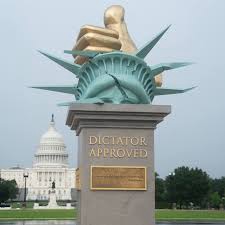
Well, the artists responsible for the political poo plop appear to have struck again. This time with a work called “Dictator Approved,” an 8-foot-tall sculpture showing a gold-painted hand with a distinctive thumbs-up quashing the sea foam green crown of the Statue of Liberty. It sits at the same location on the Mall near Third Street NW as the poop statue did last fall.

The artwork’s creators intended “Dictator Approved” as a rejoinder to the June 14 military parade and authoritarianism, according to a permit issued by the National Park Service. The parade, the creators wrote in the application, “Will feature imagery similar to autocratic, oppressive regime, i.e. N. Korea, Russia, and China, marching through DC.” The purpose of the statue, they continued, is to call attention to “the praising these types of oppressive leaders have given Donald Trump.”

Plaques on the four sides of the artwork’s base include quotes from world leaders including Russian President Vladimir Putin (“President Trump is a very bright and talented man.”), Hungarian Prime Minister Viktor Orban (“The most respected, the most feared person is Donald Trump.”), former Brazilian president Jair Bolsonaro (“We do have a great deal of shared values. I admire President Trump.”) and North Korea’s Kim Jong Un (“Your Excellency.” A “special” relationship. “The extraordinary courage of President Trump.”).

“If these Democrat activists were living in a dictatorship, their eye-sore of a sculpture wouldn’t be sitting on the National Mall right now,” Abigail Jackson, a White House spokeswoman, wrote in an emailed statement. “In the United States of America you have the freedom to display your so-called ‘art,’ no matter how ugly it is.”

Mary Harris is listed as the applicant for the permit but no contact information for her was provided. The permit allows the statue to be in place from 7 a.m. June 16 until 5 p.m. June 22.
The “Dictator Approved” statue is very similar in style and materials to the poop statue and several protest artworks placed in the District, Philadelphia and Portland, Oregon, last fall.

However, no individual or group has publicly claimed responsibility for those pieces. An unidentified caller and emailer told a Washington Post reporter last year that he was part of the group that worked on the sculptures and provided information about them that only someone who had installed the projects would know, such as when the statues would appear.

His identity remains a mystery. On Wednesday he replied to a Washington Post email asking if he was involved with the new statue. “I have heard about it but not me,” he wrote. He did not respond to additional questions or a request to meet in an Arlington parking garage.

Some of the tourists and locals who stopped by the statue between downpours Wednesday afternoon expressed surprise that it was allowed to be placed where it was. And they expressed reservations about weighing in on it publicly.

“I’m amazed that whoever dreamed this up could put this here,” said Kuresa, an 80-year-old from Australia who declined to give his last name because he said as an international visitor he didn’t feel comfortable expressing his views. “It reminds me of ‘Animal Farm.’”

Plaques on the sculpture’s base include quotes from Russian President Vladimir Putin, Hungarian Prime Minister Viktor Orban, former Brazilian president Jair Bolsonaro and North Korea’s Kim Jong Un. (Maxine Wallace/The Washington Post)


District resident and retired federal employee Yvette Hatfield stopped by with her dog Max, wearing an adorable raincoat and rain hat, to get a selfie of both of them in front of the statue. Asked why she wanted a photo, Hatfield laughed. “Because of my political views and that’s all I’m going to say.”


“I actually love it,” said another District resident. He declined to give his name because he said his parents and grandparents often told him “Fools’ names, like their faces, are always seen in public places.” He wished the reporter good luck with the story.


Francesca Carlo, 20, and Abigail Martin, 21, visiting from Cleveland, happened on the statue just before it started to pour.


“At first I was confused,” Martin said, “but then I figured it out. I think it’s beautiful.”


Carlo agreed. She thought the quotes on the plaques could send a message.


“If all these authoritarian politicians approve of our president then maybe people will see a pattern recognition and see where democracy is headed,” she said.

It was inevitable. And now it’s happening. During his first term, Trump repeatedly encouraged violence. He told police officers in New York not to be so nice when they arrest people. He asked “his” generals if they could shoot protestors in the legs. He broadcast fake videos showing him beating up a cartoon character labeled CNN. He urged his crowds at rallies to beat up protestors and said he would pay their legal fees. He wants to seem like a real man, a tough guy. But don’t forget that this tough guy dodged the draft five times with a podiatrist’s note about bone spurs in his feet.

This week, his troubles were mounting. There was the very public split with Musk, who dropped hints about Trump’s name in the still confidential Epstein files. There was Elon’s claim that Trump would have lost the election and control of the House without Elon’s help. What kind of “help”? There was the tariff mess, which was causing a global economic disruption and predictions of inflation. And Trump’s poll numbers were plummeting.

What a perfect time to send in large numbers of ICE agents to immigrant neighborhoods in Los Angeles! Send them to Home Depot, where immigrants cluster in search of work–not the “criminals, rapists, and murderers” he warned us about, but laborers looking for work.

Voila! Their friends, families, and neighbors turned out to protest the ICE raids, and all at once there are crowds and people waving Mexican flags (a big mistake, they should have waved American flags). The situation was volatile but there was no reason to think that local and state police couldn’t handle it.

Trump is shrewd: he saw his chance to distract public attention from his failing policies, and he took it. Without bothering to contact Governor Newsom, Trump mobilized the National Guard. He ordered 2,000 into the troubled neighborhood. Then he sent in another 2,000, plus 700 Marines.

Only the Governor can call up his state’s National Guard, except in the most exceptional situations (the last time it happened was 1965, when President Johnson mobilized the National Guard in Alabama to protect civil rights demonstrators because Governor George Wallace refused to do so).

It is even more unusual for a President to call in the military to oppose ordinary people, which is normally handled by state and local police. There is an act-the Posse Comitatus Act–that specifically forbids the Army and Air Force from acting against civilians on American soil. A different law, 10 U.S. Code 275, forbids Navy and Marine Corps members from the same thing. Trump claims that the anti-ICE protests are an insurrection, which allows him to call in the Marines. Legal scholars disagree, but most think he overreached and that there was no insurrection in Los Angeles.

Indeed, the large show of force drew an even larger crowd to the protests and made it more dangerous. Nonetheless, there seem to be more military at the scene than protestors.

Miraculously, no one has been killed (unlike the genuinely violent insurrection on January 6, 2021, where Trump rioters viciously beat police officers and several people died). He sat back and watched the insurrection on television and is now considering whether to reimburse them for their legal expenses after being imprisoned for engaging in insurrection.

Trump said on national television that “many people” had been killed during the protests (not true) and that if he had not sent in the troops, the city would have been “obliterated.” This is nonsense. The clash between the protesters and the military is contained to a few blocks of a very large city.

Today, there were spontaneous peaceful rallies in many cities to show support for the demonstrators in Los Angeles.

The best response: show up for a “No Kings” rally on Saturday. Check the website http://www.nokings.org to find one or create one where you live. Be peaceable. Sing. Dance. Bring American flags. The Constitution protects the right to assemble peacefully.

Trump is not only diverting attention from his monstrous One Ugly Bill, he is laying the groundwork for martial law and dictatorship.

Heather Cox Richardson writes today that Trump eagerly overstepped his authority so as to create a crisis in Los Angeles. Local and state authorities responded appropriately to protests against the aggressive actions of ICE. But Trump insisted that there was an insurrection underway, a statement tweeted by his aide Stephen Miller. He took charge of the state National Guard, which was last done in 1958 when President Eisenhower called in the Arkansas National Guard to restore order in Little Rock during white protests against civil rights enforcement.

HRC suggests two reasons for Trump’s eagerness to call in troops in L.A. First, he wants a pretext to send troops anywhere anytime, in effect, to create a police state. Second, he wants to distract attention from his embarrassing breakup with Elon Musk, the chaos caused by his tariffs, and the controversies surrounding his “One Ugly Bill” and its threat to Medicaid.

A third reason is that he seized on the opportunity to humiliate Democratic Governor Newsom.

A fourth reason is that he loves to play the part of a tough guy.

Question: why did he not send in the National Guard to protect the Capitol on January 6, 2021?

She wrote:

Flatbed train cars carrying thousands of tanks rolled into Washington, D.C., yesterday in preparation for the military parade planned for June 14. On the other side of the country, protesters near Los Angeles filmed officers from Immigration and Customs Enforcement (ICE) throwing flash-bang grenades into a crowd of protesters. The two images make a disturbing portrait of the United States of America under the Donald J. Trump regime as Trump tries to use the issue of immigration to establish a police state.

In January 2024, Trump pressured Republican lawmakers to kill a bipartisan immigration measure that would have beefed up border security and funding immigration courts because he wanted to campaign on the issue of immigration. During that campaign, Trump made much of the high immigration numbers in the United States after the worst of the coronavirus pandemic, when the booming U.S. economy attracted migrants. He went so far as to claim that migrants were eating people’s pets.

Many Trump supporters apparently believed officials in a Trump administration would only deport violent criminals, although Trump’s team had made it clear in his first term that they considered anyone who had broken immigration laws a criminal. Crackdowns began as soon as Trump took office, sweeping in individuals who had no criminal records in the U.S. and who were in the U.S. legally. The administration worked to define those individuals as criminals and insisted they had no right to the due process guaranteed by the U.S. Constitution.

Anna Giaritelli of the Washington Examiner reported that at a meeting in late May, White House deputy chief of staff Stephen Miller, who appears to be leading the administration’s immigration efforts, “eviscerated” federal immigration officials for numbers of deportations and renditions that, at around 600 people per day, he considered far too low. “Stephen Miller wants everybody arrested,” one of the officials at the meeting told Giaritelli. “‘‘Why aren’t you at Home Depot? Why aren’t you at 7-Eleven?’” Miller said.

After the meeting, Miller told Fox News Channel host Sean Hannity that the administration wanted “a minimum of 3,000 arrests for ICE every day, and President Trump is going to keep pushing to get that number up higher each and every single day.” Thomas Homan, Trump’s border czar, took the message to heart. “You’re going to see more work site enforcement than you’ve ever seen in the history of this nation,” he told reporters. “We’re going to flood the zone.”

According to a recent report by Goldman Sachs, undocumented immigrants made up more than 4% of the nation’s workforce in 2023 and are concentrated in landscaping, farm work, and construction work. Sweeps of workplaces where immigrants are concentrated are an easy way to meet quotas.

The Trump regime apparently decided to demonstrate its power in Los Angeles, where over the course of the past week, hundreds of undocumented immigrants who went to scheduled check-in appointments with ICE were taken into custody—sometimes with their families—and held in the basement of the Edward R. Roybal Federal Building in downtown L.A.

This was the backdrop when on Friday, June 7, federal officials launched a new phase of the regime’s crackdown on immigration, focusing on L.A. workplaces. Agents in tactical gear sweeping through the city’s garment district met protesters who chanted and threw eggs; agents pepper sprayed the protesters and shot at them with what are known as “less-lethal projectiles” or “non-lethal bullets” because they are made of rubber or plastic. Protesters also gathered around the federal detention center, demanding the release of their relatives; officers in riot gear dispersed the crowd with tear gas.

Officers arrested more than 40 people, including David Huerta, the president of the Service Employees International Union California (SEIU), for impeding a federal officer while protesting. Huerta’s arrest turned union members out to stand against ICE.

At 10:33 a.m. yesterday morning eastern time—so, before anything was going on in Los Angeles—Miller reposted a clip of protesters surrounding the federal detention center in Los Angeles and wrote that these protesters constituted “[a]n insurrection against the laws and sovereignty of the United States.” Miller has appeared eager to invoke the Insurrection Act to use the military against Americans.

On Saturday, in the predominantly Latino city of Paramount about 20 miles south of L.A., Rachel Uranga and Ruben Vives of the Los Angeles Times reported that people spotted a caravan of border patrol agents across the street from the Home Depot. Word spread on social media, and protesters arrived to show that ICE’s arrest of families was not welcome. As about a hundred protesters arrived, the Home Depot closed.

Over the course of the afternoon, protesters shouted at the federal agents, who formed a line and shot tear gas or rounds of flash-bang grenades if anyone threw anything at them or approached them. L.A. County sheriff’s deputies arrived to block off a perimeter, and the border agents departed shortly after, leaving the protesters and the sheriff’s deputies, who shot flash-bang grenades at the crowd. The struggle between the deputies and about 100 protesters continued until midnight.

Almost four million people live in Los Angeles, with more than 12 million in the greater L.A. area, making the protests relatively small. Nonetheless, on Saturday evening, Trump signed an order saying that “[t]o the extent that protests or acts of violence directly inhibit the execution of the laws, they constitute a form of rebellion against the authority of the Government of the United States.” Based on that weak finding, he called out at least 2,000 members of the California National Guard to protect ICE and other government personnel, activating a state’s National Guard without a request from its governor for the first time in 50 years.

At 8:25 p.m., his social media account posted: “If Governor Gavin Newscum, of California, and Mayor Karen Bass, of Los Angeles, can’t do their jobs, which everyone knows they can’t, then the Federal Government will step in and solve the problem, RIOTS & LOOTERS, the way it should be solved!!!”

California’s governor Gavin Newsom said Trump’s plan was “purposefully inflammatory.” “LA authorities are able to access law enforcement assistance at a moment’s notice,” Newsom said. “We are in close coordination with the city and county, and there is currently no unmet need. The Guard has been admirably serving LA throughout recovery. This is the wrong mission and will erode public trust.” Newsom said the administration is trying “not to meet an unmet need, but to manufacture a crisis.”

Trump apparently was not too terribly concerned about the “rebellion”; he was at the UFC fight in Newark, New Jersey, by 10:00 p.m.

At 10:06 p.m., Defense Secretary Pete Hegseth, who is under investigation over his involvement with a Signal chat that inappropriately included classified information, posted: “The violent mob assaults on ICE and Federal Law Enforcement are designed to prevent the removal of Criminal Illegal Aliens from our soil; a dangerous invasion facilitated by criminal cartels (aka Foreign Terrorist Organizations) and a huge NATIONAL SECURITY RISK.” He added that the Defense Department was mobilizing the National Guard and that “if violence continues, active duty Marines at Camp Pendleton will also be mobilized—they are on high alert.”

At 2:41 a.m., Trump’s social media account posted: “Great job by the National Guard in Los Angeles after two days of violence, clashes and unrest. We have an incompetent Governor (Newscum) and Mayor (Bass) who were, as usual…unable to to handle the task. These Radical Left protests, by instigators and often paid troublemakers, will NOT BE TOLERATED…. Again, thank you to the National Guard for a job well done!”

Just an hour later, at 3:22 a.m., Los Angeles mayor Karen Bass posted: “I want to thank LAPD and local law enforcement for their work tonight. I also want to thank [Governor Gavin Newsom] for his support. Just to be clear, the National Guard has not been deployed in the City of Los Angeles.”

National Guard troops arrived in L.A. today, but James Queally, Nathan Solis, Salvador Hernandez, and Hannah Fry of the Los Angeles Times reported that the city’s garment district and Paramount were calm and that incidents of rock throwing were isolated. Law enforcement officers met those incidents with tear gas and less-lethal rounds.

Today, when reporters asked if he planned to send troops to L.A., Trump answered: “We’re gonna have troops everywhere. We’re not going to let this happen to our country. We’re not going to let our country be torn apart like it was under Biden.” Trump appeared to be referring to the divisions during the Biden administration caused by Trump and his loyalists, who falsely claimed that Biden had stolen the 2020 presidential election. (In the defamation trial happening right now in Colorado over those allegations, MyPillow chief executive officer Mike Lindell, who was a fierce advocate of Trump’s lie, will not present evidence that the election was rigged, his lawyers say. They added: “it’s just words. All Mike Lindell did was talk. Mike believed that he was telling the truth.”)

At 5:06 p.m. this evening, Trump’s social media account posted: “A once great American City, Los Angeles, has been invaded and occupied by Illegal Aliens and Criminals. Now violent, insurrectionist mobs are swarming and attacking our Federal Agents to try and stop our deportation operations—But these lawless riots only strengthen our resolve. I am directing Secretary of Homeland Security Kristi Noem, Secretary of Defense Pete Hegseth, and Attorney General Pam Bondi, in coordination with all other relevant Departments and Agencies, to take all such action necessary to liberate Los Angeles from the Migrant Invasion, and put an end to these Migrant riots. Order will be restored, the Illegals will be expelled, and Los Angeles will be set free.” He followed this statement with that odd closing he has been using lately: “Thank you for your attention to this matter!”

Marketplace host Kai Ryssdal answered: “Hello. I live in Los Angeles. The president is lying.”

At 6:27, Governor Newsom posted that he has “formally requested the Trump Administration rescind their unlawful deployment of troops in Los Angeles county and return them to my command. We didn’t have a problem until Trump got involved. This is a serious breach of state sovereignty—inflaming tensions while pulling resources from where they’re actually needed. Rescind the order. Return control to California.” The Democratic governors issued a statement standing with Newsom and calling Trump’s order “ineffective and dangerous.”

At 10:03, Trump posted: Governor Gavin Newscum and “Mayor” Bass should apologize to the people of Los Angeles for the absolutely horrible job that they have done, and this now includes the ongoing L.A. riots. These are not protesters, they are troublemakers and insurrectionists. Remember, NO MASKS!” Four minutes later, he posted: “Paid Insurrectionists!”

There is real weakness behind the regime’s power grab. Trump’s very public blowup with billionaire Elon Musk last week has opened up criticism of the Department of Government Efficiency that Musk controlled. In his fury, Musk suggested to Trump’s loyal followers that the reason the Epstein files detailing sexual assault of children haven’t been released is that Trump is implicated in them. Trump’s promised trade deals have not materialized, and indicators show his policies are hurting the economy.

And the Republicans’ “One Big, Beautiful Bill” is raising significant opposition. Today Senator Rand Paul (R-KY) complained about the excessive spending in the bill for ICE, prompting Stephen Miller to complain on social media and to claim that “each deportation saves taxpayers hundreds of thousands of dollars.” But David J. Bier of the libertarian Cato Institute on Friday estimated that the deportation plans in the measure would add almost $1 trillion in costs.

There is no doubt that as their other initiatives have stalled and popular opinion is turning against the administration on every issue, the Trump regime is trying to establish a police state. But in making Los Angeles their flashpoint, they chose a poor place to demonstrate dominance. Unlike a smaller, Republican-dominated city whose people might side with the administration, Los Angeles is a huge, multicultural city that the federal government does not have the personnel to subdue.

Trump stumbled as he climbed the stairs to Air Force One tonight.

Oliver Darcy, media journalist, writes about NPR’s decision to fight the Trump administration’s efforts to shut it down.

Trump is directly infringing on freedom of the press, punishing NPR because it is not slavishly devoted to him and his views.

I listen to NPR for straightforward, unbiased news. I appreciate their long-form reports on a wide array of subjects. Many parts of the country are news deserts, where the only media available are the rightwing Sinclair radio stations and FOX News.

The nation needs NPR, just as the world needs Voice of America, which Trump is defunding.

As with so many of his decisions, I wonder who benefits? I have no answer.

Darcy writes:

When Trump signed an order to defund NPR, the network faced a choice over how it would respond—but CEO Katherine Maher made one thing clear from the start: there would be no backroom negotiations.

In the days following Donald Trump’s May 1 executive order to strip NPR of all federal funding, leaders at the public broadcaster began deliberating their options. But even before the network’s legal team got to work on the litigation, one decision had already been made. NPR chief executive Katherine Maher made clear that the outlet would not quietly negotiate with the White House—an approach other media companies have recently taken under immense political pressure. 

“As an independent media organization,” Maher told me by phone Tuesday, “we wouldn’t go ahead and have that conversation because that would be negotiating on editorial principle.” 

On Tuesday morning, NPR and three of its member stations in Colorado filed a federal lawsuitagainst Trump and his administration, alleging the executive order he signed was not only punitive, but also unconstitutional. In a 43-page complaint, the stations argued that Trump’s directive violated theFirst Amendment, usurped Congress’authority over federal spending, and more broadly, posed a threat to the editorial independence of public media nationwide. 

The language of the filing was unambiguous. It framed the executive order not as a routine dispute over funding priorities or media policy, but as a retaliatory strike designed to punish critical coverage and reshape the information environment in Trump’s favor. “The Order’s objectives could not be clearer,” the lawsuit stated. “The Order aims to punish NPR for the content of news and other programming the President dislikes and chill the free exercise of First Amendment rights by NPR and individual public radio stations across the country.” 

I asked Maher what it felt like to take a sitting president to court. She didn’t hesitate. “What did it feel like?” she rhetorically asked me. “It felt like recognizing that there are responsibilities that one takes on in running a media organization, and this was one of those.” She emphasized that the case wasn’t just about NPR’s national desk or morning programming—it was about the entire public media system: “We did this on behalf of our newsroom. We did this on behalf of our editorial independence. We did this on behalf of public media at large.”

Maher, who only took the helm of NPR in January 2024, told me that the legal option became increasingly clear as the organization studied the implications of the executive order. “We took a look at [the order] and wanted to be able to make sure that we really analyzed it,” she said. “We got to understand what avenues existed for us to be able to seek relief—and litigation was something that we came to once we realized that fundamentally this was a First Amendment issue.” The legal review moved quickly. “Obviously, it’s only been four weeks,” Maher added, “and so you can imagine it happened on a pretty quick timeline.”

The lawsuit was filed by not just NPR, but also Colorado Public RadioKSUT Public Radio, and Aspen Public Radio. Together, they asked the court to block enforcement of the order and affirm that federal support for public broadcasting, which Congress has repeatedly approved, cannot be overturned by presidential fiat. For its part, NPR receives just 1% of its annual operating budgetdirectly from the Corporation for Public Broadcasting, the private nonprofit that distributes federal funding. But local member stations across the country receive a much larger slice of their budgets from the $535 million in taxpayer funds CPB distributes. PBS, facing a similar predicament, said Tuesday it is also actively weighing a legal challenge of its own.

While Trump has long treated NPR as a proxy for elite coastal media (he’s referred to it as a “liberal disinformation machine,” among other insults), Maher declined to say in her own words why he despises the outlet with the white-hot passion of a thousand suns. “I really couldn’t say what the president thinks or doesn’t think,” she told me. “It’s beyond my powers to get inside his mind.” At the same time, she acknowledged the broader context in which public broadcasting has become a partisan target. “I think that we recognize that there has long been pushback about public media,” she said.

In any case, the legal issue, she insisted, is separate from any political debate. When asked whether she worries that suing the president could further cement in the minds of the MAGA faithful that NPR has a bias against him, she pushed back. 

“I fundamentally reject the idea that defending the Constitution is partisan,” Maher told me. “We are taking this action on behalf of the First Amendment. We’re taking this action on behalf of the free press. Regardless of your political beliefs, we all benefit from that.” She added that the lawsuit should be viewed as an act of civic duty, not political retaliation: “I would much rather people saw this as an act of patriotic commitment to our Constitution on behalf of citizens rather than saying that this is somehow partisan or political.”

Of course, that’s not how her actions have been portrayed by MAGA Media, which—similarly to Trump–views NPR as a liberal mouthpiece of the so-called “deep state.” Maher seemed to acknowledge that reality, but said she would continue to work to get the outlet’s message out. She even said she would be willing to appear on outlets like Fox News to do so. “I’m always happy to talk to people who are happy to talk to us,” Maher said. “I think that we’d be open to having that conversation.”

What happens if the court doesn’t rule in their favor? Maher didn’t give the possibility of such an outcome any oxygen. “I’m really confident that we will [win],” she said. “I feel that we’re on very, very solid ground, so I’m not concerned about the downside.”

While big corporate media are falling all over themselves trying to placate Trump, one guy says “Nope, won’t do it.” Bruce Springsteen.

The head of CBS News and the producer of “60 Minutes” quit rather than agree to settle with Trump, who sued “60 Minutes” for $10 billion for editing its interview with Kamala Harris. Trump called it election interference but he surely knows that interviews are always edited down. Besides, he won the election, so how was he “damaged”? Shari Redstone, who is the CEO of Paramount Global, which owns CBS, needs federal approval for a corporate merger that will net her billions. Will she stand up to Trump? Not likely.

Brian Stelter of CNN reported that The Boss is not afraid of Trump. Trump is going nuts. He thinks he should be able to intimidate everyone.

Stelter writes:

‘No retreat, baby, no surrender’

Andrew Kirell writes: Bruce Springsteen has no surrender. For the first two nights of his Europe 2025 tour, Bruce delivered scripted remarks railing against a “corrupt, incompetent and treasonous” Trump administration. And after both shows, he was the subject of Trump’s fury on social media. Following the first night, Trump called the Boss a “dried out prune” and demanded he “KEEP HIS MOUTH SHUT.” After the second show, the president threatened a “major investigation” into Springsteen (and Beyoncé and Oprah Winfreyand Bono). 

Last night in Manchester, England, Springsteen went for round three. He did not mention Trump’s tirade; instead, he repeated the speeches verbatim and sent a clear message by switching up the night’s opening song. This time it was “No Surrender.”

>> This morning, Springsteen dug in even further, surprise-releasing a six-song live EP recorded the first night of the tour, including most of his anti-Trump speeches.

>> Neil Young jumped into the fray on Tuesday to call out Trump’s threats against Springsteen and other musicians. “I am not scared of you. Neither are the rest of us,” Young wrote on his website. “STOP THINKING ABOUT WHAT ROCKERS ARE SAYING. Think about saving America from the mess you made.”

Pastors for Texas Children has been working hard to defeat vouchers, which would not only eliminate separation of church and state but destroy the state’s rural schools.

Pastors for Texas Children said the following:

FOR IMMEDIATE RELEASE

Contact: Jay Pritchard, 214.558.6656, jay@upwardpa.com

April 14, 2025

Faith Leaders Condemn Voucher Vote During Holy Week as an Affront to Religious Liberty

Austin, TX — Pastors for Texas Children (PTC) strongly condemns the Texas House’s decision to schedule a vote on HB3—the Governor’s private school voucher bill—for this Wednesday, squarely in the middle of Jewish Passover and ChrisHan Holy Week.

“This is an outrageous assault on religious liberty,” said Rev. Charles Johnson, ExecuHve Director of Pastors for Texas Children. “Governor AbboP is exploiting sacred days of worship and family observance to silence faith leaders who have led the opposiHon to his dangerous voucher scheme.”

For months, clergy and faith communiHes across Texas have spoken out against diverHng public funds to private and religious schools. By scheduling this vote during the holiest days of the year, Governor Abbott and House Public Education Chair Brad Buckley are showing calculated disrespect for those religious tradiHons.

“By forcing this vote during ChrisHan Holy Week and Jewish Passover, Greg Abbott and Brad Buckley aredefiling our sacred Hme and silencing prophetic voices,” said Rev. Johnson. “It’s a cynical and cowardly political tacHc.”

Let the People Decide

PTC calls on Governor Abbott and Chair Buckley to reschedule the vote or, better yet, put the issue on the November 2025 ballot and let Texans decide whether public tax dollars should fund private and religious schools.

Momentum is growing to place a school voucher referendum before the voters. Texas law allows for ballot initiatives with a simple majority vote in the Legislature—a far more democratic path than ramming this bill through during a religious holiday week.

“God is God is God—not Greg Abbott,” said Rev. Johnson. “We have a divine and constitutional mandate to protect free, public education. To schedule this vote when clergy are in the pulpit and families are at the Seder table is a disgrace. If the Governor believes in his plan, he should put it before the people—not hide behind a holiday.”

Pastors for Texas Children urges lawmakers of all faiths and parties to stand up against this manipulaHon and vote NO on HB3. Let Texans decide the future of their schools—not politicians exploiting the calendar for poliHcal gain.

About Pastors for Texas Children

Pastors for Texas Children is a statewide network of nearly 1,000 churches, synagogues, and other houses of worship working to protect and support public educaHon. We equip faith leaders to advocate for fully funded public schools and oppose efforts to divert public dollars to private and religious institutions.

Learn more at pastorsfortexaschildren.org

Petula Dvorak of the Washington Post wrote about the efforts by the Trump administration to rewrite American history. Trump wants “patriotic history,” in which evil things never happened and non-white people and women were seldom noticed. In other words, he wants to control historical memory, sanitize it, and restore history as it was taught when he was in school about 65 years ago (1960), before the civil rights movement, the women’s movement, and other actions that changed what historians know and teach.

Dvorak writes:

A section of Arlington National Cemetery’s website highlighting African American military heroes is gone.

Maj. Lisa Jaster was the first woman to graduate from Army Ranger school. But that fact has been scrubbed from the U.S. Army Reserve [usar.army.mil] and Department of Defense websites. [search.usa.gov]

The participation of transgender and queer protesters during the LGBTQ+ uprising at New York’s Stonewall Inn was deleted from the National Park Service’s website [nps.gov] about the federal monument.

And the Smithsonian museum in Washington, which attracts millions of visitors who enter free each year, will be instructed by Vice President JD Vance to remove “improper ideology.”

In a series of executive orders, President Donald Trump is reshaping the way America’s history is presented in places that people around the world visit.

In one order, he declared that diversity, equity and inclusion efforts “undermine our national unity,” and more pointedly, that highlighting the country’s most difficult chapters diminishes pride in America and produces “a sense of national shame.”

The president’s orders have left historians scrambling to collect and preserve aspects of the public record, as stories of Black, Brown, female or LGBTQ+ Americans are blanched from some public spaces. In some cases, the historical mentions initially removed have been replaced, but are more difficult to find online.

That rationale has galvanized historians to rebuke the idea that glossing over the nation’s traumas — instead of grappling with them — will foster pride, rather than shame.

Focusing on the shame, they say, misses a key point: Contending with the uglier parts of U.S. history is necessary for an honest and inclusive telling of the American story. Americans can feel pride in the nation’s accomplishments while acknowledging that some of the shameful actions in the past reverberate today.

“The past has no duty to our feelings,” said Chandra Manning, a history professor at Georgetown University.

“History does not exist to sing us lullabies or shower us with accolades. The past has no obligations to us at all,” Manning said. “We, however, do have an obligation to the past, and that is to strive to understand it in all its complexity, as experienced by all who lived through it, not just a select few.”

That is not to say that the uncomfortable weight of difficult truths isn’t a valid emotion.

Postwar Germans were so crushed by the burden of their people’s past, from the horrors of the Nazi regime to the protection of war criminals in the decades after the war, that they have a lengthy word for processing it: vergangenheitsbewältigung, which means the “work of coping with the past.” It has informed huge swaths of German literature and film and has shaped the physical way European cities create memorials and museums.

America’s version of vergangenheitsbewältigung can be found across the cultural landscape. From films to books to classrooms and museums, Americans are learning more details about slavery in the South, the way racism has affected everything from baseball to health care, and how sexism shaped the military.

Trump, however, looks at the U.S. version of vergangenheitsbewältigung differently.
“Over the past decade, Americans have witnessed a concerted and widespread effort to rewrite our Nation’s history, replacing objective facts with a distorted narrative driven by ideology rather than truth,” said the executive order targeting museums, called “Restoring Truth and Sanity to American History.”

That is what “fosters a sense of national shame,” he says in his order.

Historians take exception to that. “I would argue that it’s actually weird to feel shame about what people in the past did,” Georgetown history professor Katherine Benton-Cohen said.
“As I like to tell my students, ‘I’m not talking about you. We will not use ‘we’ when we refer to Americans in the past, because it wasn’t us and we don’t have to feel responsible for their actions. You can divest yourself of this feeling,’” she said.

Germans also have a phrase for enabling a critical look at their nation’s past: die Gnade der spät-geborenen, “the grace of being born too late” to be held responsible for the horror of the Nazi years.

Benton-Cohen said she honed her approach to this during her first teaching job in the Deep South in 2003, when she emphasized the generational gap between her students and the history they were studying.

“They could speak freely of the past — even the recent past, like the 1950s and 1960s, because they weren’t there,” she said. “They were free to make their own conclusions. It was exciting, and it worked. Many told me it was the first time they had learned the history of the 1960s because their high schools — both public and private — had skipped it to avoid controversy. We did fine.”

Trump hasn’t limited his attempt to control how history is presented in museums or memorials. Among the first executive orders he issued was “Ending Radical Indoctrination in K-12 Schooling.” Another one sought to eliminate diversity, equity and inclusion in the nation’s workplaces, classrooms and museums. His version of American history tracks with how it was taught decades ago, before academics began bringing more diverse voices and viewpoints into their scholarship.

Maurice Jackson, a history professor at Georgetown University who specializes in jazz and Black history, said Black Americans have fought hard to tell their full story.

Black history was first published as “The Journal of Negro History” in 1916, in a townhouse in Washington when academic Carter G. Woodson began searching for the full story of his roots. A decade later, he introduced “Negro History Week” to schools across the United States, a history lesson that was widely cheered by White teachers and students alongside Black Americans who finally felt seen.

“Black history is America’s history,” Jackson said. And leaving the specifics of the Black experience out because it makes some people ashamed gives an incomplete picture of our nation, he said.

After Trump issued his executive orders, federal workers scrambled to interpret and obey them, which in some cases led to historical milestones being removed, or covered up and then replaced.

Federal workers removed a commemoration of the Tuskegee Airmen from the Pentagon website, then restored it. They taped butcher paper over the National Cryptologic Museum’s display honoring women and people of color, then uncovered the display.

Mentions of Harriet Tubman in a National Park Service display about the Underground Railroad were removed, then put back. The story of legendary baseball player Jackie Robinson’s military career was deleted from the Department of Defense website, then restored several days later.

Women known as WASPs risked their lives in military service — training and test pilots during World War II for a nation that didn’t allow them to open a bank account — is no longer a prominent part of the Pentagon’s digital story.

George Washington University historian Angela Zimmerman calls all the activity. which happened with a few keystrokes and in a matter of days, the digital equivalent of “Nazi book burnings.”

In response, historians — some professional, some amateur — are scrambling to preserve information before it is erased and forgotten.

The Organization of American Historians created the Records at Risk Data Collection Initiative, which is a callout for content that is in danger of being obliterated

This joins the decades-long work of preserving information by the Internet Archive, a California nonprofit started in 1996 that also runs the Wayback Machine, which stores digital records.

Craig Campbell, a digital map specialist in Seattle, replicated and stored the U.S. Geological Service’s entire historical catalogue. His work was crowdfunded by supporters.

“Historical maps are critical for a huge range of industries ranging from environmental science, conservation, real estate, urban planning, and even oil and gas exploration,” said Campbell, whose mapping company is called Pastmaps. “Losing access to the data and these maps not only destroys our ability to access and learn from history, but limits our ability to build upon it in so many ways as a country.”

After astronomer Rose Ferreira’s profile was scrubbed from, then returned, to NASA’s website, she posted about it on social media. In response, an online reader created a blog, Women in STEM, to preserve stories such as Ferreira’s.

“Programs that memorialize painful truths help ensure past wrongs are never revived to harm again,” Rep. Steven Horsford (D-Nevada), said on X, noting that presidents are elected to “run our government — not rewrite our history.”

Authoritarian leaders have long made the whitewashing of history a tool in their regimes. Joseph Stalin expunged rivals from historic photographs. Adolf Hitler purged museums of modernist art and works created by Jewish artists, which he labeled “degenerate.” Museums in Mao Zedong’s China glorified his ideology.

While this may be unfamiliar to Americans, Georgetown University history professor Adam Rothman says that in the scope of human history, “these are precedented times.”

It’s not yet clear what the real-world effect of Trump’s Smithsonian order will be or exactly how it will be carried out. Who will determine what exhibits cause shame and need to be removed? What will the criteria be? Will exhibits that discuss slavery, for instance, be eliminated or altered?

“Our nation is an ongoing experiment,” says Manning, the Georgetown history professor, who has written books about the Civil War. “And what helps us do that now in 2024 compared to 1776 is that we do have a shared past.

“Every single human culture depends upon, grows out of, and is shaped by its past,” she said. “It is the past that has shaped all of us, it is our past that contains the bonds that can really hold us together.”

It’s what makes the study — and threat to — American history unique among nations. Benton-Cohen said that is what she sees happen with her students.

“The American striving to realize the democratic faith and all the difficulties it entailed and challenges overcome should inspire pride, not shame,” she said. “If you feel shame, as the kids would say, that’s a ‘you’ problem. That’s why I still fly the flag at my house; I’m not afraid of the American past, I’m alive with the possibilities — of finding common cause, of fighting for equality, of appreciating our shared humanity, of upholding our freedoms.”