Archives for category: Republicans

Peter Greene reviews efforts by Congressional Republicans to pass legislation guaranteeing parent rights. He goes through the legislation point-by-point and concludes that most of the “parent rights” are already common practice in American public schools.

He writes:

The bullet point version of the bill lists five rights– the right to know what’s being taught, the right to be heard, the right to see school budget and spending, the right to protect their child’s privacy, and the right to be updated on any violent activity at school. Most of which seems… kind of redundant, giving parents rights that they already have.
But maybe the actual bill reads a little better. (Spoiler alert: it does not. It is far worse.).

What the GOP is really seeking is to give parents the power to veto whatever is taught, which is alarming as it will lock in place the “right” of parents to rewrite history.

American public schools have many problems related to class sizes, lack of investment in repairing and upgrading obsolete facilities, racial segregation, and the need to retain qualified teachers, but the GOP does nothing to address critical needs. What it is actually willing to do is to pander to its aggrieved base.

Greene writes:

There’s are also levels of irony here. For one, the voucher programs that the GOP loves so well (e.g. Betsy DeVos’s Education Freedom Scholarships) champion schools that don’t have to do any of these things–and often strongly resist any pressure to make them do any of these things. The other is that the GOP is still trying to brand itself as the Parent’s Party, despite its opposition to paid family leave, medicare for all, and a variety of other measures that would actually help parents (like. say. addressing the US’s shameful maternal mortality rate). But why actually do something when you can instead float some doomed symbolic legislation that doesn’t actually do anything, let alone something useful.

Someday soon, when dispassionate observers write about the pandemic, the biggest question will be why so many people fought to remain unprotected from the deadly virus. Rational explanations don’t work. Why would parents insist on their children’s “right” to catch the virus? Why would state governors and legislatures oppose life-saving mandates?

Here is an analysis of COVID death rates.

Michelle Goldberg is a regular columnist for the New York Times. In this post, she says that Republicans are cynically exploiting parents’ exhaustion with pandemic measures and fears of Criticsl Race Theory to undermine public schools and replace them with school choice: charters and vouchers. Democrats have traditionally been the party of public schools. Now it’s time for them to remember that.

She writes:

Last Wednesday morning, Christopher Rufo, the architect of the right-wing crusade against critical race theory, sent me a message asking if I wanted to talk, I suppose because I was one of the first people to write about his project back in February. He was feeling triumphant.

A year ago, few conservatives outside of academia had heard of critical race theory, a graduate school approach to the study of race and power. Now it’s become a central issue in Republican politics, helping to fuel Glenn Youngkin’s victorious gubernatorial campaign in Virginia.

“I’ve unlocked a new terrain in the culture war, and demonstrated a successful strategy,” said Rufo, a documentary filmmaker-turned-conservative activist. With that done, he was getting ready for a new phase of his offensive.

“We are right now preparing a strategy of laying siege to the institutions,” he said. In practice, this means promoting the traditional Republican school choice agenda: private school vouchers, charter schools and home-schooling. “The public schools are waging war against American children and American families,” he said. Families, in turn, should have “a fundamental right to exit.”

Democrats need to take this coming onslaught seriously. The school choice movement is old — it’s often dated back to a 1955 essay by Milton Friedman. But Covid has created fertile ground for a renewed push.

As many have pointed out, the reason education was such an incendiary issue in the Virginia governor’s race likely had less to do with critical race theory than with parent furyover the drawn-out nightmare of online school. Because America’s response to Covid was so politically polarized, school shutdowns were longest in blue states, and Virginia’s was especially severe; only six states had fewer in-person days last year.

“The failure of our leadership to prioritize public education in Virginia is what’s created this firestorm,” said Christy Hudson, one of the founders of the Fairfax County Parents Association, which grew out of a pro-reopening group that formed in the summer of 2020. Critical race theory, she said, “has certainly added flames to that fire,” but “this is 19 months in the making.”

Across the country, the shutdowns have contributed to an exodus from public schools. In Fairfax County, for example, public school enrollment is down by more than 10,000students since before the pandemic, a 5.5 percent decrease. Enrollment in New York City public schools declined by 4.5 percent, about 50,000 students. In California, public school enrollment decreased by 3 percent, or 160,000 students, the largest drop in 20 years. Because school budgets are partly dependent on head counts, these missing students could lead to severe cuts, making public schools even less attractive.

In an environment like this, Republican proposals to subsidize private school tuition are likely to be received gratefully by many parents. It’s a perilous situation for Democrats, the party of public schools. If they want to stanch the bleeding, they should treat the rollout of the children’s Covid vaccine as an opportunity to make public schools feel lively and joyful again.

Public schools may finally be open across the country, but in many districts, things are far from normal. In Fairfax County, an unvaccinated student identified as a “close contact” of someone who tests positive for Covid must quarantine for 14 days, no matter the results of the student’s own Covid tests. At some schools, students have been forbidden to talk during lunch. At my own kids’ school, students must be masked even during outdoor recess.

Randi Weingarten, president of the American Federation of Teachers, wants to see outdoor masking ended as a first step toward unwinding other Covid restrictions. “The C.D.C. has been clear that everyone can unmask outside unless they’re in close contact with each other,” she said. “And I believe that schools should be doing this for recess. And I believe we need to give parents and teachers a road map to what it takes to start undoing the mitigations. It was clear that vaccines for teachers helped us reopen schools. Maybe it’s vaccines for kids helping us get to unmasking of teachers and kids in schools.”

Other post-Covid problems are harder to solve than masks. In Michigan, schools have been forced to close because of staff shortages. “Workers in short-staffed departments are shouldering more work, students have been denied bus rides to get to school, special education students are going without one-to-one aides, classrooms are doubled up and principals are acting as substitutes as pools of candidates dwindle,” reported The Detroit Free Press. This is a complicated problem, but it’s up to the state’s Democratic governor, as well as the Biden administration, to solve it, for their own sake as well as that of their constituents.

Rufo readily admits that school closures prepared the ground for the drive against critical race theory. “You have a multiracial group of parents that felt like the public school bureaucracies were putting their children through a policy regime of chaos, with Covid and shutdowns, and then pumping them full of left-wing racialist ideologies,” he said. He’s right about the first part, even if the second is a fantasy.

Now Democrats have a choice. They can repair the public schools, or watch people like Rufo destroy them.

Dana Milbank writes about politics for the Washington Post. Whenever I read his column, I find myself vigorously agreeing. This one is right on. Milbank says that Gosar made a murderous video, showing him killing AOC. McCarthy, he says, is murdering democracy. The Democratic members of the House, aided by two Republican colleagues (Cheney and Kinzinger), voted to censure Gosar. McCarthy shrugged. He saw no reason to punish a member of Congress for threatening to murder another member of Congress. McCarthy is a man with no principles. Threatening violence against one’s political adversaries is dangerous, not only for Congress, but for society at large, where far too many people have guns and are ready to use them. They don’t need incitement from Gosar, McCarthy, and Trump.

Rep. Paul Gosar, the Arizona Republican who used congressional resources to produce and release a cartoon video of him murdering Rep. Alexandria Ocasio-Cortez (D-N.Y.), deservedly became the 24th person in history to be censured by his House peers.

But Kevin McCarthy (Calif.) is the one who truly has earned the censure of posterity. In his craven attempt to maintain himself as the House Republican leader, McCarthy showed once again that there is no level of violent, hateful or authoritarian speech that goes too far. By condoning threats and intimidation in the people’s House, he is inviting actual violence — and signing democracy’s death warrant.

Ten days ago, as the world now knows, Gosar, a dentist/insurrectionist, tweeted from his official congressional Twitter account a manipulated anime in which the Gosar figure flies through the air and slashes the Ocasio-Cortez figure across the back of the neck. Blood sprays profusely from the neck wound. Ocasio-Cortez’s lifeless head snaps back. Gosar moves on in the video, swords drawn, to confront President Biden.
Gosar didn’t apologize for the video. He mocked the “faux outrage” and labeled as “laughable” the “shrill accusations that this cartoon is dangerous.”

On the House floor Wednesday afternoon, a defiant Gosar, noting that he took down the video (after about two days and 3 million views), portrayed himself as the victim. “No matter how much the left tries to quiet me, I will continue to speak out,” he vowed.

Only two of 213 House Republicans voted with Democrats to censure Gosar.

McCarthy was outraged — not by the unrepentant Gosar’s homicidal cinematography but by Democrats’ move to reprimand him. Instead of condemning the video, McCarthy said Democrats would “break another precedent” of the House.

So Gosar depicts himself murdering a Democratic colleague, but Democrats are the ones breaking precedent for reprimanding him?
McCarthy, on the House floor, mentioned the matter only in passing (“I do not condone violence, and Rep. Gosar had echoed that sentiment”), instead reciting a meandering list of grievances: Proxy voting! The Steele dossier! Afghanistan! He threatened that when speaker he would retaliate by stripping committee assignments from five Democrats over various perceived offenses.

The victim of Gosar’s anime sword, speaking immediately after McCarthy, noted McCarthy’s strained search for equivalent wrongs. “When the Republican leader rose to talk about how there are all of these double standards … not once did he list an example of a member of Congress threatening the life of another,” Ocasio-Cortez pointed out.
“It is a sad day,” she said, “in which a member who leads a political party in the United States of America cannot bring themselves to say that issuing a depiction of murdering a member of Congress is wrong.”

Sad, but to be expected from McCarthy.

Gosar claimed that Ashli Babbitt, the insurrectionist shot dead by Capitol Police on Jan. 6 as she breached the final barrier protecting lawmakers, was “executed in cold blood” by a police officer “lying in wait” for her. Gosar attended a conference run by a White nationalist banned from YouTube because of hate speech and was listed as the beneficiary of a fundraiser by the same White nationalist. Gosar alleged that the FBI planned and carried out the Jan. 6 insurrection, and he was named by an organizer of Jan. 6 as one of the lawmakers who “schemed up” the atrocity. Gosar joined 20 Republican colleagues in voting against awarding the Congressional Gold Medal to the officers who defended the Capitol on Jan. 6.

And McCarthy pretty much let it all slide.

Rep. Marjorie Taylor Greene (R-Ga.) earlier this year posted an image of herself with an AR-15 next to photos of Democratic Reps. Ocasio-Cortez, Rashida Tlaib (Mich.) and Ilhan Omar (Minn.) with the caption “Squad’s Worst Nightmare.”

Rep. Madison Cawthorn (R-N.C.) warned that “if our election systems continue to be rigged and continued to be stolen then it’s going to lead to one place and that’s bloodshed.”

Former president Donald Trump said Babbitt “was murdered at the hands of someone who should never have pulled the trigger …. The Radical Left haters cannot be allowed to get away with this.”
Several House Republican lawmakers have been tied (or tied themselves to) violent or anti-government groups such as the Proud Boys, the Oath Keepers and the Three Percenters.

And McCarthy pretty much let it all slide.

Instead, he threatened to strip Republican lawmakers of their committee assignments — if they joined the committee investigating the Jan. 6 insurrection. McCarthy also had a laugh when noting that, if he wins the speakership, “it will be hard not to hit” Pelosi with an oversized gavel.
There was once a case to be made that McCarthy was simply a weak leader. But now it’s clear he is blessing the provocations to violence.
Gosar made a murderous video. McCarthy is murdering democracy.

A reader who signs in as “Democracy” posted the following comment in response to Jennifer Berkshire’s article in The Nation. Berkshire argued that Terry McAuliffe lost the governor’s race in Virginia because he is a corporate Democrat who doesn’t understand or value public education and couldn’t defend it against Glenn Youngkin’s attacks.

Democracy wrote:

I’ll agree with Jennifer Berkshire that Terry McAuliffe didn’t exactly grasp the historical foundation(s) for public schools. But then, neither do MOST politicians. Nor do most voters. That’s NOT why McAuliffe lost the Virginia election. Racism was.

As I noted previously, prior to the election, the NY Times reported this: “Republicans have moved to galvanize crucial groups of voters around what the party calls ‘parental rights’ issues in public schools, a hodgepodge of conservative causes ranging from eradicating mask mandates to demanding changes to the way children are taught about racism…Glenn Youngkin, the Republican candidate in Virginia, stoked the resentment and fear of white voters, alarmed by efforts to teach a more critical history of racism in America…he released an ad that was a throwback to the days of banning books, highlighting objections by a white mother and her high-school-age son to ‘Beloved,’ the canonical novel about slavery by the Black Nobel laureate Toni Morrison.”

The Washington Post reported this: “Youngkin surged in the late weeks of the race by tapping into a deep well of conservative parental resentment against public school systems. He promised to ban the teaching of critical race theory, an academic approach to racial history that’s not on the Virginia K-12 curriculum….the conservative news media and Republican candidates stirred the stew of anxieties and racial resentments that animate the party’s base — thundering about equity initiatives, books with sexual content and transgender students on sports teams.”

And, again, the NY Times: “the past half-century of American political history shows that racially coded attacks are how Republicans have been winning elections for decades…Youngkin dragged race into the election, making his vow to ‘ban critical race theory’ a centerpiece of his stump speech and repeating it over the closing weekend — Race is the elephant in the room.”

The Associated Press reported this, on CRT and the the Virginia governor’s race: “The issue had weight in Virginia, too. A majority of voters there — 7 in 10 — said racism is a serious problem in U.S. society, according to AP VoteCast, a survey of Tuesday’s electorate…The divide along party lines was stark: 78% of Youngkin voters considered the focus on racism in schools to be too much.”

How does Jennifer Berkshire explain all this? She doesn’t. UVA political analyst Larry Sabato described the Youngkin Critical Race Theory strategy this way: “The operative word is not critical.And it’s not theory. It’s race. What a shock, huh? Race. That is what matters. And that’s why it’s sticks. There’s a lot of, we can call it white backlash, white resistance, whatever you want to call it. It has to do with race. And so we live in a post-factual era … It doesn’t matter that [CRT] isn’t taught in Virginia schools. It’s this generalized attitude that whites are being put upon and we’ve got to do something about it. We being white voters.”

White voters — especially low-education white voters surely did listen hard and hear well. Youngkin won 76 percent of non-college graduate whites. And Youngkin got way more of the non-college white women votes (75 percent) than McAuliffe.

Check the exit polls:

WHITE WOMEN COLLEGE GRADS
VA 2020: 58% Biden, 41% Trump
VA 2021: 62% McAuliffe, 38% Youngkin

WHITE WOMEN NON-COLLEGE
VA 2020: 56% Trump, 44% Biden
VA 2021: 75% Youngkin, 25% McAuliffe

How does Jennifer Berkshire explain all this? She doesn’t. There’s a reason that KKKers, and Neo-Nazis and white supremacists — Trump’s “very fine people” — identify with the Republican Party. And that’s because it is the party of Trump, and racism, and voter suppression, and white grievance and white nationalism. The Virginia election just mirrored who and what white Republican voters are.

This article by Ed Montini in the Arizona Republic explains the childish behavior of Republican leaders, who engage in taunts instead of reasoned discourse about their agenda. They don’t want to expand Medicare. They don’t want universal pre-K. They don’t support efforts to combat climate change. They oppose paid family leave for families in need after surgery or childhood. They are against a federal guarantee of two years tuition-free community college. They oppose higher taxes on billionaires. They don’t care about voting rights. They don’t want to expand opportunity. They don’t want to reduce inequality. They don’t invest in the future.

What are they for? Tax breaks for the rich.

Since they have no agenda, their goal is to make sure Biden can’t succeed. After blocking everything he proposes (with the help of Senator Manchin of West Virginia and Senator Krysten Sinema), they have nothing to offer other than the schoolyard chant.

Ed Mancini was walking his dog early one morning, and he saw two other dog owners engage in conversation, a man and a woman. As they part ways, the man says to the woman, “Let’s go, Brandon!” then turning away.

The woman is puzzled and asks Montini if he knows what that phrase means.

So, first thing in the morning I am called upon to explain this recent cultural phenomenon to one of the few American grown-ups who has managed to remain a fully functioning adult, while most of the rest of us have been transformed by social media into crude, smart-alecky 8-year-olds.

There’s that Southwest Airlines pilot

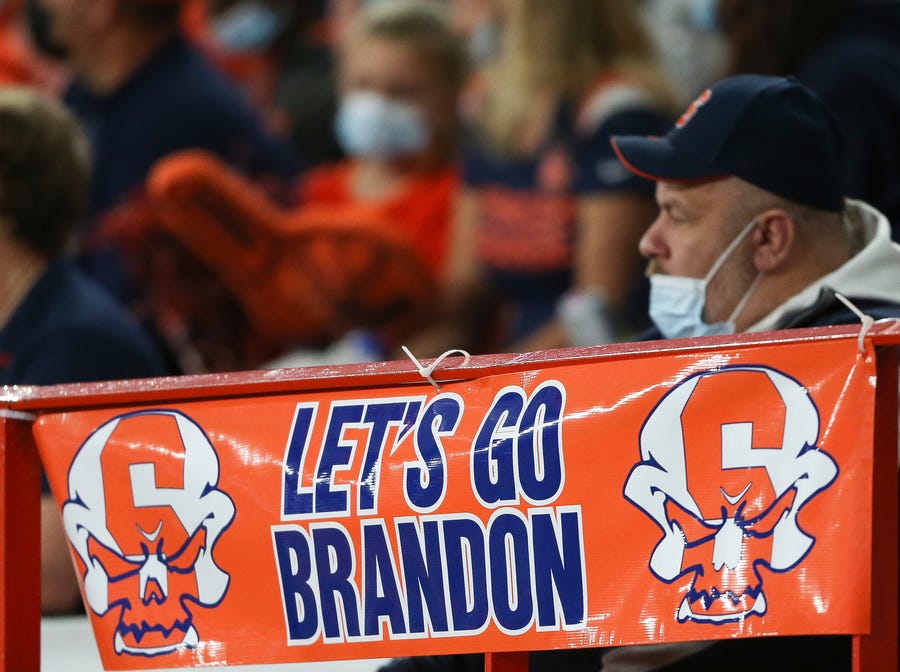
This particular sign was a the Boston College-Syracuse football game Oct. 30. A fan’s juvenile jab at President Joe Biden.Joshua Bessex

For instance, the woman had not heard about the Southwest Airlines pilot who recently signed off on a flight, telling passengers, “Let’s go, Brandon.”

Or about how the whole thing began when a race car driver named Brandon Brown won a NASCAR race and, while being interviewed on TV, the crowd started chanting, “F–k Joe Biden.” The flummoxed interviewer suggested they might be saying, “Let’s go, Brandon.”

After that, the phrase became a way for grown-up 8-year-olds to say the f-word about Biden without actually using it.

Really.

Elected Republican politicians in Washington, D.C., started using the phrase.

Donald Trump began selling “Let’s go Brandon” T-shirts through his Save America PAC for $45, and grown-up 8-year-olds in America actually purchased them.

$45.

There are adults who channel their 8-year-old selves by bringing signs saying, “Let’s go, Brandon” to public events, as well as some who scribble the message in paint on the rear window of their automobiles….

How to answer someone who says such a thing

Of course, we all learned as children that infantile behavior tends to draw some type of backlash….

After I explain the whole “Let’s go, Brandon” thing to the woman who’d been walking her dog she says, “That seems incredibly childish. How are you supposed to answer someone who says such a thing?”

I tell her that, as a grown-up, she would be best served simply ignoring it.

As for the rest of us, suffering as we do from social-media-induced age regression, I’d respond, “I’m rubber and you’re glue …”

Reach Montini at ed.montini@arizonarepublic.com.

Problem viewing email? View in browser

School boards across the nation have complained about members of the public who create chaos at school board meetings: screaming, threatening violence, disrupting the proceedings. The National School Boards Association lodged a complaint with Attorney General Merrick Garland, asking for an investigation.

A large group of prominent rightwingers sent out a notice to parents and other allies, urging them to attend school board meetings. The leading voice who signed the letter is 89-year-old Ed Meese, former attorney general for Ronald Reagan.

Their letter begins:

Conservatives are deeply disturbed by the efforts of the Department of Justice to criminalize parental dissent at school board meetings. This is a dangerous and anti-democratic attempt at intimidation that should be vigorously opposed.

The DOJ has recently announced it will direct the FBI to investigate “threats of violence” at school board meetings. The announcement came just days after the National School Boards Association urged the Biden administration to invoke the Patriot Act against concerned parents, as they might be engaged in “domestic terrorism.”

This level of outright authoritarianism must be opposed. Parents not only pay for the instruction taking place in public schools, but as parents, have the right to know how and in what manner their children are being instructed. Those expressions of disagreement and demands for accountability are not only appropriate in a democratic society, but protected under the Constitution.

If Attorney General Merrick Garland and the Biden administration are going to make it their business to ban, demean, and belittle parents and citizens for engaging in protected speech in the institutions funded by their tax dollars, the response from concerned parents must be more speech, not less.

State Senator Lincoln Fillmore is very worried about the teaching of “critical race theory,” although there is no evidence that anyone is teaching it in Utah schools. He is calling for a law requiring social studies teachers to post their daily lesson plans online, so parents and other concerned members of the community can scrutinize them. Teachers are rightly furious.

A Utah lawmaker wants to require that all materials for social science classes in K-12 be vetted and posted online for parents to review in advance — and teachers are pushing back.

Educators say the proposal shows a lack of trust in their judgment. They call it micromanaging. Some argue that it will hamper their ability to teach students about what’s happening in the world in real time. One called it a “classic witch hunt.”

“The ‘witches’ are social studies teachers who dare discuss current events,” said Deborah Gatrell, a teacher at Hunter High in Granite School District, in a post about her concerns.

The controversial idea comes Sen. Lincoln Fillmore, R-South Jordan, as a continuation of the effort by conservative Utah leaders to control what’s being taught about history in the classroom. Fillmore was also the Senate sponsor on the bill last session that banned discussion of critical race theory in public schools in the state.

The Republican war on “critical race theory” began in the closing months of Trump’s term in office, when he denounced it and called for “patriotic education.” One Republican state after another began passing resolutions and laws banning the teaching of CRT, which was interpreted to mean teaching about racism or anything that might make “some” children feel uncomfortable or be “divisive.” Teaching about the Ku Klux Klan or white supremacy apparently made some children feel uncomfortable.

Jan Resseger reports that the Ohio State Board of Education repealed a 2020 anti-racism resolution, since any such proposal are “divisive.” She goes into detail about the national reach of the Republican effort to eliminate anti-racist materials from the schools.

She begins:

Late on Wednesday night, the Ohio State Board of Education repealed Resolution 20, an important declaration passed in the summer of 2020 directing the Ohio Department of Education to establish staff diversity training and launch a curriculum review intended to reduce racism and bias in the state’s public schools.

The Columbus Dispatch’s Anna Staver reports: “Ohio’s State Board of Education repealed an anti-racism resolution Wednesday night and replaced it with one condemning any teachings that ‘seek to divide.'” Staver explains that the 2020 anti-racism resolution: “condemned hate crimes and white supremacy movements ‘in the strongest possible terms,’ but it also directed the Ohio Department of Education to teach its employees about implicit bias. Local school boards were asked to review their graduation rates, discipline records and classroom resources… Opponents… argued that (the resolution) opened the door for districts to teach ‘disturbing’ and ‘divisive’ material about racism and identity.”

State Board member Brandon Shea drafted Resolution 13, a counter statement which eventually passed but without some of Shea’s proposed language. Shea’s proposal, according to Staver’s report, “observed not only a growing national divide but a troubling focus on the color of one’s skin rather than on the content of one’s character.'” Shea’s proposal also condemned “critical race theory.”

While Staver reports that Resolution 13, as passed, removes the incendiary language about critical race theory, the replacement resolution condemns “any language that seeks to divide” and “any standards, curriculum, or training programs for students, teachers, or staff that seek to ascribe circumstances or qualities, such as collective guilt, moral deficiency, or racial bias, to a whole race or group of people.” This is, of course, language that conforms to the prescriptions of far right ideologues who want to protect the white majority from looking honestly at white privilege and examining the history of slavery and racism in the United States.

For The Intercept, Akela Lacy summarized the original July 2020 resolution which was rescinded on Wednesday night: “The resolution, introduced by board President Laura Kohler, acknowledges that ‘Ohio’s education system has not been immune’ to racism and inequality, and that ‘while we earnestly strive to correct them, we have a great deal of work left to do.’ It calls for the state education board to offer board members implicit bias training, programs designed to help people understand their own unconscious biases and the ways stereotypes can distort their beliefs; for all state Department of Education employees and contractors to take the training; for the department to reexamine curricula for racial bias; and for school districts to examine curricula and practices for hiring, staff development, and student discipline.”

As Lacy explains, ever since the original resolution passed, there has been an outcry from members of the public and a loud minority within the State Board itself complaining that the resolution constitutes “critical race theory.” Under pressure, the State Board finally asked Ohio Attorney General Dave Yost to determine whether the resolution is constitutional. He let the resolution stand, saying such a determination is outside his authority, except, he said, the State Board cannot impose these mandates on private contractors. For months, the resolution has been the subject of hearings in the Ohio House of Representatives’ State and Local Government Committee, where hundreds of educators and members of the public have offered testimony in favor of last year’s resolution. However, at one hearing, Lacy reports that one member of the State Board of Education, Diana Fessler, openly defended white supremacy.

It would be one thing if this sort of battle were happening only in Ohio’s state board of education, but instead the same fight is being reported in local school boards all across the country. And the arguments and downright fights are highly politicized. In the Washington Post, Adam Laats reported: “Conflicts (have) roiled school board meetings across the country, over a range of hot-button issues: masks, vaccines, policies for trans athletes, Critical Race Theory. The conflicts moved past yelling, to lawsuits and demands for recalls—and not just of individual members but entire boards. Over and over again, local school board meetings have turned from staid discussions of budgets and staffing to heated ideological forums, hosting a go-nowhere series of fights that have little to do with the actual needs of the local schools. Conservative pundits have talked up these confrontations as part of a larger political strategy… Why have school boards become ground zero for these aggressive ideological skirmishes? Quite simply: They are accessible. Most meetings are open to the public, in local town halls or school district offices; their members are local volunteers, who usually have no campaign war chests or partisan election support… And if school board meetings are disrupted, members recalled, teachers threatened, students intimidated, it is that much harder for schools to function and children to learn.”

Open the link and read on.

In the race for governor of Virginia, Republicans have focused their campaign on hot-button issues like banning “critical race theory” from the schools, opposing mask mandates, and taking a stand against tiny numbers of transgender students. Republicans have also argued that parents should be able to determine what teachers are allowed to teach and to ban books that they don’t like. And of course, they support school choice. In short, the Republican candidate has decided to base his campaign on “culture war” issues, offering no proposals to improve the schools.

In contrast, the Democratic candidate Terry McAuliffe has promised to raise teachers’ salaries, expand pre-K, and protect students from the virus. He has also taken a stand against parents dictating what should be taught, instead leaving those decisions to teachers. In these times, he has shown that principle and courage are possible when running for high political office, which is why he was endorsed by the Network for Public Education Action. We will learn on November 2 whether principle and courage can beat rank opportunism.

Lisa Lerer wrote in the New York Times about how unusual it is to have a statewide race centered on education. .

WINCHESTER, Va. — …From fights over evolution to desegregation to prayer, education battles have been a staple of the country’s divisive cultural issues for decades. But not quite like this.

After months of closed classrooms and lost learning time, Republicans in Virginia are making the schools the focus of their final push to capture the governor’s office, hoping to rally conservatives around both their frustrations over mask mandates and mandatory vaccinations and their fears of what their children are being taught.

Vocal groups of parents, some led by Republican activists, are organizing against school curriculums, opposing public-health measures and calling for recalls of school board members. And Mr. Youngkin, a former private equity executive, has capitalized, seizing on conservatives’ concerns about instruction on race and the rights of transgender children to argue that Democrats want to come between parents and their children’s education.

Mr. Youngkin’s attacks have forced Terry McAuliffe, the Democratic former governor trying to win back his old job, onto the defensive, and have thrust the ordinarily local issues surrounding schools into the middle of a rancorous nationwide shouting match.

The Virginia race offers an early electoral test of that conservative energy.

A victory by Mr. Youngkin would mark the first statewide win for Republicans in a dozen years and likely trigger a political panic within the Democratic Party about its prospects in next year’s midterm elections. Some Republican officials and strategists liken the surge of activism to the Tea Party, the anti-government movement that helped them win control of the House in 2010 and unleashed a revival of outrage politics that would define their party for the next decade.

“There’s just so much focus on the schools, and it’s visceral,” said John Whitbeck, a former chairman of the Republican Party of Virginia from Loudoun County, where acrimonious school board meetings have led to arrests, death threats and constant airtime on conservative media. “It’s not like, ‘Oh, I’m against the debt ceiling.’ This is like, ‘You’re destroying our children’s education.’ And, look, angry people vote.”

Polling in recent weeks has shown a tight race, with Democrats less enthusiastic than Republicans about voting. Mr. McAuliffe, who was barred from seeking re-election in 2017 by Virginia law, is faring worse in the fast-growing, voter-rich Northern Virginia suburbs than Gov. Ralph Northam, a Democrat, did when he won four years ago, according to some surveys.

Mr. Youngkin’s focus on schools may not resonate as strongly with the broader electorate.

Measures such as mask and vaccine mandates are cutting differently in the governor’s race in more liberal New Jersey and are overwhelmingly popular among Virginia’s independents and Democrats. Critical race theory — an advanced academic concept generally not introduced until college — is not part of classroom teaching in Virginia and many voters say they do not know enough about it to have an opinion.

And turning schools into a cultural war zone by railing against equity initiatives, books with sexual content and public health measures avoids tackling issues like budget cuts and the other thornier problems facing American education.

But in an off-year election, when both sides anticipate a sharp falloff in voting, victory may hinge on which candidate can best motivate their base. Mr. Youngkin and his strategists believe that in the fights roiling schools they have discovered the rare issue that can galvanize their voters, even in places that are shifting the state to the left.

Frustration with education is an issue that unites Republicans, energizing moderates eager to ensure their children remain in school as well as conservatives who see a liberal plot to indoctrinate their children with the belief that white people are inherently racist.

“The former governor is saying, ‘Hey I’ll decide how to teach your kids, not you’ — that’s really the issue driving this,” said John Fredericks, who led Donald Trump’s Virginia campaign last year. “Glenn Youngkin is the candidate that’s been able to straddle both sides of the party. And so far he’s given us just enough where we can enthusiastically vote for the guy.”

Republicans have centered much of their closing argument around a statement by Mr. McAuliffe in last month’s debate.

The comment came after Mr. Youngkin attacked Mr. McAuliffe over his 2017 veto of a bill permitting parents to opt out of allowing their children to study material deemed sexually explicit. The dispute was prompted by a mother who objected to her son, a high school senior, reading literary classics including Toni Morrison’s “Beloved.”

Mr. McAuliffe shot back that he did not believe “parents should be telling schools what they should teach.” In the weeks since, he’s stood by those remarks, saying that the state Board of Education and local school boards should determine what is taught in the classroom.

But Mr. Youngkin and Republicans, stripping the quotation from its context, have turned the footage into the core of their argument that Mr. McAuliffe would side with government over parents.

Video of the remark was featured in a flurry of digital ads and a statewide television commercial accusing Mr. McAuliffe of going “on the attack against parents.” Mr. Youngkin’s team began scheduling “Parents Matter” rallies in exurban counties, as they actively courted parent activist groups.

And Mr. Youngkin has also voiced support for Byron Tanner Cross, a physical education teacher in Loudoun County. Mr. Cross was suspended after announcing at a school board meeting that he would not address transgender students by their preferred pronouns because of his Christian faith.

At a campaign rally last week in Winchester, a small town in the Shenandoah Valley in one of the fast-growing exurb counties around Washington, Mr. Youngkin made little mention of Mr. Trump, vaccines or the coronavirus. Instead, he repeatedly invoked issues around schools as top priorities.

He drew some of the loudest applause from the overwhelmingly white audience when he promised to ban critical race theory on his first day in office and vowed that schools would never be closed again.

“This is what big government means for Terry McAuliffe. He not only wants to stand between you and your children. He wants to make government a tool to silence us,” Mr. Youngkin told the crowd of nearly 200 people at a farm stand. “This is no longer a campaign. This is a movement. It’s a movement led by parents.”

Mr. McAuliffe has dismissed the outrage surrounding critical race theory as “racist” and “a dog whistle.” He supports mask and vaccine mandates for students, teachers and school staff. (Mr. Youngkin says he encourages Virginians to get vaccinated against the coronavirus but does not support mandates.)

But there are signs that Democrats sense danger.

Mr. McAuliffe’s campaign has returned to highlighting his education proposals to undercut any argument that Mr. Youngkin could be stronger on the issue, promising to invest $2 billion in education, raise teacher pay, expand pre-K programs and invest in broadband access for students. On Friday, Mr. McAuliffe released an ad saying that Mr. Youngkin would cut billions of dollars in education funding and bring “Donald Trump and Betsy DeVos’s education policies to Virginia.”

The parent organizations in Virginia say they are nonpartisan and more focused on school board elections than national politics. But many are led by Republican activists, raise funds from Republican Party donors and are helped by conservative think tanks such as the Heritage Foundation, which has held briefings to discuss model legislation to block critical race theory. Last month, the Republican National Committee ran ads attacking “fascist mask mandates” and highlighting video clips of angry parents yelling at school board members.