Archives for category: Republicans

Dana Milbank is a columnist for the Washington Post. He is one of my favorites. (I also adore Valerie Strauss and Jennifer Rubin, and of course, Glenn Kessler, the fact-checker). I’m sorry that his many links did not transfer when I copied and pasted. Subscribe to the Post.

He writes:

There were even more vermin than usual in Washington this week. A rabid fox at the Capitol bit at least nine people, including Rep. Ami Bera (D-Calif.). And Democratic National Committee Chair Jaime Harrison attacked Sen. Tom Cotton (R-Ark.) with an insult most entomological.

After Cotton implied that Supreme Court Justice-designate Ketanji Brown Jackson is a Nazi sympathizer, Harrison referred to Cotton as a “little maggot-infested man” on MSNBC’s “Morning Joe.”

Fake news! Cotton may go low, but, at 6-foot-5, he is not little. Also, maggots typically feed on dead things, and Cotton, though stiff, is not currently deceased. The man likes to carry on, but he is not carrion.

Harrison went on to censure the Republican Party as a whole: “It is a party built on fraud, fear and fascism.” Interestingly, a statement from the Republican National Committee taking offense at the “maggot-infested” charge did not dispute the “fraud, fear and fascism” formulation. As your self-appointed fact-checker, I have therefore examined the merits of the accusation.

Fraud


Sixteen months after President Donald Trump’s claims of election fraud failed in some 60 court cases, we have finally found evidence of potential voter fraud. Trump’s White House staff chief, Mark Meadows, reportedly registered to vote in 2020 using the address of a mobile home he never lived in. And former Trump State Department official Matt Mowers, a current congressional candidate, voted twice during the 2016 primaries, in New Hampshire and New Jersey.

The “big lie” about a rigged election, accepted by two-thirds of Republican voters, has spawned new frauds about the dangers of coronavirus vaccines (leading to sharply higher death rates in heavily Republican counties) and the promise, touted by Sen. Ron Johnson (R-Wis.) of the deworming drug ivermectin to treat covid-19; an exhaustive new study finds the drug useless.

Then there are the little everyday frauds. Just days after Rep. Madison Cawthorn (R-N.C.) told the world that his colleagues engage in coke-fueled orgies, Rep. Lisa McClain (R-Mich.) declared at a Trump rally that it was Trump who “caught Osama bin Laden,” record-low unemployment is at a “40-year high” and there weren’t “any wars” during Trump’s presidency. Never mind Syria and Afghanistan.

Fear

Sen. Ted Cruz (R-Tex.) said people like Ketanji Brown Jackson become public defenders because “their heart is with the murderers.” Cotton said Justice Robert H. Jackson “left the Supreme Court to go to Nuremberg and prosecute the case against the Nazis. This Judge Jackson might have gone there to defend them.”

Republican senators used the Jackson confirmation to stir fear of minorities and vulnerable groups with manufactured crises about transgender athletes (of the 200,000 participants in women’s collegiate sports, perhaps 50 are transgender) and “critical race theory” (which isn’t taught in public schools).

Ohio Republican Senate candidate J.D. Vance released an ad saying “Biden’s open border is killing Ohioans, with more illegal drugs and more Democrat voters pouring into this country.”

The Florida legislature approved an “election crimes” police force for Gov. Ron DeSantis (R), with the potential to intimidate voters, while various GOP-led states move forward with new provisions providing residents with incentives to inform on each other.

The newly-revealed text messages of Justice Clarence Thomas’s activist wife, Ginni, show her sharing with the Trump White House her “hope” that the “Biden crime family” as well as elected officials, bureaucrats and journalists would be taken to “barges off GITMO to face military tribunals for sedition.”
**
Is the GOP “a party built on fraud, fear and fascism”? Certainly, not all Republicans think this way. But too many others are subverting democracy, cavorting with white nationalists, spreading racist fears and fantasizing about extrajudicial punishment for political opponents and the media. For them, the jackboot fits
There is a sort of hysteria about transgender people that has gripped the minds of (mostly) Republican legislators. They claim that teachers are “grooming” children to be gay or transgender. We used to think of the word “groom” to refer to a male who was getting married and the word “grooming” as a description of one’s manner of dress (“good grooming” or “bad grooming”). Now the word has a sinister connotation, as rightwing zealots like Christopher Rufo and Moms for Liberty accuse the nation’s teachers of conspiring to turn their students gay or transgender.

The Williams Institute at the School of Law at UCLA developed an estimate of the number of transgender people in the U.S. population. The estimate is that transgender people are 0.06%, or about 1.4 million people. Unless my math is off, that is six people out of every 10,000 people identify as transgender.

I have not seen any evidence that children were turned gay or transgender because of what their teachers did in school. It seems to be a decision that is never taken easily or lightly because there is so much social opprobrium attached to being transgender.

The issue has been dormant until recently, when a transgender woman (formerly male) swimmer won national competitions. So, now, the issue has become a matter of “protecting women’s sports.” No one worries about a transgender man (formerly female) competing in men’s sports, but they believe that a transgender woman has biological advantages that make the competition unfair.

I won’t share my views because frankly I am conflicted. The only thing I can say with conviction is that a problem that affects a very tiny number of people has been cynically turned into a culture war issue.

This report comes from the Center for Educational Equity at Teachers College, Columbia University. The Leandro case ordered equitable funding for the state’s public schools, but the funding has not been delivered due to the Tea Party Republican control of the legislature (General Assembly). Republicans have chosen to focus on charters and vouchers, not equitable funding.

Seeking to end the long-pending Leandro/Hoke litigation, Superior Court Judge David Lee last June approved a comprehensive, 8-year plan that aims to ensure all students in the state the opportunity for a sound basic education guaranteed by the state constitution. When the legislature failed to approve the initial funding to support the plan, in November, the Judge ordered the state of North Carolina to transfer $1.7 billion from its reserves to fund the first phase of the plan. At the end of November, the North Carolina Court of Appeals overruled Judge Lee’s order, holding that although the lower court was correct in saying that the state must fund the plan, it is not within its power to order money be appropriated.

Late last month, North Carolina Supreme Court Chief Justice Paul Newby, a registered Republican, suddenly replaced Judge Lee, a registered Democrat, as the presiding trial court judge for the case, without any advance notice. Justice Newby then ordered special Superior Court Judge Michael Robinson, a registered republican, to take over the case. Judge Robinson is required to determine how much of the $1.7 billion that is necessary to fund a comprehensive remedial school improvement plan was included in the current state budget. Judge Robinson must present his findings to the state Supreme Court by April 20.

The federal Charter Schools Program was launched in 1994 with a few million dollars, when the Clinton administration decided to offer funding for start-ups. At the time, there were few charter schools. In the early, idealistic days, charter enthusiasts asserted that charters would set lofty goals and close their doors if they didn’t meet them. They were sure that charters would be far better than public schools because they were free to hire and fire teachers.

Right-wingers jumped on the charter bandwagon as a way to undermine public schools and to bust teachers’ unions. In short order, a gaggle of billionaires decided that charter schools would succeed because they operated with minimal or no regulation, like a business.

What no one knew back in 1994 was that the charter industry would grow to be politically powerful, with its own lobbyists. No one knew that the “most successful” charter schools were those that excluded the students who might pull down their test scores. No one knew that for-profit entrepreneurs would set up or manage charter chains and make huge profits, mainly by their real estate deals. No one knew that one of the largest charter chains would be run by a Turkish imam. No one knew that charter schools would develop a very old-fashioned militaristic discipline that prescribed every detail of a student’s life in school. No one knew that the little program of 1994 would grow to $440 million a year, with much of it bestowed on deep-pocketed chains that had no need of federal money to expand. No one knew that charter schools would become a favorite recipient of big money from Wall Street hedge-fund managers and billionaires like Bill Gates, the Walton family, Eli Broad, Michael Bloomberg, John Arnold, Betsy DeVos, Reed Hastings, and many other billionaires and multi-millionaires. No one anticipated that by 2022, there would be 3.3 million students in more than 7,400 charter schools.

Perhaps most important, no one expected that charter schools, on average, would perform no better than public schools. And in many districts and states, such as Ohio, Nevada, and Texas, charter schools perform far worse than the public schools.

School choice has been a segregationist goal ever since the Brown Decision of 1954, when southern states created segregation academies and voucher plans to help white students escape from racial integration. It should be no surprise, then, to see that the same states that are passing laws to restrict discussion of racism, to ban teaching about sexuality and gender, and to censor books abut these topics are the same states that demand more charter schools. Coincidence? Not likely. These are culture war issues that rile the Republican base.

How strange then, given this background, that the Washington Post published an editorial opposing the Department of Education’s sensible and modest effort to impose new regulations on new charter schools that seek federal funding. The education editorial writer Jo-Ann Armao very likely wrote this editorial, since she has that beat. Armao was a cheerleader for Michelle Rhee when she was chancellor of the D.C. schools and imposed a reign of terror on the district’s professional staff, based on flawed theories of reform and leadership.

In the following editorial, she makes no effort to offer two sides of the charter issue (yes, there are two, maybe three or four sides). She writes a polemic that might have been cribbed from the press releases of the National Alliance for Public Charter Schools, the amply endowed lobbyist for the industry. She gives no evidence that she has ever heard of the high closure rate (nearly 40%) of the charters that received federal funds from the Charter Schools Program. She seems unaware of the scores of scandals associated with the charter industry, or the number of charter founders who have been convicted of embezzlement. She doesn’t care about banning for-profit management from future grants. She thinks it’s just fine to set up new charters in communities where they are not needed or wanted. She seems unaware that the new regulations will not affect the 7,000 charters now in existence. Charters can still get start-up funding from Michael Bloomberg, the Waltons, or other privatizers. New charters can still be opened by for-profit entrepreneurs like Academica, but not with federal funds.

Here is the editorial, an echo of press releases written by Nina Rees of the National Alliance for Public Charter Schools (Rees previously worked at the right-wing Heritage Foundation, served as education advisor to Vice-President Dick Cheney, and worked for financier Michael Milken).

The editorial’s title is: “The Biden Administration’s Sneak Attack on Charter Schools.”

Advocates for public charter schools breathed easier last month when Congress approved $440 million for a program that helps pay for charter school start-up expenses. Unfortunately, their relief was short-lived. The Biden administration the next day proposed new rules for the program that discourage charter schools from applying for grants, a move that seems designed to squelch charter growth.


On March 11, a day after the funding passed, the Education Department issued 13 pages of proposed rules governing the 28-year-old federal Charter Schools Program, which funnels funds through state agencies to help charters with start-up expenses such as staff and technology. “Not a charter school fan” was Mr. Biden’s comment about these independent public schools during his 2020 presidential campaign, and the proposed requirements clearly reflect that antipathy.


The Biden administration claims that the proposed rules would ensure fiscal oversight and encourage collaboration between traditional public schools and charter schools. But the overwhelming view within the diverse charter school community is that the proposed rules would add onerous requirements that would be difficult, if not impossible, to meet and would scare off would-be applicants. Those most hurt would be single-site schools and schools led by rural, Black and Latino educators.


Consider, for example, the requirement that would-be applicants provide proof of community demand for charters, which hinged on whether there is over-enrollment in existing traditional public schools. Enrollment is down in many big-city school districts, which would mean likely rejection for any nonprofit seeking to open up a charter. “Traditional schools may be under-enrolled, but parents are looking for more than just a seat for their child. They want high quality seats,” said Nina Rees, president of the National Alliance for Public Charter Schools.Hence the long waiting lists for charter school spots in cities with empty classrooms in traditional schools. Also problematic is the requirement that charters get a commitment of collaboration from a traditional public school. That’s like getting Walmart to promise to partner with the five-and-dime down the street.

The Biden administration surprised the charter school community by what charter advocates called a sneak attack. There was no consultation — as is generally the case with stakeholders when regulations are being drafted — and the public comment period before the rules become final ends April 14.The norm is generally at least two months.

The proposed changes, according to a spokesperson for the Education Department, are intended to better align the Charter Schools Program with the Biden-Harris administration’s priorities. “Not a charter fan,” Mr. Biden said, and so bureaucratic rulemaking is being used to sabotage a valuable program that has helped charters give parents school choice.

If you disagree with this editorial, as I do, please send a comment thanking the Department of Education for proposing to regulate a program that has spun out of control and urging them to approve the regulations. Give your reasons.

If you think that charter schools have no need for federal funding when so many billionaires open their wallets for them, if you think that your community has enough charter schools, if you think that public schools must be strengthened and improved, if you want to stop federal funding of for-profit entrepreneurs, if you are tired of funding schools that never open, please write to support the U.S. Department of Education’s reasonable proposal to regulate the federal Charter Schools Program.

Journalist Jennifer Berkshire and historian Jack Schneider wrote a warning in the New York Times to the Democratic Party about education. Democrats, they say, used to have a big advantage over Republicans on the education issue, but that advantage has almost disappeared. They say that Democrats have erred in celebrating education as the most important, if not the only, route to economic success. Meanwhile, they ignored trade unions, which dwindled under red state assaults and corporate attacks, and tax policy, which favored the rich.

While I don’t disagree with their analysis, I have a different take on why Democrats lost the education issue. Not only did they ignore growing economic inequality, but Democrats abandoned their historic devotion to public schools (attended by 90% of American students) and adopted the Republicans’ long-standing belief in choice, competition, testing, and accountability.

Thirty years later, it is indisputably clear that those policies do not improve education, do not increase opportunity for those who are at the bottom, and do not reduce economic inequality.

Under Bill Clinton in the early 1990s, the Democratic platform sounded remarkably like the Republican Party on education. Clinton and Gore pledged to create a national system of standards and tests. Their Goals 2000 legislation of 1994 laid the groundwork for George W. Bush’s No Child Left Behind, which had bipartisan support. The Clinton administration created the federal Charter Schools Program in 1994, which allocated a few million dollars to help start new charters; it has now grown into a charter slush fund of $440 million annually, which is strongly supported by Republicans and for which there is no need, given the many billionaires who subsidize charters.

Race to the Top was the culmination of the Democrats’ complete merger with Republicans on education policy.

The Democrats lost their primacy as the party of public schools because they embraced Republican ideology, and they ignored the causes of economic inequality, which testing, standards, and choice could not fix.

Berkshire and Schneider write:

The warning signs are everywhere. For 30 years, polls showed that Americans trusted Democrats over Republicans to invest in public education and strengthen schools. Within the past year, however, Republicans have closed the gap; a recent poll shows the two parties separated on the issue by less than the margin of error.

Since the Republican Glenn Youngkin scored an upset win in Virginia’s race for governor by making education a central campaign issue, Republicans in state after state have capitalized on anger over mask mandates, parental rights and teaching about race, and their strategy seems to be working. The culture wars now threatening to consume American schools have produced an unlikely coalition — one that includes populists on the right and a growing number of affluent, educated white parents on the left. Both groups are increasingly at odds with the Democratic Party.

For the party leaders tasked with crafting a midterm strategy, this development should set off alarms. Voters who feel looked down on by elites are now finding common cause with those elites, forming an alliance that could not only cost the Democrats the midterm elections but also fundamentally realign American politics.

The Democrats know they have a problem. One recent analysis conducted by the Democratic Governors Association put it bluntly: “We need to retake education as a winning issue.” But reclaiming their trustworthiness on education will require more than just savvier messaging. Democrats are going to need to rethink a core assumption: that education is the key to addressing economic inequality.

The party’s current education problem reflects a misguided policy shift made decades ago. Eager to reclaim the political center, Democratic politicians increasingly framed education, rather than labor unions or a progressive tax code, as the answer to many of our economic problems, embracing what Barack Obama would later call “ladders of opportunity,” such as “good” public schools and college degrees, which would offer a “hand up” rather than a handout. Bill Clinton famously pronounced, “What you earn depends on what you learn.”

But this message has proved to be deeply alienating to the people who once made up the core of the party. As the philosopher Michael Sandel wrote in his recent book “The Tyranny of Merit,” Democrats often seemed to imply that people whose living standards were declining had only themselves to blame. Meanwhile, more affluent voters were congratulated for their smarts and hard work. Tired of being told to pick themselves up and go to college, working people increasingly turned against the Democrats.

Today, as the middle class falls further behind the wealthy, the belief in education as the sole remedy for economic inequality appears more and more misguided. And yet, because Democrats have spent the past 30 years framing schooling as the surest route to the good life, any attempt to make our education system fairer is met with fierce resistance from affluent liberals worried that Democratic reforms might threaten their carefully laid plans to help their children get ahead.

Please read the rest of their article.

Writing in Slate, Dahlia Lithwick calls out Senate Democrats on the Judiciary Committee (excepting Senator Booker) for failing to support Judge Ketanji Brown Jackson as Republicans pummeled her, berated her, distorted her record.

She writes:

I wrote earlier this week about the utter failure on the part of Senate Judiciary Committee Democrats to connect this hearing to what is going to be a catastrophic series of progressive losses at the Supreme Court this term, and the almost staggering inability to lay out any kind of theory for progressive jurisprudence, or even a coherent theory for the role of an unelected judiciary in a constitutional democracy. My colleague Mark Joseph Stern wrote today about a broadside attack on the whole idea of unenumerated rights, substantive due process, and the entire line of cases that protect Americans from forced sterilization, indoctrination of their children, and penalties for using birth control, and afford them the right to marry whom they want. More mysterious than this coordinated GOP project to undermine LGBTQ rights, marriage equality, contraception, and abortion—again, none of this is new or shocking—was the almost complete silence from Senate Democrats on these issues of substantive due process, privacy, and bodily autonomy. On the simplest level, the hearing might have been an opportunity to explain why Roe v. Wade is in fact the tip of the constitutional iceberg; that the same doctrinal underpinnings at risk in this term’s looming catastrophe of Dobbs v. Jackson Women’s Health Organization could lead to existential losses of countless other freedoms. But the hearings were framed as if Republicans stand to lose the court and the midterms, while the Democrats behaved as if the future of the courts, the Senate, and democracy itself has no bearing on what happened inside the Senate chamber.

I understand that the decision was taken to just get the nominee confirmed. Take the win. But for those of us watching and waiting to see Democrats support and back the nominee, there was an immense sense of underreaction. Jackson looked alone fending off the QAnon smear brigade for much of these hearings because she was alone, at least until Sen. Cory Booker took it upon himself in his last colloquy to offer up a powerful corrective to the hatred being leveled at her, and to remind us why love can be an equal and opposite reaction to fear.

If we can all agree that the purpose of this charade for Graham is to try to flip Sens. Susan Collins or Lisa Murkowski, and that for Sen. Ted Cruz the purpose of this charade is to goose his own Twitter mentions, and that for Sen. Josh Hawley the purpose is to take what was a fringe “endangering our children” smear campaign last week and push it to the GOP mainstream today, it’s manifestly clear who the real pornographers are this week. But if we can all agree what the GOP agenda has been, I remain utterly mystified by the Democrats. They have the votes to confirm. They are about to irrevocably alter the course of American history. So what are they afraid of?

Chairman Dick Durbin’s inability to control some of the most shocking bullying and abuse from Cruz, Graham, Tom Cotton, and Hawley left observers speechless. At some point, you need to just start gaveling. But there was also a pervasive sense of Democratic senators’ almost chilling unwillingness to go to the mat for their nominee, who was being savaged by Cotton, who called her “not credible,” and Graham, who berated her with the claim that he was sparing her from being bullied like Justice Amy Coney Barrett.

Take my word for this one thing: If you have been subject to abuse, bullying, and intimidation, what you really don’t need to hear from people in power is that they think you are “brave,” or that you’re modeling perseverance and grace. What you really want is for someone to stand beside you and take a punch—or throw one. Yet beyond a handful of such moments, and notably Booker’s final speech, virtually everything Democrats did felt insufficient to the moment. More than that, it felt inexplicable.

After four days of hostile grilling by Republicans, the nation had the chance to see a person who stood up to every insulting and demeaning question with a calm and collected demeanor. Judge KJB has a judicial temperament. She demonstrated grace under pressure.

She just received the highest rating from the American Bar Association, in recognition of her record, wisdom and intellect.

The senators running for the Republican nomination used the opportunity to appeal to their racist, Q Anon base, asserting that she was an advocate of critical race theory (false), soft on crime (false), and easy on child pornographers (false).

The judge has been endorsed by police organizations; several of her family members were law enforcement officers.

She opposes racism, but that does not make a CRT ideologue. The fact that her husband is white gives the lie to those like Senator Cruz who portray her as a racist who is hostile to white people.

The flap about child pornographers was an effort by GOP senators to placate the crazies in Q Anon who believe the government is filled with predators of children. Anyone who panders you them should be ashamed.

The judge was even questioned about whether she supports court-packing, a strange question coming from a party who refused to meet with President Obama’s choice “because it was an election year,” but rushed through Justice Barrett’s nomination on the eve of the 2020 election. The court now has 6 conservatives and only three liberals. Judge Brown would not change that uneven balance.

Judge Ketanji Brown Jackson is well qualified to serve on the High Court. She should be promptly confirmed. Republicans should demonstrate that they are not knee-jerk partisans by voting for her.

Historian Heather Cox Richardson writes on her blog that Republicans want to remove federal protections on many issues and restore states’ control. Several Republican senators have spoken out against Supreme Court decisions that overturned state laws on abortion, contraception, same-sex marriage, even interracial marriage. It was Senator Mike Braun of Indiana who said that the states should decide whether people of different races should be allowed to marry, but when the negative reactions poured in, he claimed he misunderstood the question. He was unusually clear for someone who “misunderstood the question.”

It’s sad that any Republican would question the right of people of different races to marry at the very moment that the Senate is questioning a Black woman judge who is married to a white man.

The Republicans who seek to revive a system of states’ rights and long-discredited laws reveal that they long to return to the 1950s, when segregation was legal in some states, women were not allowed to buy contraceptive devices or have an abortion, and gays were in the closet.

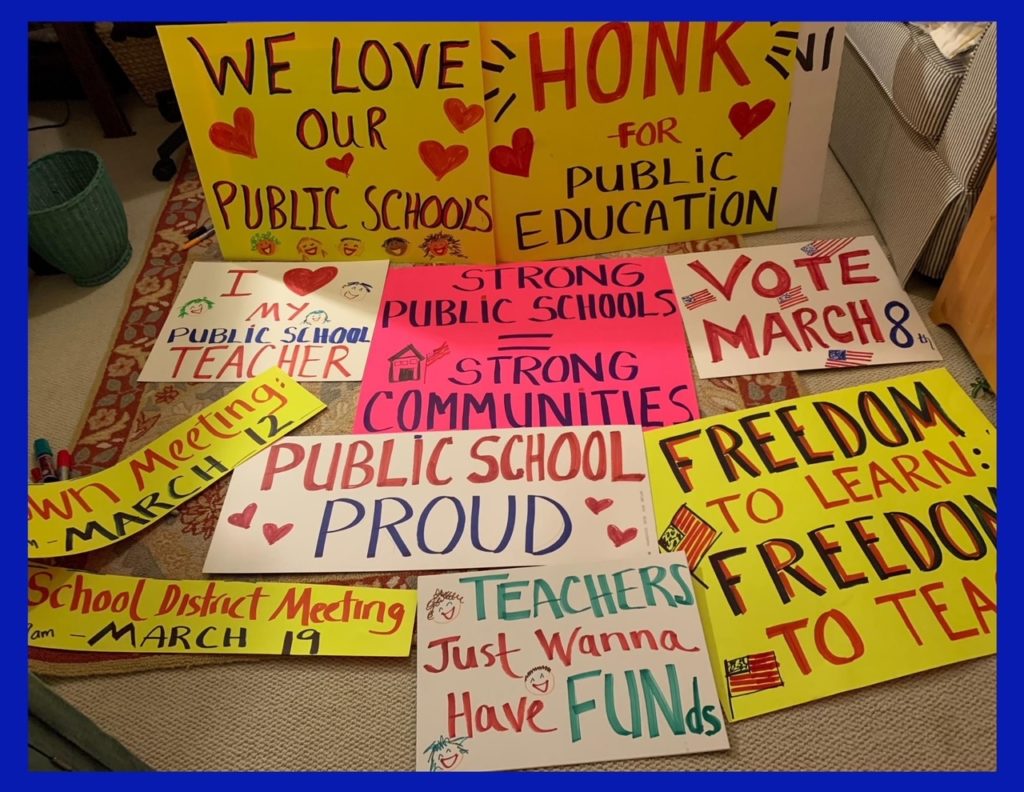
Tuesday’s school board election in New Hampshire was a triumph for parents and citizens who love their public schools!

This must have shocked Republican Governor Chris Sununu, the Republican-controlled legislature, and State Commissioner Frank Edelblut, who home-schooled his own children and is pushing a sweeping voucher plan for the state.

AfterGlenn Youngkin was elected Governor of Virginia by pandering to parents angry about “critical race theory,” mask mandates, and eager to control what children learned and what books they read, the media bombarded us with stories predicting that Republicans would win next November by running against public schools.

New Hampshire families and citizens said on Election Day, “Not so fast! We love our public schools.”

I Love Public Education Sign Visibility

In first town elections since onslaught of attacks on public education and a honest, accurate education, voters send clear message that they support strong public schools and a honest, accurate education

CONCORD, NH – In race after race across New Hampshire on Town Meeting Day, concerned parents and community members in communities large and small successfully organized to elect pro-public education candidates and reject those seeking to dismantle public education and censor history.

“These results should raise serious doubts about any Republican 2022 election strategy that is built around pitting parents against local public schools and educators,” said Zandra Rice Hawkins, Executive Director of Granite State Progress. “In nearly every school board race, Granite State voters chose out-spoken champions for public education and an honest, accurate, inclusive education. This is a big win for public schools and for our future. These leaders are committed to keeping our public schools strong and making sure every student’s history and experience is valued.”

The results from the election are all the more astounding for record-shattering voter turnout, and for the blatant differences between the candidates on everything from public education, COVID public health measures, and attempts to whitewash American history and censor educators. A priority list of school board results can be found here.

Key examples from around the state:

  • Merrimack Valley School District, home to some of the state’s most vocal anti-vaccine, anti-mask, and classroom censorship activists, experienced a 56% increase in voter turnout from 2019, and supported public education candidates while also defeating a classroom censorship/anti-equity warrant resolution.
  • Bedford experienced a 36% increase in voter turnout and elected pro-public education candidate and teacher Andrea Campbell with 2832 votes, compared to 1293 votes for Sean Monroe, a candidate supported by right-wing organization Defend Our Kids, and 856 for incumbent John Schneller; both of whom supported efforts to censor teachers and ban conversations about race and racism in public schools.
  • Londonderry elected pro-public education candidates Amanda Butcher and Kevin Gray, defeating vocal anti-masker Rachel Killian (seen here harassing school board members during a public meeting). Voters also rejected a warrant resolution to make masks completely optional and the sole decision of parents instead of school leaders and public health experts; a significant decision given Gov. Sununu’s recent decision to ban schools from enacting COVID public health measures like masks.
  • Governor Wentworth School District elected Republican State Rep. Brodie Deschaies over far-right activist Jessica Williams, who believes public schools are indoctrinating students and was arrested at a GWSD school board meeting on September 13, 2021.
  • Weare elected pro-public education candidates William “Bill” Politt and Alyssa Small, and passed full-day kindergarten; and Hollis elected pro-public education candidates Carryl Roy, Krista Whalan, and Holly Babcock.
  • Exeter and SAU 16 elected a full slate of pro-public education and honest education candidates, despite a nearly $20,000 effort by the opposition and months of voter mailings from those who oppose diversity, equity, and inclusion justice efforts in the school districts.

“We are in awe of how our communities have come together to protect and support public education,” said Sarah Robinson, Education Justice Campaign Director for Granite State Progress. “Parents, students, educators, and community leaders have been working for months to organize, recruit strong candidates, and support pro-public education campaigns. Watching the results come in and knowing that so many public education champions are going to be serving in these roles gives us all hope. Our schools have been under constant attack from privatization schemes, neo-Nazi’s, and of course Governor Sununu’s statewide ban on a honest education. We all know that serving on a school board right now is challenging, and we thank these leaders for stepping up for our students. We hope the folks at the State House are paying attention, because this showdown will play out again in November unless they stop the attacks on our public schools.”

Last week, I reported a poll in Educatuon Week, which found that half the public thinks that schools should not teach about racism today. With opinion polls, the results are influenced by many factors, including how the questions are worded. A poll by CBS got very different results.

Greg Sergeant writes in the Washington Post that Democrats should take heart from a CBS News poll: Most Americans oppose book banning. Democrats should stop being defensive.

He writes:

As Democrats debate the GOP’s all-culture-war-all-the-time campaign strategy, here’s a maxim worth remembering: If you’re wasting political bandwidth denying lies about yourselves, you’re losing.

A new CBS News poll offers data that should prod Democrats into rethinking these culture-war battles. It finds that surprisingly large majorities oppose banning books on history or race — and importantly, this is partly because teaching about our racial past makes students more understanding of others’ historical experiences.

The poll finds that 83 percent of Americans say books should never be banned for criticizing U.S. history; 85 percent oppose banning them for airing ideas you disagree with; and 87 percent oppose banning them for discussing race or depicting slavery.

What’s more, 76 percent of Americans say schools should be allowed to teach ideas and historical events that “might make some students uncomfortable.” And 68 percent say such teachings make people more understanding of what others went through, while 58 percent believe racism is still a serious problem today.

Finally, 66 percent say public schools either teach too little about the history of Black Americans (42 percent) or teach the right amount (24 percent). Yet 59 percent say we’ve made “a lot of real progress getting rid of racial discrimination” since the 1960s.

This hints at a way forward for Democrats. Notably, large majorities think both that we’ve made a good deal of racial progress and that we should be forthrightly confronting hard racial truths about our past and present, even if it makes students uncomfortable.

Culture warriors in the Republican Party want to ban all teaching about racism, in the past or present. They pass vague laws that are meant to intimidate teachers.

Their rhetorical game works this way: If you focus too much on the persistence of racial disparities in the present, you’re denying the racial progress that has taken place. You’re telling children that race still matters. You’re not telling a positive or uplifting story about our country. You’re saying America is irredeemable. You’re trying to make children hate our country, each other and themselves.

But this polling suggests many Americans doesn’t necessarily see things this way. Place proper emphasis on the idea that racial progress has been made, and it’s fine to highlight the problems that remain, even if it creates feelings of discomfort. It’s possible to tell a story that is in some ways about progress but also doesn’t whitewash our past.