Florida Gov. Ron Desantis and his administration have used their authority to essentially punish organizations he deems to be insufficiently conservative. One of their latest targets is the Special Olympics. Jay O’Brien of ABC News reported on Friday that the governor threatened to levy an eight-figure fine against the Special Olympics if it didn’t drop its Covid-19 vaccine requirement for its games in Orlando this weekend.
The Special Olympics backed off its vaccine requirement hours later, saying in a statement, “We don’t want to fight. We want to play.”
A letter from the Florida Department of Health dated June 2 threatened to assess the Special Olympics a $27.5 million fine due to “5,500 violations” of state law prohibiting business entities (including charitable organizations) from requiring individuals to show proof of vaccination. The applicable fine per person under this law is $5,000.
DeSantis is a dangerous ideologue who disregards science and the lives of his constituents.
The latest news from Florida is that there is an outbreak of a new strain of omicron COVID virus. Governor DeSantis doesn’t care if anyone is vaccinated. He believes that “public health” is a private, individual decision and that government should do nothing to protect the public.
Dana Milbank tells the sad story of Elise Stefanik, a promising moderate who was elected to Congress from Upstate New York. But when power beckoned, she threw aside character, ethics, and principle to join the Trump brigade. For this once-moderate member of Congress, there are no bounds to her willingness to go full MAGA. She echoes the Great Donald, walking in lockstep with him and his Big Lie, even endorsing the “great replacement theory” that terrifies MAGA-Carlson voters but inspired a massacre of ten innocent Black people in Buffalo. A week after the massacre of children and teachers in Uvalde, Texas, Stefanik said she opposes gun control, but favors more funding for mental health. Anything for the base. Anything for power. Sad.
When John Bridgeland left a senior position in George W. Bush’s White House and joined Harvard’s Kennedy School of Government in the fall of 2004, an eager undergraduate got assigned to him as a student fellow and facilitator of his seminar.
“She was so excited because I was one of the few Republicans” then at the school’s Institute of Politics (IOP), Bridgeland told me this week. He remembered her as “extremely bright” and “through-and-through public-service-oriented.” She was so impressive in the seminar that he chose her to do a project with him selling Harvard students on the Peace Corps, AmeriCorps and other service opportunities. “I thought the world of her,” Bridgeland said.
The young woman’s name was Elise Stefanik.
Bridgeland secured her a job in the White House when she graduated in 2006, personally appealing to Chief of Staff Josh Bolten and other former colleagues to hire her. Bridgeland later encouraged her to run for Congress, which she did, successfully, in 2014 — and the New York Republican quickly established herself as a leading moderate. “I was so incredibly happy and proud,” Bridgeland said. “I viewed her as the bright light of her generation of leaders. She was crossing the aisle. She was focused on problem-solving. She had the highest character.”
And then, he said, “this switch went off.” Today, the world sees a much different Stefanik. This past week, after the racist massacre in Buffalo, attention turned to her articulation of “great replacement” theory, the white-supremacist conspiracy beliefs said to have propelled the alleged killer. Before that, she had been a prominent election denier, voting to overturn the 2020 results after the Jan. 6 insurrection, and then using the issue to oust and replace House Republican Conference Chairwoman Liz Cheney (Wyo.) because she refused to embrace President Donald Trump’s election lies.
Now, Stefanik has thrown her support, as the No. 3 House GOP leader, behind a proposal to “expunge” Trump’s impeachment for his role in the insurrection. She has joined a small group of extreme backbenchers as co-sponsors of the resolution, which casts doubt again on Joe Biden’s “seeming” win, citing “voting anomalies.” The resolution has no purpose (there’s no constitutional way to expunge impeachment) other than to sow further distrust of democracy.
It’s a story told a thousand times: Ambitious Republican official abandons principle to advance in Trump’s GOP. But perhaps nobody’s fall from promise, and integrity, has been as spectacular as the 37-year-old Stefanik’s. “I was just so shocked she would go down such a dark path,” said her former champion, Bridgeland. “No power, no position is worth the complete loss of your integrity. It was just completely alarming to me to watch this transformation. I got a lot of notes saying, ‘What happened to her?’ ” The answer is simple: “Quest for power,” Bridgeland said. “But power without principle is a pretty dark place to go. She wanted to climb the Republican ranks and she has, but … she’s climbed the ladder on the back of lies about the election that are undermining trust in elections, putting people’s lives at risk.”
As a candidate in 2014, Stefanik refused to sign Grover Norquist’s no-tax pledge, a Republican purity test. Then the youngest woman ever elected to Congress, she became a co-chair of the Tuesday Group of Republican moderates. She boasted about being among the most bipartisan lawmakers. She criticized Trump’s “insulting” treatment of women, his “untruthful statements,” and his proposed Muslim ban and border wall.
But Trump’s huge popularity in her upstate New York district changed all that. She became one of Trump’s most caustic defenders during his first impeachment. After Trump’s 2020 loss, she embraced the “big lie,” making a stream of false claims about voter fraud, court actions and voting machines, and urging the Supreme Court to reject the results.
When Bridgeland saw his former protegee’s lies about the election, “I was shattered. I was really heartbroken,” he told me. Alumni of Harvard’s IOP petitioned to remove Stefanik from its advisory committee, and Bridgeland signed it. “I had to,” he said, “because Constitution first.” Stefanik called her removal a “badge of honor” and a decision on the school’s part “to cower and cave to the woke left.”
Bridgeland, a career-long policy innovator who still considers himself a Republican, retains a flicker of hope that his former student might return to her early promise, recant the lies, and prove true Ralph Waldo Emerson’s belief that if a “single man plant himself indomitably on his instincts, and there abide, the huge world will come round to him.”
“People become totally ruined by their failure to stand up for the good and the true, but I do think she has the spark still and could awaken to it,” Bridgeland said. “It’s not too late.”
For our country’s sake, I wish I could believe that.
Michael Hiltzik is a brilliant columnist for The Los Angeles Times. This article is the single best analysis of gun control that I have read anywhere. In it, Hiltzik demonstrates the fallacies of those who oppose gun control. The Second Amendment does not give unlimited rights to own guns. Gun control is supported by majorities. Effective gun control saves lives. Why should the right to own a gun be more sacred than the right to life?
Hiltzik writes:
Another massacre, another outpouring of political balderdash, flat-out lies about gun control and cynical offers of “thoughts and prayers” for the victims.
I haven’t commented on the slaughter of 19 children and two adults in Uvalde, Texas, by an assault rifle-wielding 18-year-old before now, hoping that perhaps the passage of time would allow the event to become clarified, even a bit more explicable.
But in the week since the May 24 massacre, none of that has happened. The news has only gotten worse. It’s not merely the emerging timelines that point to the inexcusable cowardice of local law enforcement at the scene, but the ever-growing toll of firearm deaths across the country.
The right secured by the Second Amendment is not unlimited.
— Justice Antonin Scalia, District of Columbia vs Heller
There have been 17 mass shootings nationwide since Uvalde, including 12 on Memorial Day weekend alone. A mass shooting is defined by the Gun Violence Archive as one in which four people or more are killed or wounded, not including the shooter.
What is most dispiriting about this toll is the presumption that campaigning to legislate gun safety is fruitless, because gun control is unconstitutional, politically unpopular, and useless in preventing mass death.
These arguments have turned the American public into cowards about gun control. Voters seem to fear that pressing for tighter gun laws will awaken a ferocious far-right backlash, and who wants that?
Yet not a single one of these assertions is true, and repeating them, as is done after every act of mass bloodshed, doesn’t make them true. The first challenge for those of us concerned about the tide of deaths by firearms in America is to wean the public and public officials from their attitude of resignation.
We’ll skip lightly over a few of the more ludicrously stupid claims made by politicians and gun advocates about Uvalde.
For example, that the disaster could have been averted if the school had only one door, says Sen. Ted Cruz (R-Texas); apparently Cruz is ignorant of the Triangle Shirtwaist Factory disaster, in which 146 garment workers died, many because they could not escape the factory through its locked doors.
But that happened in 1911, and who can expect a Senator to remain that au courant?
Or the assertion by Texas Gov. Greg Abbott and many others that the problem leading to Uvalde isn’t the epidemic of assault weapons, but mental illness. This is nothing but an attempt to distract from the real problem.
“Little population-level evidence supports the notion that individuals diagnosed with mental illness are more likely than anyone else to commit gun crimes,” a team from Vanderbilt University reported in 2015.
Finally, there’s the argument that the aftermath of horrific killings is not the time for “politics.” In fact, it’s exactly the time for politics. Mass death by firearm is the quintessential political issue, and there’s no better time to bring it forward than when the murders of children and other innocents is still fresh in the public mind.
Let’s examine some of the other common canards about gun violence and gun laws, and start thinking about how to move the needle.
The 2nd Amendment
For 217 years after the drafting of the Bill of Rights, which included the 2nd Amendment, courts spent little effort parsing its proscription that “A well regulated militia, being necessary to the security of a free state, the right of the people to keep and bear arms, shall not be infringed.”
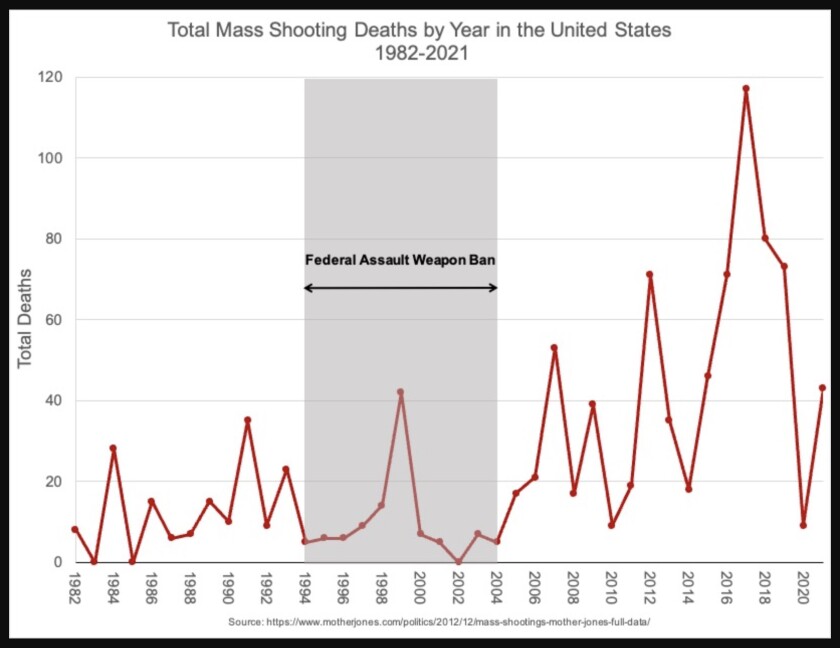
Since the federal ban on assault weapons expired in 2004, mass shootings with those weapons has climbed. An assault weapon was used in the Uvalde massacre of May 24. (Mother Jones)
That changed in 2008, with the Supreme Court’s ruling in the so-called Heller case overturning the District of Columbia’s ban on possession of handguns in the home. Since then, the impression has grown — fostered by the National Rifle Assn. and other elements of the gun lobby — that Heller rendered virtually any gun regulation unconstitutional.
But Justice Antonin Scalia’s 5-4 majority opinion said nothing of the kind. Indeed, Scalia explicitly disavowed such an interpretation. “The right secured by the Second Amendment is not unlimited,” he wrote. The Constitution does not confer “a right to keep and carry any weapon whatsoever in any manner whatsoever and for whatever purpose.”
There was, and is, no constitutional prohibition against laws prohibiting the carrying of concealed weapons, he found. Nothing in his ruling, he wrote, should “cast doubt on longstanding prohibitions on the possession of firearms by felons and the mentally ill, or … the carrying of firearms in sensitive places such as schools and government buildings,” or conditions on gun sales.
The problem with the D.C. law, Scalia wrote, was that it went too far by reaching into the home and covering handguns, which were popular weapons of defense in the home. “The Constitution leaves the District of Columbia a variety of tools” for regulating handguns, as well as other firearms, he wrote.
The federal assault weapons ban, which was enacted in 1994 and expired in 2004, repeatedly came under attack in federal courts, and prevailed in every case. Not a single one of those challenges was based on the 2nd Amendment. Since the expiration of the ban, mass shooting deaths in the United States have climbed steadily.
“Heller has been misused in important policy debates about our nation’s gun laws,” wrote former Supreme Court clerks Kate Shaw and John Bash in a recent op-ed. “Most of the obstacles to gun regulations are political and policy based, not legal.” Shaw and Bash worked on the Heller decision as clerks to Scalia and John Paul Stevens, the author of the leading dissent to the ruling, respectively.
So let’s discard the myth that gun control laws are unconstitutional.
The NRA
By any conventional accounting, the NRA is a shadow of its former self. Its leadership has been racked with internal dissension, its resources have been shrinking and it has faced a serious legal assault by New York state. Attendance at its annual convention last week in Houston drew only a few thousand members, even with former President Trump on hand to speak.
Yet the organization still carries major political weight. To some extent that’s an artifact of its political spending. Even in its straitened circumstances it’s a major political contributor, having handed out more than $29 million in the 2020 election cycle. Some of the politicians taking resolute pro-gun stands are beneficiaries of this largess, mouthing “thoughts and prayers” for the victims of gun massacres while pocketing millions from the NRA.
The NRA also has played a lasting role in blocking funds for research into gun violenceby federal agencies such as the Centers for Disease Control and Prevention, an obstacle that remained in place for some two decades until Congress restored funding in 2019. But the gap in research still hampers gun policymaking. It’s long since time to curb this organization’s blood-soaked influence on our politics.
Debate? What debate?
Part of the knee-jerk news coverage of the aftermath of gun massacres is the notion that the American public is deeply divided over gun regulations. This is a corollary of the traditional claim that American society is “polarized,” which I showed last year to be absolutely false. The truth is that large majorities of Americans favor abortion rights, more COVID-related restrictions and, yes, gun regulations.
More than 80% of Americans favor instituting universal background checks on gun buyers and barring people with mental illness from owning guns, according to a Pew Research Center poll. More than 60% favor banning assault weapons and high-capacity ammo magazines.
The poll was taken last September; it’s a reasonable bet that the majorities would be larger now. To put it another way, the “debate” is over — most Americans want to bring gun sales and ownership under greater control.
Gun regulations work
One claim popular among pro-gun politicians is that gun regulations don’t serve to quell gun violence. (A common version of this trope is that proposed regulations wouldn’t have stopped the latest newsworthy massacre.)
This is a lie, as statistics from the CDC show. States with stricter gun laws have much lower rates of firearm deaths than those with lax laws. The first category includes California (8.4 deaths per 100,000 population) and Massachusetts (3.7). The second group includes Louisiana (26.3) and Texas (14.2, and the highest total gun-related mortality in the country, at 4,164 in 2020).
Texas even loosened its gun regulations just months before the Uvalde massacre. When Missouri repealed its permit regulations for gun ownership in 2007, gun-related homicides jumped by 25% and gun-related suicides by more than 16.1%. When Connecticut enacted a licensing law in 1995, its firearm homicide rate declined by 40% and firearm suicides by 15.4%.
Make them vote
Perhaps the most inexplicable argument justifying congressional inaction over gun laws is that tough laws have no chance of passage, so it’s pointless even to try. Defeatism in the face of urgent need is inexcusable.
The resistance of Republicans to voting for gun laws is precisely the very best reason for bringing those bills to the floor. There’s no reason to give Republican obstructionists a free pass — make them stand up and take a vote.
Make them explain what it is about making Americans safer in schools and workplaces that they find objectionable, and why they think that voting against measures supported by 80% of the public is proper. Bring the fight to them, and show voters the character of the people they’ve placed in high office.
Show the pictures
Americans have become inured to gun violence in part because our culture minimizes its horrors. We’re awash in the most visceral depictions of shootings in movies and television, but at their core those depictions are unthreatening — indeed, in most cases they’re meant for entertainment.
Even our news programs revel in gore — the classic dictum of local news broadcasting has long been “If it bleeds, it leads.”
These conditions have inoculated us against the horror of firearm injuries as they occur in real life — especially those caused by assault weapons such as the AR-15. There’s a big difference between hearing the words “gunshot wound” and learning what actually happens to the organs of victims of AR-15 assaults. They don’t look anything like what we see on TV, and we need to have a true, visceral sense of the difference.
“These weapons are often employed on the battlefield to exact the maximum amount of damage possible with the strike of each bullet,” radiologist Laveil M. Allen wrote last week for the Brookings Institution. “Witnessing their devastating impact on unsuspecting school children, grocery shoppers, and churchgoers is unfathomable. The level of destruction, disfigurement, and disregard for life that a high-powered assault rifle inflicts on the human body cannot be understated. Placed into perspective, many of the tiny Uvalde victims’ bodies were so tattered and dismembered from their ballistic injuries, DNA matching was required for identification because physical/visual identification was not possible.”
You’ll hear the argument that showing photographs of real victims or the scenes of massacres will only be more traumatizing. For some people, including the victims’ families, that may be true. But that only underscores my point — we have not been sufficiently traumatized, and the creation of a truly effective mass movement for gun laws requires that we be traumatized.
Because we experience the horror of gun massacres at a remove, they tend to drift out of public consciousness in a distressingly short time span. Even after the Sandy Hook killings, which took the lives of 20 children ages 6 and 7 less than 10 years ago, there was something distancing about reportage of the event. Photos of some of the murdered children have been made public, but they are photos from life, showing the children smiling at birthday parties or gamboling about the playground.
Let’s face it — few Americans were thinking about the Sandy Hook killings until May 24, when the Uvalde massacre brought them bubbling back to public consciousness. Would our reaction be different had we seen photographs of classrooms slathered in blood, of children’s bodies ripped to pieces by Adam Lanza’s assault rifle?
You bet it would. Those images would not easily be forgotten. Every time a GOP senator or representative stood up to declare that the right to own assault weapons trumped the right of those children to live their lives, someone should have produced one of those photographs and said, “Justify this.”
Our risk is that Uvalde will be just another Sandy Hook. Soon to move off the front burner, or soon buried under the choruses of “We can’t pass this” or “This won’t work” or “This is the path we’ve chosen.” We need to change the terms of discussion, or Uvalde will just be the latest massacre of a long line, not the last massacre of its kind.
We know now that the extreme crazies are determined to create “universal distrust” in public schools, as far-right extremist Chris Rufo said in his infamous Hillsdale speech. We have seen how they insult dedicated, hard-working teachers as greedy, lazy, even implying or saying that some are “grooming” children for sexual perversions.
The gutter snipes of the extreme right never rest, so they quickly leapt on a statement by President Biden praising outstanding teachers. The haters cleverly deleted one important word from his statement to turn his praise into a claim that the state “owns” the children.
Wonder what that one word was? Open Peter Greene’s commentary for a demonstration of how the omission of one word was used to promote demagoguery and deception.
So back in September the BLS [the federal Bureau of Labor Statistics] released the monthly Jobs number. A terribly disappointing 234,000 Jobs +- . It was disappointing because the same economic analysts who could not see a Housing Bubble bigger than the Stay Puff Marshmallow man had predicted 300,000 + . The fact that it was as high or higher than all but a handful of the previous 120 months never seemed to dawn on the talking heads. In October there were 677,000 Jobs added. And at the same time the number for October was adjusted 200,000 higher. It took the media all of 10 seconds to shift the narrative to “oh but inflation” As stated by some CNBC talking head that day, inflation is an expectations game. If workers expect inflation they will ask for higher wages. If employers expect inflation they will charge more for goods and services. Inflation in September was all of 4.4 ,% high but not earth shaking. Then the (respectable) media ran stories of almost $6 dollar a gallon gas as if that was the norm. Of a Tex-ass couple who goes through 9 gallons of milk a week and was bankrupted by the cost (don’t ask about birth control). Of a Station owner in NJ who spends $1000s a week on gas for his 1970 muscle car and his 2000 Escalade.
Well the message was received, the expectation of inflation was created. Wages now contribute 8.5% of the inflationary spike. Raw materials and supply chain issues 27% of the inflation we see. And excess profits contribute 53% of the price hikes we are seeing. (EPI). It would seem the right people got the right message but it was not the American worker who in spite of all the hype does not have the power to demand wage increases on a broad based scale as they did in the past. In previous inflationary spikes inflation was driven 70% by wage increases . The media hype on inflation prior to the Ukraine war enabled corporations to profit vastly. The expectation was there. Corporate America hopped right on the band wagon. Don’t expect the corporate media to hop on board calling for an excess profits tax, or even to harp on those excess profits. Instead we will hear nonsense about low wage workers holding out for a living wage.
Was it a conscious conspiracy ? Probably not . Is it a combination of of group think and inferior reporting (IMHO) absolutely.
Moving on to Crime in NYC . In a nut shell if NYC was the safest big city in America in 2010 (according to Bloomberg) than how did it get unsafe in 2021 when every Crime Stat released by the NYPD is lower than 2010, when people felt the City was safe.
My favorite NYC crime category is rape. In 2021 there were 1491 reported rapes in NYC up from 1427 in 2020. Women be afraid be very afraid!!!. But wait there were 1755 in 2019 and 1791 rapes in 2018, when everyone thought the City was very safe.
The Right wing media generates a narrative and instead of countering it, the supposedly Liberal MSM run with the story. . Cowardly Democratic politicians who call themselves moderates hop right on board not wanting to seem like they are ignoring an issue.
If Trump was President every Republican would be calling inflation fake news and their Ivermectin downing base would be swallowing it hook line and sinker.
Robert Hubbell is a blogger who writes consistently insightful, common sense commentaries. In this one, he makes an important point. What happened to outrage?
I recall when presidential candidate Senator Gary Hart of Colorado dropped out of the race after the press got photos of him on a boat with a woman who was not his wife. Imagine that! I remember when a president (Nixon) was forced to resign his office because he lied about his role in burgling the offices of the Democratic National Committee. At least official Washington had public standards of behavior. Republican Senator Howard Baker of Tennessee was as appalled by Nixon’s behavior as members of the other party. Yet Lamar Alexander, who claimed Baker as his role model, twice refused to vote to impeach Trump for violating his oath of office and for actions far more dangerous than anything Nixon did, even though Alexander was retiring.
Hubbell wrote this before the Uvalde school massacre. Watch the process: Americans are outraged. The media are outraged. What happens next? Our attention shifts. Uvalde fades, as Sandy Hook faded, as Parkland faded, as Buffalo will fade.
The capacity for outrage—in the political class, in the media, and in the public— seems to have vanished.
Hubbell writes:
“The apparent death of outrage is one factor driving many Americans to distraction, if not despair. Stories that would have shaken the foundations of democracy a decade ago barely reverberate for a single news cycle today. Quick! Answer this question: What was the biggest story of last Friday (as in two days ago)? It is that the wife of a sitting Supreme Court justice actively encouraged Arizona legislators to overthrow the Constitution by appointing fraudulent electors. The January 6th Committee previously discovered that Ginni Thomas forwarded emails from other election deniers to members of the Trump administration, but the most recent revelation clarifies that Ginni Thomas was a direct participant in the plot to subvert democracy. But by Sunday evening, the story has dropped from the pages of every major newspaper in America.
And, of course, Justice Clarence Thomas reviewed Mark Meadows’ request to block the disclosure of emails and texts from Ginni Thomas about the attempted coup. Before the endless stream of Trump scandals killed outrage, those facts would have prompted Justice Thomas to submit his resignation and spend the remainder of his life in solitude and shame. Instead, Thomas is on a revenge tour at the Antonin Scalia School of Law, where he is scolding women for protesting an impending decision that will grant state governments control over their reproductive choices.
Over the weekend, Senator Rick Scott couldn’t find the decency to say that leaders of the GOP should condemn white supremacy. Talking Points Memo, Scott Deflects On Whether GOPers Should Condemn White Nationalism. Scott agreed that racism was bad and that “all Americans” should condemn “any hate” and “any white supremacy,” but repeatedly dodged the question of whether Republican leaders had a responsibility to do so. Instead, he volunteered that “We have to stop asking people on government forms for their skin color” and “every Senate candidate on both sides is going to decide what is important to them”—evasions that leave room for his Republican colleagues to wink-and-nod to white supremacists on the campaign trail.
Also over the weekend, the Conservative Political Action Conference (CPAC) held its annual meeting in Hungary so that Hungarian Prime Minister Viktor Orbán could lecture aspiring American autocrats on how to subvert “illiberal democracy.” The panel of speakers included Trump, Tucker Carlson, and a Hungarian journalist infamous for writing that Jews are “stinking excrement,” that Roma are “animals,” and that Black people are [unprintable]. See Times of Israel, Hungarian journalist who called Jews’ stinking excrement’ addresses CPAC conference. Do either Trump or Carlson feel any need to distance themselves from the reprehensible views of their co-presenter? Ha! It was not worth the electrons to type that rhetorical question on my laptop.
On Friday of last week, Louisiana Senator Bill Cassidy attempted to explain away the high maternal mortality rates in his state. Cassidy made the following repugnant statement:
About a third of our population is African American; African Americans have a higher incidence of maternal mortality. So, if you correct our population for race, we’re not as much of an outlier as it’d otherwise appear.
See Business Insider, Maternal death rate isn’t as bad if you don’t count Black women, GOP senator says. Cassidy’s statements were so offensive it is difficult to know where to begin. To be clear, Louisiana’s maternal death rate among Black women is worse than the maternal death rate for Black women in other states, so Cassidy’s racist statistics are wrong. But what does Cassidy mean, “if you correct our population for race?” By “correcting” for race, Cassidy clearly implies that the “correct” race in Louisiana is white. But Cassidy’s comments have been largely ignored by the mainstream media.
And then there is Dr. Oz, who went out of his way on election night thank Fox News personality Sean Hannity for helping his campaign. That would be the same Sean Hannity who was busy trashing one of Dr. Oz’s opponents in the primary (the late-surging Kathy Barnette) as Hannity acting as a a “behind the scenes advisor” to Oz. See Dan Rather and Elliot Kirschner in Steady, Crossing the Line. Rather and Kirschner write that Fox News “is a functional arm of the Party of Trump.” Does anyone care? As Rather astutely observes,
Needless to say, if a reporter at a news organization other than Fox supported a candidate with half as much complicity as Hannity did Dr. Oz, it would be grounds for immediate termination. Not surprisingly, at Fox News, Hannity’s actions don’t even earn a slap on the wrist.
And therein lies the problem: The capacity for outrage is becoming a one-way street. Hannity can break all rules of journalistic independence, and no one cares. Senator Cassidy can suggest that Blacks are not part of Louisiana’s “correct” race, and no major mainstream sources bother to report on the comments. The wife of a Supreme Court justice can encourage insurrection, and the justice goes on the attack against “liberals.” But . . . If any of those situations were reversed such that a liberal journalist, Democratic Senator, or liberal justice was involved, the outrage from the right would be unending, unforgiving, and shrill.
We must not lose our capacity for outrage. We cannot allow insurrection to be normalized. We cannot allow the sheer volume and velocity of GOP scandals to overwhelm and exhaust us. Indeed, we must recognize that conservatives try to turn outrage to their benefit by making more of it—to provoke “outrage fatigue.”
The wife of a supreme court justice participated in an attempted coup. That fact is outrageous and should matter to every American and should remain on the front pages of every newspaper in America until the justice resigns or recuses himself from all election-related cases.
More one-sided reporting in WaPo.
The Washington Post is running a story in its Monday edition, Democrats See Headwinds in Georgia, and Everywhere Else. The subheader says that Democratic candidates will “be running against President Biden’s low ratings as well as their G.O.P. rivals.” The article accurately reports on the challenges facing Democrats but does not acknowledge that Republicans are led by a twice-impeached failed coup-plotter who insists on absolute allegiance to a disproven conspiracy theory and has led the effort to deny women the right to control their reproductive choices.
About two-thirds of the way through the story, the author makes a nod to the difficulties faced by the GOP—but only by describing comments from a Republican voter:
[Democrats] need to do more to communicate clearly with voters that they are a steady hand at the wheel of getting the economy back on track for people.” Ms. Bourdeaux said. But she, too, saw a chance to draw a sharp contrast with what she described as ascendant far-right Republicans. “The other side, candidly, has lost its mind,” she said, pointing to efforts to restrict voting rights and abortion rights.
Hmm . . . if a Democratic voter had said that the Democratic Party “has lost its mind,” that would be the headline in the article. Oh, and here is the clincher: The author concedes near the end of the article that “Most polling shows a close race for [Georgia] governor and Senate, with a slight Republican advantage.”
Got that? The races for Governor and Senator in Georgia are “close,” but the story focuses on “headwinds” faced by Democrats because of the economy and Biden, with almost no mention of the challenges for the GOP created by an out-of-control Trump, reversal of Roe v. Wade, and unrestrained concealed carry of handguns by June.
More accurate headlines for the article could include, “One reporter’s attempt to trash the Democrats by rehashing the economy and Biden’s favorability ratings” or “According to one Republican voter, ‘The GOP has lost its mind.’” I will let you choose your favorite headline or suggest alternatives in the Comments section or by reply email to me.
Concluding Thoughts.
There is an old joke that goes like this: “I just flew into Las Vegas and, boy, are my arms tired.” My wife and I just spent forty-eight hours taking care of one granddaughter while simultaneously pinch-hitting with a second granddaughter for eight hours on Saturday, and boy, are my arms tired! It was tough writing the newsletter tonight because I could not get the words of the literary classic Good Dog Carl Visits the Zoo out of my mind. (Reading a book out-loud dozens of times over the course of forty-eight hours will do that to you.) A sign of my desperation is that I was delighted to take a mental break by watching The Little Mermaid after failed multiple failed attempts to get our granddaughter to take a nap. Let me say that The Little Mermaid is an underappreciated classic that deserves a place alongside The Godfather and Citizen Kane (at least that’s how I feel tonight).
In lieu of my own closing thoughts (which are often the most challenging part of the newsletter to write), I include a list of Democratic candidates to support, supplied by Ellie Kona. Many of you may know Ellie as a frequent commenter on Heather Cox Richardson’s newsletter on Substack, Letters from an American. Per Ellie, “Here is a handy-dandy list of Dems to support, along with their Twitter handles (courtesy of Nick Knudsen):
Robert Kuttner of The American Prospect is one of my favorite thinkers, and I am glad to share his latest with you. Republicans like to say, as Texas Governor Greg Abbott did, that this is not the time to “politicize” the issue of gun control, in the midst of a massacre of students and their teachers. But, if this is not the right time, when is? This horrific event was not an accident, it was the result of Republican policies that put the rights of gun owners over the right to life. Republicans have used politics to put the lives of children, teachers, grocery shoppers, and other citizens at risk. Now is the time to say so.
Republicans on the Wrong Side of Public Outrage
Their opposition to gun laws and assault on women’s health should be center-stage issues.
Here’s the bizarre thing about mass gun violence that takes the lives of schoolchildren and the likely reversal of Roe v. Wade: Public opinion is not with the right. It is overwhelmingly in favor of banning civilian purchase of assault weapons. It is overwhelmingly in favor of keeping Roe. And yet a party that espouses these and other extreme views is on the verge of taking over the country. If we let it.
What can prevent this grim fate is resolute leadership that stands with most Americans—and also hangs this lunacy around the necks of Republicans and makes them squirm. In his first statement on the mass murder, Texas Gov. Greg Abbott noted that the shooter was dead. You can imagine how much comfort that offers parents.
Other Republicans have offered reassurance by pointing out that the killer acted alone. No, he did not. He had multiple Republican accomplices who keep blocking gun control and valorizing guns with open-carry laws.
They also like to term the Texas shooting a “tragedy.” No, it was not. It was preventable homicide of children. Political allies of abortion zealots who worry about the alleged rights of the unborn need to look to the rights of living children.
President Biden was at his best in his statement on the Texas school shooting. He called out both the gun lobby and the gun manufacturers. He ridiculed gun nuts who conflate hunting rifles with assault weapons.
When we passed the assault weapons ban, mass shootings went down. When the law expired, mass shootings tripled. The idea that an 18-year-old kid can walk into a gun store and buy two assault weapons is just wrong. What in God’s name do you need an assault weapon for except to kill someone? Deer aren’t running through the forest with Kevlar vests on, for God’s sake. It’s just sick. Biden’s expression of appalled sympathy was from the heart. “To lose a child is like having a piece of your soul ripped away,” he said. Biden has been there.
Maybe the president’s first statement on the shooting was not the time to call out the Republicans who resist even the mildest gun legislation. But this is no time to temporize for fear of rural voters or pro-gun Democrats. The vast majority of citizens are sick of this carnage.
Biden needs to follow up by sending Congress legislation that goes beyond poll-tested “commonsense” measures like background checks and the extension of existing regulations to gun shows. We need to ban all military weapons, and to identify the wall-to-wall opposition with Republicans, and dare them to block it.
Biden is facing political headwinds on inflation and supply shortages. But on gun control and women’s health, public opinion is with him, and Republicans look like fools. There is nothing shameful about maximizing the partisan advantage. In a democracy, that’s what leadership is all about.
Vouchers are a big issue in Texas. Governor Greg Abbott recently announced he would promote them. Lt. Gov. Dan Patrick—the Rush Limbaugh of Texas—is a voucher fanatic. Senator Ted Cruz said that school choice is the most important issue of our time.
Vouchers are unpopular in places where public schools are the lifeblood of community.
With Gov. Greg Abbott’s announcement that he’ll pursue “school choice” in the upcoming Legislature, there’s political math to be done.
The governor’s proposal is pencil whipping his previously reliable rural voting base, presuming that rural communities will stick with him as he looks past the November match-up against Beto O’Rourke, and moves to the next problem of Florida Gov. Ron DeSantis, a probable 2024 presidential foe. But in rushing to check off another box on the national GOP purity exam, questionable work has been submitted.
Out where rural public schools constellate expansive Lone Star landscape, out where the real Texas economic miracle of food, fuel, and fiber is produced, there’s pencil scratching being done.
Rural folks know school choice will come at their expense. Almost like the same-old bait (moral convictions) and switch (economic interests) over and over. It’s been that way for more than 30 years, since the GOP came to power promising term limits and local control — and how has that gone?
We’ve voted for plenty of slippery-as-slop-jar scenarios, like numerous federal officials who vote against subsidies for the state’s $25 billion annual agriculture industry. In 2018, cotton had fallen out of a federal funding program to help producers break even, and it was Abbott who single-handedly stalled restoration from Austin. We’ve closed 26 hospitals since 2010. Now just 163 hospitals provide care for 85% of the state’s geography, many with limited services. We’ve incrementally upped local property taxes to fill state budget holes over three decades. And Abbott’s routing of state infrastructure, including pivotal rural telecommunications by his commissioned appointees, could make Santa Anna blush.
But the missing variable in the slippery school choice proposal is the importance of public schools to respective rural communities — and the pillars of community within those schools. I know because I attended them.
Gid Adkisson, a gargantuan man, long in kindness as he was physique, was a retired school superintendent in Abernathy (population 2,904, about 25 miles north of Lubbock) with a bad lifelong cotton farming habit. He’d head out from his homestead to the high school for Gid Night Lights to voluntarily tutor us in algebra on Mondays and Thursdays, so we could play under the Friday Night Lights.
Children, even deviant teenagers like I was, know goodness when they see it. When I first think of Gid, I don’t picture him physically; I think of his heart. The physical trait I most remember is the big dent on his forehead that shone in the lights of Ms. Hardin’s classroom.
Bettie Hardin was a petite, put-together woman — pristine white perm, horn-rimmed glasses, mock turtleneck. She played the Methodist piano every Sunday morning with the same precision she expected from our math during the week.
Sports were our world. And Ms. Hardin could end that world with the swipe of a red pen.
But Gid came to the rescue, helping us understand it all. The first time I figured out ratio and proportion equations, Gid was right there, two huge knuckles on the desk behind me, affirming and encouraging me as my mind translated through pencil what Hardin and he had worked so hard to cultivate. When the problem was solved, the huge knuckles rose above the suspenders past the dent and to the lights, “Good, golly. You got it.”
I don’t today use an acquired high school skill — from on or off the field — more frequently than that equation.
Sitting in Wayne Riley’s 6th Grade Sunday School with half a dozen others was the first time I ever first-hand witnessed a grown man weep; we’d know him later as Coach Riley, our varsity basketball coach.
When my grandmother passed, I was destroyed and my band teacher Harold Bufe took a knee and consoled me about the loss of my world and his longtime friend.
When Gid died, many of us learned what we didn’t know all along: he’d been rescuing people for a long time. He led the 317th Regiment, 80th Infantry Division up Utah Beach where dented-head man earned, but later refused, a Purple Heart. Too many missing human variables under his command for him to accept such an award.
Public education gave us a tutor who defeated Hitler, coaches who earned our respect, and band teachers who helped us outside the notes. And Ms. Hardin who played Amazing Grace as the soundtrack.
My story isn’t uncommon, which is the point.
We’ll vote against ourselves on a myriad of issues, but not our schools.
Add to it all, rural folks know a little grammar as well.
“Choice” is a political synonym for “consolidation” and “consolidation” is another way of saying “closing” our communities — and our organists, Purple Hearts, and Sunday school teachers.
The political math for Abbott and statewide Republicans is they desperately need rural Texas votes to overcome deficits in the likes of Dallas, Tarrant, Travis, and Harris Counties. Their campaign commercials running longer loops every four years are evidence.
And while Oltons, Borgers, Ballingers, Floydadas, Abernathys, and the 85% of Texas geography won’t become Beto O’Rourke Country anytime soon, if ever, these places might just not vote.
Pull the lever, do your duty, get the sticker, but leave the gubernatorial box left open.
The collective rural Republican state representative silence on the governor’s initiative is already telling. Silence from electeds who backed Abbott’s $118 million for pre-K public education funding in 2015, only to have Abbott abdicate in subsequent far-right primary challenges.
Mr. O’Rourke may well come for some of our guns, but that’s highly unlikely with a legislative and judicial GOP stronghold.
But Abbott’s open threat is against the lifeblood of our communities: our schools. And he’s making it with a three-branch majority.
That’s Abbott’s math now. And Gid’s currently unavailable to tutor.
Jay Leeson is a freelance writer and artist in Lubbock. He wrote and illustrated this for The Dallas Morning News.
This post by Heather Cox Richardson aims to explain the bizarre transformation of the Republican Party. To those of us old enough to remember Republicans such as Dwight D. Eisenhower, Earl Warren, Howard Baker, George Romney, Nelson Rockefeller, and Jacob Javits, today’s GOP is incomprehensible. Long ago, the GOP was the party of fiscal conservatism. Today it is the party of Trump and the religious right. An odd combination. Please open the link to see the notes at the end of the post.
She writes:
The modern Republican Party rose to power in 1980 promising to slash government intervention in the economy. But that was never a terribly popular stance, and in order to win elections, party leaders wedded themselves to the religious right. For decades, party leaders managed to deliver economic liberties to business leaders by tossing increasingly extreme rhetoric and occasional victories to the religious right. Now, though, that radicalized minority is driving the party. It has thrown overboard the idea of smaller government to drive economic growth and embraced the idea that a strong government must enforce the religious and social beliefs of their base on the rest of the country.
This religiously based government wants to control not just individuals, but also businesses. We are seeing not only the apparent overturning of the Roe v. Wade decision legalizing abortion, but also the criminalization of contraception, attacks on gay and trans rights, laws giving the state the power to design school curricula, fury at immigrants, book banning, and a reordering of the nation around evangelical Christianity.
Today, when the Senate voted on the Women’s Health Protection Act, a bill protecting the constitutional right to abortion as originally recognized in Roe v. Wade, all of the Republicans voted against it, along with Democrat Joe Manchin of West Virginia. Manchin said the bill was too broad, although he did not say in what way.
Modern Republicans are not limiting this strong state to the policing of individuals. They are using it to determine the actions of businesses. Even two years ago, it was unthinkable that Florida governor Ron DeSantis would try to strip its longstanding governing power from the Walt Disney Company to force the company to shut up about gay rights, and yet, just last month, that is precisely what happened.
Similarly, in his quest to weaponize the issue of immigration, Texas governor Greg Abbott drastically slowed the trade routes between Texas and Mexico between April 6 and April 15, costing the country $9 billion in gross national product and prompting Mexico to change the route of a railway connection worth billions of dollars from Texas to New Mexico. And now Senator Josh Hawley (R-MO) is proposing to use the government to strip Disney of its copyrights, a plan Professor Paul Goldstein of Stanford Law School, who specializes in intellectual property, calls “blatantly unconstitutional.”
This is no longer your mother’s Republican Party, or your grandfather’s… or his grandfather’s.
Today’s Republican Party is not about equal rights and opportunity, as Lincoln’s party was. It is not about using the government to protect ordinary people, as Theodore Roosevelt’s party was. It is not even about advancing the ability of businesses to do as they deem best, as Ronald Reagan’s party was.
The modern Republican Party is about using the power of the government to enforce the beliefs of a radical minority on the majority of Americans.
After more than a year of emphasizing that he could work with Republicans, President Joe Biden yesterday went on the offensive against what he called “the Ultra-MAGA Agenda.”
He focused on Florida senator Rick Scott’s “11-Point Plan to Rescue America,” which offers a blueprint for creating the modern Republican vision, beginning with its statement that “[t]he nuclear family is crucial to civilization, it is God’s design for humanity, and it must be protected and celebrated.” To protect that family, Scott not only wants to end abortion rights, but also proposes requiring all Americans, no matter how little money they make, to pay income taxes, and to make all laws—including, presumably, Social Security, the Affordable Care Act, Medicare, and so on—expire every five years. Congress can then just repass the ones it likes, he says.
Yesterday, Biden laid out the difference between his economic plan and Scott’s. He pointed out that his policies of using the government to support ordinary Americans have produced 8.3 million jobs in 15 months, the strongest job creation in modern history. Unemployment is at 3.6%, and 5.4 million small businesses have applied to start up this year—20% more than in any other year recorded.
Now, he says, the global inflation that is hurting Americans so badly is his top priority. To combat that inflation by taking on the price of oil, he has released 240 million barrels of oil from the Strategic Petroleum Reserve to boost supplies, and increased domestic oil production. To lower prices, he has untangled supply chains, and now he wants to reduce our dependence on oil by investing in renewables, to restore competition in key industries (like baby formula) now dominated by a few companies, and to take on price gouging. And he has asked the wealthiest Americans “to pay their fair share in taxes,” since “[i]n recent years, the average billionaire has paid about 8% in federal taxes.”
Biden wants to take on household finances quickly by letting Medicare negotiate prices for prescription drugs to lower prices—as other developed nations do—and cap the price of insulin.
In contrast, he said, Republicans are proposing to raise taxes on 75 million American families, more than 95% of whom make less than $100,000 a year. “Their plan would also raise taxes on 82% of small-business owners making less than $50,000 a year,” he said, but would do nothing to hold corporations accountable, even as they are recording record profits. The plan to sunset laws every five years would give Republicans leverage to get anything they want: “Give us another tax cut for billionaires, or Social Security gets it.”
Biden pointed out that while Republicans attack Biden’s plans as irresponsible spending, in fact the deficit rose every year under Trump, while Biden is on track to cut the deficit by $1.5 trillion this year. Reducing government borrowing will ease inflationary pressures.
Republicans responded to the president with fury, recognizing just how unpopular Scott’s plan would be if people were aware of it. They suggested that it is a fringe idea; host Dana Perino of the Fox News Channel tried to argue that Scott “is eating alone at the lunch table.” Scott promptly called Biden “unwell,” “unfit for office,” and “incoherent, incapacitated and confused,” and said he should resign.
While Republicans have not championed Scott’s program, they have let it stand alone to represent them. White House press secretary Jen Psaki pointed out that Scott’s plan is the only one the Republicans have produced, since Senate minority leader Mitch McConnell has said he will not release any plans before the 2022 midterm elections, preferring simply to attack Democrats. Until he does, Scott is speaking for the party. And Scott is hardly a fringe character: as chair of the National Republican Senatorial Committee, he is in charge of electing Republicans to the Senate. Psaki went on to read a list of Republicans who supported Scott’s plan, including the chair of the Republican National Committee, Ronna McDaniel, who applauded Scott’s “real solutions to put us back on track.”.
Senator Elizabeth Warren (D-MA) also called out Republican far-right extremism yesterday in her defense of abortion rights, hitting again and again on how their stripping away of a right established almost 50 years ago is dangerous and radical. Polls show that a majority of Americans want the court to uphold Roe v. Wade, while a Monmouth poll published today shows that only about 8% of Americans want abortion to be illegal in all cases, as new trigger laws are establishing.
The unpopularity of the probable overturning of Roe v. Wade also has Republicans backpedaling, trying to argue that losing the recognition of a constitutional right that has been protected for fifty years will not actually change abortion access. Ignoring both the move toward a national abortion ban and the voting restrictions newly in place in 19 states that cement Republican control, they say that voters in states can simply choose to protect abortion rights if they wish. Wisconsin Republican senator Ron Johnson said, “It might be a little messy for some people,” but Wisconsin women could obtain an abortion by driving to Illinois. “[I]t’s not going to be that big a change,” he told the Wall Street Journal.
If overturning Roe v. Wade is such a nothingburger, why has the radical right fought for it as a key issue since the 1980s? In any case, Republicans are no longer able to argue that their extremists are anything other than the center of the party. As Representative Elise Stefanik (R-NY), the third officer in Republican leadership in the House, said after Biden spoke: “I am ultra MAGA. And I’m proud of it.”
The Tennessee voucher bill passed by only one vote. There was a delay in getting that last vote. Charges flew that the vote was swayed by more than reason. The FBI started an investigation, and the legislator was just called to appear before a grand jury.
NASHVILLE, Tenn. (WTVF) — A Republican lawmaker who cast the decisive vote for Tennessee Gov. Bill Lee’s school voucher plan has been subpoenaed to appear before a federal grand jury next week, NewsChannel 5 has learned.
Two independent sources with knowledge of the investigation tell NewsChannel 5 Investigates that Rep. Jason Zachary, R-Knoxville, is among a group of House Republicans who were served with federal grand jury subpoenas this week. That group includes House Speaker Cameron Sexton, R-Crossville.
Zachary refused to comment as he entered the House session Thursday morning.
The investigation of corruption on Tennessee’s Capitol Hill comes against the backdrop of apparently ongoing interest by the FBI in how then-Speaker Casada managed to pass Lee’s plan to create a school voucher program, known as Educational Savings Accounts, to pay for private school tuition in Davidson and Shelby counties.
In April 2019, a House vote on Lee’s voucher bill failed on a 49-49 tie vote.
Casada held the vote open for some 45 minutes while he sought the decisive 50th vote.
Zachary eventually switched his vote after Lee’s team agreed to exempt Knox County from the legislation. Zachary later denied that he was offered anything improper for his vote.
That lawmaker, who asked not to be identified, said agents wanted to know about campaign contributions offered to support the reelection efforts of those willing to vote for the bill.
In July 2019, Rep. John Mark Windle, D-Livingston, confirmed information obtained by NewsChannel 5 Investigates that another lawmaker had overheard Casada suggesting that — in exchange for his vote — Windle could be promoted to the rank of general in the Tennessee National Guard.
Windle, an Iraq war veteran who was a colonel in the Guard, refused to switch his vote, saying in a statement that his vote was “not for sale.”

 Diane Ravitch's blog