Archives for category: Republicans

Thom Hartmann looks back to the Ronald Reagan presidency to explain how Republicans seized the strategy of tax cuts and spending to counter the Democrats’ winning formula of social welfare spending. Now Republicans are threatening to force the federal government to default on the national debt, which would plunge the global economy into chaos, unless Democrats make deep cuts in social programs like Social Security and Medicare.

Hartmann writes:

The media refers to it as a debate around the debt ceiling, but it’s actually far simpler than that. And entirely political.

Back in November, a few weeks after House Republicans won the election and seized control of that body, I wrote to you warning that the House Republicans would try the same scam that Ronald Reagan first rolled out in the 1980s. I wrapped the article up with the “hope that Democratic politicians and our media will, finally, call the GOP out on Wanniski’s and Reagan’s Two Santa Clauses scam.”

So far, no soap. I haven’t heard a single mention of Two Santas in the mainstream media, and I’ll bet you haven’t, either. That’s the bad news.

The good news — perhaps — is that the scam has lost its sting after working so well for them for 42 years. President Biden and House Democrats are standing firm, saying they have no intention of negotiating around the debt ceiling with terrorists threatening to destroy our economy.

But even if it’s the last gasp of this scam, it appears House Republicans plan to go out with a bang. So let’s quickly review how Two Santas works.

Back in 1976 the Republican Party was a smoking ruin. Nixon had resigned after being busted for lying about his “secret plan to end the Vietnam War,” his involvement in the Watergate burglary, and his taking bribes from Jimmy Hoffa and the Milk Lobby. He only avoided prosecution because Gerald Ford pardoned him. 

His first Vice President, Spiro Agnew, had also resigned to avoid prosecution for taking bribes.

Newspaper and television editorialists were openly speculating the GOP might implode. The Party hadn’t held the House of Representatives for more than two consecutive years since 1930(and wouldn’t until 1994), Jerry Ford had ended the War the year before in a national humiliation, the unemployment rate was over 7 percent, as was inflation after hovering around 11 percent the year before.

The Republican Party had little to offer the American people beyond anti-communism, their mainstay since the 1950s.

Americans knew it was Democrats who’d brought them Social Security, Medicare, Medicaid, unemployment insurance, subsidized college, the right to unionize, antipoverty programs, and sent men to the moon. And they knew Republicans had opposed the “big government spending” associated with every single one of them.

But one man — a Republican strategist and editorial writer for The Wall Street Journal named Jude Wanniski — thought he saw a way out. It was, he argued, a strategy that could eventually bring about a permanent Republican governing majority.

In a WSJ op-ed that year, Wanniski pointed outthat Americans thought of Democrats as the “Party of Santa” and Republicans as, essentially, Scrooge. Republicans, he noted, hadn’t even proposed a tax cut in 22 years!

The solution, Wanniski proposed, was for Republicans to start pushing tax cuts whenever the GOP held the White House. This would establish their Santa bona fides, particularly if Democrats objected. It would flip the script so Democrats would fill the role of Scrooge.

To make it even easier for Republicans to cut taxes, Wanniski invented and publicized a new economic theory called Supply-Side Economics. When taxes went down, he said, government revenue would magically go up!

Four years later, when Reagan came into the White House with the election of 1980, he picked up Wanniski’s strategy and doubled down on it. (In the primary of 1980, he’d even run on it: his primary opponent, George Herbert Walker Bush, derided it as “Voodoo Economics.”)

Reagan not only cut taxes on the rich: he also radically increased government spending, goosing the economy into a sugar high while throwing the nation deeply into debt.

Citing Supply-Side Economics, in eight short years Reagan ran up greater deficits than every president from George Washington to Jerry Ford combined, taking our national debt from around $800 billion all the way up to around $2.6 trillion when he left office.

By 1992, when Bill Clinton won the presidency, Reagan and Bush’s debt had climbed to over $4.2 trillion, giving Republicans a chance to double down on Two Santas. Bill Clinton would be their test case.

House Republicans loudly demanded that Clinton “do something!” about the national debt, waving the debt ceiling like a cudgel. Over the next eight years they repeatedly wielded the debt ceiling, shutting down the government twice. The battles lifted Newt Gingrich to the speakership. 

Clinton caved, making massive cuts to the social safety net to get a balanced budget, a gut-shot to the Democratic Santa programs.

By the end of the Clinton presidency the formula was set. When Republicans held the White House, they’d spend like drunken Santas and cut taxes to the bone to drive up the national debt.

When Democrats come into the presidency, Republicans would use the debt ceiling to force them to cut their own social programs and shoot the Democratic Santa. 

As I noted last November, when Clinton shot Santa Claus the result was an explosion of Republican wins across the country as GOP politicians campaigned on a “Republican Santa” platform of supply-side tax cuts and pork-rich spending increases.

Democrats had controlled the House of Representatives in almost every single year since the Republican Great Depression of the 1930s, but with Newt Gingrich rigorously enforcing Wanniski’s Two Santa Claus strategy, they used the debt ceiling as a weapon.

State after state turned red and the Republican Party rose to take over, in less than a decade, every single lever of power in the federal government from the Supreme Court to the White House.

Looking at the wreckage of the Democratic Party all around Clinton in 1999Wanniski wrote a gloating memo that said, in part:

“We of course should be indebted to Art Laffer for all time for his Curve… But as the primary political theoretician of the supply-side camp, I began arguing for the ‘Two Santa Claus Theory’ in 1974. If the Democrats are going to play Santa Claus by promoting more spending, the Republicans can never beat them by promoting less spending. They have to promise tax cuts…”

Ed Crane, then-president of the Koch-funded Libertarian CATO Institute, noted in a memo that year:

“When Jack Kemp, Newt Gingrich, Vin Weber, Connie Mack and the rest discovered Jude Wanniski and Art Laffer, they thought they’d died and gone to heaven. In supply-side economics they found a philosophy that gave them a free pass out of the debate over the proper role of government. … That’s why you rarely, if ever, heard Kemp or Gingrich call for spending cuts, much less the elimination of programs and departments.”

Two Santa Clauses had fully seized the GOP mainstream.

Never again would Republicans worry about the debt or deficit when they were in office, and they knew well how to scream hysterically about it and hook in the economically naïve media as soon as Democrats again took power….

Please open the link and read the rest of the article.

Think of the most extreme, most vitriolic, least responsible members of the GOP caucus in the House of Representatives. Think of the ones who defended the insurrection. Think of those who encouraged the effort to overturn our government. Speaker Kevin McCarthy just put them on the most important committee in the House, the one that will conduct investigations for the next two years.

Hunter Biden’s laptop! Hunter Biden’s Laptop! Jewish space lasers! QAnon! Pedophiles! The entire Biden family (unlike the Trump family) enriching themselves on your dime (please don’t bring up the $2 billion that the Saudis gave Jared Kushner after Biden took office!) Hunter Biden’s laptop! The hundreds of classified documents that Trump fought to hold onto for over a year, first claiming they were planted by the FBI, then claiming they were his personal property, and the small number of documents that Biden immediately turned over! Trump good, Biden bad! Laptop!

The New York Times reported:

WASHINGTON — They were deeply involved in President Donald J. Trump’s efforts to overturn the 2020 presidential election results. They have come to the defense of people being prosecuted for participating in the deadly storming of the Capitol on Jan. 6, 2021. Some have called for violence against their political enemies online, embraced conspiracy theories or associated with white supremacists.

Several of the most extreme Republicans in Congress and those most closely allied with Mr. Trump have landed seats on the Oversight and Accountability Committee, the main investigative organ in the House. From that perch, they are poised to shape inquiries into the Biden administration and to serve as agents of Mr. Trump in litigating his grievances as he plots his re-election campaign.

Their appointments are the latest evidence that the new Republican majority is driven by a hard-right faction that has modeled itself in Mr. Trump’s image, shares his penchant for dealing in incendiary statements and misinformation, and is bent on using its newfound power to exact revenge on Democrats and President Biden.

Many of the panel’s new Republican members — including Representatives Marjorie Taylor Greene of Georgia, Paul Gosar of Arizona, Lauren Boebert of Colorado and Scott Perry of Pennsylvania — are among Mr. Trump’s most devoted allies in Congress. Their appointments underscore that, while the former president may be a shrunken presence in the current political landscape, he still exerts much control over the base of his party.

Arnie Alpert is an activist in New Hampshire. In this post, he calls out the state GOP for attributing its racist “divisive concepts” law to Dr. Martin Luther King Jr. Its real author is Donald Trump, or more likely, Trump’s sidekick Stephen Miller. At the end of his article is a tape of Dr. king’s famous “I Have a Dream” speech of 1963. It has nothing in common with the GOP’s efforts to whitewash the curriculum of America’s schools. The GOP betrays Dr. King’s ideals.

When New Hampshire House Republican leaders quoted Martin Luther King, Jr. in their defense of the state’s “Divisive Concepts” or “Non-Discrimination” law last week, it wasn’t the first time King’s words were used to imply something quite different from what he intended.

All the law does, according to a statement from GOP Majority Leader Jason Osborne, R-Auburn, and Deputy Leader Jim Kofalt, R-Wilton, is prohibit “teaching children that some of them are inherently racist based on their skin color, sex, race, creed, etc. Is that not what Dr. Martin Luther King, Jr. called for when he said, ‘I have a dream that my four little children will one day live in a nation where they will not be judged by the color of their skin but by the content of their character?’”

To that I say, no, that’s not what he called for, not if one takes the time to review the entirety of the speech now known as “I Have a Dream.”

Since all sides to this controversy say they want history portrayed accurately, a review is in order, starting with the New Hampshire law in question.  The statute began its life in 2021 as HB 544, sponsored by Rep. Keith Ammon, R-New Boston, and co-sponsored by Rep. Osborne, aiming to bar teachers, other public officials, and state contractors from the “the dissemination of certain divisive concepts related to sex and race in state contracts, grants, and training programs.”

The proposal was not of local origin.  According to The First Amendment Encyclopedia, “’Divisive concepts’ legislation emerged in multiple states beginning in 2021, largely fueled by conservative legislatures seeking to limit topics that can be explored in public school classrooms. The laws have been driven in large part by opposition to critical race theory, an academic theory that says racism in America has largely been perpetuated by the nation’s institutions.”  Those proposals followed an Executive Order on “Combating Race and Sex Stereotyping” issued by President Donald Trump the previous year, which blocked federal agencies from providing diversity, equity, and inclusion training “rooted in the pernicious and false belief that America is an irredeemably racist and sexist country; that some people, simply on account of their race or sex, are oppressors.”

In its statement of purpose, the order cited the same brief extract from Dr. King’s 1963 speech, talked about the “significant progress” made in the intervening 57 years, and went on to criticize diversity training conducted in a variety of federal agencies.  It listed nine “divisive concepts” which would be prohibited, among them were that “the United States is fundamentally racist or sexist,” and that anyone “should feel discomfort, guilt, anguish, or any other form of psychological distress on account of his or her race or sex.” 

Trump’s order was deemed unconstitutional by a federal judge and later rescinded by President Joseph Biden, but it’s intent and language were picked up by legislators in several states, including New Hampshire. 

The Trump order’s list of “divisive concepts” was repeated almost word-for-word in Rep. Ammon’s bill, which received considerable attention from supporters, several of whom tried to recruit Dr. King among their ranks.  For example, a letter-to-the-editor published both in the NH Union Leader and Concord Monitor, stated, “HB 544 eliminates the use of Critical Race Theory (CRT) in the discussion of issues of race and the other ‘isms’ we are addressing today.”  It went on, “America has been moving in that direction of Dr. King’s idea for the last 50 years. We want to teach our children and share with our employees that we want to act in the way Dr. King has prescribed, not the CRT idea of systemic racism.”  Speakers made similar comments at a State House rally that spring, where one participant reportedly carried a sign reading, “Teach MLK, Not CRT.” 

But after a public hearing and extensive work in committee, HB 544 was tabled on the House floor.

The proposal was not dead, however.  Instead, it sprang back to life as a provision in the House version of the state budget.  Now titled, “Right to Freedom from Discrimination in Public Workplaces and Education” and with a somewhat reduced menu of concepts to be prohibited in schools and other public workplaces, the Finance Committee inserted it into HB 2, the budget trailer bill.  Under this version, “any person” who believed they had been aggrieved by violation of the law could pursue legal remedies. 

When Senate GOP leaders heard that Governor Sununu was not happy about the “Freedom from Discrimination” language, Senator Jeb Bradley re-re-wrote it, turning it into what is now the non-discrimination statute.  Once again the proposal’s scope was reduced, for example limiting it only to conduct of teachers.  But it did contain a provision that “any person claiming to be aggrieved by a violation of this section, including the attorney general, may initiate a civil action against a school or school district in superior court for legal or equitable relief, or with the New Hampshire commission for human rights.” 

It’s worth noting that other than in the original public hearing on HB 544, at no time did the House or Senate provide a meaningful opportunity for public comment on the proposal, whose final details were worked out in the rapid deliberations of a House-Senate conference committee.  

Following adoption of the budget, with the Bradley version intact, the NH Department of Education added a link to its website encouraging parents to report teachers they believe are disseminating ideas banned under the “Non-Discrimination” law.  A right-wing group promised $500 to the first family that files a successful complaint.

Given what we might call the “original intent” of its sponsors, it’s no surprise that some teachers are fearful that “any member” of the public might put their jobs at risk if they teach about the ways in which African Americans and other people of color have faced systematic discrimination. 

It was the clamor for laws that would end systematic discrimination that brought a few hundred thousand people to Washington DC on Aug. 23, 1963, for the March for Jobs and Freedom.  Inspired by A. Phillip Randolph, president of the Brotherhood of Sleeping Car Porters, the rally marked the 100th anniversary of the Emancipation Proclamation which ended slavery in the states of the Confederacy.  It took place shortly after demonstrations in Birmingham, Alabama brought inescapable attention to the brutality needed to maintain racial segregation.  By emphasizing jobs and freedom, the march sought to advance an agenda for job training and an end to workplace discrimination as well as voting rights and a civil rights bill that would end segregation in schools and public accommodations.  Dr. King was one of several major speakers.  

A century after emancipation, Dr. King said, “the Negro still is not free; one hundred years later, the life of the Negro is still sadly crippled by the manacles of segregation and the chains of discrimination.”  Referring to the Declaration of Independence, Dr. King said, the founders of the nation had issued “a promissory note to which every American was to fall heir.” 

“It is obvious today that America has defaulted on this promissory note insofar as her citizens of color are concerned,” he charged, saying that instead of following through on a promise, America had issued a bad check.  “We’ve come to cash this check, a check that will give us upon demand the riches of freedom and the security of justice,” Dr. King said. 

Seeking to rescue the nation from “the quicksands of racial injustice,” including “the unspeakable horrors of police brutality,” Dr. King said, “There will be neither rest nor tranquility in America until the Negro is granted his citizenship rights.  The whirlwinds of revolt will continue to shake the foundations of our nation until the bright day of justice emerges.” 

Looking back, there is no doubt Dr. King was addressing the collective and systematic discrimination experienced by African Americans, a view fully consistent with what HB 544 backers decried as critical race theory. 

Yes, progress has been made since 1963. But the realities of police brutality, extreme inequality, and denial of voting rights which Dr. King condemned are still with us. Dr. King can still help us find the way forward if we take the time to study what he actually meant.

Far-right extremists concocted a cascading series of so-called culture wars that have no basis in fact or reality. Their purpose is to undermine public trust in teachers and public schools, paving the way for divisive “school choice,” which defunds public schools.

Teachers are intimidated, fearful that they might violate the law by teaching factual history about race and racism. Students are deprived of honesty in their history and social studies classes. Schools are slandered by extremists. Needless divisions are created by the lies propagated by zealots whose goal is to privatize public funding for schools.

First came the furor over “critical race theory,” which is not taught in K-12 schools. CRT is a law school course of study that examines systemic racism. The claim that it permeates K-12 schools was created as a menace threatening the children of America by rightwing ideologue Chris Rufo, who shamelessly smeared the teachers of America as purveyors of race hatred that humiliated white children. Rufo made clear in a speech at Hillsdale College that the only path forward was school choice. The entire point of Rufo’s gambit was the destruction of public trust in public schools.

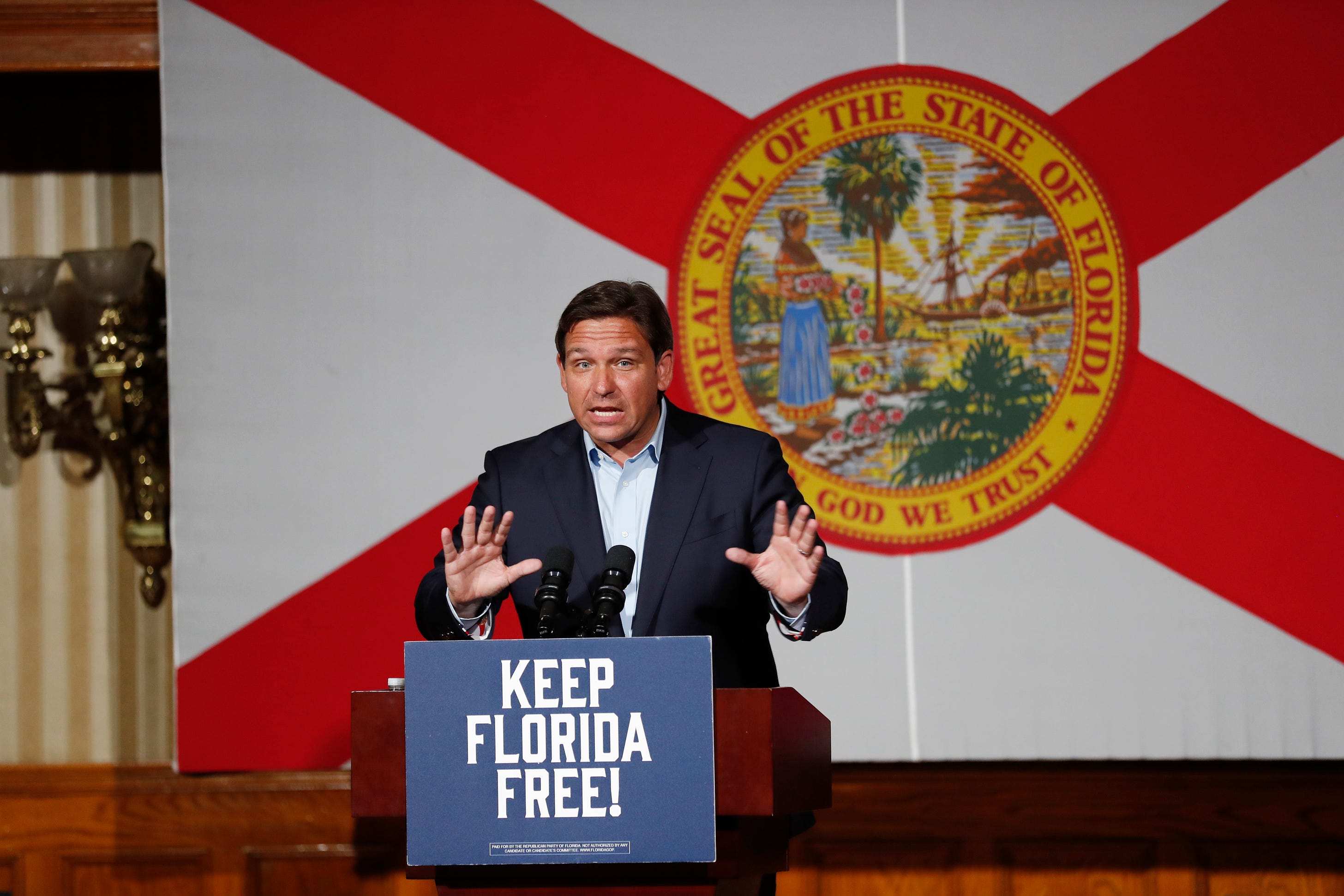
Then came a manufactured brouhaha over transgender students who wanted to use a bathroom aligned with their sexual identity. The number of transgender students is minuscule, probably 1%. And yet again there was a furor that could have easily been resolved with a gender-neutral bathroom. Ron DeSantis made a campaign ad with a female swimmer who complained that she competed against a trans woman. What she didn’t mention was that the trans woman was beaten, as was she, by three other female swimmers.

And then came the nutty claim that teachers were “grooming” students to be gay. Another smear. No evidence whatever. Reading books about gay characters would turn students gay, said the critics; but would reading about elephants make students want to be elephants?

Simultaneously, extremists raised loud alarms about books that introduced students to dangerous ideas about sexuality and racism. If they read books with gay characters, students would turn gay. If they read about racism, they would “hate America.” So school libraries had to be purged; even public libraries had to be purged. One almost expected public book burnings. So much power attributed to books, as if the Internet doesn’t exist, as if kids can’t watch porn of all kinds, as if public television does not regularly run shows about American’s shameful history of racism.

As citizens and parents, we must stand up for truth and sanity. We must defend our schools and teachers against libelous claims. We must oppose those who would ban books.

Of course, parents should meet with their children’s teachers. They should partner with them to help their children. They should ask questions about the curriculum. They should share their concerns. Learning benefits when parents, teachers, students, and communities work together.

Many of us watched the spectacle this week of the Republican Party trying to elect a leader. We watched through 15 ballots, when Kevin McCarthy—Trump sycophant—finally was elected. We knew that behind the scenes he was promising to do whatever his far-far-right Chaos Caucus wanted, to give them whatever power they sought. The whole episode was humiliating for McCarthy and a source of amusement for Democrats, who stayed united behind their leader Hakeem Jeffries.

Heather Cox Richardson wrote about the debacle:

Early this morning, shortly after midnight, Republican Kevin McCarthy of California won enough votes to become speaker of the House of Representatives. Not since 1860, when it took 44 ballots to elect New Jersey’s William Pennington as a compromise candidate, has it taken 15 ballots to elect a speaker.

The spectacle of a majority unable to muster the votes to elect a speaker, while the Democratic opposition stayed united behind House minority leader Hakeem Jeffries (D-NY), raised ridicule across the country. McCarthy tried to put a good spin on it but inadvertently undercut confidence in his leadership when he, now the leader of the House, told reporters: “This is the great part…. Because it took this long, now we learned how to govern.”

But there is no doubt that the concessions he made to extremist Republicans to win their votes mean he has finally grasped the speaker’s gavel from a much weaker position than previous speakers. “He will have to live the entirety of his speakership in a straitjacket constructed by the rules that we’re working on now,” one of the extremist ring leaders, Matt Gaetz (R-FL) told reporters. Gaetz later explained away his willingness to accept McCarthy after vowing never to support McCarthy by saying “I ran out of things I could even imagine to ask for.”

In his acceptance speech, McCarthy first thanked the House clerk, Cheryl Johnson, who presided over the drawn-out fight. Johnson was chosen by Nancy Pelosi (D-CA) when she became speaker in 2018, and has served since 2019. Her work this week was impressive.

McCarthy promised that the Republicans recognized that their responsibility was not to themselves or their conference, but to the country, but then went on to lay out a right-wing wish list for investigations, business deregulation, and enhanced use of fossil fuels, along with attacks on immigration, “woke indoctrination” in public schools, and the 87,000 new IRS agents funded by the Inflation Reduction Act to enforce tax laws. Somewhat oddly, considering the Biden administration’s focus on China and successful start to the repatriation of the hugely important chip industry, McCarthy promised that the Republicans would essentially jump on Biden’s coattails, working to counter communist China and bring jobs home. McCarthy promised that Republicans would “be a check and provide some balance to the President’s policies.”

It was a speech that harked back to the past 40 years of Republican ideology, although he awkwardly invoked Emanuel Leutze’s heroic 1851 painting of Washington crossing the Delaware to suggest that America is a land in which “every individual is equal” and “we let everybody in the boat.” Despite the language of inclusion, just as the Republicans have since 1980, he emphasized that the Republicans would center the “hardworking taxpayer.” The Republican conference repeatedly jumped to its feet to applaud his promises, but it felt rather like listening to a cover band playing yesterday’s hits.

Immediately after his victory, McCarthy thanked the members who stayed with him through all the votes, but told reporters: “I do want to especially thank President Trump. I don’t think anybody should doubt his influence. He was with me from the beginning…. He would call me and he would call others…. Thank you, President Trump.”

Aaron Rupar of Public Notice pointed out that “McCarthy going out of his way to gush over Trump at a time when his influence is clearly diminished & political brand is more toxic to mainstream voters than ever—especially on the anniversary of the insurrection—is notable & indicative of who he’ll be beholden to as speaker.”

I would go a step further and say that embracing Trump after his influence on the Republican Party has made it lose the last three elections suggests that, going forward, the party is planning either to convince more Americans to like the extremism of the MAGA Republicans—which is unlikely—or to restrict the vote so that opposition to that extremism doesn’t matter.

Yesterday, Ohio’s Republican governor, Mike DeWine, signed into law a series of changes in election law that include requiring a photo ID rather than permitting people to use other government documents or utility bills, shortening the time for returning ballots and fixing errors in them (called “curing”), prohibiting curbside voting, and limiting ballot drop boxes to one per county.

Also yesterday, a panel of three federal judges ruled that South Carolina’s First Congressional District is an unconstitutional racial gerrymander. Following the 2020 census, the Republican-dominated legislature moved 62% of the Black voters previously in that district into the Sixth District, turning what had recently been a swing district into a staunchly Republican one that Republican Nancy Mace won in November by 14 percentage points. District Judge Richard M. Gergel said: “If you see a turtle on top of a fence post, you know someone put it there…. This is not a coincidence.”

In contrast to McCarthy stood Minority Leader Jeffries, who used the ceremonial handing over of the speaker’s gavel from the Democrats to the Republicans to give a barn-burning speech. He began by praising “the iconic, the heroic, the legendary” former House speaker Nancy Pelosi as “the greatest speaker of all time,” and offering thanks to her lieutenants Steny Hoyer (D-MD) and Jim Clyburn (D-SC).

He reviewed the laws the Democrats have passed in the past two years—the American Rescue Plan, the Infrastructure Investment and Jobs Act, gun safety legislation, the CHIPS & Science Act, and the Inflation Reduction Act, among others. “It was one of the most consequential congresses in American history,” he said, accurately. He called for Democrats to continue the fight for lower costs, better paying jobs, safer communities, democracy, the public interest, economic opportunity for all, and reproductive freedom.

“As Democrats,” he said, “we do believe in a country for everyone…. We believe in a country with liberty and justice for all, equal protection under the law, free and fair elections, and yes, we believe in a country with the peaceful transfer of power.

“We believe that in America our diversity is a strength—it is not a weakness—an economic strength, a competitive strength, a cultural strength…. We are a gorgeous mosaic of people from throughout the world. As John Lewis would sometimes remind us on this floor, we may have come over on different ships but we’re all in the same boat now. We are white. We are Black. We are Latino. We are Asian. We are Native American.

“We are Christian. We are Jewish. We are Muslim. We are Hindu. We are religious. We are secular. We are gay. We are straight. We are young. We are older. We are women. We are men. We are citizens. We are dreamers.

“Out of many, we are one. That’s what makes America a great country, and no matter what kind of haters are trying to divide us, we’re not going to let anyone take that away from us, not now, not ever. This is the United States of America….

“So on this first day, let us commit to the American dream, a dream that promises that if you work hard and play by the rules, you should be able to provide a comfortable living for yourself and for your family, educate your children, purchase a home, and one day retire with grace and dignity.”

In this moment of transition, he said, the American people want to know what direction the Congress will choose. The Democrats offer their hand to Republicans to find common ground, Jeffries said, but “we will never compromise our principles. House Democrats will always put American values over autocracy…

“benevolence over bigotry, the Constitution over the cult, democracy over demagogues, economic opportunity over extremism, freedom over fascism, governing over gaslighting, hopefulness over hatred, inclusion over isolation, justice over judicial overreach, knowledge over kangaroo courts, liberty over limitation, maturity over Mar-a-Lago, normalcy over negativity, opportunity over obstruction, people over politics, quality of life issues over QAnon, reason over racism, substance over slander, triumph over tyranny, understanding over ugliness, voting rights over voter suppression, working families over the well-connected, xenial over xenophobia, ‘yes, we can’ over ‘you can’t do it,’ and zealous representation over zero-sum confrontation. We will always do the right thing by the American people.”

The torch has indeed passed to a new generation, at least of Democrats. Between them and the extremists in his own ranks, McCarthy has his work cut out for him.

Please open the link to read her references.

David Frum was a speechwriter for George W. Bush. He writes for The Atlantic. He reminds us why Kevin McCarthy is as contemptible as the 20 members of the Chaos Caucus blocking his ascent to the Speakership.

The defeat of Kevin McCarthy in his bid for the speakership of the House would be good for Congress. The defeat of Kevin McCarthy would be good for the United States. It might even be good for his own Republican Party.

Because the people attempting to inflict that defeat upon McCarthy include some of the most nihilistic and destructive characters in U.S. politics, McCarthy is collecting misplaced sympathy from people who want a more responsible Congress. But the House will function better under another speaker than it would under McCarthy—even if that other speaker is much more of an ideological extremist than McCarthy himself.

McCarthy is not in political trouble for the reasons he deserves to be in political trouble. Justice is seldom served so exactly. But he does deserve to be in trouble, so justice must be satisfied with the trouble that he’s in.

McCarthy deserves to be in trouble because he refused to protect the institution he now seeks to lead. After the January 6, 2021, insurrection, he told fellow Republicans that he would urge President Donald Trump to resign immediately. When that vow became public, McCarthy denied he had ever made it, until a contemporaneous audio recording exposed his lie.

“I’ve had it with this guy,” McCarthy said after the January 6 attack—then voted in the impeachment proceedings to protect this guy. Eight days after Trump left office, McCarthy flew to Florida for a photo opportunity with the ex-president who had sent a mob to rampage through the Capitol and harm, abduct, or do worse to McCarthy’s own colleagues. Trump then released a statement boasting that he and McCarthy would be working closely together into the future, a statement McCarthy never contradicted.

McCarthy then enabled and supported a purge of every House Republican who had acted with the integrity that he himself had failed to muster. He endorsedthe primary opponent to Liz Cheney. He stripped committee assignments from Republicans who served on the committee to investigate the Capitol riot he had once condemned and now condoned.

For weeks after January 6, McCarthy denied that he’d telephoned Trump that day to blame him for the attack. When then–Representative Jaime Herrera Beutler exposed his denials as false, McCarthy brutally rebuked her.

“You should have come to me! Why did you go to the press? This is no way to thank me!”

“What did you want me to do? Lie?”

Well, yes, obviously. That’s what McCarthy did.

Herrera Beutler then lost the nomination in a primary battle against one of the most reactionary Republicans of the 2022-midterms slate—who then proceeded to lose a seat in rural Washington State to a Democratic newcomer.

There’s more but you have to subscribe to The Atlantic to read it.

Harold Meyerson of The American Prospect reflects on the Republican debacle of the past few days. Kevin McCarthy wants desperately to be Majority Leader of the House of Representatives. He needs a majority of all members present. But he can’t get a majority because 20 members of the far-right “Freedom Caucus” oppose him. He has conceded to all of their demands for power. Yet after nine ballots, they still oppose him. They want to impeach Biden. They want to impeach cabinet members. They want to humiliate Dr. Anthony Fauci. They are the Chaos Caucus, the party of No. They don’t know how to govern. They are obstructionists.

Harold Meyerson wrote today:

Meyerson on TAP

The Revolution Eats Its Own

Like the Jacobins and Stalinists of yore, today’s Republicans have extirpated their moderates and have no one left to execute besides themselves.

Time was when the conservative credo was “That government is best which governs least.” If that needed quantitative metrics, Grover Norquist came along to say that government should be small enough that “it can be drowned in a bathtub.”

But that was oh, so then. Today’s Republicans repudiate those nostrums as way too statist. What they’re making ridiculously clear (and just plain ridiculous) on the floor of the House this week is that their new credo is “That government is best which cannot even convene.”

The process of revolutions growing more radical by bumping off every previous revolutionary cadre is well established. In revolutionary France, the Girondins supplanted the royalists, the Montagnards supplanted and executed the Girondins, the Jacobins supplanted and executed the Montagnards, and having run out of rival factions, the Jacobins executed each other. In revolutionary Russia, the Leninists overthrew and executed the czarists, the Stalinists overthrew and executed the Leninists. And having run out of Leninists, the Stalinists executed each other.

Today’s Republicans seem to have reached that final phase this week, the supplanting and political execution of each other. Here’s a quote from a speech preceding the eighth ballot for Speaker, in which a Republican described the candidate he was nominating:

“He’s not Paul Ryan! He’s not Mitch McConnell! He’s not John Boehner! He’s different!”

That was not, however, from a speech nominating the Gang of 20’s oppositionist de jour. It was the nominating speech for the hapless Kevin McCarthy, who apparently still clings to the forlorn hope that he can win the Speakership by repudiating every Republican leader and tenet to the left of Matt Gaetz and the Proud Boys.

To be sure, that’s a strategy that didn’t play all that well at the polls last November. Arizona Republican gubernatorial nominee Kari Lake made clear that she didn’t want the votes of Republicans who’d supported that squishy John McCain. In that, she succeeded, which was a major reason why she lost. But today’s Republicans are undaunted by anything so ephemeral as electoral results.

Even in comparison with the first two days of McCarthy’s public humiliation, today has been particularly cruel. The news this morning was full of reports that a team from McCarthy’s opposition had spent the night bargaining with McCarthy’s minions and came away with every concession under the sun. McCarthy agreed that a single member of the Republican caucus could call for ousting the Speaker and that would be all that was required to force a vote. McCarthy’s PAC cut a deal with the Club for Growth that it would no longer intervene in open-seat primaries. Hope sprung yet again among the Kevinoids that these concessions would bring perhaps 10 of the 20 malcontents into Kevin’s camp. In fact, however, through today’s seventh and eighth ballots, precisely none of those 20 dissidents, including those in last night’s meetings, came into Kevin’s column. McCarthy’s vote total remained stuck at 201.

There are some reports that the Gang of 20’s negotiators want the agreements in writing. To get his total up to the required 218, however, I suspect McCarthy will have to go beyond that, promising committee chairmanships and seats on the Koch Brothers board of directors to every one of the 20, and that he’ll have to sign this promissory note in his own blood. And a small cut on the finger won’t suffice.

~ HAROLD MEYERSON

Don Trump Jr. Is on Twitter selling the Trump version of the Bible, called the “We the People” Bible.

I wonder what Trump’s Ten Commandments are.

Thou shalt steal.

Thou shalt commit adultery.

Thou shalt lie and lie and lie.

Thou shalt bear false witness.

Thou shalt have no god but Mammon.

  PatriotTakes 🇺🇸⁦‪@patriottakes‬⁩Don Jr. is now selling Bibles, declares “Judeo-Christian value are under attack.” pic.twitter.com/euAuBnALkV 12/30/22, 10:56 AM  

The new Governor of Arkansas, Sarah Huckabee Sanders, has chosen Jacob Olivia, a member of Ron DeSantis’ education team to lead Arkansas’ schools.

Max Brantley of the Arkansas Times expects that the change in personnel indicates a new move to install vouchers and to copy other parts of disastrous and divisive education agenda.

Yep, the Cabinet appointment today by incoming Governor Sanders was a big one. She’ll be replacing Asa Hutchinson’s Education secretary, Johnny Key, with a veteran of the DeSantis administration in Florida, Jacob Oliva, senior chancellor at the Florida Department of Education, overseeing the Division of Public Schools.

Brantley quotes an opinion piece written in the district where Olivia was a superintendent before DeSantis brought him into a statewide position:

A quick search turned up this opinion piece on Oliva, by a writer who said he’d been a generally progressive school administrator in Flagler County but had drunk DeSantis’ “reactionary Kool-Aid.” It notes that, as a high school principal, Oliva initially moved to kill a student production of “To Kill a Mockingbird,” but relented after protests, a positive sign of his willingness to listen.

But the writer also said of Olivia:

I am trying to understand how you went from being one of the most progressive, innovative and inclusive superintendents in the history of Flagler County to a shill, as one of two Florida senior chancellors of education, for the single most regressive, reactionary and, frankly, just plain mean state departments of education in the nation. Something isn’t adding up.

This isn’t the Jacob Oliva we knew, unless you’ve placed a bet on Ron DeSantis becoming president and your next nameplate getting laminated in Washington. Even so: has your ambition become so primeval that you’re willing to make these Faustian bargains the way you have on covid safety measures, on gender identity, on sanitized civics and history, and now degrading math textbooks for something as innocuous–if not provably useful–as their social-emotional learning content?

I urge you to open the link and read the article, and please, please read the comments.

The Washington Post reported that the anti-vaccination movement has prompted the return of diseases that were previously thought to be eliminated. The anti-vaccination folk are mainly Republicans, and their antipathy to vaccines has been encouraged by their party’s leaders, like Ron DeSantis, who has banned vaccine mandates in Florida. Republican members of Congress forced the abandonment of mandatory vaccinations for the military.

Veteran reporter Lena H. Sun wrote:

A rapidly growing measles outbreak in Columbus, Ohio — largely involving unvaccinated children — is fueling concerns among health officials that more parent resistance to routine childhood immunizations will intensify a resurgence of vaccine-preventable diseases.


Most of the 81 children infected so far are old enough to get the shots, but their parents chose not to do so, officials said, resulting in the country’s largest outbreak of the highly infectious pathogen this year.

“That is what is causing this outbreak to spread like wildfire,” said Mysheika Roberts, director of the Columbus health department.

The Ohio outbreak, which began in November, comes at a time of heightened worry about the public health consequences of anti-vaccine sentiment, a long-standing problem that has led to drops in child immunization rates in pockets across the United States. The pandemic has magnified those concerns because of controversies and politicization around coronavirus vaccines and school vaccine mandates.

More than a third of parents with children under 18 — and 28 percent of all adults — now say parents should be able to decide not to vaccinate their children for measles, mumps and rubella (MMR) to attend public schools, even if remaining unvaccinated may create health risks for others, according to new polling by the Kaiser Family Foundation, a health-care research nonprofit.

Public sentiments against vaccine mandates have grown significantly since the pandemic, said Jen Kates, a Kaiser senior vice president. A 2019 poll by the Pew Research Center found that less than a quarter of parents — and 16 percent of all adults — opposed school vaccination requirements.

The growing opposition stems largely from shifts among people who identify as or lean Republican, the Kaiser survey found, with 44 percent saying parents should be able to opt out of those childhood vaccines — more than double the 20 percent who felt that way in 2019.

Adam Moore, a father of three in the Detroit suburbs, said none of his children — 9, 12 and 17 and enrolled in private school — have received routine childhood immunizations, let alone vaccines for the coronavirus or flu. He values personal liberty and says the government has no right telling people what to do with their bodies.

“I find it a hard argument when the government says we’re all for individual liberty on abortion rights and all this other stuff, but when it comes to vaccinations, there’s no such thing as ‘my body, my choice,’” said Moore, 43, an account manager for a marketing company.

Moore, who describes himself as Republican-leaning, said he does not view childhood diseases such as measles and polio, which have resurfaced in recent years, as threats. But if the deadly Ebola virus were circulating, he said, he would want his children to get vaccinated.

Other parents who oppose school immunization mandates echo long-standing misinformation about vaccines that continue to spread via anti-vaccine groups.

Bianca Hernandez, a 37-year-old dog breeder in the Albuquerque metropolitan area, described concerns about the link between vaccine ingredients and autism, a view that has been extensively disproved. She said her two youngest children receive religious exemptions from school vaccination requirements.

Support for immunization mandates has held steady among Democrats, with 88 percent saying that children should be vaccinated to attend public schools because of the potential risk for others when they are not.

Overall, 71 percent of all adults still support school immunization requirements, compared with 82 percent in 2019.

“The situation about increasing negative sentiment about childhood vaccination is concerning, but in absolute terms, vaccines remain the social norm,” said Saad Omer, director of Yale’s Institute for Global Health and an infectious-disease expert who has studied vaccine hesitancy.

Anne Zink, chief medical officer for Alaska’s health department, said that even in a state with historically lower vaccination rates, childhood immunization rates have yet to return to their pre-pandemic levels. In the years before the pandemic, about 65 percent of Alaskan children 19 to 35 months old had completed their routine childhood immunizations. By the end of 2021, 46 percent had.

A few weeks ago, Zink, an emergency room doctor, saw her first case of chickenpox when a young woman walked into the Mat-Su Regional Medical Center in Palmer covered in large, painful lesions. The woman said she and her family did not believe in vaccinations and told Zink she thought chickenpox no longer existed.

“I think there is more mistrust of the government, there’s more questioning of vaccines, and we’ve been having a harder time getting people vaccinated,” said Zink, who is also president of the Association of State and Territorial Health Officials.

“I was like, ‘Well, it really doesn’t when all of us choose to get vaccinated, but you aren’t vaccinated, your family’s not vaccinated, and the people you hang out with are not vaccinated. Chickenpox has been spreading in your community, and now you’re really sick,’” Zink recalled.

In the past, Zink said, herd immunity would have protected the woman against such childhood diseases. But that protection has waned as anti-vaccine sentiment grows, she said.


To distance its push for vaccination from the current political narrative, the Alaska health department recently brought back images and language from a 1960s promotion for polio vaccination. The new social media campaign uses the vintage Wellbee cartoon and rocket — “Get a booster!” — to remind people that immunization has always been part of the country’s history.

It is too early to see the effects of eroding public support for school vaccination requirements on childhood immunization rates because federal data typically lag by about two years. During the pandemic, routine vaccination rates slipped because of school closures and because children were not going to the doctor.


The growing negative attitudes about school immunization requirements are troubling for health workers. Kentucky officials are urging that people get flu shots after six children — none of whom were vaccinated — died after contracting influenza. South Carolina officials had also promoted childhood vaccinations after two chickenpox outbreaks in March — the first since 2020 — affected nearly 70 people.


A case of paralytic polio in a New York man this summer prompted worry that low childhood immunization rates and rising vaccine misinformation could result in the disease’s resurgence, decades after vaccination had eliminated it in the United States.

“There is definitely a group of parents who have shifted their attitudes,” said Jennifer Heath, immunizations program coordinator for Minnesota’s health department who works on vaccine hesitancy and outreach. “Part of it is true attitude shift. But part is a disconnection to the primary care provider, the human being who’s telling you that vaccines are important.”


School vaccination requirements are among the most effective tools to keep children healthy. All states and the District of Columbia require children to be vaccinated against certain diseases, such as measles, polio and whooping cough, to attend public school. All states grant exemptions based on medical reasons; a growing number allow religious or philosophical exemptions.


D.C. also requires students 12 and older to be vaccinated against covid-19 but has delayed enforcing the mandate until the 2023-2024 school year. California has a pending statewide student coronavirus vaccine mandate that will not take effect until after July 2023. Nearly two dozen states have some form of ban against student coronavirus vaccine mandates.


The Centers for Disease Control and Prevention recommends children get two doses of MMR vaccine, with the first dose at 12 to 15 months, and the second dose between 4 and 6 years old. One dose of the vaccine is about 93 percent effective in preventing measles, one of the most infectious pathogens on the planet that can cause serious complications, including death. Two doses are about 97 percent effective at preventing the disease.

In the Ohio measles outbreak, only three of the 81 children had received a single dose of vaccine, according to state data. None were known to be fully vaccinated.


“I think some of these attitudes were here before the pandemic, and then we probably picked up some additional community members who were accepting of vaccines before but now maybe are more critical about vaccines as a result of what transpired with the coronavirus vaccine,” Roberts said.

Some of the cases occurred in Columbus’s large Somali community, the second-largest Somali population in the United States after the Minneapolis area, Roberts said. Parents have said they “intentionally delayed” giving their children the measles vaccine because of their fear of autism, she said, despite considerable research disproving any relationship between vaccines and autism.

Those fears echoed similar concerns of parents in Minnesota’s Somali community during a 2017 measles outbreak that infected 75 children, mostly unvaccinated preschool kids.

Minnesota is also battling a new measles outbreak — 22 cases — as vaccine hesitancy around the MMR vaccine continues to be an issue, said Doug Schultz, spokesman for the Minnesota health department.

Officials are bracing for more cases in the coming weeks as families travel and gather indoors for the holidays. At least 29 of the Ohio children have been hospitalized, some so sick they required intensive care.

Most of the sickened children — 78 percent — are Black, 6 percent are Asian, 6 percent are White, and 4 percent are Hispanic, according to Columbus officials.

Because the measles virus is so contagious, an overall community vaccination rate of about 90 to 94 percent is needed to keep the virus from causing large outbreaks, according to infectious-disease experts. In the United States, nearly 91 percent of children have received at least one dose of the MMR vaccine by age 2. In the Columbus area, Roberts said, the measles vaccination rate is estimated at 80 to 90 percent, but health-care providers are not required to report data to Ohio’s vaccine registry.

Even if overall coverage in a community is high, measles can transmit easily in clusters of under-vaccinated or unvaccinated people. The Columbus outbreak began when one or two unvaccinated people traveled to countries where measles is still common between June and October and infected others in the community, Roberts said.

In recent years, many of the measles cases reported to the CDC have occurred in underimmunized, close-knit communities, where anti-vaccine misinformation has gained a foothold. In 2019, the United States reported the highest annual number of measles cases — 1,294 — in more than 25 years; three-fourths of those cases occurred among New York’s Orthodox Jewish communities. Outbreaks have also occurred among the Amish in Ohio and Eastern European groups in the Pacific Northwest.

After consulting with counterparts in Minnesota, health officials in Ohio have been working closely with the Somali community to increase vaccination uptake without stigmatizing them. Columbus public health workers have hosted vaccine clinics at a community center and a mosque and are conducting home visits to provide shots. They have also reached out to schools, day-care centers and grocery stores about the importance of vaccination.


The efforts appear to be making a difference.
Nationwide Children’s Hospital in Columbus recently saw a 20 percent increase in the number of parents seeking the MMR vaccine, Roberts said. The health department, too, has seen a small uptick in vaccinations.


“They are trickling in,” she said, “slowly but surely.”