Archives for category: Privatization

Perhaps Betsy DeVos knows that the Trump administration’s days in power are winding down. She is throwing $46 million in federal money at New Hampshire in an effort to destroy the state’s public schools. This grant will double the number of charter schools in the state. Most of the state is rural or small towns. The largest city in the state is Manchester, with a population of about 100,000, with 14,000 students.

The Congressional delegation and legislature are Democrats but the Governor Chris Sununu is a conservative Republican who appoints the State Board of Education and the state commissioner of education. The latter, Frank Edelblut, homeschooled his seven children. Edelblut has proposed a program called “Learn Everywhere,” which would compel districts to pay for programs offered by for-profit or non-profit non-school providers. Edelblut has a vision of deschooling or unschooling, disestablishing public schools. He is like Betsy DeVos, only worse. Governor Sununu’s State Board narrowly approved ”Learn Everywhere.” Edelblut says public schools will “save money,” because they will cut programs and lay off teachers. Public money will flow to private providers and there will be less for public schools. He likes that. A state legislative committee is trying to block Learn Everywhere, saying that the state can’t tell districts how to spend money.

DeVos is helping Edelblut undermine the NH public schools.

The New Hampshire Department of Education is getting $46 million from the federal government to expand public charter schools over the next five years.

The DOE says it will use the money to help new charter schools with start-up costs and increase professional development for charter school staff.

Charter schools have been slow to grow in New Hampshire. Over the past 15 years, the State Board of Education has approved 33 charters, and 28 schools are now operating. With this new grant, the DOE says it plans to add 27 new schools over the next five years, with a particular focus on serving poor and at-risk students.

The grant money will be used to help schools with start-up costs, rather than ongoing operational costs, which are covered by a combination of state funding and external fundraising.

The state has no income tax or sales tax, which means schools are funded by property taxes. The property owners will bear the cost of two separate school systems, even if they would rather support their community public schools.

Meanwhile, folks in New Hampshire have some questions about who will pay for the charters after the federal start-up money is spent. They point out that the state’s few ”high quality” charters do not enroll many students eligible for free-reduced price lunch (i.e., low-income.) Commissioner Edelblut is thrilled with the chance to defund public schools.

No Democrat should support charter schools. They are an integral component of the rightwing effort to privatize public funding.

Quinn Strassel, a drama teacher at Ann Arbor Community High School has written a music about Betsy DeVos, the arch-for of America’s public schools. The Michigan media took note.

Strassel recruited Diane Hill, his former Ypsilanti High School drama teacher, to take on the role of Betsy DeVos, while he played husband Dick DeVos and brother Erik Prince.

The cast also included some of Strassel’s former students and fellow school teachers and staff.

As the fictitious storyline in the play goes, DeVos makes an appearance at a Grand Rapids charter school, “Future Business Leaders of Tomorrow Academy,” and enlists the help of six students of color in putting on a musical. She promises to personally give them $200,000 to renovate the school theater if they do a good job.

As the musical progresses, things go wrong and DeVos upsets and frightens the children. Guns enter the picture, one student is worried a family member may be deported, and another student has his brains scrambled by “Neurocleanse,” a mockery of the real-life Neurocore, a DeVos-backed, brain-performance company.

Another student complains about his family falling victim to a “pyramid scheme” run by Amway Corp., a DeVos company.

My friend Jennifer Berkshire wrote to tell me about Quinn’s terrific show.

She wrote:

The teacher who wrote the musical is amazing – his name is Quinn Strassel and he teaches drama at Ann Arbor Community High School. The part of Betsy was played by his former theater teacher at Ypsilanti High School, Diane Hill. That acclaimed theater program no longer exists, by the way, a casualty of Michigan’s schools of choice policy that has devastated schools in working class communities like Ypsilanti.

Here’s a bit about him and the show.

The writer, director, and producer Quinn Strassel wrote:

I believe comedy can be a path to change.

As a teacher, I’ve watched as Betsy DeVos has led a movement to defund and dismantle public schools in Michigan. It has been heartbreaking and devastating to witness.

I can’t outspend Betsy but I’m fighting back with what I’ve got: comedy, music, love, support from my community, and years of experience teaching and directing theatre.

I spent this past summer writing “Betsy Devos! The Musical!”

The show is completely ridiculous (with songs like “Jesus Wants Me to be Rich” and “The Best Kind of Teacher is a Teacher with a Gun”). But I’m proud of what it’s become. I think it has substance and heart.

I would like to share this show with you and as many of your friends as you can bring along for the ride. I want us to laugh and to celebrate public schools. I want to win hearts and change lives. https://www.gofundme.com/f/staged-reading-for-betsy-devos-the-musical

Please watch the link to the show, help fund it, and reach out to Quinn Strassel about staging a production in your community.

Art and humor will save us! And this show has both.

The Center for American Progress has been the think tank of centrist Democrats and a refuge for veterans of the Obama administration and the would-have-been Clinton Administration. The media calls it “progressive,” but on education its agenda was aligned with the mainstream of the Republican Party. It never supported vouchers but it was all-in for charter schools. Now that Betsy DeVos is the new face of the Reform and Choice moment, it’s bizarre to call charters a progressive idea.

CAP’s new site “Think Progress” is folding. It could not find a patron. The problem may have been not just money but message. With Sanders and Warren vying for the progressive vote, CAP has lost its claim to be”progressive.”

Given its unrelenting defense of the privatization of public schools by entrepreneurs and corporate chains, it is clear that CAP was not in touch with the meaning of progressivism. It defended all the noxious tenets of Obama and Duncan’s Race to the Top. High-stakes testing, evaluation of teachers by test scores, closing schools with low scores, and charter schools. In D.C, these were the common threads in the Bush-Obama era. In state after state, these principles are being repudiated. They failed. They were corporatist, not progressive.

In this post, Carol Burris lays out a devastating bill of indictment against the charter industry in Pennsylvania. Technically, it is run by “non-profit” Boards, but most of the time those words are fig leaves for for-profit corporations that are growing rich with the help of the state legislature.

Governor Wolf recently announced his determination to hold charter schools accountable, and the charter industry howled with rage. They don’t want any of their cushy deals to be jeopardized.

Carl Petersen, a veteran of the charter wars in Los Angeles, writes her about the serious defect in the charter reform law.

The law finally allows local school boards to determine whether proposed charter schools will damage the fiscal stability of the public schools, a welcome change.

But it also allows the unelected County Board of Education to overturn the decisions of the elected district school board. If the elected school boards determine that the proposed charter will damage the district, the unelected County Board can reject the decision of the local elected board. That is just plain wrong.

And nowhere is it wronger than in Los Angeles, where Corporate Reformers funded by billionaires fight to control the LAUSD school board. When the public manages to get the upper hand, the decisions of the school board can be overruled by a charter-friendly unelected county school board.

The county board in LA is dominated by phony Reformers, including the candidate who lost to George McKenna, a true friend of public schools, and Kate Braude, the executive director of astroturf Speak Up, the voice of the charter industry.

Elected officials should have the last word, not charter shills.

With so much billionaire cash sloshing around California to promote charter schools and to disparage public schools, it can be difficult to know which groups are real and which are Memorex.

Here is one that definitely is not a real parents’ group. It is called Speak Up and it is populated with people who are embedded in the charter sector. It recently chastised L.A. Superintendent Austin Beutner for not moving swiftly enough to clamp ratings on every school, the better to close them with and set them up for privatization. How will parents know how to choose a school if the district doesn’t give it a grade or a rating? They say he is in danger of “breaking a promise” to the parents of Los Angeles, who are longing to have their schools rated.

Schools should be evaluated based on such issues as their class size; the experience of their teachers; the resources invested by the district, such as: does the school have a library with a librarian? Does it have a school nurse? Does it have classes in the arts for all students?

But Speak Up seems to be interested mostly in test scores. Are they going up or down? Most people these days recognize that test scores measure the demographics of the students enrolled, not the quality of the school.

So who is this group?

Its founder and executive director is Katie Braude, a former KIPP executive. Until recently, she was on the Los Angeles County Board of Education, which has the power to overrule the LAUSD Board of Education on charter school decisions.

On Speak Up’s board of directors is Russell Altenburg, who is also connected to KIPP, was a program officer at the Broad Foundation, and a fellow at the NewSchools Venture Fund. And he was part of the “inaugural cohort” at the Pahara Next Gen Network.

Mary Najera was a founder of the Los Angeles Parents Union, now known as the Parent Revolution, which used the Parent Trigger law to try to convert public schools into charter schools. Parent Revolution was funded by Walton, Broad, Gates, Arnold and other billionaires. She is “chief community officer” at the Extera Public Schools charter chain.

Rene Rodman is another member of the board of directors of Speak Up. She is a also on the board of the Palisades Charter High School, where she served as president.

Aida Rodriguez is Vice President of Advocacy and Government Relations at Alliance College-Ready Public Schools, a charter school network. She too worked for Parent Revolution.

Speak Up is an organization led by charter school advocates. Twenty percent of the students in Los Angeles are enrolled in charter schools. Eighty percent are not.

Nowhere on Speak Up’s website does it list the names of its funders. One can only guess. Waltons? Broad? Hastings? Gates?

When you see a press release from Speak Up, remember that they are speaking up for Eli Broad, Reed Hastings, the Waltons, Bill Gates, and the charter industry, not for the 80 percent of students in the public schools.

Finland’s educational success became an international sensation when the nation’s students unexpectedly topped the PISA test a few years back. The Finns really don’t care much about rankings and standardized tests, and they were as surprised as everyone else. Thousands of visitors came to Finland to find out what they were doing. Then Finland slipped out of first place, and the gossip mill began spinning out theories about why Finland was losing its luster. Finland still doesn’t care about rankings or test scores.

In this post, Finnish expert Pasi Sahlberg and Finnish educator Peter Johnson explain what Finland is doing and what it is not doing to improve its schools (not its test scores).

They identify the three cornerstones of Finnish education:

*Education systems and schools shouldn’t be managed like business corporations where tough competition, measurement-based accountability and performance-determined pay are common principles. Instead, successful education systems rely on collaboration, trust, and collegial responsibility in and between schools.

*The teaching profession shouldn’t be perceived as a technical, temporary craft that anyone with a little guidance can do. Successful education systems rely on continuous professionalization of teaching and school leadership that requires advanced academic education, solid scientific and practical knowledge, and continuous on-the-job training.

*The quality of education shouldn’t be judged by the level of literacy and numeracy test scores alone. Successful education systems are designed to emphasize whole-child development, equity of education outcomes, well being, and arts, music, drama and physical education as important elements of curriculum.

They then debunk the myths and misperceptions that have been bruited about.

Unlike the U.S., where billions of dollars are wasted in efforts to switch control of schools from public to private, Finnish educators are trying to work through the problems of building a curriculum and pedagogy for the 21st century–and beyond.

The original rationale for charter schools was that they would be innovative, would be accountable, and would have lessons to share with public schools. We now know that the only innovation associated with charter schools is the adoption of stern discipline, reminiscent of schools a century or more ago.

We now know that charter lobbies fight any accountability.

They no longer see themselves as collaborators but as competitors. If they have anything to share, they are not doing it.

Their biggest innovations are diverting resources from the public schools and choosing the students they want. As a sector, the charter industry has produced a plethora of frauds and scandals, which is what you would expect to happen when entrepreneurs get government money without supervision, oversight or accountability.

Charter advocates claimed they would “save poor kids from failing schools,” but in most states the poor kids are better off staying in their public school.

Texas is about to be flooded with dozens of new charter schools, thanks to recent brats by Betsy DeVos to big charter chains IDEA and KIPP. These grants came from the federal Charter Schools Program, which DeVos uses as her personal slush fund to undermine public schools.

Here is a report from Texas:

By: William J. Gumbert

The State’s Efforts to Privatize Local Public Schools is NOT Improving Student Outcomes –
The State’s Academic Accountability Rating System Provides the Evidence

The Texas Education Agency (“TEA”) has released its 2019 Academic Accountability Ratings for taxpayer funded schools. In this regard, ratings were assigned to both locally governed, community-based school districts and State approved, privately-operated charters that comprise the State’s “dual education” system (see “TXSchools.gov”). In total, 1,089 taxpayer funded entities received ratings from TEA: 1,020 community-based school districts and 169 State approved, privately-operated charters (“charters”).

Charters are private organizations that the State unilaterally approves to operate schools in local communities with taxpayer funding. Originally authorized by the Texas Legislature in 1995, the State has provided privately-operated charters with over $20 billion of taxpayer funding to improve student learning in local communities. The “charter promise” was that in exchange for the State transferring the control of local schools to private organizations and allowing charters to be more autonomous with taxpayer funding, charters would produce better student outcomes.

However, the State’s 2019 Academic Accountability Rating System documents that privately-operated charters are producing lower student outcomes than community-based school districts. As a result, students and taxpayers are both paying the price for the State’s ongoing policies that support the operation and expansion of lower performing, privately-operated charters in local communities.

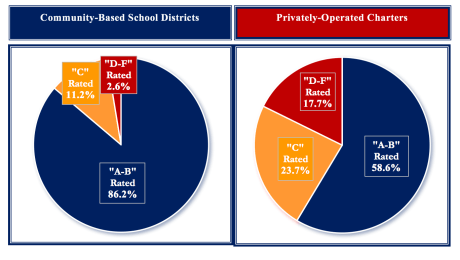
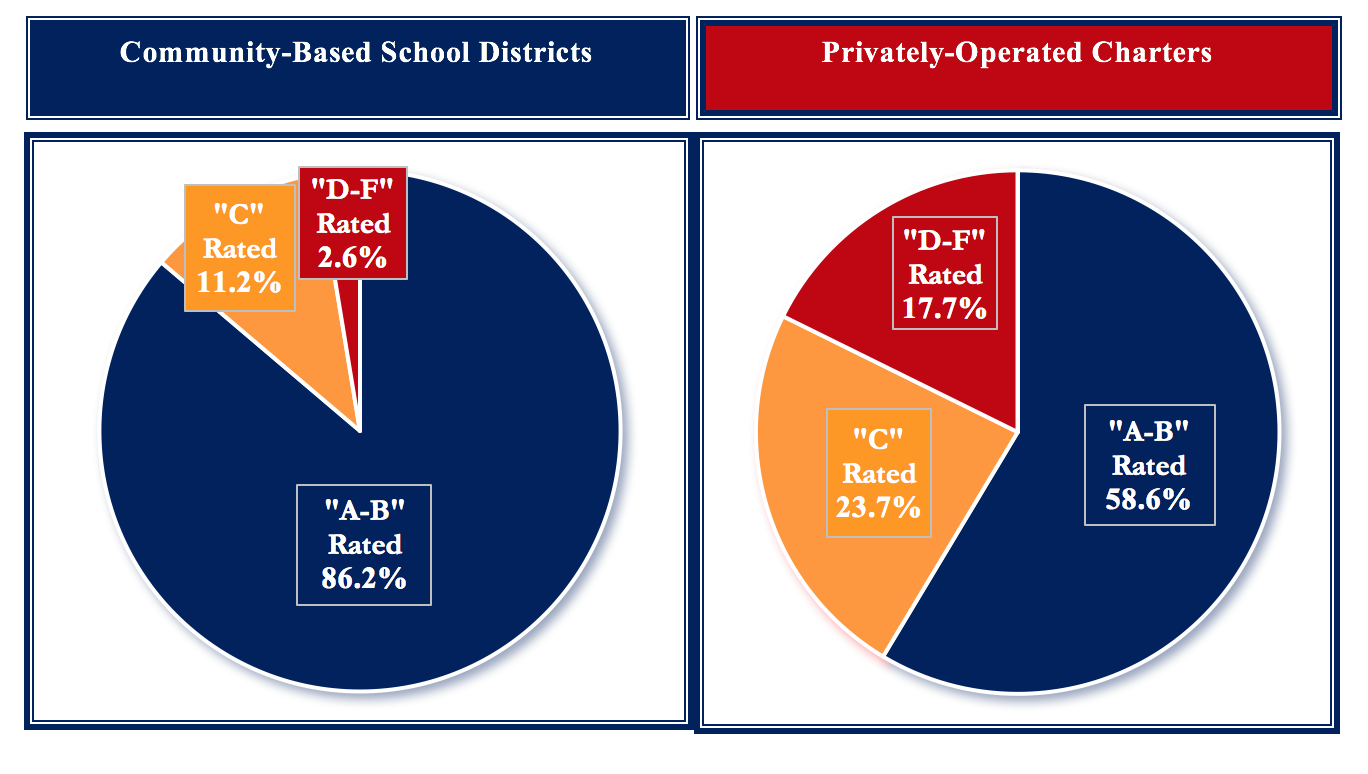
Rating Summary: According to the State’s ratings, an impressive 86.2% of community-based school districts received an “A” or “B” rating and only 2.6% of community-based school districts were assigned a “D” or “F” rating. In other words, 97.4% of the 1,020 community-based school districts were awarded the “good housekeeping seal of approval” by the State.

In comparison, the percentage of charters receiving an “A” or “B” rating was significantly lower at 58.6%, which is 27.6 percentage points lower than the percentage of community-based school districts with “A” or “B” ratings. The differences do not stop there. The percentage of charters receiving a rating of “C” or below was 41.4%, while the percentage of community-based school districts rated “C” or below was only 13.8%. In addition, an alarming 17.7% of State approved charters received a “D” or “F” rating. In other words, almost 1 of every 5 charters was deemed “low performing” by the State.
 

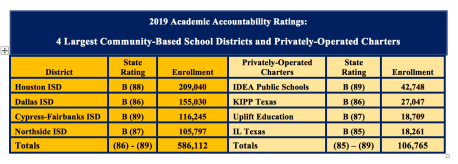
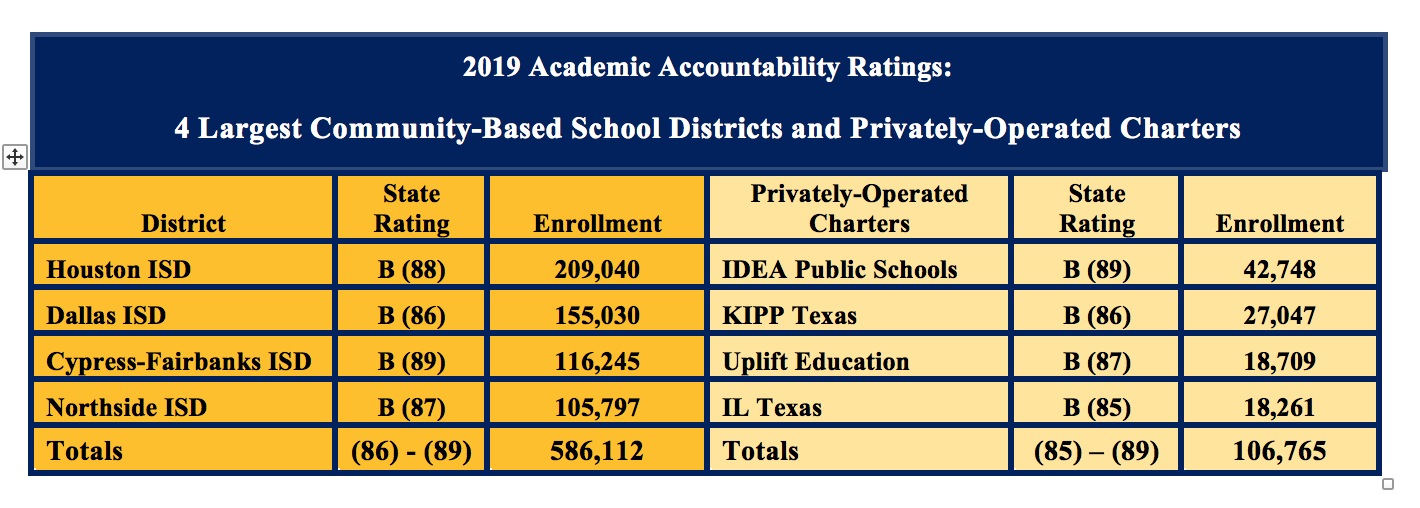
Largest Community-Based School Districts and Privately-Operated Charters – Rating Summary: The 4 largest community-based school districts in Texas serve the unique needs of 586,112 students and these school districts are not immune to scrutiny and criticism. Often, the criticism is from politically motivated State legislators, privately funded charter school advocacy organizations and charter school leaders that claim community-based school districts are failing students.

Despite these “self-serving” criticisms to promote the need for more charter schools, these claims are simply NOT true according to the State’s Academic Accountability Ratings. The reality is that although the largest community-based school districts enroll and serve the diverse needs of all students in their community, each received a high “B” rating (86-89) from the State. In comparison, despite the benefits of excluding enrollment to certain students and serving 479,347 fewer students, the 4 largest privately-operated charters that the State approved to improve student learning also received a “B” (85-89) rating.
 

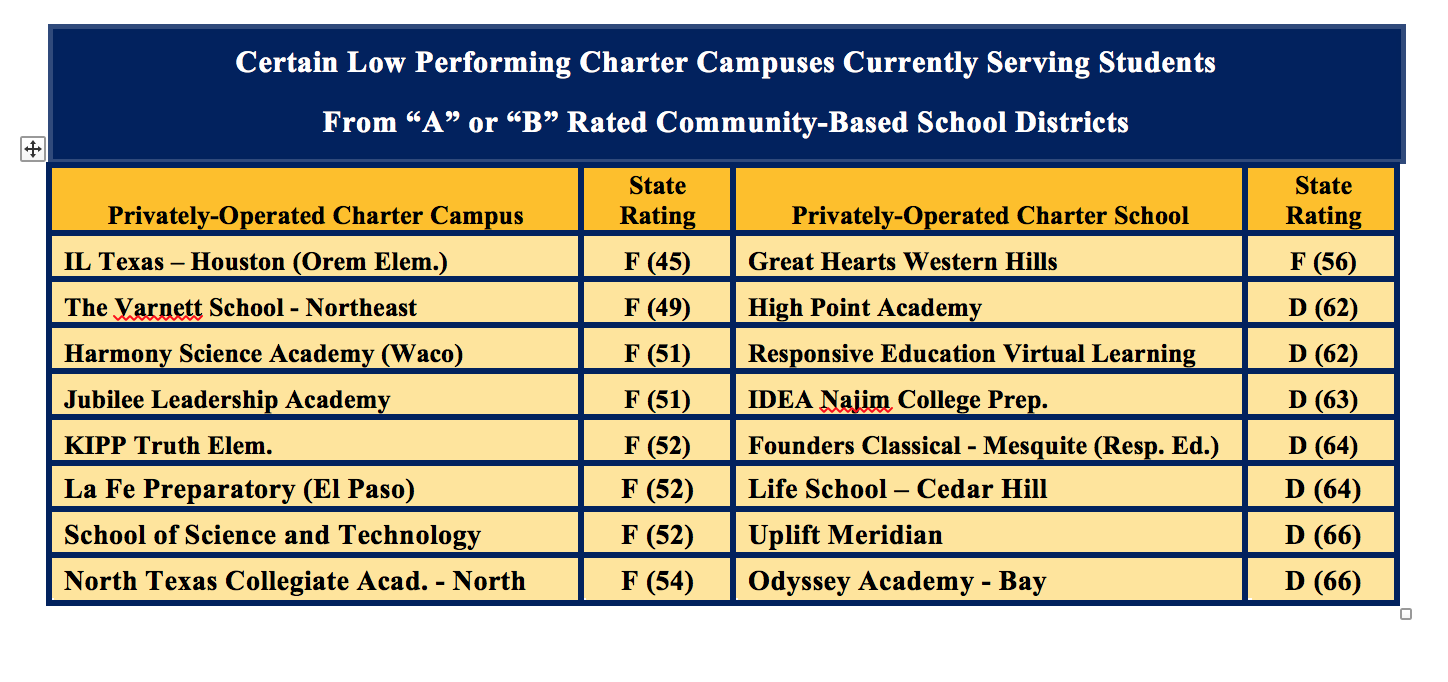
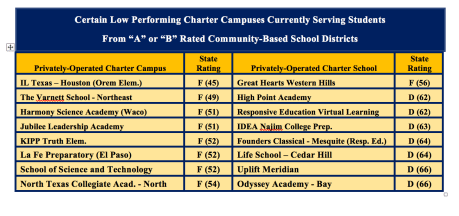
Low Performing Charter Campuses: The State has approved 288 separate charters to operate in local communities. To date, 110 of these charters have been surrendered or mandatorily closed and are no longer permitted to serve students. Despite these closures, many charters are still negatively impacting student outcomes. According to the State’s academic ratings. 17.3% of privately-operated charter campuses were rated “D” or “F” and many of these campuses serve students in higher performing community-based school districts. The table below summarizes a few of the “low performing” charter campuses that currently serve students from community-based school districts with “A” or “B” academic ratings.
 

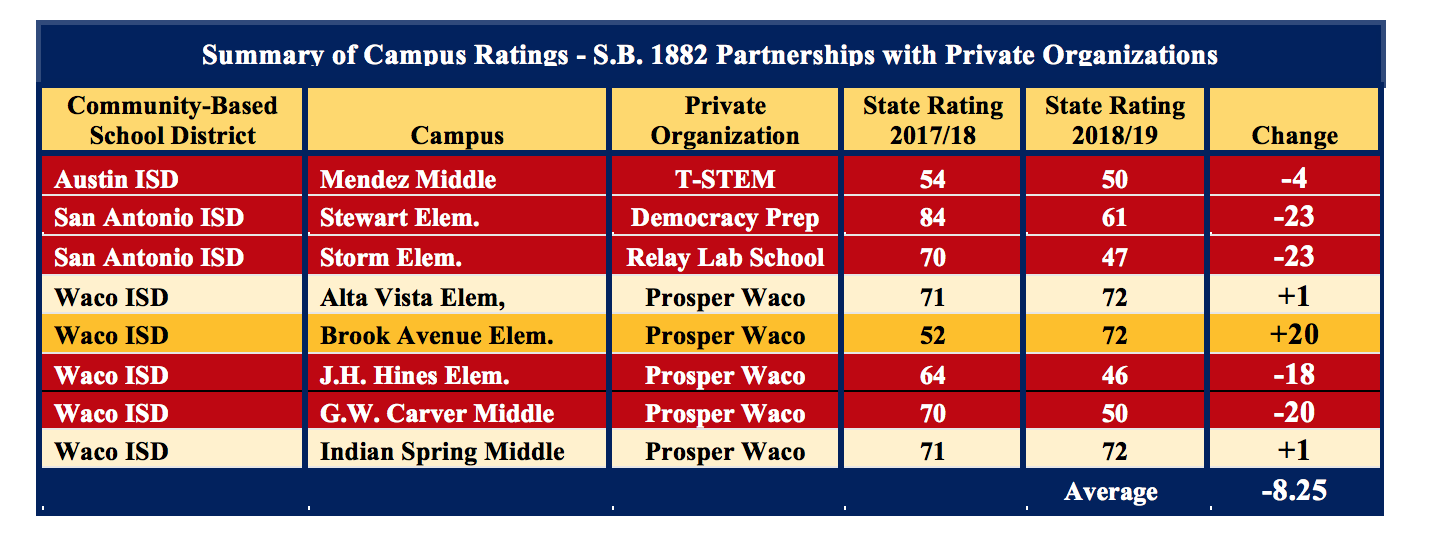
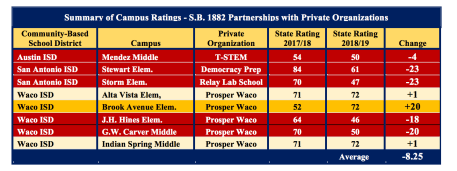
S.B. 1882 Partnerships – Results: In 2017, the Legislature approved S.B. 1882 that provides financial and accountability incentives for community-based school districts to partner with private organizations to operate existing schools. S.B. 1882 and TEA rules also require that any community-based school district campus with a “D” or “F” rating for 5 consecutive years must be turned over to a private charter/non-profit or closed. If neither of these occur, the community-based school district becomes subject to a State takeover.

S.B. 1882 is based upon the premise that “privatization” will improve the results of low performing campuses. However, the State’s premise is not based upon documented research or fact. For the 2018/19 school year, the 8 community-based school district campuses listed below were turned over to privately-operated charters/non-profits pursuant to S.B. 1882 partnerships. Unfortunately, most of these privately-operated campuses experienced a decline in student performance. In fact, the average academic ratings of these campuses declined by 8.25 points with private organizations at the helm. In addition, 4 of the campuses that had previously been rated “met standard” were relegated to an “Improvement Required” (“F”) rating under the control of private organizations.
 

Conclusion: While it can certainly be debated that the State’s Academic Accountability Rating System does not accurately reflect the effectiveness of a school, especially since it relies upon the performance of students on the standardized STAAR test and it ignores the many other positive educational attributes that schools provide to students every day. However, the system is the measuring stick that the State has chosen to evaluate student learning. It is also the accountability system that the State has chosen to govern the quality of public education deployed in local communities.

So:

♣ The purpose of privately-operated charters was to “improve student learning” by providing a State controlled, taxpayer funded alternative to community-based school districts; but

♣ The State’s Academic Accountability Rating System documents that:

⎫ Community-based school districts have significantly higher academic ratings than State approved charters;
⎫ Charters continue to operate a higher percentage of the “low performing” schools in local communities; and
⎫ The “privatization” of campuses pursuant to S.B. 1882 partnerships has primarily resulted in reduced student outcomes.

So why is the State continuing to support the operation and rapid expansion of privately-operated charter schools in community-based school districts? Why is the State offering financial incentives to “privatize” local schools? Could the answer be that politics and “special interests” are driving the State’s efforts to “privatize” schools in local communities?

The State created privately-operated charters to improve student learning in community-based school districts and it created the Academic Accountability Rating System which documents that State approved charters are producing lower student outcomes than community-based school districts. This creates quite a dilemma for the current policies of the State, but that is usually what happens when a “politically motivated” bad policy is exposed by another bad policy.

If it is truly about the “kids” and providing the highest quality education to students, it is time for parents, taxpayers and communities to hold the State accountable. It is time to return the control of public schools to taxpayers and democratically governed, community-based school districts that have proven to consistently produce better outcomes for students!

DISCLOSURES: The author is a voluntary advocate for public education and this material solely reflects the opinions of the author. The author has not been compensated in any manner for the preparation of this material. The material is based upon information provided by the Texas Education Agency, TXSchools.gov and other publicly available information. While the author believes these sources to be reliable, the author has not independently verified the information. All readers are encouraged to complete their own review and make their own independent conclusions.
Jessica Bakeman and a team of investigative reporters at WLRN in Florida report here on the state’s takeover and privatization of Jefferson County, the state’s first all-charter district. It was forced on the district by the state against the wishes of local elected officials and funded by state legislators with close financial ties to the charter school company (and its for-profit parent) that took over the district. It’s also setting the stage for a massive expansion of charter schools in the state.

http://chartered.wlrn.org/

The Republicans who run state government in Florida have abandoned local control. They worship the Almighty Dollar.

Bakeman writes:

Florida’s first and only all-charter school district was engineered by unelected state bureaucrats at then-Gov. Rick Scott’s Department of Education, funded by the Legislature and carried out by Somerset Academy, Inc., a rapidly expanding network that’s affiliated with a politically connected for-profit company in Miami.

Two years into Jefferson County’s transformation, the still-unproven charter-district “experiment” is being used to justify a potentially massive expansion of charter schools in the state’s poorest communities. A state law dubbed “schools of hope,” first passed in 2017 and broadened this year, offers millions of dollars to charter schools that open near traditional public schools that have struggled for years.

Jefferson County is home to the first charter “schools of hope.” Neighborhoods in Miami, Tampa and Jacksonville are next…

South Florida legislators with close financial ties to Somerset and its for-profit contractor, Academica, played a key role in facilitating and bankrolling the all-charter district, which critics argue is a conflict of interest.

Nina Turner of the Bernie Sanders campaign speaks out against charter school expansion.

Watch this.

Every Democratic Presidential Candidate should follow Bernie’s lead. He has the pulse of the people on this issue.