Archives for category: Privatization

This article about charter real estate dealings was written by Professors Preston Green III, Bruce Baker, and Derek W. Black.

They argue that lax state laws allow charter operators to reap profits while maintaining an ostensibly “nonprofit” status.

While critics charge that charter schools are siphoning money away from public schools, a more fundamental issue frequently flies under the radar: the questionable business practices that allow people who own and run charter schools to make large profits.

Charter school supporters are reluctant to acknowledge, much less stop, these practices.

Given that charter schools are growing rapidly – from 1 million students in 2006 to more than 3.1 million students attending approximately 7,000 charter schoolsnow – shining a light on these practices can’t come too soon. The first challenge, however, is simply understanding the complex space in which charters operate – somewhere between public and private.

Unregulated competition

Charters were founded on the theory that market forces and competition would benefit public education. But policy reports and local government studiesincreasingly reveal that the charter school industry is engaging in the type of business practices that have led to the downfall of other huge industries and companies.

Charter schools regularly sign contracts with little oversight, shuffle money between subsidiaries and cut corners that would never fly in the real world of business or traditional public schools – at least not if the business wanted to stay out of bankruptcy and school officials out of jail. The problem has gotten so bad that a nationwide assessment by the U.S. Department of Education warned in a 2016 audit report that the charter school operations pose a serious “risk of waste, fraud and abuse” and lack “accountability.”

Self-dealing

The biggest problem in charter school operations involves facility leases and land purchases. Like any other business, charters need to pay for space. But unlike other businesses, charters too often pay unreasonably high rates – rates that no one else in the community would pay.

One of the latest examples can be found in a January 2019 report from the Ohio auditor-general, which revealed that in 2016 a Cincinnati charter school paid $867,000 to lease its facilities. This was far more than the going rate for comparable facilities in the area. The year before, a Cleveland charter was paying half a million above market rate, according to the same report.

Why would a charter school do this? Most states require charter schools to be nonprofit. To make money, some of them have simply entered into contracts with separate for-profit companies that they also own. These companies do make money off students.

In other words, some “nonprofit” charter schools take public money and pay their owners with it. When this happens, it creates an enormous incentive to overpay for facilities and supplies and underpay for things like teachers and student services.

Many millions of dollars of public funds that were intended to educate children are squandered, they say.

It is called “legal graft.”


Chris Whittle is the Uber entrepreneur of for-profit education. Back in the 1990s, he launched the Edison Project, assuming that George H.W. Bush would be re-elected and would get a voucher plan through Congress. That didn’t happen, so Edison sought contracts to run low-performing schools. Lots of push back from districts and parents. The share price plummeted. To learn th3 story of Edison, read Samuel Abrams’ excellent book, Education and the Commercial Mindset.

After the failure of the Edison Project, Whittle raised many millions to start a for-profit private school called avenues that was to have locations around the world. He hired educators with long experience in elite private schools and had splashy openings in Manhattan and in China. tuition was over $50,000 a year. In 2015, he and the board had differences, and he moved on.

Now Whittle is opening a new international for-profit chain, and openings are planned in multiple locations, including the District of Columbia, Brooklyn, and international locations. As the roll out of the new chain proceeds, with glitz and glamour, the board of Avenues is suing Whittle for $5.8 million that he allegedly owes them.


Leslie Brody of the Wall Street Journal wrote:

As he wooed hundreds of guests with cocktails, mini lobster rolls and goat cheese bonbons at a reception in Brooklyn, entrepreneur Chris Whittle made an audacious claim: There are no world-class K-12 schools, anywhere.

And he intends to change that.

“Our mission is to actually create the first modern school,” Mr. Whittle told a crowd last week at the launch of a downtown site of Whittle School & Studios. His new for-profit enterprise aims to create one school with 36 campuses world-wide in a decade, with a shared curriculum and “a collective intelligence,” according to its stylish 118-page brochure.

At 72 years old, Mr. Whittle is known for marketing prowess, bold visions and major setbacks in his quest to build educational empires. He says he has raised more than $1 billion for Whittle School, including funds from investors and real-estate expenses borne by firms that construct and own its campuses. Its first sites started operating this fall in Washington, D.C., and Shenzhen, China. The Brooklyn venue, to open next fall, will be the third.

“It’s an ambitious, risky venture,” said Thomas Toch, director of FutureEd, a think tank at Georgetown University. “It’s classic Chris Whittle, to throw a long pass and attempt to run under it for a touchdown.”

Mr. Whittle, a former publisher of Esquire magazine, co-founded Edison Schools, a company that aimed to bring private-sector efficiencies to managing taxpayer-funded schools in the 1990s. The company helped usher in the charter school movement, but ran into financial problems.

In 2002, Edison Schools was investigated by the Securities and Exchange Commission, which said it inaccurately described aspects of its business in SEC filings. The company settled, saying it would add an internal audit function, without admitting or denying the SEC findings. It was taken private and renamed, and Mr. Whittle left.

Mr. Whittle’s first attempt at launching a global school in New York fizzled in the 2008 financial crisis. Then he co-founded Avenues: The World School, a for-profit institution in Manhattan, in 2012 with a pitch of 15 campuses world-wide by 2021. But he left Avenues in 2015. So far, the school has only three sites, including São Paulo and Shenzhen, China, plus a new online program with 20 students…

Whittle School plans capacity for 90,000 students in 15 countries, with much of its leadership from China, India and the U.S. “We were building from scratch an organization that was very intentionally bi- and tri-cultural,” Mr. Whittle said. “It’s been very challenging.”

His team includes such high-profile educators as Benno Schmidt, the former Yale president who worked with him at Edison Schools and Avenues; Nicholas Dirks, former chancellor of the University of California, Berkeley; and Jim Hawkins, former head of the elite Harrow School in London. Designing the schools is Renzo Piano, architect of the Whitney Museum.

Such big-ticket staff and glossy marketing are expensive, said Jonathan Knee, a Columbia Business School professor who called Whittle the “Wizard of Ed” in his book “Class Clowns: How the Smartest Investors Lost Billions in Education.” Mr. Knee questioned whether the school will be sustainable, given Mr. Whittle’s lavish spending.

“This is a startup that is going to be losing money for a long time,” Mr. Knee said. “It’s sort of breathtaking, given the track record, that he could get away with using his name as the brand.”

Mr. Whittle says his investors take the long view: “This is what I would call patient and long-term capital.”

Thomas Franco, an early investor, said he was drawn by Mr. Whittle’s expertise and deep networks in education. “Chris is a catalyst for constructive change in an industry that is very ripe for disruption,” he said. “The obvious challenges are the execution risks but so far the team has demonstrated an ability to manage these.”

Mr. Whittle puts the price of launching the Brooklyn site at more than $300 million, including the developers’ costs. It involves renovating 10 floors of the old Macy’sbuilding on Livingston Street, with a roof terrace, theater, boarding facilities and 16-foot ceilings to inspire creativity.

It advertises hands-on, personalized learning and Mandarin lessons from age 3 to help children compete in a fast-changing global economy. In an echo of Avenues, it promises students will be able to hop among campuses to study abroad. New York already has several established for-profit schools with sister sites in other countries.

With its first open house for parents on Thursday, Whittle School is soliciting applications for preschool and kindergarten next fall. Tuition and fees cost $49,500. Mr. Whittle says the bill for older grades, to start in fall 2021, will reflect the city’s other independent schools, which can top $56,000 yearly.

Some parents are leery of the model. Samuel Abrams, director of the National Center for the Study of Privatization in Education at Teachers College, Columbia University, cautions that seeking profit from tuition doesn’t fit with an educational mission, or putting as much money as possible into instruction.

“There is a lot of opacity” in the business operations, Mr. Abrams said. “You have to trust, in the case of a complex service, that the provider is going to do what was promised.”

Mr. Whittle says parents care about innovation far more than nonprofit status. “There is no way we could assemble these resources philanthropically,” he said.

The new head of the Brooklyn site, Larry Weiss, has led two nonprofit private schools, Brooklyn Friends and Saint Ann’s. He says Whittle School’s resources will liberate him from the onerous job of raising donations. “It’s an enormous relief for parents, who end up besieged by fundraising” at nonprofits, Mr. Weiss said. “People get angry with each other. People get disappointed.”

Joyce Szuflita, admissions consultant at NYC School Help, says she will watch how the school fares before recommending it. Parents “occasionally grumble that a for-profit school will be less choosy because they have to fill seats,” she said. “Any new school, for profit or not-for-profit, will have this problem.”

Another consultant, Victoria Goldman, says she is happy a new school is coming to Brooklyn, which lacks enough options. “This may not be for everybody,” she said, “but it will be on everybody’s list” to check out.

Some parents are curious. Ari Goldstein, a real-estate executive with a baby and a 3-year-old in Brooklyn Heights, wants to explore public schools nearby as well as Whittle School. He says he likes that it has “the capacity to step back and think about what is the best educational environment, and create something from scratch.”


In a follow up article, Brody of the Wall Street Journal described the legal battle between Whittle’s previous venture, Avenues, and Whittle. The board is prepared to force Whittle to sell his lavish East Hampton estate on Long Island, valued at more than $100 million, to settle his debt.

https://www.wsj.com/articles/schools-entrepreneur-chris-whittle-still-owes-5-8-million-to-avenues-11574289768?mod=searchresults&page=1&pos=1

Chris Whittle, the education entrepreneur who is launching a new for-profit global school in New York City, has been mired in a legal battle over his multimillion-dollar personal debt to his previous local startup, Avenues.

Legal filings by the school’s company, Avenues Global Holdings, say it lent its co-founder, Mr. Whittle, a sum in 2013 that grew to more than $13 million in 2017. He didn’t repay it on time, and the dispute landed in state Supreme Court in Manhattan in 2018.

Officials at Avenues and Mr. Whittle agreed this month that he still owed it roughly $5.8 million, records show. Avenues is one of the city’s biggest independent schools, with annual tuition topping $56,000.

Avenues officials said Wednesday that Mr. Whittle still hadn’t paid the debt and that they are seeking to force a sale of his estate in Long Island’s East Hampton, which they say was appraised at more than $100 million. It sits near the Atlantic Ocean with a view of Georgica Pond.

“Chris has failed to meet his commitments to Avenues,” said Jeff Clark, president of Avenues: The World School, by email. “Despite giving him many chances and time to cure this, we are now pursuing other remedies because of his track record of unkept promises.”

A representative for Mr. Whittle said Wednesday that “Chris anticipates paying the final $5.8 million due over the next couple of weeks.”

Mr. Whittle is known for his bold visions and major setbacks in a series of educational projects. His new business is Whittle School & Studios, which he says will become a single private school with 36 campuses world-wide in a decade. One site is scheduled to open in Brooklyn next autumn.

In a 2017 arbitration filing, Avenues Global Holdings said it lent him about $10.8 million in 2013 “to ameliorate his dire personal financial situation so he could focus on his work for Avenues.” The filing was included as an exhibit in Avenues’ 2018 legal action against Mr. Whittle. He resigned in 2015 because of disagreements with the company’s leadership, and his outstanding loan grew to more than $13 million in 2017, the arbitration filing said.

In his separation agreement, he promised he wouldn’t engage in school operations in New York City and other major cities until November 2018, according to the arbitration filing. Avenues accused him of violating that noncompete clause and his confidentiality agreement by working on the Whittle School before the clause allowed. Some Chinese officials mistook Whittle School representatives for those of Avenues, the arbitration filing said.

Whittle School’s business plan reflects Mr. Whittle’s “effort to copy wholesale the Avenues model in direct violation of his covenants,” the arbitration filing said.

Mr. Whittle vehemently denied violating the noncompete and confidentiality clauses, his representative said Wednesday, noting that the settlement agreement required that he pay only the loan amount due, and no additional damages. The representative said the allegation that Chinese officials mistook anyone from Whittle School as being part of Avenues was never substantiated.

Mr. Whittle has said he has raised more than $1 billion for Whittle School, including funds from investors and real-estate expenses borne by firms that construct and own its campuses.

Mr. Whittle is a former publisher of Esquire magazine and co-founded Edison Schools, a company that helped usher in the charter-school movement in the 1990s but ran into financial problems.

He went on to help start Avenues, which opened in the city’s Chelsea neighborhood in 2012.

Benson Lu, a Whittle School board member, said he was aware of Mr. Whittle’s dispute with his former company. “I don’t think this will be important to parents,” Mr. Lu said. “Parents care more about the quality of education and faculty members.”

 

New Hampshire has divided government. The governor is a Republican, who chooses the State Commissioner. But in the last election in 2018, Democrats won control of the legislature.

The State Commissioner is a home-schooling parent who is hostile to public schools. He comes from the Betsy  DeVos mold.

Speaking of DeVos, she gave New Hampshire $46 million from the federal Charter Schools Program, which is her own $440 million slush fund to promote charters.

If spent, this money would double the number of charters in the state, a dramatic expansion.

But the Legislature used its powers to hold up the grant. They want answers to their questions about how the state’s public schools would be affected, and how the charter expansion would affect the state’s finances.

The pending charter expansion grant – the largest earmarked for any state – aims to double the number of charter schools in New Hampshire over the next five years. It is currently on hold, after Democrats on the Joint Legislative Fiscal Committee cited concerns that building more charter schools would lead to unanticipated costs for the state and harm existing, non-charter public schools. 

Governor Chris Sununu criticized the hold, calling the money a “game-changing grant [that] would have cost New Hampshire taxpayers nothing.”

But an analysis by the public education non-profit Reaching Higher estimated that, because charter schools are typically funded by the state rather than local districts, the state’s plan to expand charters with this grant money could cost the state over $100 million in the next ten years.

Is this a pig in a poke?


On November 26, the New York Times published an article that had this headline: ‘Minority Voters Chafe As Democratic Candidates Abandon Charter Schools.’

The point of the article was that many black and Latino families are very disappointed that all the Democratic candidates have turned their backs on charter schools, excepting Cory Booker, currently polling around 1-2%. The article was especially critical of Senators Bernie Sanders and Elizabeth Warren, who have, as the article put it, “vowed to curb charter school growth.”

The article implied that the shift was due to the candidates’ pursuit of the support of the teachers’ unions, and charter schools are mostly non-union. Thus, if you want the union vote, you oppose non-union charters. (In my experience, neither the AFT nor the NEA is anti-charter, since they seek to organize charters to join their unions and have had some modest success; still, about 90% of charters are non-union.)

The article was prompted by an organized disruption of a speech in Atlanta by Elizabeth Warren, who was talking about a washerwomen’s strike in Atlanta in 1881, led by black women. The disruption was led by Howard Fuller, who, as the article notes, has received many millions from rightwing foundations, not only the Waltons but the Bradley Foundation in Milwaukee, to sell vouchers and charters to black families.

Not until paragraph 25 does the article mention that the national NAACP, the nation’s largest organization representing black families, called for a charter moratorium in 2016. That fact alone should raise the question of how representative the protestors are.

I wrote this post about the article. The gist of my complaint was that the Times’ article gave the impression that black and Latino families are clamoring for more charters, when in reality there are many cities in which black and Hispanic families are protesting the destruction of their public schools and the loss of democratic control of their schools.

I questioned why the article relied on a five-year-old press release from the National Alliance for Public Charter Schools as evidence for its claim that the “wait list” for charter schools was in the “hundreds of thousands.” Actually, the 2014 press release from the charter advocacy group said the “wait list” topped one million students. My comment was that “wait lists” have never been audited or verified and that a claim by a lobbying group is not evidence.

I added to my post a commentary by Robert Kuttner, the editor of the American Prospect,  who was also critical of the article.

Both Kuttner and I heard from a reporter from the New York Times. In the response posted below, he acknowledges he made an error in citing poll data in the article, without reading the underlying poll.

I heard from one of the writers of the Times article. She said my post had many inaccuracies. I invited her to write a response and promised I would post it in full. I pleaded with her to identify any inaccuracies in my post and said I would issue a correction. She did not send a response that I could post nor a list of my “inaccuracies.”

The Times posted an article last July about the growing backlash against charter schools. But I do not think the Times has exhausted the question of why the charter “movement” is in decline.  It would surely be interesting if the Times wrote a story about why the NAACP took a strong stand against charter expansion, despite the funding behind charters. Or why Black Lives Matter opposes privatization and supports democratic control of schools. Or why black families in Little Rock, Chicago, Houston, and other cities are fighting charter expansion. None of those families are funded by the Waltons, Bill Gates, Eli Broad, Charles Koch, or Michael Bloomberg, so they don’t organize buses to take hundreds or thousands of people to demonstrations.

The Times should take note of the fact that white Southern Republicans have made the charter issue their own, and they are using it to recreate segregated schools. Indeed, the Republican party has made charter schools and vouchers the centerpiece of their education agenda, and Democrats in most state legislatures have resisted that agenda and support public schools. There is also the fact that DeVos and Trump are pushing charters and school choice even as they dismantle civil rights protections.

I wish the Times had noticed a court decision in Mississippi a few months ago that upheld the right of the state to take tax money away from the predominantly black public schools of Jackson, Mississippi (which are 96-97% black), and give it to charter schools authorized by the state, not the district. They might note that the sole black justice on the Mississippi Supreme Court, Justice Leslie King, dissented from that decision. The district, under black leadership, fought that decision and lost. The black parents of Jackson, Mississippi, are fighting for adequate funding of their public schools, while the white Republicans in state government are imposing charter schools.

In Justice Leslie King’s dissenting opinion, which Justice James Kitchens joined, he wrote “This Court should not be a rubber stamp for Legislative policies it agrees with when those policies are unconstitutional.”

Public school districts in Mississippi receive local funding from ad valorem tax receipts. When a student enrolls in a charter school, which is a free public school, money that would have gone to the district follows the student to the charter school instead.

My view is that we need a great public school in every neighborhood, with experienced teachers, a full curriculum, a vibrant arts program, a nurse, and all the resources they need for the students they enroll. I think that charter schools should be authorized by districts to meet their needs and supervised by district officials to be sure that there is full transparency and accountability for the academic program, the discipline policies, and the finances. Charter schools should complement public schools, not compete with them or supplant them.

Here is Robert Kuttner’s second commentary on the article:

americanprospect


DECEMBER 2, 2019

Kuttner on TAP

Charter Schools and the Times: a Correction and Further Reflections. I made an error in my On Tap post last week on the New York Times feature piece on black public opinion and charter schools.

My post criticized the Times for publishing a page-one story with an exaggerated headline, “Minority Voters Feel Betrayed Over Schools.”

The Times piece cited a poll showing black support for charter schools at 47 percent. My mistake was to infer from this figure that black support and opposition were about equally divided. As one of the story’s authors pointed out in an email, the actual poll showed support at 47 percent, opposition at 29 percent, and no opinion or similar for the rest.

That 29 percent opposed figure was not mentioned in the Times piece. Nonetheless, I should have pursued the underlying poll and reported it, and not just made assumptions. I regret the error.

That said, polling results vary widely depending on the wording and framing of the question, the sponsor of the poll, and the context. For instance, a poll by the Public Policy Institute of California, in a state that has more charters than any other, reverses the finding of the Education Next poll cited by the Times. In California, blacks, with just 36 percent support, were far less likely to support charters than whites.

One of the two polls that the Times linked to used the phrase “public charter schools.” Most charter schools are public only in their taxpayer funding; their actual accountability to public systems varies widely. Many are for-profit, or nominally nonprofit but managed by for-profit management companies.

Another poll, which my post cited, by Peter Hart Associates (for the American Federation of Teachers), finds that black parents are strongly opposed to the idea of reducing funds for public schools and redirecting them to charters, which is often the practical impact of increased spending on charters. As this study shows, the practical effect of charters, in a climate of fiscal scarcity, is often precisely to divert funds from public schools.

I owe our readers a much deeper look at the charter school controversy, as well as error-free reading of polls. Both will be forthcoming. ~ ROBERT KUTTNER

Robert Kuttners new book is The Stakes: 2020 and the Survival of American Democracy.

Follow Robert Kuttner on Twitter

Indiana legislators have rewritten state laws to favor privatization of public assets. If a public school is considered unutilized, a charter operator can claim it for only $1. When the West Lafayette school district sued to challenge the law, a judge sided with the legislators. Give the public school away to a private operator, even though it belongs to the public who paid for it!

Karen Francisco, the brilliant editor of the Fort Wayne Journal Gazette, writes here that the state’s political leadership is conspiring against the public interest by giving away public property to entrepreneurs. More than once, the  public has been fleeced by shady charter operators in search of profit.

The “real estate racket” that the legislature endorsed on behalf of charter entrepreneurs is draining millions of dollars away from taxpayers in Indiana and other states.

It would take an accountant to disentangle the tangled web of real estate deals that allow charter operators to rip off the public.

Francisco tries to explain it here:

A decade ago, The Journal Gazette reported a local charter school, Imagine MASTer Academy, was using state tax dollars to pay a for-profit landowner nearly triple in rent what it could have paid to own its building outright.

No one – not the governor, attorney general or any lawmaker – stepped up to protect taxpayers from that poor deal. None showed interest in the growing number of national headlines about charter school real estate scams. In announcing last week it was getting out of the charter school business, the former property owner of Imagine MASTer Academy illustrated why West Lafayette and other public school districts must challenge Indiana law.

Admittedly, the complex shell game is tough to follow, but no one should doubt who is prospering when an out-of-state real estate investment company boasts of 10.5% returns on a charter school portfolio that just sold for $454 million. Is it any wonder Indiana teacher salaries weren’t growing?

EPR Properties of Kansas City, Missouri, bought Imagine’s North Wells Street campus in 2008 from Schoolhouse Finance, the real estate arm of Imagine Schools Inc., a management group hired by businessman Don Willis and other area residents to operate the local charter school. The sales price was $5.5 million. Two years earlier, Schoolhouse had bought the campus from the YWCA. EPR, a real estate investment trust, sold it back to Schoolhouse eight years later for nearly $7.4 million. Just two years later, it was sold to Wallen Baptist Church for $3.25 million.

In the interim, Indiana taxpayers made rent payments of nearly $2 million in a three-year period alone. Under a triple net lease, the public was also on the hook for the for-profit company’s property taxes, insurance and maintenance. When the charter school faced closure because of poor academic performance in 2013, Imagine was converted to Horizon Christian School. State officials, under another charter-friendly law, forgave $3.6 million in loans to Imagine.

We don’t know how much Horizon Christian School paid in rent during its six years at the Wells Street site.Although the school, now at3301 E. Coliseum Blvd., is supported almost entirely by taxpayer-funded vouchers, its financial affairs are not subject to public access laws.

The entrepreneurs are betting that the public won’t be able to follow the trail of bread crumbs that transfers millions of dollars from taxpayers to the bank accounts of private corporations.


The PISA results were released, and they put the test-and-punish reforms of the past two decades in a harsh light. Billions have been spent on testing and spurious teacher evaluations.

Dana Goldstein writes in the New York Times:

The performance of American teenagers in reading and math has been stagnant since 2000, according to the latest results of a rigorous international exam, despite a decades-long effort to raise standards and help students compete with peers across the globe.

And the achievement gap in reading between high and low performers is widening. Although the top quarter of American students have improved their performance on the exam since 2012, the bottom 10th percentile lost ground, according to an analysis by the National Center for Education Statistics, a federal agency.

If you recall, the Disrupters claimed that their method would both “Race to the Top” and “close achievement gaps.”

Their strategies did neither. Time for a change.

The celebrated Boston charter City on a Hill is closing one of its schools and imposing budget cuts at another due to falling enrollments.

Once a shining star in the Boston charter school world, City on a Hill Charter School is facing a massive financial crisis, prompting trustees on Monday to enact a series of dramatic budget cuts: It will lay off 23 teachers, administrators, and other staffers at its Roxbury and New Bedford campuses and will close the New Bedford campus in June.

This is a really difficult decision and we don’t take it lightly,” said Cara Stillings-Candal, chair of the trustees in an interview following their Monday morning board meeting. “We wouldn’t have made these decisions if it wasn’t in the best interest of families and students.”

The sweeping budget cuts represent the latest turbulent turn for the nearly 25-year-old charter school, which has been struggling with high leadership turnover, lackluster academic performance, and financial woes. Earlier this year, state officials placed the New Bedford campus on probation, and a year earlier teachers at all three sites unionized, a rarity for independent charter schools, which place a premium on operational autonomy.

The severity of this fall’s financial crisis emerged after headcounts at the three campuses revealed enrollment had dropped for a second year in a row. That, in turn, will lead to a loss of hundreds of thousands of dollars in per-student aid from the state and federal governments. The three campuses operate as independent schools overseen by a single board of trustees and an executive team.

Just 570 students are currently enrolled in grades 9-12 across City on a Hill’s three campuses, leaving 270 seats empty. The Boston campuses receive about $20,000 per student in state aid and the New Bedford site gets about $15,000 per student. Last year’s enrollment drop resulted in an $842,000 loss in state and federal aid.

The decline in charter enrollments mirrors a trend seen in a few states, like Michigan, where charters have lost their luster.

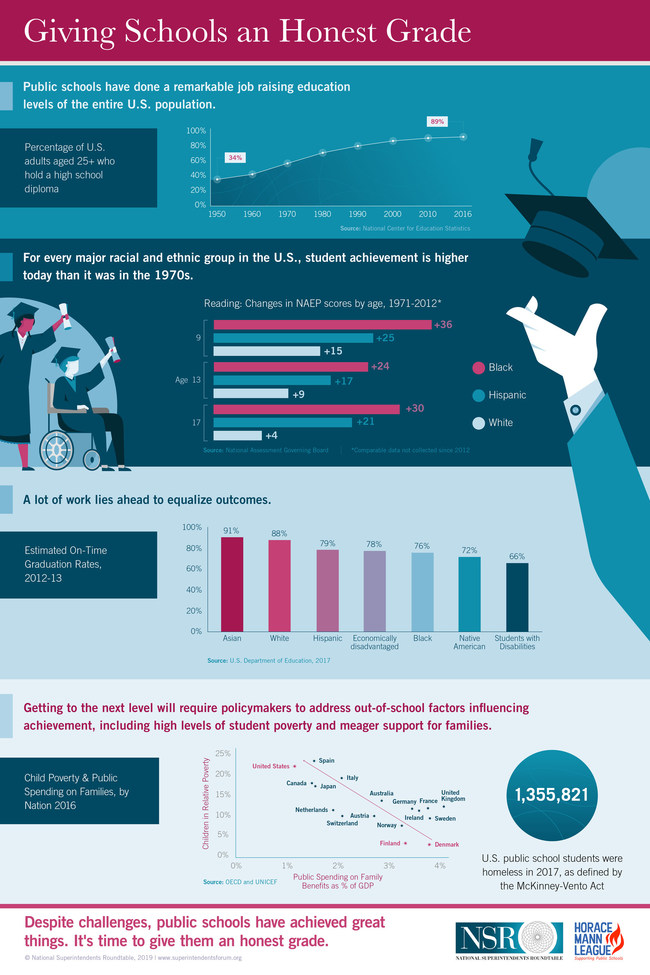
The National Superintendents Roundtable has a message for the public: be fair when judging our public schools. Schools today are far better than they were 40 or 50 years ago, by all conventional measures. what they might have added was that schools made steady progress until about 2007 or so, when No Child Left Behind took hold, then things were made worse by Race to the Top and Common Core. The proliferation of choice has flattened the progress made from 1970 to 2007.

Helen Ladd is one of our nation’s most distinguished economists. She has written extensively about education and poverty, as well as school choice.

Dr. Ladd informed me that she has written some new scholarly articles about charter schools.

I read them and was impressed.

I asked if she would let me post them here. She said that they are on a website that has limited access.

However, she said, the articles are now available and accessible to individuals who download them.

You can find the links on her web site:

https://sanford.duke.edu/people/faculty/ladd-helen-f

Or You may go directly to the links to the articles on the web site.

https://sanford.duke.edu/sites/sanford.duke.edu/files/images/Ladd-2019-Journal_Policy_Analysis_and_Management_Charter%20Schools.pdf

https://sanford.duke.edu/sites/sanford.duke.edu/files/images/Ladd-2019-Journal%20Policy%20Analysis%20%26%20Management%20Experimentation.pdf

Dr. Ladd asked me to point out that she was invited to write as part of a Point-Counterpoint discussion in the Journal of Policy Analysis and Management.  The author of the pro-charter paper and response, which are not posted here,  was  Philip Gleason from Mathematica.

I do not have access to links for the Gleason part of the exchange.


Many people have written to me to complain about an article that appeared Wednesday on the front page of the New York Times, saying it was pro-charter propaganda. The article claims that black and brown parents are offended that the Democratic candidates (with the exception of Cory Booker, now polling at 1%) have turned their backs on charter schools.

This is not true. Black parents in Little Rock, Arkansas, are fighting at this very moment to stop the Walton-controlled state government from controlling their district and re-segregating it with charter schools. Jitu Brown and his allies fought to keep Rahm Emanuel from closing Walter Dyett High School, the last open enrollment public high school on the South Side of Chicago; they launched a 34-day hunger strike, and Rahm backed down. Jitu Brown’s Journey for Justice Alliance has organized black parents in 25 cities to fight to improve their neighborhood public schools rather than let them be taken over by corporate charter chains. Black parents in many other districts–think  Detroit–are disillusioned with the failed promises of charter schools. Eve Ewing wrote a terrific book (Ghosts in the Schoolyard: Racism and School Closings on Chicago’s South Side) about resistance by parents, grandparents, students, and teachers in the black community to Rahm Emanuel’s mass closings of public schools to make way for charter schools; Ewing called their response “institutional mourning.” When Puerto Rico teetered on the verge of bankruptcy, parents, teachers, and students rallied against efforts to turn the Island’s public schools over to charter chains.

The article’s claim that “hundreds of thousands” of students are on “waiting lists” to enroll in charters links to a five-year-old press release by a charter advocacy group, the National Alliance for Charter Schools. In fact, there has never been verification of any “wait list” for charters. Although there are surely charters that do have wait lists, just as there are public schools that have long wait lists, there is no evidence that hundreds of thousands of students are clamoring to gain admission to charters. That claim appears to be a marketing ploy. Earlier this year, a member of the Los Angeles school board revealed that 80% of the charters in that city have empty seats. Just this past week, a well-established Boston charter announced that it was closing one campus and consolidating its other two because of declining enrollments. Four of Bill Gates’ charter schools in Washington State have closed due to low enrollments. The only effort to verify the claim of “waiting lists” was carried out by Isaiah Thompson, a public radio reporter in Boston; his review showed that the list contained many duplications, even triplications, since many students applied to more than one school, and the same lists held the names of students who had already enrolled in a charter school or a public school.

Perhaps the Times will now interview Dr./Rev. Anika Whitfield in Little Rock to learn about the struggles of Grassroots Arkansas to block the Walton campaign to destroy their public schools. Perhaps its reporters will interview Jitu Brown to hear from a genuine civil rights leader who is not funded by the Waltons or the Bradley Foundation or Betsy DeVos. Perhaps they will dig into the data in Ohio, where 2/3 of the state’s charter schools were rated either D or F by the state in 2018, and where the state’s biggest cyber charter went into bankruptcy earlier this year after draining away over $1 billion from public schools’ coffers. Perhaps they will cover the news from New Orleans, the only all-charter district in the nation, where the state just posted its school scores and reported that 49% of the charters in New Orleans are rated either D or F. Perhaps they will cover the numerous real estate scandals that have enabled unscrupulous charter operators to fleece taxpayers.

Fairness requires that the New York Times take a closer look at this issue, not by interviewing advocates for the charter industry but by trying to understand why so many Democrats, especially progressives, have abandoned the charter crusade. Why, as the Times asked in July, have charter schools lost their luster?  (I asked the same question last April.) [Editor’s note: I added these two links to refer to use of the term “lost their luster.”] Why have the number of new charters plummeted nationally despite the expenditure of $440 million a year by the federal government and even more by foundations like Gates, Broad, DeVos, Bloomberg, Koch, and Walton. Maybe it was disappointment in their lackluster, often very poor, academic performance. Or maybe it was the almost daily revelations of waste, fraud, and abuse that occurs when public money is handed to entrepreneurs without any accountability of oversight.

The question that must be answered is whether it is just and sensible to create two publicly funded school systems, instead of appropriately funding the public schools that enroll 47 million students, almost 90% of all students. It serves the interests of billionaires to keep people fighting about governance and structure, but it serves the interest of our society to invest in great public schools for everyone.


ON TAP Today from the American Prospect

NOVEMBER 27, 2019

Kuttner on TAP

The Times: In the Tank on Charter Schools. The Times ran an overwrought and overwritten front-page story Wednesday under the breathless headline, “Minority Voters Feel Betrayed Over Schools.” Betrayed? The headline on the jump page where the story continues is even more exaggerated: “Minority Voters Chafe as Democrats’ Charter School Support Wanes.”

The piece reads as if it were dictated by the charter school lobby. Read the story very carefully, if you bother to read to the end, and you will learn that some black and Hispanic voters see charters as a good alternative to public schools, while others are concerned that charters, which serve only a fraction of minority kids, drain resources from the larger number of kids in public schools, as the Prospecthas documented.

And if you read all the way to paragraph 38 (!), you will learn that according to a poll by Education Next, a journal that supports charters, black opinion on charter schools is in fact evenly divided, 47 percent supportive to 47 percent opposed. But that kind of nuance doesn’t get your story on the front page, while quoting fervent charter school activists and making unsupported generalizations does.

Other 2017 polling by Peter Hart Associates showed that large majorities of voters, black and white, oppose shifting funds from public schools to charters. Black parents were opposed, 64 to 36. Hart’s Guy Molyneux says there’s no evidence that these views have changed.

Does the Times have fact-checkers? Editors? Do they hold writers accountable?

Back to school!

Robert Kuttner’s new book is The Stakes: 2020 and the Survival of American Democracy.