Steven Singer will be in Pittsburgh on Saturday as part of the Network for Public Education delegation to the MSNBC forum on public education.
Here are his questions for the candidates.
He won’t get to ask them all, but they are all great questions!
Steven Singer will be in Pittsburgh on Saturday as part of the Network for Public Education delegation to the MSNBC forum on public education.
Here are his questions for the candidates.
He won’t get to ask them all, but they are all great questions!
Michael Kohlhaas, blogger in Los Angeles, writes here about a charter leader who harassed a teacher who protested his staff’s lack of qualifications.
Excelencia Charter Academy is yet another creepy little charter school run by yet another shockingly unqualified creepy little galaxy-brained grifter, this one known as Ruben Alonzo, going about the place making creepy little announcements of delusionally impending disruptive excellence while lining his creepy little pockets with public money1 at the expense of the actual human children that the state legislature, for reasons they’re going to have to answer for eventually, has seen fit to place into his care.
In this regard Alonzo is much like Sakshi Jain, shockingly unqualified founder of the ill-fated GANAS Academy, whose plan to co-locate on the campus of Catskill Elementary School conjured up such a monumental hurricane of activist opposition and scorn that, it appears, she has had to put her school’s opening on hold while she slinks back to her lair to soothe her metaphorical wounds with a salve made of equal parts boorish self-pity and Walton family megabucks.
Unlike Jain, though, Alonzo did actually manage to open his school. In the Fall of 2018 as it happens and, like Jain’s fiasco, co-located, in this case on the campus of Sunrise Elementary School in Boyle Heights. And like Jain’s folly Alonzo’s weirdo little project conjured up some opposition, most publicly from Sunrise Elementary teacher Mimi Guzman-Duncanson.
Duncanson famously parked her SUV out in front of the school covered in flyers advertising the appalling lack of qualifications of Excelencia’s teachers, let alone Ruben Alonzo, the self-proclaimed founder. Duncanson’s protest was covered in the Los Angeles Timesand by Jason McGahan, writing in The Baffler.

You can see a picture of Maestra Duncanson2 with her minivan somewhere near this sentence.That picture and another like it came from a huge set of emails released to me recently by Alonzo pursuant to the California Public Records Act.3 And if it looks like hostile photography, like surveillance, well, that’s because that’s precisely what it is. It turns out that aggressively callow hellbaby Ruben Alonzo just could not deal with the fact that anyone at all dared to question his galaxy-brained 29 year old self.
Curtis Cardine, former superintendent of both public and charter schools, is the preeminent expert on charter schools in Arizona. He created the Grand Canyon Institute to study education issues, and it keeps a close eye on charter malfeasance.
Cardine has written two books that are well worth reading to learn about the failures of the charter industry in Arizona. He is an expert in school finance, and he demonstrates in detail how charter operators are ripping off the public.
The first was Carpetbagging America’s Public Schools.
I quote that book extensively in my own new book SLAYING GOLIATH.
Cardine’s second book, recently published, is Schooling Alone, in which he compares the atomization of society caused by school privatization, and likens its effects to sociologist Robert Putnam’s classic study of social disintegration, Bowling Alone.
Cardine recently prepared a review of Arizona charter school closures and their relation to the bond debt incurred by charters.
Read his letter to two Arizona state senators here.
Steven Singer discovered that the Pennsylvania Department of Education invited citizens to comment on the state’s charter law.
Now is your chance to be heard.
Steven has some definite ideas about what needs to change and he tells you where to send your own comments.
He writes:
This is a huge opportunity for residents fed up with the nonsense the school privatization industry has been getting away with in the Commonwealth for decades.
Pennsylvania has one of the worst charter school laws in the nation.
Charter schools are taxpayer-funded but privately operated.
Though there are about 180 of these privatized institutions throughout the state with more than 137,000 students, that represents only about 6 percent of the kids enrolled in public school.
Yet the state funding system pits authentic public schools against charter schools for the financing needed to stay open.
Charter schools siphon money from authentic public schools serving the neediest students creating a deficit spiral. Money gushes out of public districts which have to cut teachers and programs to patch budget gaps which in turn result in even more parents pulling their children out of the public schools and trying to enroll them in charters.
Though the legislature used to help authentic public schools by reimbursing them for 30% of the charter school costs, that funding has been eliminated.
Meanwhile, the charter school law has barely changed at all since it was enacted in 1997.
Gov. Tom Wolf has promised to correct that with sweeping reforms in 2020 – even if it means bypassing the gerrymandered and gridlocked legislature with executive orders.
But before he can begin, he needs to hear from commonwealth voters.
Rahm Emanuel is gone. The boosters of privatization are out of power in Chicago. Mayor Lori Lightfoot has committed to improving the public schools that the vast majority of students attend.
No new applications to open charter schools this year in the city of Chicago.
It is a new day in Chicago, with new leadership.
Yana Kunichoff writes in Chalkbeat:
No new charter schools are applying this year to expand or open in Chicago, a sign of the shifting environment for the independently run, publicly funded schools in Chicago and at the state level.
Last summer Illinois abolished the state agency hearing appeals of charter school denials. Chicago schools, both district- and charter-run, are experiencing an ongoing drop in enrollment, leaving schools competing for fewer students.
A charter school operator named Destiny STREAM Academy for Girls Charter School initially applied to open a new charter, focused on math and technology education for girls, but then withdrew its application.
Chicago has more than 120 charter schools; the school district runs more than 500 schools. The number of charter school applications has diminished by half over the past three years, according to a Chalkbeat analysis.
After more than two decades of expansion in Chicago, charter school growth has tapered off.
Last year, the district denied three new charter proposals.
In 2017, nine schools sent in proposals. One was approved, one denied, and seven schools withdrew their applications. In 2016, there were 10 submissions, one of which was incomplete, and the rest were withdrawn.
That’s a wildly different landscape to just a few years before, when more than 16 schools threw their hat in the ring for a new charter or expansion in 2014-2015 school year (the majority later withdrew their proposals).
The district is also recommending that two charter schools be closed: Chicago Virtual Charter School, which offers primarily online classes for elementary and high school grades, and Frazier Preparatory Academy Charter School, a K-8 school in North Lawndale that shares a building with a district-run school.
The virtual school is under investigation by the district’s Office of Inspector General and has “the lowest School Quality Rating Policy score, used to rate how schools are performing, of any charter high school, the lowest Freshman OnTrack rate, and one of the lowest graduation rates in the district,” according to the district. Last year, it received a rating of 2, the second-lowest possible.
Chicago Virtual Charter School has held a charter with the district since 2006. The district renewed its charter in 2015 for five years.
The district is recommending that the board revoke the Frazier Preparatory Academy charter because it hasn’t been able to get off the academic warning list, which is for schools who received a low school rating three years in a row. During the 2017-18 school year the board proposed the school’s charter be renewed for three years, with conditions. The board approved a co-location with Theodore Herzl Elementary School in 2014.
Rachel Cohen writes here about the charter supporters backing Pete Buttigieg.
Billionaire Reed Hastings held a fundraiser for Mayor Pete. Hastings, CEO of Netflix, has given millions to the California Charter Schools Association. He has said he looks forward to the day when there are no elected school boards. He likes schools run by corporate boards. He says they didn’t discuss charter schools, which is one of Hastings’ causes about which he is passionate.
Cohen writes:
Linda Lucy, who has served as the president of the South Bend teachers union since June 2018, told VICE she had never met with Pete Buttigieg, and had “nothing to add” about the union’s relationship with the mayor. “Politicians have hijacked the teaching profession in our public schools,” she said.
Buttigieg does appear to have made time for Heather Willey, one of Indiana’s top charter school lobbyists, who co-hosted a fundraiser for Buttigieg in Indianapolis on October 4, according to an invitation obtained by VICE.
Willey served on the board of the Institute for Quality Education, an Indiana school choice advocacy group, for years, and co-chairs her law firm’s “Charter School and School Innovation” group. In 2019, the Institute for Quality Education, Teach for America Indianapolis, and Charter Schools USA, Inc., a for-profit charter company, all listed Willey’s firm, Barnes & Thornburg LLP, as a hired lobbyist. According to her professional biography, Willey “has been intimately involved in the charter school and school reform movements since the inception of the laws in Indiana in 2001.” She did not return repeated requests for comment.
In Silicon Valley, meanwhile, Buttigieg has also had fundraisers with several prominent charter school supporters.
Satya Patel, a venture capitalist who formerly worked as a vice president of product at Twitter, co-hosted an event for Buttigieg in the Bay Area in late August. Between 2007 and 2017, Patel served on the board of KIPP Bay Area Schools, part of the nation’s largest charter school network, which has received tens of millions of dollars in federal grants. He did not return requests for comment.
The charter industry has lobbied for years to promote the idea that public schools and their teachers and teachers unions are uniquely responsible for denying educational opportunity to children of color. Ever since the propaganda film “Waiting for Superman,” produced by billionaire charter supporter (and rightwing evangelical zealot Philip Anschutz), the charter industry has promoted the claim that supporters of public schools are hostile to children of color while they—funded by billionaires like the Waltons, the Sacklers, the Koch brothers, the DeVos family, and every Republican governor—claim to be champions of civil rights.
”Malarkey!” says FAIR (Fairness and Accuracy in Reporting).
FAIR offers a “close reading” of media bias against public schools and demonstrates how the charter industry has deceptively labeled any opposition to charters as the work of teachers’ unions, never admitting that supporters of public schools include parents, grandparents, and graduates of public schools, as well as members of the public who understand the importance of public education in a democracy.
After thirty years of charter advocacy, only 6% of American students are enrolled in them. In the only city that is all-charter, New Orleans, the only choice that is forbidden is a public school. This decision was not the result of a vote by the citizens of New Orleans, but a decision imposed by the white Republicans who control the State Legislature. Southern white Republicans are not typically perceived as concerned about the well-being of children of color.
Valerie Strauss reviews “Still Asleep at the Wheel” here.
She begins:
“More than 35 percent of charter schools funded by the federal Charter School Program (CSP) between 2006 and 2014 either never opened or were shut down, costing taxpayers more than half a billion dollars, according to a new report from an advocacy group that reviewed records of nearly 5,000 schools.
“The state with the most charter schools that never opened was Michigan, home to Education Secretary Betsy DeVos.
“The report, titled “Still Asleep at the Wheel,” said that 537 “ghost schools” never opened but received a total of more than $45.5 million in federal start-up funding. That was more than 11 percent of all the schools that received funding from CSP, which began giving grants in 1995.
”In Michigan, where the billionaire DeVos has been instrumental over several decades in creating a charter school sector, 72 charters that received CSP money never opened, at a total cost of some $7.7 million from 2006 to 2014. California was second, with 61 schools that failed to open but collectively received $8.36 million. The Education Department did not respond to a query about the findings. DeVos has made expanding alternatives to school districts — including charters and programs that use public money for private and religious schools — her top priority as education secretary, and has said her metric for a state’s education success is how much they expand school “choice.”
”Casandra Ulbrich, president of the Michigan State Board of Education, said in an interview that she found the new report “extremely troubling.” “It raises some very legitimate questions about a federal grant program that seems to have been operating for years and years with little oversight and very little accountability,” she said.”
Last spring, the Network for Public Education published a report on waste, fraud, and abuse in the federal Charter Schools Program. The report, called Asleep At the Wheel, documented the Department of Education’s failure to monitor the veracity or feasibility of applications for the program or to follow up on what happened to the money spent to launch new charter schools. It found that nearly $1 billion of federal dollars had been wasted on charters that either never opened or closed soon after opening.
Today, NPE released a new report that delves into what happened with federal money from the Charter Schools Program in the states. The findings were even more concerning than last spring’s report.
The new report is called Still Asleep At the Wheel.
An excerpt:
This report, Still Asleep at the Wheel: How the Federal Charter Schools Program Results in a Pileup of Fraud and Waste, takes up where our first report left off. In it, we provide detailed information, state by state, on how federal dollars were doled out to schools that no longer exist or never existed at all.
In 2015, the U.S. Department of Education (the Department) published a list of charter schools that received grants between the years of 2006 and 2014. Using that database of 4,829 schools, we meticulously determined which charters that received grants were still open, which had closed and which had never opened, resulting in state by state records of enormous waste. We examine the detailed spending records of some of Michigan’s ghost charter schools that received grants exceeding $100,000. We explain how money moves into the hands of for-profit management organizations and tell the stories of subgrantees that engaged in fraud—sometimes amounting to hundreds of millions of dollars—all beginning with funding from the federal Charter Schools Program.
Major findings of our research include the following:
Documented charter school closures and the waste of federal funds exceeds our first report’s estimations.
We believed that about 1,000 recipient charters were defunct. However, using the 2015 database (active grantees from 2006-2014), we identified 1,779 grantee schools that either never opened or had shut down. The number of non-operational recipients, across 25 years of the program is inevitably in the thousands.
In the first report, we estimated the fail- ure rate for recipient schools to be 30 percent. For schools listed in the database, however, our latest review found a failure rate of 37 percent.
It is impossible to document total waste for the entire 25 year program because the Department never required the states to report the names of funded schools until 2006. However, we have now documented $504,517,391 (28 percent of the total database amount) that was awarded to schools between 2006-2014 that never opened or that have closed. Applying that percentage to the total expenditures ($4.1 billion) of the CSP programs designed to create new schools, approximately $1.17 billion in federal funding has likely been spent on charters that either never opened, or that opened and have since shut down.
The disbursement of over one billion dollars during the program’s first decade was never monitored for its impact or results. There is no record of which schools received the funds.
From 1995 to 2005, enormous funds were pushed out to the states to distribute to schools via subgrants. Yet the Department has no complete record of which schools re- ceived funding during the program’s early years, because it never required the states to report the names of subgrantee schools or their status. The Department’s over- sight ended when the funds left Washington.
During the first decade of the program when states did not have to report where the money went, Florida, a state where nearly half of all charter schools are run by for-profit organizations, received four grants totaling $158,353,525. Michigan, where about 80 percent of all charters are run by for-profit management companies, received four grants totaling $64,608,912. California also received four grants, totaling $190,857,243.
Although the overall rate of failed charter projects was 37 percent, in some states the rate of failure was much higher.
Iowa and Kansas have the largest propor- tions of failed subgrantee charter schools. Eleven charter schools in Iowa received grants. Ten failed, wasting over $3.66 million. As of 2014, the database indicates that Kansas doled out $8.51 million to 29 schools. Twenty-two (76 percent) of those schools either never opened or are closed today–$6,389,964 of the $8.9 million was wasted.
States with a subgrantee failure rate exceeding 50 percent include: Delaware, Georgia, Hawaii, Iowa, Kansas, Maryland, Mississippi, Virginia and Washington (state). Mississippi had only one grantee and that school failed. Georgia had 75 failures, resulting in over 23 million federal dollars wasted.
The percentage of defunct charter school grantees in Florida was 37 percent ($34.2 million); the Michigan failure rate was over 44 percent ($21 million) and Lou- Asian’s failure rate was 46 percent ($25.5 million).
The most astounding loss, however, was California’s: nearly $103 million was awarded to charters that never opened or have shut down—37% failed.
Five hundred thirty-seven (537) schools list- ed in the database never opened at all. Many received over $100,000 in federal funds.
Since 2001, charter school entrepreneurs have been eligible to receive CSP grants before they have even identified an authorizer or submitted a detailed application to open a school. In total, we identified 28 states that had at least one charter school (537 schools in total) that never enrolled even one student for one day and yet had received federal funds. According to the CSP database, those schools received, or were due to receive when the database collection ended, a total of $45,546,552 million.
Topping the list was the state of Michigan where 72 never-opened schools received grants, most exceeding $100,000. Over $7.7 million was wasted. In California, we identified 61—with waste of $8.36 million.
Other states with large numbers of never- opened schools receiving CSP funds in- clude Arkansas (18), Florida (46) Illinois (20), Maryland (38), Massachusetts (17), New Jersey (23), Ohio (20), Oregon (40), Pennsylvania (41), South Carolina (34), Tennessee (43) and Wisconsin (15).
This report provides details on how several of these never-opened charters in Mi- chigan spent those federal funds.
Although Congress forbids for-profit opera- tors from directly receiving CSP grants, they still benefit by having their schools apply.
Although we could not identify every charter in the CSP database that was run by a for-profit management company, we were able to identify those run by the large for-profit chains including Academica, K12, National Heritage Academies, White Hat and Charter Schools USA. In total, we found 357 schools in the database run by major for-profit chains. These schools had received a total of $124,929,017 in federal CSP start-up funds. Unsurprisingly, most of this money flowed to for-profit run schools in Florida ($46,936,979) and Michigan ($26,452,927). Eighty-three (83) schools run by the Flor- ida-based, for-profit chain Academica received CSP grants, totaling $23,426,383.
Still Asleep at the Wheel also describes why so many charter schools fail, along with the stories of grantee schools that abruptly closed, sometimes with little or no notice to their students and families. Far too often those schools shut down due to corruption and fraud. Our report provides disturbing accounts of grifters and profiteers who took CSP and other taxpayer funds only to enrich themselves at the expense of the students they had promised to serve.
The staggering amount spent on schools that have closed or never opened, as well as those that have engaged in fraud, is nothing short of a national scandal. As public dollars are diverted from public schools, the students who attend their neighborhood schools have fewer resources. It is time to put on the brakes and chart a new course.
We were heartened that after the publication of our first report in March of 2019, the U.S. House of Representatives reduced funding for the CSP program for 2020. However, a small reduction is not sufficient to address the program’s structural flaws.
We therefore strongly recommend that Congress end appropriations for new charter school grants in the upcoming budget and continue funding only for obligated amounts to legitimate projects. Once those grants have been closed, we recommend that the CSP be ended and that charter schools continue to receive federal support only through other federal funding streams such as Title I and IDEA. Students, not charter school en- trepreneurs, should benefit from federal funds.
We also recommend thorough audits by Congress of previous grant awards, the establishment of regulations to ensure grant awards still under term are being responsibly carried out and that misspent money is returned to the federal coffers.
Three years ago, the pro-charter, pro-voucher Thomas B. Fordham Institute published a study of Ohio’s voucher program. The study, conducted by David Figlio and Krzysztof Karbownik of Northwestern University is called “Evaluation of Ohio’s EdChoice Scholarship Program: Selection, Competition, and Performance Effects.”
The study concluded that the voucher program was failing to improve student achievement.
It said in its conclusions:
There appears to be positive selection, as measured by prior academic performance and family advantage, among voucher-eligible students into private schools as part of the EdChoice program. Although a substantial majority of the students participating in the program, as well as their peers remaining in public schools, tend to be from low-income backgrounds, those students leaving for private schools under the program tend to be more advantaged and higher performing than their peers who were eligible to participate in the program but who remained in public schools…the evidence regarding the effects of EdChoice program suggests that while higher-performing students tend to leave public schools to attend private schools under the EdChoice program, the students who remain in the public schools—at least, those public schools that were comparatively high achieving—generally perform better on statewide tests as a consequence of EdChoice vouchers being available to students in a school. On the other hand, those students who leave these comparatively high-achieving public schools to go to private schools appear to perform worse than they would have had they remained in the public schools (which we estimate to have improved as a consequence of the introduction of EdChoice). Together, it appears that EdChoice has benefitted the majority of students, but the students who actually left the public schools—at least those on the margin of eligibility—perform worse on statewide tests. Although test performance is only one measure of educational success, these findings suggest that a detailed exploration of the possible causes of the negative test-score results (for instance, which private schools participate in the program, policies on school-grade retention, test-curriculum alignment, and the like) may be warranted.
Thus, the students eligible to leave with a voucher do better if they stay in public school; the students who use the voucher, who come from more advantaged backgrounds, do worse in school.
This is the only statewide evaluation of the Ohio EdChoice Program, and not what one would call a ringing endorsement since those who use the voucher do worse in school than those who stay in public school and don’t use the voucher.
Such research did not impress the Ohio legislature. Under the prodding of State Senator Matt Huffman (R.-Lima), the state has expanded the voucher program, so that students in two-thirds of the districts across the state are now eligible to get state funding to attend a religious school.
The Cleveland Plain-Dealer wrote that the voucher expansion will hit the budgets of school districts hard, districts that in the past were not part of the voucher program.
A year ago, no students in the Parma school district used Ohio’s main tuition voucher program to attend private schools.
This year, thanks to changes in state law, 359 students are using vouchers.
For families paying tuition to send their kids to Parma-area private Catholic schools like Padua or Holy Name, a $6,000 tax-funded voucher toward tuition is a huge help.
For the district, it’s a $2.1 million hit to the budget that impacts teachers, books and supplies for its schools.
Parma isn’t alone in facing new or increased costs to help students attend private schools. Changes to state law, have more than tripled the number of districts declared part of the voucher program, from 40 in 2018-19 to 139 this school year.
Next year, the program meant to help students escape being stuck in failing schools will grow further, to more than 400 districts, which represents more than two-thirds of the districts in the state.
Even Solon, always at the top of state test score rankings, has a school considered failing and whose students are now eligible for vouchers. Next year, add a school in each of the high-scoring Brecksville-Broadview Heights and Mayfield districts.
The change has school officials protesting and gathering to find ways to seek relief…
The use of vouchers within school districts is also increasing. The Cleveland Heights-University Heights schools saw 500 more students use vouchers this year than last year, mostly to attend Jewish schools. The district’s voucher bill increased by $3 million.
That change, said district Treasurer Scott Gainer, has the school board seeking a higher tax increase than planned this spring.
Shaker Heights Superintendent David Glasner, whose district is seeing a small bill this year, but faces a larger one next year, complained to the state school board last week about the hit that school district budgets are taking.
“There are school districts that are now expecting to lose millions of dollars in the course of one year as a result of the EdChoice [voucher] expansion,” Glasner said. “These are losses for which districts were unable to forecast or prepare.”
State Sen. Matt Huffman, one of the strongest supporters of vouchers in Ohio, said some of the rules are subtle and have changed a few times. But districts should have known, he said, and should be blaming themselves for not improving their schools…
Ohio has four “scholarship” or voucher programs that provide tax dollars to pay tuition at private schools, almost all of which are Christian schools. There is one program just for Cleveland, which was started in 1996, so Cleveland is not affected by the current changes.
The biggest is called EdChoice. Created in 2005 for students attending “underperforming” schools or who would be assigned to them, EdChoice has a student’s home district pay $4,650 toward tuition for kindergarten through eighth grade and $6,000 for private high schools.
Stephen Dyer, a former legislator in Ohio who writes a blog about education, called “BS” on Huffman’s claim that school districts should have known and should have been prepared.
Dyer says that the state rigged the grades and school report cards to produce failure and make more schools voucher-eligible.
This is where I call BS.
How can I do that? Simple: Over the last decade, the state report card grades upon which these new voucher building designations are being based have been deliberately and artificially deflated for the state’s school districts. And I’m increasingly convinced it was for this sole purpose: to ensure more districts and buildings are deemed “failing” by the state so more public money can be poured into private, mostly religious schools.
Don’t believe me?
Look at school districts’ overall grade performance since the 2012-2013 school year — the first for the A-F state report card system.
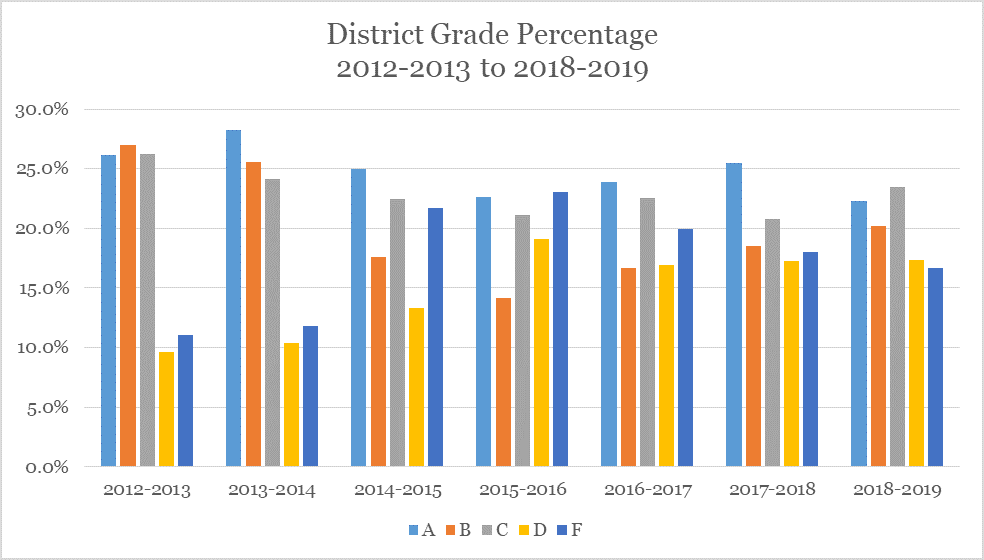
Notice anything? Like a massive jump in D and F grades between 2013-2014 and 2014-2015?
Let me ask you a question: Does anyone — and I mean ANYONE — actually believe that between the 2013-2014 school year and the 2014-2015 school year school districts became more than twice as likely to “fail” kids?
Of course not.
This is a classic case of grade manipulation by state lawmakers. You’ll also notice a steady decline in the rate of Fs since the high point of 2015-2016. Why were these grades so much worse? Because the state kept changing standardized tests. So teachers and students had no idea what the testing expectations were. Since they’ve remained the same, you can see a steady and precipitous decline in the rate of F grades, though the percentages of D and F grades remain far higher than the 2012-2013 school year.
To add insult to injury, a study examing the test performance of students who take vouchers found they did worse on state tests after taking the voiucher than before … according to the pro-voucher Fordham Institute. But that doesn’t matter to Huffman, whose hero is apparently the Titanic captain who kept plowing ahead, damn the iceberg.
Anyway, here’s where Huffman struck gold for those who are taking a public subsidy to send their kids to private, mostly religious schools — only 2 out of the three years’ grades count to have your building designated “failing” from 2013-2014, 2017-2018 and 2018-2019. And once the building is eligible for vouchers, every student who gets a voucher gets to keep it forever, even if the public building becomes the highest-performing in the state…
But it’s all been a plan from the beginning:
1) Deliberately deflate district report card grades
2) Get as many buildings as possible eligible for vouchers
3) Market them like crazy to families in these districts so the rest of us taxpayers can subsidize their choices with our local tax dollars and/or fewer opportunities for our kids who remain in local school districts.
That’s not a district performance problem.
It’s Huffman’s plan.
****************************************
Last Saturday I was on Meryl Johnson’s radio show, based in Cleveland, where she was a teacher in the public schools for many years. Meryl is an elected member of the Ohio State Board of Education, and she is very concerned about the explosion of vouchers. She alerted me to this disaster. I pointed out that there is one possible silver lining. Until now, the suburban districts in Ohio could ignore vouchers and assume they affected only Ohio’s urban districts. Now the cost of vouchers will hit their school budgets and their taxes will have to go up so that a few students can go to religious schools, where they are likely to get a worse education than the one offered in their local public schools. Their own schools will now feel the pinch caused by vouchers. Maybe this is the wake-up call that is needed to create a statewide coalition to stop defunding the public schools that enroll the vast majority of students in the Buckeye State.
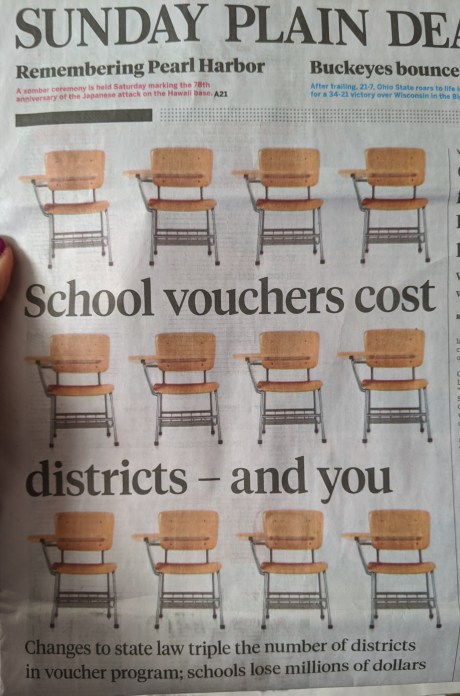
Meryl sent me a screen shot of the front page of the Cleveland Plain Dealer. Will this wake up the citizens of Ohio? Will they realize that they must raise their taxes to pay for vouchers for the small number who leave their public schools? Do they know that the students who leave for religious schools will lose ground academically?

 Diane Ravitch's blog