Archives for category: Privatization

Margaret Raymond is the director of the Center for Research in Educational Outcomes (CREDO) at Stanford University, which conducts studies of charter schools, funded by the Walton Family Foundation. On December 10, 2014, she addressed the Cleveland City Club. About 50 minutes (and a few seconds) into a 56-minute talk, she gave the following response to a question about charter school policy:

“This is one of the big insights for me because I actually am a kind of pro-market kind of girl, but the marketplace doesn’t seem to work in a choice environment for education… I’ve studied competitive markets for much of my career… Education is the only industry/sector where the market mechanism just doesn’t work… I think it’s not helpful to expect parents to be the agents of quality assurance throughout the state. There are other supports that are needed… I think we need to have a greater degree of oversight of charter schools, but I also think we need to have more oversight of the overseers… the authorizers.”

https://www.youtube.com/watch?v=H1-mPiSQLfc

Jeremy Mohler of the nonpartisan “In the Public Interest” wrote a clear summary of the reasons to be concerned about charter schools:

The holidays are a time of joy and relaxation but also uncomfortable conversations with family. Will Uncle Tommy go on another rant about windmills causing cancer? Does grandma still think Russia is the only reason Trump won?

So, what should you say when someone starts dissing traditional, neighborhood public schools and hyping up charter schools?

Charter schools generally perform academically about the same as neighborhood public schools.

Study after study show that, just like there are high and low performing neighborhood public schools, there are high and low performing charter schools.

In fact, because some charter schools effectively exclude special education students or expel students with perceived disciplinary issues, charter school academic success often can be overstated.

Charter schools can drain school district budgets, taking resources from neighborhood public school students.

Research is revealing that, in many states, school districts and the students they serve are undermined by policies that prioritize opening new charter schools.

For example, California’s unchecked charter school growth cost San Diego’s school district $65.9 millionduring the 2016–17 school year. That’s $620 less in funding a year for things like nurses, counselors, and computers for each neighborhood public school student.

Charter schools have been co-opted into a market-based model of providing education with winners and losers.

While some charter schools are founded and run by grassroots groups of parents and educators, many are run by large, corporate-like chains, such as Rocketship and KIPP.

Wealthy donors and organizations like the family who owns Walmart are bent on privatizing public education through the creation of a parallel education system in competition with neighborhood public schools.For example, since 1997, the Walton Family Foundation has invested more than $407 millionin charter schools.

The seeds of today’s “school choice” movement were sewn in the years after desegregation.

Charter schools are more racially isolated than neighborhood public schools in virtually every state and large metropolitan area in the nation.

The vast majority of the school districts that have experienced state takeovers in the last 30 years are majority black and Latinx. Many subsequently were forced to allow for the creation of charter schools. Some middle and upper class, predominantly white communities are even using charter schools to opt out of neighborhood public schools.

This harkens back to the years following Brown v. Board of Education when southern legislatures enacted as many as 450 laws and resolutions attempting to discredit, block, postpone, limit, or evade school integration. Many of these acts allowed the re-direction of taxpayer dollars to benefit private schools, such as private school vouchers, as white Americans fled in record numbers from neighborhood public schools.

Even though most charter schools are nonprofit doesn’t mean the people who run them aren’t pocketing tons of taxpayer money.

Running a nonprofit charter school can be a highly lucrative undertaking. Some charter schools hire for-profit charter management organizations. Others rent buildings from real estate investors who specialize in charter school investment.

One charter school in California’s Bay Area rented school space at three and one-half times market rate from a company with business ties to its CEO. Through this and other schemes, the CEO diverted $2.7 million in taxpayer dollars without any supporting documents over a span of five years.

Public school systems should provide a great education to each and every student.

Students (and society alike) don’t need a public school system that creates winners and losers. They need smaller classes, better paid teachers, more support services, and cleaner and safer facilities.

Whatever you do during the holidays this year, don’t buy into the myth that the U.S. public education system is broken. There are countless neighborhood public schools around the country finding powerful and groundbreaking ways to educate students. There are hardworking, courageous teachers in every city and town across this land.

What’s broken is how we fund public education. Public schools simply need more resources, and, for that to happen, we don’t need anything all that complicated. Corporations must pay their fair share in taxes, and more resources must to go to the schools and communities that need them most.

Mercedes Schneider writes here about Betsy DeVos and her not-innovative idea of a “backpack full of cash.”

Betsy used the metaphor to refer snidely to a disguised voucher. It is a common metaphor among rightwing advocates of privatization. Betsy didn’t realize she was using the title of a popular documentary, shown in hundreds of communities across the country as a warning about privatization.

(If you want to book a screening of Backpack Full of Cash, go to the website.)

The film-makers, Sarah Mondale and Vera Aronow, borrowed the term from choice advocate Jeanne Allen of the Center for Education Reform, who has dreamed for years about defunding public schools by strapping the child’s cash in a backpack and sending the child to a charter school, religious school, cyber charter or home school, the less regulated the better. Anything will do for the backpack of cash except a public school.

Betsy didn’t know the etymology of the term but loved the idea of taking money away from public schools and giving it to any entrepreneur or grifter who wanted it.

Read the post to learn the not-sad fate of the rightwing’s favorite bad idea.

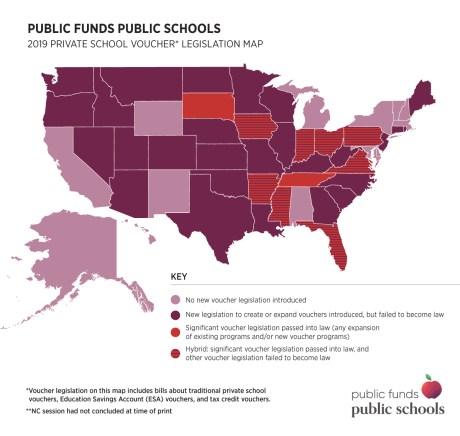
The Education Law Center created this graphic and explanatory information about the battle to keep public funds in public schools. The graphic shows the state of the voucher movement and identifies which states have advanced or repelled efforts to privatize public funding to religious and private schools via vouchers. It is heartening to see the number of states that rejected voucher legislation, especially when such legislation was defeated by a coalition of rural Republican legislators and urban Democratic legislators, as was the case in Texas and Arkansas. Thanks to all those who are joining forces to keep public funds in public schools.

pic1pic2

PRIVATE SCHOOL VOUCHERS: ANALYSIS OF 2019 STATE LEGISLATIVE SESSIONS
For a larger version and a text description of this map with a list of the states in each category, click ​here​.
In anticipation of states’ 2020 legislative sessions, this is the first in a series about the fate of private school voucher proposals during 2019 sessions.
Introduction
Despite the continued promotion of school privatization by U.S. Education Secretary Betsy DeVos, as well as support from a number of governors, legislatures, and well-funded advocacy organizations across the country, only two states enacted new private school voucher programs during their 2019 legislative sessions. Although some states expanded existing voucher programs, most passed no voucher legislation at all, and the majority of those that did made small-scale changes.
2019 Legislative Session Highlights:
  • Bipartisan majorities in Georgia, Kentucky, and West Virginia rejected voucher proposals supported by those states’ newly elected governors.
  • Although 22 states have full Republican control, only Florida and Tennessee were able to pass legislation creating new voucher programs in votes largely along party lines.
  • In Nevada, just a few years after the nation’s most expansive Education Savings Account (ESA) voucher law was passed, a new governor signed a bill repealing the program, which had never been implemented.
2019 Legislative Session Lowlights:
  • Tennessee passed a new private school voucher program, though it is limited to two counties.
  • Florida added yet another voucher program to the state’s existing voucher system.
  • Other states increased funding for their previously enacted programs, including Indiana and Iowa.
State Actions in Brief:
Arkansas
For the second consecutive legislative session, rural Republican lawmakers teamed with Democrats in a bipartisan effort to defeat legislation that would have created new school voucher programs. Proposals for a tax credit voucher and a traditional voucher were defeated. Although eligibility for the state’s existing ESA vouchers was modestly expanded, a bill passed requiring a biennial study that will provide lawmakers with important information to analyze how public funds are being spent in that program.
Arizona
Months after voters overwhelmingly rejected the 2017 expansion of the state’s ESA voucher program, legislators introduced a number of bills to again expand the program. Two of these bills passed out of relevant committees but were not taken up by the House or Senate. The remaining expansion bills did not advance, and a bill that slows the growth of tax credit vouchers passed into law.
Diverting public money to private education starves public schools of vital resources and does not lead to improved academic outcomes. For information about various types of private school voucher programs, visit the Public Funds Public Schools website. The PFPS website also highlights a wide range of research showing that private school voucher programs are an ineffective and harmful use of public funds.
Florida
Governor Ron DeSantis (R) signed Florida’s latest private school voucher plan, the “Family Empowerment Scholarship Program,” into law. This program will divert an estimated $130 million to private schools over the authorized period and will make vouchers available to middle class families earning up to $80,000 a year.
Georgia
Despite a new Republican governor who supports private school vouchers, voucher legislation failed in the State Senate. Six of the 13 Republican senators who represent rural areas of the state voted against the bill.
Indiana
Governor Eric Holcomb (R) signed legislation to increase funding for Indiana’s existing tax credit voucher program by almost 15% over the next two years. The legislation also increases the voucher amount for eligible families.
Iowa
Governor Kim Reynolds (R) signed legislation to increase the cap for Iowa’s existing tax credit voucher program by $2 million over the next two years. A bill to establish an ESA voucher was not considered by the full legislature.
Kentucky
Mobilization at the state capitol by educators standing up for public schools and several days of school sickout closures led to the defeat of legislation to create a tax credit voucher program. The Republican majority did not bring the bill up for a vote.
Louisiana
In Louisiana, a bill creating a “reading voucher” for public school students to use for private tutoring and other private uses passed the House but did not make it out of the Senate Finance Committee.
Mississippi
A bill to expand the state’s limited ESA voucher program was not voted on in the Republican-led House Education Committee. However, as the session was ending, the Lieutenant Governor included $2 million in new ESA funding in a bill to fund state construction projects.
Missouri
Bills to create a tax-credit-funded ESA voucher program were not acted upon before the legislative deadline.
Nevada
Governor Steve Sisolak (D) signed a bill formally repealing the state’s ESA voucher program first passed in 2015, and subsequently struck down by the Nevada Supreme Court. Additionally, a number of bills to create ESA vouchers for students deemed “victims of bullying” failed to advance in the legislature.
North Dakota
A bill that would have authorized a “school choice” study, including of ESA vouchers, passed in the House of Representatives but failed in the Senate.
Pennsylvania
Governor Tom Wolf (D) vetoed a major expansion of the state’s tax credit voucher program passed by the Republican-led legislature. The bill would have nearly doubled the amount that could be diverted to the program, included automatic annual expansions, and significantly raised the income limit for participating families.
South Carolina
Two bills were introduced in the legislature to establish an ESA voucher for students with disabilities. Both were referred to their chamber’s education committee, with no action taken by the legislature.
Tennessee
Governor Bill Lee (R) signed a law to establish an ESA voucher program. Concessions were made to rural Republican legislators in order to pass the bill, including limiting the program to the state’s two largest school districts and capping it at 15,000 students per year.
Texas
State leadership, including Republican legislators and the governor, did not include vouchers among their education priorities in 2019. In response to electoral losses in the suburbs and a lack of support for vouchers, legislative leaders emphasized improving the state’s public school financing system instead.
West Virginia
After a nine-day teachers’ strike in 2018, educators went on strike again, closing all but one of the state’s 55 county public school districts, to protest bills to allow charter schools and to create an ESA voucher program. The voucher bill did not pass during the regular session. Vouchers were again considered, but the program did not pass, during a special session on education legislation.
Resources
Acknowledgements
Many thanks to Jason Unger for compiling the research and drafting this series on 2019 legislative sessions.
Press Contact:
Sharon Krengel
Policy and Outreach Director
Education Law Center
973-624-1815, ext. 24

Angie Sullivan is a teacher in a Title 1 elementary school in Las Vegas. She regularly writes the members of the Nevada legislature to share her outrage about the underfunding of the state’s neediest schools and the state’s waste of money on charter schools, which dominate the state’s list of the lowest performing schools.

Here is her latest:


Peter Greene in Forbes
Still Asleep At The Wheel 
What happened?  
Pile of fraud and graft.  
These charter titles got money and did what?   
This charter changed its name many many times.   It is difficult to follow its trail – 100, One Hundred, Imagine at different locations.   Is this graft? fraud?  Imagine still has a failing charter campus opened? What happened to the two additional campuses?  $300,000 disappeared with change in names and admin?   This is what lack of accountability and transparency does. 
What happened to the Montessori in Carson?   I believe it is still there – complaining about cash.  These charters worry me because they never have a testing year so zero data and zero accountability. This is what lack of accountability and transparency does.   They received funding but complain about no money and blame Vegas.  They may try to get the Silver State/Argent Building.   They do not serve the poor. 
Silver State Charter School changed its name to Argent and lost almost all its students.  Sounds like the receiver had concerns because no one attended the “distance” low performer school.  No one ever graduated.   As in zero.   Perhaps Joshua Kern knows where the $440,000 went?   No one graduated.  This is the first charter I have seen “closed” by the charter authority.  I do not think it had any students left and that is what actually closed it. 
School of the deaf went bankrupt.  Im surprised it did not go into receivership and just get more money like Quest, Silver State and others.  The Nevada Tax Payer pays millions to keep financially floundering  charters open. 
E-TECHS had a facebook and a twitter for $300,000.  This was in 2011 and they never opened?   What happened to the money? 
Gardnerville’s Sierra Crest closed in 2010.  Sounds like the local school board was not putting up with low quality.  What happened to the $172,000? 
Did Washoe Team A even exist at all?  Where did the $220,000 go?  
Nevada folks need to demand to see this money.   
If Nevada Senator Scott Hammond is hiding behind a non-profit management system – we need to know that too.    Managing 5 charters for free?  What kind of accountability and transparency is this?  
There needed to be a charter moratorium for good reason.   Rest in Power Tyrone Thompson who knew that.  Playing games like this with money when Nevada has none is crazy. 
We see you Gulenist Soner Tarim 👀 Agenda 4a.   How much money are you bringing to Nevada Strong?  Expert at getting grants and not opening?   Everyone should protest every Nevada Charter Meeting to close that Gulen Charter down.  Nevada does not need anymore scamming known bad actors. 
None of these December 2019 charter applicants should be granted anything.  These scams are too much. 
Asleep at the wheel and gone off the road and crashed into a ditch.  
This is bad. 
Angie Sullivan. 

Zeph Capo, president of the Texas AFT,  writes here about the state’s determination to take over the Houston Independent School District because ONE SCHOOL HAS LOW TEST SCORES.

The State has failed in other takeovers, and its only plan in Houston is to usurp the elected school board. Capo believes that the goal is to allow charter operators a free hand in the state’s biggest school district.

He writes:

“In a profoundly unbelievable decision, the state announced last month it will take over the entire Houston school district, the largest district in Texas, even though the schools have been showing remarkable progress. Either the TEA doesn’t know what’s actually happening on the ground hundreds of miles away or, more likely, it doesn’t care because it is anxious to deliver Houston’s 284 public schools to charter operators. If the state succeeds, other Texas school districts could be its next target.

”The TEA has a poor track record on state takeovers and other interventions. Take the Marlin Independent School District, about 100 miles from Austin. In late 2016, the TEA replaced the district’s board of trustees with state-appointed managers, who basically rubber-stamped the desires of the TEA. It’s been nothing but failure ever since, including a revolving door of managers, the suspension of the latest superintendent and the revocation of Marlin’s accreditation status for the 2018-19 year after failing state academic accountability standards. It could be TEA’s next takeover target.

”When the state’s takeover of North Forest ISD didn’t succeed, the district was folded into the Houston ISD, at a time when the Houston district had a higher number of “improvement-required” schools than it does now.

“The state wants to take over two other small districts now — Shepherd ISD in East Texas and Snyder ISD in West Texas — and we’re very concerned that it’s not the right solution, especially given the state’s inability to put in place an effective improvement plan.

”The state’s move is especially baffling because the state itself — not some outside group — just awarded the Houston public schools an academic accountability rating of 88: nearly an A. But to justify its long-held ideological desire to hand over the entire Houston district to charter and other private groups, the TEA is using the fact that one school was chronically underperforming as an excuse to take over the whole district.

”The takeover is a deliberate attempt to silence the voices of Houstonians, who, just two days before the takeover announcement, acknowledged problems with the local school board and voted for new members who could better address the needs of the district’s black and brown students. The seizure of the Houston ISD and school board violates democratic principles.

“From the very beginning, the Houston takeover has been about a political, not an educational, agenda. Charter schools and other forms of privatized schools often are foisted on takeover districts. However, research shows that over the past 30 years and after more than 100 takeovers in districts across the country, state takeovers have failed to deliver in places such as Detroit, Newark (N.J.), Philadelphia and New Orleans. Millions of students and thousands of communities around the country have been victimized by aggressive state and federal intrusion into their local public education.”


Nancy Bailey explains here that if you are dissatisfied with your public school, blame the Disruption Machine, the ones who call themselves “reformers,” like Betsy DeVos.

They have run public schools into the ground for the decades.

They have imposed their malevolent ideas and policies on public schools, with no accountability for their mistakes.

She writes:

Frustrated by public schools? Look no further than the corporate education reformers and what they have done to public education.

Education Secretary DeVos and her corporate billionaire friends have been chipping away at the fabric of democratic public schools for over thirty years!

The problems we see in public schools today are largely a result of what they did to schools, the high-stakes testing and school closures, intentional defunding, ugly treatment of teachers, lack of support staff, segregated charter schools, vouchers that benefit the wealthy, Common Core State Standards, intrusive online data collection, and diminishing special education services.

Big business waged a battle on teachers and their schools years ago. The drive was to create a business model to profit from tax dollars. Now they want to blame teachers for their corporate-misguided blunders! It’s part of their plan to make schools so unpleasant, parents will have no choice but to leave….

I student taught in an elementary school in Detroit, in 1973. Schools were certainly not perfect, but my modest school did a good job.

The third-grade teachers were excellent reading teachers. They organized rotating small groups of students based on their skill needs decoding letters and words. There were no data walls. No child appeared to compare themselves unfavorably to other children.

Students were encouraged to read, did free reading, lots of writing, and had access to plenty of books. The school had a nice library with a librarian who often read beautiful and funny stories to the class. They spent time studying social studies, science, and art and music. Teachers worked closely with the PTA and reached out to parents.

There was no testing obsession. Students didn’t fear failing third grade. They were continually learning, and most liked school. There were twenty-two students in the class.

Teachers did their own assessment, and they discussed the results with each other at their grade level meetings. The school had a counselor and I believe a nurse stationed at the school. We worried about the students and addressed concerns about issues like why some showed up without mittens in the cold weather.

Students did class projects to help remember what they learned in their subjects. For science, we created a rocket out of a huge cardboard box. We painted it and spent time studying the solar system. Children took turns sitting in the rocket pretending they were astronauts.

This school had an excellent Learning Center where teachers could share materials to cut down on costs. They had a nice collection of resources for every subject.

My supervising teacher was kind, well-prepared, and tough. She expected daily written lesson plans which she reviewed with me before I taught. She was an excellent mentor!

Where’s that school today? I wish I could go back and visit, but it closed years ago, razed and turned into a housing development. It was shuttered like 225 other public schools in Detroit!

For the fourth time in only five years, the leader of a charter school has been arrested for siphoning money away from the school.

The Houston Chronicle reports:

The founder of a now-closed Houston charter school network failed to properly disclose more than $1 million in payments to his brother’s companies and used taxpayer funds to cover costs associated with a timeshare in Hawaii, federal prosecutors said Wednesday.

Richard S. Rose, who served as superintendent, CEO and chief financial officer of Zoe Learning Academy, was arrested Monday after a grand jury returned an 18-count indictment against him. The charter school enrolled several hundred students per year at campuses in Houston’s Third Ward and Duncanville, a city south of Dallas, prior to its abrupt closure in 2017.

Rose is the fourth Houston-area charter leader in the past five years arrested on charges related to illegally taking money from a school.

The Varnett Public School founders Alsie and Marian Cluff were charged in 2015, and sentenced to prison last year for spending more than $4 million in campus funds to support their lavish lifestyle. Houston Gateway Academy Richard Garza awaits sentencing after pleading guilty in October to participating in a $160,000 kickback scheme involving an information technology contractor.

Investigators said Zoe Learning Academy paid bus service fees totaling more than $1 million over four years to companies owned by his brother, as well as about $60,000 to Rose’s wife and a company the couple owned. Rose failed to disclose the payments to the Texas Education Agency on annual governance forms, violating a state law that requires charter leaders to detail any school funds paid to their relatives, federal officials said.

Investigators also said Rose withdrew money from Zoe Learning Academy accounts and used the charter’s credit card to pay for a Honolulu timeshare, a $75,000 personal legal settlement and $30,000 in fees to a lawyer who represented him in matters unrelated to the school. Rose’s indictment did not detail the amount paid for the timeshare.

The charges against Rose include money laundering, conspiracy and theft from programs receiving federal funds. Rose did not have a defense lawyer listed in court records Wednesday. Efforts to reach him were unsuccessful.

The charter elementary opened in 2001 and shuttered in September 2017, weeks after Hurricane Harvey landed in Houston. At the time, Rose said the school’s enrollment was too low to generate enough revenue to remain open.

Zoe Learning Academy received a failing grade on the 2017 state financial integrity rating scale for schools, one of four Texas charters to receive the designation. The charter district also failed to meet state academic standards in 2013, 2015 and 2017.

Will Betsy DeVos and other charter cheerleaders claim that the parents chose Zoe Learning Academy and we should respect their choices regardless of its academic ratings or its founder’s financial practices?

After all, it is the parents’ choice and we should respect that choice, right? Even if the founder has been indicted and arrested.

In response to challenges from Elizabeth Warren about his funders, Mayor Pete Buttigieg released a list of his major donors, including his “bundlers,” the people who raise money from others for him.

The list included some interesting names.

One of them was Wall Street hedge fund manager John Pertry, who serves on the board of Eva Moskowitz’s Success Academy charter chain in New York City.

Petry was one of the original founders of DFER (Democrats for Education Reform), the organization of hedge fund managers that funds charter supporters across the nation.

While Buttigieg published a list of bundlers on his website last week, the campaign privately circulated the names of people in its “Investors Circle” — fundraisers who had raised at least $25,000 — in a finance update this summer. The 20 people and couples on that document who weren’t on Buttigieg’s public bundler list last week are: Andrew Tobias of New York; Barbara and Rodge Cohen of Irvington, N.Y.; David Winter of New York; Didem Nisanci of Washington; Eli Cohen of Chevy Chase, Md.; Eric Schieber of Chicago; Freddy Balsera of Miami; Genevieve and Robert Lynch of New York; Hamilton South of Cornwall, Conn.; Jack Connors of Boston; John Petry of New York; John Phillips of Washington; Jordan Horowitz of Los Angeles; Kelly Bavor of Atherton, Calif.; Kyle Keyser of Atlanta; Nicole Avant of Los Angeles; Stephen Patton of Chicago; Ted Dintersmith of Charleston, S.C.; Tom Gearen of Chicago; and William Rahm of New York.

Buttigieg has combined the power of low-dollar online fundraising and big events with wealthy supporters to become one of the most successful fundraisers in the Democratic field. He has raised $51 million in his bid for president as of Sept. 30, the most recent fundraising deadline, with 47 percent of the contributions coming from donors who gave less than $200.

But as Buttigieg’s poll numbers have risen in Iowa and New Hampshire, critics on the left are accusing the South Bend, Ind., mayor of failing to live up to Democratic Party ideals. Protesters picketed outside a Buttigieg fundraiser in New York last week, chanting “Wall Street Pete.” Warren, who is competing with Buttigieg for the top spot in February’s Iowa caucuses, has been particularly critical, calling out Buttigieg for offering donors “regular phone calls and special access.”

By signing up you agree to receive email newsletters or alerts from POLITICO. You can unsubscribe at any time. This site is protected by reCAPTCHA and the Google Privacy Policy and Terms of Service apply.

Buttigieg recently began allowing media access to his campaign fundraisers in response to some of that criticism.

Buttigieg, who like other candidates is racing to bank millions of dollars to spend on television and field staff in Iowa and other early voting states, has continued hitting high-dollar fundraisers at breakneck speed between his campaign stops. On Monday morning, the families of several of Silicon Valley’s biggest executives — including spouses and relatives of Netflix CEO Reed Hastings, Google co-founder Sergey Brin, former Google CEO Eric Schmidt and Facebook Chief Operating Officer Sheryl Sandberg — assembled in Palo Alto, Calif., for an event supporting Buttigieg.

The night before, Buttigieg was in Napa Valley, where Buttigieg and donors dined under a chandelier adorned with 1,500 Swarovski crystals in cavernous room known as a “wine cave.” “Needless to say, we will never have a fundraiser at a wine cave,” Sanders’ campaign wrote Monday in a fundraising email to supporters.

Speaking to the crowd in Napa, Buttigieg urged his donors to redouble their work.

“I’m asking to you to work to share whatever it is that brought you here to those that may have gotten a little more cynical about the whole thing,” Buttigieg told the donors. “If we do that, as bleak as things are in our country circa December 2019, my hope and my faith is that, in a few years, we’ll be able to look back on 2020 with pride.”

Sue Legg is a leader of the League of Women Voters in Florida and a member of the board of the Network for Public Education.

She writes here about Miami, a district that is “all in” for school choice. 

Miami seems to have taken the place of Denver as their favorite district, now that the choice Majority was booted out of power.

Legg writes:

Miami is the school choice capital!  According to this EducationNext article, 20% of Miami’s public schools are charters.  Another 20% of students are in private schools, and approximately half of those are paid for with vouchers and tax credit scholarships.  It does not stop there.  District-run choice programs now enroll 61% of public school children.  Is this a school choice dream or a nightmare?

Dade County schools tout high academic achievement.  The district receives an ‘A’ grade from the state and no failing school grades.  Of course, there are only 15 schools in the state that have an ‘F’ rating, so Miami is not unique there.  An ‘A’ school only has to earn 62% of the possible points based on state assessment test scores etc.  Over one-half of all Florida’s schools earn an ‘A’ or ‘B’ grade.

Miami’s  fourth grade students rank above the national average on the National Assessment of Educational Progress (NAEP) reading test, but there is no statistically significant difference between Duval, Hillsborough and Dade Counties’ scores.  Could it be that third grade retention pushes Florida scores up because so many fourth graders were retained?

The Dade County eighth grade NAEP scores also seem to be higher in comparison to other cities.  Yet, the average Miami-Dade score is right at the national average.  Miami’s high school graduation rate is just below the national average.  It would seem that Miami-Dade is good at hype.  The reality is quite different on the ground.

According to the report ‘Tough Choices‘, Miami is the second most segregated district in the state.  Of 460 schools in Miami, 214 are considered isolated.  They are more than 85% single race.   Miami’s lowest performing schools are overwhelmingly black.  Hispanic students also tend to be enrolled in segregated schools.

Is this what Florida is striving for?  Our schools are driven by grades which are easy to manipulate.  Yet, Florida, the third largest state in the nation, is just average in student achievement and children are increasingly separated by race and economic status.

Florida is ground zero for school choice, since it has been controlled by Jeb Bush and his allies since 1998. By now, it should have surpassed Massachusetts on the NAEP, but its eighth grade scores continue to be mediocre.