Archives for category: Privatization

Thomas Ultican, retired teacher of advanced mathematics and physics in California, has written the first review of my new book SLAYING GOLIATH: THE PASSIONATE RESISTANCE TO PRIVATIZATION AND THE FIGHT TO SAVE AMERICA’S SCHOOLS.

He liked it!

He calls it “spiritually uplifting” and describes it (accurately) as a “fight to save the commons.”

Enjoy!

The Education Law Center is one of the nation’s pre-eminent civil rights organizations committed to improving equality of educational opportunity. It points out in the following release that the charter schools have never signed the legally required contracts to participate in court-ordered universal pre-school programs in the state’s poorest districts, the “Abbott Districts.”


December 9, 2019
ELC CALLS FOR END TO SEPARATE CHARTER SCHOOL PRE-K PROGRAMS IN ABBOTT DISTRICTS
Education Law Center is calling for the NJ Department of Education (NJDOE) to immediately end the unauthorized practice of allowing charter schools in poor urban Abbott districts to operate separate preschool programs outside the districts’ universal “Abbott Preschool Program.”
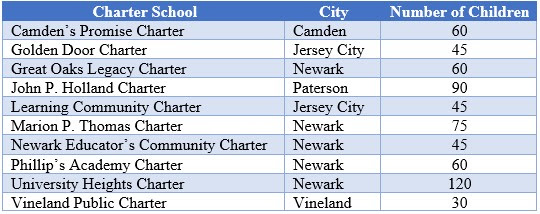
The administration of former Governor Chris Christie allowed 10 charter schools in five Abbott districts to operate their own preschool programs, despite not having a contract from the districts to participate in the districts’ universal program, as required by the landmark Abbott v. Burke rulings. In 2019-20, the 10 charter preschool programs enrolled 630 three- and four-year-olds, funded by over $8 million in state preschool aid.
ELC’s December 2019 letter to the NJDOE emphasizes that, under the NJ Supreme Court’s detailed Abbott preschool mandates, only Abbott districts are authorized to offer high quality preschool to all resident three- and four-year-olds through an NJDOE-approved universal enrollment program. While community providers and Head Start are eligible to operate preschool classrooms in Abbott districts, they can only do so under a contract with the districts. The district contract requires strict adherence to teacher quality, class size, and other Abbott preschool standards, as well as enrollment through the district’s universal outreach and recruitment process.
As the Supreme Court has made clear, these requirements are essential elements of the constitutional obligation imposed on Abbott districts to provide high quality preschool to all eligible three- and four-year old children residing in their communities. The districts are mandated to enroll at least 90 percent of the universe of those children. The requirement for community-based providers to operate only under district contracts ensures that only those providers capable of and willing to deliver high quality preschool through district coordination, support and supervision, can participate in the Abbott program.
The NJDOE’s decision to allow the 10 charter schools to operate separate preschool programs not only violates the Abbott rulings and the agency’s own regulations, but also undermines the cornerstone of the nationally-recognized success of the Abbott Preschool Program: a district-supervised, mixed delivery system of early education unifying community-based providers and district classrooms under a common set of high quality standards, backed by adequate funding. This well-established legal and policy framework does not permit any entity, including charter schools, to provide preschool wholly outside of the district-run, universal Abbott program.
“The NJDOE has no authority to permit a charter school to run a parallel preschool program that competes with the district’s Abbott program for students and funding,” said David Sciarra, ELC Executive Director and lead counsel in the Abbott litigation. “Charter schools in Abbott districts cannot operate preschool classrooms unless they enter into a contract with the district, as is required of every community-based provider and Head Start program participating in Abbott preschool.”
In 2019-20, the following charter schools are providing preschool without obtaining the legally required contract to participate in the Abbott district program:
In addition to calling for an end to the unauthorized practice of allowing charter schools to operate their own preschool programs, ELC is also demanding the NJDOE immediately notify the 10 charter schools that to continue to provide preschool in the 2020-21 school year, they must secure a contract with their district to participate in the district-wide Abbott preschool program.
Press Contact:
Sharon Krengel
Policy and Outreach Director
Education Law Center
60 Park Place, Suite 300
Newark, NJ 07102
973-624-1815, ext. 24

Kentucky passed a law authorizing charters but never provided funding for them. The new governor of Kentucky, Democrat Andy Beshears, was elected in part because of his strong support by teachers and his commitment to public schools.

First charter school application in Kentucky rejected

NEWPORT, Ky. (AP) — The first charter school application filed in Kentucky has been unanimously denied. News outlets report Newport Independent Schools rejected the application Thursday night. The superintendent says the documents submitted by the proposed River Cities Academy lacked planning in multiple areas. A review committee says there was significant plagiarism in the application process. The committee also found a lack of authentic community support for the school. River Cities Academy can appeal the decision to the state board of education. The state approved charter schools in 2017 but a funding source for the schools hasn’t been provided

Among rightwing think tanks, none has more intellectual firepower than the Thomas B. Fordham Institute, due to its leading thinker Chester E. Finn Jr., who has an Ed.D. from Harvard Graduate School of Education and worked in the administrations of Reagan and Nixon, as well as working for Daniel Patrick Moynihan and Lamar Alexander.

The Institute, formerly a foundation, is based in Washington, D.C., where it has a large voice in Republican politics, but its actual (if not physical) home is Ohio, because the money came from a Mr. Thomas B. Fordham, who lived in Ohio.

TBF is very influential in Ohio, where it recently wrote the state’s academic standards. TBF has been a loud cheerleader for the Common Core standards, having received millions from the Gates Foundation both to evaluate them and advocate for them.

Fordham looms large as an advocate for charters, vouchers, high-stakes testing, and punitive policies towards teachers and principals. I was an original member of the TBF board, when it was launched, and resigned in 2009, when I realized that my views were no longer aligned with those of TBF. One of the projects I disliked intensely was a “manifesto” funded by Eli Broad, which argued that one did not need to be an educator to be a school principal. I disagreed. I also disagreed with the TBF decision to accept Gates’ funding, since it would hamstring TBF’s role as an independent think tank and put it in the debt of Gates. It was also unnecessary, since TBF had $40 million in the assets at the time. Since I left TBF, it has accepted many, many millions from Gates, Broad, Walton and other external funders.

Who was Thomas B. Fordham? How did his fortune become the founder of a rightwing think tank?

Mercedes Schneider here reviews an analysis of the origins of the Thomas B. Fordham Institute, based on a paper by Richard Phelps. 

As I have often stated, I was an original member of the board of the Thomas B. Fordham Foundation. I objected to two major policy positions: one, the decision to become an authorizer of charter schools in Ohio, which I believed was not the role of an independent think tank. I lost that vote. As I recall, almost every one of the charters authorized by TBF either closed or failed or both. I also objected to accepting money from the Gates Foundation, as it would impair our independence and make it impossible to criticize Gates when it was wrong. And TBF didn’t need the money, it had assets of $40 million. I lost that vote too. I left the board in 2009, since I no longer supported either choice or the TBF vision of accountability. I later heard that “my seat” (the girl) was awarded to the CEO of a Gulen charter chain in Los Angeles. So there.

The distinguished education researcher Gene Glass reads this blog and occasionally comments. Yesterday I quoted a short statement by Margaret Raymond, director of CREDO, the Walton-funded evaluator of charter schools, who stated publicly that markets don’t work well in schooling. We can speculate on why markets don’t work: parents don’t have enough information, information is distorted by marketing and propaganda, test scores are the wrong information, etc. If you believe that society has a fundamental obligation to provide good schools for all children, the market is the worst delivery mechanism because it exacerbates inequity. The one thing the market can never do is produce equality of educational opportunity.

Gene Glass responded to the post with this comment:

Wikipedia describes Kenneth Ewart Boulding as “… an economist, educator, peace activist, poet, religious mystic, devoted Quaker, systems scientist, and interdisciplinary philosopher. “ Indeed, Ken Boulding was all of those things and many more. At the University of Michigan in the 1950-60s, he founded the General Systems society with Ludwig von Bertalanffy. Born in Liverpool in 1910, he was educated at Oxford (Masters degree).

His textbook, Economic Analysis (1941) was virtually the introduction to Keynesianism to American academics. He never obtained a doctorate, though surely he never felt the want of one due to the many honorary doctorates he received. In his long career, he served as president of the Amer. Econ. Assoc. and the AAAS, among other organizations. He died in Boulder in 1993.

I was very lucky to be situated at the University of Colorado when Boulding left Michigan in 1967 to join the Economic Department at Boulder. I had joined the faculty there in 1966. Within a few years the word spread that this new fellow in Economics was someone to listen to. Twice, in the early 1970s, I sat through his undergraduate course in General Systems. The undergraduates had no idea how lucky they were; I was enthralled. Boulding was a Liverpudlian, and that coupled with a pronounced stammer made listening to him lecture extremely demanding. But somehow the effort produced greater concentration. I can recall so many of the things he said though more than 40 years have passed. “”The invention of the correlation coefficient was the greatest disaster of the 19th century, for it permitted the subtitution of arithmetic for thinking.”

From 1969 through 1971, I was editing the Review of Educational Research for the American Educational Research Association (AERA). In the office, I enjoyed a few small privileges in connection with the 1971 Annual Meeting. For one, I could invite a speaker to address the assembled conventioneers. I invited Boulding. An expanded version of his talk was published in the Review of Educational Research (Vol. 42, No. 1, 1972, pp. 129-143). I have never read anything else by an economist addressing schooling that equals it.

Here is the merest sampling of what he wrote:

Schools may be financed directly out of school taxes, in which case the school system itself is the taxing authority and there is no intermediary, or they may be financed by grants from other taxing authorities, such as states or cities. In any case, the persons who receive the product-whether this is knowledge, skill, custodial care, or certification-are not the people who pay for it. This divorce between the recipient of the product and the payer of the bills is perhaps the major element in the peculiar situation of the industry that may lead to pathological results. (pp. 134-135)

Boulding originated the notion of the “grants economy” in which A grants a payment to B who delivers a service or product to C. Of course, this turned on its head the paradigm used by most economists, who imagine C paying B for services or products. When Boulding referred to this grants economy underlying schooling as leading to “pathological results,” he was referring to the fact that the schooling industry is “not normal,” i.e. does not follow the course of classical economic models. In the years ensuing since Boulding’s early forays into this notion, the grants economy has become increasingly important to understanding a nation’s economy.

Boulding was considered a bit of a rebel. David Latzko wrote of Boulding that “The narrow bounds of the economics discipline could not contain his interests and talents.” Perhaps this accounts for why many traditional economists have not followed him where reality leads. Perhaps this is why Dr. Margaret Raymond could pronounce so recently that “And it’s the only industry/sector [schooling]where the market mechanism just doesn’t work.” In fact, the “market mechanism” fails to work in many sectors.

But back to Dr. Raymond. Margaret Raymond is the head of the Hoover Institution’s Center for Research on Educational Outcomes. As key researcher in charge of the first big CREDO study of charter schools that dropped on the charter school lobby with a big thud: charter schools no better than old fashion public schools, some good, some really bad. And then more recently, CREDO under Raymond’s direction conducted a study of charter schools in Ohio, a locale that has known its problems attempting to keep charter schools out of the newspapers and their operators out of jail. What did this second CREDO charter school study find? Charter schools in Ohio are a mess.

All of this bad news for the charter school folks caused Dr. Raymond to go before the Cleveland Club and confess thusly:

“This is one of the big insights for me. I actually am kind of a pro-market kinda girl. But it doesn’t seem to work in a choice environment for education. I’ve studied competitive markets for much of my career. That’s my academic focus for my work. And it’s the only industry/sector [schooling] where the market mechanism just doesn’t work.”

Of course, it is positively absurd to think that schooling is the only “industry” in which free markets just don’t work. And Dr. Raymond didn’t give up entirely on the free market ideology for education — she would probably have to find a professional home outside the Hoover Institution if she did. She went on to tell the Cleveland Club that more transparency and information for parents will probably do the trick.

Frankly parents have not been really well educated in the mechanisms of choice.… I think the policy environment really needs to focus on creating much more information and transparency about performance than we’ve had for the 20 years of the charter school movement.

So parents just aren’t smart enough to be trusted to make choices in a free market of schooling, and they need more information, like test scores, I presume. I’ll leave Dr. Raymond at this point, and recommend that she and her associates at the Hoover Institution spend a little more time with Kenneth Boulding’s writings.

Margaret Raymond is the director of the Center for Research in Educational Outcomes (CREDO) at Stanford University, which conducts studies of charter schools, funded by the Walton Family Foundation. On December 10, 2014, she addressed the Cleveland City Club. About 50 minutes (and a few seconds) into a 56-minute talk, she gave the following response to a question about charter school policy:

“This is one of the big insights for me because I actually am a kind of pro-market kind of girl, but the marketplace doesn’t seem to work in a choice environment for education… I’ve studied competitive markets for much of my career… Education is the only industry/sector where the market mechanism just doesn’t work… I think it’s not helpful to expect parents to be the agents of quality assurance throughout the state. There are other supports that are needed… I think we need to have a greater degree of oversight of charter schools, but I also think we need to have more oversight of the overseers… the authorizers.”

https://www.youtube.com/watch?v=H1-mPiSQLfc

Jeremy Mohler of the nonpartisan “In the Public Interest” wrote a clear summary of the reasons to be concerned about charter schools:

The holidays are a time of joy and relaxation but also uncomfortable conversations with family. Will Uncle Tommy go on another rant about windmills causing cancer? Does grandma still think Russia is the only reason Trump won?

So, what should you say when someone starts dissing traditional, neighborhood public schools and hyping up charter schools?

Charter schools generally perform academically about the same as neighborhood public schools.

Study after study show that, just like there are high and low performing neighborhood public schools, there are high and low performing charter schools.

In fact, because some charter schools effectively exclude special education students or expel students with perceived disciplinary issues, charter school academic success often can be overstated.

Charter schools can drain school district budgets, taking resources from neighborhood public school students.

Research is revealing that, in many states, school districts and the students they serve are undermined by policies that prioritize opening new charter schools.

For example, California’s unchecked charter school growth cost San Diego’s school district $65.9 millionduring the 2016–17 school year. That’s $620 less in funding a year for things like nurses, counselors, and computers for each neighborhood public school student.

Charter schools have been co-opted into a market-based model of providing education with winners and losers.

While some charter schools are founded and run by grassroots groups of parents and educators, many are run by large, corporate-like chains, such as Rocketship and KIPP.

Wealthy donors and organizations like the family who owns Walmart are bent on privatizing public education through the creation of a parallel education system in competition with neighborhood public schools.For example, since 1997, the Walton Family Foundation has invested more than $407 millionin charter schools.

The seeds of today’s “school choice” movement were sewn in the years after desegregation.

Charter schools are more racially isolated than neighborhood public schools in virtually every state and large metropolitan area in the nation.

The vast majority of the school districts that have experienced state takeovers in the last 30 years are majority black and Latinx. Many subsequently were forced to allow for the creation of charter schools. Some middle and upper class, predominantly white communities are even using charter schools to opt out of neighborhood public schools.

This harkens back to the years following Brown v. Board of Education when southern legislatures enacted as many as 450 laws and resolutions attempting to discredit, block, postpone, limit, or evade school integration. Many of these acts allowed the re-direction of taxpayer dollars to benefit private schools, such as private school vouchers, as white Americans fled in record numbers from neighborhood public schools.

Even though most charter schools are nonprofit doesn’t mean the people who run them aren’t pocketing tons of taxpayer money.

Running a nonprofit charter school can be a highly lucrative undertaking. Some charter schools hire for-profit charter management organizations. Others rent buildings from real estate investors who specialize in charter school investment.

One charter school in California’s Bay Area rented school space at three and one-half times market rate from a company with business ties to its CEO. Through this and other schemes, the CEO diverted $2.7 million in taxpayer dollars without any supporting documents over a span of five years.

Public school systems should provide a great education to each and every student.

Students (and society alike) don’t need a public school system that creates winners and losers. They need smaller classes, better paid teachers, more support services, and cleaner and safer facilities.

Whatever you do during the holidays this year, don’t buy into the myth that the U.S. public education system is broken. There are countless neighborhood public schools around the country finding powerful and groundbreaking ways to educate students. There are hardworking, courageous teachers in every city and town across this land.

What’s broken is how we fund public education. Public schools simply need more resources, and, for that to happen, we don’t need anything all that complicated. Corporations must pay their fair share in taxes, and more resources must to go to the schools and communities that need them most.

Mercedes Schneider writes here about Betsy DeVos and her not-innovative idea of a “backpack full of cash.”

Betsy used the metaphor to refer snidely to a disguised voucher. It is a common metaphor among rightwing advocates of privatization. Betsy didn’t realize she was using the title of a popular documentary, shown in hundreds of communities across the country as a warning about privatization.

(If you want to book a screening of Backpack Full of Cash, go to the website.)

The film-makers, Sarah Mondale and Vera Aronow, borrowed the term from choice advocate Jeanne Allen of the Center for Education Reform, who has dreamed for years about defunding public schools by strapping the child’s cash in a backpack and sending the child to a charter school, religious school, cyber charter or home school, the less regulated the better. Anything will do for the backpack of cash except a public school.

Betsy didn’t know the etymology of the term but loved the idea of taking money away from public schools and giving it to any entrepreneur or grifter who wanted it.

Read the post to learn the not-sad fate of the rightwing’s favorite bad idea.

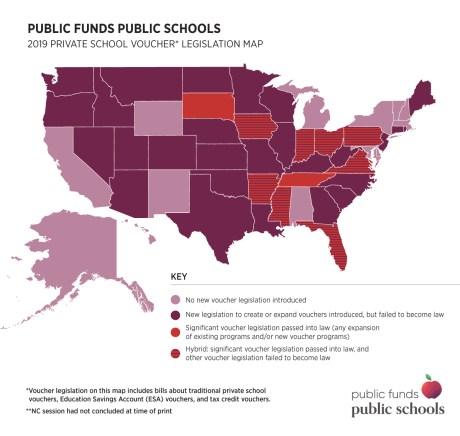
The Education Law Center created this graphic and explanatory information about the battle to keep public funds in public schools. The graphic shows the state of the voucher movement and identifies which states have advanced or repelled efforts to privatize public funding to religious and private schools via vouchers. It is heartening to see the number of states that rejected voucher legislation, especially when such legislation was defeated by a coalition of rural Republican legislators and urban Democratic legislators, as was the case in Texas and Arkansas. Thanks to all those who are joining forces to keep public funds in public schools.

pic1pic2

PRIVATE SCHOOL VOUCHERS: ANALYSIS OF 2019 STATE LEGISLATIVE SESSIONS
For a larger version and a text description of this map with a list of the states in each category, click ​here​.
In anticipation of states’ 2020 legislative sessions, this is the first in a series about the fate of private school voucher proposals during 2019 sessions.
Introduction
Despite the continued promotion of school privatization by U.S. Education Secretary Betsy DeVos, as well as support from a number of governors, legislatures, and well-funded advocacy organizations across the country, only two states enacted new private school voucher programs during their 2019 legislative sessions. Although some states expanded existing voucher programs, most passed no voucher legislation at all, and the majority of those that did made small-scale changes.
2019 Legislative Session Highlights:
  • Bipartisan majorities in Georgia, Kentucky, and West Virginia rejected voucher proposals supported by those states’ newly elected governors.
  • Although 22 states have full Republican control, only Florida and Tennessee were able to pass legislation creating new voucher programs in votes largely along party lines.
  • In Nevada, just a few years after the nation’s most expansive Education Savings Account (ESA) voucher law was passed, a new governor signed a bill repealing the program, which had never been implemented.
2019 Legislative Session Lowlights:
  • Tennessee passed a new private school voucher program, though it is limited to two counties.
  • Florida added yet another voucher program to the state’s existing voucher system.
  • Other states increased funding for their previously enacted programs, including Indiana and Iowa.
State Actions in Brief:
Arkansas
For the second consecutive legislative session, rural Republican lawmakers teamed with Democrats in a bipartisan effort to defeat legislation that would have created new school voucher programs. Proposals for a tax credit voucher and a traditional voucher were defeated. Although eligibility for the state’s existing ESA vouchers was modestly expanded, a bill passed requiring a biennial study that will provide lawmakers with important information to analyze how public funds are being spent in that program.
Arizona
Months after voters overwhelmingly rejected the 2017 expansion of the state’s ESA voucher program, legislators introduced a number of bills to again expand the program. Two of these bills passed out of relevant committees but were not taken up by the House or Senate. The remaining expansion bills did not advance, and a bill that slows the growth of tax credit vouchers passed into law.
Diverting public money to private education starves public schools of vital resources and does not lead to improved academic outcomes. For information about various types of private school voucher programs, visit the Public Funds Public Schools website. The PFPS website also highlights a wide range of research showing that private school voucher programs are an ineffective and harmful use of public funds.
Florida
Governor Ron DeSantis (R) signed Florida’s latest private school voucher plan, the “Family Empowerment Scholarship Program,” into law. This program will divert an estimated $130 million to private schools over the authorized period and will make vouchers available to middle class families earning up to $80,000 a year.
Georgia
Despite a new Republican governor who supports private school vouchers, voucher legislation failed in the State Senate. Six of the 13 Republican senators who represent rural areas of the state voted against the bill.
Indiana
Governor Eric Holcomb (R) signed legislation to increase funding for Indiana’s existing tax credit voucher program by almost 15% over the next two years. The legislation also increases the voucher amount for eligible families.
Iowa
Governor Kim Reynolds (R) signed legislation to increase the cap for Iowa’s existing tax credit voucher program by $2 million over the next two years. A bill to establish an ESA voucher was not considered by the full legislature.
Kentucky
Mobilization at the state capitol by educators standing up for public schools and several days of school sickout closures led to the defeat of legislation to create a tax credit voucher program. The Republican majority did not bring the bill up for a vote.
Louisiana
In Louisiana, a bill creating a “reading voucher” for public school students to use for private tutoring and other private uses passed the House but did not make it out of the Senate Finance Committee.
Mississippi
A bill to expand the state’s limited ESA voucher program was not voted on in the Republican-led House Education Committee. However, as the session was ending, the Lieutenant Governor included $2 million in new ESA funding in a bill to fund state construction projects.
Missouri
Bills to create a tax-credit-funded ESA voucher program were not acted upon before the legislative deadline.
Nevada
Governor Steve Sisolak (D) signed a bill formally repealing the state’s ESA voucher program first passed in 2015, and subsequently struck down by the Nevada Supreme Court. Additionally, a number of bills to create ESA vouchers for students deemed “victims of bullying” failed to advance in the legislature.
North Dakota
A bill that would have authorized a “school choice” study, including of ESA vouchers, passed in the House of Representatives but failed in the Senate.
Pennsylvania
Governor Tom Wolf (D) vetoed a major expansion of the state’s tax credit voucher program passed by the Republican-led legislature. The bill would have nearly doubled the amount that could be diverted to the program, included automatic annual expansions, and significantly raised the income limit for participating families.
South Carolina
Two bills were introduced in the legislature to establish an ESA voucher for students with disabilities. Both were referred to their chamber’s education committee, with no action taken by the legislature.
Tennessee
Governor Bill Lee (R) signed a law to establish an ESA voucher program. Concessions were made to rural Republican legislators in order to pass the bill, including limiting the program to the state’s two largest school districts and capping it at 15,000 students per year.
Texas
State leadership, including Republican legislators and the governor, did not include vouchers among their education priorities in 2019. In response to electoral losses in the suburbs and a lack of support for vouchers, legislative leaders emphasized improving the state’s public school financing system instead.
West Virginia
After a nine-day teachers’ strike in 2018, educators went on strike again, closing all but one of the state’s 55 county public school districts, to protest bills to allow charter schools and to create an ESA voucher program. The voucher bill did not pass during the regular session. Vouchers were again considered, but the program did not pass, during a special session on education legislation.
Resources
Acknowledgements
Many thanks to Jason Unger for compiling the research and drafting this series on 2019 legislative sessions.
Press Contact:
Sharon Krengel
Policy and Outreach Director
Education Law Center
973-624-1815, ext. 24

Angie Sullivan is a teacher in a Title 1 elementary school in Las Vegas. She regularly writes the members of the Nevada legislature to share her outrage about the underfunding of the state’s neediest schools and the state’s waste of money on charter schools, which dominate the state’s list of the lowest performing schools.

Here is her latest:


Peter Greene in Forbes
Still Asleep At The Wheel 
What happened?  
Pile of fraud and graft.  
These charter titles got money and did what?   
This charter changed its name many many times.   It is difficult to follow its trail – 100, One Hundred, Imagine at different locations.   Is this graft? fraud?  Imagine still has a failing charter campus opened? What happened to the two additional campuses?  $300,000 disappeared with change in names and admin?   This is what lack of accountability and transparency does. 
What happened to the Montessori in Carson?   I believe it is still there – complaining about cash.  These charters worry me because they never have a testing year so zero data and zero accountability. This is what lack of accountability and transparency does.   They received funding but complain about no money and blame Vegas.  They may try to get the Silver State/Argent Building.   They do not serve the poor. 
Silver State Charter School changed its name to Argent and lost almost all its students.  Sounds like the receiver had concerns because no one attended the “distance” low performer school.  No one ever graduated.   As in zero.   Perhaps Joshua Kern knows where the $440,000 went?   No one graduated.  This is the first charter I have seen “closed” by the charter authority.  I do not think it had any students left and that is what actually closed it. 
School of the deaf went bankrupt.  Im surprised it did not go into receivership and just get more money like Quest, Silver State and others.  The Nevada Tax Payer pays millions to keep financially floundering  charters open. 
E-TECHS had a facebook and a twitter for $300,000.  This was in 2011 and they never opened?   What happened to the money? 
Gardnerville’s Sierra Crest closed in 2010.  Sounds like the local school board was not putting up with low quality.  What happened to the $172,000? 
Did Washoe Team A even exist at all?  Where did the $220,000 go?  
Nevada folks need to demand to see this money.   
If Nevada Senator Scott Hammond is hiding behind a non-profit management system – we need to know that too.    Managing 5 charters for free?  What kind of accountability and transparency is this?  
There needed to be a charter moratorium for good reason.   Rest in Power Tyrone Thompson who knew that.  Playing games like this with money when Nevada has none is crazy. 
We see you Gulenist Soner Tarim 👀 Agenda 4a.   How much money are you bringing to Nevada Strong?  Expert at getting grants and not opening?   Everyone should protest every Nevada Charter Meeting to close that Gulen Charter down.  Nevada does not need anymore scamming known bad actors. 
None of these December 2019 charter applicants should be granted anything.  These scams are too much. 
Asleep at the wheel and gone off the road and crashed into a ditch.  
This is bad. 
Angie Sullivan.