Archives for category: Pennsylvania

Once again, we are reminded that charter schools are a Republican cause, and their champion is Betsy DeVos.

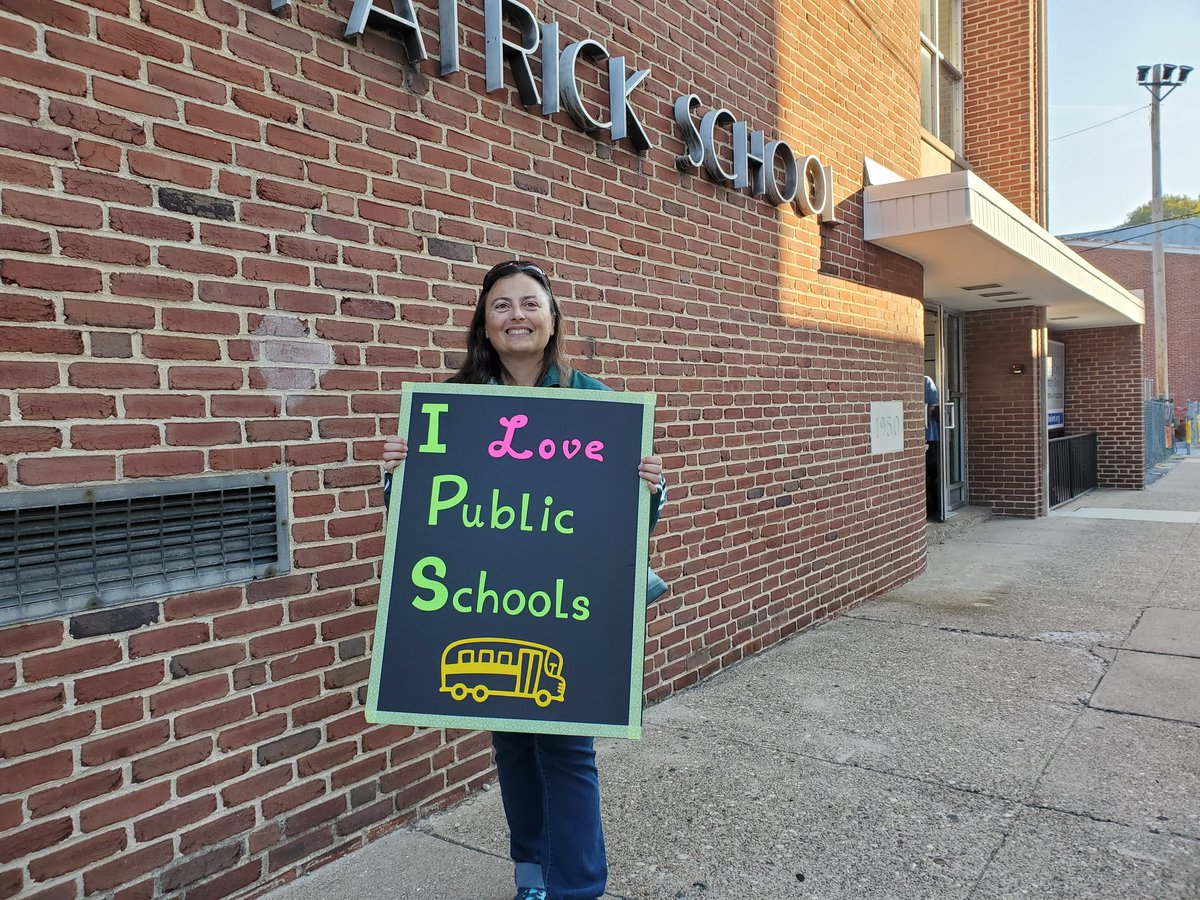
Mike Turzai, Republican Speaker of the House in Pennsylvania, was on his way to a meeting with Betsy DeVos when he encountered some public school teachers, who were picketing with signs saying they loved their public schools.

Turzai found this deeply offensive, and he proceeded to lambaste the teachers as a “special interest group” defending a “monopoly.”

In the video, Turzai praised charter schools, which receive government funding but operate independently of the public school system, saying that in charter schools. “you have to care about each child, not about the monopoly.” He then claimed that the public school advocates were part of a monopoly 

What you care about is a monopoly and special interests,” said Turzai, whose district encompasses the North Hills municipalities of McCandless, Pine, Marshall, Bradford Woods, and Franklin Park. 

One of the advocates then said, “I am little offended from that,” to which Turzai responded, pointing to the posters they were holding, “Oh, I am offended by your posters.”

One poster read “I love public schools.” The other read “Public Money for Public Schools.”

We ♥ our teachers.

Sincerely,
All of Pennsylvania

View image on Twitter

In this post, Carol Burris lays out a devastating bill of indictment against the charter industry in Pennsylvania. Technically, it is run by “non-profit” Boards, but most of the time those words are fig leaves for for-profit corporations that are growing rich with the help of the state legislature.

Governor Wolf recently announced his determination to hold charter schools accountable, and the charter industry howled with rage. They don’t want any of their cushy deals to be jeopardized.

Take five minutes and watch as Superintendent Joseph Roy of the Bethlehem Area School District explains how private charters are harming the public schools and the unfairness of the funding formula, which is rigged on behalf of the charters.

This year, private charters will subtract $1.8 billion from the budget of public schools in Pennsylvania.

Governor Tom Wolf has proposed revising the charter law to prevent the defunding of the state’s public schools, which enroll the vast majority of students.

Please take action and show support for Governor Wolf.

Do you want to understand why Pennsylvania’s charter school law needs to be reformed?

Let Steven Singer explain.

Singer teaches in Pennsylvania. In this post, he describes the dangers that privatization poses to his school district.

I work in a little suburban school district just outside of Pittsburgh, Pennsylvania, that is slowly being destroyed by privatization.

Steel Valley Schools have a proud history.

We’re located (in part) in Homestead – the home of the historic steel strike of 1892.

But today it isn’t private security agents and industrial business magnates against whom we’re struggling.

It’s charter schools, voucher schools and the pro-corporate policies that enable them to pocket tax dollars meant to educate kids and then blame us for the shortfall.

Our middle school-high school complex is located at the top of a hill. At the bottom of the hill in our most impoverished neighborhood sits one of the Propel network of charter schools.

Our district is so poor we can’t even afford to bus our kids to school. So Propel tempts kids who don’t feel like making the long walk to our door.

Institutions like Propel are publicly funded but privately operated. That means they take our tax dollars but don’t have to be as accountable, transparent or sensible in how they spend them.

And like McDonalds, KFC or Walmart, they take in a lot of money.

Just three years ago, the Propel franchise siphoned away $3.5 million from our district annually. This year, they took $5 million, and next year they’re projected to get away with $6 million. That’s about 16% of our entire $37 million yearly budget.

Do we have a mass exodus of children from Steel Valley to the neighboring charter schools?

No.

Enrollment at Propel has stayed constant at about 260-270 students a year since 2015-16. It’s only the amount of money that we have to pay them that has increased.


The state funding formula is a mess. It gives charter schools almost the same amount per regular education student that my district spends but doesn’t require that all of that money actually be used to educate these children.

If you’re a charter school operator and you want to increase your salary, you can do that. Just make sure to cut student services an equal amount.

Want to buy a piece of property and pay yourself to lease it? Fine. Just take another slice of student funding.

Want to grab a handful of cash and put it in your briefcase, stuff it down your pants, hide it in your shoes? Go right ahead! It’s not like anyone’s actually looking over your shoulder. It’s not like your documents are routinely audited or you have to explain yourself at monthly school board meetings – all of which authentic public schools like mine have to do or else.

Read the rest of the post.


Pennsylvania’s largest charter school is the Chester Community Charter School. It is owned by Philadelphia lawyer Vehan Gureghian, who is a major donor to the Republican Party in the State. He was the biggest contributor to former Republican Governor Tom Corbett. What is surprising about his political donations is how little it takes to win the affection of the party in power. The Chester Community Charter School enrolls most of the elementary students in its district and even draws students from Philadelphia, despite the fact that it is a low-performing school on state tests. As you will see in one of the articles below, CCCS received a charter renewal through 2026, an extension not given to any other charter in the state.

The Keystone State Education Coalition posted this list of his political contributions. 

Blogger commentary: In an effort to gain a better understanding of the dynamics in Harrisburg, from time to time over the years we have published “Follow the Money” charts using data from the PA Department of State’s Campaign Finance Reporting website:

https://www.campaignfinanceonline.pa.gov/Pages/CFReportSearch.aspx


We’ll leave it up to our readers to draw their own conclusions regarding how such contributions may or may not influence policymakers as they go about the people’s business in Harrisburg.


The chart below lists over $470,000 in campaign contributions made by Mr. and Mrs. Gureghian for PA state offices from 2013 through 2019.


Highlights include $205,000 to the House Republican Campaign Committee, $37,000 to the Senate Republican Campaign Committee, $30,000 to House Speaker Mike Turzai, $82,000 to Senate Majority Leader Jake Corman’s Build PA PAC, $85,000 to Senate President Pro Tempore Joe Scarnati and$16,000 to House Majority Leader Bryan Cutler.


While school district budgets, check registers and salaries are public information, charter school management companies like Gureghian’s CSMI are not required to provide any details on how they spend taxpayers dollars. CSMI runs Chester Community Charter School, the state’s largest brick and mortar charter. CSMI’s founder and CEO is Vahan H. Gureghian of Gladwyne, a lawyer, entrepreneur and major Republican donor –the largest individual contributor to former Gov. Tom Corbett. And though CSMI’s books are not public – the for-profit firm has never disclosed its profits and won’t discuss its management fee – running the school appears to be a lucrative business. State records show that Gureghian’s company collected nearly $17 million in taxpayer funds just in 2014-15, when only 2,900 students were enrolled.”


Over the years, Gureghian has spent well over $1 million on political contributions in Pennsylvania.

https://keystonestateeducationcoalition.blogspot.com/2011/06/follow-money-contributions-by-vahan.html


“As previously reported by the (Palm Beach) Daily News, the buyers in this week’s sale are Philadelphia attorney and businessman Vahan Gureghian and his attorney wife, Danielle. Two weeks ago, they sold their never-lived-in oceanfront mansion on 2 acres at 1071 N. Ocean Blvd. for more than $40 million. That 35,992-square-foot mansion had been on the market for about four years. ….Vahan Gureghian is involved in a number of businesses, he said, including management and consulting in the charter-school industry through a company he founded, CSMI Education Management. His wife provides legal counsel for his business ventures, he said.”

Exclusive: Palm Beach mansion lost by developer in bankruptcy sells for $30.275M

Palm Beach Daily news By Darrell Hofheinz  July 12 Posted at 5:46 PM Updated at 6:32 PM

Mortgage-holder sells former home of Robert V. Matthews to couple who just sold a Palm Beach mansion for more than $40 million. As developer Robert V. Matthews awaits sentencing on felony conspiracy and money-laundering charges in Connecticut, the Palm Beach seaside mansion he completed in 2006 has changed hands for a recorded $30.275 million. The deed recorded today shows the house at 101 Casa Bendita was sold by Singer Island Tower Suite LLC, which took title in April via a bankruptcy judge’s order in Matthews’ Chapter 11 case. The seller is identified in court documents as an “assignee” of a Deutsche Bank affiliate owed $31 million from a mortgage it held on the property. Matthews moved out of the mansion with his wife, Mia, shortly after the bankruptcy court’s March 31 order. Matthews developed the long-troubled, never-finished — and since-sold — Palm House hotel-condominium at 160 Royal Palm Way, which is a focus of his federal criminal case in Connecticut. The six-bedroom, two-story residence on Casa Bendita has 15,849 square feet of living space, inside and out, on nearly an acre. With about 188 feet of beachfront, the property lies about a three-quarters of a mile north of Royal Palm way.

https://www.palmbeachpost.com/news/20190712/exclusive-palm-beach-mansion-lost-by-developer-in-bankruptcy-sells-for-30275m


Following data is from the Pennsylvania Department of State Campaign Finance website: http://www.campaignfinance.state.pa.us/ContributionSearch.aspx

Selected State Level Campaign Contributions by Vahan Gureghian 2013 – 2019


Recipient Date Amount
TURZAI, MIKE FRIENDS OF 9/5/2013 $10,000.00
HOUSE REP CAMPAIGN COM 2004, INC 3/18/2014 $75,000.00
HOUSE REP CAMPAIGN COM 2004, INC 9/16/2014 $27,500.00
HOUSE REP CAMPAIGN COM 2004, INC 10/31/2014 $25,000.00
TURZAI, MIKE LEADERSHIP FUND 10/4/2014 $10,000.00
SENATE REP CAMPAIGN COM 4/14/2015 $25,000.00
SENATE REP CAMPAIGN COM 3/10/2015 $12,727.91
SCARNATI, JOSEPH FRIENDS OF 10/31/2016 $25,000.00
BUILD PA PAC 6/15/2016 $10,000.00
CORMAN, JAKE FRIENDS OF 10/26/2016 $10,000.00
SCARNATI, JOSEPH FRIENDS OF 11/9/2017 $10,000.00
BUILD PA PAC 6/22/2017 $10,000.00
CORMAN, JAKE FRIENDS OF 10/16/2017 $2,500.00
FUND FOR A BETTER PENNSYLVANIA 6/8/2017 $5,000.00
HOUSE REP CAMPAIGN COM 2004, INC 8/29/2017 $2,750.00
HOUSE REP CAMPAIGN COM 2004, INC 11/2/2017 $3,000.00
HOUSE REP CAMPAIGN COM 2004, INC 11/2/2017 $2,000.00
CUTLER, BRYAN FRIENDS OF 6/15/2018 $5,000.00
SCARNATI, JOSEPH FRIENDS OF 10/31/2018 $25,000.00
TURZAI, MIKE FRIENDS OF 9/12/2018 $10,000.00
BUILD PA PAC 6/4/2018 $25,000.00
BUILD PA PAC 7/25/2018 $25,000.00
BUILD PA PAC 10/17/2018 $10,000.00
HOUSE REP CAMPAIGN COM 2004, INC 4/24/2018 $5,000.00
HOUSE REP CAMPAIGN COM 2004, INC 5/1/2018 $20,000.00
HOUSE REP CAMPAIGN COM 2004, INC 7/20/2018 $10,000.00
HOUSE REP CAMPAIGN COM 2004, INC 9/18/2018 $10,000.00
HOUSE REP CAMPAIGN COM 2004, INC 10/26/2018 $25,000.00
SAYLOR, STAN CITIZENS FOR 5/29/2018 $5,000.00
BUILD PA PAC 3/29/2019 $2,000.00
CUTLER, BRYAN FRIENDS OF 4/3/2019 $1,000.00
CUTLER, BRYAN FRIENDS OF 5/28/2019 $10,000.00
$478,477.91


Mansion of embattled Palm Beach developer sells for $30M (Photos)

By Brian Bandell  – Senior Reporter, South Florida Business Journal Jul 15, 2019, 12:31pm EDT Updated Jul 15, 2019, 12:44pm EDT

Philadelphia businessman Vahan H. Gureghian paid $30.275 million for the Palm Beach mansion that belonged to embattled Palm Beach developer Robert V. Matthews. Singer Island Tower Suite LLC, part of DB Private Wealth Mortgage, sold the nearly 16,000-square-foot home at 101 Casa Bendita to Gureghian. The lender seized the home in April under orders of U.S. Bankruptcy Court in Matthew’s personal Chapter 11 filing. DB Private Wealth Mortgage, part of Deutsche Bank, had a $27.4 million loan on the property. The bank provided a $25.67 million mortgage to Gureghian to help him buy the property. Matthews built the oceanfront home on the 0.88-acre site in 2006. The mansion has six bedrooms, eight bathrooms, two half bathrooms and a pool. Gureghian, the founder and CEO of CSMI, which invests in the charter school industry, can immediately occupy the home.

https://www.bizjournals.com/southflorida/news/2019/07/15/gureghian-buys-palm-beach-mansion-for-30m.html


“The decision means staff and parents at the state’s largest bricks-and-mortar charter – already slated to receive more than $55 million in taxpayer funds this school year – won’t have to worry about its fate for nearly a decade, even if its test scores continue to fall far short of state benchmarks. It also guarantees that CSMI LLC, a for-profit education management company that operates the K-8 school with 4,200 students, will receive millions of dollars in revenue for nine more years. Chester Community’s extension comes as school districts across the commonwealth and nation are wrestling with the growth of charter schools, more privatization in education and the impact on traditional public schools. It also renews lingering questions about the intersection of politics, government and schools.

Reprise Dec. 2017: How Chester Community Charter School got a 9-year deal

Inquirer by Martha Woodall, Posted: December 22, 2017

For years, charter school proponents have been trying to change Pennsylvania law so that operating agreement renewals could be extended from five years to 10. They haven’t succeeded in Harrisburg. But that didn’t deter Chester Community Charter School. One year into Chester Community’s latest five-year agreement, Peter R. Barsz, the court-appointed receiver who oversees the financially distressed Chester Upland School District and wields nearly all the powers of a school board, took the unprecedented step of extending the Delaware County school’s term for five more years to 2026. Barsz contends that the move was designed to protect Chester High School: In return, Chester Community, which already enrolls about 70 percent of the primary grade students in the struggling district, agreed not to open a high school.

https://www.inquirer.com/philly/education/chester-community-charter-school-renewal-extension-under-scrutiny-20171222.html


“The Pennsylvania Department of Education is questioning the Chester Upland School District’s decision to renew its operating agreement with the state’s largest brick-and-mortar charter school through 2026 while the school was just one year into its current five-year term.”

Reprise April 2018: Judge, state question quick renewal for Chester charter school

Inquirer by Maddie Hanna, Posted: April 20, 2018

The Pennsylvania Department of Education is questioning the Chester Upland School District’s decision to renew its operating agreement with the state’s largest brick-and-mortar charter school through 2026 while the school was just one year into its current five-year term. “If charters are going to be renewed right out of the chute, … they’ve already been approved before they’ve even performed,” said James Flandreau, a lawyer for the department, at hearings this week ordered by a Delaware County Court judge. “Certainly, one year is way too early to evaluate any charter’s performance.” Kevin Kent, a lawyer for Chester Community Charter School, said the court-appointed receiver and school district could reevaluate the charter school at any point. “Nothing’s been compromised,” he said. Peter Barsz, the receiver for the financially distressed district, testified on Thursday that he had reviewed audits and school performance records and had support from the district’s school board before approving the renewal request last year that allowed the charter school to operate through 2026.

https://www.inquirer.com/philly/education/judge-state-question-quick-renewal-for-chester-charter-school-20180420.html


Three years ago, the Pennsylvania Auditor General Eugene DePasquale declared that the state’s charter law was the worst in the nation. The scandals and frauds were frequent, and many public school districts teetered on the brink of bankruptcy. But Republican Governor Tom Corbett and the Republican Legislature had no interest in reforming the charter law. A major charter owner was the single biggest contributor to Corbett’s re-election campaign and leader of his education transition team.

Democrat Josh Shapiro is now the state’s Attorney General, and the current Democratic Governor Tom Wolf announced that he intends to issue executive orders and propose legislation to reform the charter law to require accountability and transparency.

Unfortunately, the Legislature is still controlled by charter-friendly Republicans, who betray the families who elected them, whose children go to public schools.

Gov. Wolf announced a plan on Tuesday to improve financial accountability and academics among Pennsylvania’s charter schools, focusing on cyber charters and charter management companies, through executive actions and new legislation.

“Charter schools, like traditional public schools, should be high quality and they should be held accountable,” Wolf said. “But the laws currently don’t allow us to hold charter schools and their operators to the same standards as traditional public schools.”

Wolf called the state’s charter law “irresponsible” and “flawed.” He described the original intent of the law as “creating new and innovative educational opportunities” and said that some charter schools are doing this and doing it well.

“Unfortunately, this is not the case for all charter schools, especially among cyber charter schools,” he said.

On average, Pennsylvania charter schools have not improved student test scores in reading compared to public schools and have done worse in math, according to a study from Stanford University cited by Wolf. It also found that the academic situation was worse among the state’s cyber charters, which dramatically underperform compared to public schools.

The charter lobby was outraged! How dare the governor demand accountability! They think they should be unregulated and unaccountable. Their spokesperson said the governor’s efforts were nothing less than a “ blatant attack” on the charter industry. Never mind that the founder of the state’s biggest cyber charter is serving jail time for tax evasion on $8 million that were spent on personal luxuries. Never mind that the state’s cyber charters have never met academic standards.

Why reform failure and fraud?


The house of cards and propaganda that sustained the charter industry is beginning to crumble. Despite the Obama-Duncan promotion of charters through the disastrous Race to the Top program, no Democrat in the crowded presidential race will openly endorse charter schools. Not even Cory Booker will support charters, despite two decades of fighting for them.

Now, it is no longer cool for a Democrats to back charters.

Democrats support public schools, not charters, vouchers, or privatization. Thank you, Betsy DeVos, for clearing the air.

Shawgi Tell of Nazareth College in upstate New York describes what happened when Democratic Governor Tom Wolf stated the obvious: Charter Schools Are NOT public schools. 

Tell writes:

Calling a charter school public is mainly for the self-serving purpose of illegitimately funneling vast sums of public money from public schools to wealthy private interests who own-operate nonprofit and for-profit charter schools. Charter schools are essentially pay-the-rich schemes masquerading as “innovations” that “save public education” and “give parents choices.”

Charter school owners-operators would not be able to fleece public money from public schools if they were openly recognized as the privatized arrangements that they are. Most people understand that public money belongs solely to the public, not private interests. They understand that public wealth must be used only for public purposes and that private interests have no right to decide how to use public money.


The times they are a’changing.

PeterGreene reports what happened when Governor Tom Wolf really hurt the feelings of the charter lobby. He said that charter schools are NOT public schools. 

“When Pennsylvania Governor Tom Wolf trotted out his budget last month, he made it a point to note that he was raising money for public schools– and that he had some definite ideas about which schools are public and which schools are not.

“He wants to see more of those basic education dollars to school districts get distributed through the state’s fair funding formula. He also wants to address concerns related to cyber charter schools, which he referred to as “the growing cost of privatization of education in our public schools.”

“And just in case that wasn’t clear enough, a press release from the governor’s office was even more direct:

“Pennsylvania must help school districts struggling with the problem of increasing amounts of school funding siphoned by private cyber and charter schools. Funding reform would increase transparency so all schools that receive state dollars are accountable to the taxpayers.

“This made Ana Meyers sad.”

Awww.


Jonathan Burdick, a history teacher in Pennsylvania, wrote on Twitter about a new group called “Free to Teach,” which encourages teachers to abandon their union and form an “independent” union.

He can be found @JonathanBurdick on Twitter. In case you are not on Twitter and can’t find the thread, Jonathan writes that the group’s ads are sponsored by an Oklahoma-based organization called “Americans for Fair Treatment.” Here we go down the rabbit hole of right-wing groups. That group shares the same registered address in Oklahoma with “The Fairness Center,” which sued the teachers’ union in Philadelphia and lost. The Fairness Center shares offices in Harrisburg, Pennsylvania, with the Commonwealth Foundation. The Commonwealth Foundation is funded by DonorsTrust and Donors Capital Fund. These organizations are part of a massive network of right-wing groups called the State Policy Network. These organizations have donated HUNDREDS OF MILLION OF DOLLARS to extreme right causes: many anti-union and pro-educational privatization. These organizations are funded by billionaires including the Koch Brothers and Richard and Helen DeVos—the parents-in-law of Betsy DeVos. They also fund the Mackinac Center in Michigan, a favorite cause of Betsy DeVos, which works to crush unions and workers’ rights. Jonathan Burdick points out that Peter Greene wrote about “Free to Teach” and its connections to the right-wing oligarchs.


Chester Community Charter School is the largest brick-and-mortar charter school in Pennsylvania, with more than 4,000 students. It is a for-profit charter school owned by a wealthy lawyer named Vahan Gureghian, who was the largest individual contributor to former Governor Corbett. It is hard to know how much money CCCS makes, because its books are not open to the public. It must be doing very well, because his 36,000 square-foot oceanfront house in Palm Beach was recently sold for $60 million.

But his profits are less important than the fact that CCCS now enrolls 70% of the primary students in the Chester-Upland school district. And it is not because the charter is an academic success. Its test scores are very low. Only 16.7% were proficient in English language arts, compared to a state average of 63%. Only 7% were proficient in mathematics, compared to a state average of 45%.

By most metrics, this charter school is a failing school, yet it gets preferential treatment. The scores in the charter school are below those of the remaining public schools in the district.

The district, one of the poorest in the state, is in receivership, and the receiver—who exercises total control over the district—decided in 2017 to take the unprecedented step of extending the charter to 2026. No charter in the state has ever had a nine-year extension. The receiver said he did it in exchange for a promise by the charter that it would not open a high school to compete with the Chester High School, but would remain satisfied to enroll 70% of its primary students. Why might the receiver make this unusual decision? Surely it would not be because he was treasurer of Governor Corbett’s campaign.

So, from 2017 to 2026, there is no accountability for this low-performing for-profit charter school. The charter corporation is now recruiting young students from Philadelphia with an aggressive marketing campaign. Currently, more than 1,100 students from Philadelphia ride a school bus that takes from 2-3 hours to reach the school in the morning and another 2-3 hours to return home each day. Most of these students are in kindergarten through third grades. I wonder if their parents know they are riding a bus 5-6 hours a day to attend one of the lowest performing schools in the state?

Philadelphia officials also say that Chester Community has mounted an aggressive marketing campaign and distributed glossy fliers that don’t include information about the charter’s academic performance.

“It is fundamentally a marketing strategy,” Monson said. “The lure is how you sell yourself,…We all have plenty of examples of advertised products that don’t live up.”

Results from the Pennsylvania System of School Assessment (PSSA) exams released in September showed that Chester Community had some of the lowest scores among charter schools in the region: 15.6 percent of Chester Community students passed the PSSA reading test in the last school year; 6 percent passed math.  Those scores are similar to those of Khepera Charter School in North Philadelphia, which the School Reform Commission has voted to close in June because of poor academics and financial woes. At Khepera, 15.8 percent of students passed reading; 2 percent passed math.