Archives for category: Ohio

Bill Phillis has spent years battling for the principle that public funds should go only to public schools. Rightwingers in the state have passed laws allowing charters, Cybercharters, and vouchers. Their appetite for public funds in insatiable. The charter lobby wrote the charter law. As Bill Phillis often reminds us, the funding of privately managed charters schools, private schools and religious schools directly contradicts the state constitution. But the school choice lobby ignores the state constitution. They think it doesn’t mean what it says.

Article VI, section 2:

The General Assembly shall make such provisions, by taxation, or otherwise, as, with the income arising from the school trust fund, will secure a thorough and efficient system of common schools throughout the state; but no religious or other sect, or sects, shall ever have any exclusive right to, or control of, any part of the school funds of this state.

Bill Phillis believes the state constitution means what it says.

He writes:

Education Savings Account (ESA), an Egregious Anti-Public School Scheme, Has Already Begun on a Small Scale in Ohio. The Privatization Crowd is Lobbying to Expand It.

The state’s two-year budget bill (HB110) provides for a $500 education savings account for certain K-12 students. Privatization gimmicks start small then grow into a tax-eating glutton. Privatizers are pushing for Ohio’s new education savings account to become a high dollar entitlement to students for education things such as laptops, tutoring, supplemental educational materials, or whatever. Whereas EdChoice vouchers can only be used at a private school, ESA’s can be used for whatever. Hence ESA’s fund parent-chosen education, not necessarily a private school. ESA’s are essentially public funds distributed to parents to purchase some kind of education for their children.

How is this scheme funded and how will the expanded version be funded? Right out of the K-12 public education budget line-items! Will it reduce funds for school districts? You bet!

How would this same type of funding scheme be used to fund Ohio’s physical infrastructure? Suppose, for example, each citizen would receive a proportionate amount of highway funds to purchase right of ways, aggregates, bituminous materials, etc., at their choosing? What chaos! The same applies to the social infrastructure. Without the public common school, the common good is diminished to a chaotic level.

Stephen Dyer, a former state legislator in Ohio, writes a blog that tracks funding and privatization in Ohio. It’s called “10th Period.” He relies on state data to tell the truth about the failure of charters and vouchers. Here is the latest data on charter schools.

Dyer’s summary:

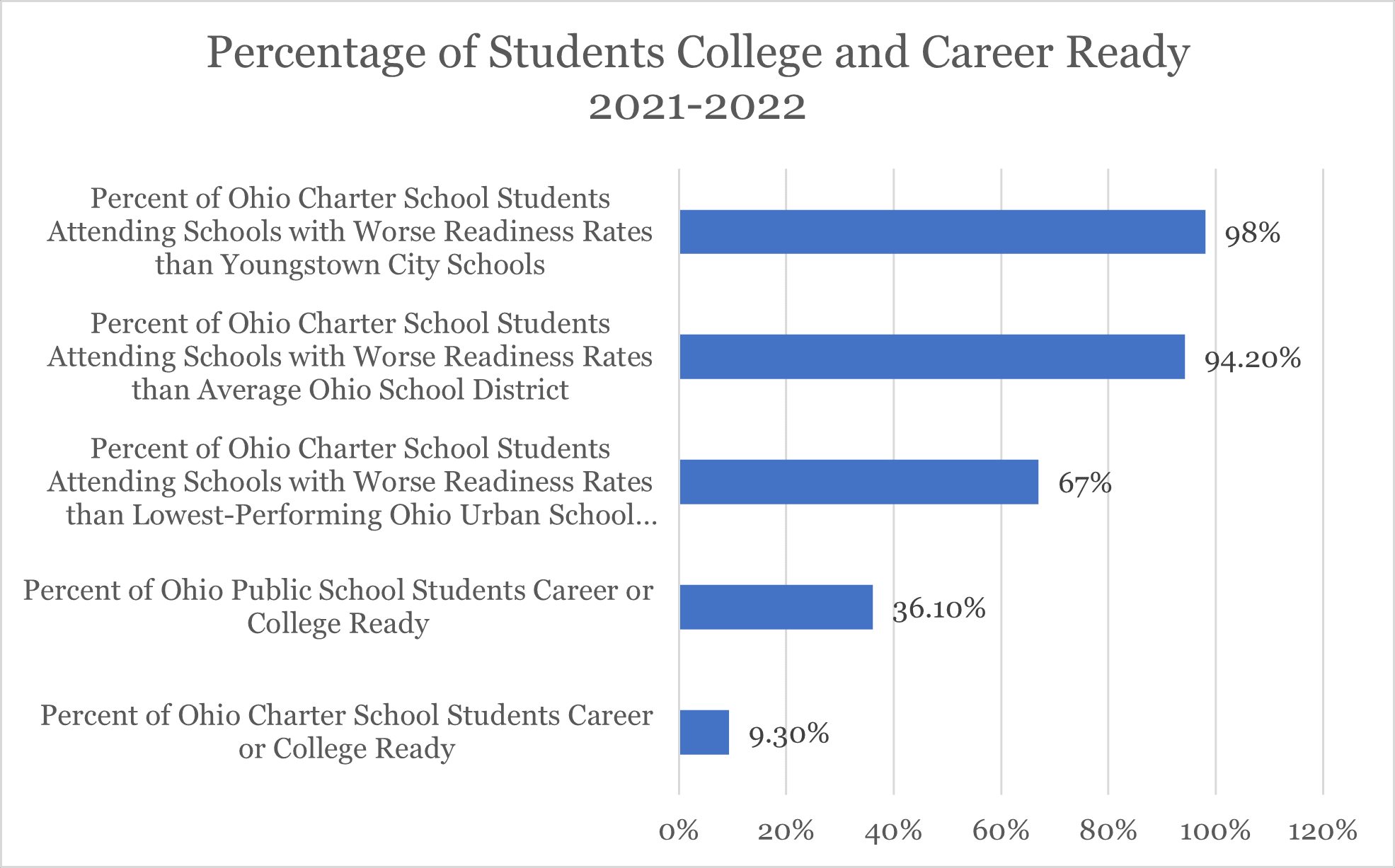
98 Percent of Ohio Charter School Graduates are Less Prepared for Post-Graduate World Than Students in Youngstown City Schools

Dayton is the lowest performing major urban district. Yet 2 out of 3 Ohio charter schools are less prepared than Dayton students

Ohio’s new report card has revealed something extremely troubling about Ohio’s Charter Schools. On a new measure called “Students in the 4-year Graduation Cohort who Completed a Pathway and are Prepared for College or Career Success”, only 9 percent of Ohio’s potential Charter School graduates met those qualifications. More than 36 percent of Ohio’s public school district students met those qualifications.

(Data Note: These data only examine students who could graduate high school, not whetherthey graduated high school. Public School Districts graduated 91.4 percent of their potential 121,968 graduates. Charter Schools only graduated 65 percent of their 4,657 potential graduates — a lower rate than any Ohio Public School District.)

Of the 43 Ohio Charter Schools with enough students to count in this College and Career Readiness measure, 18 schools had zero — that’s right, not a single student —who qualified as college or career ready. That means that 3 out of every 25 Ohio charter school graduates attended a school where not a single potential graduate was considered college or career ready.

But it gets worse.

More than 54 percent of Youngstown City School potential graduates are college or career ready. Only one Ohio Charter School — Dayton Early College Academy — has a higher rate.

That means that 98 percent of potential Ohio Charter School graduates are less prepared for post-high school lives than Youngstown City Schools’ potential graduates. Remember that Youngstown was seen as such a “failed” school district that the state created a new law to take over the district — in large part so more Charter Schools could open there.

Yet that district’s students are more likely to be prepared for post-high school lives than 98 percent of the 4,657 students potential graduating Ohio’s Charter Schools.

But wait. It gets worse.

The lowest-performing major urban school district in Ohio — Dayton — only had 5.7 percent of its students qualify as career or college ready.

Not good.

But before all you pro-charter school/voucher people scream “School Choice, Now!”, an astonishing 2 out of every 3 potential Ohio Charter School graduates attend schools with worse post-graduate preparation measures than Dayton.

Dayton is the home of the Thomas B. Fordham Institute and has been a hotbed of charter and voucher activity for 25 years. It’s not like school choice hasn’t been tried in Dayton.

And it ain’t working.

More Ohio students in all schools need to be career and college ready than they currently are. Full stop.

But what’s clear is that the best place for that to happen is in Ohio’s local public schools, not in Ohio Charter Schools.

I’d also like to use some space to bring up the Ohio Virtual Academy (OHVA) — the ECOT-sized online school. OHVA was paid to educate 14,530 students last year — more students than ECOT ever was paid to educate.

Yet they are just as bad as ECOT at preparing their students for the post-graduate world. An astonishing 87 of 1,820 potential OHVA grads were considered college or career ready. That 4.8 percent rate is lower than all but one Ohio school district — New Miami Local in Butler County, which only had 1 of 44 potential graduates considered college or career ready.

There’s more. If you want to follow the terrible results of privatization in Ohio, subscribe to Stephen Dyer’s blog.

Our reasonable and sensible friend Jan Resseger writes here about the efforts by the Heritage Foundatuon and its allies to saddle Ohio with vouchers. This is especially bizarre because researchers have consistently found that kids in public schools learn more than those in religious schools. Their goal: diminish or eliminate public schools.

She writes:

When you notice a particular educational trend moving across state legislatures, it is useful to investigate who’s behind the policy and who is making it so difficult to mount effective opposition. On Tuesday, this blog covered some of the far-right advocacy groups pressuring Ohio’s supermajority Republican legislature to pass House Bill 290, the Backpack Bill, which would bring a universal Education Savings Account (ESA) school voucher program to the state. Kathryn Joyce’s research for SALON demonstrates that the effort to pass a wave of universal ESA voucher bills is much broader than the particular groups working in Ohio.

Profiling a strategic effort by the Heritage Foundation to drive ESA vouchers through a number of state legislatures, Joyce describes the Heritage Foundation’s new Education Freedom Report Cardwhich rates the states in four categories: “In the category of education choice, Heritage’s primary focus is on education savings accounts (ESAs), a form of school voucher that allows parents to opt out of public schools and use a set amount of state funding (sometimes delivered via debit card) on almost any educational expenses they see fit. ESAs can be used towards charter schools, private schools, parochial schools and low-cost (and typically low-quality) ‘voucher schools,’ as well as online schools, homeschooling expenses, unregulated ‘microschools’ (where a group of parents pool resources to hire a private teacher) or tutoring.”

“In terms of regulatory freedom, Heritage weighs whether states enforce ‘overburdensome’ regulations… The chief concern here appears to be (weakening) teacher certification credentials…. In the third category, transparency, the report rewards states that have ‘strong anti-critical race theory’ laws, high rates of engagement by groups like Parents Defending Education… and laws requiring school districts to provide exhaustive public access to any student curricula or educational materials… Lastly, in terms of spending, the report compares per-pupil (public school) spending not just to learning outcomes but also to matters like the future tax burden created by teacher pensions.”

In states whose legislatures are considering universal Education Savings Account bills like Ohio’s HB 290 Backpack Bill, legislators are receiving lots of help from far-right organizations pumping out “model legislation” that can be adapted to the needs of any state legislature. Joyce points out that the Heritage Foundation’s new report includes “a section containing model legislation written by the Goldwater Institute, the libertarian law firm, Institute for Justice, and (from) the Heritage Foundation itself, covering more ‘anti-CRT’ proposals, more requirements for schools to publicize their training materials for students and staff, and more or bigger ESA voucher programs.” You will remember that Tuesday’s blog post on Ohio quoted the Ohio Capital Journal’s Zurie Pope reporting that Ohio legislators sponsoring the Ohio House Bill 290, have received guidance from the Ohio Center for Christian Virtue, the American Legislative Exchange Council (ALEC), EdChoice (the former Friedman Foundation for EdChoice), and Heritage Action.

The top scorers on the Heritage Foundation’s Education Freedom Report Card are Florida with the top ranking and Arizona coming in second. Kathryn Joyce publishes comments from public education supporters in both states. In Florida, Andrew Spar, president of the Florida Education Association notes that Florida ranks 45th in the United states in average per-student public school funding. He comments: “In their report, it seems like the states that fund their (public school) students at a higher level have a worse ranking than those who invest less in their children… the Heritage Foundation celebrating the rankings of how well you underfund public schools, how well you dismantle public schools.”

In Arizona, Beth Lewis, director of Save Our Schools Arizona, “which is currently leading a citizen ballot referendum against the state’s new universal ESA Law,” said “The fact that the Heritage Foundation ranks Arizona second in the country, when our (public) schools are funded nearly last in the nation, only underscores the depraved lens with which they view the world… Heritage boasting about realizing Milton Friedman’s dream reveals the agenda—to abolish public schools and put every child on a voucher….”

Ohio is not the only state where politicians are currently being pressed by far right advocates to adopt one of the model ESA bills that are available to anyone who wants one.

States whose legislatures have enacted Education Savings Account vouchers to date include Florida, Arizona, North Carolina, Mississippi, Tennessee, West Virginia, New Hampshire, Indiana, and Missouri. ESA programs were passed but later found unconstitutional in Nevadaand Kentucky under the provisions of their state constitutions.

For example, for the Wisconsin Examiner, Ruth Conniff reports that education policy has become a huge issue of contention between “Republican candidate Tim Michels, Donald Trump’s choice for governor of Wisconsin, who is challenging incumbent Democratic Gov. Tony Evers, the former state schools superintendent, this fall.” Evers has managed to hold off the school privatizers in both houses of Wisconsin’s Republican-dominated state legislature for the past four years. Last week, Conniff explained: “A group of heavy hitters in Wisconsin politics announced Thursday that they are forming a coalition to push for universal school choice and ‘parents’ rights.’ The group, which calls itself the Wisconsin Coalition for Education Freedom, includes Wisconsin Manufacturers and Commerce, Americans for Prosperity, the American Federation for Children, School Choice Wisconsin, and the Wisconsin Institute for Law and Liberty… Michels and Evers are far apart on a lot of issues, from abortion to immigration to how the state runs elections, but one of the most profound impacts of the Wisconsin governor’s race will be the way it shapes the future of education. Michels’ education blueprint calls for an immediate, statewide expansion of Wisconsin’s school choice program… Michels said, ‘I will introduce universal school choice in my first budget in 2023… Among the other goals of the Wisconsin Coalition for Education Freedom is a ‘Parents’ Bill of Rights’ which would encourage lawsuits against school districts that don’t take direction from parents on these issues.”

Conniff concludes: “But beyond these flashy culture-war issues is a steady march toward a privatized education system that is on its way to bankrupting Wisconsin’s once-great public schools.”

Jan Resseger is a careful researcher and thoughtful political analyst who lives in Ohio. In this post, she has compiled a list of the far-right groups who influence the Ohio legislature as it wreaks havoc on the public schools that most children attend.

She writes:

Ohio is overrun with far-right advocates pushing the privatization of public education through the expansion of both vouchers and charter schools and with people spreading alarm about public school teaching of divisive subjects. This should not be surprising in our notoriously gerrymandered Republican state legislature. Here are some of the extremist organizations whose lobbyists counsel our legislators, help them draft legislation, and make political donations.

The Buckeye Institute

Sourcewatch describes this Ohio organization: “The Buckeye Institute… is a right-wing advocacy group based in Ohio. It is a member of the $120 million-a-year State Policy Network (SPN), a web of state pressure groups that denote themselves as “think tanks” and drive a right-wing agenda in statehouses nationwide.” Sourcewatch further describes the State Policy Network: “SPN groups operate as the policy, communications, and litigation arm of the American Legislative Exchange Council (ALEC), giving the cookie-cutter ALEC agenda a sheen of academic legitimacy and state-based support.”

On Tuesday of last week, The Buckeye Institute released a new report outlining its strategy for helping students “regain lost learning” during the pandemic: “In its new policy report… The Buckeye Institute outlines how empowering parents, funding students first, and enhancing school choice can counteract the ill effects the pandemic had on learning loss for Ohio’s K-12 students.” While The Buckeye Institute claims to focus on individual students in its response to the past two years of COVID disruption, the new report doesn’t mention students at all. There is nothing about giving students extra attention in smaller classes or more enrichments and activities to make school exciting or more counselors and mental health support. Instead the report addresses the more abstract issues of school ownership and governance. In essence universal marketplace school choice via vouchers is the solution: “The report offers four commonsense policy solutions that will improve the K-12 academic experience:

  • “Broad-Based Education Savings Accounts: Create a broad-based ESA initiative to reform Ohio’s education system and its long-standing government-run education monopoly…
  • “Universal Open Enrollment: Make it easier for all families to send students to their school of choice by requiring all Ohio public schools to participate in inter-district open enrollment.
  • “Expanded Tax Credit Scholarships: Increase the maximum tax credit from its current $750 limit to $2,500 to make it easier for grant organizations to offer larger scholarships (vouchers) to more students in need.
  • “Enhanced Spending Transparency: Require all public school districts to operate more transparently by sharing their spending data with parents in Ohio Checkbook.”

The Center for Christian Virtue

The Center for Christian Virtue recently purchased an office building across the street from the Statehouse in Columbus to bring the organization right into the center of power in Ohio. One of the Center for Christian Virtue’s new initiatives is to help locate private religious schools in churches—schools that qualify for tax-funded EdChoice vouchers. For the Statehouse News Bureau, Jo Ingles reports: “A new, private school has been commissioned in Columbus, but it’s not like many others… Inside the walls of the Memorial Baptist Church on the west side of Columbus, classrooms normally used for Sunday church services are being readied for kindergarten through second grade students who have been going to local public schools. That’s according to Aaron Baer, president of the Center for Christian Virtue, a conservative Christian organization. He said seven churches came together to create this new model school. This is a pilot project for the Center for Christian Virtue. And the group said it’s just the first of many that will use church facilities for a private Christian school.” “Children who enroll in the school this year can use state money through Ohio’s EdChoice Scholarship Program to pay for their tuition because they will fit the income or school attendance area guidelines… Other Christian-based schools are now receiving money from the EdChoice Scholarship program.”

Ingles adds that, “Baer’s organization is leading the charge for majority Republicans state lawmakers to adopt a bill, commonly called the “backpack” bill, that would expand the Ed Choice Scholarship even more to allow any student, regardless of income or where they live, to use public money for private schools. ”

For the Ohio Capital Journal, Zurie Pope reports that the Center for Christian Virtue has gone farther than merely supporting HB 290, the Backpack Bill. Members of the Center for Christian Virtue’s staff helped write the language of the bill: “(D)ocuments obtained by the Ohio Capital Journal through a public records request reveal CCV’s involvement in HB 290 has been more extensive than previously known, and included the advice and promotion of outside groups like Heritage Action and the American Legislative Exchange Council (ALEC). This past February, a legislative aide for McClain (one of the bill’s sponsors) emailed a draft of the bill to CCV legislative liaison Nilani Jawahar and CCV lobbyist and Ohio Christian Education Network Assistant Director Corine Vidales.” The Ohio Capital Journal‘s report also names so-called academic research the drafters of the Backpack Bill considered as they were drafting the bill: “Both studies were created by EdChoice, an Indiana-based think tank that advocates for school choice. Ohio’s private school voucher program is also called EdChoice.” Finally, explains Zurie Pope, of the Ohio Capital Journal, the executive director of the Ohio Christian Education Network, Troy McIntosh, “sent a draft of the bill to Stephanie Kruez, a regional director for Heritage Action, the policy arm of the right-wing think tank, The Heritage Foundation.”

The Thomas Fordham Institute

The Ohio Capital Journal‘s Susan Tebben reports that the Thomas Fordham Institute has joined a lawsuit pushing to overturn reasonable and sensible new rules recently imposed by the U.S. Department of Education to improve oversight of the federal Charter Schools Program. The Fordham Institute functions not only as an Ohio think tank, but also as an approved sponsor of its own Ohio charter schools. Tebben explains: “An Ohio group that supports charter schools has joined in a lawsuit fighting against what they say is ‘hostility’ in rule-making by the U.S. Department of Education. The D.C. and Ohio-based Thomas Fordham Institute, a conservative education policy think tank, spoke as a ‘charter school sponsor’ for the state of Ohio, arguing that rules regulating enrollment and use of charter schools… will ‘disadvantage some or all of the charter schools sponsored by Fordham’… The part of the rule that charter school advocates have a problem with states charter schools would need to prove public schools are over-enrolled, and encourage but don’t require ‘community collaboration’ with fellow school districts.” The lawsuit Fordham joined claims: “The most successful charter schools are those that provide educational alternatives to under-enrolled schools, not those that simply house excess numbers of students.” Ohio’s Fordham Institute is supporting the idea that charter schools should operate in competition, not collaboration, with the public school districts in which they are located. Neither does Fordham worry about the areas in Ohio where too many low quality charter schools with fancy advertising are sucking essential dollars from the public schools that serve the majority of the community’s students.

The Fordham Institute’s Aaron Churchill recently published a detailed set of priorities the Fordham Institute will be advocating this winter when the legislature begins to debate Ohio’s FY 2024-2025 biennial state budget. Churchill explains that Fordham will lobby to expand the charter school funding formula, expand special targeted assistance for charter schools, raise the facilities alliance to cover building costs, and support a credit enhancement to make building restoration and construction more affordable for charter schools. Fordham will also lobby to make EdChoice vouchers available for all students living in families with income up to 400 percent of the federal poverty level and allow brand new private schools to receive publicly funded vouchers from students even in a private school’s first year of operation. To its credit, Fordham will push to make the academic quality of private schools accepting vouchers more transparent by requiring, for the first time, private schools to release standardized test scores. Fordham will also lobby to make interdistrict public school choice universal across all the districts in the state, removing discretion for local school boards to decide whether to participate.

Hillsdale College Barney Charter School Initiative

In the first of an important three-part expose for SALON last spring, Kathryn Joyce outlined the fast-growing initiative of Michigan’s conservative Christian Hillsdale College to disseminate its Classical Academy curriculum—which is Christian as well as classical—nationwide by encouraging charter schools to incorporate its model curriculum: “Hillsdale is not just a central player, but a ready-made solution for conservatives who seek to reclaim an educational system they believe was ceded decades ago to liberal interests. The college has become a leading force in promoting a conservative and overtly Christian reading of American history and the U.S. Constitution. It opposes progressive education reforms in general and contemporary scholarship on inequality in particular… Across the nation, conservative officials from state leaders to insurgent school board embers are clamoring to implement Hillsdale’s proudly anti-woke lesson plans, including the ‘patriotic education’ premises of its recently released 1776 Curriculum, or add to its growing network of affiliated classical charter schools.”

The NY Times‘ Stephanie Saul explains the Hillsdale College Barney Charter School Initiative’s name: “Hillsdale’s charter school operation… began in 2010 with a grant from the Chicago-based Barney Family Foundation, endowed by Stephen M. Barney, a financial industry executive.  Saul continues: “The Hillsdale charter schools are neither owned nor managed by Hillsdale. Instead, the schools enter agreements to use the Hillsdale curriculum and the college provides training for faculty and staff, as well as other assistance—all free of charge.”

The number of Hillsdale Classical Charter Schools is growing in Ohio.  I currently count four either in operation already or getting set to open: the Cincinnati Classical Academy; the Northwest Ohio Classical Academy in Toledo; the Heart of Ohio Classical Academy in Columbus; and the Southeast Ohio Classical Academy in Athens.  Another Hillsdale Classical Academy is a private school, the Columbus Classical Academy, which, I’m sure, accepts vouchers which have been permitted for religious schools since 2002 under the U.S. Supreme Court’s decision in Zelman v. Simmons Harris.

Four of these schools, however, are charter schools—which Ohio considers public schools. As schools with an explicitly Christian curriculum, these charter schools, deemed public by Ohio law, raise obvious questions about church-state separation. After the recent U.S. Supreme Court decision in Carson v. Makin, a Maine school voucher decision which affirmed the constitutionality of publicly funding schools that explicitly teach religion, perhaps these Ohio Hillsdale charter schools will ultimately be tested with further litigation.

Stephen Dyer, former Ohio legislator, keeps tabs on the cost and quality of school choice. The cost is higher than anyone anticipated, and the quality is far below public schools.

In this post, he describes how surprised he was to learn that 2 of every 3 students who apply for a voucher never attended a public school. Remember how voucher promoters said that vouchers would allow “poor kids to escape failing public schools”? Well, you can’t escape a failing public school if you never attended one.

The voucher program is a straight-up subsidy for parents of students in private schools.

Ok. My jaw literally dropped when I read this bill analysis of House Bill 583 — a bill originally intended to help alleviate the substitute teacher shortage, but thanks to Ohio Senate Education Chairman Andrew Brenner, is now a giveaway to school privatizers.

Tucked away on page 7 of this analysis, I read this:

… (R)oughly 33% of the new FY 2022 income-based scholarship recipients entering grades 1-12 were students who attended a public school the previous year.

That’s right. 

2 of every 3 EdChoice Expansion recipients this year never attended a public school before they received their taxpayer-funded private school tuition subsidy...

And remember that families up to 400% of poverty qualify. How much is that? For a family of 4, $111,000 qualifies as 400% of poverty That would qualify about 85% of Ohio households for this taxpayer funded private school tuition subsidy.

Oh yeah, the bill also eliminates the prorated voucher for EdChoice Expansion. What’s that mean? Well, until this bill, families between 250% and 400% of poverty would qualify for a subsidy, but at a reduced rate from the $5,500 K-8 voucher or the $7,500 high school voucher.

Not anymore. Under HB 583, those prorations go away. What else goes away? The recipient’s loss of a voucher if their income grows beyond 400%. 

That’s right. 

Someone could make $100,000 one year, qualify their kids for a full, $5,500 Grade 1 private school tuition subsidy, change jobs, make $200,000 a year or more for the next 11 years and keep the full voucher as long as their kid was in school.

Look, I don’t need to keep repeating this, but I will: In nearly 9 of 10 cases, kids taking a voucher perform worse on state testing than kids in the public schools they leave behind. Not to mention the racial segregation the program exacerbates.

Parents in Athens County, Ohio, are concerned that a planned new charter school will drain funding away from their local public schools. The proposed classical academy is relying on conservative Christian Hillsdale College to deliver its curriculum and set it up but insists it is not a Hillsdale charter, despite appearances.

A planned charter school with ties to evangelical Christian and politically conservative organizations could, if successful, divert approximately $2 million a year from area school districts starting in 2024.

Southeast Ohio Classical Academy, to be based in Athens County, has stirred controversy among local parents and educators who are concerned in part about the school’s:

  • Association with a private Christian college known for its political activism.
  • Ties to a “planted” evangelical church in Athens.
  • Curriculum based on “our Western civilization inheritance.”
  • Potential to siphon state funding away from public schools.

Those concerns have been aired on social media, including a spirited discussion in the Women of Athens Facebook group last month and the creation of an Athens Parents against SOCA Twitter page. Local law enforcement investigated one Facebook comment for “indirect threats” to SOCA board members, although the case was closed without charges.

The school’s founders say that SOCA has no religious affiliation, that its curriculum offers a “well-rounded education,” and that “school choice is a part of freedom.”

Public charter school, private Christian backing

Board member Kim Vandlen said she has long hoped to open a classical school, inspired by her own education at Hillsdale Academy in Michigan. The private, Christian K-12 school is operated by Hillsdale College, a private Christian college with longstanding ties to libertarian and conservative politics.

For the first time in nearly half a century, teachers in Columbus, Ohio, have voted to go on strike.

The Columbus Education Association announced Sunday night that more than 94% of it members had voted to reject the Columbus City school board’s last final offer and go on strike for the first time since 1975….

The nearly 4,500-member union — which represents teachers, librarians, nurses, counselors, psychologists and other education professionals — met for more than three hours at the convention center to vote.

A spokesperson for the CEA said:

“…The school board has tried desperately to make this strike about teacher salary, teacher professional development, and teacher leaves,” she said. “Let me be clear. This strike is about our students who deserve a commitment to modern schools with heating and air conditioning, smaller class sizes, and a well-rounded curriculum that includes art, music and (physical education).”

This is bad news for retired teachers in Ohio. Their pension fund lost $3 billion in the market, but the fund is set to award $9 million in bonuses to its employees.

Sure, the market’s down, and everyone is losing money. But this doesn’t seem like the right time to hand out performance bonuses.

COLUMBUS, Ohio – The board governing the Ohio’s teacher pension fund will consider a proposal on Thursday that could award $9.7 million in performance-based incentives to its investment associates, despite having lost $3 billion in the first 11 months of the year.

The fund for the State Teachers Retirement System of Ohio, or STRS, was valued at $94.8 billion June 30, 2021 and $91.8 billion on May 30 of this year, according to the most recent asset mix and portfolio performance report, posted online in mid-June. That’s a $3 billion loss.

What part of the fund’s performance deserves a bonus?

Bill Phillis, former deputy state commissioner of education in Ohio, is a relentless defender of the state constitution and public schools. In this post, he warns that the state has already lost hundreds of millions on a virtual charter school (ECOT), which went bankrupt. Having demonstrated its ability to supervise one highly visible school, how will it monitor a voucher program?

He writes:

10,000 ECOT’s Coming to Ohio

William Lager, the ECOT Man, purchased for himself the best state officials he could, and that was a lot. Controlling state officials allowed him to steal hundreds of millions from Ohio taxpayers. Did they learn a lesson?

State officials seemingly missed the lesson they should have learned from the ECOT Man: regulate the charters and private schools that are funded by taxpayers.

Since the ECOT travesty, state funds for privatization of education ventures have increased substantially and many regulations have been cancelled. Ohio is on the education privatization trajectory that will result in 10,000 ECOT’s. Since Ohio government was unable to monitor ECOT, how will it monitor vouchers for a couple million students?

HB290, the Universal Voucher Bill, may not be on a fast track, but it will be slipped into the next budget bill, unless the public education community en masse wakes up to the threat.

Charter schools and private schools that are awarded public money will never be appropriately regulated unless the mind-set of controlling state officials changes. That will not happen; hence the EdChoice voucher litigation is essential.

Learn more about the EdChoice voucher litigation

Like us on Facebook: https://www.facebook.com/OhioEandA

VOUCHERS HURT OHIO

William L. Phillis | Ohio Coalition for Equity & Adequacy of School Funding | 614.228.6540 |ohioeanda@sbcglobal.net| http://ohiocoalition.org

Ohio Republican legislators have drafted a bill to require teachers to teach “both sides” of controversial issues. The sponsor wants teachers to teach the Holocaust from the perspective of German soldiers. Concentration camp guards?

COLUMBUS— Today, State Reps. Brigid Kelly (D-Cincinnati) and Casey Weinstein (D-Hudson), demanded House Bill (HB) 327, the ‘Both Sides’ bill, be barred from any further consideration by the Ohio House after the Republican bill sponsor said in a recent interview that educators should teach “German soldiers’” perspective of the Holocaust. The bill sponsor then proceeded to make several inaccurate and anti-Semitic claims about the Holocaust during the interview.

“Claiming there are two neutral and legitimate sides to the Holocaust is nothing short of denial,” said Rep. Weinstein, a Jewish member of the Ohio House. “Trying to wipe out and ignore our history while imposing big government on school districts to limit First Amendment rights in an unconstitutionally broad and vague way is chilling and reminiscent of the ‘thought police.’”

The ‘Both Sides’ bill would make “failing to fairly present both sides of a political or ideological belief or position” conduct unbecoming of an Ohio educator, which prompted widespread alarm from teachers and concerned parents. Educators and potentially-impacted organizations across the state have asked how teachers would be expected to confront difficult subjects. How do you teach both sides of the Holocaust? Of 9/11? Of slavery? Of Ukraine?

“These comments are absolutely reprehensible, and reveal HB 327’s true intent: to force our educators to teach ‘both sides’ of topics like the Holocaust, slavery or 9/11 that unequivocally have only a right side and a wrong side. This is exactly why we must trust well informed educators, not partisan politicians, to determine what is taught in our classrooms so our children are best prepared for the future,” said Rep. Kelly.

As they’ve worked through four public versions and at least 12 unofficial drafts of the legislation, Republican lawmakers have been forced to grapple with what a requirement to teach both sides of topics like Communism, Christian values, and even American traditions like standing for the National Anthem might look like in the classroom. Putting restrictions on what people can and can’t say, as it turns out, is a difficult task.

That said, the impossible choice the bill would present to teachers – false equivocacy or firing, is one of the most straightforward provisions in the far-reaching and ambiguous censorship bill.

The bill is intentionally broad, making it nearly impossible for schools, universities, police stations, libraries, and local governments to predict when they cross the line into legal liability. Even business-minded organizations have expressed concerns behind closed doors about the legal uncertainty it would impose.