Archives for category: North Carolina

David Wallace-Wells, a regular contributor to the New York Times, is confounded by the lack of preparation for Hurricane Helene. The weather reports warned that it would be a deadly storm, yet many people thought they could ride it out, and they paid with their lives. Extreme weather events are becoming more frequent, and the public is not adequately prepared. Have they been lulled by the politicians who claim that climate change is a hoax? Climate change denial claims lives.

Wallace-Wells writes:

Last week, warning about the imminent arrival of Hurricane Helene, the National Weather Service in Tallahassee, Fla., used the word “unsurvivable.”

And yet the storm seemed to take much of the country by surprise. You might have thought, not that long ago, that the arrival of extreme weather could wake us up, belatedly, from climate complacency. But the dull drumbeat of disaster seems almost to be putting us to sleep instead. Even the imminent arrival of a cataclysm like Helene, a Category 4 storm that spanned more than 400 miles across the Gulf Coast and threatened communities as far north as Appalachia, was not enough to generate all that much attention ahead of time, when more might have been done to limit the devastation. The storm has so far produced at least 100 deaths and perhaps $160 billion in damages (according to early estimates).

In Florida’s Big Bend region, Helene was the third hurricane to make landfall in barely a year, flattening beach towns and barrier islands and sending water into the attics of homes as far away as Tampa Bay. In several states to the north, locals from dozens of communities hundreds of miles from one another were calling the storm “our Katrina,” some of them watching whole homes or shiny caskets carried downstream, others clinging to tree branches for hours on end waiting for the floodwaters to recede or help to arrive. In Tennessee, there was no emergency declared before hospital patients were evacuated from a rooftop by helicopter, and as of Saturday, across western North Carolina, hundreds of vulnerable power substations were still down, along with the infrastructure and power lines meant to actually deliver electricity and the vast majority of the world’s supply of high purity quartz, a necessary input for the production of semiconductors. Dozens of coal ash ponds holding billions of tons of toxic coal ash have likely been flooded, as well. Cars and trucks “were tossed around like toys.”

Forty trillion gallons of rain fell in total, the equivalent of one-third of the total volume of Lake Erie, enough to cover the entire state of Massachusetts in 23 feet of water. The intense rainfall was made, over the last week, perhaps 50 percent more intense over parts of Georgia and the Carolinas by global warming. (Other rapid assessments suggested it was perhaps only 20 percent more intense.) Entire towns appear to have been turned into flotsam or pulverized into splinters, and few of those living in the hardest-hit areas even carried flood insurance. In Asheville, N.C., which sits hundreds of miles from the coastline and thousands of feet above sea level and is now the drowned ground zero of the storm, the National Flood Insurance Program coverage rate was under 1 percent. Across the country, as many as six million more homes are at severe risk of flooding than are even included on the federal government’s flood risk maps, Michael Thomas pointed out in the aftermath of the storm. Across Asheville’s Buncombe County, 17 times as many homes had been judged at risk in a 100-year flood event as carried insurance against that risk; Helene was called a “thousand-year” flood for certain parts of the Southeast, though those terms grow less meaningful almost by the day. Another ostensible thousand-year storm had hit the coastal Carolinas just one week before. “Sometimes ‘worst case’ scenarios really do come to pass,” the climate scientist Daniel Swain wrote over the weekend on Sunday, “and I think we often lack the collective imagination to fully envision what that looks like.”

Former President Trump was the first politician to arrive, and he indulged his impulse to politicize the disaster. He asserted, falsely, that President Biden refused to take calls from Georgia Governor Brian Kemp, though Kemp said that he had talked to Biden, who sent the help he asked for. Trump also claimed that Biden wasn’t sending help to states with Republican leaders (every state but North Carolina), but that wasn’t true either.

Trump never learned that natural disasters are times when people help people, regardless of party.

Mark Robinson, currently the Lt. Governor of North Carolina, is running for Governor. He has a long record of making inflammatory, extremist statements. He was endorsed by Trump and is true-MAGA. Recently his personal life has caught up with his extreme rightwing views. North Carolina is a crucial “battleground state” in the Presidential race.

After learning that Lt. Gov. Robinson had a history of frequenting porn stores, CNN discovered his Internet activity on porn sites.

CNN) — Mark Robinson, the controversial and socially conservative Republican nominee for governor of North Carolina, made a series of inflammatory comments on a pornography website’s message board more than a decade ago, in which he referred to himself as a “black NAZI!” and expressed support for reinstating slavery, a CNN KFile investigation found.

Despite a recent history of anti-transgender rhetoric, Robinson said he enjoyed watching transgender pornography, a review of archived messages found in which he also referred to himself as a “perv.”

The comments, which Robinson denies making, predate his entry into politics and current stint as North Carolina’s lieutenant governor. They were made under a username that CNN was able to identify as Robinson by matching a litany of biographical details and a shared email address between the two.

Many of Robinson’s comments were gratuitously sexual and lewd in nature. They were made between 2008 and 2012 on “Nude Africa,” a pornographic website that includes a message board. The comments were made under the username minisoldr, a moniker Robinson used frequently online.

Robinson listed his full name on his profile for Nude Africa, as well as an email address he used on numerous websites across the internet for decades.

CNN is reporting only a small portion of Robinson’s comments on the website given their graphic nature.

Many of Robinson’s comments on Nude Africa stand in contrast to his public stances on issues such as abortion and transgender rights.

Publicly, Robinson has fiercely argued that people should use bathrooms only that correspond to the gender they were assigned at birth. He’s also said transgender women should be arrested for using women’s restrooms.

“If you’re a man on Friday night, and all the sudden Saturday, you feel like a woman, and you want to go in the women’s bathroom in the mall, you will be arrested, or whatever we gotta do to you,” Robinson said at a campaign rally in February 2024. “We’re going to protect our women.”

Yet privately under the username minisoldr on Nude Africa, Robinson graphically described his own sexual arousal as an adult from the memory of secretly “peeping” on women in public gym showers as a 14-year-old. Robinson recounted the story as a memory he said he still fantasized about.

“I came to a spot that was a dead end but had two big vent covers over it! It just so happened it overlooked the showers! I sat there for about an hour and watched as several girls came in and showered,” Robinson wrote on Nude Africa.

CNN is not publishing the graphic sexual details of Robinson’s story.

“I went peeping again the next morning,” Robinson wrote. “but after that I went back the ladder was locked! So those two times where [sic] the only times I got to do it! Ahhhhh memories!!!!”

In other comments on Nude Africa, Robinson discussed his affinity for transgender pornography.

“I like watching tranny on girl porn! That’s f*cking hot! It takes the man out while leaving the man in!” Robinson wrote. “And yeah I’m a ‘perv’ too!”

In an interview with CNN on Thursday, Robinson repeatedly denied that he made the comments on Nude Africa.

“This is not us. These are not our words. And this is not anything that is characteristic of me,” Robinson said. Presented with the litany of evidence connecting him with the minisoldr user name on Nude Africa, Robinson said, “I’m not going to get into the minutia of how somebody manufactured this, these salacious tabloid lies…”

A history of controversial statements

Campaigning for lieutenant governor in 2020, Robinson advocated for a complete abortion ban without exceptions. He later expressed regret in 2022 for paying for his now-wife to have an abortion in the 1980s.

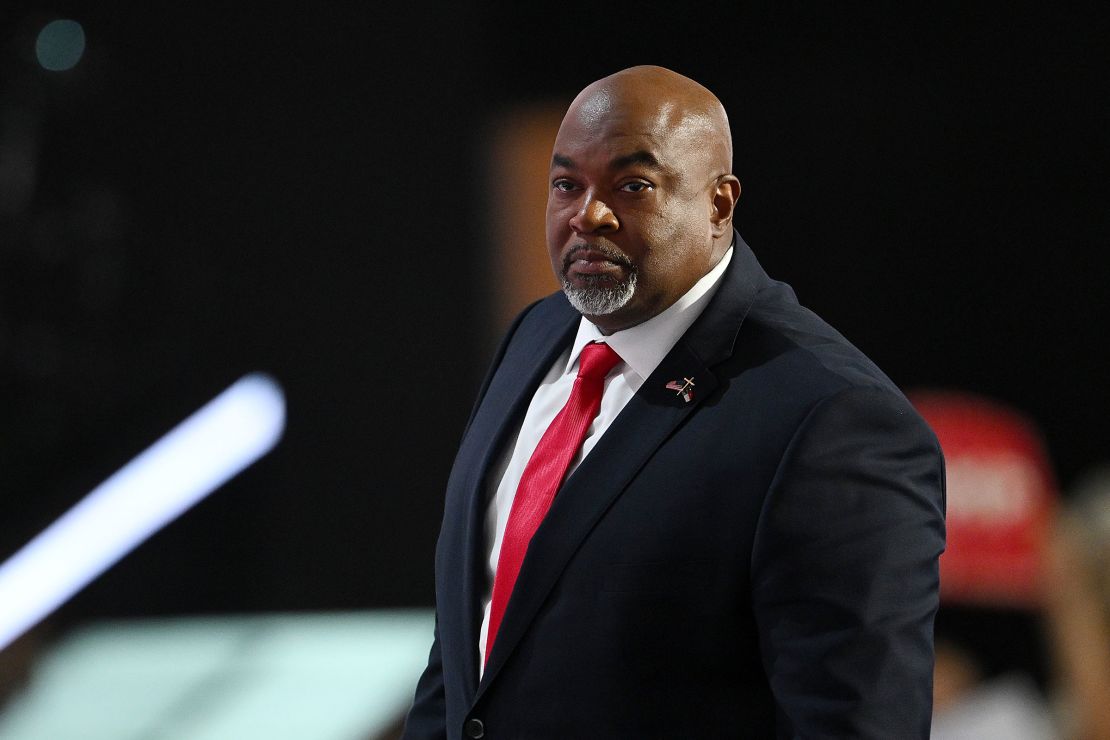
North Carolina Lt. Gov. Mark Robinson speaks on stage on the first day of the Republican National Convention at the Fiserv Forum on July 15, 2024, in Milwaukee.

North Carolina Lt. Gov. Mark Robinson speaks on stage on the first day of the Republican National Convention at the Fiserv Forum on July 15, 2024, in Milwaukee. Leon Neal/Getty Images

Now campaigning for governor, he says he supports a so-called “heartbeat” bill that would ban abortion when a heartbeat is detected – approximately six weeks – with exceptions for rape, incest and health of the mother…

In another thread, commenters considered whether to believe the story of a woman who said she was raped by her taxi driver while intoxicated. In response, Robinson wrote, “and the moral of this story….. Don’t f**k a white b*tch!”

Robinson, who would become North Carolina’s first Black governor if elected, also repeatedly maligned civil rights leader Martin Luther King Jr., attacking him in such intense terms that a user accused him of being a white supremacist.

“Get that f*cking commie bastard off the National Mall!,” Robinson wrote about the dedication of the memorial to King in Washington, DC, by then-President Barack Obama.

“I’m not in the KKK. They don’t let blacks join. If I was in the KKK I would have called him Martin Lucifer Koon!” Robinson responded.

CNN’s reporting on Robinson’s comments comes a few weeks after The Assembly, a North Carolina digital publication, reported that Robinson frequented local video pornography shops in the 1990s and 2000s. The story cited six people who interacted and saw him frequent the stores in Greensboro, North Carolina. A spokesperson for Robinson called the story false and a “complete fiction.”

Open the link to see CNN’s extensive documentation.

Public Schools First NC posted the following statement about the passage of additional funding for the state’s voucher program. The General Assembly has a veto-proof majority in both houses, thanks to the defection of one Tricia Cotham, who ran as a Democrat who opposed abortion and vouchers, then changed parties. The bill raises voucher spending to over $600 million this year and to nearly $1 billion annually in a decade.

Here is the statement:

This week the House and Senate majority passed House Bill 10 “Require ICE Cooperation & Budget Adjustments” in a process that allowed no adjustments to any part of the bill. The new bill added a number of budget items to the previous bill, including massive increases in North Carolina’s voucher programs

The bill added millions in OS vouchers and ESA+ vouchers, bringing the total for 2024-25 to $616.1 million. The new appropriations were made to ensure that all voucher applicants this year received a voucher regardless of their income. As described in our September 7 newsletter, the majority of OS applicants on the waitlist have incomes too high to have been eligible for vouchers before the income cap was removed this year

In 2024-25, the OS vouchers pay up to $7,468 toward the private school tuition for each student. The voucher amount is tied to state per-pupil funding and increases each year. 

The wealthiest applicants—those making more than $260,000/year for a family of four—will receive $3,360 per child from the state. 

The bill does not increase teacher pay, so veteran teachers in their 15th through 24th years of teaching will receive a raise of only $820 in 2024-25.

The bill also sets out additional increases for both voucher programs through 2032-33 and establishes spending “for each fiscal year thereafter.” The result, as shown in the chart, is a whopping $937.6 million scheduled to be spent in 2033-34 alone. This is stunning and a total disregard for our underfunded public schools.

North Carolina will have spent a total of nearly $9 billion on private school vouchers by 2033-34. Those dollars would have fully funded the Comprehensive Remedial Plan (Leandro) to provide a sound basic education for all public school students—and much more. In November 2022, the North Carolina Supreme Court ordered the legislature to appropriate funds according to the Leandro plan, but legislative leaders are still fighting the ruling. 

Taxpayers may wonder whether the billions spent on private schools are helping students learn. We do know, based on national data, that private schools do not outperform public schools. Taxpayers won’t get answers—at least not yet – about NC students since private schools are not required to publicly report information on student achievement, unlike traditional public schools and charter schools.

Last year’s budget bill required private schools to administer the ACT to 11th grade students whose tuition was at least partially funded by vouchers starting this school year (public school 11th graders already take the ACT). It also required the Superintendent of Public Instruction to recommend a test to be administered in 3rd and 8th grade to both public school students and private school voucher students. There has been no word yet on what test Superintendent Truitt recommended and whether it will be administered this spring. 

Governor Cooper has signaled that he will veto House Bill 10 this week due to the massive voucher increases and other provisions in the bill that he has previously come out against such as the ICE requirement. 

It’s NOT TOO LATE to take action to STOP HB 10!

Legislators will be back in session on October 9. Governor Cooper is expected to veto the bill this week. Legislators will then be asked to vote to override his veto. What can you do to make sure the veto holds?

  • Contact legislators to urge them to reject this voucher expansion.
  • Contact all other elected officials and local business leaders to let them know how harmful the voucher expansion is to communities. They should contact legislators too. 
  • Encourage your local school board to submit a resolution rejecting vouchers (see examples here).
  • Support your local PTA as they advocate for public schools.
  • Sign our petition urging legislators to reject HB 10 and support the VETO.

PSFNC’s Statement on Voucher Expansion

Legislators, when sworn in, pledge to uphold the NC state constitution to provide a free public education. They should not be sending nearly a billion dollars of our tax money to private school vouchers while starving our public schools as they ignore the NC Supreme Court’s ruling to fully fund Leandro. By adding school voucher funding to clear the voucher waitlist of mostly wealthy families, this bill gives our hard earned tax dollars to wealthy families who can afford to pay their own tuition bills. In contrast, salary increases for teachers with 5 or more years of experience were less than $950, which amounts to pay cuts given cost of living increases. 

This bill prioritizes private schools over public schools, urban families over rural families, and wealthy families over our teachers and the nearly 1.4 million children who attend our public schools. Now, with no income limits to determine eligibility and no prior public school attendance required, it has become a handout to wealthy families to underwrite their private school tuition. This is the wrong path for our state. It undermines the social and economic fabric of our state–a state that used to be known nationwide for putting our public schools first- we need to do it again.

Public Schools First, North Carolina’s premier parent-advocacy group, warns that the GOP-controlled legislature plans to expand the state’s voucher program on Monday. It asks parents and concerned citizens to sign a petition and get active to stop the ongoing campaign to defund public schools.

Public Schools First NC writes:

In a familiar move, voucher supporters in the legislature are adding a $248M voucher expansion to an existing bill instead of proposing a stand-alone bill that can be debated and voted on separately. 

House Bill 10 “Require Sheriffs to Cooperate with ICE” has been newly branded “Require ICE Cooperation & Budget Adjustments.” This is where they have included an additional $248 million for private school vouchers in 2024-25.

With the school year underway, parents have already had to make schooling decisions for their children. This means that the $248 million is primarily for private school tuition for students who are already enrolled in a private school this year. In other words, families that can already afford private school will simply receive a tax-funded tuition rebate. 

Left out of the ICE/Budget Adjustments bill are any additional funds for teacher pay, which leaves the average pay increase at 3% for teachers this year. Due to inflation increases, the 3% raise is effectively a pay cut unless local communities add salary supplements large enough to make up the difference. Even worse, teachers with more than 4 years of experience received increases of less than 2% this year.  

Why aren’t legislators spending the $248 million boosting teacher salaries so they’re not getting a pay cut?

Put into specific dollar amounts, the proposed voucher expansion would give $4,480 to families (of 4) making up to $259,740 per year and $3,360 to millionaires, while teachers with 10 years of experience make just $49,350 per year and are stuck with a skimpy $920 salary increase. Is this fair? Is this how we strengthen and support our public schools?

Also missing are dollars to support early childhood education or fund North Carolina Pre-K. Currently just 53% of eligible children are enrolled in NC Pre-K, leaving nearly 24,000 low-income children without an adequate pre-k option

Instead of clearing the private school voucher waitlist to fund wealthy families, perhaps the legislature should spend the $248 million to clear the NC Pre-K waitlist and support low-income families.

There are many, many more important issues the legislature should be addressing during their time in Raleigh than adding dollars to a program that harms public schools and sends dollars to private schools that are completely unaccountable to the public.

It is critical that you act now! The NC Senate will open their session at noon. Join us if you can.

Please sign our petition to let legislators know you want them to OPPOSE THIS THREAT TO OUR PUBLIC SCHOOLS – TELL THEM VOTE NO TO ANY PRIVATE SCHOOL VOUCHER EXPANSION!Sign the Petition

Need help explaining this to your neighbors and friends? Public Schools First NC just released a short video explaining vouchers in NC. Please share it widely!

video

CNN reported that Michele Morrow, the GOP candidate for State Superintendent of Schools in North Carolina, filmed a video on January 6 urging Trump to “put the Coonstitution to the side” and use the military to stay in power. Morrow was in DC for the January 6 rally but she says she never entered the Capitol.

In a deleted Facebook livestream she filmed from her hotel room, Morrow called for mass arrests of anyone who helped certify the 2020 election. “And if the police won’t do it and the Department of Justice won’t do it, then he will have to enact the Insurrection Act,” said Morrow. “In which case the Insurrection Act completely puts the Constitution to the side and says, now the military rules all.”

Morrow was at the Capitol as the attack occurred, according to public videos reviewed by CNN that show her in a restricted area on the northwest side of the Capitol. CNN has seen no evidence that Morrow entered the Capitol building that day or that she engaged in violence, and she was not charged with any crimes.

In March’s Republican primary, Morrow defeated the incumbent North Carolina Superintendent of Public Instruction, a job that manages the state’s $11 billion budget for K-12 public schools and helps set education priorities and implement curriculum standards.

That same month, CNN’s KFile reported Morrow had previously called for the public execution of Barack Obama and the death of Joe Biden and other prominent Democrats in comments on a since-deleted X account.

“I prefer a Pay Per View of him in front of the firing squad,” Morrow wrote in a since-deleted post from May 2020 about Obama. “I do not want to waste another dime on supporting his life. We could make some money back from televising his death.”

Morrow home-schooled her children. She previously lost a local school board election. She is running now to take control of the education of all the children in North Carolina.

A terrifying prospect.

Politico interviewed Governor Roy Cooper of North Carolina about his decision to withdraw from consideration as Kamala Harris’s Veep. It’s a fascinating interview and well worth reading. Both parties consider North Carolina to be a key swing state.

Cooper talks about his conversations with both Biden and Harris and his reaction to the President’s decision to step aside.

But he swiftly concluded he could not run as Vice-President with Harris because of the danger that the Lt. Governor Mark Robinson would be Acting Governor in his absence and do something crazy.

Gov. Cooper said:

In North Carolina, we have in our constitution — back from the wagon wheel days — a provision that says when the governor leaves the state, the lieutenant governor becomes the acting governor. Many states across the country have this provision. You had no way to communicate. Back then, it made sense.

There have been a few cases across the country that have said, “Look, now with text and phone and email and Zoom and ways to communicate, this doesn’t make sense for this to be the case.” And courts have ruled that it doesn’t literally mean that. North Carolina courts have not ruled that, however, and fairly recently, Republicans have taken over the North Carolina Supreme Court. They have made some extremely partisan decisions here lately, particularly regarding voting and redistricting.

Mark Robinson, the Republican nominee for governor, is the most extreme statewide candidate in the country right now. I was on a recruiting trip to Japan. He did claim he was acting governor. He did a big proclamation and press conference while I was gone. It was something about support for the state of Israel. It was obviously to make up for all of his antisemitic comments that he’d made, his denial of the Holocaust that he’d made over the years. But it was a big distraction. We analyzed this….

We also know that with our big statewide races, Josh Stein — our attorney general whom I’ve endorsed — running against Mark Robinson, his extremism; his disrespect for women, saying that men should lead and not women; saying that when you get pregnant, it’s not your body anymore; extreme abortion ban with no exceptions; saying that he has an AR-15 and that he would shoot government officials who got too big for their britches. It is on and on and on and on.

Back in February, long before President Biden stepped back and Vice-President Kamala Harris became the Democratic nominee for President, two red-state Governors spoke out against vouchers. Both are Democrats who understand the importance of public schools for their communities. They are Governor Roy Cooper of North Carolina, whose gerrymandered legislature has a Republican supermajority, and Governor Andy Beshear of Kentucky, whose legislature is controlled by Republicans. When Beshear ran, he picked a teacher as Lieutenant Governor.

The two Governers wrote this article in USA Today:

In North Carolina and Kentucky, public schools are the center of our communities. We’re proud public school graduates ourselves – and we know the critical role our schools play in teaching our students, strengthening our workforces and growing our economies.

We’ve seen record-high graduation rates of almost 90% in our public schools. North Carolina and Kentucky rank in the top 10 for National Board-certified teachers, one of the highest recognition teachers can earn.

In Kentucky, we’ve seen significant improvement in elementary school reading, even with setbacks from the pandemic like many states experienced. In North Carolina last year, public school students completed a record 325,000 workforce credentials in areas like information technology and construction. The bottom line? Our public schools are critical to our success and an overwhelming number of parents are choosing them for their children.

That’s why we’re so alarmed that legislators want to loot our public schools to fund their private school voucher scheme. These vouchers, instituted in the 1950s and 1960s by Southern governors to thwart mandatory school desegregation, are rising again thanks to a coordinated plan by lobbyists, private schools and right-wing legislators.

Voucher programs chip away at the public education our kids deserve

This is their strategy: Start the programs modestly, offering vouchers only to low-income families or children with disabilities. But then expand the giveaway by taking money from public schools and allowing the wealthiest among us who already have children in private schools to pick up a government check.

In North Carolina, the Republican legislature passed a voucher program with no income limit, no accountability and no requirement that children can’t already go to a private school. This radical plan will cost the state $4 billion over the next 10 years, money that could be going to fully fund our public schools. In Kentucky, legislators are trying to amend our constitution to enshrine their efforts to take taxpayer money from public schools and use it for private schools.

Both of our constitutions guarantee our children a right to public education. But both legislatures are trying to chip away at that right, leaving North Carolina and Kentucky ranked near the bottom in per-pupil spending and teacher pay.

Public schools are crucial to our local economies. In North Carolina, public schools are a top-five employer in all 100 counties. In many rural counties, there are no private schools for kids to go to – meaning that those taxpayer dollars are torn out of the county and put right into the pockets of wealthier people in more populated areas.

Governor Roy Cooper, North Carolina

In fact, in Kentucky, 60% of counties don’t even have a certified private school. This has caused rural Republicans in red states like Texas and Georgia to vote against voucher schemes that would starve their rural schools.

Governor Andy Beshear, Kentucky

Private schools get taxpayer dollars with no real accountability

As governors, we’ve proposed fully funding our public schools, teacher pay raises to treat our educators like the professionals they are and expanded early childhood education. We know that strong public schools mean strong communities. Families in Kentucky and North Carolina know that too. In North Carolina, nearly 8 in 10 children go to public schools.

Our public schools serve all children. They provide transportation and meals and educate students with disabilities. And they’re accountable to taxpayers with public assessments showing how students and schools are doing and where they need to improve.

But private schools that get this taxpayer money have little to no accountability. They aren’t even required to hire licensed teachers, provide meals, transportation or services for disabled students. They don’t even have to tell the taxpayers what they teach or how their students perform. North Carolina’s voucher system has been described as “the least regulated private school voucher program in the country.”

Studies of student performance under school voucher programs not only showed that they don’t help them, but that they could actually have harmful effects. Results from a 2016 study of Louisiana’s voucher program found “strong and consistent evidence that students using an LSP scholarship performed significantly worse in math after using their scholarship to attend private schools.” In Indiana, results also showed “significant losses” in math. A third study of a voucher program in Ohio reported that “students who use vouchers to attend private schools have fared worse academically compared to their closely matched peers attending public schools.”

We aren’t against private schools. But we are against taxpayer money going to private schools at the expense of public schools.

The future of our nation goes to class in public schools, and all Americans must be on guard for lobbyists and extremist politicians bringing similar plans to their states. Our segregationist predecessors were on the wrong side of history, and we don’t need to go back.

We are going to keep standing up for our public school students to ensure that they have the funding they need, and that teachers are paid like the professionals they are. It’s what’s best for our children, our economy and our future.

Roy Cooper is the governor of North Carolina. Andy Beshear is the governor of Kentucky.

The editorial board of the Capitol Broadcasting Company wonders why voucher schools in North Carolina are exempt from the same accountability as public schools. The answer is simple: They don’t want the public to know. They don’t want them to know that most kids who use vouchers never attended public schools. They don’t want them to know that the few public school kids who sought vouchers are falling behind their peers in public schools.

The editorial boldly chastises the North Carolina General Assembly:

It is not an unrealistic expectation that North Carolinians hold elected officials – whether executive, legislative or judicial – accountable for how tax dollars are spent.

When legislators dole out — say more than half-a-billion dollars – to private schools it should go without mention there would be clear provisions for taxpayers to know how much money goes where, whether the money is being spent for the purpose intended and whether that purpose is being achieved.

Accountability isn’t simply to the parents of students. Achievement isn’t merely a matter of the parents’ happiness.

All North Carolinians – particularly every taxpayer who is paying the tab – have a right to know how their money is being spent and whether it is in the hands of competent and qualified people to deliver the services intended – educating school children.

When it comes to private school vouchers, the leaders of the General Assembly want to pump as much as $632 million into them so that even wealthy families can gain taxpayer subsidies for their kids’ tuition. Nearly 20% of the likely beneficiaries are families with annual household incomes exceeding $259,000 (representing the top 7% of families in the state).

Accountability is overlooked. More than overlooked, it seems legislative leaders are actually blocking the kinds of routine accountability that other recipients of taxpayer money must adhere to.

A recent examination of 200 private schools that receive the greatest share of taxpayer-funded vouchers by the Public School Forum of North Carolina revealed little oversight and few of the basic requirements that are in place for public schools, so taxpayers can see if their schools are properly staffed and kids are learning.

It is the law that students in public schools be taught by state-certified teachers. Voucher-supported private schools have no teacher-certification requirements. Only 2% of private schools require teachers have state certification.

Public schools must operate at least 185 days for classroom instruction. There’s no requirement of any minimum on instruction for voucher-supported private schools.

Public schools – including charter schools – must administer state end of grade tests. Voucher private schools can administer a nationally-normed standardized test of their choice to students.  They must pay if they choose to  use the state’s end of grade tests (see clarification below).

Current funding schemes for private school vouchers – even if funding for students from low- and modest-income families – needs to be accountable.

And there’s certainly no urgency to act on the unwise expansion of private school vouchers. The reality is that none of the families who might be awaiting word on the availability of the subsidies, is dependent upon them to send their kids to ANY school of their choice – public or private.

There are certainly some circumstances when the education needs of students cannot be met in public schools. Having a taxpayer-financed option for those students who need it – and need financial assistance – is appropriate.

But every taxpayer should be able to know – by transparency and accountability set out in state law – that their dollars are being spent as intended by competent teachers and there’s a demonstrable way to determine the effectiveness of the instruction.

Schools that discriminate in admissions or hiring, schools that don’t require basic teacher certification, classroom attendance, schools that don’t show student achievement through the same end-of-grade testing used in public schools and schools that don’t make that information available as public schools do, should not be subsidized with taxpayer dollars.

That’s just basic accountability our legislators should demand and schools willingly provide.

CLARIFICATION: An earlier version of this editorial stated that North Carolina private schools receiving taxpayer-financed vouchers were prohibited from using state end of grade tests. Private schools, including those receiving vouchers, are not prohibited from participating in the state’s end of grade and/or end of course tests, according to the state Department of Public Instruction.  If the private schools pay they can participate and some do, according to the department.

Leaders of the pro-public school organization called Public Schools First in North Carolina discovered that many public school parents and advocates are unaware that the state’s General Assembly has passed a budget that gives vouchers to the rich. They are distributing the following opinion piece from the Greensboro News to inform the public:

Our Opinion: Five words for GOP candidates: ‘And you’re OK with That?’

“And you’re OK with that?”

As Republican candidates for the state legislature begin to the make the rounds this fall, they should be hearing those five words over and over from constituents of all political stripes.

At every stop, on every stump, they should be pressed to give straight answers to that simple question on three issues:

Private-school vouchers

Even as they’ve increased taxpayer funding for private school tuition, adding wealthy families to the dole, many local public districts, including our own in Guilford and Forsyth counties, complain that they are seriously underfunded.

To be more specific, your party plans to plow hundreds of additional millions in taxpayer money into private school tuition assistance. Although 40% of that money ($96 million) would go to middle-class and working-class families earning between $57,721 to $115,440 a year (for a family of four), 44% (or $107 million) would go families earning $115,441 to $259,740.

And 16% (or $39 million) would go to those who need it the very least: wealthy families earning more than $259,741 annually.

One Democratic lawmaker likened it to asking low- and moderate-income taxpayers to help pay for a wealthy kid’s Porsche.

How do you square that with your rhetoric against “the welfare state” and profligate spending of other people’s money?

How do you square it with public school funding gaps throughout the state?

And how do you tell public schools no, that’s all we have to spend and then turn around and tell rich families y’all come. Who do we make the check out to?

Keeping secrets

Your party also slipped a provision into the state budget bill last fall that allows state lawmakers to decide for themselves whether they will make any of their documents accessible to the public. 

By law, they also get to choose whether to destroy or sell documents. They’re the decider. Which means they’re creating their own deep state right here and now on Tobacco Road.

What are they trying to hide and why?

And what gives them the right to membership in this exclusive club, but not others (the governor, the lieutenant governor, the attorney general and other North Carolina officials who are elected statewide need not apply)?

Easy money

Then there’s the provision the Republican-controlled legislature embedded within an (unnecessary) anti-masking bill that allows more “dark money” donations to political candidates in North Carolina.

As the current law stands, candidates must disclose the names of donors to their campaigns. They also are prohibited from taking donations from corporations, and contributions from individuals and political groups may not exceed $6,400.

This bill would change all that by making it legal for political parties in the state to take money from “Super PACs,” which are allowed to keep their donors secret and may receive unlimited amounts of money.

Those Super PACs would be able to collect the money and pass it on to the political parties, which could then funnel it to candidates, no questions asked.

At least your party has made no secret of the fact that it designed this new rule specifically with the GOP gubernatorial candidate in mind. Mark Robinson substantially trails his Democratic opponent, Josh Stein, in fundraising.

To recap, are you OK with:

Channeling taxpayer money to rich people as public schools go wanting?

Keeping documents and correspondence a secret from the public … unless you decide to share it?

And allowing anonymous cash to flow unfettered to candidates of both parties?

If the answer is yes, please explain how any of this benefits most North Carolinians and why we should vote for you anyway.

And how this in any way resembles government for, by and of the people.

The Republicans in North Carolina have submitted legislation in the General Assembly to authorize a charter school with powerful political connections.

Ann Doss Helms of WFAE reported:

Buried deep in the 271-page House budget bill introduced Monday night, there’s a provision that would allow an unnamed charter school to bypass state review and open in August.

The description is very specific: The “expedited opening” would apply only to applications filed in 2024, for schools in the state’s largest statistical metropolitan area, in a fast-growing county and a school district serving fewer than 25,000 students.

Also, “the proposed charter school will be located in a fully furnished school facility purchased from a local board of education.”

That description applies to Trinitas Academy, which bought the old Mt. Mourne School in Mooresville from Iredell-Statesville Schools in 2022.

Trinitas hasn’t even begun the state review process that ensures its board is ready to educate students and responsibly handle millions of dollars of public money.

But it does have a website describing it as a K-8 classical academy. It lists a board that includes:

  • Susan Tillis, wife of Republican U.S. Senator Thom Tillis and founder of the Susan M. Tillis Foundation. She’s described as having  “an extensive background in state and national politics.” (Her name was removed from the site Wednesday, after this story aired.)
  • Will Bowen, communications director for Republican Rep. Patrick McHenry.
  • Marcus Long of Mooresville, described as a retired chief circuit judge from Virginia.
  • Board Chair Mark Lockman, described as having been “part of the district leadership at Charlotte-Mecklenburg Schools and Iredell-Statesville Schools. Additionally, Mark was instrumental in building the State of North Carolina’s first data-based instructional growth model for public K-12.”

They couldn’t immediately be reached. Trinitas board member Mikail O. Clark, a Charlotte lawyer, confirmed that Trinitas plans to open in August, but said he didn’t know enough about the House Bill to discuss it. “We’ve obviously engaged counsel to assist us with this matter,” he said, and hung up before answering a question about the status of the Trinitas application…

State Charter Schools Director Ashley Baquero said Tuesday that she knew nothing about the plan to bypass the approval process.

Open the link to finish the story of cronyism.