Archives for category: New York City


Leonie Haimson is a model of an activist who drives city and officials crazy, as well as the billionaires who think they can drive policy with their money. She has two passions: reducing class size and student privacy. She created two groups to fight for her causes: class Size Matters and Student Privacy Matters. Leonie and her allies (the Parent Coalition for Studebt Privacy)  killed inBloom, the data mining program of students that Gates and Carnegie funded with $100 Million. (Full disclosure: I am a member of her board [Class Size Matters] and she is a member of the board of the Network for Public Education.) With meager resources, Leonie writes, testifies, organizes, blogs, and is a force to be reckoned with.

This week, she and a coalition of parents filed a lawsuit against the state and the city to demand class size reduction. 

See the lawsuit here. 

“Advocates and city parents have filed a lawsuit calling on state Education Department officials and city schools Chancellor Richard Carranza to reduce class sizes in the public schools.

“The suit filed in Albany State Supreme Court Thursday was brought by advocates with Class Size Matters, the Alliance for Quality Education and nine parents from all five New York City boroughs.

“It claims the state and city Education officials have ignored a 2007 law called the Contract for Excellence that required the city to lower class sizes.

“Class Size Matters founder Leonie Haimson said the city has instead increased class sizes, with nearly one-third of all students in classes of 30 or more children.

“It is unconscionable that the state and the city have flouted the law and are subjecting over 290,000 students to overcrowded classes of 30 students or more,” said Haimson, citing a Class Size Matters analysis of city Education Department data.”


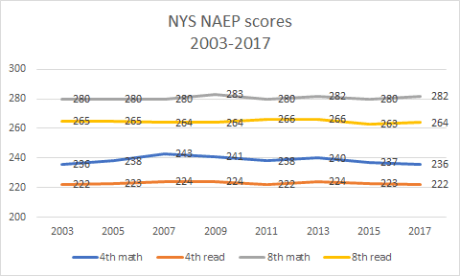
Leonie Haimson points out that, despite much boasting, New York City and New York State have made no gains on NAEP from 2013-2017.

What she did not include is a graph showing that New York State’s NAEP scores have been flat from 2003-2017.

naep


Newsday reports that the opt out movement continues with vigor on Long Island, the heart of the test-refusal movement.

State officials did their best to intimidate, and some local officials tried to bully parents. The new chancellor of New York City public schools said that parents who choose opt out were “extremists.” The city’s schools have successfully suppressed opt outs by warnings of serious consequences to schools and students. Pundits predicted that the state had killed opt out.

But students and parents on Long Island were unbowed by threats.

”More than half of eligible students on Long Island boycotted the state English Language Arts test this week — a continuation of high opt-outs despite state efforts to win back students and their parents by shortening the exams.

“A total of 74,018 students in grades three through eight across Nassau and Suffolk counties refused to take the exam out of 145,127 students eligible, according to a Newsday survey that drew responses from 97 of the Island’s 124 districts. That’s a refusal rate of 51 percent.

“In Nassau, 28,831 students out of 67,630 students in the districts that responded, or 42.6 percent, sat out the latest assessments. In Suffolk, 45,187 students out of 77,497 in the responding systems, or 58.3 percent, refused to participate…

”So far, opt-outs in the Island’s schools are running close to the 52.2 percent peak recorded at this time last year. The boycott movement has now racked up six straight years of support, starting on a small scale in spring 2013 and ballooning to tens of thousands of students annually since 2015.

“The Comsewogue district, serving Port Jefferson Station, hit a new local refusal record of 90.3 percent.

“School systems reporting opt-out rates of 60 percent or more included Bellmore-Merrick, Malverne, Seaford, Babylon, Middle Country, Patchogue-Medford and West Babylon.”

Education Trust-New York expressed disappointment that so many parents didn’t understand the value of annual standardized testing.

Normally I wouldn’t write about the fate of a single school. But this is a special case.

I recall that when Bill DeBlasio ran for Mayor in 2013, he said emphatically that he would not follow the Bloomberg script of closing schools. I moderated a debate back in that first election where he pledged to take a different path. He has recently hinted that he has national ambitions, so his reversion to the previous Mayor’s plan of closing schools as a matter of course, over the protests of the school community, is very disturbing.

Here is a statement by the PTA president of a school that is slated for closure. It is a “transfer school,” that is, a high school for kids who have persistently struggled and are trying to earn a diploma. In other words, it is a “last chance” school for kids who have not been able to make it in the general education program.

Read this and see what you think. Should this school die?

“For Immediate Release

Contact: Shaunte Williams, PTA President
(718)-877-3821

“Crotona Academy, a transfer high school in the South Bronx, is actively rallying its community of students, alumni, parents, and staff to challenge a New York City Department of Education proposal to lock its doors to more than 150 at-risk students.

“Superintendent Paul Rotondo informed the school’s community in early February that the DOE had put the alternative high school on a fast track toward closure by August 2018. “This proposal threatens a major disruption in the education of teenagers who are at Crotona precisely because they have already suffered a disruption in their education,” said Shaunte Williams, president of Crotona Academy’s parents association and the parent of a current student at Crotona Academy.

“Unlike other identified NYCDOE schools proposed for closure, the decision to close the transfer high school Crotona Academy was left totally at the discretion of the Superintendent of transfer schools, Paul Rotondo. Superintendent Rotondo has been granted the authority to select which of his transfer high schools he elects to merge, co-locate, replace the school leader, or close completely. On February 9, 2018, Superintendent Paul Rotondo shocked the Crotona Academy community of students, parents and staff by stating that the school was proposed for closure effective September 2018.

“For thirteen years, Crotona Academy High School, the “Little Transfer School That Could” has dedicated itself to educating and supporting at risk, over aged, under credited students in their determination to earn a traditional high school diploma. Crotona Academy High School is a small transfer high school located in the poorest congressional district in America in the heart of the South Bronx. Since its inception, Crotona Academy High School has worked in conjunction with community-based organizations to offer in depth-individualized support, job readiness and career exploration to students who for a litany of reasons could not succeed in a general education high school. A large proportion of the Crotona students and their families are struggling with poverty-induced obstacles such as homelessness, unemployment, substance abuse, and mental health issues. Nearly half of Crotona Academy’s total enrollment compromised of special education and English language learners. In September 2016, the Crotona Academy school community was grateful to move into a new school building location after eleven years of being relegated to receiving instruction situated in series of TCU trailer units.

“Superintendent Rotondo’s decision to close Crotona Academy High School leaves many questions to bear in mind…

“Crotona Academy High has been identified by NYSED as a school “In Good Standing” for over five consecutive years. There are currently nine underperforming Transfer High Schools identified by the NYSED ESSA as “Focus” or “Priority” schools. Four of these underperforming Transfer High Schools identified by NYSED as Focus or Priority transfer high schools are located in the Bronx. Superintendent Rotondo however has elected to select only Crotona Academy High School, a school in GOOD STANDING for closure. Crotona Academy High School is actually the only transfer high school Superintendent Rotondo has selected for closure.

“Crotona Academy has made significant educational gains within the last three years in student attendance and has experienced a steady increase in student enrollment, graduation rates of English Language Learners and Special Education students and the inclusion of a variety of multi-cultural and college/career ready programs.

“Unfortunately, Superintendent Rotondo in the published Impact Statement has strategically concealed much of this data in order to support his rationale to close Crotona Academy High School.

“In spite of the educational gains Crotona Academy has made, the school’s five year identified status as a school “In Good Standing” by NYSED ESSA, and the fact that Crotona Academy students were just moved into their new school building less than two years ago, Superintendent Rotondo has still chosen Crotona Academy High School for closure. To add insult to injury, the proposed plan for the school building is to move the Crotona Academy students out and designate the school building to another school currently located in TCU trailer units.

“What message does this send to the Crotona Academy students? Those Crotona Academy students are less worthy than other students to be educated within a nice school building. That although NYSED has identified Crotona Academy as a school in good standing for the past five years, that this information is irrelevant, that the gains made at Crotona Academy in attendance, enrollment, graduation rates and post-secondary enrollment rates, is deemed by Paul Rotondo as inconsequential. What is the rational for Superintendent Rotondo to TARGET Crotona Academy High School for closure rather than those underperforming transfer schools identified by NYSED? What was the rationale for Superintendent Rotondo directing Crotona Academy High School to seize enrollment in August 2018 and preventing admissions although there was a demand from the community and no indication that the school was being proposed for closure that announcement was made later in February 2018.

“Clearly, many unanswered questions deserve to be answered before a decision is made to close Crotona Academy High School. It would be a travesty to punish at risk students by forcing them to relocate to other schools due to the questionable and possibly bias decision making practices of Superintendent Rotondo.

“A public hearing on the DOE proposal will be held on Thursday, April 12, 2018 at 5:00 P.M. at Crotona Academy High School located at 1211 Southern Boulevard, Bronx, NY, 10459. The panel for Educational Policy will vote on the proposal at a meeting on Wednesday, April 25, 2018 at 5 pm Murray Bergtraum High School, located at 411 Pearl Street, New York, NY, 10007. The Crotona Academy community encourages supporters to attend and voice their opposition to the proposal at both hearings.

“To voice your opposition to the closure ahead of the above-mentioned hearing dates, contact the DOE (anonymously) calling 212-374-5159 or email D12proposals@schools.nyc.gov”


Shulem Deen was raised in an Orthodox home. He wrote an opinion article in the New York Times today about the low quality of education he received in religious schools.

He writes:

”Last Friday, as observant Jews hurried with last-minute preparations for Passover, one Orthodox Jew was in Albany, holding up the New York State budget. He was insisting that this roughly $168 billion package include a special provision that would allow religious schools to meet the state’s educational requirements by using their long hours of religious instruction.

“In recent years, education activists, among them former Hasidic yeshiva graduates, have pushed aggressively to bring the yeshivas into compliance with the state’s education laws. Simcha Felder, the state senator from Brooklyn who represents the heavily ultra-Orthodox neighborhoods of Borough Park and Midwood, was on a mission to get legal permission for the state to turn a blind eye to the near-absence of secular instruction in many yeshivas. The upshot? Tens of thousands of children would continue to graduate without the most basic skills.

“I know about the cost. I was one of those kids.

“I was raised in New York’s Hasidic community and educated in its schools. At my yeshiva elementary school, I received robust instruction in Talmudic discourse and Jewish religious law, but not a word about history, geography, science, literature, art or most other subjects required by New York State law. I received rudimentary instruction in English and arithmetic — an afterthought after a long day of religious studies — but by high school, secular studies were dispensed with altogether.

“The language of instruction was, for the most part, Yiddish. English, our teachers would remind us, was profane…

”When I was in my 20s, already a father of three, I had no marketable skills, despite 18 years of schooling. I could rely only on an ill-paid position as a teacher of religious studies at the local boys’ yeshiva, which required no special training or certification. As our family grew steadily — birth control, or even basic sexual education, wasn’t part of the curriculum — my wife and I struggled, even with food stamps, Medicaid and Section 8 housing vouchers, which are officially factored into the budgets of many of New York’s Hasidic families….

”I now have two sons, ages 16 and 18. I do not have custody of them — I lost it when I left the Hasidic world, and so I have no control over their education. Today, they cannot speak, read or write in English past a second-grade level. (As for my three daughters, their English skills are fine. Girls, not obligated with Torah study, generally receive a decent secular education.)

“Like me, my sons will be expected to marry young and raise large families. They too will receive no guidance on how to provide for them and will be forced into low-wage jobs and rely heavily on government support.

“They are not alone. Across the state, there are dozens of Hasidic yeshivas, with tens of thousands of students — nearly 60,000 in New York City alone — whose education is being atrociously neglected. These schools receive hundreds of millions of dollars in government funding, through federal programs like Title I and Head Start and state programs like Academic Intervention Services and universal pre-K. For New York City’s yeshivas, $120 million comes from the state-funded, city-run Child Care and Development Block Grant subsidy program: nearly a quarter of the allocation to the entire city.”

These are the schools to which Betsy DeVos would supply vouchers. What a shame. The children deserve better education.


New York State has been negligent in protecting the right to an adequate education in Yeshivas. The state has a large, vibrant, and politically powerful Orthodox Jewish community.

If you care about a better education for all students, and you live in New York City, try to attend the press conference on April 5.

It is sponsored by Young Advocates for Fair Education (YAFFED)

April 5 Press Conference to Discuss how NY has Betrayed Its Values to Please A Bully and Next Steps in Fight to Protect the Rights of Orthodox Children

For immediate release: New York, NY (4/2/18)
Contact: Naftuli Moster, Exec. Director, naftuli@yaffed.org

A press conference will be held in front of City Hall to protest how in the NY State budget deal, elected officials rolled back the protection of children’s right to an adequate education.

When: Thursday, April 5, 2018 at 1pm

Where: The steps of City Hall in lower Manhattan

Who: Members of Yaffed, along with former Yeshiva students and invited elected officials

Why: A new law passed as part of the 2018 NY state budget was crafted specifically to affect only Hasidic and Orthodox Jewish children. It seeks to weaken the NY State Education Department’s ability to provide sufficient oversight to ensure that these children receive an adequate education.

This law was passed as result of the efforts of Simcha Felder, a State Senator from Brooklyn who alone held up the state budget in order to insert language intended to deprive students of their right to a basic education that will prepare them for good-paying jobs and success in life.

New York State law requires non-public schools to provide an education that is “at least substantially equivalent” to that of public schools, so that no student is left in ignorance. The law requires non-public schools to provide instruction in “arithmetic, reading, spelling, writing, the English language, geography, United States history, civics, hygiene, physical training, the history of New York state and science.”

But this law has not been enforced for decades, by either the state or the city. The Mayor and the NYC Department of Education has delayed taking any action for over two and a half years, even after they had promised to do so repeatedly. The NY Commissioner of Education was in the process of drafting new guidelines to enforce the law, which apparently prompted Sen. Felder’s actions to attempt to exempt Yeshivas from meeting any educational standards. Meanwhile, tens of thousands of children are not receiving the basic education to which they are entitled.

At the press conference, advocates from Yaffed, former Yeshiva students and elected officials will speak out against extremists who are strong-arming our government to block sensible education policies, and. will discuss next steps in the fight to protect the human rights of all children to be adequately educated.

For more information on Yaffed’s five-year campaign to achieve a better education for ultra-Orthodox children, see http://www.yaffed.org


I invited Leonie Haimson, executive director of ClassSizeMatters, to write about the unfortunate decision by the New York City Department of Education to close P.S. 25 in Bedford-Stuyvesant, Brooklyn. It is one of the most successful schools in the city. It is under enrolled, but the authorities could easily change that by advertising its success or placing additional programs in the building. If and when the school closes, the empty building would then be available for Eva Moskowitz’s charter chain, and the children in the area would no longer have a zoned public school. Did Mayor DeBlasio forget that he campaigned on the promise to support public schools against the voracious expansion of charter schools?


Leonie writes:

On Tuesday, a lawsuit was filed to block the closing of PS 25 Eubie Blake, a small school in the Bed Stuy section of Brooklyn, which by all accounts is a school that is excelling and exceeding expectations, especially given the high-needs students it serves.

Last month, the Panel for Educational Policy voted to approve the closure of ten city schools, most of them struggling schools on the Renewal list.  Lost in the media shuffle was the fact that one of these schools, PS 25, wasn’t a low-performing school; far from it.

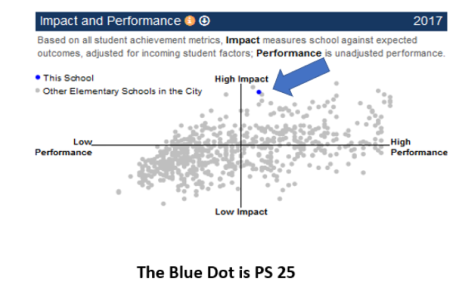
According to the DOE’s School Performance Dashboard, (according to Chancellor Farina, the “the most advanced tool of its kind,” PS 25 has the fourth highest positive impact of any public elementary school in the city and the second best in the entire borough of Brooklyn, when the need level of its incoming students is taken into account.
Picture1

According to this metric, the positive impact of PS 25 also exceeds that of any charter school in the city, except for Success Academy Bronx 2, given the fact that most of its students are economically disadvantaged, have disabilities and/or are homeless.

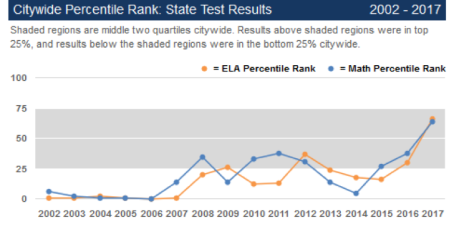
The test scores from PS 25 on the state exams show a sharp upward trajectory, with its students now exceeding the city average in both ELA and math.
Picture2

In fact, controlling for background and need, the students at PS 25 now outperform similar students by 21 percentage points in both subjects.

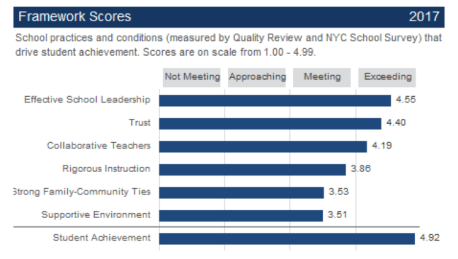
Now for those who say test scores aren’t everything, the school also excels according to all other methods the DOE uses to evaluate schools.  It exceeds or meets standards in “Effective School Leadership”, “Trust”, “Collaborative Teachers”, “Rigorous Instruction”, “Strong Family-Community Ties” and “Supportive Environment,” according to the school’s Quality Review as well as parent and teacher surveys.
Picture3

The fact that the DOE is closing a school which is delivering such great results for its students should not have been ignored.

Also unreported by any media outlet were two other salient facts: if PS 25 is closed, the entire city-owned building will be left to a charter school – Success Academy Bed Stuy 3, the first time this has happened in NYC, to my knowledge.

Also ignored was that the Community Education Council District 16 never voted to close this zoned school. State law requires that before this can occur, the CEC must authorize this, as any changes in zoning lines can only happen with their approval. The is one of the main responsibilities of CECs and some would argue their sole veto power over the unilateral and often arbitrary decision-making of the Mayor and the Chancellor.

So why does the Chancellor say PS 25 should be closed?  Chancellor Farina argues that the school is under-enrolled.  Yet at least five other schools have smaller enrollments than PS 25 and are not being closed.  Moreover, DOE has never publicized the fact that this school outperforms nearly every other school in the city.  If they had celebrated this school’s accomplishments, surely more parents would apply.  The sad reality is that many public schools in D16 have lost enrollment because of the supersaturation of charter schools in the district –  a drain on space, funding and resources which will only worsen if this school is closed.

According to the DOE’s controversial school capacity formula, PS 25’s “underenrollment” also means there is sufficient space in the building for its small class sizes of 10 to 18 – which provide ideal learning environments and are likely a major reason for its students’ success.  The DOE could also place another preK or a 3K class in the building if they wanted its enrollment to grow.

Currently, PS 25 parents are being shown a list of other schools to apply to, most outside the district and a few schools within — but none will have the same small classes and positive impact on learning, and none of them will their children have the right to attend.

Given how difficult many of these families’ lives are already, with nearly one quarter of the students homeless, this will be yet another terrible disruption, though in this case, wholly preventable. One can only hope the DOE changes course and withdraws the proposal to close PS 25 immediately.

Below is the press release about the lawsuit, which describes a 2009 legal precedent when then-Chancellor Joel Klein withdrew a proposal to close three zoned schools in Harlem and Brooklyn after being sued.  He then signed an agreement that the DOE would never do this again without a vote of the CECs.  The legal complaint to block PS 25’s closure with more data about the school and facts about the law is posted here.


For Immediate Release: Tuesday, March 27, 2018

Contact: Leonie Haimson, 917-435-9329; leoniehaimson@gmail.com


Lawsuit filed to stop the closure of PS 25, the 4th best public elementary school in NYC according to the DOE


Today a lawsuit was filed in the Brooklyn State Supreme Court against the proposed closure of P.S. 25 Eubie Blake in District 16, Brooklyn, a zoned neighborhood school, which Chancellor Carmen Farina and the Board of Education are attempting to close without the prior approval of the Community Education Council.

Last month, on February 28, the Panel on Educational Policy voted to close the school which will require students to seek enrollment in other schools, with no assurance of admission.  Not only is it a violation of NY State Education law 2590-e to close the only zoned school in the neighborhood without the district CEC’s prior approval, but P.S. 25 is also the fourth best public elementary school in NYC in the estimation of the Department of Education, and the second best in the borough of Brooklyn, when the need level of its students is taken into account.

According to the DOE’s School Performance Dashboard, which according to Chancellor Fariña is ““the most advanced tool of its kind,” the positive impact of P.S. 25 is greater than all but three of the city’s 661 public elementary schools, and its closure would leave the entire city-owned building to Success Academy Bed Stuy 3, a charter school. [1]

Achievement levels of P.S. 25 students have steadily climbed over the last three years, and the school now exceeds the city average in state test scores, despite the fact that a large percentage of students are homeless, economically disadvantaged, and/or have disabilities. According to DOE’s figures, the school’s students outperform similar students by 21 percentage points in ELA and math.  The achievement of the more than thirty percent of students with disabilities is also exceptionally high.

The school also meets or exceeds standards in all the following areas:  Effective School Leadership, Trust, Collaborative Teachers, Rigorous Instruction, Strong Family-Community Ties, and Supportive Environment.

Plaintiff Crystal Williams, a parent of two children at P.S. 25, said: “The school has seen a big improvement in recent years.  The teachers are excellent.  They give students close support, and my kids are learning.  The teachers take their time in part because they have small classes, and I don’t believe my children would be provided with the same quality of education at whatever other schools they are forced to attend.”

“PS 25 should be honored and replicated, not closed,” said Mark Cannizzaro, President of the Council for School Supervisors and Administrators, the principals’ union. “The school has been on a clear, upward trajectory: Dedicated school leaders and teachers have helped boost English and math test scores ever higher compared to the district and the city as a whole. All the while, PS 25 has made great strides in addressing students’ social and emotional needs, and has offered them a vibrant curriculum with art, music, library skills, coding and STEM classes. We continue to oppose this decision. The students, families and educators of PS 25 deserve better.”

Said Shakema Armstead, a plaintiff who has a third grader at PS 25, “My son, who has an I.E.P, loves the school.  It gives him and other students with a sense of community and stability that allow them to thrive.  There is no reason for them to be thrown into another school where they would have to re-adjust to an entirely new environment, especially as P.S. 25 is doing so well.”

There is a precedent for this lawsuit. In 2009, a lawsuit was filed against Chancellor Joel Klein on behalf of parents at three neighborhood zoned schools, in Harlem and Ocean Hill-Brownsville area, to prevent the closure of these schools without a vote of the relevant CECs.  The lawsuit was joined by Randi Weingarten, then President of the UFT, and NYC Public Advocate Betsy Gotbaum. Within weeks, Chancellor Klein withdrew the closure proposals.[2]  He subsequently signed the following settlement agreement:

The [plaintiffs and the DOE] agree with regard to the three schools identified in the Complaint and any other traditional public school that, for those grades that are within the province of school attendance zones, [the DOE] will not close, phase-out, remove, alter or engage in conduct designed to effect the closure of any such school in a way that deprives residents of the right to send a qualifying child to his or her zoned traditional school, without either (1) obtaining, pursuant to 2590-e(11) of the Education Law, the approval of the relevant Community Education Council as to such change or (2) timely replacing such school with another zoned school within the same attendance zone.

In this case, DOE has no plans to create another zoned school for these children, and yet no vote of Community Education Council 16 has occurred.  The DOE claims that the school is being closed because it is under-enrolled, but this ignores several important factors:  Parents have not been told of the exceedingly high quality of the school according to the DOE’s own metrics, and if they had been informed of this, more of them would likely enroll their children in the school.  The DOE could also install another preK or a 3K program in the school.   The availability of space has also allowed for very small classes, which in turn have provided PS 25 students with an exceptional opportunity to learn.

Said Leonie Haimson, Executive Director of Class Size Matters, “It would be tragic if the second best elementary school in Brooklyn were closed.  PS 25 has very small classes of 10 to 18 students, which are ideal for such high-poverty students.  Given how the DOE refuses to align the school capacity formula with smaller classes, that alone makes the school appear underutilized.  It would be extremely disruptive if this closure occurs, especially for the large number of homeless children at PS 25, because the school is a sanctuary of stability in their lives. Instead of closing PS 25, the DOE should celebrate, emulate and expand it—and give more NYC children the same chance to succeed.”

A copy of the lawsuit is posted here: https://tinyurl.com/y6wjocsu

###

[1] https://tools.nycenet.edu/dashboard/#dbn=16K025&report_type=EMS&view=City

[2] https://www.nyclu.org/en/press-releases/response-nycluuft-lawsuit-doe-announces-it-will-keep-schools-open
 

Three parents at PS 25 in Bedford Stuyvesant, Brooklyn, are suing to stop the closure of one of the city’s highest performing elementary schools. The Department of Education said the school was too small.

“The lawsuit hinges on a state law that gives local education councils the authority to approve any changes to school zones. Since P.S. 25 is the only zoned elementary school for a swath of Bedford-Stuyvesant, the department’s plans would leave some families with no zoned elementary school dedicated to educating them, forcing students to attend other district schools or enter the admissions lottery for charter schools.”

Question: Why didn’t DOE and local superintendent recruit additional students to 25?

Next question: will the building be emptied and handed over to another charter?

Next question: Why are charter operators focused on killing public schools in black communities, leaving them with no choice but a charter?


Michael Elliott, videographer, caught this scene on the streets of Brooklyn, where high school and middle school students demonstrating against gun violence on March 14 erupted in cheers when they saw a group of elementary school children marching across the street. Must watch! One minute!


When Bill de Blasio ran for Mayor the first time, he sought my help. We met and spoke candidly. He told me he would strongly support traditional public schools. He said he would oppose the expansion of private charters into public school space. He promised to stop closing schools because of their test scores. His own children went to public schools. He would protect them and end the destructive tactics of Joel Klein, who coldly and cruelly closed schools over the tearful objections of students, parents, and teachers.

I enthusuastically endorsed him. The campaign issued a press release. De Blasio was elected in 2013, and re-elected in 2017. I wanted him to succeed and to support public schools against the privatizers.

He tried to stand up to the charters, but Eva’s billionaire backers rolled out a multi-million dollar TV campaign and donated huge sums to Governor Cuomo and key legislators. That ended de Blasio’s effort to block charter expansion. The legislature gave them a blank check in New York City, allowed them to expand at will, and even required the city to pay their rent in private facilities if it couldn’t provide suitable public space. Now his majority appointees to the city board rubber stamp charter co-locations and expansions.

Although the Mayor and Chancellor Farina have tried to support struggling schools, they have not hesitated to close them when they don’t show test score gains.

At the last meeting of the city’s Board of Education (which Mayor Bloomberg capriciously named the Panel on Education Policy to indicate its insignificance in the new era of mayoral control but which is still called the Board of Education in statute), the Mayor submitted a list of schools to close. Sadly, like Bloomberg, he has closed many schools. Unlike Bloomberg, he does not boast about it. There’s that.

At the last meeting of the Board, onee of the Mayor’s appointees, T. Elzora Cleveland, dissented and another abstained, denying the majority needed to close two of the schools on the Mayor’s list. Cleveland has resigned, and education activists assume she was forced out to make way for a more pliable board member. 

How is this different from Mayor Bloomberg’s tactics?

During the Bloomberg regime, the Mayor ousted three appointees who objected to his wish to end social promotion. The three members worried that no one had devised a plan to help the kids held back. Bloomberg fired them on the spot, and said, in effect, mayoral control means I am in charge and my appointees do as I wish. At the time, the firings were called “the Monday night massacre.”

I strongly oppose closing public schools, especially those that are historic anchors of their community. Several years back, I was on a panel with John Jackson, president of the Schott Foundation for Public Education. He said he had traveled to many countries to learn how they dealt with struggling schools. In every country, the Minister of Education said, “If a school is struggling, we send in support.” Dr. Jackson asked, “What do you do if you send support, and the school doesn’t improve?” In every case, the Minister said, “We send in more support.”

The bottom line is that accountability lies with the leadership. If a school is in trouble, it is up to the leadership to help, not punish. They control the resources. They decide whether the school will reduce class sizes and have the staff and programs it needs. Accountability begins at the top.