I invited Leonie Haimson, executive director of ClassSizeMatters, to write about the unfortunate decision by the New York City Department of Education to close P.S. 25 in Bedford-Stuyvesant, Brooklyn. It is one of the most successful schools in the city. It is under enrolled, but the authorities could easily change that by advertising its success or placing additional programs in the building. If and when the school closes, the empty building would then be available for Eva Moskowitz’s charter chain, and the children in the area would no longer have a zoned public school. Did Mayor DeBlasio forget that he campaigned on the promise to support public schools against the voracious expansion of charter schools?
Leonie writes:
On Tuesday, a lawsuit was filed to block the closing of PS 25 Eubie Blake, a small school in the Bed Stuy section of Brooklyn, which by all accounts is a school that is excelling and exceeding expectations, especially given the high-needs students it serves.
Last month, the Panel for Educational Policy voted to approve the closure of ten city schools, most of them struggling schools on the Renewal list. Lost in the media shuffle was the fact that one of these schools, PS 25, wasn’t a low-performing school; far from it.
According to the DOE’s School Performance Dashboard, (according to Chancellor Farina, the “the most advanced tool of its kind,” PS 25 has the fourth highest positive impact of any public elementary school in the city and the second best in the entire borough of Brooklyn, when the need level of its incoming students is taken into account.
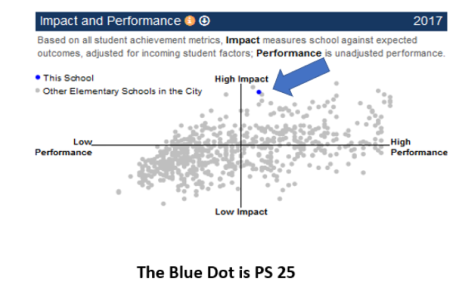
According to this metric, the positive impact of PS 25 also exceeds that of any charter school in the city, except for Success Academy Bronx 2, given the fact that most of its students are economically disadvantaged, have disabilities and/or are homeless.
The test scores from PS 25 on the state exams show a sharp upward trajectory, with its students now exceeding the city average in both ELA and math.
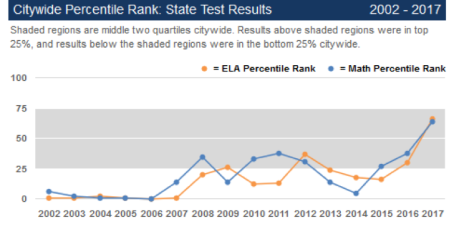
In fact, controlling for background and need, the students at PS 25 now outperform similar students by 21 percentage points in both subjects.
Now for those who say test scores aren’t everything, the school also excels according to all other methods the DOE uses to evaluate schools. It exceeds or meets standards in “Effective School Leadership”, “Trust”, “Collaborative Teachers”, “Rigorous Instruction”, “Strong Family-Community Ties” and “Supportive Environment,” according to the school’s Quality Review as well as parent and teacher surveys.
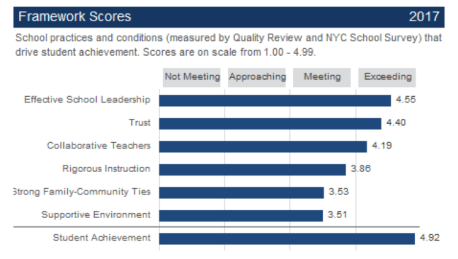
The fact that the DOE is closing a school which is delivering such great results for its students should not have been ignored.
Also unreported by any media outlet were two other salient facts: if PS 25 is closed, the entire city-owned building will be left to a charter school – Success Academy Bed Stuy 3, the first time this has happened in NYC, to my knowledge.
Also ignored was that the Community Education Council District 16 never voted to close this zoned school. State law requires that before this can occur, the CEC must authorize this, as any changes in zoning lines can only happen with their approval. The is one of the main responsibilities of CECs and some would argue their sole veto power over the unilateral and often arbitrary decision-making of the Mayor and the Chancellor.
So why does the Chancellor say PS 25 should be closed? Chancellor Farina argues that the school is under-enrolled. Yet at least five other schools have smaller enrollments than PS 25 and are not being closed. Moreover, DOE has never publicized the fact that this school outperforms nearly every other school in the city. If they had celebrated this school’s accomplishments, surely more parents would apply. The sad reality is that many public schools in D16 have lost enrollment because of the supersaturation of charter schools in the district – a drain on space, funding and resources which will only worsen if this school is closed.
According to the DOE’s controversial school capacity formula, PS 25’s “underenrollment” also means there is sufficient space in the building for its small class sizes of 10 to 18 – which provide ideal learning environments and are likely a major reason for its students’ success. The DOE could also place another preK or a 3K class in the building if they wanted its enrollment to grow.
Currently, PS 25 parents are being shown a list of other schools to apply to, most outside the district and a few schools within — but none will have the same small classes and positive impact on learning, and none of them will their children have the right to attend.
Given how difficult many of these families’ lives are already, with nearly one quarter of the students homeless, this will be yet another terrible disruption, though in this case, wholly preventable. One can only hope the DOE changes course and withdraws the proposal to close PS 25 immediately.
Below is the press release about the lawsuit, which describes a 2009 legal precedent when then-Chancellor Joel Klein withdrew a proposal to close three zoned schools in Harlem and Brooklyn after being sued. He then signed an agreement that the DOE would never do this again without a vote of the CECs. The legal complaint to block PS 25’s closure with more data about the school and facts about the law is posted here.
For Immediate Release: Tuesday, March 27, 2018
Contact: Leonie Haimson, 917-435-9329; leoniehaimson@gmail.com
Lawsuit filed to stop the closure of PS 25, the 4th best public elementary school in NYC according to the DOE
Today a lawsuit was filed in the Brooklyn State Supreme Court against the proposed closure of P.S. 25 Eubie Blake in District 16, Brooklyn, a zoned neighborhood school, which Chancellor Carmen Farina and the Board of Education are attempting to close without the prior approval of the Community Education Council.
Last month, on February 28, the Panel on Educational Policy voted to close the school which will require students to seek enrollment in other schools, with no assurance of admission. Not only is it a violation of NY State Education law 2590-e to close the only zoned school in the neighborhood without the district CEC’s prior approval, but P.S. 25 is also the fourth best public elementary school in NYC in the estimation of the Department of Education, and the second best in the borough of Brooklyn, when the need level of its students is taken into account.
According to the DOE’s School Performance Dashboard, which according to Chancellor Fariña is ““the most advanced tool of its kind,” the positive impact of P.S. 25 is greater than all but three of the city’s 661 public elementary schools, and its closure would leave the entire city-owned building to Success Academy Bed Stuy 3, a charter school. [1]
Achievement levels of P.S. 25 students have steadily climbed over the last three years, and the school now exceeds the city average in state test scores, despite the fact that a large percentage of students are homeless, economically disadvantaged, and/or have disabilities. According to DOE’s figures, the school’s students outperform similar students by 21 percentage points in ELA and math. The achievement of the more than thirty percent of students with disabilities is also exceptionally high.
The school also meets or exceeds standards in all the following areas: Effective School Leadership, Trust, Collaborative Teachers, Rigorous Instruction, Strong Family-Community Ties, and Supportive Environment.
Plaintiff Crystal Williams, a parent of two children at P.S. 25, said: “The school has seen a big improvement in recent years. The teachers are excellent. They give students close support, and my kids are learning. The teachers take their time in part because they have small classes, and I don’t believe my children would be provided with the same quality of education at whatever other schools they are forced to attend.”
“PS 25 should be honored and replicated, not closed,” said Mark Cannizzaro, President of the Council for School Supervisors and Administrators, the principals’ union. “The school has been on a clear, upward trajectory: Dedicated school leaders and teachers have helped boost English and math test scores ever higher compared to the district and the city as a whole. All the while, PS 25 has made great strides in addressing students’ social and emotional needs, and has offered them a vibrant curriculum with art, music, library skills, coding and STEM classes. We continue to oppose this decision. The students, families and educators of PS 25 deserve better.”
Said Shakema Armstead, a plaintiff who has a third grader at PS 25, “My son, who has an I.E.P, loves the school. It gives him and other students with a sense of community and stability that allow them to thrive. There is no reason for them to be thrown into another school where they would have to re-adjust to an entirely new environment, especially as P.S. 25 is doing so well.”
There is a precedent for this lawsuit. In 2009, a lawsuit was filed against Chancellor Joel Klein on behalf of parents at three neighborhood zoned schools, in Harlem and Ocean Hill-Brownsville area, to prevent the closure of these schools without a vote of the relevant CECs. The lawsuit was joined by Randi Weingarten, then President of the UFT, and NYC Public Advocate Betsy Gotbaum. Within weeks, Chancellor Klein withdrew the closure proposals.[2] He subsequently signed the following settlement agreement:
The [plaintiffs and the DOE] agree with regard to the three schools identified in the Complaint and any other traditional public school that, for those grades that are within the province of school attendance zones, [the DOE] will not close, phase-out, remove, alter or engage in conduct designed to effect the closure of any such school in a way that deprives residents of the right to send a qualifying child to his or her zoned traditional school, without either (1) obtaining, pursuant to 2590-e(11) of the Education Law, the approval of the relevant Community Education Council as to such change or (2) timely replacing such school with another zoned school within the same attendance zone.
In this case, DOE has no plans to create another zoned school for these children, and yet no vote of Community Education Council 16 has occurred. The DOE claims that the school is being closed because it is under-enrolled, but this ignores several important factors: Parents have not been told of the exceedingly high quality of the school according to the DOE’s own metrics, and if they had been informed of this, more of them would likely enroll their children in the school. The DOE could also install another preK or a 3K program in the school. The availability of space has also allowed for very small classes, which in turn have provided PS 25 students with an exceptional opportunity to learn.
Said Leonie Haimson, Executive Director of Class Size Matters, “It would be tragic if the second best elementary school in Brooklyn were closed. PS 25 has very small classes of 10 to 18 students, which are ideal for such high-poverty students. Given how the DOE refuses to align the school capacity formula with smaller classes, that alone makes the school appear underutilized. It would be extremely disruptive if this closure occurs, especially for the large number of homeless children at PS 25, because the school is a sanctuary of stability in their lives. Instead of closing PS 25, the DOE should celebrate, emulate and expand it—and give more NYC children the same chance to succeed.”
A copy of the lawsuit is posted here: https://tinyurl.com/y6wjocsu
###
[1] https://tools.nycenet.edu/dashboard/#dbn=16K025&report_type=EMS&view=City
[2] https://www.nyclu.org/en/press-releases/response-nycluuft-lawsuit-doe-announces-it-will-keep-schools-open