Archives for category: Musk, Elon

It’s a time for courage. A time for outrage. Who dares to speak out against the “great and mighty” King Donald? (Where is Toto when we need someone to pull away the curtain?)

Not the Republicans in Congress. Not Republican governors. Not Amazon. Not Mark Zuckerberg. Not ABC. CBS? We will see.

But not everyone is afraid.

The Orlando Sentinel and the South Florida Sun Sentinel editorial boards wrote the following chilling editorial:

Trump’s terrifying reign, at home and abroad

Donald Trump has erased any doubt that he’s a dictator.

“He who saves his Country does not violate any Law,” he posted on X.

It’s perfectly clear that he intends to let no law, court or even the Constitution restrain him. And certainly not Congress, which he treats as a confederacy of dunces.

Trump’s quote, ostensibly first uttered by Napoleon, also brought to mind the remark attributed to an earlier tyrant, King Louis XIV: “L’État, c’est moi” — I am the state.

Louis was an absolute monarch. The United States was to have no kings, nor anyone acting like one. Our founding document, the Constitution, made that clear.

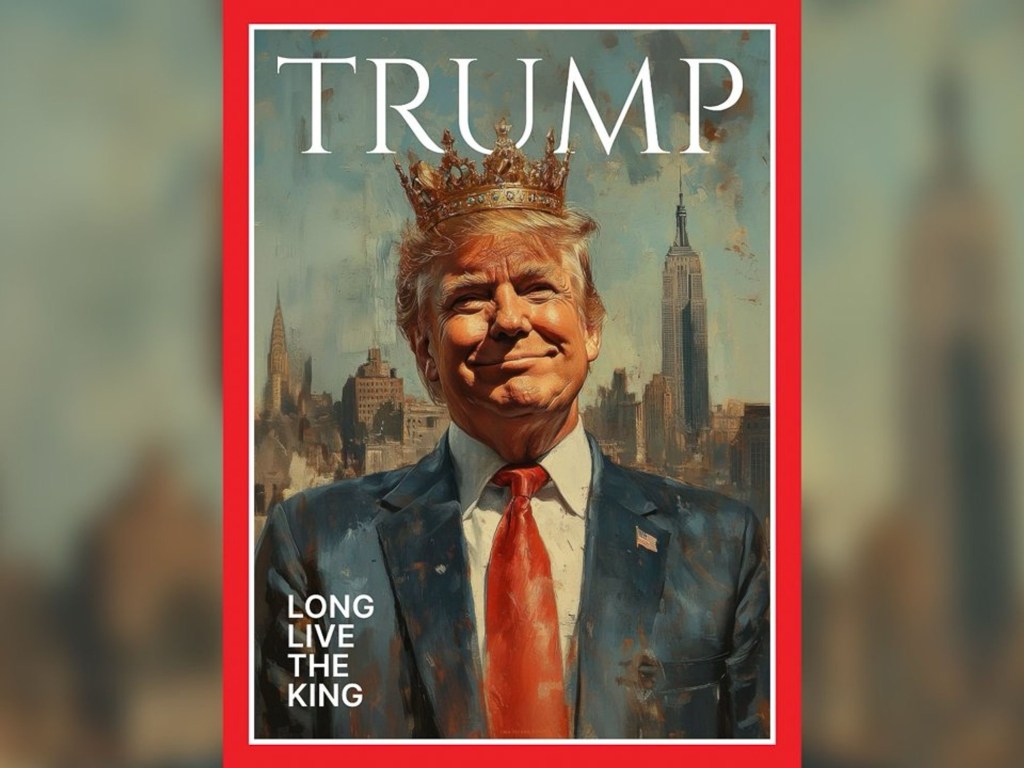
That didn’t stop Trump from declaring “Long live the King,” with a crown superimposed atop his head on a Time magazine knockoff, for supposedly stopping New York City’s congestion pricing plan.

Far from saving our country, Trump is on a path to destroying it.

He and his billionaire hatchet man, Elon Musk, devoid of any accountability, are sabotaging every function and agency of government to an extent unseen in our history. It’s senseless, savage, sadistic, self-serving and subversive.

Following the Kremlin

Listen carefully. You might hear Vladimir Putin applauding. Nothing Putin could do alone could so weaken us at home and abroad, or so undermine the NATO alliance that has kept first the Soviet Union, and now Russia, in check.

This week, Trump fed the suspicion that he’s the Kremlin’s puppet, echoing Putin’s lie that Ukraine started his war of aggression. Trump actually called Ukraine’s President Volodymyr Zelenskyy a “dictator.” A psychologist might call that projection.

Musk and Vice President JD Vance have also followed precisely the Kremlin’s line by lauding the rise of far-right parties in western Europe and demanding that the governments there make nice toward them.

The pillaging of our government persists — a coup against Congress, courts and the Constitution.

Consult Congress? Never

Congress did not consent to slashing the air traffic control system as if the loss of 67 lives near the White House on Jan. 29 did not prove the need for more personnel.

Congress would not consent to decimating and idling agencies responsible to restore communities ravaged by fire and flood, to cripple those needed to defend the nation against a bird flu pandemic, or to allow Musk to see your tax returns.

Congress would not consent to destroying the U.S. Agency for International Development and cutting off its lifesaving aid to children around the world.

Congress has not been asked about annexing Canada, threatening to break the Senate-ratified Panama Canal treaty, or claiming sovereignty over Gaza and ethnically cleansing it of some 2 million Palestinians, which would be a war crime.

Congress has not voted to bleach the government and the nation’s universities and public schools of anything suggesting multiracial and gender equity. Trump arbitrarily threatens to withhold funds from any that don’t bow to his white power agenda.

Congress has not voted to deny federal funds, as Trump is threatening, to cities and counties that don’t implement his racist deportations. Nor has it voted to destroy the civil service.

Congress has not voted to surrender to Trump the independence of the Federal Trade Commission or other agencies, nor to neuter their authority over Musk’s vast conflicts of interest.

Trump’s grasp to control everything extends even to the arts, to sacking the Kennedy Center leadership and making himself its president. It’s what dictators do.

Terrifying much of Europe

For all of its ingenious attributes, the Constitution is dangerously silent in one respect. It gives the president nearly a free hand in foreign affairs, subject only to Senate approval of treaties.

Every other president has made it his common-sense duty to consult Congress before leading the nation in dangerous directions. But Trump has already sold out Ukraine to Putin without consulting Ukraine, NATO or Congress.

Ever since World War II, which cost more than 400,000 American lives, it has been bipartisan U.S. policy to protect our nation by supporting democracy in Europe and opposing dictatorships there. No longer.

Congress has not been consulted on any of this because Trump considers it a nuisance.
Louis XIV corralled troublemakers at the Palace of Versailles.

Trump keeps Congress in a political straitjacket, striking fear into Republican members of the precarious majority by threatening to “primary” them from the right. So Congress capitulates. It’s brutally effective.

Saving his country? Under Trump 2.0, America has never been in greater danger.


The Orlando Sentinel Editorial Board includes Executive Editor Roger Simmons, Opinion Editor Krys Fluker and Viewpoints Editor Jay Reddick. The Sun Sentinel Editorial Board consists of Executive Editor Gretchen Day-Bryant, Editorial Page Editor Steve Bousquet, Deputy Editorial Page Editor Dan Sweeney and editorial writers Pat Beall and Martin Dyckman. Send letters to insight@orlandosentinel.com.
© 2025 Orlando Sentinel

The DOGE story gets weirder by the day.

Elon Musk has boasted of saving $65 billion thus far (nowhere near his $2 trillion goal), but various critics have complained that he has produced no evidence of such savings. Mostly, Musk has used a hacksaw to force people into retirement or fire them without cause. In only a month, he has demoralized the federal workforce and shattered federal workplaces without knowing the significance of those he pushed out.

Just yesterday, DOGE sent out emails to federal employees asking them what they accomplished in the past week, listing five specific tasks. Employees believed that failure to respond would lead to their termination, but unions are advising their members not to respond.

Trump is very pleased with Musk’s aggressive firings and urged him to do more of it.

Musk’s team of mostly inexperienced computer whizzes have taken charge of almost every agency, canceled contracts without knowing their importance, and fired veteran civil servants while being completely ignorant of their expertise.

Attention has focused on the youngest of the DOGE team, Edward Coristine, because of his age and curious background. Young Coristine calls himself “Big Balls” online. According to Brian Krebs, a technology blogger, Coristine was fired by a computer security firm for leaking secrets to a competitor and had some association with a gang of cybercriminals.

Now comes the shocker: according to Jacob Silverman, who writes about spies, Edward Coristine is the grandson of Valery Martynov, a Soviet spy turned double agent, who was lured back to Moscow and executed by the Soviets.

Coristine is now a “senior advisor” at the State Department and also a “senior advisor” at the Department of Homeland Security. He also participated in the snap review of FEMA, the Office of Personnel Management, and other departments.

Our government is in chaos, proving the adage: Where Trump goes, chaos follows.

The New York Times described the various ways that Elon Musk is helping himself and his business empire as he reorganizes the federal government. It was clear from the start that Musk has multiple conflicts of interest in his relationship to the government. He has taken control of several agencies that are investigating his business practices. He presently receives billions of dollars of federal subsidies for his SpaceX project and other businesses. It’s impossible to imagine any other President allowing a person with so many financial conflicts to make consequential decisions.

Eric Lipton and Kirsten Grind of The New York Times wrote:

President Trump has been in office less than a month, and Elon Musk’s vast business empire is already benefiting — or is now in a decidedly better position to benefit. 

Mr. Trump and Mr. Musk, the world’s richest man who has been given enormous power by the president, have been dismantling federal agencies across the government. Mr. Trump has fired top officials and pushed out career employees. Many of them were leading investigations, enforcement matters or lawsuits pending against Mr. Musk’s companies.

Mr. Musk has also reaped the benefit of resignations by Biden-era regulators that flipped control of major regulatory agencies, leaving more sympathetic Republican appointees overseeing those lawsuits.

At least 11 federal agencies that have been affected by those moves have more than 32 continuing investigations, pending complaints or enforcement actions into Mr. Musk’s six companies, according to a review by The New York Times.

Trump firings hit agencies with oversight of Musk’s companies

Staffing changes, including the firing of several top officials, have affected agencies with federal investigations into or regulatory battles with Elon Musk’s companies.

The events of the past few weeks have thrown into question the progress and outcomes of many of those pending investigations into his companies.

The inquiries include the Federal Aviation Administration’s fines of Mr. Musk’s rocket company, SpaceX, for safety violations and a Securities and Exchange Commission lawsuit pressing Mr. Musk to pay the federal government perhaps as much as $150 million, accusing him of having violated federal securities law.

On its own, the National Labor Relations Board, an independent watchdog agency for workers’ rights, has 24 investigations into Mr. Musk’s companies, according to the review by The Times.

Since January, Mr. Trump has fired three officials at that agency, including a board member, effectively stalling the board’s ability to rule on cases. Until Mr. Trump nominates new members, cases that need a ruling by the board cannot move forward, according to the agency.

Over at the Consumer Financial Protection Bureau, a public database shows hundreds of complaints about the electric car company Tesla, mostly concerning debt collection or loan problems. The agency has now effectively been put out of commission, at least temporarily, by the Trump administration, which has ordered its staff to put a hold on all investigations. The bureau also is an agency that would have regulated Mr. Musk’s new efforts to bring a payments service to X.

“CFPB RIP,” Mr. Musk wrote in a social media post last week as the Trump administration moved to close down the bureau…

Traditional federal conflict of interest rules seem almost antiquated, if Mr. Musk is determined to be involved in specific decisions about agencies his companies do business with.

That is why Mr. Musk’s role is so concerning to former White House ethics lawyers in Democratic and Republican administrations alike.

No kidding! Elon Musk has the power to close down agencies that are investigating his businesses. That’s not normal.

He also has the personal data of every person, from their tax filings and Social Security. That’s a treasure trove, worth a lot of money.

What could possibly go wrong?

.

James Fallows is a veteran journalist, one of the best. He predicts disaster ahead because of the ignorance of the DOGE team slashing the federal workforce.

Screenshot from CNN, credited to John Nelson, of Delta regional jet flight 4819 upside-down after landing at Pearson Airport in Toronto, after crash landing today.

He writes:

This post is about today’s crash-landing of a commuter jet, en route from Minneapolis to Toronto, which for still-unexplained reasons flipped over and landed on its back without killing any passengers.

Good news for all those aboard.

It coincides with cautionary news about anyone flying on US-based airlines. Let’s go through the de-brief:


The big questions.

Was today’s crash-landing in Toronto directly traceable to this past weekend’s Musk-Trump mass layoffs of FAA officials in the US? 

Almost certainly not.

Will future crashes be directly traceable to this move?

Almost certainly so

Any future-history of US airline disasters in 2026 or beyond will probably start its narrative in this past holiday weekend of 2025. That is when the Musk tech-bro team known as DOGE, instructed by Russel Vought and empowered by Trump, began its mass layoffs of air-safety officials whose employment status showed “probationary.” (Even if they had been on the job for decades, and were classified as “probationary” only because they had recently received a promotion.)

After any aviation disaster, the careful investigators of the NTSB try to reconstruct the “accident chain.” We’re beginning the accident chain for future disaster, right now. 

Let’s take this step-by-step.


What happened in Toronto.

As with almost any aviation accident, it will take time to be sure. What is known as the time I write is this:

  • The airplane was a Bombardier regional jet. By coincidence, this was the the same make, though a slightly different model, as the regional jet involved in the large-casualty collision near National Airport in DC this month. 
  • Many of the passengers have been taken to the hospital. But as of the time I write, all appear to have survived.
  • The weather was challenging, and the winds were very strong and gusty, when the plane touched down at Toronto/Pearson and then apparently flipped over onto its back. Did the gusty crosswinds cause the plane to lose its balance and flip? At this moment no one can be sure. The weather and winds appear to have been bad but not unmanageable.¹ We’ll see what further data might reveal.
  • Was this in any way related to the large-scale layoffs of air traffic control professionals by the new Musk-Trump-Doge regime? There’s no reason yet to think so. The recording of Air Traffic Control guidance from the Toronto tower, which you can listen to here², seems entirely routine until the moment the regional jet has a bad touch down.³

But will it be related to crashes in the future? That seems to me inevitable. 

—You lay off much of the fire-fighting force, you’re inviting a destructive fire. 

—You lay off teachers, you’re inviting ignorance. 

—And if you lay off the people who have made air-travel safe, you are inviting unsafe air travel. 

Which is Trump, Musk, and their ninjas seem to be doing now. 

But don’t ask me. Ask someone who has devoted his life to air-traffic safety. 


What will happen in our skies.

Someone I have been in touch with for many years, and whose airspace I once flew through during his time as a controller and mine as a pilot in that part of the country, sends a message today that I thought worth quoting in full. This correspondent writes:

They fired a bunch of probationery employees last night. Basically everyone other than controllers or safety inspectors, apparently.

It’s one of those things that has a slow but corrosive effect on safety. For example: Our team is bracing for cuts. One of the biggest things we do is environmental review and community engagement for proposed actions in airspace or procedures.

So if someone needs a new or amended approach [JF note: like those over the Potomac, in light of recent problems], the flight procedure team—currently staffed at 13, should be 17—designs it and gives it to us.

Our environmental specialists do the NEPA [environmental policy] review; myself and other ATC subject matter experts assist them by checking the procedures, explaining what’s going on, and checking it for any variety of things in how it fits in with everything else in the area. We also do community engagement stuff if it is called for. 

[On our team] all the ‘probationary’ people got fired.

Will it lead to disaster? Not immediately. But fewer people trying to do the same amount of work will lead to stuff getting missed….

We prioritize and do the most safety-critical stuff first. But a lot will fall aside.


‘Boys throw stones at frogs in fun…’

Let’s return to the theme of a preceding dispatch: Elon Musk and his acolytes are having fun, and perhaps preparing for a privatization of the FAA, but in the process they are putting all of the rest of us in danger.

—I submit that I know more about air safety, and about FAA procedures, than Elon Musk does, or any of the members of his zealot/ignoramus team.

—And I know at least a thousand people who are vastly more experienced and knowledgeable than I am.

The Musk/Trump people are empowering the know-nothings. Who tear things down because they have no idea of who built them up.

Conceivably this will be the barrier—the risk that constituents might die in airplane crahses—that stops them? When GOP politicians flying out of DCA think that Musk-ite shortcuts might kill them? When even Musk’s private jets have to deal with over-stressed air traffic controllers?

We don’t know. But the powers that be are pushing the limits.

—As a pilot, I trust air traffic controllers. As a passenger, I trust the multi-layer safety network that decades’ worth of relentless self-examination has built up.

—As a citizen, I do not trust the standards that the clown-corrupt Trump/Musk regime has introduced. 

‘Defund the police’ became a right-wing campaign slogan. ‘Defund Air Traffic Control’ will get us killed.

Julie Creswell of The New York Times reported that The Washington Post killed an ad calling on Trump to fire his best buddy Elon Musk. The story was first reported in The Hill. Who could have given such an order?

Creswell writes:

An advertisement that was set to run in some editions of The Washington Post on Tuesday calling for Elon Musk to be fired from his role in government was abruptly canceled, according to one of the advocacy groups that had ordered the ad.

Common Cause said it was told by the newspaper on Friday that the ad was being pulled. The full-page ad, known as a wraparound, would have covered the front and back pages of editions delivered to the White House, the Pentagon and Congress, and was planned in collaboration with the Southern Poverty Law Center Action Fund.

A separate, full-page ad with the same themes would have been allowed to run inside the newspaper, but the two groups chose to cancel the internal ad as well. Both ads would have cost the groups $115,000.

“We asked why they wouldn’t run the wrap when we clearly met the guidelines if they were allowing the internal ad,” said Virginia Kase Solomón, the president and chief executive of Common Cause. “They said they were not at liberty to give us a reason.”

News of The Washington Post canceling the ad was earlier reported by The Hill.

Although it is unclear who made the decision to pull the ad or why, the move comes amid growing concern about the changing mission of the Washington Post newsroom under the ownership of Jeff Bezos, the founder of Amazon. The newspaper’s decision last fall to end its longstanding tradition of presidential endorsements and Mr. Bezos’ front-row seat at Mr. Trump’s inauguration have led some to wonder whether the news organization has been accommodating a Trump administration.

Last month, more than 400 employees sent a letter to Mr. Bezos requesting a meeting to discuss leadership decisions that they said “led readers to question the integrity of this institution.”

Mrs. Kase Solomón said that all the content for the ad — art and text — had been sent to The Post’s advertisement department last Tuesday and that “no alarm bells were rung” by anyone from the newspaper at that time. She said she did not know who inside the organization made the decision to pull the wrap.

The ad featured an image of Mr. Musk laughing over a picture of the White House with text that reads: “Who’s Running This Country: Donald Trump or Elon Musk?” The ad called for readers to contact their senators and tell them it’s time for Mr. Trump to fire Mr. Musk…

Mr. Musk, the world’s richest man who controls six companies, including Tesla, SpaceX and the social media platform X, has been given far-reaching power by the president, who has allowed Mr. Musk to dismantle federal agencies and freeze funding for various grants and programs.

Margaret Huang, president and chief executive of the Southern Poverty Law Center, said the disappearance of critical programs and grants would have a direct and negative effect mostly on lower-income individuals and people of color.

Do you have 10-15 minutes to read a very important article? It contains a lot of alarming details about the 19-year-old computer whiz on Elon Musk’s DOGE team.

Brian Krebs, a former Washington Post reporter, writes a blog about Internet security called Krebs on Security. In this awesome post, he describes the links of Edward Coristine to known cyber criminals.

Krebs is an expert on cybercrime.

He writes:

Wired reported this week that a 19-year-old working for Elon Musk‘s so-called Department of Government Efficiency(DOGE) was given access to sensitive US government systems even though his past association with cybercrime communities should have precluded him from gaining the necessary security clearances to do so. As today’s story explores, the DOGE teen is a former denizen of ‘The Com,’ an archipelago of Discord and Telegram chat channels that function as a kind of distributed cybercriminal social network for facilitating instant collaboration.

Since President Trump’s second inauguration, Musk’s DOGE team has gained access to a truly staggering amount of personal and sensitive data on American citizens, moving quickly to seize control over databases at the U.S. Treasury, the Office of Personnel Management, the Department of Education, and the Department of Health and Human Resources, among others.

Wired first reported on Feb. 2 that one of the technologists on Musk’s crew is a 19-year-old high school graduate named Edward Coristine, who reportedly goes by the nickname “Big Balls” online. One of the companies Coristine founded, Tesla.Sexy LLC, was set up in 2021, when he would have been around 16 years old.

“Tesla.Sexy LLC controls dozens of web domains, including at least two Russian-registered domains,” Wired reported. “One of those domains, which is still active, offers a service called Helfie, which is an AI bot for Discord servers targeting the Russian market. While the operation of a Russian website would not violate US sanctions preventing Americans doing business with Russian companies, it could potentially be a factor in a security clearance review.”

Mr. Coristine has not responded to requests for comment. In a follow-up story this week, Wired found that someone using a Telegram handle tied to Coristine solicited a DDoS-for-hire service in 2022, and that he worked for a short time at a company that specializes in protecting customers from DDoS attacks.

DDoS is “denial of service, meaning that one’s access to the internet has been cut off. So, I learned that there are companies that can be paid to implement a DDoS and companies that can be paid to protect against DDoS. Presumably, a clever cyber criminal could be on both sides, sort of like the early 20th century mobsters who demanded protection money from small-time merchants so that no one would break their windows.

Krebs’ writing about cybercriminals got personal when they retaliated:

The founder of Path is a young man named Marshal Webb. I wrote about Webb back in 2016, in a story about a DDoS defense company he co-founded called BackConnect Security LLC. On September 20, 2016, KrebsOnSecurity published data showing that the company had a history of hijacking Internet address space that belonged to others.

Less than 24 hours after that story ran, KrebsOnSecurity.com was hit with the biggest DDoS attack the Internet had ever seen at the time. That sustained attack kept this site offline for nearly 4 days.

The other founder of BackConnect Security LLC was Tucker Preston, a Georgia man who pleaded guilty in 2020 to paying a DDoS-for-hire service to launch attacks against others.

The aforementioned Path employee Eric Taylor pleaded guilty in 2017 to charges including an attack on our home in 2013. Taylor was among several men involved in making a false report to my local police department about a supposed hostage situation at our residence in Virginia. In response, a heavily-armed police force surrounded my home and put me in handcuffs at gunpoint before the police realized it was all a dangerous hoax known as “swatting.”

Woven throughout this story is the career trajectory of Edward Coristine, a core member of DOGE’s elite team. He possibly has a thumb drive with all of your and my personal data on it.

Krebs wonders whether and how Coristine got a top security clearance, given his history.

Given the speed with which Musk’s DOGE team was allowed access to such critical government databases, it strains credulity that Coristine could have been properly cleared beforehand. After all, he’d recently been dismissed from a job for allegedly leaking internal company information to outsiders.

According to the national security adjudication guidelines (PDF) released by the Director of National Intelligence (DNI), eligibility determinations take into account a person’s stability, trustworthiness, reliability, discretion, character, honesty, judgment, and ability to protect classified information.

The DNI policy further states that “eligibility for covered individuals shall be granted only when facts and circumstances indicate that eligibility is clearly consistent with the national security interests of the United States, and any doubt shall be resolved in favor of national security.”

Now that Tulsi Gabbard is DNI, maybe she’ll give young Edward the clearance he needs.

Please read it and let me know if you were as horrified as I.

The youngest member of Elon Musk’s team of “expert” evaluators is Edward Coristine whose online moniker is “Big Balls.”

Young Mr, Coristine is a 19-year-old high school graduate. He has key roles at the State Department, DHS, FEMA, and USAID, despite being unvetted.

The Washington Post wrote about the young man’s large portfolio:

He is a “senior adviser at the State Department and at the Department of Homeland Security, raising concerns among some diplomats and others about his potential access to sensitive information and the growing reach of his tech billionaire boss into America’s diplomatic apparatus, said U.S. officials familiar with the matter who spoke on the condition of anonymity to discuss a sensitive issue.

Edward Coristine, who briefly worked for Musk’s brain chip start-up Neuralink, was recently posted to the State Department’s Bureau of Diplomatic Technology, a critical hub for data both sensitive and nonsensitive, officials said. Coristine, who also holds positions at the U.S. DOGE Service and the Office of Personnel Management, has attracted significant attention across Washington for his edgy online persona and the relative lack of experience he brings to his new federal roles.

But his new position — and similar roles at DHS and other agencies — could give him visibility into far more than just tech.

Some U.S. officials expressed alarm about Coristine’s new perch at the bureau, which serves as the IT department for Washington’s diplomatic apparatus. All of the department’s IT and data management functions were centralized at the bureau during an overhaul before President Donald Trump returned to office, making it a treasure trove of information.

“This is dangerous,” said one of the U.S. officials, noting Coristine’s age and a report by Bloomberg News that he was fired for leaking a data security firm’s information to a competitor.

A State Department official said Coristine’s position probably would not be confined to the Bureau of Diplomatic Technology.

Eddie is 19. He worked briefly for Musk’s Neuralink. He is a “senior advisor” to multiple departments. He has access to highly confidential at the State Department and the Office of Personnel Management. He was fired for leaking data from a data security firm to a competitor. He apparently was never vetted.

What could possibly go wrong?

What exactly is Elon Musk’s DOGE team doing? Who are they? This article in The New York Times seeks to answer those questions.

The article was written by Theodore Schleifer, Nicholas Nehamas, Kate Conger, and .

At the end of his third week bulldozing through the federal government, Elon Musk sat down to give Vice President JD Vance a 90-minute briefing on his efforts to dismantle the bureaucracy. Mr. Musk was not alone.

Invited to join him on Thursday morning in Mr. Vance’s stately ceremonial office suite in the Eisenhower Executive Office Building, next to the White House, were a clutch of young aides whose presence at federal agencies has served as a harbinger of the upheaval that would follow them.

Across the federal government, civil servants have witnessed the sudden intrusion in the last two weeks of these young members of the billionaire’s team, labeled the Department of Government Efficiency. As Mr. Musk traipses through Washington, bent on disruption, these aides have emerged as his enforcers, sweeping into agency headquarters with black backpacks and ambitious marching orders.

While Mr. Musk is flanked by some seasoned operatives, his dizzying blitz on the federal bureaucracy is, in practice, largely being carried out by a group of male engineers, including some recent college graduates and at least one as young as 19.

Unlike their 20-something peers in Washington, who are accustomed to doing the unglamorous work ordered up by senior officials, these aides have been empowered to break the system.

Of the roughly 40 people on the team, just under half of them have some previous ties to the billionaire — but many have little government experience, The New York Times found. This account of their background and activities is based on public records, internal government databases and more than 20 people familiar with their roles, who spoke on the condition of anonymity out of fear of retaliation.

Some on the Musk team are former interns at his companies. Others are executives who have served in his employ for as long as two decades. They all appear to have channeled his shoot-first, aim-later approach to reform as they have overwhelmed the bureaucracy.

A 23-year-old who once used artificial intelligence to decode the word “purple” on an Ancient Greek scroll has swiftly gained entree to at least five federal agencies, including the Centers for Medicare and Medicaid Services, where he has been seeking access to sensitive databases. He was part of a group that helped effectively shutter the United States Agency for International Development, joined by the 19-year-old, a onetime Northeastern student who was fired from a data security firm after an investigation into the leaking of internal information, as Bloomberg first reported.

In the past week, his aides have descended upon the Education, Energy, Housing and Urban Development, Health and Human Services, Transportation and Veterans Affairs Departments, along with the National Oceanic and Atmospheric Administration, the Federal Emergency Management Agency and the Consumer Financial Protection Bureau, according to people familiar with their activities.

Mr. Musk has praised his team as talented and relentless, defending its work as crucial to rooting out what he perceives as wasteful spending and left-wing ideology in the federal government.

“Time to confess,” he wrote on X this week. “Media reports saying that @DOGE has some of world’s best software engineers are in fact true.”

Mr. Musk did not respond to a request for comment.

On Friday, Mr. Trump told reporters that he was “very proud of the job that this group of young people, generally young people, but very smart people, they’re doing.

“They’re doing it at my insistence,” he added. “It would be a lot easier not to do it, but we have to take some of these things apart to find the corruption.”

Even as Mr. Musk’s team members upend the government, their identities have been closely held, emerging only piecemeal when the new arrivals press career officials for information and access to agency systems.

The opacity with which they are operating is highly unusual for those working in government. Aside from those conducting classified or intelligence work, the names of public employees are not generally kept secret.

Harrison Fields, a White House spokesman, said the cost-cutting team has gone through the same vetting as other federal employees, but declined to say what the vetting consisted of or whether Mr. Musk’s aides have security clearances.

The Times identified members of Mr. Musk’s initiative through internal emails identifying their roles and interviews with employees across the government who have interacted with them. None of the Musk aides responded to requests for comment.

The secrecy, Musk allies have said, is necessary so the team members do not become targets.

Several of Mr. Musk’s aides have resisted being listed in government databases out of fear of their names leaking out, according to people familiar with the situation. Others have worked to remove information about themselves from the internet, scrubbing résumés and social media accounts.

When their names have been made public by news organizations such as Wired, they have been scrutinized by online sleuths. Mr. Musk has asserted, falsely, that the exposure of their roles is a “crime,” and X has removed some posts and issued suspensions to those who publicize their identities.

One Musk aide whose name surfaced, Marko Elez, a 25-year-old former employee of X, resigned on Thursday, according to a White House official, after The Wall Street Journal revealed that he had made racist posts on X, writing in one message that “you could not pay me to marry outside of my ethnicity.” Mr. Elez, a former employee at both X and xAI, Mr. Musk’s artificial intelligence company, was one of two staff members affiliated with Mr. Musk’s team who had gained access to the Treasury Department’s closely held payment system.

Mr. Elez was among those who had been invited to attend Mr. Musk’s meeting with the vice president before he resigned, according to documents seen by The Times. On Friday, Mr. Musk called for The Journal reporter to be fired and said he was reinstating Mr. Elez, a move that both the president and the vice president said they supported. “We shouldn’t reward journalists who try to destroy people,” Mr. Vance posted on X.

A spokesman for Mr. Vance declined to comment.

Some of Mr. Musk’s top advisers are more seasoned. Senior players include Brad Smith, a health care entrepreneur and an official during President Trump’s first term; Amy Gleason, a former U.S. Digital Service official who has been helping at the Centers for Medicare and Medicaid Services; and Chris Young, a top Republican field operative whom Mr. Musk hired as a political adviserlast year. Others bring extensive private sector backgrounds, including from firms like McKinsey and Morgan Stanley.

But Washington is a town where much is run by twentysomethings. And much of Mr. Musk’s handiwork — gutting federal websites, demanding access to internal systems, sending late-night all-staff emails and asking veteran employees to justify their jobs — is being executed by young aides, some of them pulling all-nighters as they burrow into agencies.

Last week, young representatives of Mr. Musk’s team with backpacks stuffed with a half-dozen laptops and phones arrived at the headquarters of U.S.A.I.D., demanding access to financial and personnel records. On Friday, a dozen stayed into the night, powered by a bulk order of coffee. The next day, the agency’s website went dark.

At the Education Department alone, as many as 16 team members are listed in an employee directory, including Jehn Balajadia, who has effectively served as Mr. Musk’s assistant for years.

At the Office of Personnel Management, the nerve center of the federal government’s human resources operation, a small group of coders on Mr. Musk’s team sometimes sleep in the building overnight. They survive on deliveries of pizza, Mountain Dew, Red Bull and Doritos, working what Mr. Musk has described as 120-hour weeks.

At the General Services Administration, another central hub for Mr. Musk’s aides, beds have been installed on the sixth floor, with a security guard keeping people from entering the area.

While most senior employees wear suits, the aides favor jeans, sneakers and T-shirts, sometimes under a blazer, with one sporting a navy-blue baseball cap with white lettering reading “DOGE.”

The culture clash is evident. Perhaps unsurprisingly, career employees who have worked for decades in the government have bristled at taking orders from the young newcomers. One coder has openly referred to federal workers as “dinosaurs.” Some staff members at the personnel office, in turn, derisively call the young men “Muskrats.”

As they assess the workings of the government, Mr. Musk’s aides have been conducting 15-minute video interviews with federal workers. Some of their questions have been pointed, such as querying employees about whom they would choose to fire from their teams if they had to pick one person. At times, the aides have not turned on their cameras or given their last names, feeding suspicion.

In one video interview heard by The Times, a young team representative who introduced himself by his first name said he was an “adviser” to government leadership and a startup founder. He pressed the interviewee to describe their contributions with “highest impact” and to list any technical “superpowers.”

It is not always clear which employees are formally part of the team. Even the putative head of the department, Steve Davis, a decades-long lieutenant of Mr. Musk who has accompanied the billionaire on his meetings in Washington, has not been formally announced.

Many of Mr. Musk’s aides, including Mr. Davis, hold multiple roles simultaneously, working for one of the team’s central hubs — the personnel office or the General Services Administration — while also maintaining email addresses and offices at other agencies.

Luke Farritor, who won the award for using artificial intelligence to decipher an ancient scroll, joined Mr. Musk’s initiative after dropping out of the University of Nebraska-Lincoln to pursue a fellowship funded by the billionaire PayPal founder Peter Thiel. A former SpaceX intern, Mr. Farritor, in preparation to join the team, started learning COBOL, a coding language considered retrograde in Silicon Valley but common in government.

He and Rachel Riley, a former McKinsey consultant who works closely with Mr. Smith, are now both listed as employees in the Office of the Secretary at the Department of Health and Human Services. This week, they requested access to payment systems at the Medicare agency, according to a document seen by The Times.

Mr. Farritor, who also has email accounts at the General Services Administration, the Education Department and the Centers for Disease Control and Prevention, was at the Energy Department on Wednesday, and has told others that he is getting deployed to additional agencies. He is one of about a half-dozen aides who are holed up in a corner around the G.S.A. administrator’s offices, interviewing tech staff members about their work.

Other figures often on hand include Ethan Shaotran and Edward Coristine, who have been accompanying a top Musk ally, Thomas Shedd, who oversees the agency’s tech division. Mr. Shaotran, a 22-year-old Harvard student, was part of a team that was the runner-up in a hackathon competition run by xAI last year.

Mr. Coristine, 19, graduated from high school in Rye, N.Y., last year, according to a school magazine that noted his outstanding performance on the Advanced Placement exams. Nowadays, he has an email address at the Education Department.

Before joining the government, Mr. Coristine was fired in June 2022 from an internship at Path, an Arizona-based data security company, after “an internal investigation into the leaking of proprietary company information that coincided with his tenure,” the company said in a statement Friday.

One Musk acolyte has leaned into his new status as a Washington celebrity.

Gavin Kliger, a newly minted senior adviser at the personnel office, wrote a Substack post this week titled “Why DOGE: Why I gave up a seven-figure salary to save America” — and asked users to pay a $1,000-per-month subscription fee to read it.

The post behind the paywall appeared to have been left intentionally blank, according to users who saw it.

Mr. Kliger, 25, a software engineer, amplified a message posted on X in December by Nick Fuentes, one of the country’s most prominent young white supremacists, which mocked those who celebrate their interracial families. The post was removed from Mr. Kliger’s page after The Times inquired about it. He did not respond to requests for comment.

Mr. Kliger and Mr. Farritor were among those who obtained access to U.S.A.I.D. websites and tried to get into a secure area at the agency before being turned away by security last week, according to people familiar with the matter. After midnight on Monday, Mr. Kliger sent an email from a U.S.A.I.D. email account informing thousands of staff members that the agency’s headquarters would be closed.

On X, Mr. Kliger has defended cuts to the agency. He also responded to one person who criticized him as “one of the men carrying out Musk’s coup.”

“A ‘coup’ is when a duly elected president wins a democratic election and delivers on campaign promises,” Mr. Kliger wrote on X on Monday. “Got it.”

Reporting was contributed by Maggie Haberman, Mattathias Schwartz, Edward Wong, Erica L. Green, Madeleine Ngo, Zach Montague, Christopher Flavelle, Andrew Duehren, Brad Plumer, Kellen Browning and Aric Toler. Kitty Bennett contributed research.
DOGE swept into the Institute of Education Sciences at the U.S. Department of Education and, following its advice, the Trump administration canceled $900 million in contracts. Bear in mind, this is the team of 20-somethings who knows a lot about software and coding. It’s unlikely that they know anything about education research.

This is the agency that I ran 30 years ago when I was Assistant Secretary of Education in the first Bush administration. At that time it was called the Office of Education Research and Improvement. I could have suggested some cuts, but certainly not $900 million!

What really bothers me is that this group of kiddies could not possibly know enough to judge the quality of the work they were canceling. Not in a day. Impossible. This was just a slash and burn operation.

ProPublica reported:

The Trump administration has terminated more than $900 million in Education Department contracts, taking away a key source of data on the quality and performance of the nation’s schools.

The cuts were made at the behest of Elon Musk’s cost-cutting crew, the Department of Government Efficiency, and were disclosed on X, the social media platform Musk owns, shortly after ProPublica posed questions to U.S. Department of Education staff about the decision to decimate the agency’s research and statistics arm, the Institute of Education Sciences.

A spokesperson for the department, Madi Biedermann, said that the standardized test known as the nation’s report card, the National Assessment of Educational Progress, would not be affected. Neither would the College Scorecard, which allows people to search for and compare information about colleges, she said.

IES is one of the country’s largest funders of education research, and the slashing of contracts could mean a significant loss of public knowledge about schools. The institute maintains a massive database of education statistics and contracts with scientists and education companies to compile and make data public about schools each year, such as information about school crime and safety and high school science course completion.

Its total annual budget is about $815 million, or roughly 1% of the Education Department’s overall budget of $82 billion this fiscal year. The $900 million in contracts the department is canceling includes multiyear agreements.

This post appeared originally on October 10, 2023. It explains why Elon Musk’s grandfather Joshua Haldeman left a prosperous life in Canada and moved his family to apartheid South Africa in 1950. He was a successful chiropractor and aviator. He was also involved in politics, but was not successful at winning elections.

Wikipedia describes Haldeman’s racism and anti-Semitism:

Haldeman was a supporter of South Africa’s apartheid policies and the ruling National Party of South Africa, telling a reporter for the extremist Die Transvaler newspaper, a tool of the Nazis in South Africa during World War II: “Instead of the Government’s attitude keeping me out of South Africa, it had precisely the opposite effect—it encouraged me to come and settle here”.[2] In 1951, he wrote an article about South Africa for the Saskatchewan newspaper, the Regina Leader-Post, defending apartheid and writing of Black South Africans: “The natives are very primitive and must not be taken seriously… Some are quite clever in a routine job, but the best of them cannot assume responsibility and will abuse authority. The present government of South Africa knows how to handle the native question.”[2][20]

Weeks after the Sharpeville massacre on 21 March 1960, Haldeman self-published The International Conspiracy to Establish a World Dictatorship and the Menace to South Africa, a 42-page response to the massacre. The United Nations passed Resolution 134, the body’s first official condemnation of apartheid and the beginning of decades of diplomatic isolation. Later Haldeman self-published a second book alleging again international conspiracies: The International Conspiracy in Health, which cast suspicion on fluoridation, vaccinations, and health insurance.[2][21]

Grandfather Haldeman was an energetic private pilot, who traveled the globe. He died in a plane accident in 1974, when Elon was only three years old. Maybe he had no influence on his grandchild.

Too bad Elon Musk didn’t stay there. He could have used his entrepreneurial brain to vitalize the economy of the African continent.