Archives for category: Media

Dr. Azar Nafisi, author of the mega-bestseller Reading Lolita in Tehran, will speak at Wellesley College on April 15 at Wellesley College at 4 p.m. in the Jewett Arts Center. Admission is free.

Please mark the date on your calendar. She is speaking in a lecture series that I endowed several years ago. The lecture will be available eventually on the archive website of the College.

The book, which was a sensation upon its publication for its depiction of life under the mullahs, has recently been made into a film.

This review of the film was published by The Atlantic and written by Arash Azizi. At present, the film can be seen only at film festivals.

He wrote:

The past few years may well be remembered as the nadir of Iranian-Israeli relations, and the first occasion when the two countries attacked each other directly. But they were also a golden period for Iranian-Israeli collaboration in cinema. In 2023, Tatami was the first-ever film to be co-directed by an Israeli (Guy Nattiv) and an Iranian (Zar Amir). And in 2024 came Reading Lolita in Tehran, directed by Eran Riklis, who is Israeli, and adapted from a book by an Iranian author, with an almost entirely Iranian cast. The film premiered at the Rome Film Fest last year and is now starting to tour the United States.

Anyone old enough to remember cultural life at the beginning of this century will know the book. Azar Nafisi’s memoir came out in 2003, spent 36 weeks on the New York Times best-seller list, and quickly developed a cult following. A reviewer for The Nation confessed to missing a dental appointment, a business lunch, and a deadline just because she couldn’t put the book aside.

Literary scholars—Nafisi is an English professor—are not known for their page-turning thrillers. But Nafisi’s story and prose are captivating. She’d gone to Iran shortly after the 1979 revolution in the hope of putting her American education to use by teaching English at a university. Instead, she was hounded out of the classroom by authorities hostile to Western literature. She wound up holding clandestine seminars for young women in her living room, delving into the masterpieces that the Islamic Republic forbade: the Vladimir Nabokov novel that gives the memoir its name, alongside the works of Henry James and Jane Austen, as well as one of Nafisi’s favorites, F. Scott Fitzgerald’s The Great Gatsby. Nafisi brings these classics into dialogue with the real-life stories of young Iranians in the heady decades following the 1979 revolution. Her book isn’t just about reading and teaching literature under a repressive regime, but about how literature in and of itself could serve as an antidote to all that the regime stood for.

Despite its global fame and translation into 32 languages, Reading Lolita in Tehran was never turned into a film before now, mostly because Nafisi didn’t like the proposals she’d received. Then, seven years ago, Riklis came around, as he recounted to a New York audience on January 13, after a special screening of the film. The Israeli director managed to convince Nafisi of his vision—and then to secure the funding, assemble a suitable Iranian cast, and settle on Rome as the shooting location, given that Tehran was not an option.

When the book was initially released in 2003, the American zeitgeist, shaped by 9/11 and the Bush administration’s global War on Terror, was rife with debates about the representations of Muslim women and life in the Middle East. Nafisi’s was one of several popular memoirs by Iranian women published during this period, including Firoozeh Dumas’s Funny in Farsi (2003) and Marjane Satrapi’s Persepolis series (2000–03). And perhaps inevitably, given its success, Nafisi’s book became the subject of political scrutiny, much of it bearing little relation to the book’s content. Although Nafisi opposed the Iraq War, some critics lumped her in with neoconservatives because she portrayed the travails of Iranians under an anti-American regime. One scholar even proclaimed that he saw no difference between her and American soldiers convicted of abusing prisoners in Iraq.

More than 20 years later, Riklis’s loyal adaptation has opponents just as the book did, and even more so because of the nationality of its director. In Tehran, the regime media have denounced the film as furnishing a “pretext for attacking Iran” and called its Iranian actors “traitors working with Zionists.” One outlet claimed that the film peddled a “violent, anti-culture, anti-art, and anti-human view of Iran and Iranians.”

The idea that Reading Lolita in Tehran is anti-Iranian because of its portrayal of the Islamic Republic, and of the life of women under its rule, was always patently ridiculous. The claim bears up particularly poorly in 2024, two years after women-centered protests rocked Iran under the slogan “Women, Life, Freedom.” What Nafisi does best, and the reason her work has endured, is precisely to refuse cartoonish portrayals and basic morality plays.

In Riklis, known for his empathetic depiction of Israelis and Palestinians in films such as Lemon Tree and Dancing Arabs, her book finds an able interpreter who has stayed true to its ethos. The film isn’t neutral. It vividly tells the story of how puritanical Islamist goons attacked universities in the early years after 1979, imposed mandatory veiling on women, and banned books they didn’t like. But neither is it a simple story of scary Islamists versus heroic women resisters.

The film captures the atmosphere of Iran in the 1980s and ’90s remarkably well for having been shot in Italy and directed by an Israeli who has never set foot in the country. The dialogue is mostly in Persian, a language Riklis doesn’t speak; he was able to pull this off with the help of a carefully chosen cast of diasporic Iranians. Golshifteh Farahani, perhaps the best-known Iranian actor outside the country, is at her height as Nafisi, whom she plays as confident but humane, by turns brazen and vulnerable.

The young women of the clandestine class include Sanaz (Zar Amir), who has survived imprisonment and torture; Mahshid (Bahar Beihaghi, in one of the film’s most delightful performances), who, unlike most of her classmates, wore the Islamic veil even before the revolution and defends an ideal of modesty as virtue; and Azin (Lara Wolf), whose multiple divorces make her an object of fascination to the less experienced students, but who turns out to be suffering from domestic abuse.

In Nafisi’s apartment, the students are far from the prying eyes of the regime and also of men (even the professor’s husband is barred from their meetings). They construct for themselves, in that all-female room, a little literary republic that survives the years of war and revolution. In one memorable scene, Nafisi has the students practice a Jane Austen–era dance as part of their study of Pride and Prejudice, drawing parallels between the stifling rules of courtship in Victorian England and those of some contemporary families in Iran.

The film also ventures beyond that cloistered space. Bahri (Reza Diako), a devout 1979 revolutionary, is nevertheless an avid student in Nafisi’s class at the university before it is shut down. Despite their diametrically opposed politics, Nafisi and Bahri form a bond. Early in the story, she tells him his essay on Huckleberry Finn is the best she’s ever received from a student, even in America. The two reconnect when Bahri returns from the Iran-Iraq War of 1980–88, having lost an arm. He has used his family connections to the regime to obtain a surprise gift for his old professor: two tickets to The Sacrifice, by Andrei Tarkovsky, showing at the Tehran film festival. The connection between Nafisi and Bahri is presented with complexity and without sentimentality, neither papering over political differences nor caricaturing Bahri as a generic revolutionary.

In this way, both film and book avoid didacticism. And in doing so, they demonstrate exactly the point Nafisi explores with her students, which is the power of literature to stir empathy across seemingly unbridgeable divides. When the group discusses The Great Gatsby, Nafisi insists on understanding the forbidden love that Daisy Buchanan, the married socialite, has for Jay Gatsby as a true human feeling, not a symbol of Western perfidy, as some of her more revolutionary students claim it to be. The latter advocate banning the book. Nafisi organizes a mock trial for the novel in her class, with students divided into teams for and against.

Nafisi calls on students on both sides of the political divide to treat each other with humanity. When she catches some in her class expressing glee at the wartime deaths of pro-regime peers, she enjoins them not to become like their oppressors. And she is no dogmatic opponent of Islam, only of religiously inspired repressive government: At one point Nafisi tells Bahri, “My grandmother was the most devout Muslim I knew. She never missed a prayer. But she wore her scarf because she was devout, not because she was a symbol.” (I am not the only critic with a Muslim background who found this line powerful.)

The point here isn’t just to repeat the liberal platitude that “the problem isn’t with Islam but with its repressive enforcement.” Rather, Nafisi is rejecting the revolutionaries’ tendency to treat all that surrounds them as a field of symbols. People are worth more than that, she tells them and us, as though echoing the Kantian dictum to treat one another “as an end, never merely as a means.”

This message about the humane power of literature makes Reading Lolita in Tehran a work of art rather than an exercise in sloganeering. And the fact that now, more than two decades after the book’s release, and at a time of regional tension, an Israeli filmmaker has worked with Iranians to adapt Nafisi’s book to the screen gives the film a special power.

The audience at the screening I attended, at a Jewish community center on the Upper West Side, included American Jews, Israelis, and Iranians. What we had in common was the experience of being gripped by a story about the capacity of literature to reveal us to one another as ends rather than as means. The setup might sound mawkish. But I recommend avoiding the temptation of cynicism and embracing the film as truly one for these times.

ABOUT THE AUTHOR

Arash Azizi is a contributing writer at The Atlantic. His new book, What Iranians Want: Women, Life, Freedom, was published in January 2024.
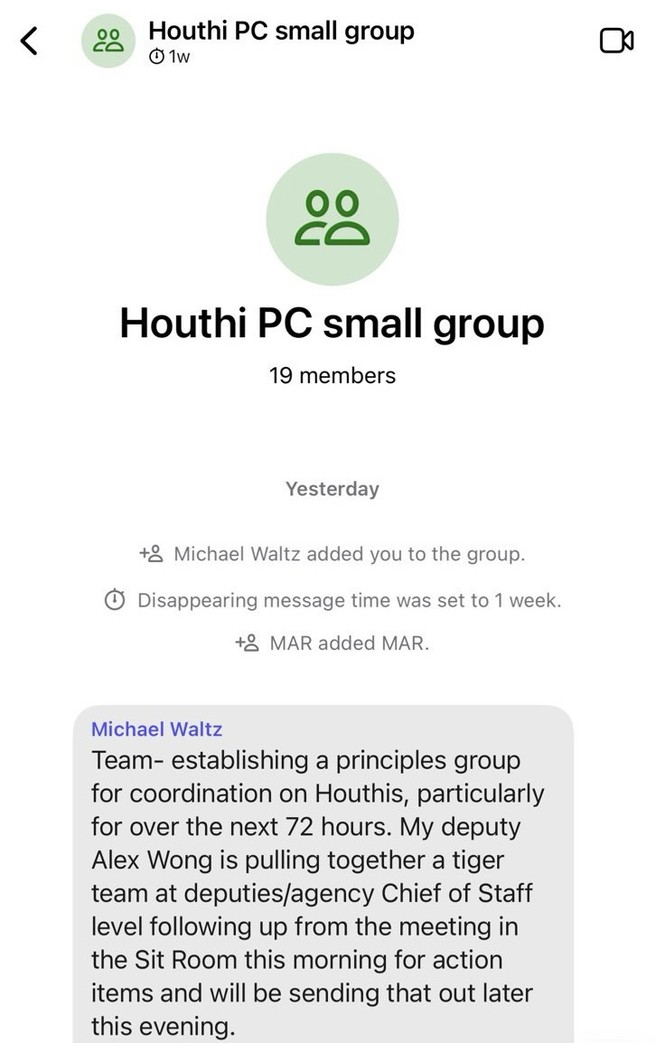
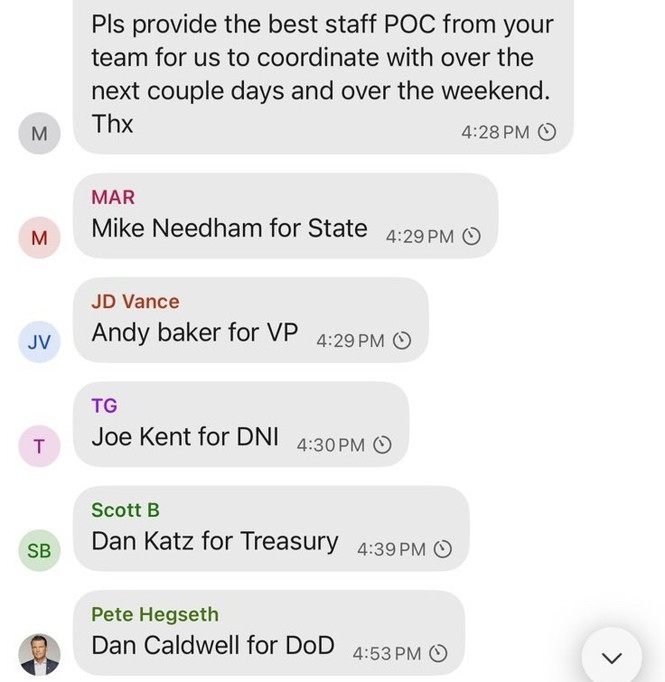
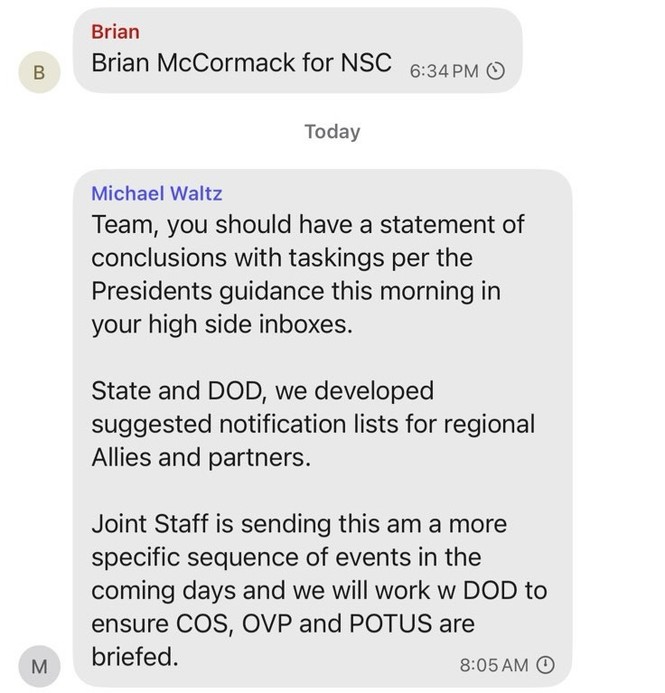
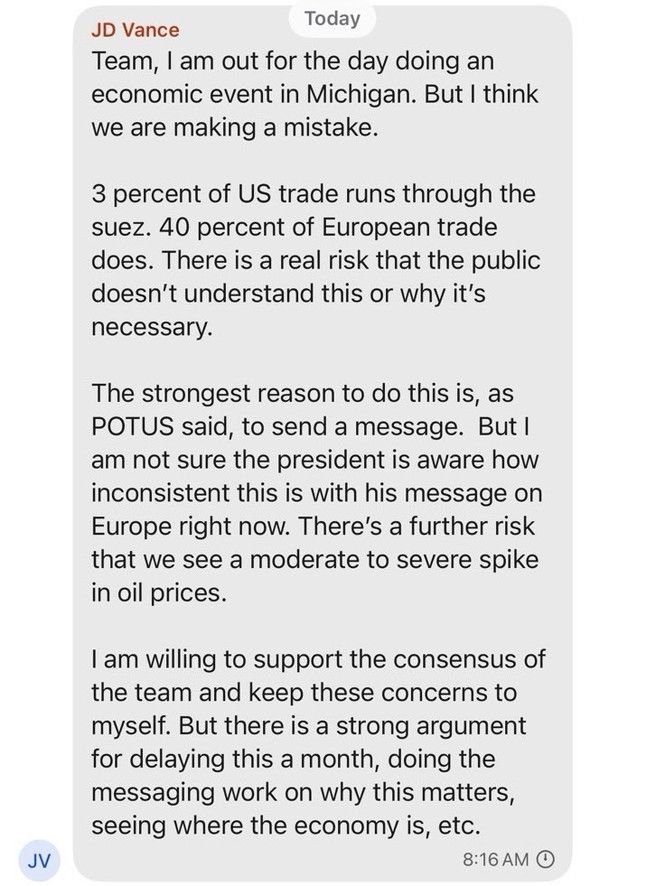
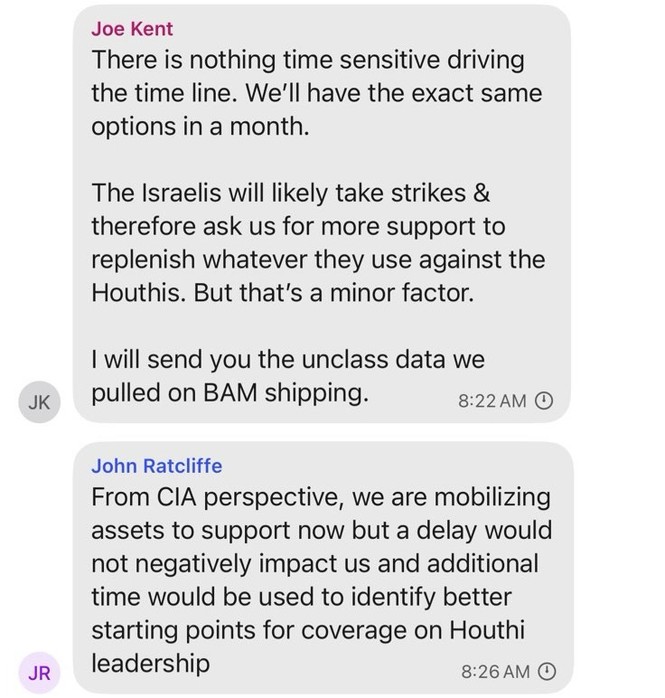
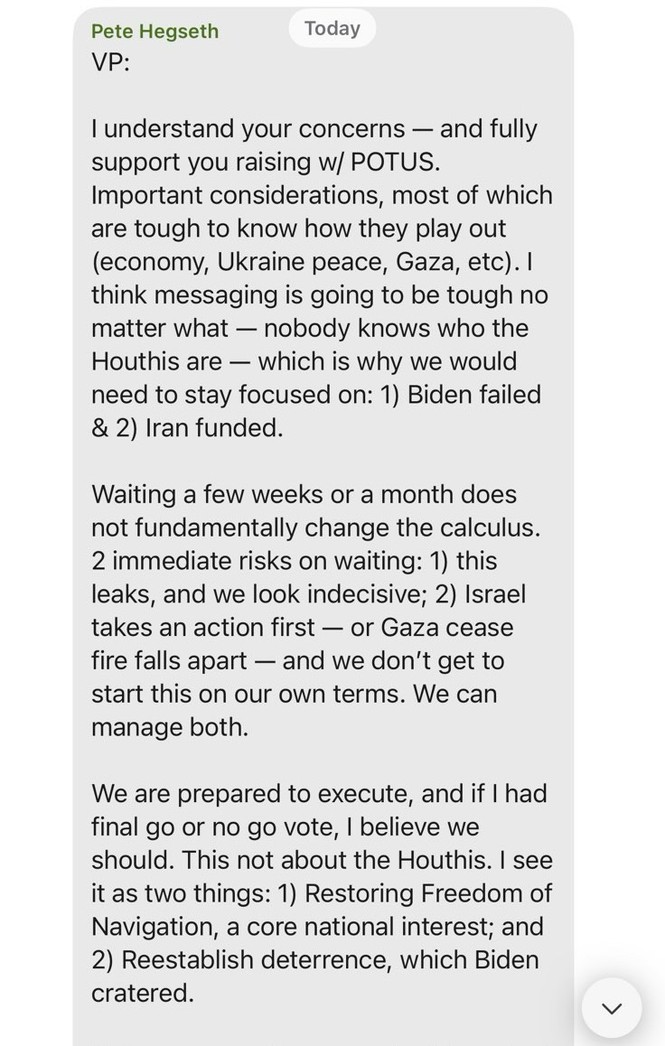
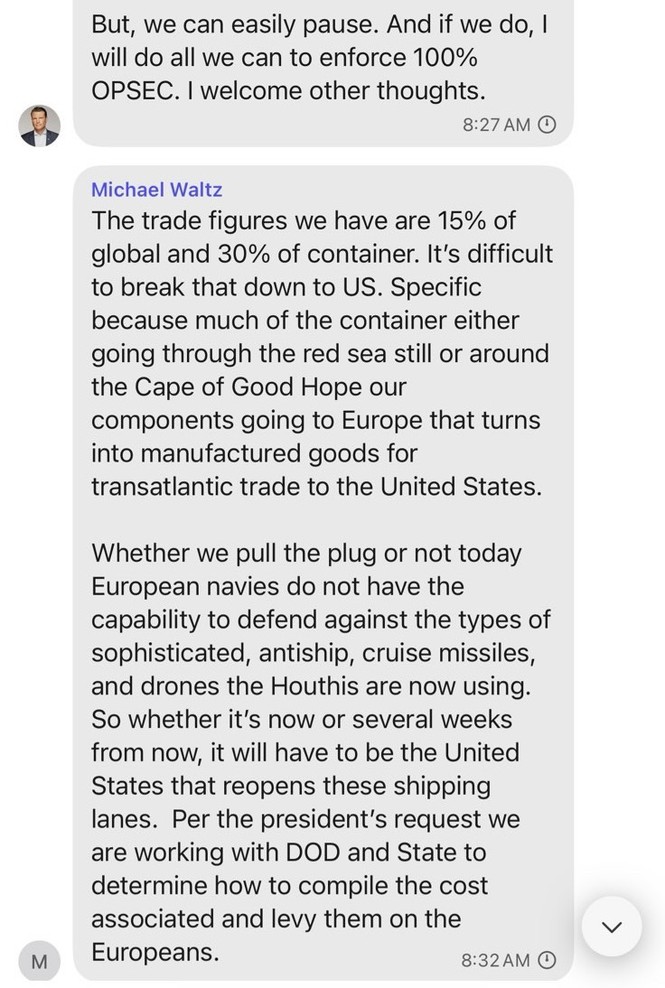
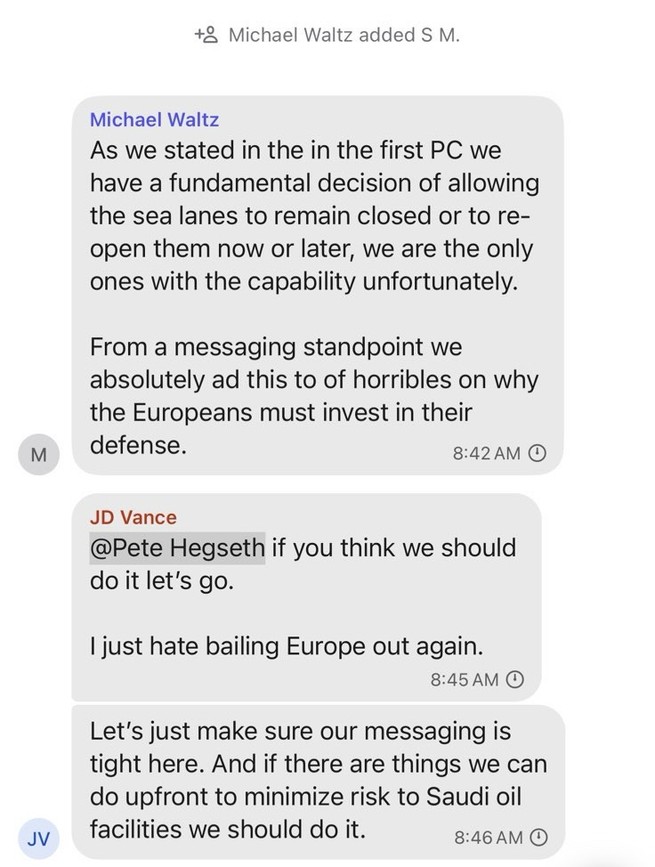
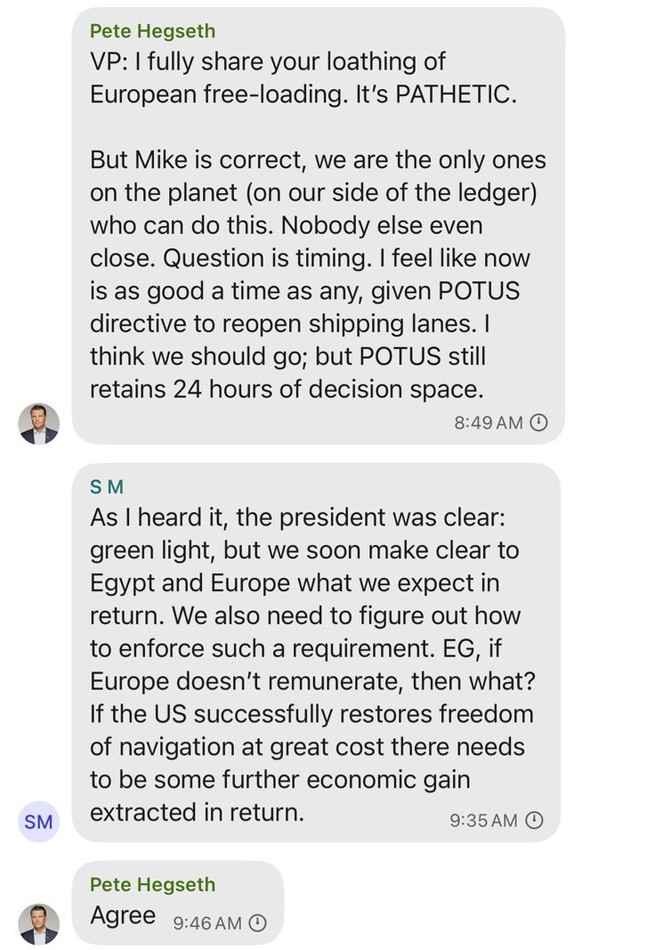
In the first big scandal of the Trump administration, the editor-in-chief of The Atlantic was invited to participate in a top-secret texting session about bombing the Houthis. Jeffrey Goldberg first thought it was a joke or a scam, but he joined the group and discovered it was real. He wrote about it in The Atlantic (“The Trump Administration Accidentally Texted Me It’s War Plans”), and the story went viral. But everyone involved other than Goldberg said that it was not a top-secret meeting, that no confidential information was discussed, and Pete Hegseth insulted Goldberg by suggesting he was lying. The messaging used an app called Signal, which disappears after a certain period of time and is not secure. One participant, Steve Witkoff, was in Russia at the time of the exchange.

So Jeffrey Goldberg and Shane Harris wrote up the conversation and published it.

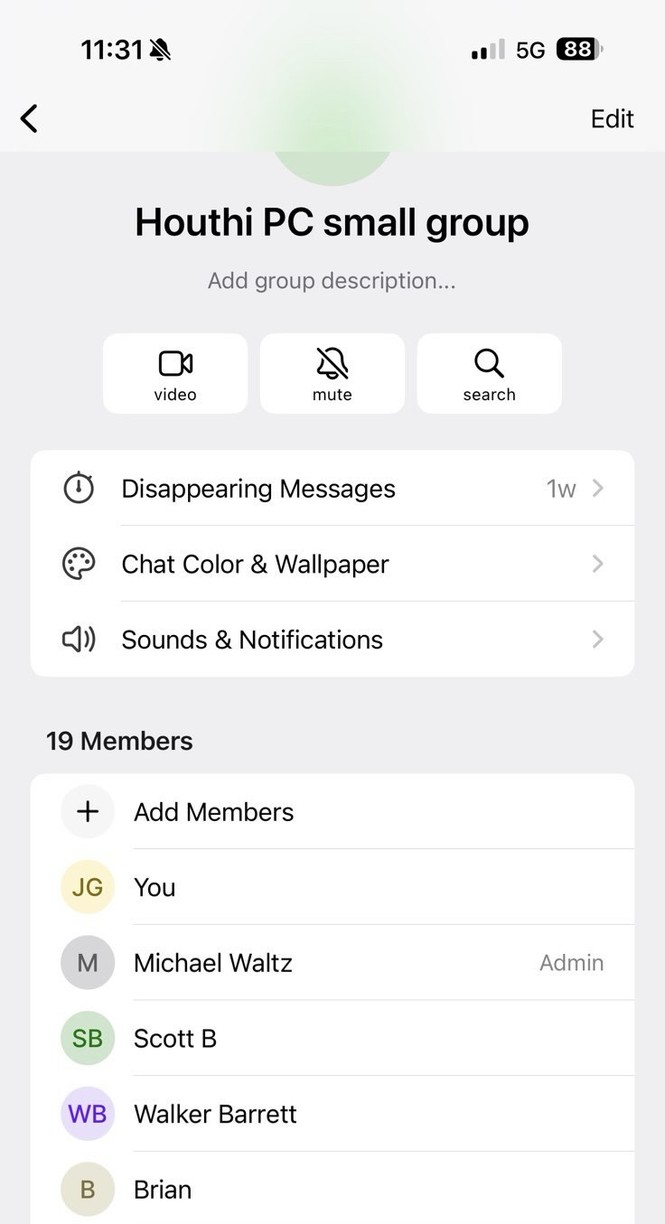
So, about that Signal chat. On Monday, shortly after we published a story about a massive Trump-administration security breach, a reporter asked the secretary of defense, Pete Hegseth, why he had shared plans about a forthcoming attack on Yemen on the Signal messaging app. He answered, “Nobody was texting war plans. And that’s all I have to say about that.”

At a Senate hearing yesterday, the director of national intelligence, Tulsi Gabbard, and the director of the Central Intelligence Agency, John Ratcliffe, were both asked about the Signal chat, to which Jeffrey Goldberg, the editor in chief of The Atlantic, was inadvertently invited by National Security Adviser Michael Waltz. “There was no classified material that was shared in that Signal group,” Gabbard told members of the Senate Intelligence Committee.

Ratcliffe said much the same: “My communications, to be clear, in the Signal message group were entirely permissible and lawful and did not include classified information.”

President Donald Trump, asked yesterday afternoon about the same matter, said, “It wasn’t classified information.”

These statements presented us with a dilemma. In The Atlantic’s initial story about the Signal chat—the “Houthi PC small group,” as it was named by Waltz—we withheld specific information related to weapons and to the timing of attacks that we found in certain texts. As a general rule, we do not publish information about military operations if that information could possibly jeopardize the lives of U.S. personnel. That is why we chose to characterize the nature of the information being shared, not specific details about the attacks.

The statements by Hegseth, Gabbard, Ratcliffe, and Trump—combined with the assertions made by numerous administration officials that we are lying about the content of the Signal texts—have led us to believe that people should see the texts in order to reach their own conclusions. There is a clear public interest in disclosing the sort of information that Trump advisers included in nonsecure communications channels, especially because senior administration figures are attempting to downplay the significance of the messages that were shared.

Experts have repeatedly told us that use of a Signal chat for such sensitive discussions poses a threat to national security. As a case in point, Goldberg received information on the attacks two hours before the scheduled start of the bombing of Houthi positions. If this information—particularly the exact times American aircraft were taking off for Yemen—had fallen into the wrong hands in that crucial two-hour period, American pilots and other American personnel could have been exposed to even greater danger than they ordinarily would face. The Trump administration is arguing that the military information contained in these texts was not classified—as it typically would be—although the president has not explained how he reached this conclusion.

Yesterday, we asked officials across the Trump administration if they objected to us publishing the full texts. In emails to the Central Intelligence Agency, the Office of the Director of National Intelligence, the National Security Council, the Department of Defense, and the White House, we wrote, in part: “In light of statements today from multiple administration officials, including before the Senate Intelligence Committee, that the information in the Signal chain about the Houthi strike is not classified, and that it does not contain ‘war plans,’ The Atlantic is considering publishing the entirety of the Signal chain.”

We sent our first request for comment and feedback to national-security officials shortly after noon, and followed up in the evening after most failed to answer.

Late yesterday, White House Press Secretary Karoline Leavitt emailed a response: “As we have repeatedly stated, there was no classified information transmitted in the group chat. However, as the CIA Director and National Security Advisor have both expressed today, that does not mean we encourage the release of the conversation. This was intended to be a an [sic] internal and private deliberation amongst high-level senior staff and sensitive information was discussed. So for those reason [sic] — yes, we object to the release.” (The Leavitt statement did not address which elements of the texts the White House considered sensitive, or how, more than a week after the initial air strikes, their publication could have bearing on national security.)

A CIA spokesperson asked us to withhold the name of John Ratcliffe’s chief of staff, which Ratcliffe had shared in the Signal chain, because CIA intelligence officers are traditionally not publicly identified. Ratcliffe had testified earlier yesterday that the officer is not undercover and said it was “completely appropriate” to share their name in the Signal conversation. We will continue to withhold the name of the officer. Otherwise, the messages are unredacted.

At 11:44 a.m. eastern time, Hegseth posted in the chat, in all caps, “TEAM UPDATE:”

The text beneath this began, “TIME NOW (1144et): Weather is FAVORABLE. Just CONFIRMED w/CENTCOM we are a GO for mission launch.” Centcom, or Central Command, is the military’s combatant command for the Middle East. The Hegseth text continues:

  • “1215et: F-18s LAUNCH (1st strike package)”
  • “1345: ‘Trigger Based’ F-18 1st Strike Window Starts (Target Terrorist is @ his Known Location so SHOULD BE ON TIME – also, Strike Drones Launch (MQ-9s)”

Let us pause here for a moment to underscore a point. This Signal message shows that the U.S. secretary of defense texted a group that included a phone number unknown to him—Goldberg’s cellphone—at 11:44 a.m. This was 31 minutes before the first U.S. warplanes launched, and two hours and one minute before the beginning of a period in which a primary target, the Houthi “Target Terrorist,” was expected to be killed by these American aircraft. If this text had been received by someone hostile to American interests—or someone merely indiscreet, and with access to social media—the Houthis would have had time to prepare for what was meant to be a surprise attack on their strongholds. The consequences for American pilots could have been catastrophic.

The Hegseth text then continued:

  • “1410: More F-18s LAUNCH (2nd strike package)”
  • “1415: Strike Drones on Target (THIS IS WHEN THE FIRST BOMBS WILL DEFINITELY DROP, pending earlier ‘Trigger Based’ targets)”
  • “1536 F-18 2nd Strike Starts – also, first sea-based Tomahawks launched.”
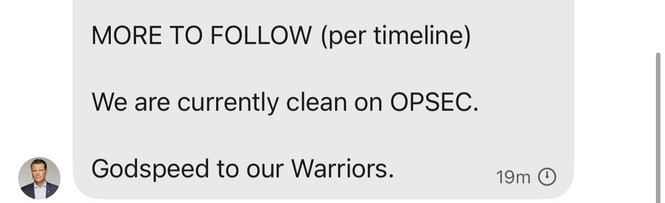
  • “MORE TO FOLLOW (per timeline)”
  • “We are currently clean on OPSEC”—that is, operational security.
  • “Godspeed to our Warriors.”

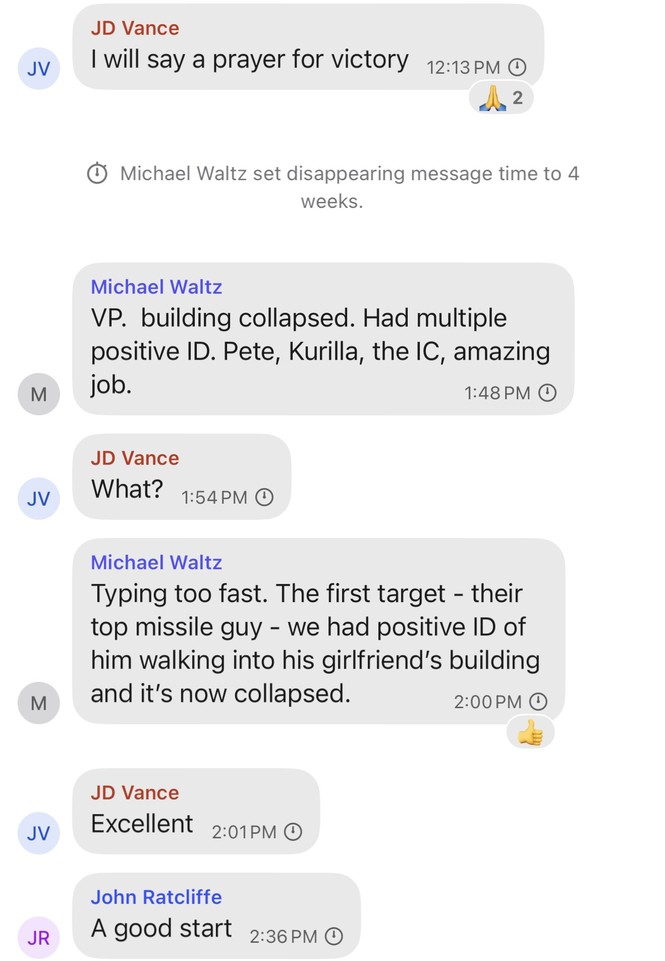
Shortly after, Vice President J. D. Vancetexted the group, “I will say a prayer for victory.”

At 1:48 p.m., Waltz sent the following text, containing real-time intelligence about conditions at an attack site, apparently in Sanaa: “VP. Building collapsed. Had multiple positive ID. Pete, Kurilla, the IC, amazing job.” Waltz was referring here to Hegseth; General Michael E. Kurilla, the commander of Central Command; and the intelligence community, or IC. The reference to “multiple positive ID” suggests that U.S. intelligence had ascertained the identities of the Houthi target, or targets, using either human or technical assets.

Six minutes later, the vice president, apparently confused by Waltz’s message, wrote, “What?”

At 2 p.m., Waltz responded: “Typing too fast. The first target – their top missile guy – we had positive ID of him walking into his girlfriend’s building and it’s now collapsed.”

Vance responded a minute later: “Excellent.” Thirty-five minutes after that, Ratcliffe, the CIA director, wrote, “A good start,” which Waltz followed with a text containing a fist emoji, an American-flag emoji, and a fire emoji. The Houthi-run Yemeni health ministry reported that at least 53 people were killed in the strikes, a number that has not been independently verified.

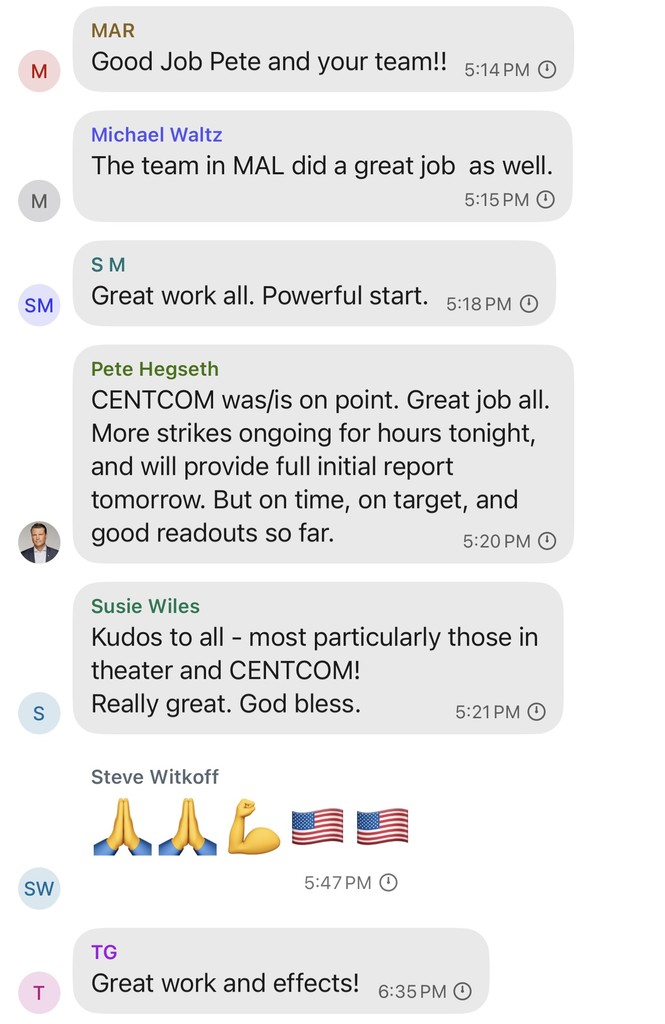
Later that afternoon, Hegseth posted: “CENTCOM was/is on point.” Notably, he then told the group that attacks would be continuing. “Great job all. More strikes ongoing for hours tonight, and will provide full initial report tomorrow. But on time, on target, and good readouts so far.”

It is still unclear why a journalist was added to the text exchange. Waltz, who invited Goldberg into the Signal chat, said yesterday that he was investigating “how the heck he got into this room.”


Screenshot
Screenshot
Screenshot
Screenshot
Screenshot
Screenshot
Screenshot
Screenshot
Screenshot
Screenshot
Screenshot
Screenshot
Screenshot
Screenshot
Screenshot
Screenshot
Screenshot

All those who participated in the meeting lied.

Stupid, incompetent liars are in charge of our national security.

Dana Milbank warns about Trump’s determination to stamp out a free press. The most salient fact about Trump is his narcissism. He demands obeisance, praise, respect, admiration, even groveling. He despises criticism. That’s why he is determined to intimidate journalists and media moguls.

If he can’t intimidate them, he sues them, expecting to intimidate them with financial disaster (he sued CBS for $10 billion for allegedly editing an interview on “60 Minutes”to help Kamala Harris in the election, even though he can’t demonstrate any harm he suffered since he won the election). Milbank does not mention his publisher Jeff Bezos’ obsequious attempts to please Trump by spiking the Washington Post’s editorial endorsement of Kamala Harris and by clamping down on the content of opinion columns, limiting them to praise of “personal liberties” and “free markets.”

The appearance of Milbank’s column is proof that Milbank has not kowtowed to Bezos’ edict, although he does fail to mention that Amazon, also owned by Bezos, paid Melania Trump $40 million to produce a film about her life.

Maybe his last line is a pleas to his boss Bezos, the second richest man in the world.

Milbank writes:

President Donald Trump’s Oval Office ambush of Ukraine’s Volodymyr Zelensky last week was rightly seen as a disaster for freedom in the world. But it also showcased a disaster for freedom at home: the administration’s attempts to extinguish the free press.

Barred by the White House from entering the room that day were the Associated Press and Reuters, venerable news agencies that have covered American presidents for decades. In their place: a correspondent from Russian state media, Tass’s Dmitry Kirsanov. The White House removed Kirsanov from the event in progress, claiming he was not “approved” to be there — asking us to believe that, in an astonishing security lapse, a Russian government propagandist had infiltrated the Oval Office without its knowledge.

Also brought into the room by the White House (which reversed more than a century of practice by seizing from journalists the authority to decide which reporters will be in the press “pool” that has access to Trump): Brian Glenn, correspondent for the MAGA outlet Real America’s Voice and boyfriend of Rep. Marjorie Taylor Greene (R-Georgia). He accused Zelensky of “not respecting the office,” asking: “Why don’t you wear a suit?”

Then there was the correspondent from another MAGA outlet, One America News. He told Trump that foreign leaders had “praised your courage and conviction” and asked him “what gave you the moral courage” to start talks with Russian dictator Vladimir Putin about Ukraine, “something that previous leaders lacked the conviction to do.”

“I love this guy,” Trump replied. Upon learning he was from One America News, Trump said: “Well, that’s why I like him. One America News does a great job. That’s very — I like the question. I think it’s a very good question.”

This is the result when the government decides who can cover the president: a sycophantic circus.

The First Amendment tells us that “Congress shall make no law … abridging the freedom of speech, or of the press.”


But Trump tells us otherwise. “Who knows, maybe we will create some NICE NEW LAW!!!” he posted on Truth Social last week, suggesting he wanted to make it illegal for journalists to use anonymous or off-the-record sources, an essential part of newsgathering because it protects people from retaliation. “They are made up, defamatory fiction, and a big price should be paid for this blatant dishonesty,” Trump wrote.
Thomas Jefferson wrote, “Our liberty depends on the freedom of the press, and that cannot be limited without being lost.” But Trump has launched a multipronged attack on our most essential freedom, with precious little pushback:

• His ferociously partisan chairman of the Federal Communications Commission has launched or threatened investigations into ABC, NBC, CBS, PBS, NPR, a website that rates media credibility and radio stations with ties to progressive billionaire George Soros.
• Trump’s acting U.S. attorney for the District of Columbia has threatened to prosecute “anyone who impedes” the work of Elon Musk and his team — a threat widely understood to include journalists.
• Trump himself has kept up a barrage of lawsuits against ABC, CBS, the Des Moines Register (over an inaccurate poll), the Pulitzer Prize board and others, and corporate owners have felt pressured to settle lawsuits they would otherwise win to avoid Trump’s retribution.
• The administration has cut off funds to pro-democracy media outlets in places such as Cuba, Iran and Ukraine, and it is cutting off the editorial independence of Voice of America.
• The president has spread lies about American news organizations, such as Politico and the New York Times receiving USAID funds as a “‘PAYOFF’ FOR CREATING GOOD STORIES ABOUT THE DEMOCRATS” in “THE BIGGEST SCANDAL OF THEM ALL,” and he has ordered government agencies to cancel subscriptions to news outlets.
• Trump on Feb. 23 called NBC and “MSDNC” “an illegal arm of the Democrat Party” that “should be forced to pay vast sums of money for the damage they’ve done to our Country.” He also called for my colleague Eugene Robinson to be “fired immediately” because he didn’t like one of Robinson’s columns that was critical of Republicans.
• Musk last month called for journalists at “60 Minutes” to be given “a long prison sentence” because of their (routine) editing of a Kamala Harris interview during the election. He also said a Wall Street Journal reporter who exposed racist rants by one of Musk’s employees should be “fired immediately.”
• And, of course, there’s the aforementioned White House takeover of the press pool and its banishment of the AP from the Oval Office, Air Force One and similar settings because it still refers to the Gulf of Mexico as the Gulf of Mexico. Trump wants to call it the Gulf of America, but the gulf doesn’t belong exclusively, or even mostly, to the United States, and the rest of the world still uses its traditional name — which is why the AP (and The Post) still uses its traditional name. Posters in the White House briefing room declared “VICTORY” over the AP, which Musk now calls “Associated Propaganda.”

As Rebecca Hamilton, an American University law professor, put it in Just Security last month, it all amounts to “a wholesale effort by Trump and his allies to eviscerate the free press in order to construct an information ecosystem dominated and controlled by those who espouse his views.”

Among Trump’s possible next steps: prosecuting journalists, as some in the administration have threatened. “It is essential that we understand how serious this threat is, because it is much harder to bring things back after they’ve already been finished,” Hamilton tells me. “And so it is worth fighting every single attack on press freedom, even if each attack individually seems like it could be a minor issue.”

The systematic assault on the press is part of a broader crackdown on the civil liberties of those who disagree with Trump. FBI Director Kash Patel has vowed to prosecute Trump’s opponents and critics, and Ed Martin, the D.C. prosecutor, has sent “letters of inquiry” to Rep. Robert Garcia (D-California) and Senate Minority Leader Chuck Schumer, suggesting they were “threatening” Musk (in Garcia’s case) and Supreme Court justices (in Schumer’s case, based on five-year-old remarks he said at the time were not intended as threats). Trump’s border adviser, Tom Homan, has asked the Justice Department to investigate Rep. Alexandria Ocasio-Cortez (D-New York) over her advice to migrants.

More broadly, the administration’s attempts to ban anything that it considers to be “diversity, equity and inclusion” were blocked by a federal judge on First Amendment grounds, because the executive orders force grant recipients to certify that they do not promote DEI. Other agencies have cracked down on expression, including the Pentagon and Veterans Affairs, where the display of gay pride flags has been banned in offices and cubicles.

The efforts are at times clumsy: The day after Wired published an article titled “The Young, Inexperienced Engineers Aiding Elon Musk’s Government Takeover,” Martin sent a public letter to Musk that read like a phishing email from a non-native English speaker. “Anyone imperiling others violating our laws,” proclaimed one sentence in its entirety. “Any threats, confrontations, or other actions in any way that impact their work may break numerous laws,” read another. “We will not act like the previous administration who looked the other way as the Antifa and BLM rioters as well as thugs with guns trashed our capital city. We will protect DOGE and other workers no matter what.”

That’s not the sort of language one typically sees coming from the Justice Department — but these are not normal times. ABC News’s parent company, Disney, paid $15 million to Trump in December to settle a defamation lawsuit — a decision that appeared to be based not on the legal merits but on fear of Trump’s vengeance. Meta in January agreed to pay Trump $25 million to settle a 2021 lawsuit over Trump’s suspended Facebook and Instagram accounts. CBS News parent Paramount Global is now in settlement talks over the “60 Minutes” editing. Even so, FCC Chairman Brendan Carr, a Project 2025 author, joined the attack on CBS, demanding that it hand over the “full, unedited transcript and camera feeds.” Hanging over Paramount if it doesn’t settle Trump’s (frivolous) lawsuit: The FCC could block its planned merger with Skydance.

This is on top of Carr’s probes of NBC parent Comcast (for its supposed DEI practices) and NPR and PBS (for their underwriting practices). Upon arriving, he reinstated complaints of political bias against ABC, CBS and NBC affiliates while declining to reinstate a similar complaint against a Fox affiliate. And he’s probing KCBS radio in San Francisco for its coverage of an immigration enforcement operation. (Not to be outdone, Georgia’s Greene is using her House Oversight subcommittee chairmanship to call the head of NPR to testify about its “blatantly ideological and partisan coverage.”)

Trump’s choice to run Voice of America, failed Arizona gubernatorial and Senate candidate Kari Lake, has vowed to purge the organization of “Trump derangement syndrome.” Last week, VOA suspended veteran journalist Steven Herman over his social media activity, the New York Times reported. A few weeks ago, Trump adviser Richard Grenell called Herman “treasonous” for quoting on social media the president of a democracy advocacy group saying the elimination of the U.S. Agency for International Development “makes Americans less safe at home and abroad.”

The attempted elimination of USAID by the administration has unquestionably hurt efforts to establish a free press in repressive countries. Reporters Without Borders said the sudden freeze of foreign aid programs “has left media organizations around the world in chaos, gravely hampering access to reliable news in zones of serious interest to the United States.” For example, Cubanet, a thorn in the side of Cuba’s regime and an ally of dissidents, was informed that its $1.8 million, three-year grant had been canceled.

So it goes across the Gulf of America, as Trump has decreed it must be called. Unlike, say, restoring the name Mount McKinley in Denali National Park, this is not something Trump can do on his own. Yet the White House said the AP was “lying” by using the name the rest of the world uses. The AP, in its lawsuit seeking reinstatement at the White House, argued that “the Constitution does not allow the government to control speech” and that Americans “have the right to choose their own words and not be retaliated against by the government.” But so far, a judge has rejected the AP’s request.

The gulf tempest may be just an excuse to punish news organizations. The White House is moving to evict some outlets from their seats in the briefing room to make room for MAGA-friendly ones. The Pentagon seized office space that had gone to outlets such as the Times, NPR, NBC and Politico, giving the space to right-wing outlets such as Breitbart, One America News and the New York Post. (It also gave space to liberal HuffPost, which had not requested it.)

This comes on top of the White House’s more egregious move to take control of the press pool, the rotating group of reporters allowed to be in the room with the president. As the White House Correspondents’ Association protested, this means “the government will choose the journalists who cover the president.”

Much of this was proposed in the Project 2025 blueprint, which, despite Trump’s denials during the campaign, has turned out to be a road map for the new administration. It suggested the White House find an “alternative” to the WHCA, take away some of the media’s space in the White House, seize editorial control over VOA and defund public broadcasting, among other things — and variations of all of these policies are underway.

Ominously, Project 2025 also called for rescinding guidance issued by the Biden administration that prevented prosecutors from seizing journalists’ records during leak investigations. The Justice Department “should use all of the tools at its disposal to investigate leaks,” Project 2025 proposed. This, First Amendment advocates fear, implies use of the 1917 Espionage Act to prosecute reporters if they don’t reveal their sources — in effect criminalizing journalism.

Complicating the response by the press to these assaults: Much of American media is owned by corporations and billionaires whose interests are not always aligned with those of a free press. Hamilton, the law professor, calls for “strategic litigation” by media outlets against the administration to push back against the assaults. She says journalists need to “continue to write without self-censoring.” And she says “the public also needs to understand the true value to democracy of having a free press, because if you lose that, then you lose one of the key foundations of accountability in a democracy.”

That’s a lot to ask. But it’s going to take all three — courageous media ownership, fearless journalism and an engaged readership — if the free press is going to survive the Trump presidency.

Oliver Darcy, media journalist, reports that Mark Zuckerberg has followed the lead of Elon Musk by abandoning fact-checking.

The No-Fact Zone: Meta announced Thursday it will launch its forthcoming “community notes” feature next week to replace fact-checkers, once again going to Fox News for the rollout as the Mark Zuckerberg-led social giant runs to the right. Joel Kaplan, Meta’snew global affairs officer, blasted the company’s own longstanding fact-checking program, telling Fox’s Brooke Singman it “proved to be really prone to partisan political bias” and was “essentially a censorship tool,” echoing false claims parroted by right-wing media figures and lawmakers. Unlike the fact-checking program, Meta’s community notes will rely on users who are not bound by ethical guidelines to police content for fairness and accuracy, taking a page straight out of Elon Musk’s X. Kaplan told Singman that posts with a community note applied will not be penalized and will continue to thrive on the platform, setting the stage for viral misinformation. While Zuckerberg and Kaplan are portraying the move as a win for free speech—earning praise from Donald Trump—it will surely serve to muddy the waters on some of the world’s biggest social platforms.

Trump has closed down the Voice of America, the government-run radio service that has brought news to 420 million listeners around the world since 1942, during World War II. Although he appointed Kari Lake, a Trump ally and election-denier who lost races for Governor of Arizona and the U.S. Senate, to take charge of Voice of America, her assignment just disappeared.

The Washington Post reported (with an emphasis on Kari Lake’s tough luck):

During his first term, Donald Trump accused Voice of America of speaking “for America’s adversaries — not its citizens.” Over the weekend, he essentially dismantled it.
Late Friday, Trump issued an executive order that directed VOA and an array of federal offices to “be eliminated to the maximum extent consistent with applicable law.” About 1,000 journalists were placed on indefinite leave. Those who showed up to work to broadcast their programs were locked out of the building…

Voice of America delivers news coverage to countries around the world where a free press is threatened or nonexistent. At its start, VOA told stories about democracy to people in Nazi Germany. VOA and affiliates such as Radio Free Europe and Radio Free Asia are designed as a form of soft diplomacy, a way to tout the United States’ free-press values in countries where antidemocratic forces prevail.

Who benefits by closing the VOA?

Russia. China. North Korea. Iran. And every other authoritarian regime.

Tough luck for Lake but good news for repressive dictatorships.

Jeff Bezos may have neutered the editorial pages of The Washington Post but he has not silenced the news reporting. Here is a terrifying example. Their communications strategy is to focus relentlessly on Trump as a “king,” a man of supernatural power. This is a gift article so you should be able to open the link and see the illustrations.

Drew Harrell and Sarah Ellison wrote:

When actress Selena Gomez posted an Instagram video in January in which she cried about the Trump administration’s deportations of children, the viral clip threatened to stoke nationwide unease over the policy’s human impact.

But the White House digital strategy team had a plan. They dispatched videographers to interview the mothers of children killed by undocumented immigrants. They put President Donald Trump’s face on a Valentine’s Day card reading: “Roses are red, violets are blue, come here illegally and we’ll deport you.”

And they mimicked a style of video popular for its meditative soundscapes, known as ASMR, with a presentation that featured the rattling handcuff chains of a deportation flight. Gomez deleted her video shortly after posting, without specifying why. The Trump team’s video has been viewed more than 100 million times.

The effort was part of a new administration strategy to transform the traditional White House press shop into a rapid-response influencer operation, disseminating messages directly to Americans through the memes, TikToks and podcasts where millions now get their news.

After years of working to undermine mainstream outlets and neutralize critical reporting, Trump’s allies are now pushing a parallel information universe of social media feeds and right-wing firebrands to sell the country on his expansionist approach to presidential power.

For the Trump team, that has involved aggressively confronting critics like Gomez, not just to “reframe the narrative” but to drown them out, said Kaelan Dorr, a deputy assistant to the president who runs the digital team.

“We thought it was necessary to provide pushback in the harshest, most forceful way possible,” he said. “And through that, we had a viral hit on our hands.”

Stephen K. Bannon, a senior White House aide during Trump’s first term and the host of the “War Room” podcast, said the White House has reimagined itself as a “major information content provider.” What Trump does “is the action, and we just happen to be one of the distributors,” he said.

“Rapid-response communications are normally defensive,” he said. “They’re all offense, all the time.”

The White House’s rapid-response account posted 207 times to X on Tuesday, the day of Trump’s speech to a joint session of Congress, or nearly nine posts an hour, including Trump sound bitessupporter interviews and Democrat-slamming memes and attack lines. When a Fox News analyst called Trump “the political colossus of our time,” the team got the clip cut, captioned and posted online within 11 minutes.

In press rooms, the administration is welcoming friendly “new media” podcasters, X users and YouTubers to deliver what White House press secretary Karoline Leavitt calls “news-related content” to their millions of followers.

And on social media, the White House is firing off talking points across every platform in a bid to win online attention and reach viewers who have tuned out the traditional press. In an X post, communications director Steven Cheung described their goal: “FULL SPECTRUM DOMINANCE.”

The administration has produced news-style reports trumpeting Trump’s successes and put them in email newsletters and Leavitt-narrated “MAGA Minute” video segments; soon, they’ll be delivered via text.

The team has worked to humanize the president with picturesque postcards of a White House snowfall and behind-the-scenes videos from the Oval Office — where a New York Post showing the president’s mug shot hangs framed just outside the door. But the digital team has also gone for shock factor, posting a photo of chained men shuffling onto a transport jet (“Deportation Flights Have Begun”) and a portrait of Trump with a golden crown (“LONG LIVE THE KING”).

The president has appointed influential social media figures across the federal government — like Robert F. Kennedy Jr. and Kash Patel — who amplify his messages with their own marketing pushes. Trump has also fired off attention-getting posts of his own, including an AI-generated videotransforming the war-torn Gaza Strip into a gilded Trump beach resort, in line with his call to forcibly remove millions of people from Palestinian land.

The administration’s brash campaign-style tactics are designed to stand out on a crowded internet and speak to voters that officials believe are hungry for aggressive action.

“Even the tagline we’ve been using — ‘America is back’ — is very much saying: ‘We’re here. We’re in your face.’ It’s irreverent. It’s unapologetic,” Dorr, 32, said. (A veteran of both Trump campaigns, Dorr also worked as a “head of engagement” at Gettr, the right-wing social network run by Jason Miller.)

The posts have shocked and repulsed the left, leading Senate Judiciary Committee Democrats to say on X: “To find joy and entertainment in this is truly vile.” But the Trump team has been emboldened to go even further by the millions who have watched, shared and followed the accounts since Trump’s inauguration. Half of the White House’s Instagram views have come from non-followers, Dorr said, a sign that the team’s messages are gaining traction beyond Trump’s base.

White House spokeswoman Anna Kelly said in a statement that the approach is built to reach audiences without the media’s help and to broadcast Trump’s “America First message far and wide.”

But this model of messaging could supercharge the presidential bully pulpit until it shifts Americans’ perception of events, according to experts who study propaganda and the press. Like Trump’s moves to shore up loyalty in Congress and remake the judiciary, the strategy is designed to weaken his opponents and dismantle checks against executive power.

Undermining the accountability mission of the Fourth Estate and building a viral pipeline of state media helps the administration — and future ones — stifle dissent, said Anya Schiffrin, a senior lecturer at Columbia University’s School for International and Public Affairs.

And by replacing dispassionate observers with partisan cheerleaders, political leaders are elevating a class of messengers incentivized to defend their decisions, no matter the seriousness or scale. Every policy maneuver could turn into a meme.

Said Renee Hobbs, a communications professor at the University of Rhode Island: “It’s an effort to replace the mainstream press with a partisan press” that will function as the new “purveyors of reality.”


‘Going to be great television’

Though members of the digital team serve on the front lines of what the White House calls the “most transparent administration” in history, Trump officials requested that their identities remain anonymous, citing personnel policy and concern over public backlash.

The team is made up of roughly a dozen employees — people mostly in their 20s and 30s from outside politics — who work out of the White House and are given wide leeway to craft content. By removing layers of bureaucracy before publishing, the team avoids the “analysis paralysis” of other messaging shops, Dorr said.

And members are expected to move at internet speed. When a federal judge declined to block the White House from banning the Associated Press from certain news events, the team raced to declare “VICTORY” in graphics that members slapped across White House TVs and social accounts.

They “have the buy-in from the [Trump] team to go out there and be unapologetic in our pursuit of advancing the administration’s goals,” Dorr said, “with the ferocity and the quickness and the pointedness” the White House demands.

For its rapid-response account, the White House employs video producers and editors, known as clippers, to create and post short videos on the fly. The role was first popularized by political activists looking to highlight opponents’ gaffes on the campaign trail, but Trump’s clippers often promote his moments, hoping to make them go viral in real time.

On Friday, within minutes of Trump and Vice President JD Vance’s fiery confrontation with Ukrainian President Volodymyr Zelensky, the White House accounts blasted out video of major punch lines, meme-ready photos and images of the American flag. “This is going to be great television,” Trump said as reporters filed out of the Oval Office.

The approach seems to be resonating online: Trump’s first Cabinet meeting, which was live-streamed and featured billionaire Trump ally Elon Musk, has more than 6 million views on X. “Trump is literally overwhelming them with information” in a way that is “changing the nature of the presidency,” Bannon said. “How many young men under 30 years old would ever watch two seconds of a Cabinet meeting?”

That fast-twitch model has spread beyond the White House, including to the Defense Department, which this month launched a rapid-response account to praise Defense Secretary Pete Hegsethgrapple with senators and declare that “REAL journalism is dead.” But it has also helped seed major advertising campaigns to reach viewers beyond the web.

Kristi L. Noem, head of the Department of Homeland Security, has posted videos of herself in a flak jacket at the southern border and on immigration raids, including one on Tuesday at an apartment complex in Northern Virginia.

Footage from the raids is used in an international TV and digital ad blitz that warns undocumented immigrants to leave the country or be hunted down. At the Conservative Political Action Conference, Noem said the ads had a budget of up to $200 million and had been personally requested by Trump.

“We’re not going to let the media tell this story,” Noem recalled Trump saying, as was first reported by Rolling Stone. “We’re going to run a marketing campaign to make sure the American people know the truth.”


‘Desecrate their idols’

As the administration has expanded its marketing arm, it has also worked to uproot the classic structure of the White House press corps. In her first briefing, Leavitt called on “podcasters, social media influencers and content creators” to apply for credentialed access to a briefing room long filled by legacy news outlets. More than 12,000 have since applied, according to the White House, and several have been ushered to exclusive new-media seats near the podium.

Administration officials have said the change reflects a fundamental shift in American culture, as journalists compete for relevance with a new generation of influencers who speak to audiences of millions online.

But virtually all of the new-media creators have come from right-wing outlets friendly to the Trump cause. The Breitbart writer Matt Boyle asked whether the White House would continue its “breakneck” pace. (Yes, Leavitt said.) The pro-Trump podcaster John Ashbrook asked whether the media was “out of touch” about the border. (Yes, Leavitt said.) And John Stoll, the head of news at Musk’s X, asked about the White House’s “confidence” in going “toe-to-toe with Vladimir Putin.” (Very confident, national security adviser Michael Waltz said.)

“The Trump White House is loyal, and they are loyal to people who stood with them,” podcaster Dan Bongino said while toasting Rumble chief Chris Pavlovski’s moment in the new-media spotlight. (Days later, Bongino was named deputy director of the FBI.)

Some of the new-media figures have eagerly promoted Trump’s domestic agenda. A few hours after podcaster Sage Steele asked about the importance of passing a law to ban transgender women and girls from women’s sports, she stood behind Trump as he signed an executive order on the same issue.

Other Trump-boosting creators have joined the administration outright, like the “Dear America” podcast host Graham Allen, newly hired as the Defense Department’s digital media director. Brenden Dilley, a pro-Trump meme maker, said of the news, “There’s going to be nobody left doing podcasts soon because the top people are all going to work for the government.”

Friendliness between the White House and its messengers of choice is nothing new, including during the first Trump term, when right-wing provocateurs like Mike Cernovich and blogs like Gateway Pundit held credentials alongside the legacy press.

But back then, the traditional press corps set the tone, Bannon said. The softer questions during Trump’s recent Cabinet meeting, he said, made the first term’s briefings look like “hand-to-hand combat.”

Today “the powerful media is the ecosystem of the right,” Bannon said, “while the mainstream media [is] suffering layoffs.”

The right-wing media figures embraced by the Trump administration have often returned the favor. After the banning of the AP, Brian Glenn — a correspondent for the pro-Trump media network Real America’s Voice and the boyfriend of Rep. Marjorie Taylor Greene (R-Georgia) — was given the rare opportunity to question Trump in the Oval Office. A few days later, he posted a selfie with Trump on X that read: “So much accomplished, and we’re still under a month in office.”

For those working closely with Trump’s public-relations infrastructure, the first weeks have marked a huge opportunity for exclusive content. Benny Johnson, a Tampa-based MAGA influencer who calls himself the “Front Seat to the Golden Era,” got to interview Vance last month, then headed to the Capitol, where he live-streamed a friendly chat with two Republican senators before they voted to confirm Patel as FBI director.

“First time in history we’ll have the stream going from the senator’s office. This is amazing,” Johnson said on stream.

The night before, Johnson had posted a video of himself stopping to rejoice outside the shuttered offices of the U.S. Agency for International Development, once the world’s largest provider of food aid. “Destroy the idols of the conquered church, right?” he said with a laugh. “Desecrate their idols. Look at this. There it is. Blacked out. It’s gone.”

Cat Zakrzewski and Michael Scherer contributed to this report.

Timothy Snyder is Professor of European History at Yale University and a bestselling author. See his book “On Tyranny.”

He writes here about Jeff Bezos’ attempt to limit editorial expression at The Washington Post. When Bezos, the world’s second richest man–after Elon Musk–bought the newspaper, he insisted that he would not interfere in its editorial content. Many assumed that his vast wealth would insulate him from political pressure.

But the prospective return of Trump changed his views about editorial independence. He has other businesses (Amazon, Blue Origin) that made him a billionaire and that have government contracts. He blocked the publication of an editorial endorsing Kamala Harris. After Trump’s election, he gave $1 million to his inauguration fund. Then his company Amazon–source of his riches–paid $49 million to Melania for producing a film about her life; a tidy sum for a person with no experience as a film producer.

Bezos’ ham-handed efforts to mute criticism of Trump has hurt the reputation of the Washington Post. It has suffered a huge loss of readers–more than 300,000–and an exodus of some of its best writers. Just this week, Deputy Editor Ruth Marcus quit after Bezos or his henchman Will Lewis killed her latest column.

Snyder here takes issue with Bezos’ intervention into the Post’s editorial space:

On February 26th the Washington Post announced a new editorial line that refers to freedom while restraining it. I submitted a proposal to them on the question of what it would meant to support freedom in a newspaper. I have waited two weeks for a response. I would still happily write that opinion piece! In the essay below, I explain how the Post’seditorial line is nonsensical and authoritarian.

Jeff Bezos, who owns Washington Post, has announced its editorial line: “We are going to be writing every day in support and defense of two pillars: personal liberties and free markets.” The use of these terms in this way demeans the concept of freedom and pushes the country in the direction of tyranny. 

I will start from some arguments that are more conventional and that others have rightly made. But I want here, in ten steps, to push the point to the end. On February 27th, the day after the new editorial lines was announced, I enjoyed myself and did this as parody. Today I ask for your patience as I do so as philosophy.

1. “Liberty” is self-contradictory as an editorial code. To use liberty as a demarcation of what is and what is not to be published shows a deep misunderstanding of what liberty means. Liberty is an open meadow, not a fence. An editor who believes in liberty helps writers to make their own arguments well, because their freedom has to do with them. Liberty has to mean that people have the right to say what they want, including (for example) that liberty doesn’t need to be qualified by the adjective “personal,” that liberty is an infinite concept and not one that can be listed as specific “liberties,” that the concept is in tension with the fiction of the “free market”, or that the word is being put to pernicious, Orwellian purposes by American libertarian billionaires.

2. Editors who take “personal liberties” as a restriction on what contributors write would need protocols of measurement and control. Can we accept that a certain someone knows, for certain, whether a given article trends in favor or against personal liberty? What could this mean? To grant such authority is absurd, and also tyrannical. The whole point of freedom is that it extends beyond the boundaries of any one mind at any one moment. James Baldwin called truth “freedom which cannot be legislated, fulfillment which cannot be charted.” And surely this is all the more true of the truth about freedom! Treating the issue as impersonal makes matters no better. Imagine an official list of “personal liberties” hanging on the walls of the Posteditorial offices, each with a definition. Who decides what that says, though? And such a list would not be enough. There would then have to be some set of rules (algorithms?) by which to establish whether an article met the definition. Very quickly (on day 1? has this perhaps already happened?) we get to the Kafkaesque situation of a Post editor submitting a proposed opinion essay to an AI and asking whether it “supports and defends personal liberties and free markets.” Freedom is what distinguishes us from machines. It has to do with affirming values over the course of a limited time on earth, with taking risks, with building character. No machine can capture that. None of these practice that could be used to enforce the editorial line can possible affirm “personal liberties.” Enforcement means either human arbitrariness or mechanized abasement.

3. The qualification of the noun “liberties” by the adjective “personal” is unfounded. Any qualification is unfounded. This particular one suggests that we can become free people without society, which is absolutely not true. We all begin life as helpless infants. Whether we can become free or not depends on circumstances beyond our control. No amount of declaiming “personal liberty” will create the conditions in which a baby grows up with the capacities and structures needed to be a free person. That effort to create a person must be social, beginning with the parents, and extending to friends, teachers, child-care workers, and others. A child needs a special kind of time at a special time of life, and that time will only exist if we recognize that the entire situation is about freedom and that freedom requires cooperation. If we want liberty, in other words, we cannot limit ourselves to the personal. The example of the newborn is important, because it is what we all share, but also because it suggests a truth that continues throughout life. In one way or other, we are always vulnerable, and our ability to be free will always depend on cooperation.

4. The pairing of the phrase “personal liberties” with the phrase “free markets” suggests an understanding of freedom that is negative: freedom as just an absence of oppression, or an absence of government. The editorial line implies a world in which there is nothing more than isolated individuals and a government that might or might not oppress them, with nothing in between. To be sure, the government should not oppress people. But to ensure that governments are not oppressive, people need freedoms that go beyond the personal: that we can all vote, for example. Voting is not just a personal freedom: if you think about it that way, you will be unconcerned about equal voting rights for others, and your democracy will soon become something else. And the government is not, as negative freedom indicates, the only possible instrument of oppression. Companies and oligarchs can also oppress. And when they do, democratic governments are the only institution that can defend freedom. But for governments to be democratic, people have to be able to act together. They need a freedom that goes beyond the personal: not only to vote in fair elections, but to protest in groups, to join labor unions, to assemble and cooperate.

5. The use of the plural “liberties” (rather than “liberty” or “freedom” in the singular) is not an extension but an unwelcome qualification, in fact a limitation. The use of the plural suggests that there is a finite list of specific liberties, rather than freedom for all people as such. This indicates that liberty is constrained for people. Interestingly, no such constraint is placed upon the inhuman abstraction that also figures in Jeff Bezos’s editorial line, “the free market.” What has unqualified freedom, according to Bezos? Not people. The market. And this, as we shall see, is not only incoherent but authoritarian.

6. The two parts of the editorial line would be contradictory in practice. The “free market” and “personal liberties” would have to contradict one another in editorial decision-making, to the point that they could not be enforced together (even leaving aside the inherent problem, discussed already, of defining and “personal liberties”). If “personal liberties” include anything meaningful, they would have to include the freedom of expression — which would include the freedom to debate what markets should be like and how they should work. Otherwise the (nonsensical) orthodoxy of the “free market” functions as a restriction on freedom of speech, and “personal liberties” just turns out to mean repeating an unquestioned political orthodoxy.

7. The two parts of the editorial line are also contradictory in principle. The assumption that “free markets” and “personal liberties” work together as “pillars” is mistaken. These two concepts are not the same, and very often point in opposing directions. A “free market,” for example, would mean that companies can pollute as much as they like. But if the atmosphere poisons me and I die of cancer, I am not enjoying “personal liberties” of any sort.

8. Any reasonable concept of “personal liberties,” of freedom, will in fact constrain the market. Consider the market in human organs, which of course exists. Should there be a “free market” in human kidneys? Should rich people have the right to hunt you down on the street, tranquilize you, and harvest your organs to sell them? If not, why not? The answer has something to do with the freedom of human beings, the autonomy of their bodies, their right not to have them violated. There is no way to get to that answer, however, from the starting point of the “free market.” A “free market” includes your kidneys.

9. The editorial code requires writers to affirm the non-existent. Americans say “free market” all the time, so it sounds like something that exists, but it does not and cannot. There is no such thing as a “free market,” in the sense of a market that functions unconstrained, without government. The basis of a market is the right to property, which is of course enforced by a government. A government decides that there is such a right, and whether or not it extends to organs (or people, for that matter). Property rights are thus “government intervention,” in the jargon of the people who like to talk about “free markets.” Once this undeniable fact is recognized, we are simply in a conversation about which government action we advocate and which we oppose. Once we understand that we need governments for markets to work, and that we are inevitably making choices about how markets work, we can have a reasonable conversation about what sort of markets we want and how we want them to function. We can ask, for example, whether monopoly capitalism is the best sort of capitalism. If editors insist on calling markets “free,” they are insisting that writers connive in political fiction. And a very dangerous one, especially right now.

10. The language of “free markets” is authoritarian. Freedom belongs only to people. It does not belong to institutions or abstractions — and least of all to non-existent institutions or abstractions. The moment that we yield the word “free” to something besides a person, we are yielding our freedom. And we should be aware that others who abuse the word by taking it from us intend to oppress us. When we endorse the fiction of “free markets,” we are entering a story told by others than ourselves, in which we are the objects, the tools, the non-player characters. We are accepting that we people owe duties to those markets. By way of an unreal concept we pass into real submission. We are accepting that we have the duty to oppose “government intervention,” which is to say that we must oppose political actions that would help us to be more free: safety for workers, protection for consumers, insurance for banks, funding for schools, legality for unions, leave for parents, and all the rest. We must accept whatever the market brings us, to go wherever the billionaires take us, to surrender our words, our minds, ourselves.

Jeff Bezos, the multibillionaire owner of The Washington Post, has driven away great reporters and many readers because of his groveling before the Great Trumputin, but the Post still has Glenn Kessler, perhaps the best fact-checker in the business. It was Kessler who counted the public lies of Trumputin in his first term. He had the exact number but I recall only the round number of 30,000. Loyalist KellyAnne Conway called them “alternative facts.” Yes, indeed, Trump’s outright lies were “facts” in an alternative universe, not this one.

Glenn Kessler wrote recently about Trumputin’s latest attack on facts and truth:

The Trump administration is sweeping through the U.S. government, terminating dozens of programs, laying off tens of thousands of workers, even dismantling entire agencies. At the same time, the White House has adopted a unique lexicon to describe its agenda — in some cases, using words that in ordinary contexts mean the opposite.

Here’s a guide to the verbiage, drawn from remarks made by President Donald Trump and White House press secretary Karoline Leavitt.
‘Transparency’

Traditionally, transparency in the federal government has meant access to data, federal contracts and government reports, even if they shed light on problems.

But Trump has fired nearly a score of inspectors general, who root out fraud and malfeasance in federal agencies. (Eight have filed suit, saying they were fired illegally.) One IG, for the U.S. Agency for International Development, was booted as soon as he issued a critical report on the aid stoppage ordered by the president. When reports emerged that a State Department website revealed that Tesla, a company owned by billionaire Elon Musk, Trump’s biggest financial backer, received a $400 million contract, the contract document was scrubbed to remove any reference to Tesla. Moreover, websites across the government were deleted — including every page for USAID.

Meanwhile, the Musk-led U.S. DOGE Service — which is targeting agencies for contract terminations and personnel cuts — operates in secret and the people on his team have not been revealed, though reporters have figured out the identity of some key players.

But the White House says the administration is transparent because Trump often answers questions from reporters. (His predecessor, Joe Biden, rarely did so and usually in controlled settings.)

“President Trump has led by example on this front as the leader of the free world, the president of the United States, with his show of access and transparency on a daily basis,” Leavitt told reporters. “The president takes questions from all of you almost every single day and really reveals what he’s thinking and feeling.”

Unfortunately, as we’ve documented, much of what Trump says is inaccurate or misleading. So he’s not an especially accurate source, compared to rigorously vetted reports and databases.


‘Free speech’

The First Amendment enshrines a right to “free speech” — the right to articulate opinions and ideas without interference, retaliation or punishment from the government. There’s always been some tension in this notion — does this give someone the right to yell “fire” in a crowded theater when there is no fire?

Conservatives objected to social media platforms such as Twitter (before Musk bought it and turned it into X) and Facebook downgrading or removing posts that contained inaccurate or false information, especially during the covid pandemic. Trump himself was removed from many platforms after he instigated a riot at the U.S. Capitol to prevent the certification of Biden’s victory in 2020. But he’s been reinstated and many social media companies have scaled back efforts to police false information circulating on their platforms.

“I stopped government censorship once and for all and we brought back free speech to America,” Trump told House GOP members after taking office.

But the White House in recent days has barred Associated Press reporters from news events because the agency still refers to the Gulf of Mexico, the internationally recognized name for the body of water that has been in use since the mid-17th century. In an executive order, Trump directed federal agencies to change the name to “Gulf of America.” The AP is an international news organization, and the rest of the world does not recognize Trump’s name change. Taylor Budowich, White House deputy chief of staff, said in a statement that the AP’s stance “is not just divisive, but it also exposes the Associated Press’ commitment to misinformation.” He said that as a result of “irresponsible and dishonest reporting” — citing the name used by the rest of the world — the AP could not expect the “privilege of unfettered access to limited spaces, like the Oval Office and Air Force One.”

Similarly, Leavitt told reporters: “I was very up front in my briefing on Day 1, that if we feel that there are lies being pushed by outlets in this room, we are going to hold those lies accountable. And it is a fact that the body of water off the coast of Louisiana is called the Gulf of America, and I’m not sure why news outlets don’t want to call it that, but that is what it is.”

‘Fraud and abuse’

Fraud generally means deception, often criminal, in pursuit of financial and personal gain. But the Trump administration has upended that definition — broadening it to include programs and policies it disagrees with — while at the same time making it harder to detect fraud.

“We’re finding tremendous fraud and tremendous abuse,” Trump said as Musk stood by his side in Oval Office. But a Fact Checker accounting of the announcements from DOGE, or Department of Government Efficiency, of terminated programs found that most concern diversity, transgender and climate change programs. Musk has also led an assault on USAID, the agency that long had bipartisan support to distribute billions of dollars in development aid around the world.

“It’s a scam,” Trump said of USAID. “It’s a fraud. A lot of it, most of it, but it’s a fraud.” Asked for evidence, the White House provided a list that was often wrong or misleading — and in any case amounted only to a pittance of the agency’s $25 billion budget.

In addition to firing IGs, Trump fired top ethics officers and neutered offices that protect workers from retribution. He also suspended enforcement of a nearly half-century-old law that investigates corporate corruption in foreign countries, while his Justice Department ordered the dismissal of bribery charges against New York Mayor Eric Adams (D) for political reasons (Adams supports Trump’s immigration policies).

A Feb. 13 White House news release berated states and localities pushing back against Trump’s executives orders on diversity and immigration. “President Donald J. Trump and his administration have a simple message: follow the law,” the news release was titled.


Deficit

In Washington, the deficit usually means the federal budget deficit. But for Trump, the deficit that matters is the trade deficit. He imposed 25 percent tariffs on steel and aluminum, threatened tariffs against Canada and Mexico and proposed to upend the current trading system by imposing reciprocal tariffs.

“We have a tremendous deficit with Mexico,” Trump said last week. “We have a tremendous deficit with Canada. We have a tremendous deficit with Europe, the E.U., with China, I don’t even want to tell you what Biden is allowed to happen with China.”

(Actually, under Biden, the trade deficit with China fell to its lowest level in 10 years, according to the Census Bureau.)

In an interview with Bret Baier of Fox News, Trump said: “Why are we paying $200 billion a year essentially in subsidy to Canada? Now, if they’re our 51st state, I don’t mind doing it.”

According to the website of the U.S. Trade Representative, the goods deficit with Canada was $63 billion in 2024. The United States has a services surplus of about $30 billion with Canada, which brings down the overall deficit even more. But since Trump took office, the website does not display trade-in-services numbers.

Unlike a budget deficit — which depends on whether the government spends more than it raises in revenue — a trade deficit is shaped by underlying factors, such as an imbalance between a country’s savings and investment rates. A bigger federal budget deficit — caused by, say, a large tax cut contemplated by Trump — can boost the trade deficit because the country saves less and borrows more from abroad. A booming economy can also be at fault — the more money people have, the more they can spend on goods from overseas. And a strong currency means those foreign goods are cheaper for a particular country and its goods are more expensive for foreign consumers.

In other words, trade deficits may be beyond Trump’s ability to control.

Thom Hartmann, independent journalist, finds it curious that the Republican Party so frequently displays Nazi symbolism. And why does the major media ignore usually overlook the fondness for Nazi iconography by Trump, Musk, and their allies? Is it their youth? Their historical ignorance? Their caution?

He writes:

Is it a shout-out to the hardcore racists and haters that make up the GOP’s base, all just a performance to get enough votes to win elections? Or a proclamation that the end-goal of Republican governance is the destruction of American democracy, perhaps in deference to Vladimir Putin? How about it’s being a bizarre attempt at trolling people old or well-educated enough to remember or know what Nazism inevitably leads to?

One of the enduring mysteries in today’s American political life is why so many Republican politicians and their friends are adopting or promoting openly Nazi symbols, iconography, and slogans.

And why are America’s mainstream media so unwilling to even report on, much less discuss, all the Nazi and neo-Nazi references surrounding Trump and today’s captive Republicans?

Elon Musk, Trump’s #1 campaign donor and co-president, threw two Nazi “Sieg Heil” salutes following Trump’s inauguration, causing the media to fall all over itself trying to make excuses for his behavior. Actual, declared Nazis and white supremacists were thrown into an ecstatic tizzy, however, with the Ohio Proud Boys posting the clip with the words, “Heil Trump!”

The neo-Nazi group Blood Tribe posted the Musk clip with the Waffen SS lightning-bolt emoji; their leader, Christopher Pohlhaus, wrote: “I don’t care if this was a mistake. I’m going to enjoy the tears over it.” Other neo-Nazi, Nazi, and white supremacist groups across the web jumped in to celebrate the salute, as Rolling Stone extensively documented.

It all seems to have really picked up steam after young neo-Nazis marched in Charlottesville in 2017, chanting Nazi slogans, murdering a young woman protestor, and giving Hitler salutes. 

Our media completely failed to identify them as Nazis, even though they were proclaiming that themselves. 

Since Trump’s endorsement of their behavior with his “good people on both sides” comment, which he continues to defend, such behavior has been emulated across the nation.

Poke anything associated with Trump and odds are Nazi memes will pop out. 

The “America First” slogan was the name of an openly pro-Nazi movement in America in the 1930s, a fact that seems to have been lost down the memory hole. And Trump told his former Chief of Staff, Marine General John Kelly, that “Hitler did some good things…” along with referring to American soldiers as “suckers” and “losers.”

And then there are Trump’s attacks on the media, echoing Joe Stalin and Adolf Hitler with their “enemy of the people” rhetoric. He’s suing media outlets left and right, just like Putin and Orbán did in their early years to intimidate reporters and bankrupt opposition publications and websites. 

Elon Musk just called for reporters for CBS’s 60 Minutes program — “the biggest liars in the world” — to receive “a long prison sentence.”

In an echo of Hitler’s “denunciations,” his “border czar” is even calling for the police at the Department of Justice to investigate Alexandria Ocasio-Cortez for telling immigrants about their constitutional rights. 

After pointing out at a rally that Hitler said that Jews were “poisoning the blood” of Germany (yes, he pointed it out himself), Trump then said of nonwhites in America:

“It’s true. They’re destroying the blood of the country, they’re destroying the fabric of our country, and we’re going to have to get them out.”

The 2021 CPAC meeting featured a stage resembling the Odal Rune, a potent Nazi symbol, that drew a rebuke from the hotel hosting the conference.

In 2022, Trump dined with Nick Fuentes, a prominent and out Holocaust denier. Trump later posted a 30-second video that twice references a “unified Reich.” Trump’s buddy Steve Bannon has repeatedly endorsed the notoriously antisemitic and racist novel The Camp of the Saints” which characterizes Black Americans, “dirty Arabs,” and “feces-eating Hindu rapists” as engaging in a conspiracy to destroy white people and civilization.

His son, Don Jr., retweeted a message by a white supremacist who attacks interracial dating and queer people, “liked” tweets by another account that postspictures of Jews with exaggerated noses, made a “joke” about gas chambers and our media, and participated in an interview with a talk show host who said slavery was the best thing to have ever happened to Black people.

When Vice President Vance visited Germany this past week, instead of meeting with that nation’s chancellor or his peer, he hung out with the leader of the Nazi-adjacent AfD party, while giving a speech in which he extensively quoted Putin’s sentiments. Proud to be known by the company he keeps…

And then there’s DOGE, the official title of the iron-fisted, massively rich oligarchs who ruled Venice for ten centuries that’s been reclaimed by billionaire Musk for himself and his work. The logo is arguably explicit, as Jim Stewartson points out at his excellent mind-war.com newsletter/website:

“On the DOGE logo there are 8 stars above the cartoon, and 8 stars on the flag inside the gear. This is another National Socialist signal. It means Heil Hitler. Musk has used this signal numerous times, in addition to quite literally doing two Hitler salutes at the inauguration.”

There are also 14 teeth on the gear that makes up the O in DOGE in the logo, a direct rip-off from Hitler’s Nazi labor movement of the 1930s, reflecting the famous “14 words” memorized by every white supremacist: “We must secure the existence of our people and a future for white children….”

Following that theme, Trump, Vance, and multiple Republican politicians and media figures have, for years, promoted the Naziesque “Great Replacement Theory” that posits American Jews are paying their agents in business, government, and society to hire Black, brown, and queer people and women to replace white men.

Additionally, when Trump tweeted out his Anders Breivik quote about saving the country and thus violating no laws, Musk retweeted it with 14 American flag emojis. These guys aren’t subtle because they don’t have to be; they know any American media that calls them out will either be attacked as paranoid or they’ll simply say it was a joke or misunderstanding.

But their followers know exactly what they’re saying, and why. Just like they understood that Trump’s birther crap was really his way of saying, “Hey, white people, have you noticed that guy in the White House is Black? We can’t tolerate that!” 

And they also clearly heard the dog whistle when he came down the escalator and attacked brown-skinned immigrants. Or when he claimed the Potomac crash was because the helicopter pilot was a woman hired “because of DEI.”

Or when Trump offered refugee status to white South Africans, but not to Black or Indian South Africans.

There’s so much evidence of Trump’s and Musk’s apartheid leanings, it’s pretty much impossible to deny any longer. Which raises the question: Is our media in with the Nazis, or just committed to Not-Seeing them?

It’s dizzying to watch the changing views of Jeff Bezos since he bought the Washington Post. First, he pledged not to interfere in the editorial content of his prize bauble. Last fall, he yanked an editorial endorsing Kamala Harris. Now he has new instructions for editorialists and opinion writers: we support personal liberties and free markets.

Joshua Benton of The Nieman Lab has the story. Open the link to read more reactions.

Benton writes:

The thing about American newspaper opinion sections is this: Their owners get final say. If the man who signs the checks — it’s almost always a man — really really really wants to see his cocker spaniel run City Hall, you’ll probably see “Our Choice: Fluffernutter for Mayor” stripped atop the editorial page. For generations — from Murdoch to LoebHearstto PulitzerDaniels to Greeley — this has been one of the overriding perks of media ownership. If Jeff Bezos wanted to turn The Washington Post’s opinion section over to an AI-powered version of Alexa, he’d be within his rights to. So his announcement this morning — that Post Opinions would henceforth reorient “in support and defense of two pillars: personal liberties and free markets” — is, in a sense, merely restating the traditional droit du seigneur given over to capital.

But the scale of the hypocrisy on display here is eye-watering.

Let’s get the motivation out of the way. This is the same Jeff Bezos who decided to cancel the Post’s endorsement of Kamala Harris just before the election — a move that led to more than 250,000 paying Post readers cancelling their subscriptions within days. The same Bezos who flew to Mar-a-Lago to cozy up to Donald Trump after the election. The same Bezos whose Amazon donated $1 million to Trump’s inauguration and paid $40 million for a Melania Trump documentary — the most it had ever paid for a doc, nearly three times what any other studio offered, and more than 70% of which will go directly into Trump’s pockets. All that cash seems to have served as a sort of personal seat license for Bezos, earning him a spot right behind the president at the inaugural. The tech aristocracy’s rightward turn is by now a familiar theme of the post-election period, and it doesn’t take much brain power to see today’s announcement as part of the same shift. 

But Bezos’s assertion of power is downright laughable compared to the rhetoric he was using just four months ago when trying to justify his killing of the Harris endorsement. Remember his muddled, oligarch-splaining op-ed? His core argument back then was that the worst thing a newspaper’s opinion section could do is appear to be taking one side politically.

Bezos, October 28, 2024: We must be accurate, and we must be believed to be accurate. It’s a bitter pill to swallow, but we are failing on the second requirement. Most people believe the media is biased. Anyone who doesn’t see this is paying scant attention to reality, and those who fight reality lose. Reality is an undefeated champion. It would be easy to blame others for our long and continuing fall in credibility (and, therefore, decline in impact), but a victim mentality will not help. Complaining is not a strategy. We must work harder to control what we can control to increase our credibility.

Presidential endorsements do nothing to tip the scales of an election. No undecided voters in Pennsylvania are going to say, “I’m going with Newspaper A’s endorsement.” None. What presidential endorsements actually do is create a perception of bias. A perception of non-independence.Ending them is a principled decision, and it’s the right one.

Endorsing a candidate for president is bad because it can create the perception of bias — that the newspaper is institutionally tilted to one side or another. 

So the solution is…to have the owner spend months shipping millions off to Trump HQ and then declare that certain opinions not in favor on the political right will now be verboten in the Post’s pages?

Bezos, February 26, 2025: We are going to be writing every day in support and defense of two pillars: personal liberties and free markets. We’ll cover other topics too of course, but viewpoints opposing those pillars will be left to be published by others.

Back in October, Bezos was saddened by even the concept that his personal interests might influence the Post’s content.

Bezos, October 28, 2024: When it comes to the appearance of conflict, I am not an ideal owner of The Post.Every day, somewhere, some Amazon executive or Blue Origin executive or someone from the other philanthropies and companies I own or invest in is meeting with government officials. I once wrote that The Post is a “complexifier” for me. It is, but it turns out I’m also a complexifier for The Post.

You can see my wealth and business interests as a bulwark against intimidation, or you can see them as a web of conflicting interests. Only my own principles can tip the balance from one to the other. I assure you that my views here are, in fact, principled, and I believe my track record as owner of The Post since 2013 backs this up. You are of course free to make your own determination, but I challenge you to find one instance in those 11 years where I have prevailed upon anyone at The Post in favor of my own interests. It hasn’t happened.

But of course — when one of the wealthiest humans in the history of the species decides to block critiques of “free markets” from one of the nation’s most important news outlets, it has nothing to do with any of his interests. Completely unrelated.

Bezos, February 26, 2025: I am of America and for America, and proud to be so. Our country did not get here by being typical. And a big part of America’s success has been freedom in the economic realm and everywhere else. Freedom is ethical — it minimizes coercion — and practical — it drives creativity, invention, and prosperity

I’m confident that free markets and personal liberties are right for America. I also believe these viewpoints are underserved in the current market of ideas and news opinion. I’m excited for us together to fill that void.

A few months ago, Bezos was confident that the Post had to differentiate itself from the swarm of misleading online content by being staunchly independent of any ideological agenda:

Bezos, October 28, 2024: Many people are turning to off-the-cuff podcasts, inaccurate social media posts and other unverified news sources, which can quickly spread misinformation and deepen divisions…

While I do not and will not push my personal interest, I will also not allow this paper to stay on autopilot and fade into irrelevance — overtaken by unresearched podcasts and social media barbs — not without a fight. It’s too important. The stakes are too high. Now more than ever the world needs a credible, trusted, independent voice, and where better for that voice to originate than the capital city of the most important country in the world?

But today, the existence of all that internet muck is positioned as a perfect excuse to abandon all desire for a broad-based opinion section.

Bezos, February 26, 2025: There was a time when a newspaper, especially one that was a local monopoly, might have seen it as a service to bring to the reader’s doorstep every morning a broad-based opinion section that sought to cover all views. Today, the internet does that job.

So, to recap: A newspaper can’t be seen as taking a side. Until it’s essential that it be seen as taking a side. Bezos would never use his own ideological beliefs to restrict the Post’s work. Until he decides he must use his own ideological beliefs to restrict the Post’s work. 

As was the case in the fall, the problem with these swings is less their content than their naked service to one man’s agenda. A newspaper is free to endorse or not endorse whoever it wants. An owner is free to shape his opinion section to his will. But the realpolitik context of those decisions clashes wildly with Bezos’s lecturing tone and freshman-level political analysis. I doubt today’s announcement will generate another 250,000 subscription cancellations, if only because there are so many fewer subscribers left to cancel. But the impact will be felt. Only three months ago, the Post was prepping a plan to “win back” wayward subscribers by focusing on the paper’s star reporters and columnists — people like Ashley Parker, Eugene Robinson, and Dana Milbank. Parker’s already jumped ship; how are opinion voices like Milbank and Robinson supposed to fit into the new no-critiquing-the-genius-of-unrestrained-markets regime?