Archives for category: Joy

Dale C. Farran was one of the lead researchers in a study of the effects of an academic pre-kindergarten program in Tennessee. The study concluded that the children who participated in the program eventually fell behind those in the control group who were not in the program.

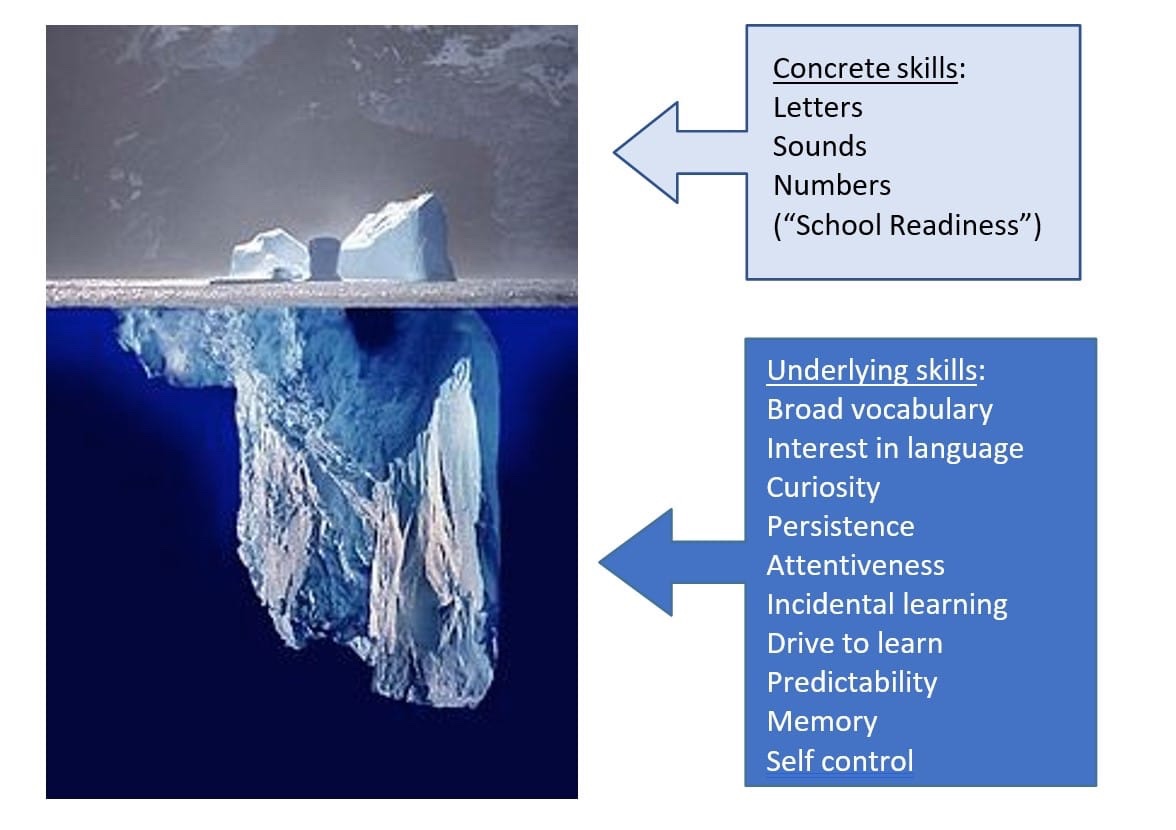
In an article on the blog of DEY (Defending the Early Years), Farran expressed her views about child development. She used the metaphor of an iceberg.

She wrote:

Years ago, few teachers believed that children should be taught to read in kindergarten; a more recent survey shows that 80% of kindergarten teachers now think children should know how to read before leaving the grade.

As recently as 1993 the great majority of kindergarten teachers did not believe an academic focus in preschool was important for children’s school success.

However, concern for the “fade out” of pre-kindergarten effects has led several researchers and policy makers to argue for a stronger academic focus in those classrooms, including the use of an intentional scripted, academically focused curriculum.

Not only do effects from pre-k classrooms fade, but also results from one study of the longitudinal effects of pre-k attendance conducted by my colleagues and me demonstrated that in the long run the effects turned negative.

A greater focus on academics for three- and four- year-olds is not the solution.

As an author of the recent paper on long term effects and as a primary investigator on the only randomized control trial of a statewide pre-k program with longitudinal data, and, finally, as a developmental psychologist whose career focused on young children’s development, I have thought extensively about what the causes of these unexpected effects might be.

I AM PROPOSING AN “ICEBERG MODEL OF EARLY DEVELOPMENTAL COMPETENCIES.”


The tip of the iceberg, the section floating above the surface, is composed of things that are easily measured.

These types of skills have recently been characterized as “constrained” skills meaning they are finite and definable.

All standard school readiness assessments focus on these types of skills.

But they do so because assessors believe that the skills represent deeper competencies.

They measure these skills somewhat like taking a finger-prick for evidence of the information the assessments provide into other more important characteristics of children.

BOTH THE FOCUS OF CURRENT PRE-K PROGRAMS AND THE PEDAGOGICAL STRATEGIES EMPLOYED FOCUS ALMOST EXCLUSIVELY ON THE TIP OF THE ICEBERG SKILLS.

Many who have been in early childhood for a long time testify to the changes in classrooms.

I believe these changes are accelerated by the process of subsuming preschool into the K-12 system.

In many states the department of education administers the pre-kindergarten program, and the program behaves like an additional grade level below kindergarten – the classrooms are open for the school day (5-6 hours a day) and the school calendar (9 months a year).

The classrooms are most often in elementary schools, where the push down from the K- 12 system is almost impossible to avoid.

Many of the elementary schools are older and unsuitable for younger children – no bathroom connected to the classroom, the requirement to have meals in the large cafeteria, and no appropriate playground.

These physical features mean that children spend a lot of time transitioning from the classroom, necessitating a high level of teacher control as children walk through the halls and endure long wait times.

Descriptions from a number of large studies of the instructional strategies used in current pre-k classrooms show them to be dominated by whole group instruction focused on basic skills (the tip of the iceberg).

TEACHERS TALK AT CHILDREN A MAJORITY OF THE TIME, SELDOM LISTENING TO CHILDREN, AND MULTI-TURN CONVERSATIONS ARE A RARE OCCURRENCE.

Learning opportunities that involve other than right-answer questions are almost never observed, and a high level of negative control from teachers characterizes many classrooms.

This content focus and the teaching strategies, I argue result in a detachment of the tip of the iceberg from the deeper skills under the surface.

Thus, children can score well on school readiness skills at the end of pre-k – especially on those related to literacy – but not maintain any advantage by the end of kindergarten when all children attain these skills with or without pre-k experience.

The tip of the iceberg skills no longer symbolizes those under the surface.

They are no longer the visible and measurable aspects of more important competencies.

Only when the deeper skills are enhanced should we expect continued progress based on early experiences.

A very different set of experiences likely facilitates the development of those deeper skills.

We have known for many years that the developmental period between four and six years is a critical one.

Neuroscience confirmed the importance of this period for the development of the pre-frontal cortex.

The pre-frontal cortex is involved in many of the skills described in the model as being below the surface.

Research does not provide good evidence for which experiences facilitate the development of important skills like curiosity, persistence, or working memory.

But research has demonstrated the importance of these kinds of skills for long term development.

For instance, some argue that early attention skills are more important than early academic skills as predictors of long-term school success including the likelihood of attending college.

In a large longitudinal study, researchers identified the importance of the development of internal self-control during the ages of four to six.

Some children with initially low self- control developed self-control during early childhood and had subsequent better outcomes via what the researchers called a “natural history change.”

Whether an intervention-induced change would yield the same positive outcomes is an open question.

So far, no early childhood curriculum has been able to bring about sustained changes in self-control or any of the below- the-surface skills listed above.

WHAT IS CLEAR IS THAT CHILDREN FROM MORE AFFLUENT HOMES ENTER KINDERGARTEN SCORING HIGHER ON SCHOOL READINESS SKILLS.

Moreover, they maintain that advantage across the school years.

But they did not learn those “readiness” skills from a didactic pre-k experience.

While these children may have had magnetic alphabet letters to play with, for example, parents did not sit them down in front of the refrigerator and force them to learn the letters.

Most of those tip-of-the-iceberg skills were learned through a variety of experiences and the opportunity to learn through interactions with adults and friends.

For these children, measuring the tip does provide information about the beneath the surface competencies that are so important.

Guidance may come from comparing the developmental contexts of families who are economically secure to the pre-k classroom context.

Children of economically secure families are more likely to succeed in school, more likely to matriculate in a two or four year college and more likely to graduate when they enter….

GOVERNMENTS IN MOST HIGHLY DEVELOPED COUNTRIES HEAVILY SUBSIDIZE THE CARE FOR YOUNG CHILDREN PRIOR TO SCHOOL AGE.

Nordic countries all provide a child supplement to parents, which most parents use to offset the modest cost of the government-subsidized group care, care that looks nothing like U.S. pre-k programs.

These programs stress different sorts of competencies in young children, capabilities like “participation” or the ability to be a functioning member of a group (not sitting “criss-cross applesauce” for 20-40 minutes during large group instruction).

The programs stress self-reliance and independence, the ability to make good decisions and to be responsible for one’s actions.

Most of these countries delay formal instruction in academic skills until children are six or seven. Their children do quite well in international comparisons in the later grades.

Concerns about the accelerating academic focus in early childcare education are being voiced by many.

I hope this “iceberg” model will provide a useful visual depiction of the danger of concentrating on basic skills instruction in pre-k.

I hope also that it will help people understand why getting early childhood right is so important and the imperative need to fix the childcare situation in the U.S. for families of poor children – in fact for all our children.

Pre-k is not the magic bullet policy makers hoped it would be. Quite the contrary. The reason it is not may lie with the unavoidable focus of the program when it becomes part of the K-12 system.

On Saturday, I went to a matinee of “The Music Man” on Broadway. Before entering, every person had to prove that they were fully vaccinated. Everyone in the audience wore masks.

We are used to that now.

What we are not used to yet is seeing a full Broadway musical, in all its glory, with a huge and very talented cast, wonderful sets and staging, and a large orchestra.

Sutton Foster as Marian the Librarian was excellent, as was Hugh Jackman as Professor Harold Hill.

The audience was ecstatic, applauding everything and everybody, every dance number and song.

Make plans to visit NYC in the spring or summer and book tickets well in advance. I promise you a delightful event.

Broadway is the beating heart of New York City, and Broadway is back!

Have a happy, HEALTHY New Year!

Get vaccinated if you haven’t already, although I can’t believe that any reader of this blog would not be double vaccinated and boosted by now. Wear an N95 or KN95 mask. (Here is advice from the New York Times about how to buy high-quality N95 masks online.) My friends tell me that this is the N95 mask used by nurses at Mt.Sinai Hospital in New York City.

Georgia Congresswoman Marjorie Taylor Greene has boasted that she is unvaccinated, but news came out last week that she owns stock in three of the four major vaccine manufacturers. At least we can be assured that she’s not fighting vaccines for her own financial benefit. Greene has repeatedly defied rules requiring masking when in the House of Representatives, and she’s so far racked up $80,000 in fines deducted from her salary for failing to wear a mask. She says the federal public health rules are “tyrannical,” “communist,” “authoritarian,” and “unconstitutional.”

This is the kind of ideological insanity that’s fueling the longevity of the pandemic. If you know people like her, avoid them until the danger is past.

Be careful.

You can’t be happy unless you are healthy.

Be healthy. Be happy.

I want you all with me in 2022.

Happy New Year!

Diane

Fred Smith published his annual Christmas poem in the New York Daily News and shares it her with us. Fred was for many the director of assessment at the New York City Board of Education. Since retiring, he has worked with parent optout-of-testing groups.

Christmas 2021

In a year filled with trauma on this Christmas eve,

I’d just taken a booster shot under my sleeve.

And then starting to fade in-and-out woozy,

I dreamt of getting a hot tub jacuzzi.

Soon my vision was clouded, my eyesight grew dim

As much as I wanted to, I couldn’t spot him.

For the guy in the red suit had been chased away.

I saw Amazon trucks, not his wonderful sleigh.

And with Bezos’ boxes flying off of the shelves,

Santa couldn’t find work for his beloved elves.

But he emailed the names on his naughty-guy list,

And said what he’d have given each one as a gift.

His roll covered miscreants across all levels

From the state to the fed to a broad range of devils:

For Andrew a thick pair of anti-grope mitts;

Melissa gets valium to curb her mean fits.

A special surprise awaits Jim Malatras:

Strong itching powder to rub in his gatkes.

And for highly placed, overstayed, wealthy Queen Tisch;

A time-to-go sendoff with a stale kasha knish.

To those congressmen who block legislation,

Cartons of Ex-Lax to relieve constipation.

For roadblock senators Manchin and Sinema,

A progressive bundle far more than the minima.

And Donald gets a golden bowlful of kale,

And sentenced to life in a health foodie jail.

A Clorox colada for his goombah Rudy,

And Mitch gets a voracious turtleneck cootie.

Community service—what Trump’s racist friends need,

Posting BLM banners ‘til their hateful hands bleed.

And to all the crazies of his insurrection,

Poison pills to choke down for the “stolen election.”

And fittingly, for all climate change deniers,Full-time sweat labor putting out raging fires.

For all anti-vaxxers and anti-mask wearers,

The names and addresses of local pall bearers.

To Proud Boy gents and those QAnon ladies,

Immediate transport to hovels in Hades.

For the same “Breaking News!” droning on all the day,

Cable news gets a free pass to go faraway.

For donors and lobbyists who bought Mayor Bill,

A backhoe that recoups their ill-gotten fill.

For Michael Mulgrew and his right of retention,

50 years to teach shop for a Tier 20 pension.

To Pearson executives who are truly villains

Killing 8-year-old minds with bubble sheet fill-ins:

Here’s an endless supply of sharp No. 2s

To suck all the lead out, as your brains start to ooze.

The roster of evil includes many foul names

Equally worthy of being consigned to the flames.

So, he filled up their stockings with hot burning coals,

An appropriate payment for selling their souls.

From the time I came under my glum Pfizer-ish fog

He hadn’t named anyone on his A+ log.

Such a negative Santa made me melancholy

There was no ho, ho, ho; what happened to jolly?

Then suddenly he sent me a rose-colored wink

To show that his spirit was still in the pink,

Reminding me how he loves kids most of all

And those who protect them who won’t let our schools fall.

So, all was not bleak on this dark Yuletide night;

The greatest gifts always go to those who do right,

Who like his own reindeer outlast any storm

With unblinking vision to create a new norm.

On Leonie fiercely striving to lower class size;

On Ravitch and Burris puncturing charter school lies;

On Rosa and Cashin up high, seeing the light

On Rebell and Jackson, winning equity’s fight

There’s steady Norm Scott always keeping the score

With faith in our teachers who deserve so much more.

And Jeanette and Lisa working at the grass roots.

Giving parents their voices and speaking the truth

Though the online business has invaded our lives“

Yes, Virginia” still lives; and goodness survives.
Dear Friends,

NPE wishes you happy holidays and Merry Christmas! Open the link to learn about our plans for 2022.

Join us in our work of supporting, defending, and improving our nation’s public schools. Join the 350,000 devotees of public schools who are part of NPE. Help us to fight budget cuts and privatization of our most valuable public assets. Help us defeat the billionaires and grifters who want to grab the funding of public schools and devote it to charters and vouchers. Stand with us as we press for reduced class sizes and the misuse of tests and technology.

2021 has brought both good and bad news for our public schools.

Schools were able to open, and although COVID is surging and difficult to manage, our students are in class with the teachers they love. We thank all of our educators for their heroic efforts during such difficult times.

The bad news is that a new war on public schools has begun. Public schools and teachers became a target after the 2008 recession; sadly, it is happening again. Post-2008 brought teacher evaluations by test scores, Common Core testing, and a push for charter schools. This time we face book-banning, anti-CRT laws, and more charter schools and vouchers.

Here is a quote from The New York Times:

Chris Rufo, the right-wing intellectual entrepreneur behind the anti-critical race theory campaign, told me last month that the next phase of his offensive will be a push for school choice, including private school vouchers, charter schools, and home-schooling. “The public schools are waging war against American children and American families,” he said, so families should have “a fundamental right to exit.”

The Network for Public Education will defend our communities’ right to have well-funded, neighborhood schools open to all students and governed by the public. We believe in the ultimate goodness of our communities, even when times are dark. Public education is a pillar of our democracy; privatized “choice” is its wrecking ball. We must fight it in all of its forms.

Won’t you help us keep the lights on and continue the fight? Please give generously.

On behalf of NPE,

Diane Ravitch, President

Carol Burris, Executive Director

Darcie Cimarusti, Communications Director

Marla Kilfoyle, Grassroots Coordinator

Sir Ken Robinson inspired educators around the world with his vision of child-centered schools that focused on imagination, creativity, the arts, and the joy of learning.

Sadly, he died last August at the age of 70.

His daughter Kate Robinson has organized a virtual celebration of his life and work on March 4, called “Imagine If…”

I hope you will watch it.

The New York Times said this about him:

Ken Robinson, a dynamic, influential proponent of stimulating the creativity of students that has too often been squelched by schools in the service of conformity, died on Aug. 21 at his home in London. He was 70.

His daughter, Kate Robinson, said the cause was cancer.

A British-born teacher, author and lecturer, Mr. Robinson viewed large school systems as sclerotic, squeezing the creative juices out of children by overemphasizing standardized testing and subjects like mathematics and science over the arts and humanities.

“There isn’t an education system on the planet that teaches dance every day to children the way we teach them mathematics,” he said during a TED Talk in 2006 that has been downloaded 67 million times, the most in the lecture organization’s history. “I think math is very important, but so is dance. Children dance all the time, if they’re allowed to.”


Recently Tom Ultican responded to something I posted on Twitter.

His response contained a typo.

He meant to write “Common Core Standards,” but mistakenly wrote “Common Care Standards.”

Wouldn’t it be wonderful if our schools had “Common Care Standards,” in which we acknowledged our responsibility to care about students?

The standards might read like this:

All children shall have access to high quality preschool.

All children should have time to play every day, between classes and after school.

All children should have three nutritious meals every day.

All children should see a school nurse whenever they don’t feel well.

All children should be checked by a doctor and dentist annually.

All children should have access to a well-stocked library.

All children should have a safe place to live.

All children should have the arts as part of their daily schedule.

All children should have a school curriculum that includes not only reading and mathematics, but civics and history, science, literature, and foreign language.

Do you have anything to add to the Common Care Standards?

The first snow storm of the season raged up the Eastern seaboard! Students thought they might have a snow day, but in some districts, the leadership said “No!”

This will upset those “reformers” who think it is time to get tough on the kids, time to get ready for the next test, time to squelch any sign of happiness, but:

In West Virginia, a school superintendent said a loud “Yes!”

In a letter to the school community on Tuesday, Jefferson County Schools Superintendent Bondy Shay Gibson said she was canceling classes so that students and faculty could take a much-needed break during a very hard year.

“For generations, families have greeted the first snow day of the year with joy,” Gibson’s letter states. “It is a time of renewed wonder at all the beautiful things that each season holds. A reminder of how fleeting a childhood can be. An opportunity to make some memories with your family that you hold on to for life.”

“For all of these reasons and many more, Jefferson County Schools will be completely closed for tomorrow, Dec. 16, in honor of the 1st snow day of the year,” the letter continues. “Closed for students … closed for virtual … closed for staff.”

Gibson said she hoped the snow day would provide the kind of joy, rest, and celebration that has been so rare during the pandemic.

“It has been a year of seemingly endless loss and the stress of trying to make up for that loss,” she said. “For just a moment, we can all let go of the worry of making up for the many things we missed by making sure this is one thing our kids won’t lose this year.”

“So please, enjoy a day of sledding and hot chocolate and cozy fires,” she said. “Take pictures of your kids in snow hats they will outgrow by next year and read books that you have wanted to lose yourself in, but haven’t had the time.”

“We will return to the serious and urgent business of growing up on Thursday, but for tomorrow,” the letter concludes, “go build a snowman.”

Joe Biden passed the 270-vote in the electoral college!

He won Pennsylvania, with leads in Arizona and Nevada.

It is a very good day for America and the world!

https://www.cnn.com/2020/11/07/politics/joe-biden-wins-us-presidential-election/index.html

Our long national nightmare is over!

Trump must go. Pack his bags. Clear out and take I ask, Don Jr., Eric, and Stephen Miller with him.

I was stacking the dishwasher one morning when I starting singing this song, which I haven’t heard for many decades.

I think you will enjoy it too.