Archives for category: History


Darrell M. West of the Brookings Institution explains the history of the electoral college and why this antique process for choosing the president should be abolished. 

He begins:

The framers of the Constitution set up the Electoral College for a number of different reasons. According to Alexander Hamilton in Federalist Paper Number 68, the body was a compromise at the Constitutional Convention in Philadelphia between large and small states. Many of the latter worried that states such
as Massachusetts, New York, Pennsylvania, and Virginia would dominate the presidency so they devised an institution where each state had Electoral College votes in proportion to the number of its senators and House members. The former advantaged small states since each state had two senators regardless of its size, while the latter aided large states because the number of House members was based on the state’s population.
In addition, there was considerable discussion regarding whether Congress or state legislatures should choose the chief executive. Those wanting a stronger national government tended
to favor Congress, while states’ rights adherents preferred state legislatures. In the end, there was a compromise establishing an independent group chosen by the states with the power to choose the president.
But delegates also had an anti-majoritarian concern in mind. At a time when many people were not well-educated, they wanted a body of wise men (women lacked the franchise) who would deliberate over leading contenders and choose the best man for the presidency. They explicitly rejected a popular vote for president because they did not trust voters to make a wise choice.

In most elections, the Electoral College has operated smoothly. State voters have cast their ballots and the presidential candidate with the most votes in a particular state has received all the Electoral College votes of that state, except for Maine and Nebraska which allocate votes at the congressional district level within their states.

But there have been several contested elections. The 1800 election deadlocked because presidential candidate Thomas Jefferson received the same number of Electoral College votes as
his vice presidential candidate Aaron Burr. At that time, the ballot did not distinguish between Electoral College votes for president and vice president. On the 36th ballot, the House chose Jefferson as the new president. Congress later amended the Constitution to prevent that ballot confusion from happening again.

You will find this to be an interesting account.

There have been a few elections where the popular vote and the electoral vote differed. In recent years, there were two. Al Gore beat George W. Bush by half a million votes while losing the election. Hillary Clinton won nearly three million votes more than Trump, who won the electoral college.

What kind of democracy elects the loser of the popular vote as its leader?

Journalist Valerie Strauss interviewed historian Jack Schneider. Is Betsy DeVos right to say that American public schools have not changed for a century, she asks. He answers: Not true. Betsy DeVos doesn’t know what she is talking about.

Schneider says:

If we could transport ourselves to a typical school of the early 20th century, the basic structural elements — desks, chalkboards, textbooks, etc. — would be recognizable. And we might see some similar kinds of power dynamics between adults and children. But almost everything else would be different. The subjects that students studied, the way the day was organized, the size of classes, the kinds of supports young people received — these essential aspects of education were all different. Teachers were largely untrained. Access to education was entirely shaped by demographic factors like race and income; special education didn’t exist. Latin was still king. It was just a completely different world. To say that schools haven’t changed is just an extraordinarily uninformed position.

DeVos says these ridiculous things because she wants to disrupt public schools. The reality is that they are constantly evolving.

Teachers and principals are too busy working every day to “reinvent” their schools.

Strauss quotes Professor Adam Laats of Binghamton University (SUNY) who wrote that DeVos’ idea of education anywhere everywhere is actually an early 19th century idea. It didn’t work, it left many children behind, and forward-thinking educators realized the need for free, universal public education.


This is a very provocative post by Teacher Ken Bernstein, who blogs at Daily Kos.

Ken has been teaching government for decades. When he muses about Trump, it’s worth reading.

This is a good time to teach the U.S. Constitution.

Trump has often said that, as president, he can do whatever he wants. He believes he is above the law. He has said that Article 2 of the Constitution assures him complete immunity from any prosecution. In addition, his lawyers asserted in a case in New York that he cannot even be investigated for breaking the law, and that this immunity shields not only him, but his family, his business, and his associates in business.

Trump says that Article 2 gives him “absolute” power and total immunity from investigation or prosecution.

Here is the totality of Article 2, describing the role and powers of the President.

Section 1.

The executive Power shall be vested in a President of the United States of America. He shall hold his Office during the Term of four Years, and, together with the Vice President, chosen for the same Term, be elected, as follows:

Each State shall appoint, in such Manner as the Legislature thereof may direct, a Number of Electors, equal to the whole Number of Senators and Representatives to which the State may be entitled in the Congress: but no Senator or Representative, or Person holding an Office of Trust or Profit under the United States, shall be appointed an Elector.

The Electors shall meet in their respective States, and vote by Ballot for two Persons, of whom one at least shall not be an Inhabitant of the same State with themselves. And they shall make a List of all the Persons voted for, and of the Number of Votes for each; which List they shall sign and certify, and transmit sealed to the Seat of the Government of the United States, directed to the President of the Senate. The President of the Senate shall, in the Presence of the Senate and House of Representatives, open all the Certificates, and the Votes shall then be counted. The Person having the greatest Number of Votes shall be the President, if such Number be a Majority of the whole Number of Electors appointed; and if there be more than one who have such Majority, and have an equal Number of Votes, then the House of Representatives shall immediately chuse by Ballot one of them for President; and if no Person have a Majority, then from the five highest on the List the said House shall in like Manner chuse the President. But in chusing the President, the Votes shall be taken by States, the Representatives from each State having one Vote; a quorum for this Purpose shall consist of a Member or Members from two thirds of the States, and a Majority of all the States shall be necessary to a Choice. In every Case, after the Choice of the President, the Person having the greatest Number of Votes of the Electors shall be the Vice President. But if there should remain two or more who have equal Votes, the Senate shall chuse from them by Ballot the Vice President.

The Congress may determine the Time of chusing the Electors, and the Day on which they shall give their Votes; which Day shall be the same throughout the United States.

No Person except a natural born Citizen, or a Citizen of the United States, at the time of the Adoption of this Constitution, shall be eligible to the Office of President; neither shall any person be eligible to that Office who shall not have attained to the Age of thirty five Years, and been fourteen Years a Resident within the United States.

In Case of the Removal of the President from Office, or of his Death, Resignation, or Inability to discharge the Powers and Duties of the said Office, the Same shall devolve on the Vice President, and the Congress may by Law provide for the Case of Removal, Death, Resignation or Inability, both of the President and Vice President, declaring what Officer shall then act as President, and such Officer shall act accordingly, until the Disability be removed, or a President shall be elected.

The President shall, at stated Times, receive for his Services, a Compensation, which shall neither be encreased nor diminished during the Period for which he shall have been elected, and he shall not receive within that Period any other Emolument from the United States, or any of them.

Before he enter on the Execution of his Office, he shall take the following Oath or Affirmation:–”I do solemnly swear (or affirm) that I will faithfully execute the Office of President of the United States, and will to the best of my Ability, preserve, protect and defend the Constitution of the United States.”

Section 2.

The President shall be Commander in Chief of the Army and Navy of the United States, and of the Militia of the several States, when called into the actual Service of the United States; he may require the Opinion, in writing, of the principal Officer in each of the executive Departments, upon any Subject relating to the Duties of their respective Offices, and he shall have Power to Grant Reprieves and Pardons for Offences against the United States, except in Cases of Impeachment.

He shall have Power, by and with the Advice and Consent of the Senate, to make Treaties, provided two thirds of the Senators present concur; and he shall nominate, and by and with the Advice and Consent of the Senate, shall appoint Ambassadors, other public Ministers and Consuls, Judges of the supreme Court, and all other Officers of the United States, whose Appointments are not herein otherwise provided for, and which shall be established by Law: but the Congress may by Law vest the Appointment of such inferior Officers, as they think proper, in the President alone, in the Courts of Law, or in the Heads of Departments.

The President shall have Power to fill up all Vacancies that may happen during the Recess of the Senate, by granting Commissions which shall expire at the End of their next Session.

Section 3.

He shall from time to time give to the Congress Information on the State of the Union, and recommend to their Consideration such Measures as he shall judge necessary and expedient; he may, on extraordinary Occasions, convene both Houses, or either of them, and in Case of Disagreement between them, with Respect to the Time of Adjournment, he may adjourn them to such Time as he shall think proper; he shall receive Ambassadors and other public Ministers; he shall take Care that the Laws be faithfully executed, and shall Commission all the Officers of the United States.

Section 4.

The President, Vice President and all Civil Officers of the United States, shall be removed from Office on Impeachment for and Conviction of, Treason, Bribery, or other high Crimes and Misdemeanors.

I can’t find any language in Article 2 that gives the president immunity from investigation or prosecution or that allows him to do “whatever he wants.” The purpose of the Constitution is to assure that no individual or branch of government has the unlimited powers of a monarch.


This is a good time to teach the Constitution. Since we are in the midst of a historic impeachment proceeding, I have highlighted the sentences referring to impeachment. I am citing this source.

Just yesterday, Trump threatened to sue Adam Schiff, chairman of the intelligence committee, and Nancy Pelosi, speaker of the House, because he doesn’t think they have the right to impeach him or even to criticize him. He thinks they should be impeached.

The CNN article says:

The speech and debate clause in the US Constitution, which appears in Article 1, section 6, protects members of Congress from being sued over their statements made on the floor, which also would apply to committees.

Let’s review what the Constitution says about the powers of Congress.

The Preamble to the Constitution delineates its purposes.

We the People of the United States, in Order to form a more perfect Union, establish Justice, insure domestic Tranquillity, provide for the common defense, promote the general Welfare, and secure the Blessings of Liberty to ourselves and our Posterity, do ordain and establish this Constitution for the United States of America.  

The Constitution establishes three co-equal branches of government to ensure that there would be checks and balances, and no branch would become authoritarian or monarchical, or superior to the other branches.

Article 1 describes the role and powers of the Congress.

Article 2 describes the role and powers of the President.

Article 3 describes the role and powers of the judiciary.

Here is Article 1:

Section 1.

All legislative Powers herein granted shall be vested in a Congress of the United States, which shall consist of a Senate and House of Representatives.

Section 2.

The House of Representatives shall be composed of Members chosen every second Year by the People of the several States, and the Electors in each State shall have the Qualifications requisite for Electors of the most numerous Branch of the State Legislature.

No Person shall be a Representative who shall not have attained to the age of twenty five Years, and been seven Years a Citizen of the United States, and who shall not, when elected, be an Inhabitant of that State in which he shall be chosen.

Representatives and direct Taxes shall be apportioned among the several States which may be included within this Union, according to their respective Numbers, which shall be determined by adding to the whole Number of free Persons, including those bound to Service for a Term of Years, and excluding Indians not taxed, three fifths of all other Persons. The actual Enumeration shall be made within three Years after the first Meeting of the Congress of the United States, and within every subsequent Term of ten Years, in such Manner as they shall by Law direct. The Number of Representatives shall not exceed one for every thirty Thousand, but each State shall have at Least one Representative; and until such enumeration shall be made, the State of New Hampshire shall be entitled to chuse three, Massachusetts eight, Rhode-Island and Providence Plantations one, Connecticut five, New-York six, New Jersey four, Pennsylvania eight, Delaware one, Maryland six, Virginia ten, North Carolina five, South Carolina five, and Georgia three.

When vacancies happen in the Representation from any State, the Executive Authority thereof shall issue Writs of Election to fill such Vacancies.

The House of Representatives shall chuse their Speaker and other Officers; and shall have the sole Power of Impeachment.

Section 3.

The Senate of the United States shall be composed of two Senators from each State, chosen by the Legislature thereof, for six Years; and each Senator shall have one Vote.

Immediately after they shall be assembled in Consequence of the first Election, they shall be divided as equally as may be into three Classes. The Seats of the Senators of the first Class shall be vacated at the Expiration of the second Year, of the second Class at the Expiration of the fourth Year, and of the third Class at the Expiration of the sixth Year, so that one third may be chosen every second Year; and if Vacancies happen by Resignation, or otherwise, during the Recess of the Legislature of any State, the Executive thereof may make temporary Appointments until the next Meeting of the Legislature, which shall then fill such Vacancies.

No Person shall be a Senator who shall not have attained to the Age of thirty Years, and been nine Years a Citizen of the United States, and who shall not, when elected, be an Inhabitant of that State for which he shall be chosen.

The Vice President of the United States shall be President of the Senate but shall have no Vote, unless they be equally divided.

The Senate shall chuse their other Officers, and also a President pro tempore, in the Absence of the Vice President, or when he shall exercise the Office of President of the United States.

The Senate shall have the sole Power to try all Impeachments. When sitting for that Purpose, they shall be on Oath or Affirmation. When the President of the United States is tried the Chief Justice shall preside: And no Person shall be convicted without the Concurrence of two thirds of the Members present.

Judgment in Cases of Impeachment shall not extend further than to removal from Office, and disqualification to hold and enjoy any Office of honor, Trust or Profit under the United States: but the Party convicted shall nevertheless be liable and subject to Indictment, Trial, Judgment and Punishment, according to Law.

Section 4.

The Times, Places and Manner of holding Elections for Senators and Representatives, shall be prescribed in each State by the Legislature thereof; but the Congress may at any time by Law make or alter such Regulations, except as to the Places of chusing Senators.

The Congress shall assemble at least once in every Year, and such Meeting shall be on the first Monday in December, unless they shall by Law appoint a different Day.

Section 5.

Each House shall be the Judge of the Elections, Returns and Qualifications of its own Members, and a Majority of each shall constitute a Quorum to do Business; but a smaller Number may adjourn from day to day, and may be authorized to compel the Attendance of absent Members, in such Manner, and under such Penalties as each House may provide.

Each House may determine the Rules of its Proceedings, punish its Members for disorderly Behaviour, and, with the Concurrence of two thirds, expel a Member.

Each House shall keep a Journal of its Proceedings, and from time to time publish the same, excepting such Parts as may in their Judgment require Secrecy; and the Yeas and Nays of the Members of either House on any question shall, at the Desire of one fifth of those Present, be entered on the Journal.

Neither House, during the Session of Congress, shall, without the Consent of the other, adjourn for more than three days, nor to any other Place than that in which the two Houses shall be sitting.

Section 6.

The Senators and Representatives shall receive a Compensation for their Services, to be ascertained by Law, and paid out of the Treasury of the United States. They shall in all Cases, except Treason, Felony and Breach of the Peace, be privileged from Arrest during their Attendance at the Session of their respective Houses, and in going to and returning from the same; and for any Speech or Debate in either House, they shall not be questioned in any other Place.

No Senator or Representative shall, during the Time for which he was elected, be appointed to any civil Office under the Authority of the United States, which shall have been created, or the Emoluments whereof shall have been encreased during such time; and no Person holding any Office under the United States, shall be a Member of either House during his Continuance in Office.

Section 7.

All Bills for raising Revenue shall originate in the House of Representatives; but the Senate may propose or concur with amendments as on other Bills.

Every Bill which shall have passed the House of Representatives and the Senate, shall, before it become a law, be presented to the President of the United States: If he approve he shall sign it, but if not he shall return it, with his Objections to that House in which it shall have originated, who shall enter the Objections at large on their Journal, and proceed to reconsider it. If after such Reconsideration two thirds of that House shall agree to pass the Bill, it shall be sent, together with the Objections, to the other House, by which it shall likewise be reconsidered, and if approved by two thirds of that House, it shall become a Law. But in all such Cases the Votes of both Houses shall be determined by Yeas and Nays, and the Names of the Persons voting for and against the Bill shall be entered on the Journal of each House respectively. If any Bill shall not be returned by the President within ten Days (Sundays excepted) after it shall have been presented to him, the Same shall be a Law, in like Manner as if he had signed it, unless the Congress by their Adjournment prevent its Return, in which Case it shall not be a Law

Every Order, Resolution, or Vote to which the Concurrence of the Senate and House of Representatives may be necessary (except on a question of Adjournment) shall be presented to the President of the United States; and before the Same shall take Effect, shall be approved by him, or being disapproved by him, shall be repassed by two thirds of the Senate and House of Representatives, according to the Rules and Limitations prescribed in the Case of a Bill.

Section 8.

The Congress shall have Power To lay and collect Taxes, Duties, Imposts and Excises, to pay the Debts and provide for the common Defence and general Welfare of the United States; but all Duties, Imposts and Excises shall be uniform throughout the United States;

To borrow Money on the credit of the United States;

To regulate Commerce with foreign Nations, and among the several States, and with the Indian Tribes;

To establish an uniform Rule of Naturalization, and uniform Laws on the subject of Bankruptcies throughout the United States;

To coin Money, regulate the Value thereof, and of foreign Coin, and fix the Standard of Weights and Measures;

To provide for the Punishment of counterfeiting the Securities and current Coin of the United States;

To establish Post Offices and post Roads;

To promote the Progress of Science and useful Arts, by securing for limited Times to Authors and Inventors the exclusive Right to their respective Writings and Discoveries;

To constitute Tribunals inferior to the supreme Court;

To define and punish Piracies and Felonies committed on the high Seas, and Offences against the Law of Nations;

To declare War, grant Letters of Marque and Reprisal, and make Rules concerning Captures on Land and Water;

To raise and support Armies, but no Appropriation of Money to that Use shall be for a longer Term than two Years;

To provide and maintain a Navy;

To make Rules for the Government and Regulation of the land and naval Forces;

To provide for calling forth the Militia to execute the Laws of the Union, suppress Insurrections and repeal Invasions;

To provide for organizing, arming, and disciplining, the Militia, and for governing such Part of them as may be employed in the Service of the United States, reserving to the States respectively, the Appointment of the Officers, and the Authority of training the Militia according to the discipline prescribed by Congress;

To exercise exclusive Legislation in all Cases whatsoever, over such District (not exceeding ten Miles square) as may, by Cession of Particular States, and the Acceptance of Congress, become the Seat of the Government of the United States, and to exercise like Authority over all Places purchased by the Consent of the Legislature of the State in which the Same shall be, for the Erection of Forts, Magazines, Arsenals, dock-Yards and other needful Buildings;–And

To make all Laws which shall be necessary and proper for carrying into Execution the foregoing Powers and all other Powers vested by this Constitution in the Government of the United States, or in any Department or Officer thereof.

Section 9.

The Migration or Importation of such Persons as any of the States now existing shall think proper to admit, shall not be prohibited by the Congress prior to the Year one thousand eight hundred and eight, but a Tax or duty may be imposed on such Importation, not exceeding ten dollars for each Person.

The Privilege of the Writ of Habeas Corpus shall not be suspended, unless when in Cases or Rebellion or Invasion the public Safety may require it.

No Bill of Attainder or ex post facto Law shall be passed.

No Capitation, or other direct, Tax shall be laid, unless in Proportion to the Census of Enumeration herein before directed to be taken.

No Tax or Duty shall be laid on Articles exported from any State.

No Preference shall be given by any Regulation of Commerce or Revenue to the Ports of one State over those of another: nor shall Vessels bound to, or from, one State, be obliged to enter, clear or pay Duties in another.

No Money shall be drawn from the Treasury, but in Consequence of Appropriations made by Law; and a regular Statement and Account of the Receipts and Expenditures of all public Money shall be published from time to time.

No Title of Nobility shall be granted by the United States: And no Person holding any Office of Profit or Trust under them, shall, without the Consent of the Congress, accept of any present, Emolument, Office, or Title, of any kind whatever, from any King, Prince or foreign State.

Section 10.

No State shall enter into any Treaty, Alliance, or Confederation; grant Letters of Marque and Reprisal; coin Money; emit Bills of Credit; make any Thing but gold and silver Coin a Tender in Payment of Debts; pass any Bill of Attainder, ex post facto Law, or Law impairing the Obligation of Contracts, or grant any Title of Nobility.

No State shall, without the Consent of the Congress, lay any Imposts or Duties on Imports or Exports, except what may be absolutely necessary for executing it’s inspection Laws: and the net Produce of all Duties and Imposts, laid by any State on Imports or Exports, shall be for the Use of the Treasury of the United States; and all such Laws shall be subject to the Revision and Controul of the Congress.

No State shall, without the Consent of Congress, lay any Duty of Tonnage, keep Troops, or Ships of War in time of Peace, enter into any Agreement or Compact with another State, or with a foreign Power, or engage in War, unless actually invaded, or in such imminent Danger as will not admit of delay.

To be clear, the House has the sole power to impeach the president. The trial occurs in the Senate, not the House.
This is a short and fascinating video about an iconic photograph: the 11 ironworkers having lunch on a steel beam high above the New York City skyline, as they constructed Rockefeller Center in 1932.

Just right for Labor Day.

Since 1987, The Concord Review (TCR) has sought and published more than 1,300 history research papers by high school
students from 41 countries in 121 quarterly issues. TCR.org. 

Over the course of these many years, Will Fitzhugh, the founder of TCR, has been turned down by every foundation while seeking funding for this worthy endeavor. In their drive for innovation, the nation’s philanthropies did not find merit in the idea of acknowledging the dedication of students who conduct primary historical research and who are recognized by having their work published.

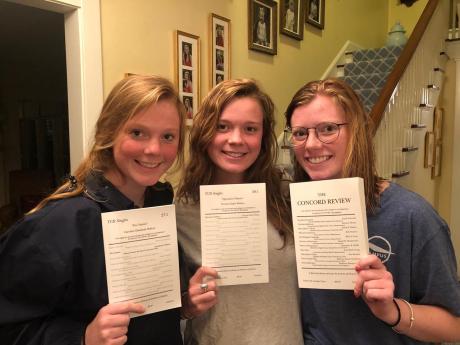
In different years,, three sisters from  Cincinnati, Ohio, won the journal’s highest honor: the Emerson Prize.

The girls attended Summit Country Day School.

Winners of the Emerson Prize: (left to right):
Caroline Elizabeth Walton, The Tudors, Volume 27, Number 1 {18,000 words)
Victoria Claire Walton, Operation Valkyrie, Volume 29, Number 1 (15,000 words)
Emily K. Walton, Mary Queen of Scots, Volume 24, Number 3 (13,200 words)

thumbnail


Fitzhugh wants high school students to read history, not textbooks, but actual history. He wants them to do research and write in-depth history essays. He publishes the best of them in TCR.

In addition, he offers these services:

TCR SERVICES
High School students planning to go to college should know that they will face reading lists of nonfiction books and be asked to write research papers. The vast majority of American public high school students are not asked to read a single complete nonfiction book or to write a term paper before graduation. But they suspect that the safe spaces of fiction readings and personal writing will not prepare them well enough for college. In many cases their teachers have neither the inclination nor the time to help them with History research papers, and while some students, such as many of those published in The Concord Review since 1987, have set up Independent Study programs which let them write such papers, others may want to make use of the services we offer to serious secondary students of History:
One: The National Writing Board [1998] provides a unique independent assessment service for the History research papers of high school students. Our reports by two Senior Readers now average five pages and may be sent to college admissions officers. Inquire at tcr.org/nwb.
Two: The TCR Summer Program [2014] offers a two-week course on the writing of serious History papers by secondary students, with three sessions in the United States, and one in Korea, in 2019. Contact: steven.lee@tcr.org (Manager of the TCR Summer Program). tcr.org/summer.
Three: The TCR Academic Coaching Service [2014] matches high school students working on a History research paper online with TCR Authors now at or recently graduated from Chicago, Columbia, Harvard, MIT, Princeton, Stanford and Yale. Personal advice and guidance from a successful older peer (many are Emerson Prize winners) can be inspiring and productive for secondary students struggling with serious term papers. Contact Jessica@tcr.org (Manager of the TCR Academic Coaches). tcr.org/coaches.
Four: The Concord Review [1987] can provide students with a fine variety of examples from the History research papers published by >1,300 high school students from 45 states and 40 other countries in 121 issues since 1987. This journal remains the only quarterly in the world for the academic History research papers of secondary students. These papers have served many students as useful models of research and writing to inspire and guide them in their own reading, research and writing. Find many examples at tcr.org/bookstore.

In no particular order.

These are books I enjoyed and learned from.

Anand Giridharadas, Winners Take All: The Elite Charade of Changing the World

Rucker Johnson, Children of the Dream: Why Integration Works

Noliwe Rooks, Cutting School:  Privatization,  Segregation, and the End of Public Education
Richard Rothstein, The Color of Law: A Forgotten History of How Our Government Segregated America 
Gordon Lafer, The One Percent Solution: How Corporations Are Remaking America One State at a Time
Nancy McLean, Democracy in Chains: The Deep History of the Radical Right’s Stealth Plan for America
Daniel Koretz, The Testing Charade: Pretending to Make Schools Better
Yong Zhao, What Works May Hurt—Side Effects in Education
Pasi Sahlberg and William Doyle, Let the Children Play: How More Play Will Save Our Schools and Help Children Thrive
Eve Ewing, Ghosts in the Schoolyard: Racism and School Closings on Chicago’s South Side
Sent from my iPad


Checker Finn and I used to be best buddies back in the days when I was on the other side (the wrong side) of big education issues. We became friends in the early 1980s. We created something called the Educational Excellence Network, which circulated a monthly newsletter on events and issues back in the pre-Internet days. I was a member of the board of the Thomas B. Fordham Foundation, which was created and chaired by his father and led by Checker. Checker had worked for Lamar Alexander when Lamar was Governor of Tennessee, and he recommended me to Lamar when Lamar became George H.W. Bush’s Secretary of Education. I accepted the job of Assistant Secretary of Education for Research and Counselor to the Secretary, the same job Checker had held during the Reagan administration, when Bill Bennett was Secretary of Education. We both served as members of the Koret Task Force at the Hoover Institution. As a member of Checker’s board, I opposed accepting funding from the Gates Foundation, since I thought that as a think tank, we should protect our independence and we had plenty of money. I opposed TBF becoming an authorizer of charters in Ohio, where TBF was theoretically based even though its main office was in DC. I was outvoted on both issues. As a member of the Koret Task Force, I was in regular conversation and discussion with the best conservative thinkers. Over time, however, I lost the conservative faith. I changed my mind, as I described in my book, The Death and Life of the Great American School System: How Testing and Choice Are Undermining Education. 

I became and remain a deeply skeptical critic of all the grand plans to reinvent American education, especially those that emanate from billionaires and from people who are hostile to the very concept of public education.

To my surprise, I read an article recently by Checker that captured my skepticism about the Big Ideas imposed on schools and teachers. This one was called the New American Schools Development Corporation. It was spun off during the brief time that Lamar Alexander was Secretary. It was David Kearns’ pet project. David was a former CEO of Xerox who agreed to serve as Lamar’s Deputy Secretary. He was a wonderful man and I enjoyed getting to know him. He thought like a CEO and he thought that the best way to spur innovation was to hold a contest with a big prize. (Race to the Top did the same thing and flopped.)

Checker relies on the work of a wonderful scholar named Jeff Mirel of the University of Michigan. Jeff, a dear friend of mine, died earlier this year, far too young. He was a strong supporter of public schools and a first-rate historian. I miss him.

As Checker show, the NewAmerican Schools project failed. But the $50 Million that Kearns raised from private sources was eagerly snapped up.

My reaction to Checker’s article was this: Twenty or thirty years from now, someone will write a similar article about charter schools and ask, “How could people have been so dumb as to believe that you could ‘reform’ American education by letting anyone get public money to open any kind of school? Why did they think it was a good idea to let entrepreneurs and for-profit entities open schools? Why did they allow corporate chains to take over community public schools? Why did they allow religious zealots to get public money intended for public schools? They must have lost all common sense or any sense of history!”


Thanks to Los Angeles blogger Sara Roos for calling my attention to this very interesting article by journalist Rachel Cohen. We have had an extended exchange about the article.

Cohen says that the typical origin story of charter schools credits the idea to AFT President Al Shanker. She shows that the idea was percolating long before Shanker began promoting charters in 1988. The idea of public-private partnerships was in the air in the late 1980s and was the underpinning of what was called Third Way politics, as practiced by Bill Clinton and Tony Blair.

Cohen does an excellent job of describing the milieu in which the charter idea emerged. Shanker was not its originator but he was an important publicist for the idea. Without his support, charters might never have achieved national attention.

Right-wingers today, as Cohen notes, like to credit paternity of charters to Shanker, which is amusing since 90% of charters are non-union. Charter advocates who think of themselves as progressive also cling to Shanker as their forebear, but can’t explain why the charter sector is both non-union and highly segregated.

Cohen fails to mention that Shanker renounced charters in 1993, five years after embracing them, because he realized that his idea had been sabotaged and had turned into a tool with which to bust unions and to privatize public schools. In one of the paid advertisements that he published every Sunday in the New York Times, he wrote that charters were no different from vouchers. And he denounced them.

Strangely, neither the right-wingers nor the progressive charter fans ever acknowledge that Shanker denounced what was allegedly his big idea.

It is important to recall what Shanker had in mind when he supported charters.

1. He saw them as schools-within-schools, not as independent schools operating with their own school board, nor as corporate chains replacing public schools.

2. He saw them as teacher-run schools.

3. He saw them recruiting the weakest and most alienated students, the ones who had dropped out or were at risk of dropping out.

4. He said they should not be authorized without the support of the teachers in the school where they would operate.

5. He said they should not be authorized without the permission of the local school board.

6. He expected that the teachers in the charter school, operating as a school-within-a-school, would be members of the same union as the other teachers in the building.

7. He believed that the charter should run for five years, which would allow it to try out new ideas and share them with the rest of the school.

8. He did not envision the charter school as a permanent entity, but as a five-year or longer experiment designed to allow innovation and collaboration.

9. He did not envision charters run by non-educators, entrepreneurs, corporations, and grifters.

10. He did not envision corporate charter chains.

11. He did not envision a charter industry that is 90% non-union, more segregated than district public schools, and inclined to cherrypick the most motivated students.

When he saw businesses moving into the public school sector, he realized his own ideas had been destroyed by greed.

What he thought initially was a progressive idea was captured by the Waltons, the DeVos family and others on the right who wanted to destroy public schools and unions.