Archives for category: Health

South Carolina may soon have one of the cruelest bans on abortion in the nation. The affluent women who want an abortion will fly or drive to another state to get an abortion. Those who can’t afford to flee to another state, one that does not criminalize reproductive rights, will bear babies they can’t afford or don’t want. They will be forced to carry dead fetuses in their wombs. They will be compelled to give birth to the child of their rapist or their father or brother. Teenagers—children themselves— impregnated by a rapist will be forced to be mothers instead of getting an education.

CNN reports:

CNN) – A South Carolina Senate committee voted Tuesday afternoon to send a proposed near-total ban on abortion to the state Senate for consideration after first removing an exception for rape and incest — a move sure to set up a fight over the legislation in the full chamber.

The South Carolina Senate Medical Affairs Committee advanced House Bill 5399 in a 9-8 vote, with two Republicans joining Democrats in voting against it. The Senate is scheduled to meet Wednesday.

Several members of the state Senate, as well as the House, have said they cannot support a bill that does not include an exception for pregnancies that result from rape or incest.

The state Senate committee voted 7-3 on Tuesday morning to eliminate an exception added by the state House last week for cases of rape or incest up to 12 weeks after conception, with required reporting to law enforcement.

This is the sadistic work of Republican men—in this instance, only Republican men—who value fetuses more than the lives of women. Once those fetuses are born, these same men will not provide healthcare or any of the basics of life.

They love the unborn. They don’t give a damn about the born.

Blake Masters is the Republican candidate opposing incumbent Democratic Senator Mark Kelly in Arizona. Masters is closely allied with misogynistic billionaire Peter Thiel.

On his campaign website, he declared that was completely opposed to abortion at any stage of pregnancy, with no exceptions. He said he was “100% pro-life.” He called Roe v. Wade a “horrible” decision.

He called for “a federal personhood law (ideally a Constitutional amendment) that recognizes that unborn babies are human beings that may not be killed.”

But then came the election in Kansas, where Republican women joined with Democrats to block an effort to remove the right to an abortion from the state constitution.

Now, reports the Arizona Republic, Masters has softened the language on his website to pretend to be a moderate on abortion. In other words, he is trying to pull a Kavanaugh, pretending that he is not what he is.

He removed the reference to being “100% pro-life.” He claims to support reasonable limits on abortion, no longer completely opposed to it. The Roe decision is now described as “bad,” not “horrible.” He now claims to support Arizona’s ban on abortion after 15 weeks of pregnancy.

The Masters campaign did not immediately elaborate on the website changes. He launched a digital ad Thursday addressing abortion, in which he says, “Most people support commonsense regulation around abortion.”

Kelly has supported federal abortion rights and blasted the Supreme Court’s ruling doing away with them.

He said about the Dobbs’ decision overturning Roe v. Wade:

“Today’s decision is a giant step backward for our country. Women deserve the right to make their own decisions about abortion. It is just wrong that the next generation of women will have fewer freedoms than my grandmother did,” he said in a written statement.

“In Arizona, there are already restrictive bans on the books that will take rights away from Arizona women, without exceptions even in the case of rape or incest. I know that this decision and these laws are leaving many Arizonans frustrated and scared. This is an all-hands-on-deck moment. I am resolved to defend and protect the right of Arizona women to make their own health care decisions.”

Masters has called Kelly an extremist for defending a right that existed for nearly half a century.

As Masters tries to rewrite his own history, will the women of Arizona be fooled?

Dahlia Lithwick, writing in Slate, makes three important points about the ongoing controversy over abortion and the Supreme Court’s overturning of Roe v. Wade. The anti-abortion movement is not satisfied because they want more than a decision that allows some states to offer abortions.

First, their real goal is a national ban on abortion and a declaration that a fetus has all the rights of a person. They want fetal personhood, in every state.

Second, since the Dobbs’ decision reversing Roe, large numbers of Republicans have expressed their opposition to the decision.

Third, post-Dobbs, expect to read frequent stories about women who died because they were denied an abortion; about women forced to carry dead fetuses for the full term of pregnancy; of children forced to give birth because they are “too immature” to have an abortion.

The only good news in this tragic turn of events is that Republicans who support abortion extremists may face a backlash.

She writes:

It’s being called “Roevember,” a reckoning around women’s rights and fundamental liberties that hasn’t been witnessed since the shaggy-haired days of the ERA. As Jeremy Stahl noted just last week, recent polling seems to show that women are pretty affirmatively pissed off about Roe v. Wade being overturned, and it’s affecting a set of key Senate races, in addition to down-ballot contests around the country. Mark Joseph Stern and I wrote recently that there is virtually no other way to assess the beatdown Kansas voters recently unleashed upon an amendment that would have removed abortion rights from their state constitution than as a repudiation of the Supreme Court’s recent Dobbs intervention, and a promise that even in ruby red states, and even among ruby red voters, only a tiny minority of female voters would endorse forcing teen girls to carry pregnancies to term. After Dobbs came down at the end of June, Kansas reported a 1,038 percent increase in voter registrations that week alone, compared just with the week before.

Yes, even Republican women get abortions. Even conservative women get abortions. Having had the “right” to an abortion and control of their bodies for almost half a century, many women will find it hard to give up their reproductive rights.

Remember when Republicans believed in local control of schools? Those days are over, at least in Florida (and in other states where billionaires and Wall Street titans pour money into school board races to advance privatization).

In Florida, Governor DeSantis has endorsed candidates in more than two dozen local school board elections who are as irresponsible as he is. He can’t bear the possibility that anyone disagrees with him.

He is endorsing candidates who opposed any mask mandates, defying the advice of doctors, scientists, and the CDC.

DORAL, Florida — Republican Gov. Ron DeSantis is working to line up a slew of loyalists on school boards across Florida as he seeks a second term in the nation’s third-largest state.

“We need help at the local level,” DeSantis said at a firefighters building before 430 enthusiastic supporters during a campaign event on Sunday. “You guys with your power going out and voting is going to make a huge difference.”

The governor has endorsed 29 conservative candidates ahead of Tuesday’s election for school board races, which typically don’t receive much attention and are technically nonpartisan.

School board members make decisions about spending, schedules, supplies, curriculum, and other matters. But in more than a dozen counties where DeSantis endorsed candidates, school boards defied the governor last fall by obligating students to wear masks.

What we know about DeSantis. He is shrewd. He plays to basic racism, homophobia, and the most extreme rightwing tendencies of voters. He is a bully.

Nearly two dozen states have moved to restrict abortion or ban it altogether since the reversal of Roe v. Wade — meaning more people, especially those with low incomes and from marginalized communities, will be forced to carry unwanted pregnancies to term.

So are states prepared to pay for the infrastructure needed to support these parents and children? The data paints a grim picture for many families: Mothers and children in states with the toughest abortion restrictions tend to have less access to health care and financial assistance, as well as worse health outcomes.

Stuart Butler, a senior fellow in economic studies at the Brookings Institution, calls the end of Roe “a double whammy” for people who live in these states, which are mostly in the South.

“They are far less likely to have assistance for themselves and their children, and they are far less likely to have health care available to them when they are pregnant and for their children,” he tells Morning Edition. “And that means that there’s going to be not only more hardship, but greater health problems and maternal deaths and so on … unless there is a fundamental change in political behavior in those states.”

As NPR has reported, a large body of research shows that being denied an abortion limits peoples’ education, time in the workforce and wages, with the economic consequences extending well into the lives of their children. One groundbreaking project called The Turnaway Study spent a decade comparing the experiences of people who had abortions with those who wanted abortions but were denied them, and found that those who were denied treatment experienced worse economic and mental health outcomes than those who received care.

Dr. Diana Greene Foster, the demographer behind the study, told NPR in May that the findings show that pregnant people who are unable to get a safe, legal abortion and end up carrying the pregnancy to term will experience long-term physical and economic harm.

“We haven’t become a more generous country that supports low-income mothers,” she added. “And so those outcomes are still the outcomes that people will experience when they are denied a wanted abortion.”

Idaho should hold a referendum and let its people speak on the subject of abortion. The state has one of the strictest bans in the nation.

The Idaho Supreme Court said late Friday that the state’s strict antiabortion laws can take effect while it reviews legal challenges against the restrictions. The near-total ban on abortions is scheduled to kick in Aug. 25.


The court also lifted a stay on a separate law that allows potential relatives of a fetus to sue a provider who carries out an abortion after six weeks of pregnancy. That law becomes effective immediately.


The decision was made in response to lawsuits from a Planned Parenthood chapter and a local doctor challenging laws such as Idaho’s near-total abortion trigger ban, which was designed to become enforceable shortly after the U.S. Supreme Court overturned Roe v. Wade in June. The petitioners had asked the judiciary to suspend enforcement of the abortion restrictions until it reached a final decision.


But Idaho’s highest court denied the requests in a split decision, saying that the petitioners had failed to show that they were likely to prevail in overturning the state’s antiabortion laws.


Idaho’s abortion restrictions have exceptions for rape, incest and when the life of the pregnant person is at risk. Abortion rights supporters had previously argued in court that the medical exceptions were written so vaguely that they were impossible to follow, the Associated Press reported.
The court also noted that the petitioners had raised “serious issues” about the “lack of clarity” regarding Idaho’s medical exceptions, particularly relating to treatment for conditions such as ectopic pregnancies — when a fetus grows outside the uterus, making the pregnancy unviable — and preeclampsia, a pregnancy complication associated with dangerously high blood pressure…

The Idaho Republican Party, which calls abortion “murder from the moment of fertilization” on its platform, didn’t immediately issue a statement in response to the ruling. Its Twitter account retweeted and liked a local reporter’s update on the court’s decision.

My friend in Oklahoma’s baby died in utero at 7 months. They forced her to carry until her body expelled it. She ended up with peritonitis, nearly bled to death and can no longer conceive. Expect this in IN too.

Tweeted by @Fifi_Larue

Chalkbeat reports that the Center for Disease Control is easing up on its COVID recommendations:

Schools can end quarantines and regular screening tests for COVID, but students and staff should keep masks on in areas with high levels of COVID spread, according to guidelines released Thursday by the Centers for Disease Control and Prevention.

The new, more limited recommendationscome as districts across the country are starting a new school year — and in many cases reflect decisions to ease up on COVID precautions that schools have already made. Almost no districts are starting the year with a mask mandate, and in-school quarantine rules are on the retreat.

“This latest guidance from the CDC should give our students, parents, and educators the confidence they need to head back to school this year with a sense of joy and optimism,” Secretary of Education Miguel Cardona said in a statement. “While COVID continues to evolve, so has our understanding of the science and what it takes to return to school safely.”

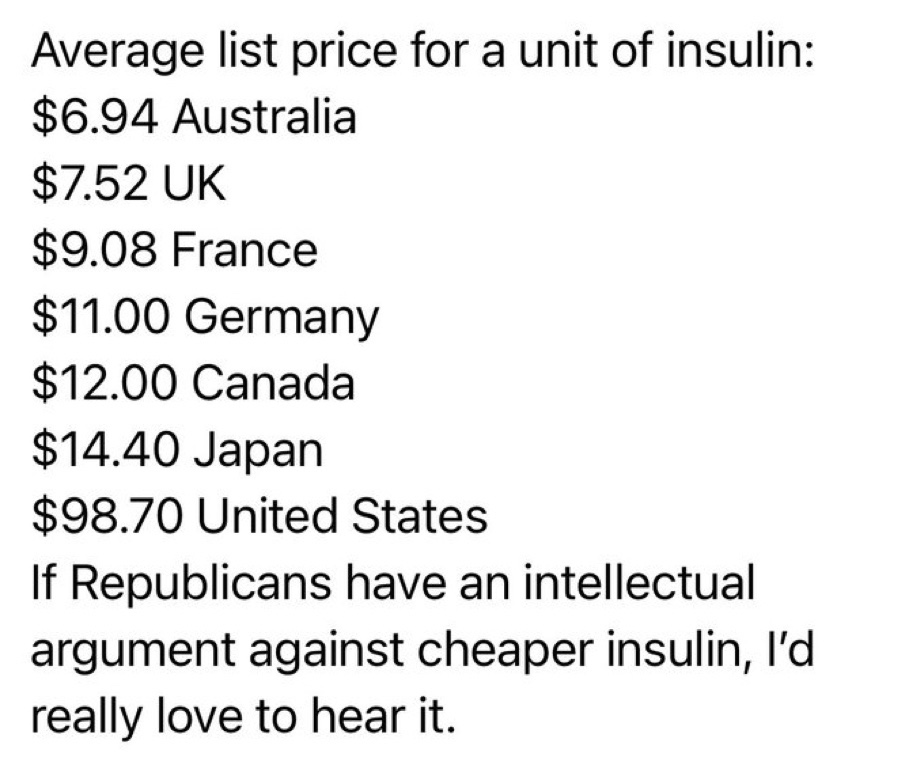
Democrats needed 60 votes to pass a $35 monthly cap on the price of insulin. Republicans, led by Senator Lindsey Graham, made sure that there would not be 10 Republican votes for the measure.

The Washington Post reported:

Republican lawmakers on Sunday successfully stripped a $35 price cap on the cost of insulin for many patients from the ambitious legislative package Democrats are moving through Congress this weekend, invoking arcane Senate rules to jettison the measure.

The insulin cap is a long-running ambition of Democrats, who want it to apply to patients on Medicare and private insurance. Republicans left the portion that applies to Medicare patients untouched but stripped the insulin cap for other patients. Bipartisan talks on a broader insulin pricing bill faltered earlier this year.

The Senate parliamentarian earlier in the weekend ruled that part of the Democrats’ cap, included in the Inflation Reduction Act, did not comply with the rules that allow them to advance a bill under the process known as reconciliation — a tactic that helps them avert a GOP filibuster. That gave the Republicans an opening to jettison it.


“Republicans have just gone on the record in favor of expensive insulin,” said Sen. Ron Wyden (D-Ore.). “After years of tough talk about taking on insulin makers, Republicans have once against wilted in the face of heat from Big Pharma.”


Some Republicans did support the price cap in the 57-43 vote for the measure, but not enough joined Democrats in support of it to meet the threshold for passage.


More than 1 in 5 insulin users on private medical insurance pay more than $35 per month for the medicine, according to a recent analysis from the Kaiser Family Foundation.


Some 7 million Americans require insulin daily. A Yale University study found that 14 percent of those insulin users are spending more than 40 percent of their income after food and housing costs on the medicine.

The seven Republicans who voted with the Democrats were: Senators Susan Collins of Maine, Josh Hawley of Missouri, Cindy Hyde-Smith of Mississippi, Lisa Murkowski and Dan Sullivan of Alaska, and John Kennedy and Bill Cassidy of Louisiana.

Mary Trump tweeted that Josh Hawley, a fierce partisan, must have a relative with diabetes. Or maybe the Republicans drew straws to see who would cast a futile vote against a popular measure.

Tweet by @toylsome

Question: Will Republican voters remember in November?

Senators Joe Manchin and Kyrsten Sinema were the two Democrats whose support for the Inflation Reduction Act was in doubt until the very end. Manchin won protection for the fossil fuel industry. Sinema killed taxes that would hit the hedge fund industry. The Washington Post explains here:

Senate Democrats agreed Sunday to protect firms owned by the private equity industry from a new minimum tax on billion-dollar corporations, bowing to pressure from Sen. Kyrsten Sinema (D-Ariz.), who insisted on making the change to the Democrats’ sprawling climate, health-care and tax package.

The decision came as Democrats tried to hold their caucus together through nearly 19 hours of debate over the Inflation Reduction Act of 2022, which the 50-50 Senate approved Sunday with the help of a tiebreaking vote from Vice President Harris.


The package proposes hundreds of billions of dollars in fresh spending, financed in part through new taxes, including a corporate minimum tax that would require firms with more than $1 billion in annual profits to pay a tax rate of at least 15 percent. As originally written, the provision would have required private equity firms to tally profits from their various holdings and pay the tax if the total exceeded the $1 billion threshold.


Sinema, who for over a year has blocked Democratic ambitions to raise taxes, raised objections on Saturday, according to two people with knowledge of the matter, who spoke on the condition of anonymity to discuss private talks.

The senator argued that, without changes to the bill, small and medium-sized businesses that happen to be owned by private equity firms would be exposed to the tax, violating a Democratic pledge to hike taxes only on the largest firms. A Sinema spokeswoman said several Arizona small businesses, including a plant nursery, had raised concerns.

The senator’s objections came days after she persuaded Democrats to abandon a different effort to raise taxes on private equity managers by closing the so-called “carried interest loophole,” which permits investment managers to pay lower rates on certain portions of their income.
In a statement, Sinema’s office said her goal is to “target tax avoidance, make the tax code more efficient, and support Arizona’s economic growth and competitiveness.”


“At a time of record inflation, rising interest rates, and slowing economic growth, Senator Sinema knows that disincentivizing investments in Arizona businesses would hurt Arizona’s economy’s ability to create jobs, and she ensured the Inflation Reduction Act helps Arizona’s economy grow,” the statement said.


The last-minute changes mark a significant victory for the private equity industry and an estimated savings of $35 billion over the next decade. Private equity represents a roughly $4 trillion industry in the United States, and as the sector has grown markedly over the past decade, it has flexed its considerable political muscle repeatedly in Washington.


From the start, the unusual way private equity businesses are structured posed a challenge for Democrats crafting the new minimum tax. Typically, large conglomerates are formed as “C corporations” under the tax code and pay corporate taxes. The new minimum tax would clearly apply to them. But private equity firms are legally formed as partnerships, which typically pay taxes on the individual returns of their owners. Senate Democrats say they crafted the legislation to ensure that wealthy investment managers who own numerous C corporations and other business entities collectively worth more than $1 billion would be subject to the tax.

But the tax was never intended to hit the smaller subsidiaries that make up private equity portfolios, said Ashley Schapitl, a spokeswoman for Senate Finance Committee Chairman Ron Wyden (D-Ore.), who called industry claims to that effect “nonsense.”


Independent analysts largely agreed with that reading of the provision. “The language in the bill was intended to make sure they are treated the same way,” said Steve Wamhoff, a tax expert at the Institute on Taxation and Economic Policy, a left-leaning think tank. “The idea that billion-dollar private equity funds must be protected to save small businesses is absolutely absurd.”