But we have a candidate for President who constantly encourages violence against enemies and disparages the federal government that he wants to lead.
And we have a political party that wants no restrictions on guns. And here we are.
LAKE LURE, N.C. — Federal emergency response personnel on Saturday had employees operating in hard-hit Rutherford County, N.C., stop working and move to a different area because of concerns over “armed militia” threatening government workers in the region, according to an email sent to federal agencies helping with response in the state.
Around 1 p.m. Saturday, an official with the U.S. Forest Service, which is supporting recovery efforts after Hurricane Helene along with the Federal Emergency Management Agency, sent an urgent message to numerous federal agencies warning that “FEMA has advised all federal responders Rutherford County, NC, to stand down and evacuate the county immediately. The message stated that National Guard troops ‘had come across x2 trucks of armed militia saying there were out hunting FEMA.’”
“The IMTs [incident management teams] have been notified and are coordinating the evacuation of all assigned personnel in that county,” the email added.
Two federal officials confirmed the authenticity of the email, though it was unclear whether the quoted threat was seen as credible. The National Guard referred questions to FEMA when asked about the incident. One Forest Service official coordinating the Helene recovery said responders moved to a “safe area” and at least some work in that area — which included clearing trees off dozens of damaged and blocked roads to help search-and-rescue crews, as well as groups delivering supplies — was paused.
By Sunday afternoon, personnel were back in place, said the official, who spoke on the condition of anonymity.
The setback is one of the latest examples of growing concerns about safety and security in western North Carolina, where many towns were almost wiped off the map after the historic hurricane made landfall two weeks ago. In the weeks since, misinformation and rumors have made the recovery more difficult, targeting multiple federal agencies operating as part of the recovery. Federal officials such as the secretary for the Department of Homeland Security and FEMA’s director of public affairs have been the target of antisemitic attacks.
Chimney Rock, in Rutherford County, has become one of the centers of tension and conflict after a rumor spread on social media that government officials planned to seize the decimated village and bulldoze bodies under the rubble. Authorities and news outlets debunked the assertion, but people still took to social media imploring militias to go after FEMA.
A person familiar with FEMA operations, who spoke on the condition of anonymity, said the agency was working out of an abundance of caution and its teams were operating at fixed locations and secure areas instead of the usual practice of going door to door.
Retired FBI agent Frank Figliuzzi writes on the MSNBC website about the internal dangers to America. It’s not from immigrants, who are typically more law-abiding than the native-born, but from Neo-Nazi gangs.
He writes:
The federal indictment of 68 defendants accused of being members of (or being associated) with a criminal gang driven by race-based hate followed an investigation that led to the seizure of Nazi paraphernalia, including Adolf Hitler posters, and 97 pounds of fentanyl, federal officials said Wednesday. U.S. Attorney Martin Estrada, who announced the charges, called it one of the “largest takedowns in the history of the Department of Justice against a neo-Nazi, white supremacist, violent extremist organization.”
That announcement landing in the final weeks of a presidential election prompts us to contrast the facts of our crime problem with the fiction that Republican presidential nominee Donald Trump and his running mate, Sen. JD Vance, would have us believe.
The dismantlement of the group that called itself the Peckerwoods, a San Fernando Valley arm of the notorious Aryan Brotherhood white supremacy organization, came in the form of charges for allegedracketeering, firearms trafficking, drug trafficking and financial fraud. If convicted as charged, some members, who adorn themselves with tattoos of swastikas and other hate symbols, could face life behind bars. The group was so heavily armed and so violent that the FBI deployed its elite Hostage Rescue Team from Quantico, Virginia, to support the arrests. According to the U.S. attorney for the Central District of California, the Peckerwoods, a derogatory name historically used against white people, “has as its mission to plan attacks against racial, ethnic, religious minorities.”
Agents seized an arsenal of illegal guns, “bomb-making components” and dozens of kilograms of fentanyl, methamphetamine and heroin, according to law enforcement officials.
The details of this multifaceted investigation reveal a significant component of America’s crime problem: hardened, U.S.-born criminals who traffic in the drugs, guns and violence plaguing our country. This contrasts with the fact-free fearmongering fabrications being sold to MAGA believers. It’s not that minorities don’t commit crimes; nor is that migrants never murder or rape. But Trump and Vance want voters to believe our gun, drug and violence problems are being driven by migrants when the opposite is true…
During the vice presidential debate, Vance claimed the vast majority of illegal guns used in crimes here come from Mexican cartels. The truth is quite different; it’s the U.S. that’s arming Mexican cartels. We have detailed data demonstrating the extent to which American weapons are fueling the violence in Mexico, right down to the make and model of the guns found at crime scenes across the border.
Please open the link to read more about crime statistics and Trump-Vance’s hateful and phony war against immigrants.
During this week’s VP debate between JD Vance and Tim Walz, Vance lied about many things. He spoke really fast, and he lied a lot. Presumably, that’s just who he is. While there have been plenty of fact-checks this week, there’s one topic we must drill down on and know the facts about because this topic has been one of the biggest drivers of mass migration over the years, and his like wasn’t only stupid. It was done with malice.
That’s right, we’re talking about the Iron River. Here’s what he said:
Why is the sound out of sync? I have no idea. Here’s the full video; this part is at the 56-minute mark.
Vance’s exact words: “Thanks to Kamala Harris’ open border, we’ve seen a massive influx in the number of illegal guns run by the Mexican drug cartel. So, that number then, the amount of illegal guns in our country, is higher today than it was three and a half years ago.”
Only a moron from Ohio, which is nowhere near a border, who peddles lies would come up with such a tall tale. JD Vance was referring to the Iron River, and it’s essential in the immigration discussion that we all know that it flows from North to South.
What is the Iron River?
The term “Iron River” refers to the large-scale trafficking of firearms from the United States to Mexico, where these weapons fuel cartel violence and crime. The term likely emerged from the constant, unrelenting flow of weapons, like a river, moving across the US-Mexico border. This metaphor emphasizes the steady and overwhelming volume of guns moving southward, often from states with looser gun regulations, into the hands of criminal organizations in Mexico.
This lie from Vance distorts the fact that the trafficking flow is mainly in the opposite direction—guns legally bought in the US are fueling violence in Mexico, not the other way around.
This is nothing new. The Iron River has been fueling mass migration for many years.
It’s a sad day in America indeed. Trump’s Secret Service agents thwarted an apparent effort to assassinate him. An agent saw a man with a long gun protruding into the golf course where the former president was playing. The agent fired at the man, who dropped his weapon and fled. A witness saw the suspect fleeing, took a picture of his car and license plate, and he was captured on the highway less than an hour later.
I send my thoughts and prayers to the former President.
I also note that he has stood solidly with the National Rifle Association in opposing all forms of gun control. One wishes that he might change his mind about gun control as a result of his fortunate escape from mortal peril. And one concludes that nothing will change.
The guy who was arrested, a former roofing contractor in North Carolina, has previously been arrested for weapons violations. From what I’ve read, he appears to be erratic, disturbed, and delusional. A crackpot.
The suspect apparently never fired a shot. Luckily, he was spotted and fled before he had the chance to fire his weapon.
Something must be said about Trump’s frequent encouragement of violence by his supporters. He likes violent imagery, he talks in apocalyptic tones about what will happen to the country if he is not re-elected. He has celebrated the J6 insurrectionists as “patriots.” He has downplayed the consequences of their violent assault on the U.S. Capitol. He told them on that fateful day, “You must fight like hell, or you won’t have a country anymore.”
Neither Trump nor JD Vance have expressed outrage when it happens to others. After the school shooting in Georgia, Vance said that school shootings are “a fact of life,” which implies that we should learn to accept them, not take meaningful steps to limit access to guns. Trump said after a school shooting in Iowa that people must “get over it” and move on.
There should be no tolerance for political violence in this country. I’d like to say “That’s not who we are,” but I can’t. It’s in the interest of every elected official to encourage unity, peace, and calm resolution of differences. It’s in the interest of every elected official to demand gun control.
Parents have parental rights, and they also have parental responsibilities. One surely is to keep your guns, if you have them, locked up. Colin Gray didn’t do that. Instead, he gave his teenage son an AR-15 type weapon for Christmas in 2023. This was after the FBI had questioned father and son about online threats to shootup the boy’s school. The father insisted that he kept his hunting guns in a safe place, and the boy denied having any thought of harming anyone.
Georgia police arrested Colin Gray, the father of the 14-year-old boy who admitted bringing an assault weapon to school and murdering four people, including two students and two teachers. The father faces multiple charges that could land him in prison for life.
If police and courts make it customary and standard to hold parents accountable for their children, especially when they allow them to obtain deadly weapons, such expectations might have a deterrent effect.
Before Thursday’s announcement, the teen’s grandfather, Charles Polhamus, said he wanted Colin Gray charged along with his son. “If he didn’t have a damn gun,” Polhamus said, “he wouldn’t have gone and killed anybody….”
The charges come just months after a mother and father in Michigan became the first parents of a school shooter ever convicted of involuntary manslaughter, a less severe crime than second-degree murder. Investigators found that, in November 2021, James and Jennifer Crumbley had bought their 15-year-old son a gun, didn’t lock it up and ignored blatant warning signs before he opened fire at Oxford High in Michigan, killing four students. In separate trials, each was found guilty and sentenced to 10 to 15 years in prison, the maximum allowed.
A 14-year-old boy is in custody after a mass shooting at Apalachee High School in northern Georgia. Four people are dead, two students and two teachers. At least nine were injured. The boy was a student in the school. At this time, no information has been released about his identity or motive, what kind of gun was used or how the boy got the gun.
Governor Brian Kemp signed legislation weakening the state’s gun laws while sitting in a gun shop, surrounded by gun enthusiasts. Since 2022, Georgia has allowed individuals to carry guns without a permit, although public opinion polls showed that almost 70% of Georgians opposed permitless carry.
Georgia Governor Brian Kemp on Tuesday signed a law allowing residents to carry handguns in public without a license or background check.
Kemp, a Republican, backed a similar proposal when he ran for governor in 2018, and expanding gun rights was a key part of his platform. He urged the legislature to take up the issue at a press conference earlier this year.
“(This bill) makes sure that law-abiding Georgians, including our daughters and your family too, can protect themselves without having to have permission from your state government,” Kemp said Tuesday before signing the bill into law. “This is an issue that I campaigned on in 2018 alongside so many members that are standing with us today. And by working together, we have gotten it across the finish line.”
Georgia has some of the weakest gun laws in the country. The legislature passed a law requiring colleges and universities to allow guns on campus in 2017, and in 2022, Georgia repealed its last foundational policy by passing permitless carry legislation. Though Georgia repealed its Citizen’s Arrest law in 2021, the state still has a dangerous Shoot First law that allows a person to kill another in a public area, even when they can safely walk away from the danger.
If Georgia had the gun death rate of our National Leaders—the eight states with the strongest gun safety laws—we could save 17,987 lives in the next decade.
To anyone who wonders if there is a difference between the two parties, here’s a big one: gun control. A Trump-appointed federal judge in Kansas struck down a ban on machine guns. He was following the advice of Justice Thomas, who made the wacky argument that if something was okay when the Constitution was written, then it’s okay now. The Founding Fathers did not ban machine guns: why should we?
Up next in the arms of school shooters: fully automatic machine guns. Trump appointee U.S. District Judge John Broomes (Kansas) ruled that the ban on owning fully-automatic machine guns that’s been part of American law since the 1930s is unconstitutional. Citing Clarence Thomas’ argument that if something wasn’t illegal at the time the Constitution was written it shouldn’t be illegal now, Broomes has set up a new case that’ll almost certainly end up before the six rightwing cranks on the US Supreme Court.
ProPublica reported on a speech by J.D. Vance in which he praised the notorious Alex Jones, who has been ordered to pay $1.5 billion to the parents of children murdered in the Sandy Hook school massacre. Jones claimed that the massacre was staged by “crisis actors” to build support for gun control. The parents of the dead children were harassed by Jones’ followers for years.
Now we learn, in a report by Andy Kroll of ProPublica and Nick Sugrey of Documented, that Vance’s views are more extreme than we knew.
They wrote:
Sen. J.D. Vance, whom Donald Trump named as his vice presidential running mate Monday, told a group of influential young conservatives in a closed-door speech in 2021 that they should stand up for “nonconventional people” who speak truth, such as Infowars founder Alex Jones.
“If you listen to Rachel Maddow every night, the basic worldview that you have is that MAGA grandmas who have family dinners on Sunday and bake apple pies for their family are about to start a violent insurrection against this country,” Vance said. “But if you listen to Alex Jones every day, you would believe that a transnational financial elite controls things in our country, that they hate our society, and oh, by the way, a lot of them are probably sex perverts too.”
Vance went on, “Sorry, ladies and gentlemen, that’s actually a hell of a lot more true than Rachel Maddow’s view of society.”
He said that every person in attendance for his speech believed “something that’s a little crazy.” In his case, he said, “I believe the devil is real and that he works terrible things in our society. That’s a crazy conspiracy theory to a lot of very well-educated people in this country right now.”
Vance made these remarks at a September 2021 gathering of the Teneo Network, an invitation-only group of young conservatives that counts elected officials, pro athletes, financial executives and media figures among its members. Vance joined Teneo six years ago. ProPublica and Documented obtained a video recording of his 30-minute speech and question-and-answer session, which has not been previously reported.
Vance’s remarks at the conference — which you can read a transcript of or watch in full below — give a rare unvarnished look at his thinking and illustrate how aligned he is with various factions within the conservative and MAGA movements. “I’ll throw out the standard campaign speech,” he began his Teneo talk. “[I’ll] actually just try to level with you guys about what I do see is the big — a few big problems that are in our country right now.”
Watch J.D. Vance’s Speech at a Private Teneo Network Event
Vance’s 2021 speech lays out what he sees as the “big problems” facing the United States and what the conservative movement should do to address them. (Obtained by ProPublica and Documented)
According to internal Teneo documents, Vance joined Teneo in 2018, several years before he ran for Senate in his home state of Ohio. His book, “Hillbilly Elegy,” had already become a bestseller, and Vance was a commentator for CNN while running his own nonprofit and investment fund backing startup companies outside of Silicon Valley.
“JD Vance has been part of the organization for at least five years and his appearance at the 2021 Teneo Retreat was well received by many young professional leaders in attendance,” Leo said. A spokesperson for the Trump campaign did not immediately respond to a request for comment.
By the time Vance spoke at Teneo’s 2021 conference, he had joined the race to fill outgoing Sen. Rob Portman’s seat. Despite his past criticisms of Trump, which included calling the former president an “idiot” and comparing him to Adolf Hitler, Vance won Trump’s endorsement in 2022 and cruised to a comfortable victory.
Vance’s connection to Teneo could form a bridge between different factions of the Republican Party that seem to be at odds. Previous news stories have reported that Trump and Leo, who advised the former president on judicial nominees during his administration, are no longer as close as they once were. Russ Vought, a Trump ally, publicly denigrated the Federalist Society, the legal networking group Leo and others built into a juggernaut.
Adding Vance to the ticket bolsters the connections between Leo’s network and the Trump 2024 campaign. It also strengthens ties between Trump’s reelection bid and the Project 2025 blueprint, which outlines plans for a second Trump administration, including firing thousands of career civil servants, shuttering the Department of Education and replacing ambitious goals to combat climate change with ramped-up fossil fuel production. In a recent TV interview, Vance said the document contained “some good ideas” but claimed that “most Americans couldn’t care less about Project 2025” and that the Trump campaign wasn’t affiliated with it.
In his Teneo remarks, he bemoaned that decades ago major corporate CEOs reliably donated money to Republicans but now they give heavily to Democrats. He lamented that conservatives had “very few oligarchs on our side,” had “lost every institution in American society” and needed to make corporations “taking the side of the left in the culture wars feel real economic pain.”
“So we’ve not just lost the academy,” meaning universities, “which we’ve lost for a long time; we haven’t just lost the media, which has been on the side of the left for a long time; we now find ourselves in a situation where our biggest multinational corporations are active participants in the culture war on the other side,” he said. “It’s really been a few of us over the past few years who have recognized that the big corporations have really turned against conservatives in a very big and powerful way.”
He argued that conservatives needed to take action against corporations that, say, defended abortion rights or punished employees who spoke out against abortion access. “If we’re unwilling to make companies that are taking the side of the left in the culture wars feel real economic pain, then we’re not serious about winning the culture war,” he said.
He said that Americans were “terrified to tell the truth” and “point out the obvious,” including that “there are real biological, cultural, religious, spiritual distinctions between men and women.” He added, “I think that’s what the whole transgender thing is about, is like fundamentally denying basic reality.”
Shortly before he spoke at the Teneo conference, Vance drew criticism when he tweeted that “Alex Jones is a far more reputable source of information than Rachel Maddow.” Jones, founder of the online show Infowars, gained a following with his promotion of conspiracy theories about the Sept. 11 terrorist attack. More recently, judges in several states ordered him to pay $1.5 billion to the families of the victims of the Sandy Hook school shooting, which Jones had called a hoax.
What’s next? A vending machine that sells handguns? Or a vending machine that makes 3-D printed guns?
This time of year, shoppers who set foot inside Lowe’s Market in downtown Canyon Lake, are usually looking for two things: swimming gear and beer. The cramped and busy grocery store, which is located about an hour north of San Antonio and whose wide selection of disparate items gives it the feel of a mini-Walmart, is often the last stop for supplies before locals and tourists float down the nearby Guadalupe River, a Texas summer tradition.
But for the last two weeks, something else has lured an endless stream of outdoor enthusiasts, ranchers, gun lovers, and tourists into the store, often with looks of excitement and curiosity splashed across their faces. It’s not the fresh produce, the sunscreen, or even the generous selection of wine and beer. They want to glimpse an audacious intersection of consumer technology and weaponry—an interactive, two-thousand-pound ammunition dispenser. Sandwiched between a small ATM and a row of ice machines near the store’s front entrance, the double-walled, triple-locked steel vault wrapped in an American flag decal beckons customers to swipe their credit card with a simple tagline: “Need to reload?” Online, the company’s motto advertises “Ammo Sales Like You’ve Never Seen Before.”
For some locals, the patriotic kiosk, which has already been restocked once after selling out, is a source of convenience, a clever idea that saves a trip to the nearest sporting goods store, which is 32 miles away in San Marcos. For others, it’s a transgressive delight, an almost comical reminder of the rights that many Texans hold dear. And for a few others, the machine is a disturbing eyesore, particularly because the first ammo vending machine in Texas is located next to a local middle school at a time when the mass shootings of children in Uvalde and Santa Fe High remain a fresh memory in many minds. During the school year, that Lowe’s Market location is frequented by teenage customers, especially after classes let out. Last week, a USA Today columnist wrote that the machines, juxtaposed with bananas and diapers, felt like “something out of a dystopian novel.” So far, at least, the curiosity—and controversy—have been great for business. “That machine has been the talk of the town,” the store’s general manager, who asked not to be named, told me as customers stopped to gawk at the kiosk on a recent Saturday.
Well before the attempted assassination of former President trump, Michael Hiltzik wrote a column about gun control for The Los Angeles Times. In this column, he expresses hope that the extraordinary gun violence in the United States might produce a moderating trend among policy makers. I confess that I am not as hopeful as he. Maybe it’s possible that the conservative majority might have second thoughts about their objection to sensible gun control. Hiltzik is encouraged by their recent decision that a man with a history of domestic abuse should not own a gun. I hope he is right.
He writes:
For decades, gun control policy in the U.S. has been virtually untouchable — except through efforts to make America’s gun culture deadlier, raising the toll of innocent victims.
Two recent developments suggest that the ground may finally be shifting toward rationality.
One is an “advisory” from Surgeon General Vivek Murthy identifying firearm violence as a public health crisis — the boldest statement from a government official calling attention to the horrific consequences of the nation’s turn away from common sense gun control.
Originalism tells judges not to consider the practical consequences of their interpretations.
— Former Supreme Court Justice Stephen Breyer explains why America can’t pass workable gun laws
As Murthy himself observes, that initiative placed the U.S. on a course of tobacco regulation that reduced the prevalence of smoking from 42% of adults in 1964 to 11.5% in 2022.
The other is a June 21 Supreme Court decision finding that laws barring domestic abusers from possessing guns are constitutional. The ruling is an indication — albeit slight — that a majority on the court has concluded that earlier decisions that found almost any state and local restrictions violated the 2nd Amendment were far too indulgent.
Let’s take the advisory and ruling in order.
Murthy’s advisory is an extraordinary synopsis of the toll of America’s fascination with firearms and its failure to regulate gun ownership.
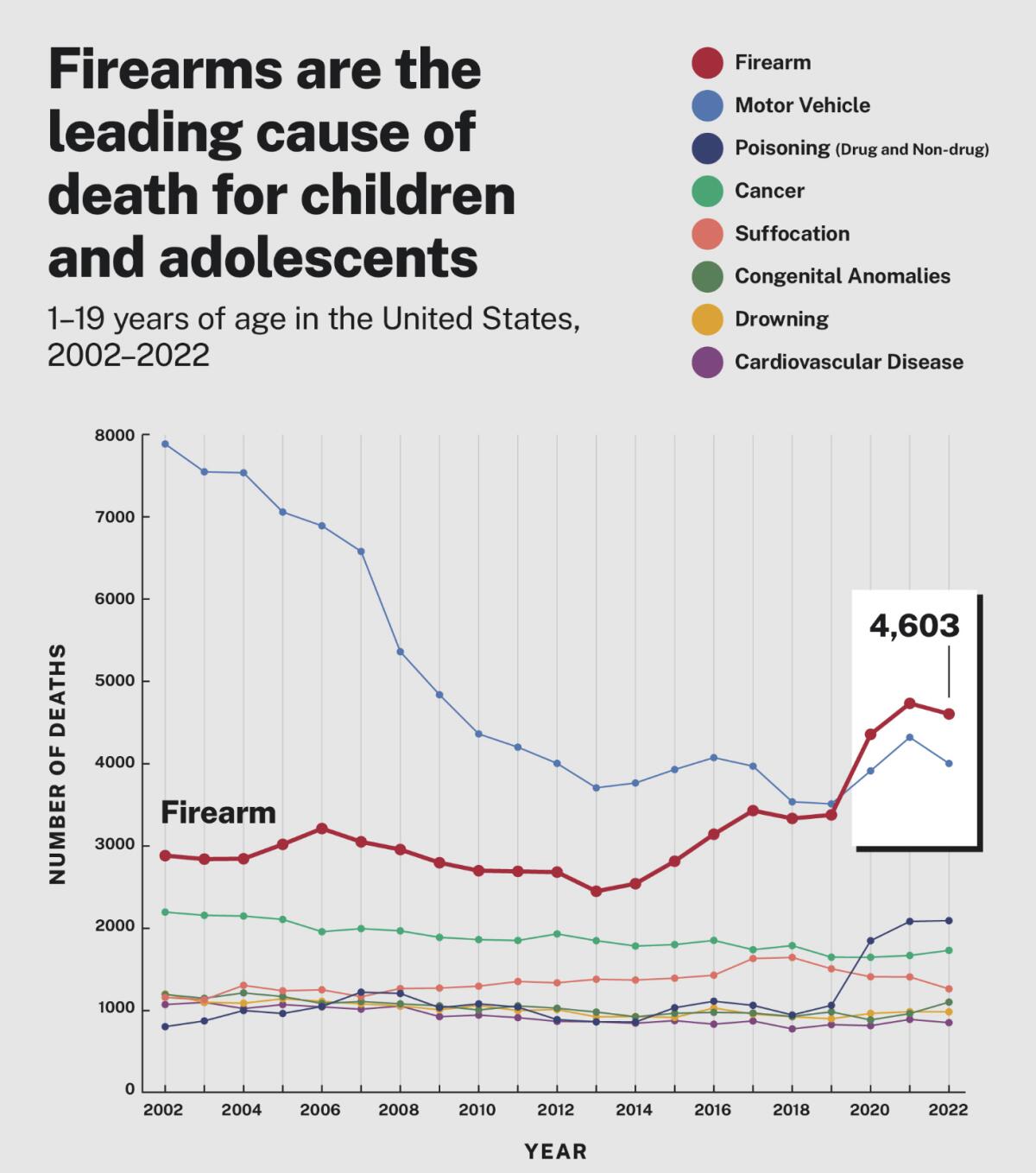
Firearms passed motor vehicles as the leading cause of death of children and adolescents in the U.S. in 2019. (U.S. Surgeon General)
He reports that firearms are now the leading cause of death among children and adolescents, having passed motor vehicles in 2019. In 2022, guns killed more than 48,200 Americans through homicides, suicides and accidents, rising by about 16,000 over the previous 10 years.
Murthy’s report notes that guns are used in 55% of all suicide attempts and that their lethality in those cases is unmatched — nearly 90% end in death, higher than any other method.
The report treats mass shootings (defined as those with four or more victims, not counting the shooter) soberly. These account for only about 1% of all firearm deaths, but their impact is far greater due to their “outsized collective trauma on society” and their “strong negative effect on the public’s perception of safety.” One in three adults “say fear prevents them from going to certain places or events.”
Murthy’s report puts the lie to the familiar claim by Republicans and gun rights fanatics that the problem, especially when it comes to mass shooting, is mental health, not firearms.
House Speaker Mike Johnson (R-La.), for instance, told Fox News anchor Sean Hannity in October, after a gunman killed 18 people in Lewiston, Maine: “Mental health, obviously, as in this case, is a big issue, and we have got to seriously address that as a society and as a government.”
Yet Murthy reports that “one’s mental health diagnosis or psychological profile alone is not a strong predictor of perpetrating violence of any type…. Importantly, most people with serious mental illness are not violent against others. In fact, people with serious mental illnesses are more likely to be victims of violence.”
For all their nattering about the need to address mental health, anyway, Republicans have never lifted a finger to promote any programs to do so.
Now to the Supreme Court.
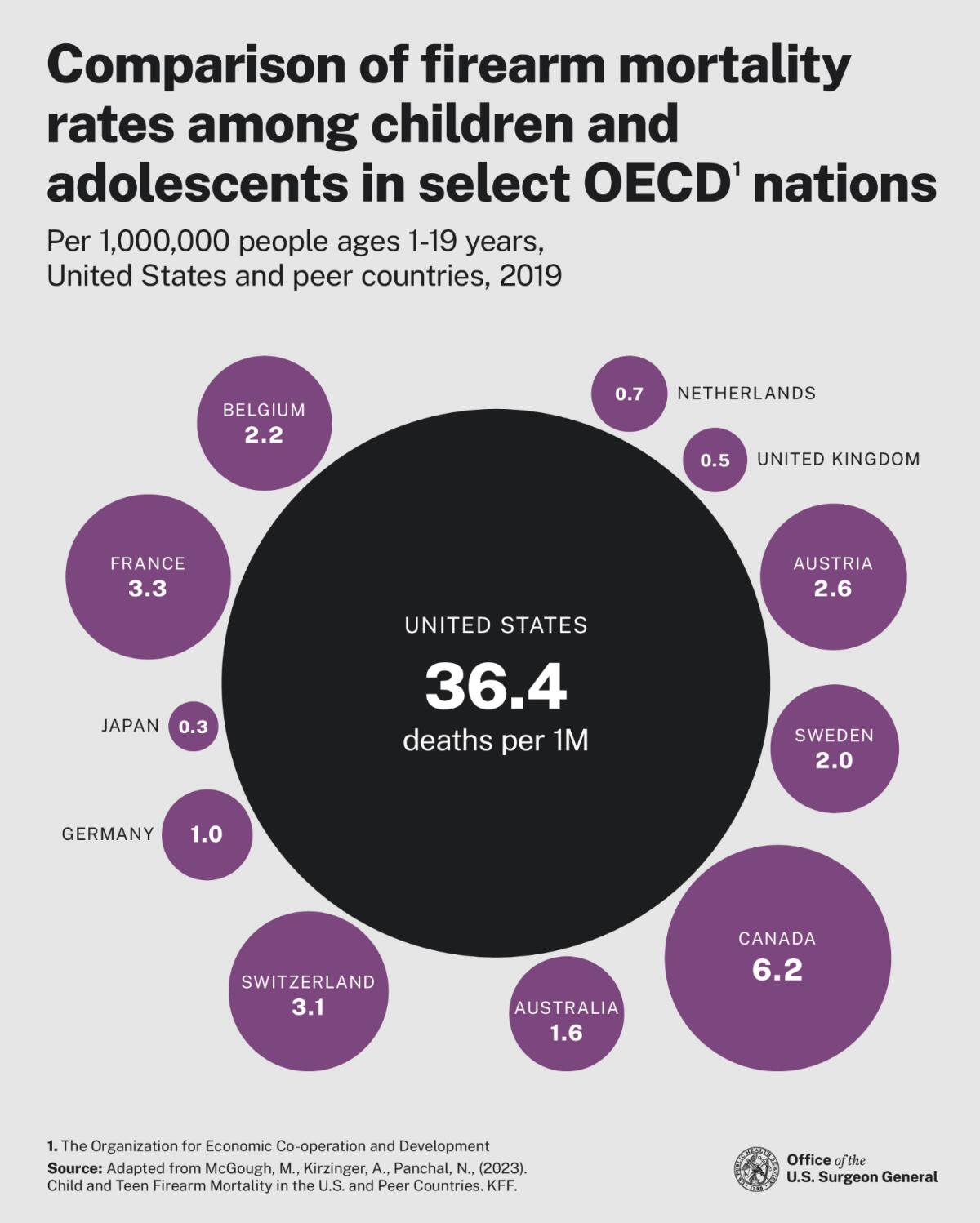
The rate of firearm deaths of childen and adolescents in the U.S. vastly surpassed the rates in other developed countries.
(U.S. Surgeon General)
Rahimi v. United States, which yielded an 8-1 decision on June 21, is the first gun-rights case to come before the court since a 2022 decision known as Bruen, in which Clarence Thomas, writing for a 6-3 majority, essentially found that all modern efforts to regulate firearms are unconstitutional.
Thomas held, in effect, that the only legitimate basis for judging gun laws is historical — weighing the laws against the language of the 2nd Amendment to determine how the amendment was viewed by its drafters in 1789 and how their approach was dictated by the political and social context of that time.
In Bruen, Thomas ridiculed Justice Stephen Breyer’s dissent (with which justices Sonia Sotomayor and Elena Kagan concurred). Breyer had opened his argument with nine pages of statistics about gun ownership and its consequences for health and safety.
“It is hard to see what legitimate purpose can possibly be served” by Breyer’s figures, Thomas sneered. “Why, for example, does the dissent think it is relevant to recount the mass shootings that have occurred in recent years?”
In Rahimi, however, Chief Justice John G. Roberts Jr. asserted that the consequences of unrestricted gun ownership were highly relevant. To be fair, this was easy. The record made clear that Zackey Rahimi, the gun owner at the center of the case, was one vicious specimen indeed. As Roberts laid out in the opening three pages of his majority opinion, Rahimi had beat up his girlfriend (the mother of his child) and fired in her direction or at a bystander as she fled his grasp.
After she got a restraining order against him, he stalked her, threatened a different woman with a gun, was suspected by police of at least five other shootings, fired at motorists in at least two road-rage incidents and fired his gun indiscriminately at least two other times. Police searched his home and found a pistol and a rifle. He was charged under a Texas law that criminalized possessing a gun while under a retraining order due to domestic violence.
Despite all that, the 5th Circuit Court of Appeals overturned Rahimi’s conviction, citing Bruen.
Roberts’ decision in Rahimi is a step toward ratcheting back the Bruen effect, in which almost every gun regulation is suspect. That brings us to the “originalism” principle, which undergirds the court conservatives’ distaste for restrictions on gun rights. As expressed by Thomas in his Bruen opinion, originalism holds that interpreting the constitution must depend on the “public understanding of a legal text in the period after its enactment or ratification.”
As the now-retired Breyer put it in a recent essay, “the originalist, instead of looking to the text and asking what the words mean now, may well ask what they would have meant to an ordinary eighteenth-century person” and applies them to the world of today. (Breyer isn’t a fan of originalism.)
Scholars such as Stanford historian Jack Rakove argue that interpretations of the 2nd Amendment depend more on originalism than any other provisions of the Constitution. Its impact emerged most notably in the Supreme Court’s so-called Heller decision. In that 2008 decision written by Justice Antonin Scalia, a 5-4 majority overturned a Washington, D.C., ordinance largely barring citizens from possessing handguns for self-defense in their own home.
Heller overturned more than the D.C. law — it upended more than 200 years of scholarship about the meaning of the 2nd Amendment’s preamble, which links “the right of the people to keep and bear arms” to the establishment of “a well regulated Militia.”
As Breyer pointed out, historians and linguists had argued (in a friend-of-the-court brief in the Bruen case) that the phrase “bear arms” overwhelmingly referred to “war, soldiering, or other forms of armed action by a group” — not to an individual right. Heller, however, established an individual right to gun ownership for the first time.
Bruen expanded that right to gun ownership outside the home. The ruling deemed unconstitutional a New York law requiring citizens to have a license to carry firearms in public. America’s rising tide of gun violence can fairly be traced to Heller.
Scholars have pointed to numerous problems with originalism. One is that judges are (usually) not historians. They may be utterly at sea when trying to find the apposite historical application to contemporary conditions.
The drafters of the 2nd Amendment, as it happens, were concerned about the public threat of a government’s standing army; historians argue that the amendment was designed to prevent the federal government from interfering with the creation of state militias.
Firearms in the 18th century were “not nearly as threatening or lethal as those available today,” Rakove writes; people in that era were concerned not with threats from “casual strangers, embittered family members, violent youth gangs, freeway snipers, and careless weapons keepers.”
In other words, applying an 18th century mind-set to 21st century conditions is a fool’s errand. “Originalism” only interferes with judges’ responsibility to ponder the real-world impacts of their decision — their option, Rakove says, is to “ransack” the historical record for quotations that can support their preexisting goals.
“Originalism,” says Breyer, “tells judges not to consider the practical consequences of their interpretations.” Its product is the paralysis of federal, state, and local efforts to regulate gun ownership. It’s also responsible for the contraction of individual rights being rolled back almost gleefully by the current Supreme Court majority, notably abortion and other women’s reproductive healthcare rights, as originalists argue that the concept of privacy on which those other rights are based can’t be found in the Constitution.
It’s also proper to note that the public during the time the 2nd Amendment was drafted, enacted and ratified is very different from the public affected by its consequences today. In 1791, among other distinctions, enslaved people were not considered citizens and women could not vote. Who set the terms back then under which today’s Americans must live?
Rahimi won’t solve the mess in gun regulation created by the Heller and Bruen rulings. A multitude of pending cases might strengthen it or undermine it. But at least it’s a step back from the abyss.
Murthy’s advisory gives a similar impression of being a first step on a path that might lead nowhere. He calls for more research on violence prevention strategies and laws preventing children’s access to guns, universal background checks, banning assault weapons and restricting the carrying of loaded firearms in public.
The bottom line, of course, is that America’s gun violence crisis can only be solved by fewer guns. There’s a long road ahead to reaching that goal.


 Diane Ravitch's blog