Archives for category: Funding

Craig Harris of USA Today wrote a blockbuster three-part series about the charter schools that grabbed at least $1 billion in federal funds from the COVID Payroll Protection Program, passed in 2020 to help struggling small businesses stay alive and retain their employees. Today the second part was posted. Because charter schools are “technically small businesses,” about 1,000 of them applied for the forgivable loans. None of the charter schools lost revenue or laid off employees but they asked for the money anyway. Even the charter school lobbyist—the National Alliance for Public charter Schools—asked for a $680,000 loan, which was forgiven.

Harris writes in this second part about charters that knew it was wrong to ask for PPP funding when they had no need, and others did. (I can’t find the link: if any reader can, please add.)

He starts:

‘The ethical thing to do’: Why this small San Diego charter school passed on COVID PPP loans

Albert Einstein Academies, a small San Diego charter school chain, turned down a forgivable $3 million Paycheck Protection Program loan.

Story Highlights

  • Learn4Life, a charter chain, got a combined $32.7 million in PPP loans through 12 related firms.
  • California charter schools had six of the eight largest PPP loans in the U.S. among charters.
  • In Arizona, two prominent charter chains also turned down the money, saying they didn’t meet the requirements.

SAN DIEGO – The Albert Einstein Academies, which educate 1,450 students from kindergarten through eighth grade at two inner-city campuses here, could have used a forgivable loan from the federal Paycheck Protection Program.

Half of the middle school students and close to one-third of the elementary kids come from low-income homes and qualify for free or reduced-price lunches at the charter schools, its superintendent said.

But while the academies were eligible for up to $3 million in forgivable loans based on revenuesthat largely came from taxes, Superintendent David Sciarretta didn’t feel right about taking the money.

He said the loan program, started by Congress in March 2020 at the beginning of the pandemic, was intended to help financially struggling small businesses stay open and avoid laying off employees.

Charters are privately operated schools that are publicly funded.

We could have always used the money. But, growing up, my mom told me: ‘If there’s food on the table and there are other folks who are hungrier than you, then you need to let them eat because they have a greater need than you do.’

Sciarretta said Einstein, whose charter school campuses are minutes from downtown, didn’t suffer financially because California continued its pre-pandemic level of public school funding during the health crisis even if enrollment declined, giving some schools additional money.He said refraining from taking the loans was “the ethical thing to do.”

“We could have always used the money,” said Sciarretta, recently awarded the 2022 Hart Vision Award Winner for California Charter Leader of the Year. “But, growing up, my mom told me: ‘If there’s food on the table and there are other folks who are hungrier than you, then you need to let them eat because they have a greater need than you do.'”

Other schools took PPP loans

That wasn’t the view of at least 268 other California charter operators, who run some of the state’s largest and wealthiest publicly funded charter chains.

Those operators had at least $335 million forgiven, a USA TODAY investigation hasfound, the most of any state with charter schools. That’s about one-third of the $1 billion in loans obtained by more than 1,100 U.S. charter schools, which educate a fraction of the nation’s children and had the loans forgiven — even though most lost no money during the pandemic.

Several of those schools also employed more than 500 workers, the limit to qualify under the program, USA TODAY found.

Kathleen Hermsmeyer, superintendent of Springs Charter Schools in Temecula, said while California didn’t cut funding, it also did not increase it for charter schools like hers that specialize in at-home, remote or hybrid learning.

Those types of charter schools,which aren’t based in classrooms, experienced significant enrollment increases because of the need for distance learning during COVID,

She said her network added 1,000 students during the pandemic and needed its nearly $9.9 million loan —the largest of any charter operator in the country. The Small Business Administration, which is in charge of the PPP program that ended last May, forgave that loan on Dec. 1.

“It was exactly what PPP was designed for — to help us provide a great quality education for our children through the most difficult years ever,” Hermsmeyer said. “We kept our programs and services, and we did not cut salaries.”

The federal government promised to forgive the loans if the money was used to keep workers on the job and to pay for pandemic-related issues.

Researchers have found the SBA has forgiven most of the loans for all industries with little auditing done to see if the money was properly used. Meanwhile, up to three-fourths of the money went into the pockets of business owners, according to a recent study.

Which charter schools near you took federal PPP money?

Search USA TODAY’s database of more than 1,100 charter schools that had Paycheck Protection Program loans totalling more than $1 billion forgiven.

California, which in 1992 became the second state to allow charter schools, had more than 1,300 of the schools and seven all-charter districts at the beginning of this school year, according to the state’s department of education. That’s roughly 11.5% of the entire public school student population in California.

The state had six of the top eight forgiven loans for charter schools in America, all in excess of $5.5 million, records show.

California Congressman Judy Chu has been highly critical of the federal oversight, saying the agency and Treasury Department prioritized speed in getting money to businesses instead of scrutiny over who needed the cash.

Learn4Life gets most PPP loans

The largest block of forgiven loans, a combined $32.7 million, went to the same address in Lancaster, California, for 12 related nonprofit companiesthat are part of Learn4Life, a charter chain whose firms reported to the IRS that they employed a combined 4,567 workers during 2019.

The loans were obtained in April and May 2020, and forgiven throughout last year, federal records show.

The combined employment would be more than nine times the threshold for obtaining a PPP loan.

Learn4Life spokeswoman Ann Abajian said the organization had 1,685 employees among its companies.

She said the discrepancy occurred because the companies had previously counted seasonal and part-time employees in their staff totals and that information was disclosed to the federal government to have the loans forgiven.

Federal tax returns for the 2019-2020 fiscal year from those 12 nonprofits, which were signed by company executives, showed the higher staffing numbers.

For example, Learn4Life’s Antelope Valley Learning Academy Inc. reported employing1,302 staff, while Western Educational Corporation and Vista Real Public Charter employed 527 and 668 people, respectively.

“Each entity — as a separate charter nonprofit, with less than 500 employees and its own independent governing board — applied with accuracy and transparency, met the criteria, and was awarded the loans and later forgiven. Proper documentation with supplemental justification and backup was presented to SBA,” Abajian said.

The chain said it used the loans to purchase and distribute 20,000 laptops and 15,000 hotspots, baby supplies for hundreds of parenting students as well as an online curriculum. In addition, the organization said its technology support desk hired more staff.

Eric Cross (middle) teaches seventh-grade science at Einstein Middle School in San Diego. The school was eligible for a federal Paycheck Protection Program loan, but school officials turned it down because the state of California did not cut any funding to public schools.CRAIG HARRIS

Other businesses, such as Shake Shack, also counted separate locations to qualify for a PPP loan. That publicly traded company with more than 7,000 employees and 205 restaurants in the U.S., was one of the first to get a PPP loan. However, Shake Shack returned its $10 million loan following public scrutiny.

In Arizona, prominent, successful chains Basis Charter Schools Inc. and Great Hearts Academies said they didn’t seek the loans even though their individual campuses employed fewer than 500 workers. Basis and Great Heart officials said they read the SBA rules as requiring all employees within an organization to be counted and both were too big.

Meanwhile, other California schools that had jumbo loans forgiven included Granada Hills Charter in Granada Hills ($8.5 million), Antelope Valley Learning Academy in Lancaster ($7.9 million), Summit Public Schools in Redwood City ($6.9 million), Western Educational Corporation in Lancaster ($6.2 million) and Magnolia Educational & Research Foundation in Los Angeles ($5.5 million).
Leonie Haimson, CEO of Class Size Matters (and a board member of NPE), watches the budget of the NYS public schools like a hawk. She is constantly amazed that there is no money to reduce class sizes but plenty for other things that are less essential.

She wrote this piece for the blog:

Tomorrow, Wed. March 23 will be the second meeting of the NYC school board under our new mayor, Mayor Eric Adams. Since Mayoral control was instituted in 2002, the board has been composed of a supermajority of Mayoral appointees. At that time, it was renamed the Panel for Educational Policy (PEP)by then-Mayor Bloomberg, though according to state law it is still officially called the NYC Board of Education.

Among the Panel’s duties is to approve Department of Education contracts, with many inflated and wasteful contracts rubberstamped over the last twenty years. Only once in its history has it voted down a contract: last year, when a majority of members voted in the midst of the pandemic not to approve acontract to Pearson for the test given to four-year-old students to be admitted into NYC’s controversial gifted program.

Even though the law requires monthly meetings of the PEP, the Chancellor cancelled the January meeting, and eight new members appointed by the Mayor participated at the February meeting, though their names and contact information are still not posted on the relevant PEP page . Instead, the names that arelisted still include the eight members appointed by de Blasio, who vacated their posts at the end of December. The identitiesof the new appointees can be found in the minutes of the February meeting, though no contact information or biographies.

The ninth member who was slated to be appointed by the Mayor in February was Joe Belluck, an attorney who is also the chair of the SUNY committee that authorizes charter schools. Belluck withdrew his name right before the meeting. This waspresumably due to conflict-of-interest issues, given that charterschools take away valuable public school space through co-locations approved by the Panel, and now cost the DOE budget more than $2.6 billion dollars annually. (Full disclosure: my organization, Class Size Matters, put out a press release against Belluck’s appointment the day before he withdrew.)

The new schools Chancellor David Banks, also appointed by the Mayor, has repeatedly said he wants to save money by cutting waste and the bureaucracy. At tomorrow’s meeting, among the many contracts they will be voting upon tomorrow is one for acompany called 22nd Century Technologies, at $16.5 million per year, renewable for five years at a total of $82.5 million. The contract is listed as “Recruiting and Staffing Services for Temporary Professionals.”

This company, the contract proposal says, will be paid to hire “consultants in a wide range of disciplines across DOE schools, central offices, and/or NYCDOE Borough/Citywide offices” and will be “responsible for identifying, processing upon selection, and managing the consultants it recruits and those referred by the DOE.”

The company will charge “markup fees of 17.35% and 22.50% for DOE-referred and vendor-recruited consultants, respectively.”

There is little detail about what these consultants will actually be doing, except for that they will be “used in a wide variety of areas including special education, curriculum design and development, all of which are needed to ensure the successful execution of several temporary DOE projects or needs. “

The mention of curriculum design may relate to the Mosaic curriculum, which initially being developed by “a team of administrators and teachers … during their off hours”, according to the Daily News, but whose roll-out has been delayed.

Of the $16.5 million being paid to this company, the document says nearly half will go to “supporting work that is legally mandated specialized expertise” and “supporting stimulus projects” – which I assume means federal stimulus funds, without identifying what this expertise or these projects involve. The reason for hiring consultants, the document claims, is that “because consultants are better suited to complete short-term tasks for schools and/or offices, instead of using full-time DOE employees.”

Even if the use of consultants is advisable in this case, there is no reason why the DOE should not hire consultants directly, but instead must pay another company to hire and manage them, with a markup of 22.50% and/or 17.35%, the latter if DOEofficials recruit these consultants themselves. In any case, we can expect that the mayoral appointees will rubberstamp this contract as they have in the past, with few if any questions asked, and no discussion of larger issues.

The DOE has lost millions in fraudulent contracts since Mayoral control was instituted in 2002. Just some of them are recounted in my City Council testimony from 2011. What this testimony doesn’t include is what happened four years later.

In 2015, along with then-Public Advocate Tish James and CM Danny Dromm, we blew the whistle on a proposed $1.1 billion five year contract, renewable at $2 billion, that was supposed to be awarded Custom Computer Specialists, a computer wiring company that had been involved in a kickback scheme just a few years before. The PEP approved this contract anyway, with a vote of 10-1, but as a result of the ensuing scandal, City Hall kicked it back, and the contract was rebid and awarded to several different companies at a far reduced price of $472 million, with savings to the city of between $163 million and $627 million.

Another result of the CCS scandal was that DOE promised from then on to publicly to post all prospective contract requests for authorization at least 30 days in advance, to allow for more scrutiny by Panel members as well as to allow for improved independent oversight. As Juan Gonzalez wrote about this result in the Daily News: “Tweed will even post information on all bids on its website 30 days before the scheduled vote by the panel, and has committed to do the same with other contracts.” Yet the DOE stopped doing this in April 2020 – nearly two years ago.

According to a New York state education law passed in 2005, all school board members must receive at least six hours of training in financial oversight, accountability, and fiduciary responsibilities. There is an exception in the law for NYC, but only if as the chancellor annually certifies to the commissioner in writing that the training they provide “meets or exceeds the requirements of this section.” Yet PEP members have told me privately and been quoted in the media to say that they have received only minimal training in financial oversight – and much less than the six hours that the law requires.

I recently filed a Freedom of Information request to the State Education Department for a copy of the annual certification from the NYC Chancellor, attesting that the training provided PEP members was compliant with the law, for the years 2019, 2020 and 2021. I received a response from NYSED that they had received no such certification. This is one of the reasons in my recent testimony before the State Legislature on Mayoral control, I strongly recommended that the governance law in NYC be amended to require that the City Comptroller’s office take over this important responsibility.

The DOE has gotten in trouble before when hiring companies to manage consultants – in the case of the Ross Lanham scandal, in which Custom Computer Specialists was also involved and millions were fraudulently charged to DOE for a different computer wiring scheme, as detailed in a report from the office of Special Investigator and in the indictment by then- US Attorney Preet Bharara. This scandal apart from the money stolen cost NYC more than $100 million in federal E-rate funds. This may not happen in this case. But if the Chancellor is concerned about cutting down on waste and bureaucracy, this is a strange way to go about doing it.

Craig Harris of USA Today wrote a blistering expose of the money grab by charter schools for federal COVID funds. Harris was previously a reporter for the Arizona Republic who often covered charter school scandals in that state where deregulation has enabled grifters to get rich by opening charter schools. This story is a national scandal. Unfortunately, it is behind a paywall, so I urge you to run out and buy the Sunday March 20 USA Today.

The story begins:

America’s charter schools received at least a $1 billion windfall during the pandemic, an unneeded cash infusion for most from a federal program intended to bail out struggling small businesses, USA TODAY has found. 

More than 1,000 of the publicly funded but privately operated schools that educate a fraction of U.S. children jumped at the chance to collect forgivable loans up to $10 million after Congress created the Paycheck Protection Program in March 2020.

The hastily launched program was designed to save small businesses during the pandemic by helping them cover employee salaries and other costs.

While more than 90% of all eligible businesses across the country took the roughly $800 billion inloan allocations, charter schools were among the first to get the money — ahead of mom-and-pop shops and minority-owned companies — during the early days of the crisis when the economy was cratering and many business owners scrambled to get a financial lifeline.

And charter schools were uniquely positioned to get the loans — even though they continually received funding from taxes, just like traditional public schools. But unlike those schools, which educate the vast majority of American children, charters qualified for what would eventually become pots of free money because they are considered a business. 

A USA TODAY investigation, based on public records,found 93%of the charter schools may not have needed the money because they were in states that continued to fund them at the same level as before the pandemic, or at even higher levels in some cases. These schools also had access to federal COVID grants. 

Records show some of the private companies that operate the charter schools used the money to pad savings accounts or, in one case, hand millions of dollars to an investor.

USA TODAY’s investigation is based on publicly available documents from 1,139 charter schools, as well as federal and state agencies, including 37 departments of education that oversee local funding for charter schools.

“It makes me furious because there was absolutely no reason for those (charter) schools to get that money and take it from small businesses,” said Carol Corbett Burris, a critic of charter schools and executive director of the Network for Public Education Foundation, an advocacy group in New York City. “They successfully double-dipped….”

Charter school advocates said operators were entitled to the loans, which ranged from $150,746 to $9.8 million,because they are technically private businesses

“Funding is always difficult to secure but was even more challenging during the pandemic,”  said Nina Rees, president and CEO of the National Alliance for Public Charter Schools.

Rees added that charter schools typically receive less public funding than traditional school districts and Congress intended for them to get the money because of “the special nature of these unique public schools.”

Critics have a different view. 

A congresswoman who has monitored the program said that while the schools may have done nothing legally wrong, their decisions to take the money were “terrible.” And one superintendent who leads an inner-city San Diego charter operation said that despite the legality, the behavior was unethical because financially strong charter businesses took money from those truly in need. 

“At the time PPP became available, we had not suffered financially,” said David Sciarretta, superintendent of the Albert Einstein Academies, which has 1,450 students from kindergarten to eighth grade at two San Diego campuses. “I saw PPP as a way to help small businesses, especially those in the service sector…There is a fiscal way to look at it, and there’s a moral and ethical way to look at it.”

While Sciarretta declined to call out specifics schools, USA TODAY found, for example, that at least 14 affiliates of the California-based charter chainKnowledge Is Power Program (KIPP) took a collective $28.4 million in loans and had them forgiven at locations around the U.S.

Its national headquarters in San Francisco, meanwhile, saw its bottom line swell 56% to $75 million during the first year of the pandemic….

The concerns about charter schools have spurred critics to pressure the federal Small Business Administration, which is in charge of forgiving the loans if companies used them to save jobs and cover COVID-related expenses, to claw back the money.

The SBA declined repeated requests for interviews in response to questions about financially solid charter schools having their loans forgiven. 

The agency in a late December email told USA TODAY it was committed to helping businesses reopen and that it had removed hindrances for small businesses to have their loans forgiven.

SBA two months later, following additional questions from USA TODAY, blamed the Trump administration for issues of “fraud, waste and abuse” in the program. Yet, nearly all of the loan forgiveness has happened at SBA during the Biden administration.

California Congresswoman Judy Chu is a member of the House Small Business Committee, and she has sought answers about where the money went and which businesses received loan forgiveness. Shamed by media attention in the early days of the pandemic, the Los Angeles Lakers and the national chain Shake Shack returned their multi-million dollar PPP loans.

Congresswoman Chu said:

It was never the intent of Congress to forgive loans to companies, such as charter schools, that experienced no economic loss.

“It’s terrible,” Chu said about the charter schools. “But nonetheless, it is in the realm of what is permissible.”

Permissible, but not ethical. Charter schools got their ”loans” early on because of their relationships with their banks, but minority-owned businesses waited for months.

The PPP program was a boon to the charter industry, which never lost its state funding, but it was ineffective. Harris quotes a study by the National Bureau of Educational Research which found that the program “the program kept up to three million workers employed an additional year at a cost of up to $258,000 per job retained.

This is a very powerful, well researched article that raises important questions. if charter schools are “businesses,” how can they call themselves ”public schools?” Public schools were not eligible for PPP funds because they are not businesses. Charter schools qualified for public school funding and for PPP funding. They are both fish and fowl. They did not lose money, like the mom-and -pop stores that had to close their doors. But they eagerly took the money that was supposed to save the jobs of people who lost them and save the businesses on the edge of bankruptcy.

Permissible? Perhaps. Ethical? No.


Jan Resseger reviewed the federal education budget for next year and found it disappointing. Although schools received large grants to get them through the COVID crisis, the other big budget promises evaporated. With private school choice programs draining money away from the public schools that educate the vast majority of our children, this is bad news indeed. The scandal-scarred federal Charter Schools Program was once again funded at $440 million, after being heavily lobbied by the charter school lobby. This means that the federal Department of Education is the biggest funder in the nation of charter schools, which also are supported by a plethora of billionaires like Gates, Waltons, DeVos, Koch, Bloomberg, and more. The Network for Public Education published two in-depth studies of the federal Charter Schools Program (see here and here), which showed that nearly 40% of the schools funded by the program either closed soon after opening or never opened at all, wasting more than $1 billion. But charter school friends like Senator Booker of New Jersey and Senator Bennett of Colorado fought to keep the money flowing. The Senate also removed a provision banning the funding of for-profit charter corporations. So, despite President Biden’s promise to get rid of for-profit charters, they will continue to feed at the public trough.

Last spring, in his first proposed federal budget for the Department of Education, President Biden tried to begin fulfilling campaign promises that defined his commitment to alleviating educational inequity.  He proposed an astounding $443 million investment in full-service, wraparound Community Schools, far above the previous year’s investment of $30 million; $36.5 billion for Title I, the Education Department’s largest program for schools serving concentrations of children in poverty; $15.5 billion for the Individuals with Disabilities Education Act; $1 billion to help schools hire counselors, nurses, and mental health professionals; and a new $100 million grant program to support diversity in public schools.

But last Thursday night, in order to prevent a federal government shutdown, Biden signeda federal budget whose whose investments in primary and secondary public education are far below what he had hoped for.

Chalkbeat’s Matt Barnum reports: “Biden hoped to reshape school funding. A new budget deal shows that’s not likely anytime soon…  While campaigning for president, Joe Biden vowed to triple funding for Title I.  Last year, Biden aimed to get much of the way there by proposing to more than double the program, which sends extra money to high-poverty schools. Now, it looks like schools will have to settle for far less… A bipartisan budget package… increases Title I by just… $1 billion, and includes a smaller-than-requested boost for funding to support students with disabilities…. In total, the K-12 portion of Department of Education spending would increase by about 5%.”

On the positive side, Biden and Congress have been able to increase the Department of Education’s largest and key programs, while under President Trump, Congress only increased funding slightly for K-12 education while fighting to prevent cuts proposed by Trump and his education secretary, Betsy DeVos.

Writing for FutureEd, Phyllis W. Jordan itemizes the education budget allocations Congress passed last week:

  • Title I — $17.5 billion
  • IDEA Grants — $13.3 billion
  • Educator Professional Development and Support — $2.2 billion
  • School Safety and Student Health — $1.2 billion
  • Mental Health Professionals in Schools — $111 million
  • School-Based Mental Health Services Grants — $56 million
  • Demonstration Grants — $55 million
  • Social-Emotional Learning — $82 million
  • Full Service Community Schools — $75 million

One of the biggest disappointments for educators and many families is Congressional failure to fulfill the President’s attempt significantly to expand the federal investment in Full-Service Community Schools.  These are the schools with wraparound medical and social services located right at school for students and families. Community Schools also often provide enriched after school and summer programs.  President Biden had proposed to expand the federal investment in these programs from the Trump era amount of $30 million to $430 million annually.  In the end, Congress budgeted $75 million for this program, an increase but not what advocates had hoped would expand this proven strategy for assisting struggling families and children in an era when over 10 percent of New York City’s public school students are homeless.

Please open the link and keep reading.

Lt. Governor Dan Patrick of Texas explains in this video why he wants to eliminate tenure in the colleges and universities of Texas. He believes in “academic freedom,” he says, but he thinks the legislature should govern what is taught in universities. He lashed out at professors who want to teach “critical race theory.” He believes that there is no academic freedom for those who want to teach the Constitution (!), but only for those who teach controversial topics.

Apparently he thinks that academic freedom and tenure should protect only those who share his views.

Just how dangerous is Dan Patrick’s proposal?

Seth Masket, director of the Center on American Politics at the University of Denver, understands that Patrick threatens one of our nation’s greatest treasures: its public institutions of higher education.

He writes, at NBC’s website:

Texas Lt. Gov. Dan Patrick announced last month a plan to phase out all tenure in Texas’ public colleges and universities, and to revoke tenure for those who teach critical race theory. These changes would have dramatic effects on public education in Texas and, ultimately, across the United States, undermining academic freedom and compromising a higher education system that is the envy of the world.

If you were to make a list of the United States’ most significant contributions to the world, our public university systems would have to be somewhere near the top. According to U.S. News’ rankings, of the top 20 universities around the world, 15 are American, and five of those are public. Thanks to these and other universities, the U.S. dominates Nobel Prizes and other scholarly achievements, while it educates tens of millions of students annually. Typically, about a million students per year come from other countries to attend American colleges and universities. Those on student visas largely return to their home countries, spreading the knowledge and values they learn here.

Rather remarkably, this is not widely celebrated. Worse, America’s public universities are currently being attacked from multiple sources, threatening both our educational integrity and global reputation, to say nothing of the way such attacks could impact student opportunities.

The first of these attacks stems from a rather long-term historical force — declining state budgets. States are simply subsidizing public education far less than they used to do. Outside just a handful of states, per-student funding from state governments dropped substantially over the past few decades. Students and their families increasingly have to make up that difference.

But there’s a more immediate threat going on, of which Patrick is only the latest instigator. Patrick is hardly the first state leader to go after tenure for university professors. Former Wisconsin Gov. Scott Walker worked to weaken tenure protections at his state’s university system. A current bill in South Carolina would end tenure in that state. Georgia made it easier last year for administrators in public universities to fire tenured professors. Tenure has long been a target of Republican state officials seeking to reduce the status of the professors they see as elitist liberals.

Tenure, of course, is complicated, involving complicated and school-specific standards. Some schools have suspiciously biased tenure patterns. But at its best, tenure serves two important purposes. First, it protects researchers from reprisals. Academics may produce findings that make state leaders uncomfortable or defensive — tenure helps assure that findings are not suppressed and altered. Think, for example, of recent academic debates over whether voter ID and other voting restrictions disproportionately affect people of color and actually reduce turnout. This is an important discussion that quite legitimately makes people on all sides of it uncomfortable. But researchers must be able to pursue the truth without fear of losing their jobs…

Second, tenure is a valuable perk for professors who could typically make more money in another line of work. In both these senses, tenure helps keep top scholarly talent at universities producing important and occasionally critical and politically unpopular research.

But Patrick’s second announcement, that he is seeking to revoke tenure protections for professors who teach critical race theory, is even more sinister. It’s important to note first that very few professors outside of law school actually teach critical race theory. Rather, the term “critical race theory” for public officials like Patrick has come to mean any lessons involving race, identity and/or history that conservatives do not like. For some, critical race theory now just means any history lesson that might make white students feel bad. It’s not hard to guess who will be blamed for teaching these sorts of lessons, and who will more readily be fired or silenced as a result

Great public university systems with top scholars educating millions of students at (relatively) low cost are legitimately one of the U.S.’ greatest accomplishments. We are watching that accomplishment being dismantled before our eyes

Pamela Lang, a parent of a child with special-needs in Arizona, wrote for Public Voices for Public Schools about her terrible experience finding a school for her son.

She writes:

I may not look like your typical public school advocate. I’m not opposed to private schools, and I even use a voucher for my son. I’ve also always loved public schools and advocated for our elected representatives to do a better job of funding and resourcing these valuable community institutions. Frustratingly, I’ve watched as morally-bankrupt radical special interests have spent decades undermining our public schools, chipping away at them year after year, until they start to buckle under the shear strain.

I would love to enroll my son at our local community public school. But I live in Arizona and my son has special needs, meaning the resources to educate my child here had already been stripped away through a myriad of defunding schemes. So my school choices were taken from me and I had to look around and see what options there were to find an education for my son. It turns out that I was the one who got an education. An education in the realities of living in a state at the forefront of “school choice” with a child who has unique and resource-intensive needs.

I decided to withdraw my son from our public school and take an Empowerment Scholarship Account voucher to help find him a place where his needs would be best met. Because of his disability, he qualified for roughly $40,000 per year on Arizona’s ESA voucher program, enough to fully cover the tuition at almost any school in the state. So we had choices. Or, we thought we had choices.

An often overlooked aspect of these voucher programs is they end up being publicly-funded education discrimination programs. Everywhere we went we were told my son would not be a good fit for their school and we were discouraged from even applying. We visited highly-rated private academies that touted their resources for special needs students only to be told his needs were too great, or that they weren’t right for us, and that they ended their special needs enrollment, while others who demanded to view my son’s files beforehand refused to even see us.

This entire situation is exacerbated by the reality that people pushing these privatization schemes and destroying public schools also require families like mine to give up federal protections for their children, as I had to do for my son because of his needs. We had to waive our federal Individual with Disabilities Education Act (IDEA) rights to be allowed to use the vouchers, meaning any private school that did accept him wasn’t legally required to provide him with adequate services. These issues could be addressed simply with minor legislation, but the lawmakers pushing these vouchers, while often parading special needs families around as the face of their privatization campaigns, have shown no interest in fixing these obvious problems. And that’s because they don’t really care about us. They didn’t care about my son when they diminished our public school’s capacity to care for and educate him, and they don’t care about my son when he’s using their prized vouchers.

We eventually found a microschool, one of the latest privatization schemes, that would take my son, only to find they were essentially abandoning him throughout the day and providing negligently minimal supervision, and this took us almost three years of continual searching to find.

It’s almost impossible to understand the environment that these “choice” programs create for desperate families. The amount of work I’ve had to invest just trying to find a private school simply willing to let my son in their doors has been exhausting. And that’s in addition to all the other resources necessary to make a private school work. I have to provide or secure transportation every day my son is in school. The workload is a lot for any family to take on, and in some cases the assault on public schooling is driving us to have no satisfying options.

Paul Bowers, previously the education journalist for the Charleston, South Carolina, Post & Courier, writes his own blog. In this post, he calls on the state legislators not to pass voucher legislation that would predictably defund the state’s already underfunded public schools. South Carolina has a large budget surplus and one of the lowest tax rates in the nation. Governor Henry McMaster announced that the surplus would be used to lower taxes instead of funding public schools and other public services.

Paul wrote the members of the S.C. Senate Education Committee in opposition to Senate Bill 935, which is an attempt to divert public school funding to private schools.

Senators Massey, Jackson, Hutto, Rice, and Talley:

I write to you as a South Carolinian and parent of 3 public school students asking you to scrap Senate Bill 935, the so-called “Put Parents in Charge Act,” which would redirect public funds to private schools via the creation of Education Savings Accounts.

Every few years, South Carolina teachers and parents have to band together to fight the latest iteration of the school voucher meme, which has spread virally across the states thanks to millions upon millions of dollars of dark-money political contributions, astroturfed special-interest groups, and a network of libertarian billionaires’ pet thinktanks. We fought this idea when New York real estate investor Howard Rich tried to buy a voucher law here in the early 2000s, and we’re fighting it again now that ALEC, Palmetto Promise, and the like are trying to ram the same idea through the Statehouse in Year of Our Lord 2022. There is truly nothing new under the sun.

As the educator Steve Nuzum has pointed out several times this year, the bill you will be considering in a subcommittee meeting on Feb. 16is largely copied from a piece of “model legislation” churned out by the American Legislative Exchange Council, a right-wing bill mill. I posit that we have enough terrible ideas to go around in this state without borrowing worse ones.

If enacted, this bill would be an obvious violation of the South Carolina Constitution, Article XI, Section 4, which states:

No money shall be paid from public funds nor shall the credit of the State or any of its political subdivisions be used for the direct benefit of any religious or other private educational institution.

Now, I am sure our attorney general would happily defend such an act against the inevitable lawsuits that would follow. I am no legal scholar, but I think it’s reasonable to assume he would employ some of the same arguments used to defend Gov. Henry McMaster when, in the thick of a global pandemic, he tried diverting $32 million worth of federal emergency funding from public schools to private schools. Notably, he lost that fight.

So, I suppose you and your colleagues in the General Assembly could enact this law, and you could win the legal battle that follows. Stranger things have happened. But the question remains whether you should go down this road.

I say no, you should not.

South Carolina’s most reactionary politicians have been clamoring for public divestment from the school system ever since radical Black Republicans created a free public school system for all in the Constitution of 1868. White supremacists clawed back at the notion of public goods with the Jim Crow Constitution of 1895; the Interposition Resolution of 1956; and the cavalcade of privatization laws, segregation academies, and district-level resegregation efforts that have continued without ceasing since Brown v. Board of Education was decided in 1954.

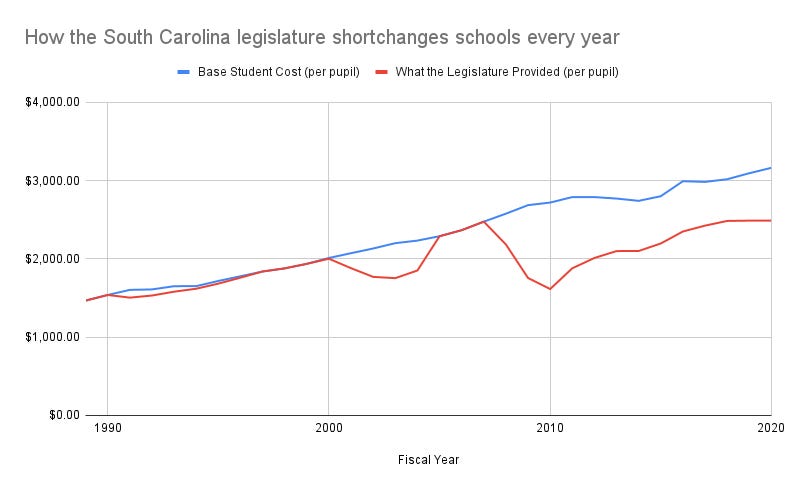
Data compiled by Steve Nuzum, via S.C. Revenue and Fiscal Affairs Office

As a matter of policy, you and your colleagues in the General Assembly have been steadily defunding public education since the start of the Great Recession. You have broken your own promises as outlined in the Education Finance Act and are currently under-funding the Base Student Cost by about a half-billion dollars per year. The results have been disastrous: Our teachers are underpaid and quitting by the thousands, classroom sizes have ballooned, our rural schools are in physical shambles, and a system of separate and unequal education along racial and economic lines has returned with a vengeance.

It is difficult to predict how much money public schools would lose as a result of Education Savings Accounts, which would allow public funds to “follow” individual students to private schools. Our state’s Revenue and Fiscal Affairs Office has tried to guess, though. According to a fiscal impact summary published in December, the ESA program could divert as much as $35 million to private schools within the first year it takes effect, depending how many families participate in the program. By 2026, they estimated the program could cost the state as much as $2.9 billion. Compounded by the General Assembly’s ongoing policy of public disinvestment, this could constitute a death blow to public schools.

The bill is built on a few faulty premises, including the underlying assumption that private schools could or would serve South Carolina students better. The authors of the bill also seem to believe that our state’s private schools could handle a sudden influx of new enrollment while accommodating students’ learning, transportation, and health needs. These are dicey propositions at best.

S. 935 is a direct attack on the notion of education as a public good. Its authors would leave us all to fend for ourselves as atomized individuals, cut loose from mutual obligations that once tied us together. For a certain type of doctrinaire conservative, this may sound like a dream scenario. For the rest of us living in the real state of South Carolina, it is a nightmare come true.

Regards,

Paul Bowers

North Charleston, S.C.

A friend of public schools in Missouri sent the following excerpt of a report by the League report by the state League of Women Voters.

EDUCATION

Senate Education Committee Votes Out Bills

The committee voted out all bills heard thus far this session on February 10, including:

SB 869 (Koenig) to revise the law specifying payments to charter schools and shift more local school funds to charter schools. The League opposes this, based on our position on charter schools and support for public school funding.

SB 650 (Eigel) to allow charter schools to be sponsored by outside entities (other than the local school board) and operate in many districts around the state. Sen. Eigel also offered a proposed SCS version that would add several other provisions, including moving school board elections to the November election, adding restrictions on approval of debt service levies, preventing schools from requiring face masks, and preventing school districts from requiring students or staff to have COVID vaccinations. The League opposes the bill.

House Elementary & Secondary Education Committee

The committee met on February 8 and heard HB 2428 (Dogan) to impose restrictions on instruction relating to race and history. The bill authorizes lawsuits against school employees for violations of the new requirements in the bill. The League opposes the bill.

Nora de la Our writes in Jacobin magazine about the plight of school bus drivers. They are in short supply across the nation. She explains why.

The 2021–22 school year has been marked by severe transportation problems across US school districts. In a nationwide survey of those in the pupil transportation industry conducted in August, 78 percent of respondents said their district’s bus driver shortages are getting worse, with 51 percent describing the situation as “severe” or “desperate.”

As a result, students are facing hours-long commutes, and parents are interrupting their work days to wait in lengthy pickup lines where busing is either unavailable or severely delayed. In September, Massachusetts governor Charlie Baker activated the National Guard to drive kids to school in communities hard hit by COVID-19.

But while school bus driver shortages are more pronounced than in years past, they’re hardly new. Jacqueline Smith, a driver-dispatcher for Indian River County School District in Florida and vice president of transportation for her union local, told Jacobin that staffing shortages were causing her and her colleagues to do “double work” long before the pandemic.

According to annual survey data from School Bus Fleet magazine, more than half of US school districts have experienced driver shortages every year since at least 2006, and more than 70 percent of districts have experienced shortages for most of those years.

Why are US school systems plagued by chronic bus driver shortages? The reason isn’t that there’s a lack of jobseekers willing in theory to work as school bus drivers. It’s that pay and benefits are grossly incommensurate with the incredibly challenging, multifaceted work that school transportation entails.

This video accompanies the story.

Advocates for fair funding for public schools in New York have pursued a remedy from the state for years. They finally won a big increase in the budget, but were shocked to discover that almost the entire increase in funding will be diverted to charter schools, which enroll 14% of the state’s students. Either coincidentally or not, Governor Hochul’s election campaign is heavily funded by charter school advocates from the financial industry.

CHARTER SCHOOL FUNDING INCREASE WIPES OUT STATE FORMULA AID BOOST FOR NYC DISTRICT SCHOOLS

February 2, 2022

In testimony on Governor Kathy Hochul’s FY23 Executive Budget, Education Law Center warned New York lawmakers that a proposed increase in state aid to charter schools in New York City will nearly offset the aid increase to district schools under lawmakers’ promised phase-in to reach full funding of the State’s Foundation Aid Formula.

Last year, after over a decade of resistance, New York elected officials committed to fully funding the Foundation Aid Formula enacted in 2007, with a three-year phase-in. After Andrew Cuomo’s resignation, Governor Hochul declared her intention to fulfill this commitment. Her administration also reached a settlement agreement with the plaintiffs in NYSER v. State, a school funding lawsuit by public school parents in New York City and Schenectady, which conditions ultimate dismissal of the case on reaching full formula funding by 2024. The Governor’s proposed FY23 budget provides for a $1.6 billion increase in Foundation Aid, as required to meet the planned phase-in.

In testimony on the proposed FY23 State Budget, ELC underscored to legislators that the Governor’s proposed 4.7% increase in state aid to New York City charter schools will effectively negate the phase-in of formula funding to the City’s district schools. If the Governor’s proposed budget is enacted, New York City charter schools would receive an increase of $300 million this year, while the City’s district schools will be allocated an increase of approximately $345 million in Foundation Aid. Under state law, New York City is the only district that receives no transitional state aid to offset what the district is required to pay in charter school tuition.

“The math is simple and shocking,” said ELC senior attorney Wendy Lecker. “The increase in tuition payments to charter schools, which enroll just 14% of New York City students, will consume the entire increase in Foundation Aid intended for the almost one million City students enrolled in district schools. Even worse, the City is also mandated by state law to provide space or pay rent for charter schools.”

The ELC testimony also calls out the Executive Budget’s failure to make any additional investments in New York’s preschool program. In a May 2021 ruling, in the “Small Cities” school funding case, a New York Appellate Court recognized preschool as an essential element of a sound basic education guaranteed students under the State Constitution.

It is undisputed that high quality preschool provides a host of academic and life benefits, such as decreased placement in special education, decreased suspension rates, higher educational attainment, higher income, and decreased contact with the criminal justice system. Yet, tens of thousands of four-year-olds across New York lack access to any preschool classes, let alone a high-quality program. ELC is urging the Legislature to invest an additional $500 million to help ensure all four-year-olds access to this essential resource.

ELC also pressed the New York Legislature to maintain and strengthen the Contracts for Excellence (C4E) Law. This law was enacted in 2007 to ensure that struggling school districts receiving additional Foundation Aid would spend those funds on programs proven to improve student outcomes. As districts across the state finally receive these long-awaited increases in funding, it is crucial to have a strong framework for directing the funding to essential resources, including class size reduction in New York City district schools.

Sustained grassroots advocacy – coupled with strategic litigation – has moved New York to make important strides toward providing all students, including students of color, the essential resources required for a constitutional sound basic education. Lawmakers must revise Governor Hochul’s proposed budget to ensure the equitable distribution of increased funding, especially in New York City.

Related Stories:

COURT SETTLEMENT LOCKS IN NY’S COMMITMENT TO INCREASE SCHOOL FUNDING BY $4.2 BILLION

APPELLATE COURT: STATE VIOLATED EDUCATION RIGHTS OF STUDENTS IN NY’S SMALL CITY DISTRICTS

Press Contact:

Sharon Krengel
Policy and Outreach Director
skrengel@edlawcenter.org
973-624-1815, x 24