Archives for category: Funding

Tom Ultican, retired teacher of physics and advanced mathematics in California, here describes the billionaires and bad policies behind Marshall Tuck’s campaign for State Superintendent of Public Instruction.

He sees the Tuck campaign as a new front in the “Destroy Public Education Movement,” which he has written about extensively.

Here are some of the Big Money contributors to Tuck’s campaign:

The Waltons control Walmart and have been spending heavily to privatize public schools for more than three decades.

Bill Bloomfield is a rich guy from LA who has also poured $7,000,000 into independent expenditures for Tuck.

The Rogers family is the main local force behind the privatization of Oakland’s school system.

Doris Fisher founded The Gap with her husband Don. They have spent extensively promoting charter schools and were the first significant benefactors for the KIPP franchise.

Eli Broad is the only person to found two fortune 500 companies. He announced plans to charterize half of Los Angeles’s schools and published a guide for closing public schools.

John Scully was the former CEO of Apple and consistently supports school privatization.

David Horowitz is a Republican activist who gained notoriety for his anti-affirmative action campaign.

Arthur Rock is Silicon Valley royalty who spends lavishly to support school privatization.

Peter Chernin was COO of Rupert Murdoch’s News Corp. He is also a movie producer of some note.

Reed Hastings is possibly the most dedicated destroy public education billionaire. He sat on the board of the California Charter Schools Association for many years.

Richard Riordan is the billionaire former Mayor of Los Angeles who spends millions on public school privatization.

John Arnold is the ex-Enron executive who did not go to jail. He and Reed Hastings have each invested $100 million in a new national school privatizing organization called The City Fund.

Jonathan Sackler is the heir to the billionaire inventors of Oxycontin. Besides selling addictive drugs, Jonathan invests in the privatization of America’s schools.

Les Biller is a former CEO of Wells Fargo bank. He and his wife have a foundation in Seattle, Washington where they give heavily to charter schools.

Julian Robertson Jr. is a hedge fund manager in Chicago who thinks California really needs Marshal Tuck.

Stacy Schusterman is an energy industry heir from Tulsa, Oklahoma. She has been particularly active in California school board elections.

Michael Bloomberg is the billionaire former New York mayor who spawned Joel Klein, Eva Moskowitz and Michelle Rhee. He spends heavily on California school board elections.

The big money is not in direct contributions like those listed above. It is in the money for independent expenditure committees that do not have contribution limits. For example, the Ed Voice for the Kids Pac has already reported spending over $13,000,000 in support of Tuck (Id 1243091). There are many more of these PACs spending money to elect Tuck such as Education Reform Now Advocacy for Tuck and Charter Public Schools Political Action Committee.

Ultican contrasts the two candidates:

Tony Thurmond was born in Monterey, California. His father was stationed at the Fort Ord Army base. Tony’s father abandoned his family of four children. Thurmond’s Panamanian immigrant mother became a school teacher and moved the family to San Jose.

Tragedy struck six-years-old Tony when his mother died of cancer. Tony and a brother moved to Philadelphia where they were raised by a cousin.

After graduating from high school in Philadelphia, Tony matriculated to Temple University where he was elected student body president and received a BA in psychology. He attended graduate school at Bryn Mawr earning a dual masters in Law and Social Policy and Social work.

The most disgusting statement in the San Diego Union editorial read, “In his interview with us, Assemblyman Tony Thurmond, D-Richmond, who finished second to Tuck in the June primary, seemed just as affable but not nearly as ambitious as Tuck.” In case that was too subtle; Tony is a black man.

After rising above his traumatic childhood and becoming educated, Tony married and returned to California in 1998. For the 20 years preceding his election to the California State Assembly, Thurmond served in various positions at non-profit social service agencies. Tony says it was his public school education that helped him become at 20-year social worker and serve on a school board, a city council and now the California State Assembly.

Tony has two daughters in public school.

Marshall Tuck received an MBA from Harvard University in 2000 and a BA in Political Science from University of California Los Angeles in 1995. He grew up in the San Francisco Bay area and has a wife and son.

He spent some time as a consultant at Mitt Romney’s Bain & Co. He was an investment analyst at the Upper Manhattan Empowerment Zone. He moved to Los Angeles to work at Salomon Brothers as an investment banker focused on both mergers and acquisitions. After a brief stint in sales for a Software company, in 2002, Tuck was hired by Green Dot Charter Schools as Chief Operating Officer.

In 2007, Los Angeles Mayor Anthony Villaraigosa had been rebuffed in his efforts to take control of Los Angeles Unified School District. He did convince a few donors to underwrite the takeover of a small number of schools in areas which had suffered years of poor standardized test results. They created a non-profit called Partnership for LA and Villaraigosa tapped Marshall Tuck to lead the Partnership.

Tuck had by then become the CEO of Green Dot. The year he left for the Partnership, Green Dot schools posted nine of the fifty lowest SAT scores among Los Angeles schools.

Tuck was extremely unpopular at the Partnership. The Sacramento Bee reported, “Teachers passed a vote of no confidence at nine of the schools at the end of the first year, leading to independent mediation.” An online education news paper in Los Angeles, School Matters, reported, “Many of us hoped that when right-wing business banker Marshall Tuck was ignominiously forced to step down as the ‘CEO’ of the Partnership for Los Angeles Schools (PLAS), that we might have heard the last of Tuck altogether.”

Tuck’s authoritarianism and lack of education background has led to serial failures, however, those forces trying to privatize California’s public schools find his style to their liking.

In 2014, when Tuck lost the most expensive SPI race in California’s history, his allies were there to take care of him. Even though he has no training as an educator, he was made Educator-in-Residence at the New Teacher Center (NTC). Bill Gates has granted NTC $26,305,252 since 2009.

This Contest is Very Important If You Value American Democracy

Marshall Tuck is the representative of the Destroy Public Education billionaires who are spending massive amounts of money to get him elected. It is widely understood that elected school boards are the soil from which American democratic government rejuvenates itself. Dark “DPE” forces are undermining democracy in this country by destroying the people’s 200-years-old public education system. They must be stopped.
Peter Greene begins with a tweet by Jose Luis Vilson and then proceeds to address the question that is the title of this post.

High expectations are free. So are hopes and dreams. But are they enough?

He writes:

It was a tweet by Jose Luis Vilson that drew my attention to the quote:

“It doesn’t cost one penny more to have higher expectations for kids, to actually believe that kids–low-income kids, kids of color, English-language learners–can succeed,” he says.

The speaker is TNTP CEO Dan Weisberg, speaking about TNTP’s latest “report.” I’ve addressed that report elsewhere, but this particular idea is worth a closer look because it has been so persistent. Arne Duncan was a big believer in the magic of expectations, and Reformsters have often touted its powers– perhaps precisely because it is a “reform” they can have for free.

But are expectations free?

I suppose expectations themselves are free, just as wishes and dreams are free. But creating the conditions and providing the tools that allow those expectations to be met– that’s not so free. And without support, some expectations are just cruel.

I mean, I can expect someone who is confined to a wheelchair to live a full and active life– but somebody needs to provide that person with the actual wheelchair as well as appropriate physical therapy. Stephen Hawking’s super-cool chair, computer interface, and voice synthesizer were not free.

And when we talk about education, there’s a problem with free if by “expectation” we mean that a teacher should expect a child who is hungry, who lives with poverty every day, who lacks support for education at home, who lives with fear and instability in her world– well, if we’re just supposed to “expect” that child to handle school as if she lived a comfortable, stable, well-fed existence, that’s just wrong.

It is also wrong to “expect” that students who go to school where there are not enough books, not enough desks, not enough supplies, but plenty of mold and decaying corners of the building– to expect those students to approach school as if it were well-supported, well-funded, shiny and clean. Too often this business about the soft bigotry of low expectations is another way to say, “No, we’re not going to fully fund this school, nor are we going to address the systemic racism and poverty that surrounds it– just get in there an expect harder.”

There is, of course, a solid core of truth to this talk about expectations. Every decent teacher understands that expectations are important in a classroom, that if you approach students with an attitude of “Well, these are just the dumb kids, so let’s not expect much, try much, or do much” you are failing those students.

But. But but but.

Read the rest. You know how good Peter Greene is when he begins to eviscerate foolishness. How many TFA teachers have been told that high expectations are enough, then run into the harsh reality that students are hungry or need a winter coat or are worried about an ill parent?

Beware, he writes: Expectations are just a form of faith, and even the Bible tells us that faith without works is dead. Expectations matter, but expectations are only a foundation and no, you can’t build the house for free. “Teachers should just expect harder,” is just an excuse for politicians and policy wonks to avoid the issue of giving underserved, underfunded schools the resources they need, the kind of resources and funding that politicians and policy wonks would give them if those guys really, truly believed in the success of those students.

A corollary: Teachers should have high expectations, and teachers should have the resources and supports they need, and states should raise taxes to pay for the schools that students and teachers need. If they are not willing to pay for good education, they won’t have the schools and teachers that students deserve.

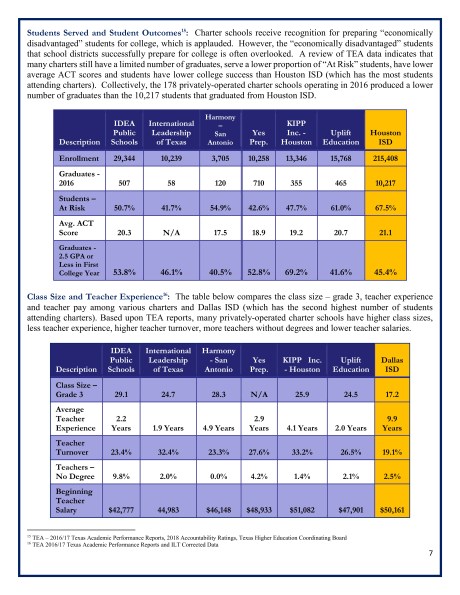
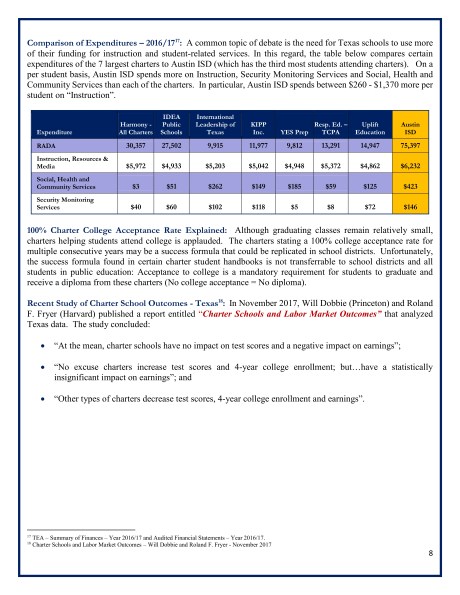
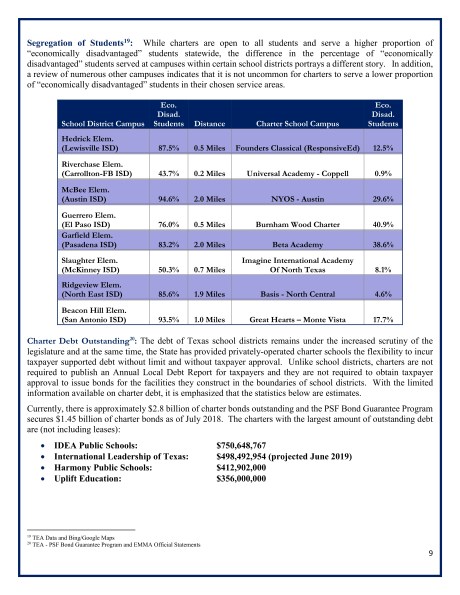
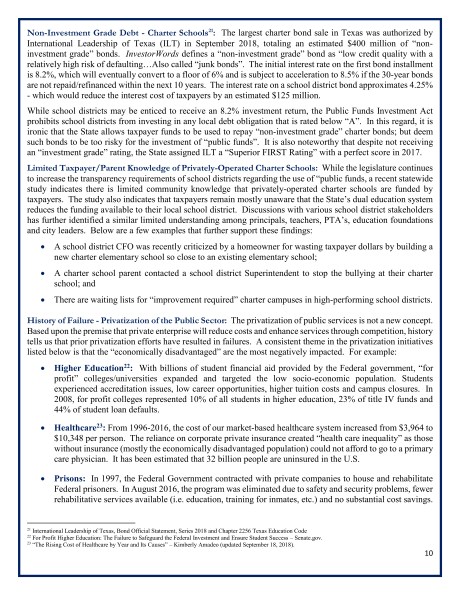
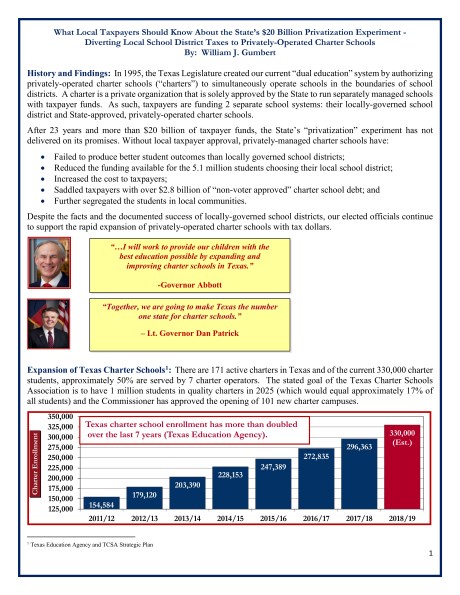
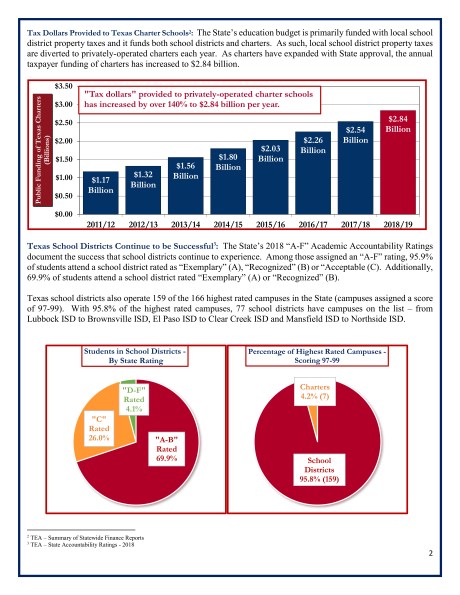
This is an important collection of data about the funding of public schools and charter schools in Texas. Do you think that taxpayers know that they are funding two separate school systems, one governed by elected, accountable school boards and the other governed by private, self-selected, unaccountable school boards? Do you think that the public knows that district public schools outperform charter schools?

What Local Taxpayers Should Know About the State's $20 Billion Privatization Experiment (October 2018)tax2tax3tax4tax5tax6tax7tax8tax9tax10tax11tax12

John Thompson, historian and teacher, lives in Oklahoma.


The Oklahoma press is focusing on the state’s low level of college readiness as measured by the ACT test, 16 percent, in comparison to the national rate of 27 percent. The state known for dramatic cuts in education funding is ranked 19th in the nation with an average composite score of 19.3. But it is missing the big picture.

https://www.tulsaworld.com/news/education/college-readiness-rate-remains-level-in-oklahoma-s-second-year/article_f94e7779-4328-56b4-8b21-a1390a634d4b.html

The average ACT composite for my old school, Centennial, is 14.8, which is above average for the high-poverty neighborhood schools in Oklahoma City and Tulsa. Even when we were ranked last in the state, our ACT scores were significantly higher. Since I retired, Centennial received a $5 million School Improvement Grant. I believe that its ACT decline is just one example of evidence explaining how and why tens of billions of dollars of corporate school reform drove meaningful learning out of many inner city schools.

The Latest ACT Scores for Public and Private High Schools

The important question is what caused the national decline. Retired PBS education reporter John Merrow argues these ACT-takers “have had 12 or 13 years of test-centric education, and the kids coming up behind them have also endured what the ‘school reformers’ designed.” He also asks, “How much more evidence do we need of the folly of ‘No Child Left Behind’ and Education Secretary Arne Duncan’s ‘Race to the Top’ before we take back our schools?”

As Ye Sow, So Shall Ye Reap…..

Since reformers sought to improve low-performing schools, it is significant that Merrow cites the ACT report on recent outcomes:

A higher percentage of students this year than in recent years fell to the bottom of the preparedness scale, showing little or no readiness for college coursework. Thirty-five percent of 2018 graduates met none of the ACT College Readiness Benchmarks, up from 31% in 2014 and from 33% last year.

Click to access National-CCCR-2018.pdf

All types of researchers are contributing to the autopsies being performed on data-driven, competition-driven reform. And many of us are especially intrigued by the analyses of corporate school reformers on why test-driven accountability, the expansion of charter schools, and the quest to “build a better teacher” failed. The latest, by the Gates Foundation’s Tom Kane, is very illustrative. Kane acknowledges that media coverage has declared his “teacher quality” effort a failure, but he mostly blamed educators.

Develop and Validate — Then Scale

Kane is typical of many reformers who say the big mistake was rapidly scaling up their teacher evaluation and test-driven accountability models. Kane forgets, however, that he, Bill Gates, other venture philanthropists, and Arne Duncan were the ones who imposed the rapid scaling up of their untested hypotheses.

This leads to my hypothesis about the Tulsa Public Schools, which is led by corporate reformer Deborah Gist and a team of Broad Academy-trained administrators. It may offer a case study in the causes of the reform debacle. The TPS has the nation’s 7th lowest rate of student performance growth from 3rd to 8th grade.

Student growth: What’s the matter with Tulsa?

Tulsa has a lot of advantages due to the Kaiser Foundation’s science-based early education efforts, and it used to have better student outcomes than the OKCPS. Tulsa has received millions of dollars in funding for it value-added teacher evaluations, “personalized” learning, and other corporate reforms. The cornerstone of their approach was the termination and “counseling out” of experienced educators, and demanding compliance to their new model.

https://www.tulsaworld.com/news/education/tulsa-public-schools-teacher-evaluation-system-is-changing-culture-has/article_6be79be3-d934-5d4a-98ef-5ec90bcea9e9.html

Of course, no single piece of data can prove that Tulsa’s experiments failed for any single reason, but a new database created by ProPublica and Chalkbeat provides valuable new information. Their research shows that many of the biggest experiments, costing hundreds of millions and even billions of dollars and that were once proclaimed as successes, actually increased the achievement gap. Despite false claims to the contrary, many districts that committed to corporate reforms, and often claimed that they improved student performance, actually practiced mass suspensions of poor, black students. And there seems to be an unmistakable correlation between their commitment to teacher quality experiments and the increase of inexperienced teachers.

https://www.chalkbeat.org/posts/us/2018/10/16/chalkbeat-propublica-collaboration-education-inequity-data-miseducation/
https://www.chalkbeat.org/posts/newark/2018/10/16/in-newark-reporting-lapses-hide-thousands-of-student-suspensions-from-public-view/

So, how much of the decline in Oklahoma ACT scores is attributable to the top-down reforms funded by the federal government, Bill Gates, and other edu-philanthropists?

It doesn’t rise to the level of “proof,” but it is noteworthy that black TPS students are 2.2 years behind their white peers. That is .5 a year worse than the OKCPS gap. (And only 18 percent of TPS students took those college readiness tests, in contrast to the OKCPS where 29 percent took the ACT or SAT.)

https://projects.propublica.org/miseducation/district/4030240

Nearly a quarter of OKCPS teachers are categorized as inexperienced. The same percentage applies to Centennial, and whenever I visit my old school I hear more concerns about the ways that teacher turnover undermines school improvement.

Nearly 1/3rd of Tulsa teachers are inexperienced.

As more data arrives, we will be able to evaluate whether the multi-million Tulsa/Gates Foundation teacher quality initiative drove down the quality of teaching and learning. But this much is obvious. It is easier for competition-driven reformers to suspend poor students than it is for them to increase student learning.

And the “exiting” of large numbers of veteran educators was seen as a feature, as opposed to a flaw in their model. Now we know it is much easier to drive teachers out of the profession than it is to social-engineer better teachers.

Last year the Arizona legislature passed legislation to make vouchers available to all students in the state. Horrified parents and educators in Arizona—led by Save Our Schools Arizona—gathered over 100,000 signatures to put a referendum on the ballot. The Koch brothers sent in their legal team to try to block the referendum. They failed. The courts kept the referendum on the ballot. The referendum question is called Proposition 305. It asks voters whether they want universal vouchers.

To stop vouchers, vote NO.

To learn more about SOS Arizona, open this link.

ARIZONA: JUST SAY NO TO UNLIMITED SCHOOL VOUCHERS!

Arizona voters have the opportunity to show their state’s lawmakers – and the entire nation – that they support their public schools by voting NO on Proposition 305. Thanks to a successful and hard-fought grassroots campaign, the November ballot will include a question about expanding Arizona’s voucher program (currently targeted to special categories of children) to all 1.1 million students in the state.

A NO vote on the November referendum will keep public funds in the public schools, instead of diverting those resources to pay for vouchers for private and religious education. This is a particularly important vote in Arizona, where 95% of students attend public schools, while the state ranks 48th in the country in terms of public school funding level.

According to the “National Report Card: Is School Funding Fair?” published by the Rutgers University Graduate School of Education and Education Law Center, Arizona receives an “F” in the “Effort” category, meaning the state makes a lower than average effort to fund its public schools.

The grassroots group that spearheaded the voter referendum, Save Our Schools Arizona, is leading the campaign for the NO vote. The goal is to make sure there are no further cuts to public education, especially since a whopping $4.65 billion has already been cut since 2009. The organization notes that $160 million could be diverted from the state’s public schools – every year – if the expanded voucher program is implemented.

Arizona public school advocates know what many states, and even the federal government, have found to be true – voucher programs are highly unpopular and therefore extremely difficult to establish or expand. In November, Arizona voters will get the chance to save their schools and send a message that will be heard across the country: Just Say NO to Vouchers!

For more information about vouchers, visit Voucher Watch on the ELC website.

Education Law Center Press Contact:
Sharon Krengel
Policy and Outreach Director
skrengel@edlawcenter.org
973-624-1815, x 24

Jeremy Mohler of “In the Public Interest” writes about a new report showing that public schools are underfunded on purpose.

“Like many reports, the latest from the Alliance to Reclaim Our Schools (AROS) drops a number of disturbing facts.
Between 2005 and 2017, the federal government neglected to spend $580 billion it was supposed to on students from poor families and students with disabilities. Over that same time, the personal net worth of the nation’s 400 wealthiest people grew by $1.57 trillion.

“Seventeen states actually send more education dollars to wealthier districts than to high-poverty ones.
Over 1.5 million students attend a school that has a law enforcement officer, but no school counselor. The school policing industry was a $2.7 billion market as of 2015.

“But Confronting the Education Debt doesn’t just throw numbers against other numbers to see what sticks. It tells a tragic story: the rich are getting richer, and our public schools are broke on purpose. And it comes to an indisputable conclusion: black, brown, and low-income students and their schools are owed billions of dollars.
That’s because many public schools do in fact work, but only when they are fully resourced, which tends to be in white, middle class, and affluent communities.

“These findings drive home that adding market forces to public education — so-called “school choice” — is a superficial and, even, harmful attempt at solving a deep and enduring problem. After being hijacked as a political project by private investors and billionaires, charter schools have begun to threaten the existence of public education itself. As they grow in number, they siphon more and more funding from school districts, forcing cuts at traditional, neighborhood schools. Charter schools are costing San Diego Unified School District, for example, over $65 million annually — or about $620 per neighborhood school student.”

The answer is clear: fully fund our public schools and drop the fantasy that the market will fix the problems of underfunded schools.

Brad Miller is a lawyer in North Carolina who served in the State Legislature. This article appeared in “Verdicts,” a publication of legal analysis.

Miller writes:

The Trump administration’s “school choice” plan is destined for court, and maybe not with just the usual suspects as plaintiffs.

The administration’s budget proposes deep cuts to programs to help low-income and other disadvantaged students at traditional public schools, which Education Secretary Betsy DeVos and her allies call “government schools” and regard as sinister institutions somewhere on the socialism spectrum. But the budget proposes an additional $1.4 billion to expand charter schools and to provide vouchers for religious and other private schools. The proposal would allow, and perhaps require, “portability” of local and state funds. When a child enrolls in a charter or private school, funds would “follow the child.”

School choice is the New Coke of education policy. The supposed superiority of charters and private schools is based on dogma, not objective research. Students in public schools perform every bit as well when the circumstances of the students are taken into account.

Charters have become a separate school system in many districts, and separate is inherently unequal now just as it was in 1954, even if the basis for separation is more subtle. Charters recruit kids who do not have special needs, will not be discipline problems, and are likely to perform well in any school. Charters often expel other kids for pretextual disciplinary reasons, who then enroll in traditional public schools. Civil and disability rights organizations have already successfully challenged some of the discriminatory policies that make traditional public schools the high-risk pool in some districts. More such challenges are certain.

But there may also be an unexpected legal challenge.

Moody’s Investors Service published research in 2013 that found that charter schools were a growing credit risk for public schools. The risk was largely the result of “state policy frameworks that support charter school growth,” such as permissive rules for the authorization of new charters and increased enrollment in existing charters, as well as per-pupil or other funding formulas based upon enrollment. According to Moody’s, public schools that lost enrollment to charters “often cut academic and other programs, reducing service levels and thereby driving students to seek educational alternatives, including charter schools,” which “can exacerbate the loss of state and local revenues, as portions of both will follow those students to charter schools.”

Some analysts say the cycle that Moody’s described became a “death spiral” for some public school systems, such as Detroit’s. At the end of 2011, Michigan’s governor signed legislation to remove the statutory cap on university-approved charter schools. Charter schools in Detroit increased from 52 to 64 the next year, and the explosive growth continued. For the 2005-2006 school year there were 130,719 students enrolled in Detroit Public Schools and 25,802 enrolled in charters. For the 2013-2014 school year, there were 48,511 students enrolled in DPS and 58,612 enrolled in charters. State per-pupil funding for 2013-2014 was $7,246 for charter schools and DPS alike. Charters are not responsible for any part of DPS’s debt.

Moody’s reduced the Detroit Public Schools’ credit rating from B3 to Caa1, two notches above imminent default, on March 24, 2015. Moody’s specifically cited the “growing charter school presence” as a cause for the system’s financial difficulty.

Charter-Friendly Legislation May Violate the Contract Clause

Investors in public school bonds may have a claim that such charter-friendly state legislation impairs their contracts with public school districts in violation of the Contract Clause of the U.S. Constitution. The courts have been sympathetic to challenges to state legislation under the Contract Clause where the contract impaired is the state’s or a political subdivision’s own, especially where the contract is a debt instrument sold on financial markets, and most especially where the legislation is a change in taxes or spending, as opposed to new public health and safety protections.
Enrollment-based funding formulas in Michigan and elsewhere resulted in the loss to public schools of far more funds than the incremental cost of educating children enrolled in charters. Public schools lost funds for fixed costs, including debt service for bonds to pay for school construction, renovation, and equipment to serve the expected enrollment.

The powers of the purse are core legislative functions. State legislatures have discretion to set tax and spending priorities, the Supreme Court said in 1977 in United States Trust Co. v. New Jersey, but “complete policy deference to a legislative assessment of reasonableness and necessity is not appropriate where the State’s self-interest is at stake. A government entity can always find a use for extra money, especially when taxes do not have to be raised.” The Court cautioned that state legislatures may change spending priorities, but “the obligations of its own contracts” are not simply one priority for legislatures to consider “on a par with other policy alternatives….”

State legislation to encourage the growth of charters has detrimentally affected the financial framework of public schools. Investors relied on the existing framework when they decided to purchase schools bonds. And states that enacted legislation to encourage the growth of charter schools have generally provided no alternative revenue to pay public schools’ debt.

Most states that have created parallel systems of traditional public school and tax-funded charter schools have not paid for the additional costs with additional taxes. Instead, most states have paid for charters from traditional public schools’ funds and thus lowered the priority of the obligations of their own contracts with investors in public school debt. The Contract Clause forbids that policy alternative.

Any Remedy Would Be a VictoryW

It is unlikely that a successful Contract Clause challenge would result in the elimination of funding for existing charters. A court would more likely enjoin new charters or the expansion of existing charters, or perhaps limit the future diversion of funds to the incremental costs of educating children who enroll in charters to protect the contract rights of bondholders. Any remedy a court might fashion, however, would be an enormous victory for traditional public schools.

A legal challenge by bondholders would be more than defensible to the public. DeVos’s clueless testimony at her confirmation hearing was an embarrassment to billionaire dilettantes everywhere, but “alternatives” to public schools remain wildly popular with what Bernie Sanders calls “the billionaire class.” Most Americans are more skeptical. Americans don’t regard public schools as creeping socialism or public school teachers as union thugs, and don’t support looting public schools to pay for charters or private schools.

It is a fight that supporters of traditional public schools should welcome.

Steven Singer describes a new report that reached a startling conclusion: the federal government shortchanged the nation’s public schools by hundreds of billions, at the same time that the top earners raked in billions of dollars.

He writes, in part:

Fun Fact: Between 2005 and 2017, the federal government withheld $580 billion it had promised to spend on students from poor families and students with disabilities.

Fun Fact: Over that same period, the personal net worth of the nation’s 400 wealthiest people ballooned by $1.57 trillion.

So, rich people, consider this the bill.

A new report called “Confronting the Education Debt” commissioned by the Alliance to Reclaim Our Schools (AROS) details the shortfall in minute detail.

For instance:

$347 billion owed to educate low-income students most of whom are children of color.

$233 billion owed to provide services for students with disabilities.

And this is just the shortfall of the last dozen years! That’s just money due to children who recently graduated or are currently in the school system!

We’ve been cheating our children out of the money we owe them for more than half a century!

Sue Legg is a retired assessment and evaluation expert who worked for three decades at the Florida Department of Education; she is past president of the Alachua County (Florida) League of Women Voters.

She writes:

>Amendment 8 Behind the Scenes: Political ideology, religion, dark money, billionaires, and of course, the money trail

Florida’s 652 charters run the gamut from small ‘mom and pop’ charters to large chains organized by for-profit management companies. Some serve children and districts well. Many others tell different stories. They involve not only political ideology but also religion, dark money networks, billionaires, and of course, self-interest.

The Erika Donalds version of the charter story starts simply. A small group of members seceded from the Florida School Boards Association (FSBA) in 2015 to form the Florida Coalition of School Board Members (FCSBM). Erika Donalds, a member of the Collier County school board and wife of Florida Representative Byron Donalds, fronts this coalition, but the political network behind it is extensive. It goes all the way to our nation’s capital.

About 14 of the 50 alternative school board association members have been publicly identified, including:

Rebecca Negron, who has just been defeated for a seat on the Martin County school board even though her supporters raised over $250,000 to unsuccessfully attack her opponent. She is the wife of Senate President Joe Negron. Senator Negron wrote the initial legislation for the Florida Tax Credit Scholarship program to give corporate taxes to private schools.

Some FCSBM members also have strong dark money ties to national conservative political advocacy groups.

Erika Donalds openly displays the Americans for Prosperity logo on her Collier 912 Freedom Council website. This is a tea party group supported by the Koch brothers and others.

In the March 29, 2018, article in the Tampa Bay Times, Speaker of the Florida House Richard Corcoran’s wife Ann, who operates her own charter school, is identified.

Shawn Frost, who is Chair of the Indian River school board, is part of this coalition.

He announced in the Indian River Guardian that he expects to be appointed to the Florida State Board of Education. Frost reported campaign contributions from Betsy DeVos, the U.S. Secretary of the Department of Education. In 2014, Frost received $20,000 in campaign contributions from the American Federation of Children run by Betsy DeVos. Frost lives in Vero Beach, but maintains a room in his father’s house in Indian River to meet the residence requirements for being on the school board. He is also the head of MVP Strategy and Policy which specializes in consulting for school board races.

A Duval School Board member Scott Shine has reportedly joined the FCSBM. He withdrew from his 2018 reelection campaign due to ‘personal attacks’.

Sarasota school board members Erik Robinson, a former Republican Party Chairman and Bridgit Ziegler are listed members. Ziegler’s campaign reported $45,000 in donations from the out of state Phoenix Media LLC. According to the Herald Tribune, the money was funneled through a PAC run by fellow board member Erik Robinson, who is often called ‘The Prince of Dark Money’.

Some FCSBM members are collaborating to build a Florida chain of Classical Academy Charters. This isn’t just any group of charter schools. They are sponsored by the Hillsdale College Barney Charter School Initiative. The College, located in Michigan, has a long religious/conservative/libertarian agenda. The DeVos immediate family and close business associates have several Hillsdale graduates. \The Barney (SmithBarney) and Stanton Foundations fund the initiative. There are 17 of these charters nationwide. In Florida, there are four: Mason in Naples, Pineapple Cove in Palm Bay, St. Johns in Fleming Island, and the newly formed Pineapple Cove in West Melbourne. Donalds and her husband have been active with the Mason Classical Academy in Collier County. Donalds is currently seeking to add a Classical Academy in Martin County where Rebecca Negron was running for school board.

Erika Donalds has more than running a charter school on her mind. She was appointed by the governor to the Florida Constitutional Revision Commission (CRC) which is convened every twenty years to consider proposals to amend the constitution. Donalds is a strategist to divide the Florida public schools into two separate systems, one for ‘independent schools’ and one for public schools established by locally elected school boards. Essentially, it would allow one system for charters and private schools receiving tax credit scholarships and one for traditional public schools.

This year the CRC was plagued with ‘log rolling’. It is a technique to bundle dissimilar proposals into one law. There is a spate of these ‘logs’ projected to be on the November ballot. Multiple lawsuits have been filed against them, and the Florida Supreme Court ruled that the League of Women Voters was correct in its opposition to at least one. This proposed Amendment 8 to the Florida constitution must be withdrawn from the November ballot. How this amendment came to be is a story in itself.

Amendment 8 combines three separate proposals: school board term limits, civics literacy and a clause stating that school boards are only responsible for schools they create. This third proposal is the heart of the amendment. The title for the amendment, however, is: “School Board Term Limits and Duties; Public Schools”. Voters might be in favor of one part of the combined proposals but opposed to another. It was a ‘take it or leave it’ strategy. The wording, even the title was intended to confuse voters.

Term limits and civics education may seem innocuous, but they are not.

Erika Donalds is also the Florida sponsor for the US Term Limits organization. This group has a well-documented conservative political agenda that targets school boards to create more opportunities to influence policy. The Koch brothers founded the US Term Limits group. The civics course requirement proposed by CRC member Gaetz, the former President of the Florida Senate, made no sense. Civics was already required by the Florida Department of Education. Former Governor Bob Graham, long a champion of civics education, stated that not only is Amendment 8 a hodge podge, it is not even good for civics education. The CATO Institute has a major focus on civics education and provides free civics material to k12 schools. Its message is clear. According to the Huffington Post, the CATO group states: “The minimum wage hurts workers and slows economic growth. Low taxes and less regulation allow people to prosper. Government assistance harms the poor. Government, in short, is the enemy of liberty.”

The third component of Amendment 8 was to remove local school board control over the authorization of new charter schools. This too represented the national move to privatize our schools by creating charters and funding vouchers to private schools. In the proposed Amendment 8, however, the schools were called ‘independent’, not charter schools. Florida Commissioner of Education Pam Stewart stated that removing local school board control over the establishment of charter schools goes too far. CRC member Patricia Levesque, CEO of Jeb Bush’s education foundation however, supported the amendment as did Marva Johnson, the President of the State Board of Education.

Erika Donalds formed a Political Action Committee called ‘8 is Great’ to sway voters to support Amendment 8. According to the Vero Communique, Howard Rich, a wealthy New York real estate investor, invested $100,000 in the ‘8 is Great’ PAC. Rich serves on the Board of the CATO institute which was founded by the Koch brothers. David Koch ran for Vice President of the U.S. in 1980 on a platform opposing social security, the FBI, the CIA and pubic schools. The billionaire Koch brothers have a long and intensive interest in promoting school choice through their Americans for Prosperity organization. They are concentrating on Florida, Arizona, Colorado, Nevada, North Carolina, Ohio, Pennsylvania, Texas, Virginia and Wisconsin. Their presence takes many forms. Watch for everything from donations to school board races, charter and voucher expansion efforts and state election campaigns. John Kirtley, the founder of Step Up for Children was a major donor. Step Up is the agency that administers a billion dollars for the Florida Corporate Tax Credit Scholarships for private schools. Indian River School Board member Shawn Frost and Duval School Board member Scott Shine have joined the PAC according to the Tampa Bay Times.

Recognizing that term limits and civics education are popular among many voters, former Supreme Court Chief Justice Wells submitted a brief to the Florida League of Women Voters in which he stated: “This change from local county school board control…is hidden by packaging the change with what are thought to be attractive proposals for term limits and civics education.” These schools were planned to be charter schools but the word ‘independent’ was substituted for the word ‘charter’.

There is a watchdog coalition of about 20 public interest groups, headed by the League, to follow and evaluate CRC proposed amendments. Amendment 8 was identified early by the coalition as part of a package of amendments intended to seize local control from city and county governments. The League of Women Voters and the Southern Poverty Law Center joined forces to file a lawsuit against Amendment 8 asking that Amendment 8 be removed from the November ballot. The suit claimed that the amendment was deliberately vague and intended to confuse the public. The circuit court in Tallahassee agreed. The State filed an appeal.

The Appellate Court immediately referred the case to the Florida Supreme Court saying, “The case involves a question of great public importance and requires immediate resolution by the Supreme Court.” The vagueness of the amendment language and its misleading title: “School Board Term Limits and Duties; Public Schools” was the basis for the justices’ 4 to 3 ruling against Amendment 8. The decision puts a roadblock in the effort to create an alternative charter school system. Some legislators will no doubt continue to push proposals to remove any local school board control of charter schools. In reality, local public schools have very limited responsibility to oversee charters, but they and the local press can shine a spotlight on what is at stake.

After sixteen years of choice, it is clear that choice divides communities, segregates children, and dissipates funding without making any appreciable improvement in student achievement. The Supreme Court has another case before it now, ‘Citizens for Strong Schools vs. Florida State Board of Education’ that has been working its way through the courts since 2009. The plaintiffs contend that Florida’s choice policy has failed to adequately fund schools and does not provide the quality education for all children that the Florida constitution requires. Of particular interest is whether there should be justiciable standards to define a ‘quality education’. The hearing is set for November 8. The future of our public school system will depend upon the ruling from the bench. The future of our public school system will depend on the ruling from the bench.

In the lawsuit that Sue Legg refers to in the last paragraph, a group called “Citizens for Strong Schools” argues that the state “is funding two separate systems of public education through its use of privately-run yet publicly funded charter schools, and vouchers that allow kids to attend private schools for varying reasons. Opponents say such programs take money away from traditional public schools.” Florida courts have rejected that argument in the past.

I think we are beginning to understand the real purpose of Corporate Reform. The 1% and their minions repeat ad nauseum that school choice will fix all education problems, lift the poor out of poverty, and no new taxes are needed. Indeed, they have pushed for tax cuts and cheered on deep cuts to public education. We are watching a generation of defunding public schools, refusing to invest in teachers’ salaries, and a massive transfer of resources from the public sector to private institutions.

Jeff Bryant explains it here.

“Recent news stories about wealthy folks giving multi-million donations to education efforts have drawn both praise and criticism, but two new reports by public education advocacy groups this week are particularly revealing about the real impact rich people have on schools and how they’ve chosen to leverage their money to influence the system.

‘The Education Debt’

“The first report, “Confronting the Education Debt” from the Alliance to Reclaim Our Schools examines the nation’s “education debt” – the historic funding shortfall for school systems that educate black and brown children. The authors find that through a combination of multiple factors – including funding rollbacks, tax cuts, and diversions of public money to private entities – the schools educating the nation’s poorest children have been shorted billions in funding.

“One funding source alone, the federal dollars owed to states for educating low-income children and children with disabilities, shorted schools $580 billion, between 2005 and 2017, in what the government is lawfully required to fund schools through the provisions of Title I of the Elementary and Secondary Education Act and the Individuals with Disabilities Education Act.

“The impact of not fully funding Title I is startling, the report contends, calculating that at full funding, the nation’s highest-poverty schools could provide health and mental health services for every student including dental and vision services, and these schools would have the money to hire a full-time nurse, a full-time librarian, and either an additional full-time counselor or a full-time teaching assistant for every classroom.

“State and local governments contribute to underfunding too by keeping in place tax systems that chronically short schools, particularly those that educate low-income students, mostly of color. Two school districts in Illinois are highlighted – one where 80 percent of students are low-income and gets about $7,808 per pupil in total expenditures, while another, where 3 percent of students are low-income, spends $26,074 per student…

“In the meantime, while the nation’s education debt expands, the accumulated wealth of the richest Americans continues to grow. During that time period the federal government was shorting schools billions, the personal net worth of the nation’s 400 wealthiest individuals grew by $1.57 trillion, the report notes.

“There is a direct correlation between dwindling resources for public schools and the ongoing political proclivity for transferring public dollars to the nation’s wealthiest individuals and corporations,” the report declares. “The rich are getting richer. Our schools are broke on purpose.”

This is the context for Bryant’s discussion of the NPE Action Report, “Hijacked by Billionaires.” The 1% buy control of state and local races so they can advance their tax-cutting, budget-cutting ideas and promote school choice.

“What motivates these wealthy people from exerting their will in the electoral process varies. They are bipartisan politically. Some are directly connected to the charter school industry. Others have expressed disdain for democratically controlled schools and argue, instead, for school governance to transfer to unelected boards. Some are motivated by their hatred of teachers’ unions. While others believe strongly that public education needs to be opened up to market competition from charters.

“But what billionaire donors all have in common, the report authors write, is their devotion to blaming schools and educators for problems posed by educating low-income children. Instead of using their political donations to advocate for more direct aid to schools serving low-income kids, wealthy donors “distract us from policy changes that would really help children,” the report argues, “such as increasing the equity and adequacy of school funding, reducing class sizes, providing medical care and nutrition for students, and other specific efforts to meet the needs of children and families.”

Their one unifying idea is lower taxes.

His third example is a new book about how predatory elites subvert democracy.

“Rich people are playing a double game,” writes Anand Giridharadas in his new book ‘Winners Take All: The Elite Charade of Changing the World.’ “On one hand, there’s no question they’re giving away more money than has ever been given away in history … But I also argue that we have one of the more predatory elites in history, despite that philanthropy.”