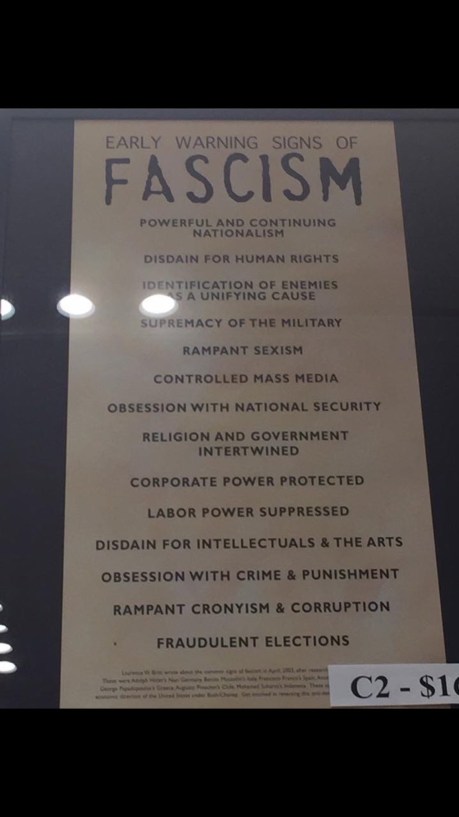
Dana Milbank of the Washington Post is one of my favorite columnists. My only disagreement with this column is that he thinks we are not threatened by fascism. I have concluded that Trump’s racist, corporatist ideology, meshed with his demogogic rhetoric, looks, sounds, and feels like fascism.
In case it is behind a paywall:
Every 75 years or so in our history, Americans have renewed their commitment to freedom.
Divide our history into thirds, and you can see, at regular intervals, a rededication to our founding doctrine. In 1789, the framers drafted the Bill of Rights. Seventy-four years later, at the turning point in the Civil War, Abraham Lincoln called for “a new birth of freedom” to honor those who died.
Seventy-eight years after that, on the eve of U.S. entry into world war in 1941, Franklin D. Roosevelt declared the “four freedoms.”
That was 77 years ago, and we are due for another renewal. Neither fascism nor civil war threatens us, but Americans are united in fear. Much of the country fears the loss of basic freedoms under President Trump: free speech, press and religion, due process and control over their bodies. Trump, meanwhile, foments fears among his followers of crime, gangs, immigrants and civil servants. And Americans of all beliefs fear they are losing the American Dream and its promise of economic mobility.
Trump’s opponents are seemingly confused about how to respond in this election year. Do they appeal to whites or nonwhites, progressives or moderates, move to the left to rally the “base” or hew to the center to capture the swing voters? Should they make an economic argument or a social argument, target those concerned about jobs or those angry about the president?
These are false choices, though, because our salvation will be what it always has been. On this 242nd birthday of the United States, let’s rededicate ourselves to freedom:
Freedom from Trump’s constant attacks on women, immigrants, people of color, gay people and Muslims.
Freedom to work and live without discrimination, harassment and violence because of your gender, race or religion.
Freedom to get medical care when you or your children are sick.
Freedom to earn a living wage, to attend college or get job training, and to retire in security.
Freedom from a rigged economy in which the top 1 percent own more than the bottom 90 percent combined. Freedom to marry whom you choose.
Freedom to make decisions about your own body.
Freedom to send your kids to school without fear for their safety.
Freedom to breathe clean air, to drink clean water, to live on a habitable planet.
Freedom to elect your leaders without the rich, or foreign governments, choosing them for you.
And freedom to speak, to protest and to publish without the threat of violence.
Not only do such ideas unify the left (far more than quibbling about, say, which form of universal health care is best or what exactly should be done with U.S. Immigration and Customs Enforcement), but freedom appeals broadly to Americans regardless of politics. Ask us what it means to be American, and you will get one answer above all others: “to be free.”
Conservatives long claimed ownership of it. (Remember Operation Iraqi Freedom, Operation Enduring Freedom and freedom fries?) But Trump has essentially ceded the freedom agenda to his opponents. One measure, using a database of his speeches, tweets and Q&As, finds that he has used the word “freedom” 72 times this year (often dismissively, as in “we need freedom of the press, but . . .”). That’s far less than he has used, say, “respect” (252), “strong” (502), “win” (306), “border” (617), “taxes” (158), “Democrat” (560), “kill” (159), “country” (1,288), “illegal” (127), “crime” (250) and “great” (2,826).
IThis isn’t just a linguistic de-emphasis of freedom; Trump has made common cause with dictators and played down human rights abroad while starting a trade war with democratic allies. At home he has questioned due process for refugees, taken immigrant children from their parents, imposed a travel ban on several Muslim-majority nations and declared the media the enemy of the American people. He is now poised to shift the balance on the Supreme Court away from abortion rights and gay rights.
In a very real sense, the fight against Trump is a battle for freedom.
He hopes to make the midterm elections about sanctuary cities, MS-13, a socialist takeover, the “deep state,” a corrupt justice system and immigrants “invading and infesting’’ America. Rather than join him in the fear chamber, progressives and Democrats ought to respond with a variation of what FDR proposed for the world in a very different context in 1941, “freedom of speech and expression,” “freedom of every person to worship God in his own way,” “freedom from want” and — of new significance now — “freedom from fear.”
“This nation has placed its destiny in the hands and heads and hearts of its millions of free men and women,” Roosevelt said, “and its faith in freedom under the guidance of God.” This faith sustained America through those dark times. It will not fail us in our 243rd year. “

 Diane Ravitch's blog