Archives for category: Florida

Peter Greene writes here about two basic facts: 1) vouchers are unpopular; and 2) because they are unpopular, their supporters call them something else, not vouchers. There have been more than 20 state referenda on vouchers. None passed. So voucher advocates had to become creative and come up with new names for them.

In Florida, the state constitution forbids spending public money on religious schools. So Jeb Bush, a fervent voucher guy, became creative. He proposed a referendum to remove that wording from the state constitution in 2012. The referendum was titled “The Religious Freedom Amendment.” Opponents of vouchers cried foul, but the misleading title remained. Others had to vote against “religious freedom” to oppose vouchers. Some were undoubtedly fooled, but the Religious Freedom Amendment was defeated anyway; only 44% supported it. Nonetheless, the Florida legislature enacted vouchers, ignoring the referendum failure, and in the past year, removed all income limits. As in every other state with universal vouchers, the majority of students applying for vouchers were already enrolled in private and religious schools.

Peter Greene writes:

Voucher supporters have one major problem: school vouchers are unpopular.

The term doesn’t test well. Measure of public support is iffy– if you ask people if they would like every student to have the chance to ride to a great school on their own pony, people say yes, but if you ask a more reality-based framing (“should we spend education dollars on public schools or subsidies for some private schools”) the results look a bit different

But one clear measure of public support for vouchers is this; despite all the insistence that the public just loves the idea, no voucher measure has ever been passed by the voters in a state. All voucher laws have been passed by legislators, not voted in by the public. 

Voucher supporters have developed one clear strategy– call them something else.

The basic school voucher idea is simple– the state takes money that it was going to spend on public education (either after that money has been paid in taxes, or by having someone trade a “contribution” to a voucher fund in exchange for tax credit) and giving it to parents, who in turn can go out and buy education services on their own. 

They’re not taxpayer-funded vouchers–they’re “tax credit scholarships.” They’re not vouchers– they’re an Education Freedom Account. And if you want to get in a twitter battle, go ahead and call education savings accounts “vouchers,” because part of the whole point of education savings account was to create an instrument that was both a super-voucher and not-something-we’ll-call-a-voucher-at-all-so-stop-doing-that-dammit.

I expect that behind the curtain there have been folks fervently doing messaging testing on other names for vouchers, and from the results around the nation, we can deduce that words that tested well were “education” and “freedom” and “scholarship.” Also, “empowerment” is coming on strong. States with education savings accounts have the chance to play with the initials ESA. 

So what pops out of the branding machine is Empowerment Scholarship Accounts (Arizona), Education Freedom Account (Arkansas, New Hampshire), Family Empowerment Scholarship Program (Florida), Choice Scholarship Program(Indiana), Opportunity Scholarship Program (North Carolina), Education Choice Scholarship (Ohio), and, of course, who could forget Betsy DeVos’s national tax credit scholarship voucher program, the Education Freedom Plan

You can mad lib your way to a voucher program of your own. Education Freedom Scholarship Opportunity Program! Family Freedom Education Scholarships! Family Freedom Empowerment Education Scholarship Opportunity Choice Program Plan! Just don’t call it a voucher.

Bonus credits to Louisianna, where someone took the trouble to write a bill pushing the Louisiana Giving All True Opportunity to Rise– LA GATOR. And in California, legislature voucherfiles are trying “Education Flex Account” for their latest attempt to pass an ESA voucher.

But a voucher by any other name still smells the same. It’s a payoff to parents so that they’ll exit public education, a false promise of education choice, a redirection of public taxpayer dollars into private pockets, an outsourcing of discrimination, a public subsidy for private religious choices, a means of defunding and dismantling public education as we understand it in this country, a transformation of a public good into a market-based commodity. Call it what you like. There isn’t enough air freshener in the world to make it smell like a rose.
The Florida Supreme Court issued two decisions on abortion this week.

Decision One, the Court approved a ban on abortion after six weeks, one of the strictest bans in the nation. Few women realize they are pregnant at that point.

Decision Two, in a 4-3 vote, the Supreme Court agreed to allow a state referendum this November on enshrining abortion rights in the state constitution. The referendum must receive 60% approval or it won’t be adopted. About one million signed the petition requesting the vote.

Also in this November’s election, two of the three judges who voted NOT to allow the referendum will be on the ballot. The two who will stand for election are Justice Renatha Francis and Justice Meredith Sasso. Governor DeSantis, an outspoken opponent of abortion, appointed five of the seven justices on the Florida Supreme Court, including these two justices.

The Miami Herald reported:

In Florida, it’s standard for Supreme Court justices to face a retention vote shortly after their appointment, and no Supreme Court justice has ever been voted out, which requires only a simple majority. But [Justice Renatha] Francis and Justice Meredith Sasso — who along with Justice Jamie Grosshans dissented in the 4 – 3 decision — have the unique distinction of sharing a ballot with a polarizing and high-profile constitutional amendment they wanted to keep from the electorate.

Supporters of reproductive rights have the opportunity to remove two judges who voted to block the referendum.

The Florida Supreme Court issued two decisions on abortion today. Five of the seven judges were appointed by Governor DeSantis.

First, the Court ruled that the pro-abortion forces could have a referendum on the ballot in November. The referendum seeks to protect abortion rights in the state constitution. The referendum must be approved by 60% of those who vote. (In Ohio, a similar amendment was passed by 58% of voters.)

Second, the Court approved the state’s new ban on abortion by 15 weeks, which will be replaced at the end of 30 days by an even newer six-week ban, one of the strictest in the nation. Few women know they are pregnant at the six-week mark. It’s not until a woman has missed her menstrual period twice (eight weeks) that women suspect they may be pregnant.

Republican leaders are preparing to fight the referendum.

The legislature in Florida passed a bill to allow school districts to hire religious chaplains to help students in need of counseling. The bill awaits DeSantis’ signature. Pastors, priests, imams, ministers, rabbis, and other spiritual counselors are standing by.

The Miami Herald reports:

Gov. Ron DeSantis has yet to sign a bill that would allow chaplains to offer counseling in public schools, but one colorful religious figure says he is already eager to volunteer.

He’s a self-described “Hindu statesman” from Nevada who says he would like to bring “the wisdom of ancient Sanskrit scriptures” to students — perhaps not exactly what Florida lawmakers had in mind when they approved a bill that supporters tout as a way to make up for a shortage of mental health counselors in many schools.

The offer from Rajan Zed, president of the Universal Society of Hinduism, may amount to just his latest effort to raise his organization’s profile, but it also underlines concerns from critics. Mainly, that the bill’s vague definition of “counseling” will invite religious groups — whether they are Hindu, Christian or otherwise — to use it as a door to teaching their beliefs in secular school systems.

Florida has a shortage of guidance counselors, and the religious chaplains are supposed to replace the missing counselors.

“This is the beginning … of them trying to implement religion in some type of capacity back into our schools,” said Sen. Shevrin D. “Shev” Jones, D-Miami Gardens, referring to lawmakers who support the bill. “It just opens up the gate for other things.”

Jones, whose father is a pastor, said he’s concerned that the bill may lead to some schools allowing chaplains to preach to students who may not hold the same beliefs, putting them in uncomfortable situations. 

“In the words of one of my colleagues on the floor, ‘We need God back in our schools.’ But what about the child who doesn’t believe in God? What if some of the chaplains don’t resonate with the lives of those kids?” Jones said. 

He used an example of a chaplain dealing with an LGBTQ child or a child battling depression. “Has the chaplain been trained enough? Once they hear those concerns, where do they direct that child to go to?”

One of my favorite columnists is Fabiola Santiagonof the Miami Herald. She is smart, principled, and fearless. She has stood strong against Governor DeSantis’s mean-spirited, hateful culture wars. And she rejoiced when the state agreed to eviscerate the so-called “Parental Rights in Education” law, better known as “Don’t Say Gay.” DeSantis called it a “victory,” and it was a victory, but not for him.

Santiago wrote:

Take a victory lap, Floridians.

For a change, good news on the culture wars front arrives in Florida by way of successful activism, a less sycophantic Legislature — and a significant court settlement reached in a constitutional challenge to the state’s “Don’t Say Gay law.”

Students and teachers will be able to discuss LGBTQ+ issues in the classroom — as long as it’s not in the lesson plans. New, detailed guidelines from the state Department of Education about what can and can’t be said regarding sexual orientation and gender identity are supposed to be coming soon to school districts. 

One can only hope these spelled-out rules focus on helping kids understand — and respect — all kinds of families that aren’t going away just because religious zealots desire it. And that they leave out the political hysterics of past years.

In other words, the rules need to be useful.

In addition to the court settlement, there were positive developments in the Legislature: Harmful censorship and rights bills infringing on free speech and a free press, and to ban abortion in the state, were left to die on the floor or in committees.

To save face and ego, the discriminatory “Don’t say gay” law’s chief instigator, Gov. Ron DeSantis, claimed the settlement as a victory over “activists and extremists.” As if we’re all blind to the fact that the activists at work spinning rage-provoking misinformation were, among right-wingers, the Moms for Liberty he heralded, a group now losing ground here and all over the country. 

As for the state’s chief extremist, it’s DeSantis himself.

It bears repeating: Gender identity and sexual orientation was never part of the curriculum in kindergarten through third grade in Florida. As the legal challenge made clear, the overblown outrage created by falsehoods and exaggerations about “pornographic” books available to children was circulated by Republicans to set the stage to pass legislation. 

They used the first ban on elementary school-aged kids as the conduit to extend anti-gay laws to prohibit the free speech of mature high school students. The courts saw that for what it was: an attempt to send back to the closet an entire community by silencing it.

Didn’t ‘stay the course’

Voters are tired of dogmatic hogwash hijacking educational institutions.

From the offensively watered-down teaching of Black history to the redefinition of subjects areas like civics — only patriotism allowed — plus, the more recent attempt to wipe out sociology the way diversity, equity and inclusion (DEI) programs were, all these initiatives have brought negative, world-wide attention to Florida.

To add insult to the injury, the free-speech restrictions in public education are happening at a time when a voucher system allows parents to afford whatever private education they choose for their children. But it’s never enough. Republicans want to impose conservative ideology on the rest of us.

“Stay the course,” a buoyant DeSantis urged legislators on the winter session’s opening day.

Some eager-beaver legislators heard him. But key players like Senate President Kathleen Passidomo of Naples and House Speaker Paul Renner of Palm Harbor didn’t follow his mandates this time like bobble-heads.

Perhaps they took their cues from Iowa caucus results: DeSantis pitched his “Make America Florida” — and got a no, thanks.

Critics of Governor DeSantis’s “Don’t Say Gay” law reached a settlement with the State of Florida about the limits of the law, striking out its most hateful provisions. A spokesman for DeSantis declared “victory,” but he was trying to salvage the governor’s reputation. The reality is that the settlement is a sharp rebuke to DeSantis and his puppet legislature. Unless there are two lawyers with the same name, the litigants were represented by the same lawyer who represented E. Jean Carroll.

The purpose of the law was to make LGBT people disappear by pretending they don’t exist. DeSantis lost.

If you can open the article, it contains the language of the settlement.

Leslie Postal of The Orlando Sentinel reported:

TALLAHASSEE —  Students and teachers can discuss sexual orientation and gender identity in classrooms under a proposed settlement reached Monday between the state and lawyers for LGBTQ advocates who sued over what they call the “Don’t Say Gay” law.

Activists say the deal clarifies vague language about what the law allows, while lawyers for Gov. Ron DeSantis says it keeps the Parental Rights in Education Act on the books.

The settlement agreement says the state “restricts only classroom instruction on particular subjects — “sexual orientation” and “gender identity.”  It doesn’t prohibit references to LGBTQ people, doesn’t discriminate against them or prohibit anti-bullying policies based on sexual orientation or gender identity, either.

“This settlement … re-establishes the fundamental principle, that I hope all Americans agree with, which is every kid in this country is entitled to an education at a public school where they feel safe, their dignity is respected and where their families and parents are welcomed,” Roberta Kaplan, the lead attorney for the plaintiffs, told the Associated Press. “This shouldn’t be a controversial thing.”

It also protects the legitimacy of gay student groups, safeguards against hate and bullying and allows LGBTQ students and teachers to display pictures of their partners and families. It also says library books are not subject to the law.

Filed with the U.S. 11th Circuit Court of Appeals, it requires the Florida Board of Education to send the agreement to all 67 school districts and make clear “the settlement reflects the considered position of the State of Florida on the scope and meaning of this law.”

The governor’s office, without offering any evidence, said the ruling was “a major win against the activists who sought to stop Florida’s efforts to keep radical gender and sexual ideology out of the classrooms of public-school children in kindergarten through third grade” because it kept the law intact.

“We fought hard to ensure this law couldn’t be maligned in court, as it was in the public arena by the media and large corporate actors,” said Florida General Counsel Ryan Newman. “We are victorious, and Florida’s classrooms will remain a safe place under the Parental Rights in Education Act.”

Despite arguing that the bill didn’t prevent people from talking about sexual orientation or gender identity in school, or even having materials that mentioned those topics, the law led to widespread confusion. Schools across the state banned gay-themed books, Gay Pride events, dances and LGBTQ support groups, even to the point of taking down rainbow stickers and other LGBTQ messages.

Central Florida school districts were among those that removed library books for fear they violated the law. The Seminole County school district, for example, last year decided “Jacob’s New Dress,” a storybook about a boy who wants to wear a dress to school, could not be available in primary grade libraries.

The Lake County school district removed three books from school libraries last school year, including “And Tango Makes Three,” a picture book based on a true story of two male penguins in Central Park Zoo who raised a chick together. That was “done in compliance with Florida state law, specifically 2022 House Bill 1557,” a district attorney wrote.

Lake schools reversed its decision on “And Tango Makes Three” after attorneys for the state, in another lawsuit, wrote that the law applied only to “formal” classroom instruction and not to library books. But that opinion, embedded in a memorandum filed in federal court in late 2022, was not necessarily widely known.

The deal came after two years of court hearings. U.S. District Judge Allen Winsor in Tallahassee twice threw it out on grounds the plaintiffs had no standing.

The plaintiffs appealed Winsor’s decision and agreed to a settlement because the appeals process would have taken years.

Under the deal, the law also doesn’t prohibit “incidental references in literature to a gay or transgender person or to a same-sex couple. Such references, without more, are not ‘instruction on’ those topics.”

References to gay or transgendered individuals are not instruction “on sexual orientation or gender identity any more than a math problem asking students to add bushels of apples is ‘instruction on’ apple farming,” the agreement said.

Typical classroom discussion and schoolwork don’t count as instruction, the settlement said, “even if a student chooses to address sexual orientation or gender identity.”

The statute allows teachers to “respond if students discuss their identities or family life … “provide grades and feedback” if a student chooses “LGBTQ identity” as an essay topic, and answer “questions about their families.”

It also doesn’t require the removal of safe space stickers or safe spaces for LGBTQ students.

It doesn’t prohibit Gay-Straight Alliances, book fairs that include LGBTQ+ focused books, gay-themed musicals or plays, or other extracurricular activities including dances, wearing gay-themed clothing, and non-conforming garb.

To say that opposite-sex attraction was the norm or that “heterosexuality is superior or that gender identity is immutable based on biological traits,” would be equally prohibited under the statute, the agreement states.

Staff writer Leslie Postal and the Associated Press contributed to this report.

At DeSantis’s urging, the Florida legislature passed a law known as “Stop Woke.” The law restricts teaching about race and gender in the state’s classrooms and bans “diversity, equity, and inclusion” programs in the workplace. Several employers sued to block the law, calling it a restriction on free speech. The employers won in the federal District Court, and the state appealed the decision. Today the 11th Circuit Court of Appeals overturned the Stop Woke Act as applied to employers. It remains in effect for schools.

The Orlando Sentinel reported:

TALLAHASSEE — A federal appeals court Monday rejected restrictions that Gov. Ron DeSantis and Republican lawmakers placed on race-related issues in workplace training, part of a 2022 law that DeSantis dubbed the “Stop WOKE Act.”


A three-judge panel of the 11th U.S. Circuit Court of Appeals said the restrictions violated First Amendment rights.


“This is not the first era in which Americans have held widely divergent views on important areas of morality, ethics, law and public policy,” the 22-page opinion said. “And it is not the first time that these disagreements have seemed so important, and their airing so dangerous, that something had to be done. But now, as before, the First Amendment keeps the government from putting its thumb on the scale.”


The panel upheld a preliminary injunction issued in 2022 by Chief U.S. District Judge Mark Walker of Tallahassee against the restrictions. The law was challenged by Primo Tampa, LLC, a Ben & Jerry’s ice-cream franchisee; Honeyfund.com, Inc., a Clearwater-based technology company that provides wedding registries; and Chevara Orrin and her company, Collective Concepts, LLC.

Orrin and her company provide consulting and training to employers about issues such as diversity, equity and inclusion.


Walker also separately issued a preliminary injunction against part of the law that would restrict the teaching of race-related concepts in universities. The state has appealed that decision.


The workplace-training part of the law listed eight race-related concepts and said that a required training program or other activity that “espouses, promotes, advances, inculcates, or compels such individual (an employee) to believe any of the following concepts constitutes discrimination based on race, color, sex, or national origin.”


As an example, the law targeted compelling employees to believe that an “individual, by virtue of his or her race, color, sex, or national origin, bears personal responsibility for and must feel guilt, anguish, or other forms of psychological distress because of actions, in which the individual played no part, committed in the past by other members of the same race, color, sex, or national origin.”

The state disputed that the law violated speech rights, saying that it regulated “conduct.” It said businesses could still address the targeted concepts in workplace training but couldn’t force employees to take part.


But the appeals court flatly rejected such arguments Monday. It described the law as the “latest attempt to control speech by recharacterizing it as conduct. Florida may be exactly right about the nature of the ideas it targets. Or it may not. Either way, the merits of these views will be decided in the clanging marketplace of ideas rather than a codebook or a courtroom.”

Certain counties in Florida are experiencing an outbreak of measles, a highly contagious and sometimes lethal that was supposedly under control due to widespread vaccination.

Florida’s top doctor, Dr. Joseph Ladapo, has thus far failed to instruct students in the affected schools to get vaccinated because he and Governor DeSantis took a strong stand against getting vaccinated for COVID.

The Miami Herald editorial board criticized Dr. Ladapo for putting students at risk:

Is there one mainstream piece of public health advice — no matter how long-standing — that Florida’s top doctor won’t buck?

Joseph Ladapo, Gov. Ron DeSantis’ anti-vaxx surgeon general, has spread misinformation about COVID-19 and has advised against coronavirus vaccines, citing debunked claims

Perhaps Ladapo saw, in the novelty and divisiveness of the pandemic, an opportunity to become the go-to, Ivy League-educated doctor for vaccine deniers. Now, he’s turned his focus to a long-known virus — up until now, largely non-controversial, but highly contagious and dangerous for children: measles.

Following an outbreak at Manatee Bay Elementary in Weston, where six measles cases have been confirmed, Ladapo sent a letter to parents that pediatricians, immunologists and infectious disease experts have criticized. The letter acknowledged what has been common practice to contain measles outbreaks — that unvaccinated children or those without immunity should remain home during the incubation period of the virus, or up to 21 days. 

Ladapo, then, however, wrote that, “due to the high immunity rate in the community,” the Department of Health “is deferring to parents or guardians to make decisions about school attendance.”

This should have been Ladapo’s opportunity to tell parents, “Get your children vaccinated — now!”

The MMR vaccine, approved by the federal government more than 50 years ago, offers 98% protection against measles after two full doses. That’s a widely known statistic that not even Ladapo can deny — he acknowledges it in his letter but stops short of recommending the vaccines. 

Instead, Florida’s top doctor is telling parents it’s OK to send kids to school sans immunization, even though they could contract a potentially lethal virus or spread it to others who are also not immunized. Worse, the Broward County school outbreak could spread to other communities…

The vaccine skepticism that gained force during the pandemic, thanks in part to public figures like DeSantis and Ladapo, is a threat to not only public-health efforts to keep COVID at bay but other diseases we thought belonged in a bygone era.

Many states (most?) require children to get vaccinated against a long list of diseases before they can start school. Apparently, Florida is not one of them. The state lets parents decide. Public health, be dammed!

The editorial board of the Orlando Sentinel spoke out against a bill that would declare fetuses to be persons from the instant of conception. Not only would this extend Florida’s draconian six-week ban on abortion, it would outlaw abortion for any reason—rape, incest, the life of the mother. Even if a woman learns early in her pregnancy that the fetus will be born without a brain or has some other fatal defect, she will not be able to terminate the pregnancy. At this time, the Florida Supreme Court is deciding whether to allow a referendum on abortion to proceed; its sponsors have collected over one million signatures. Will the people of Florida have a chance to express their views?

The editorial board wrote:

For Floridians who are already deeply uneasy about women losing the right to control their own bodies, what happened Wednesday in the House Judiciary Committee was truly terrifying. One by one, lawmakers voted yes on legislation that would, for the first time, declare fetuses to be people from the moment of conception — turning wombs into war zones before most people even know they are pregnant.

Bill sponsor Jenna Persons-Mulicka, R-Fort Myers, did her best to hide the radical nature of her legislation, which creates civil liability for anyone who causes the “wrongful death” of a fetus in utero. But everyone in that committee hearing room — and those watching remotely — knew exactly what was at stake. Conveying full rights on a fetus would be a shattering blow to reproductive independence for Floridians capable of becoming pregnant, reaching past debates over viability and bans on abortion at a specified number of weeks. HB 651 would kick in at the very start of a pregnancy, and create an easy stepping stone from wrongful deaths (including from abortions) to anything that threatens the health of a fetus, even if it is meant to benefit the mother’s health.

Floridians should bombard their state senators and representatives with messages letting them know that this potential law is far too radical for anyone who cares about freedom. Then they should turn to their congressional representatives and call on them for legislation to nip this hazardous movement in the bud.

They can start by letting lawmakers know they see through the pretense here. Persons-Mulicka pointed out, more than once, that the language of her legislation (HB 651) specifically excludes a pregnant person. But that’s a nearly negligible speed bump, especially if Florida’s Supreme Court picks up this theme and uses it to obliterate abortion rights in Florida.

Think they won’t? Think again. Justice Carlos Muniz was already hinting in that direction last week, during oral arguments over a ballot question that would (with voters’ approval) explicitly protect abortion rights in Florida.

But advocates of so-called “fetal personhood” think they’ve found a way around that language. By declaring a fetus to be a person, the Legislature and/or court would at best set up a collision course between two competing interests that just happen to share a body — along with the well-being of medical personnel being asked to care for both.

Because the fetal personhood bill does not protect the doctors, nurses and other people who perform abortions, even if the procedure is otherwise legal. Taken in context, that looming threat is clearly a large portion of the intention behind this bill…

Since I started following the cruel and unusual policies of Florida’s Governor Ron DeSantis, I have seen him repeatedly attack public schools, divert public money to private and religious schools, and remove whatever offends him from the curriculum (such as accurate histories of Black people).

I have also discovered some fearless bloggers who are not afraid of DeSantis. Billy Townsend and Jason Garcia. They take on political corruption without flinching.

Jason Garcia, an investigative reporter, wrote recently about how conservative billionaires have shaped DeSantis’s political agenda. The part I don’t understand is why someone of vast personal wealth would want to take food stamps away from impoverished children or make the lives of homeless people even more miserable. What kinds of sadists are they?

Jason Garcia writes:

Late last year, the administration of Florida Gov. Ron DeSantis made it harder for older Floridians to get food stamps.

Earlier this month, the DeSantis administration sued the federal government for the right to remove poor children from public health insurance.

And last week, the Republican governor came out in support of a plan to round up homeless people across Florida and — potentially — put them into secured camps.

Each move was, at least on the surface, a disparate executive decision. But they share something in common: They are all ideas promoted by conservative billionaires and the right-wing think tanks they fund.

Taken together, the moves offer a window into how super-rich mega donors shape action across DeSantis’ state government.

Let’s start with the food stamps.

Though it didn’t get much attention at the time, the Florida Department of Children and Families late last year changed the rules for the state’s food-stamps program, which is formally known as the “Supplemental Nutrition Assistance Program.”

Funded by the federal government but administered by the states, food stamps currently help more than 3 million impoverished Floridians buy groceries and keep food on the table for themselves and their families.

But the state of Florida makes it much harder for some people to qualify for food stamps, by imposing what are commonly called “work requirements” — mandatory employment and training programs that someone must participate in each week in order to obtain and continue receiving aid.

Florida had previously imposed work requirements on adults without children between the ages of 18 and 52. But late last year, the state expanded work requirements to adults without children up to age 59 — sweeping up somewhere around 100,000 more very low-income Floridians, according to materials provided to the governor’s office and obtained in a public-records request.  

Anti-poverty activists and advocates for working families have long argued that work requirements don’t actually work. Rather than helping people find sustainable employment in which they can work themselves out of poverty, mandatory work requirements merely create barriers that block some people from receiving any aid at all and push others into erratic, poor-paying and poverty-entrapping jobs — all while enriching a few private contractors that administer the programs.

But work requirements have some influential supporters — like the Foundation for Government Accountability, an anti-worker think thank based in Naples that is also pushing bills in Tallahassee this session that would weaken Florida’s child-labor lawserase wage and benefit protections for employees, and cut more laid-off workers off from unemployment insurance.

And the FGA isn’t just promoting work requirements generally. Records show it pitched this exact idea to DeSantis’ staff.

It happened in December 2022, when, emails show, the FGA met with senior staffers in the Governor’s Office and provided a series of policy proposals. One of the ideas they pitched? Forcing Floridians as old as 59 years old to participate in mandatory work requirements before they can get food stamps.

The recommendation was contained in a memo provided to the Governor’s Office tiled, “Taking Florida’s Food Stamp Work Requirements to the Next Level.”

One reason the FGA may have the ear of the DeSantis administration: Tax records show that its largest funder in recent years has been Richard “Dick” Uihlein, a Midwestern billionaire who is one of the biggest conservative donors in American politics.

More specifically, Uihlein is one of DeSantis’ top funders: Records show he has given DeSantis roughly $3 million in recent years — including $1.5 million to the Super PAC that supported DeSantis’ failed presidential campaign.

It’s important to note that the FGA wants DeSantis to go even further: The organization has also urged the Governor’s Office to extend food stamp work requirements to adults with children as young as six years old.

Kicking kids off health insurance

Food stamps aren’t the only safety net program that has come into DeSantis’ crosshairs recently.

Earlier this month, the state of Florida surprised anti-poverty advocates by suing the federal government over new rules related to Florida KidCare — a program that provides health insurance for low-income children whose families do not qualify for Medicaid.

KidCare is funded jointly by the federal government and the state. And Florida has long required families participating the program to pay monthly premiums in order to get coverage for their kids. 

But new federal rules require the state to provide at least one year of continuous health insurance coverage for any child who enrolls in the program — even if the child’s family misses a monthly premium payment.

The DeSantis administration has sued to overturn that rule. The suit argues that federal officials have overstepped their authority, and that forcing Florida to continue providing health insurance to kids whose parents have missed a payment would undermine the integrity of the KidCare program.

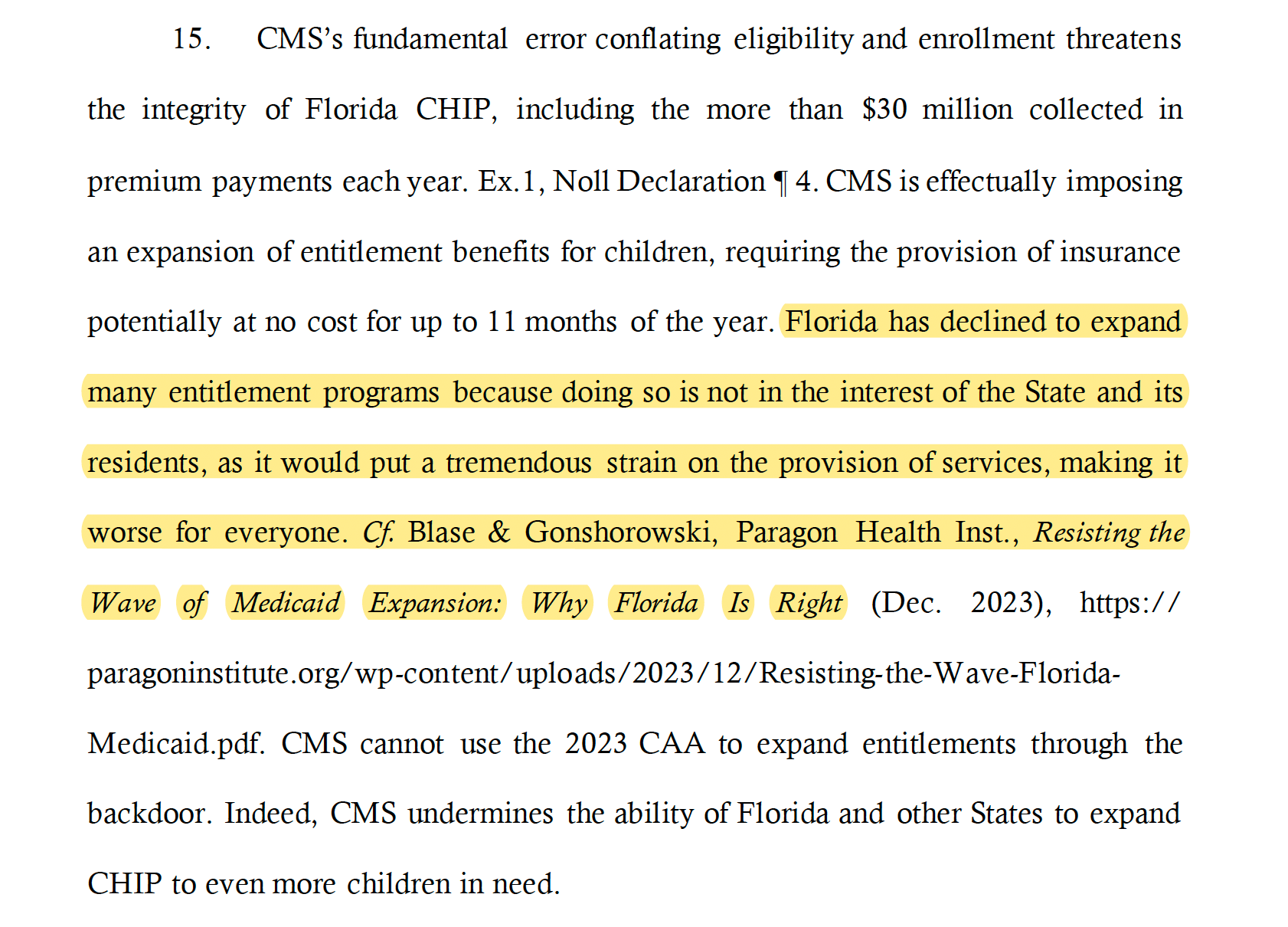
To buttress its argument, the DeSantis administration cited a think tank report, published a little more than a month before the lawsuit was filed, titled, “Resisting the Wave of Medicaid Expansion: Why Florida is Right.”

An excerpt from Florida’s lawsuit against the federal government regarding eligibility rules for children’s health insurance.

The report was produced by a two-year-old organization called the Paragon Health Institute. Tax records show it is largely funded by the nonprofit network of billionaire industrialist Charles Koch, another of the nation’s biggest conservative political donors. 

All of Paragon’s first-year funding came from one of Koch’s “Stand Together Trust.” Most of its second-year funding came from the Koch group, too.

Paragon is also intertwined with the FGA. The institute’s president — and the lead author of the report Florida cited in its lawsuit — is Brian Blase. Blase is also a visiting fellow with the FGA, according to the group’s website.

Blase said he wasn’t consulted by anyone from the state about the litigation and that he didn’t know anything about the lawsuit before it was filed.

Asked if the Governor’s Office conferred with anyone from the Paragon Health Institute or the FGA before launching its suit, DeSantis spokesperson Jeremy Redfern responded, “Not to my knowledge.”

Other closely aligned conservative groups are now cheering on the state’s lawsuit — such as the Tallahassee-based James Madison Institute, which tax records show also receives substantial fundingfrom Charles Koch’s network.

Koch and his network were important early supporters of DeSantis, though they splintered during the governor’s presidential campaign when Koch’s Americans for Prosperity ultimately decided to endorse former South Carolina Gov. Nikki Haley.

But this is a relationship that DeSantis likely wants to repair as tries to rehabilitate his political reputation and prepare for a second presidential run. Politico Florida reported last week that DeSantis allies expect him to run again in 2028 — and to restart his political fundraising operation later this year.