Archives for category: Elections

Much has been written about Trump’s controversial visit to the graves of American soldiers killed by a suicide bomber at the airport in Afghanistan as thousands of people were struggling to leave. The death of these brave soldiers was terrible and tragic. Trump decided to blame their deaths on Kamala Harris. He made common cause with some of the families and paid tribute to fallen soldiers at Arlington National Cemetery. That military cemetery has a special area, Section 60, where neither cameras nor campaign events are allowed. Both are strictly prohibited to show respect for the dead.

Trump arrived with his entourage. A young military woman, left to confront the visitors, informed them of the rules. She tried to stop them, and they pushed her aside. There was some sort of physical confrontation, and one of Trump’s group said later that the woman had “some kind of mental health episode.” Each side reported the other, and the military brass decided “case closed.” They knew that if Trump is re-elected, he would be vengeful. Trump went to the gravesites, where his photo was taken with family members. One bizarre photo showed him standing over a grave, grinning broadly and giving a thumbs-up sign, along with some family members.

Did he break the rules? Yes. He has always acted on the belief that the rules don’t apply to him. He is always immune from responsibility, accountability, or prosecution.

David Kurtz of Talking Points Memo commented:

The fascist overtones from the Arlington National Cemetery incident are unmistakeable: a presidential campaign run like a gang, with enforcers shoving aside a public servant enforcing the rules and a mob of millions of supporters with a track record of doxxing, harassing, intimidating, and threatening anyone who gets in their candidate’s way, all the while being egged on by the candidate himself.

You can’t blame the cemetery official for declining to press charges rather than put herself in the line of fire for continued and unending abuse. She didn’t sign up for that. She’s already been baselessly accused by the Trump campaign of having a “mental health episode,” being “despicable” and a “disgrace,” and not deserving to have her job. That all happened within the first 48 hours of the apparent confrontation at the national shrine to fallen service members.

But what about the Army? It oversees Arlington National Cemetery and is a victim of Trump’s bullying, too, so I hesitate to blame it for its predicament. But some of the reporting suggests the staffer on the ground was effectively if inadvertently set up by higher-ups who themselves wanted to avoid a confrontation with Trump. According to the WaPo:

Pentagon officials were deeply concerned about the former president turning the visit into a campaign stop, but they also didn’t want to block him from coming, according to Defense Department officials and internal messages reviewed by The Washington Post.

Officials said they wanted to respect the wishes of grieving family members who wanted Trump there, but at the same time were wary of Trump’s record of politicizing the military. So they laid out ground rules they hoped would wall off politics from the final resting place of those who paid the ultimate sacrifice for their nation.

Rather than mount a full-throated defense and take any kind of remedial action, the Army has closed the matter after the cemetery official declined to press charges. But the fecklessness doesn’t end there. This paragraph in the NYT is an all-timer for weak-kneed kowtowing to a bully:

Several Army officials, speaking on the condition of anonymity to discuss confidential aspects of the matter, on Wednesday sought to keep the politically charged issue from escalating. But at the same time, they defended the cemetery official and pushed back on attacks from the Trump campaign, with one official saying that the woman at the cemetery was just trying to do her job.

Officials purporting to defend their person on the ground by offering some “push back” on the Trump campaign attack, but doing so anonymously while trying to keep it from “escalating.” Escalating into what? You’ve already been run over, so that leaves the only obvious conclusion: The Army itself is trying to avoid being the target of MAGA attacks. This is untenable acquiescence to bullying.

Is that really going to be the end of the story? No consequences, no new measures to enjoin Trump from doing the same thing again at Arlington or another military cemetery, no price to pay for his thuggery. It’s a familiar pattern.

The erosion of any kind of strong, unified, national, countervailing force to Trump’s public bullying and nastiness only enables and emboldens the thuggery that is central to his appeal and that he has already notoriously used on Jan. 6 to try to retain power.

If you don’t think a Trump win in November will unleash a reign of thuggery against anyone who stands in his way – not just political foes but innocent bystanders and regular folks just doing their jobs – then I don’t know what else to tell you. He’s doing it right now, he’s promised to do it if he wins, and his minions are poised and eager to follow through.

He’s not a schoolyard bully. He’s a public menace, and if he wins back the White House, he will be a public menace with vast official powers and Supreme Court-sanctioned immunity.

Eugene Robinson, a columnist for The Washington Post, said we should not be indifferent to the latest example of Trump’s malignant behavior:

Donald Trump has shown the nation, once again, that he has no shame.

You knew that, of course. But hauling a camera crew to Arlington National Cemetery and exploiting the fresh graves of heroes — using them as props in his presidential campaign — was more than a violation of the cemetery’s rules; it was more, even, than a violation of federal law. It was a deeply dishonorable act by a shockingly dishonorable man.

Just because we are accustomed to this kind of behavior from Trump does not mean we should accept it. Just because he has no sense of honor or appreciation of sacrifice does not mean we have to pretend honor and sacrifice no longer exist. Just because “Trump is an awful person” is an old story does not mean we should yawn at this latest demonstration and quickly move on.

Section 60 at Arlington Cemetery is the resting place of the men and women who most recently gave what Abraham Lincoln called “the last full measure of devotion” to their country. Monday was the third anniversary of the suicide bombing that killed 13 U.S. troops during the chaotic withdrawal from Afghanistan. There is nothing wrong with a former president visiting those graves to commemorate that terrible day.

There is everything wrong, though, with that former president using the occasion to generate visual fodder for his bid to return to the White House. Trump brought along a photographer and videographer from his campaign to capture images of the visit — which his campaign team knew, and he surely knew, was forbidden.

And, of course, there is everything wrong with physically shoving aside a worker at the cemetery who was doing her job and trying to enforce the rules.

“Federal law prohibits political campaign or election-related activities within Army National Military Cemeteries, to include photographers, content creators or any other persons attending for purposes, or in direct support of a partisan political candidate’s campaign,” Arlington Cemetery officials said this week in a statement. This was made clear to Trump’s team as the visit was being planned, officials said — including the strict enforcement of the rule at Section 60, where grief and loss are still raw.

“What was abundantly clear-cut was: Section 60, no photos and no video,” a defense official told The Post.

Despite that warning, though, the Trump team brought its cameras into Section 60. When a cemetery employee tried to stop them, according to The Post, “a larger male campaign aide insisted the camera was allowed and pushed past the cemetery employee, leaving her shocked.”

No one can dismiss the incident as a misunderstanding by Trump and his aides, since their official position is that Trump is infallible. The campaign’s response, as usual, was a lie — a false and gratuitously cruel statement from spokesman Steven Cheung to NPR, which first reported the cemetery clash: “The fact is that a private photographer was permitted on the premises and for whatever reason an unnamed individual, clearly suffering from a mental health episode, decided to physically block members of President Trump’s team during a very solemn ceremony.”

The campaign promised to release footage to corroborate its version of the encounter. That turned out to be a TikTok post — a political ad — with video of Trump in Section 60. And the campaign released an image of Trump standing with family members of the fallen amid the still-fresh graves. He is shown flashing a broad smile and giving a thumbs-up.

Trump’s running mate, Sen. JD Vance (R-Ohio), tried to chime in MAGA-style by attacking Vice President Kamala Harris — the surging Democratic Party presidential nominee — for any role she might have played in the Afghanistan withdrawal. “She wants to yell at Donald Trump because he showed up?” Vance said at a campaign event in Pennsylvania. “She can go to hell.”

For the record, at that point Harris had not yelled, or said anything at all, about the cemetery incident.

Also for the record, it was Trump who negotiated the withdrawal of U.S. forces from Afghanistan and forced the Afghan government to release thousands of jailed Taliban fighters in a prisoner swap. Those decisions helped make possible the Taliban’s swift return to power.

And a point of personal privilege: The ashes of my father-in-law and mother-in-law, Edward Rhodes Collins and Annie Ruth Collins, are interred at Arlington. He was a Navy veteran who came under fire in the South Pacific during World War II and later in Korea.

Arlington National Cemetery is a place of honor. Donald Trump thinks honor is for suckers and losers — and values sacrifice only if it might help him win an election. Do not become numb to his nature.

For more about Trump’s disregard for our troops, read this.

The United States Army released a statement yesterday:

“Arlington National Cemetery routinely hosts public wreath laying ceremonies at the Tomb of the Unknown Soldier for individuals and groups who submit requests in advance. ANC conducts nearly 3,000 such public ceremonies a year without incident. Participants in the August 26th ceremony and the subsequent Section 60 visit were made aware of federal laws, Army regulations, and DoD policies, which clearly prohibit political activities on cemetery grounds. An ANC employee who attempted to ensure adherence to these rules was abruptly pushed aside. Consistent with the decorum expected at ANC, this employee acted with professionalism and avoided further disruption. The incident was reported to the JBM-HH police department, but the employee subsequently decided not to press charges. Therefore, the Army considers this matter closed. This incident was unfortunate, and it is also unfortunate that the ANC employee and her professionalism has been unfairly attacked. ANC is a national shrine to the honored dead of the Armed Forces, and its dedicated staff will continue to ensure public ceremonies are conducted with the dignity and respect the nation’s fallen deserve.”
We knew about RFK Jr. and his brain worm. We learned about his escapade with a dead bear cub that he found in the woods, put in his car, and dumped in Central Park as a joke. Weird. We also learned recently that he sold dope when he was a student at Harvard (The Atlantic published a story by author Kurt Andersen saying that RFK sold him cocaine and that Bobby was a heroin addict from ages 15 to 29). Last week, he teamed up with Trump, who advocated as recently as 2022 that drug dealers should be executed. Odd.

Now we learn in The New York Times that years ago, RFK Jr. sawed the head off a dead whale and brought it home. Weird!

It is a violation of longstanding federal law to collect parts from the carcass of a protected marine animal if there are still “soft tissues” attached.

It becomes political intrigue if the collector was Robert F. Kennedy Jr., and the severed head of a possibly protected marine mammal streamed “whale juice” down the side of the family minivan three decades ago.

On Monday, the political arm of the Center for Biological Diversity, a progressive environmental organization, called on federal authorities to investigate an episode, recounted by Mr. Kennedy’s daughter in a 2012 magazine article, in which she said Mr. Kennedy chain-sawed the head off a dead whale on a beach in Hyannis Port, Mass., bungee-corded it to their vehicle’s roof, and drove it five hours to the family home in Mount Kisco, N.Y.

“It was the rankest thing on the planet,” Kick Kennedy, then 24, told Town & Country, in the article, which described Mr. Kennedy as someone who likes to study animal skulls and skeletons.

The story recently resurfaced, including in an entertainment publication, The Wrap, on Sunday and in a New York Post article on Monday.

In a letter to the National Oceanic and Atmospheric Administration, which oversees marine protection, Brett Hartl, the national political director for the Center for Biological Diversity Action Fund, wrote: “There are good reasons why it is illegal for any person to collect or keep parts of any endangered species.”

“Most importantly, vital research opportunities are lost when individuals scavenge a wildlife carcass and interfere with the work of scientists. This is particularly true of marine mammals, which are some of the most difficult wildlife species in the world to study….

Mr. Kennedy, he wrote, may have violated not only the Marine Mammal Protection Act (1972) and the Endangered Species Act (1973) — two seminal marine conservation laws — but also the Lacey Act of 1900, a conservation law signed by President William McKinley that prohibits the transportation of illegally gathered wildlife, dead or alive, across state lines.

The whale has now joined a baby bear, at least one emu and a worm whose deaths have been intimately associated with Mr. Kennedy, the independent presidential candidate — and environmental lawyer — who last week joined forces with former President Donald J. Trump’s campaign.

Well, RFK Jr. may be a former environmental activist and a prominent conspiracy theorist, but he is not an animal rights activist!

Thom Hartmann is a keen observer of American politics. A prolific writer, he sees issues in historical perspective. He knows that your grandfather’s Republican Party was conservative and imbued with a sense of devotion to community and tradition. Conservatives conserve, not destroy. That party today is devoted to disruption, to destroying communities and their public schools, to protecting the billionaires, and to mocking the weak. It is not your grandfather’s Republican Party.

Thom Hartmann writes:

During the 1950s, Republicans were the party that promoted labor unions, Social Security, and a top 91% income tax bracket and 70% estate tax on the morbidly rich. Dwight Eisenhower successfully campaigned on what we’d call a progressive agenda for re-election in 1956.

During the Reagan years, Republicans embraced Milton Friedman’s neoliberalism with its free trade, opposition to unions, ending free college, and tax cuts for the fat cats. They called themselves “the party of new ideas.” They may have done more harm than good, but for most Republicans it was a good-faith effort. 

Today, they’ve pretty much given up on all of that.  All they have left is cruelty.

When Governor Tim Walz gave his heartwarming acceptance speech Wednesday night here at the DNC in Chicago, his son Gus was caught on camera proudly proclaiming, through tear-streaked eyes, “That’s my dad!” 

The response from Trumpy Republicans was immediate: Ann Coulter wrote, “Talk about weird.” Rightwing hate jock Jay Weber posted, “Meet my son, Gus. He’s a blubbering bitch boy. His mother and I are very proud.” Trumpy podcaster Mike Crispi ridiculed Walz’s “stupid crying son,” adding, “You raised your kid to be a puffy beta male. Congrats.” Another well-known podcaster on the right, Alec Lace, said, “Get that kid a tampon already.”

Compassion for a learning-disabled child is dead on the right: all they have left is cruelty.

Ronald Reagan helped shepherd through Congress the most consequential border bill in American history, and when it needed updating Oklahoma’s Republican Senator James Lankford worked with Democrats to update it in a meaningful way. Trump demanded Republicans kill the legislation, invoking the memory of his tearing over 5,500 babies away from their mothers and trafficking them into fly-by-night “adoption” schemes (around 1000 are still missing) and his demand that the border patrol shoot immigrants in the legs.

Trump’s acolytes in Congress don’t even pretend any more to have a border policy: all they have left is cruelty.

President George HW Bush worked with Soviet leader Mikhail Gorbachev to unwind the USSR in the hope of creating a democratic Russia. Neither expected Vladimir Putin to turn that nation into a virtual concentration camp where gays are routinely murdered, child pornography is legal (and they’ve kidnapped over 700,000 Ukrainian children), and dissenters are tortured, poisoned, and sent to brutal Siberian gulags. Donald Trump celebrates Putin, calling his invasion of Ukraine “genius” and “savvy,” handing Putin’s ambassador a western spy and top-secret information in his first month in office, and trying to abandon America’s traditional role as a moral leader in the world.

Trump’s GOP has abandoned our founding principles: all they have left is cruelty.

During the 2020 election, Trump followers tried to run a Biden/Harris campaign bus off the road in Texas, threatening to kill the occupants (which they believed included Kamala Harris). A crazed Trump supporter broke into Nancy Pelosi’s home and attacked her 82-year-old husband with a hammer. Trump tweeted a picture of the bus being attacked, writing below it, “I LOVE TEXAS!” and repeatedly makes jokes about the attack on Pelosi, as if to encourage future attacks on the families of other Democratic politicians.

Not a single elected Republican (as best as I can find with a pretty thorough web search) has condemned either: all they have left is cruelty.

Florida Republican Governor Ron DeSantis turned down federal money that would have fed 2.1 million low-income children in his state; he was one of 13 Republican governors to do the same, in a nation where one in seven children — over 11 million every year — go to bed hungry.

We are literally the only developed country in the world with a massive child hunger problem because all Republicans have left is cruelty.

When President Obama succeeded in passing and signing the Affordable Care Act, it offered every state funds to expand Medicaid to give healthcare coverage to all their low-income citizens with the federal government covering 90% of the cost. To this day, ten states under Republican control have refused to accept the money, leading to millions of preventable illnesses and early deaths.

Republican states could have joined all the Blue states and every other developed country in the world by providing universal healthcare, but refuse to because all they have left is cruelty.

 When a 10-year-old girl was raped and impregnated, Republicans like Congressman Jim Jordan, Governor Kristi Noem, Fox’s Tucker Carlson and Jesse Waters, and Ohio Attorney General Dave Yost ridiculed the claim. When the rape and pregnancy were proven and the girl fled Ohio to a state where abortion was legal to terminate the pregnancy, Indiana’s Republican Attorney General Todd Rokita promised to launch an “investigation.”

Rokita didn’t investigate the rape, however: he instead went after the physician who performed the abortion. Because cruelty is all Republicans have left.

When Donald Trump lost the 2020 election by seven million votes, he sent a violent mob against the US Capitol. As they tried to murder the vice president and speaker of the house, covered the walls of the building with feces and defaced priceless paintings, Trump gleefully watched on live television for over three hours while refusing to call in the national guard or take any other meaningful action.

Five civilians and three police officers died as the result of his sending that murderous mob because all he and his GOP have left is cruelty.

This week Americans saw Democrats display compassion, care, respect, and reverence for our democracy. We saw the best of this country, hope for the future, and actual plans to improve the lives of Americans.

Last month, in sharp contrast, we watched the Republican convention and saw, instead, a cavalcade of anger, bile, grievance, hate, and, of course, cruelty.

Because cruelty is all Republicans have left.

Note to Thom:

Some things you didn’t mention.

The red states that have repealed or loosened their child labor laws so that teens can work in hazardous jobs at younger ages.

The red states that overturned local laws requiring regular water breaks for laborers working outdoors in hot weather.

The red states that are defunding their public schools.

The red states that have abolished all gun laws and allow open carry of guns without a permit.

The red states oppose free lunches for children.

Paul Krugman, the economist who writes a regular column for the New York Times, recently explored why Republicans oppose free lunch for students. The simple answer is that it’s just plain weird. The more complex answer is that they don’t want to create an “entitlement” for children. The irony that he does not explore is why Republicans are unwilling to pay for free lunches, yet eager to pay the tuition of students who attend religious or other private schools, regardless of their family’s income.

He writes:

You could say that Tim Walz became the Democratic vice-presidential nominee with one weird trick — that is, by using that word to describe Donald Trump and JD Vance, a categorization that went viral. In his maiden campaign speech he upgraded it a bit further to “creepy and weird as hell.” (If you think that’s over the top, have you seen Trump’s bizarre rant speculating about whether Joe Biden is going to seize back his party’s presidential nomination?)

But Walz is more than a meme-maker. He has also been an activist governor of Minnesota with a strong progressive agenda. And I’d like to focus on one key element of that agenda: requiring that public and charter schools provide free breakfasts and lunches to all students.

Perhaps not incidentally, child care has long been a signature issue for Kamala Harris, and Walz’s policies may have played a role in his selection as her running mate.

In any case, free school meals are a big deal in pure policy terms. They have also met fierce Republican opposition. And the partisan divide over feeding students tells you a lot about the difference between the parties, and why you really, really shouldn’t describe the MAGA movement as “populist.”

Now, even many conservatives generally support, or at least claim to support, the idea of cheap or free lunches for poor schoolchildren. The National School Lunch Program goes all the way back to 1946, when it passed with bipartisan support and President Harry Truman signed it into law.

Why should the government help feed kids? Part of the answer is social justice: Children don’t choose to be born into families that can’t or won’t feed them adequately, and it seems unfair that they should suffer. Part of the answer is pragmatic: Children who don’t receive adequate nutrition will grow up to be less healthy and less productive adults than those who do, hurting society as a whole. So spending on child nutrition is arguably as much an investment in the future as building roads and bridges.

There’s a strong case that in general child nutrition programs more than pay for themselves by creating a healthier, higher-earning future work force. In other words, this is one area where there really is a free lunch.

Schools, then, should feed students who might otherwise not get enough to eat. But why make free meals available to all children, rather than only to children from low-income households? There are multiple reasons, all familiar to anyone who has looked into the problems of antipoverty policy in general.

First, trying to save money by limiting which children you feed turns out to be expensive and cumbersome; it requires that school districts deal with reams of paperwork as they try to determine which children are eligible. It also imposes a burden on parents, requiring that they demonstrate their neediness.

Additionally, restricting free meals to children whose parents can prove their poverty creates a stigma that can deter students from getting aid even when they’re entitled to receive it. I know about this effect from family history: My mother, who grew up in the Depression, used to talk about her shame at not being able to afford new shoes because her parents, although just as poor as her classmates’ parents, couldn’t bring themselves to apply for government assistance.

And it’s not as if feeding children is prohibitively expensive. So if you want to make sure that children get enough to eat, having schools offer free meals to all their students, without an income test, would seem to be simple common sense.

But Republicans in general aren’t on board. The Minnesota law that Walz signed passed essentially along party lines. The people behind Project 2025, in particular, don’t approve. (Yes, despite denials, Project 2025 is a very good guide to what a second Trump administration might do.) The project’s magnum opus, “Mandate for Leadership,” whose 900 pages lays out a detailed policy agenda, singles out feeding students as something that should be reined in. “Federal school meals increasingly resemble entitlement programs,” it warns, as if this is self-evidently a bad thing. A bit farther down, it reads, “The U.S.D.A. should not provide meals to students during the summer unless students are taking summer-school classes.” I guess being hungry isn’t a problem when school is out.

Stories like this are why my hackles rise whenever people call MAGA a populist movement. The people who will almost certainly make policy if Trump wins are as committed as ever to a right-wing economic agenda of cutting taxes on the wealthy while slashing programs that help Americans in need — including programs that help children.

In addition to being cruel, this agenda tends to be unpopular. Most Americans support providing all students with meals, regardless of their income, just as most Americans now support the Affordable Care Act, which Trump will very likely again try to destroy if returned to office.

But the American right lives in an echo chamber that normalizes views on both economic and social policy that are very much at odds with what a majority of voters want. Those extreme views often fly under the radar. But sometimes they do attract attention. And when they do, many people find them … weird.

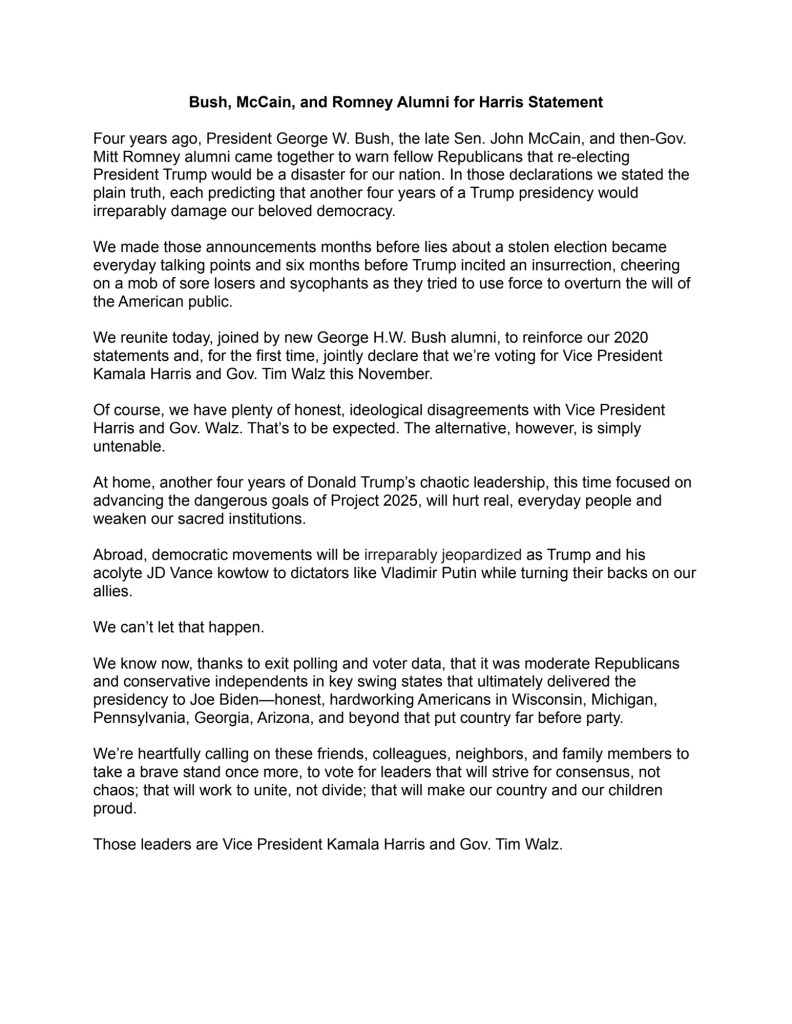
A long list of people who worked in the campaigns or government offices of George H. W. Bush, George W. Bush, Mitt Romney and John McCain issued a statement endorsing Kamala Harris yesterday. The full list appeared in USA Today. Many, but not all, of the group opposed Trump’s re-election in 2020. No comparable group of Obama-Biden alumni has endorsed Trump.

Michael Hiltzik is the Pulitzer-Prize winning business columnist for The Los Angeles Times. He explains here that Kamala Harris’s economic plans to help families make sense.

He writes:

Up to now, Kamala Harris’ presidential campaign has been careful about rolling out its policy initiatives, and — at least in political terms — for good reason.

Policy details at this stage of a campaign do little but give opponents and pundits grist for nitpicking. Most voters aren’t very interested in the details of what a given legislative venture will look like once it goes through the Capitol Hill meat grinder. Political journalists, for their part, seem to be chiefly interested in teasing out holes in the proposal.

For Harris’ campaign, this looks like a lose-lose proposition. After grousing incessantly that Harris hadn’t offered policy specifics since becoming the evident Democratic nominee on July 21, the press has moved on to questioning her intentions, sometimes by seizing on misrepresentations of her actual proposals.

That has been happening since Friday, when Harris issued her first policy “agenda.” This was largely devoted to lowering the cost of housing, food, medical services and child-raising for families, and generated a swell of quibbles in the press and the punditocracy. As it happens, however, Harris is right about the burden of those costs, and right about the best ways to address them.

At this point in an election cycle, presidential campaigns are all about themes and impressions. Harris plainly is setting out a theme of help for an American middle class that has rightly felt neglected by government for decades. Donald Trump’s theme is … what, beyond whining about how he’s treated? 

Harris’ professed desire to lower food prices led to a spurt of news articles and columns asserting that she was proposing “price controls.”

It’s hard to know where that idea came from; it peaked even before Harris’ policy brief was issued Friday, when the hand-wringers discovered that she was contemplating nothing of the kind. 

Some commentators, abetted by the right-wing peanut gallery, may simply have extrapolated from indications that she was targeting price gouging, but that’s on them, not her. (The Murdoch-owned New York Post strained so hard to tag her policies as “Kamunism” that one almost fears that it gave itself a hernia.)

The Harris campaign in its formal statement proposed “the first-ever federal ban on price gouging on food and groceries.”

Some commentators pointed out that the average net profit margin for supermarkets is about 1%. They argued that this rules out any indication that Americans had been the victim of gouging by retailers.

Is that so? 

It’s true that retail grocery profit margins are in the very low single digits. They always have been. But food retailing is a high-volume business, so margins below 2% can translate into annual profits of — to take just two examples — $1.3 billion (at Albertsons) and $2.2 billion (at Kroger).

That doesn’t mean that the grocers can’t gouge shoppers. After all, they did so during the pandemic. 

How do we know this? From their own financial disclosures, which show that Albertsons and Kroger jacked up prices well beyond any increases in their costs. 

The pretax profit margin at Albertsons rose from 0.96% in 2019 to 1.62% in 2020 and 2.92% in 2021; it fell back to 2.01% in 2023, once the pandemic appeared to move to the rearview mirror. At Kroger, the margin went from 1.62% in 2019 to 2.54% the following year. It dipped to 1.49% in 2021, but rose again to 1.96% in 2022 and 1.89% last year.

Nothing can explain the pandemic-era spike in profits better than these companies raising prices faster than their costs. In other words, gouging.

The Federal Trade Commission said so, without using the term. It found that food and beverage retailer revenues rose to 7% over total costs during the pandemic, well beyond “their recent peak of 5.6 percent in 2015.” That trend, the FTC reported, “casts doubt on assertions that rising prices at the grocery store are simply moving in lockstep with retailers’ own rising costs.” 

Even beyond the food sector, as I reported earlier, corporate profiteering was unmistakably a significant contributor to inflation over the last few years. That was the conclusion of a team at the Federal Reserve Bank of Kansas City, who reported that markup growth “could account for more than half of 2021 inflation.” The annualized inflation rate reached 5.8% that year.

Notwithstanding the ginned-up controversy over Harris’ anti-gouging initiatives, it’s proper to note that price gouging and its country cousin, price-fixing, have traditionally been a bipartisan concern.

In 2020, Donald Trump issued an executive order to prevent gouging on health and medical resources, which makes his claim that Harris’ initiatives on prices are tantamount to “communism” seem more than a teensy bit hypocritical. 

In the food sector, Republicans and Democrats in Congress last year took aim at price-fixing in the meat packing business. In 2022, StarKist pleaded guilty to price-fixing on tuna and paid a $100-million fine; Bumble Bee had also pleaded guilty and its former chief executive was sentenced to a prison term.

One linchpin of Harris’ attack on food prices is closer scrutiny of consolidation in the food industry. “Vice President Harris will … direct her Administration to crack down on unfair mergers and acquisitions that give big food corporations the power to jack up food and grocery prices,” the campaign stated.

If you’re an executive of Kroger and Albertsons, you can probably figure out that she’s talking about you. Those grocery giants are trying to push through a gargantuan $24.6-billion merger that, like all such mergers, will almost certainly produce higher prices at the checkout conveyor. The Harris campaign telegraphed that she will give the Federal Trade Commission more authority to chase bad actors in the food sector. The FTC already has sued to block the merger, and it’s a fair supposition that under a President Harris the agency won’t be backing off.

On housing, Harris is proposing $25,000 in down-payment assistance for first-time home buyers, with special attention for first-generation buyers. Her campaign didn’t specify how that assistance would be delivered, but did project that more than 4 million first-time buyers would be eligible over four years.

This proposal generated cavils in the chattering classes that it would drive home prices up to absorb the $25,000 grant, putatively keeping homes out of the reach of the beneficiaries. 

A couple of points are germane here. One is that government-sponsored down-payment assistance programs are in place in all 50 states and the District of Columbia. The difference in Harris’ proposal is that it would be federalized and somewhat more generous than many state programs.

Pundits who claim that the proposal would drive prices higher must not know much about how the housing market works. First, fewer than one-third of home buyers are first-time buyers.

Sellers who assume that all their bidders are sitting on $25,000 in government cash risk pricing their homes out of a market in which two-thirds are using their own resources. 

Budget hawks at the Committee for a Responsible Federal Budget, which was founded with money from a hedge fund billionaire, fretted that the down-payment proposal would raise the federal deficit by $100 billion over 10 years, at least. 

To put this in perspective, consider the biggest federal giveaway to homeowners, the mortgage interest deduction from federal income tax.

This deduction costs the Treasury about $30 billion a year; if the increase in the standard deduction enacted in the Republicans’ Tax Cuts and Jobs Act of 2017 expires as scheduled next year, the cost of the mortgage deduction will soar to $84 billion in 2026, according to the congressional Joint Committee on Taxation.

Unlike the down-payment assistance contemplated by Harris, the deduction on home mortgage interest and points is heavily skewed toward the wealthy. 

More than 63% of its claimants in tax year 2018, the most recent for which the IRS provides statistics, had incomes higher than $100,000; the $123 billion of deductible interest and points they reported to the IRS was 73% of the total. 

More to the point, the mortgage interest deduction is a lousy tool for spurring home ownership, which supposedly is the goal of such tax breaks. That’s because it is “targeted at the wealthy, who are almost always homeowners,” as Harvard economists Edward L. Glaeser and Jesse Shapiro observed in 2003. 

For middle- and low-income Americans, on the other hand, the No. 1 obstacle to home ownership is the down payment. Helping those households buy a house is tantamount to the government putting its money where its mouth is. 

During an impromptu encounter with the pressSunday, Harris rightly described her initiatives as investments, not spending. Consider her remarks about the child tax credit, on which she proposes to restore to the level of up to $3,600 per child enacted in the Biden administration’s American Rescue Plan, and to raise to $6,000 for the first year of a child’s life.

“The return on investment in terms of what that will do and what it will pay for will be tremendous,” she said. 

She’s right: In 2021, when the higher credit was enacted, the credit reduced the child poverty rate by about 30%, keeping as many as 3.7 million children out of poverty by the end of that year. When the enhancements expired in January 2022 and the credit fell to $2,000, the child poverty rate spiked to 17% from 12.1%, plunging those 3.7 million children back under the poverty line. 

This is the program that Sen. JD Vance, the GOP candidate for vice president, claims to love. But when a raise in the program came up for a vote in the Senate earlier this month, Vance didn’t even bother to show up to vote.

Andy Borowitz is a humorist who wrote for The New Yorker for years. He now has his own blog. This is a recent entry:

MINNEAPOLIS (The Borowitz Report)—A study published by the University of Minnesota Medical School on Friday “strongly indicates” that people who are exposed to Sen. JD Vance lose all interest in activity that would lead to reproduction.

According to Dr. Davis Logsdon, who supervised the study, “Research subjects exposed to JD Vance became less likely to reproduce and more inclined to acquire a cat.”

Logsdon said the responses of study participants became “even more pronounced” when they were shown an image of Vance in drag.

In that situation, he said, the participants exhibited a range of behaviors from “recoiling in horror” to “attempting to flee.” 

“Taken as a whole, this research suggests that JD Vance might not be the best messenger for his own pro-reproduction stance,” the researcher said. “He could, however, be an effective promoter of abstinence.”

When Project 2025, the definitive guide to Trump’s second term, began to generate negative reactions, Trump claimed he was taken by surprise. All of a sudden, he played dumb about Project 2025: He said he didn’t know who was behind it and had barely heard about it.

As Dan Rather and his team at “Steady” determined, he was lying again. Nothing new there, but he wanted to discourage the public from learning more about Project 2025.

Dan wrote:

Donald Trump and his campaign may have disavowed it, but don’t think for a moment that Project 2025 is going anywhere. A newly released hidden camera interview with one of the project’s authors, who also served in Trump’s Cabinet, reveals that the Republican nominee has “blessed it.” 

First, a little background.

Project 2025, the MAGA blueprint to completely overhaul the federal government, is being spearheaded by the Heritage Foundation, the daddy of conservative think tanks, with input from more than 100 other right-wing organizations. “The Mandate for Leadership 2025: The Conservative Promise,” the official title, consists of four pillars:

  • A 900-page policy guide for a second Trump term
  • A playbook for the first 180 days, consisting of 350 executive orders and regulations that have already been written
  • A LinkedIn-style database of potential MAGA personnel 
  • A “Presidential Administration Academy,” a training guide for political appointees to be ready on day one

On July 24, Russell Vought, Trump’s former director of the Office of Management and Budget, Project 2025 author and Republican National Convention policy director, met with two people he thought were potential donors to his conservative group, Center for Renewing America. They were actually working for a British nonprofit trying to expose information about Project 2025. The two secretly recorded the two-hour conversation.

In the video posted on CNN, Vought described the project as the “tip of the America First spear.” He said that after meeting with Trump in recent months, the former president “is very supportive of what we do.” The project would create “shadow agencies” that wouldn’t be subject to the same scrutiny as actual agencies of the federal government. Vought also told members of the British nonprofit that he was in charge of writing the second phase of Project 2025, consisting of the hundreds of executive orders ready to go on day one of a new administration. 

When asked how the information would be disseminated, his deputy said it would be distributed old-school, on paper. “You don’t actually, like, send them to their work emails,” he said, to avoid discovery under the Freedom of Information Act.

Last week, ProPublica, an investigative journalism nonprofit, obtained more than 14 hours of training videos, which are part of Project 2025’s effort to recruit and train tens of thousands of right-wing appointees to replace a wide and deep swath of current federal civil servants. 

“We need to flood the zone with conservatives,” said Paul Dans, who was in charge of Project 2025 until he was fired because it’s become such a headache for Trump. “This is a clarion call to come to Washington,” Dans said in 2023. 

Project 2025 is not a new plan; it has been in the works for decades. The first version was published just after Ronald Reagan took office in 1981. In 2015 the Heritage Foundation gave the incoming Trump administration the seventh iteration. Should you think that Trump and his cronies know nothing about any of this, the Heritage Foundation boasted that Trump instituted 64% of the policy recommendations in that document, including leaving the Paris Climate Accords.

Trump has tried and largely failed to distance himself from Project 2025. Perhaps because two high-ranking members of his administration were directors of the project. On Truth Social, Trump posted, “I know nothing about Project 2025. I have no idea who is behind it….” As for those training videos, most of the speakers in them are former Trump administration officials.

Many of Project 2025’s recommendations are deeply unpopular with Americans. A survey conducted by YouGov found that almost 60% of respondents opposed several big tenets, including: eliminating the Department of Education, giving tax cuts to corporations, ending the Affordable Care Act (Obamacare), and changing the law to allow the president to fire civil servants.

It is difficult to convince voters that the project’s policy recommendations are real because they are so radical. Anat Shenker-Osorio, a political strategist, spoke about the challenges of discussing Project 2025 with focus groups on the podcast “The Wilderness.”

“When we actually cut and paste verbatim from the Heritage document, people are like, that’s a bunch of bull****. Like, why did you make that up? And what is wrong with you? And why are you lying to us?” she said. 

To that end, here are just a few of the most democracy-threatening suggestions, verbatim:

On child labor: “With parental consent and proper training, certain young adults should be allowed to learn and work in more dangerous occupations.”

On education: “Federal education policy should be limited and, ultimately, the Federal Department of Education should be eliminated.“

On climate change: “Climate-change research should be disbanded … The National Oceanic and Atmospheric Administration (NOAA) should be broken up and downsized.”

On LGBTQ+ rights: “The next secretary should also reverse the Biden Administration’s focus on ‘LGBTQ+ equity,’ subsidizing single-motherhood, disincentivizing work, and penalizing marriage, replacing such policies with those encouraging marriage, work, motherhood, fatherhood, and nuclear families.”

On families: “Families comprised of a married mother, father, and their children are the foundation of a well-ordered nation and healthy society … The male-female dyad is essential to human nature and … every child has a right to a mother and father.”

Not to mention several highly publicized recommendations on abortion and women’s rights that are an effort to return to America of the 1950s.

The architects of and adherents to Project 2025 want a white, heterosexual Christian nation. The ideals of our 250-year-old form of government, in which majority rules, are anathema to them. They want to inflict their beliefs on everyone, representative democracy be damned. 

I cannot state it strongly enough: Project 2025, with Donald Trump at the helm, is the greatest existential threat to American democracy in recent history. And make no mistake, should Trump win in November, he will usher in many if not most of the project’s recommendations. 

Perhaps Project 2025 should be referred to as Project 1925. In Trump’s mind, that was the time that America was “great,” and they want to go back to that era of low taxes, no abortions, white Christian male domination, no civil rights laws, low taxes, and a very limited federal government.

No thanks. We are not going back!

Jill Lawrence is a veteran journalist who writes now for The Bulwark, a Never-Trumper site. She writes here about the ridiculous epithets hurled at Kamala Harris’s plan to punish price-gouging. After trying out various insulting names, he has settled on “Communist Kamala.” This is ridiculous, of course, but it stirs fear. Apparently anyone who believes that the federal government has a role to play in supporting the general welfare is a Commie. In Trump’ssworld, the purpose of the Feds is to cut taxes on the rich.

She writes:

VICE PRESIDENT KAMALA HARRIS wants to punish companies for price gouging—but only food suppliers and grocery stores, and only if federal or state authorities investigate and determine that they have violated what her campaign calls “clear rules of the road.”

Reaction across the spectrum has run a mild to overheated gamut of negativity, with the proposal being called everything from counterproductive and “not sensible” to “Venezuelan-style” Nixonomics and “a heavy-handed socialist policy” that will fuel former President Donald Trump’s attacks on her as “Comrade Kamala” going “full Communist” by imposing “socialist price controls” that would cause rationing and hunger.

Give me a break, man, as President Joe Biden might say. Communist? Socialist? Nixonesque? Not even close.

“In our country both wholesale and retail prices are established by the government,” Soviet Finance Minister Vasily Garbuzov said in 1960. All of them. By fiat. And quite similar to what President Richard Nixon did eleven years later. “I am today ordering a freeze on all prices and wages throughout the United States,” he said on August 15, 1971.

None of this is remotely akin to the modest scope and due process of what Harris has in mind, per her campaign: writing national rules “to make clear that big corporations can’t unfairly exploit consumers to run up excessive profits on food and groceries,” and authorizing the Federal Trade Commission and state attorneys general to investigate and penalize companies that break those rules.

Many states—those vaunted laboratories of democracy—already have laws that ban price-gouging. At its core, it’s simply consumer protection. And while we don’t yet know the details of the Harris plan, let alone how it would evolve when enacted or what impact it would have, as a political calculation it’s never a mistake to empathize with consumers during inflationary times.

Nixon lifted his price and wage controls right after he was re-elected in 1972. Harris announced her plan last week—less than a month after her sudden rise to the top spot on the Democratic ticket in a contest against Trump, who is manifestly unfit to serve and a proven danger to democracy.

Speaker Emerita Nancy Pelosi helped engineer that candidate switchout, Harris slotted in for a flagging 81-year-old Biden, and it’s the Pelosi campaign mantra that comes to mind these days: Just win, baby. Plus, what’s wrong with politicians signaling in a visceral way that they feel people’s pain at the grocery store? Nothing.

Bill Clinton, the epitome of a feel-your-pain president, signaled both political moderation and emotional connection in two State of the Union speeches—1996 when he was running for re-election and 1997 after he had won a second term—by backing uniform requirements in public schools that wanted them. He argued they could help “break the hold of gangs and violence” and promote “discipline and order and learning” in classrooms.

By scale and historic import, Clinton’s school uniforms push didn’t rank among his administration’s most noteworthy achievements, yet it allowed him to relate to people on a personal, daily-life level, and that’s what Harris needs…

Joe Biden has not gotten the credit he deserves for his economic record. The U.S. economy on his watch has made a stellar recovery from the pandemic. Wages are up, unemployment is way down, the stock market is up, retail sales are up, inflation is down, and as of last week, small business applications were at a record high of 19 million since Biden and Harris took office.Join

Maybe the public hasn’t given Biden credit for all this because inflation has only just shown signs of subsiding. Or maybe it’s because of his age and general unhappiness about a Biden–Trump rematch. But part of it may be, as I have written, that Biden has been playing the long game—setting us up to fight climate change, compete with China, and bring manufacturing home to protect America against future global supply-chain disruptions.

And the investments have been targeted well: renewable energy, high-speed broadband, electric-vehicle battery plants and charging networks, a wave of future-forward manufacturing that studies show has gone largely to red and purple states and congressional districts. Biden will leave the whole country, not just the parts he likes or wins, more self-sufficient and better equipped to take care of the planet.

The concrete results in some cases won’t be apparent for years after Biden leaves office, but progress is happening now—high-speed internet proposals submitted and approved, new jobscoming online, semiconductor manufacturing projects advancing with federal and private-sector financing, and America on its way to producing 30 percent of the world’s semiconductor chips by 2032—up from zero.

Key parts of Biden’s Build Back Better plan largely fell by the wayside in 2022—most notably a care component that included free preschool, paid family and medical leave, child care subsidies, higher pay for home health care workers, an expanded child tax credit, and remedies for what even then was a crisis-level housing shortage. But Biden has not lost sight of any of this, and in fact he revived the family-relief provisions this past spring before exiting the 2024 race.

Harris, whose interest in such policies is longstanding, is now adapting and expanding on the care agenda in ways that mesh with today’s populist economics. She’s doing the same on housing and inflation, informed by her background as a prosecutor and attorney general who protected consumers and their interests, from privacy to home foreclosures.

This is the moment we’re in and Harris is seizing it. That’s the right thing to do in 2024, just as the right thing to do in 2020 was to defend democracy and fight for the soul of the nation. That’s how Biden defeated Trump four years ago and he’s been clear about his objective this year… “Win.”

Heather Cox Richardson describes the Democratic National Convention and Kamala Harris offering a vision of community, of neighbors helping neighbors, of government removing barriers to opportunity and lifting up those who need help.. She notes that the party has gone beyond identity politics: Harris did not mention her race or gender even as her nomination was history-making because of her race and gender. Instead of the tired tropes of the past, she appealed to traditional American values.

She writes:

The raucous roll call of states at the 2024 Democratic National Convention on Tuesday, as everybody danced to DJ Cassidy’s state-themed music, Lil Jon strode down the aisle to cheers for Georgia, and different delegations boasted about their states and good-naturedly teased other delegations, brought home the real-life meaning of E Pluribus Unum, “out of many, one.” From then until Thursday, as a sea of American flags waved and attendees joyfully chanted “USA, USA, USA,” the convention welcomed a new vision for the Democratic Party, deeply rooted in the best of traditional America. 

Under the direction of President Joe Biden, over the past three and a half years the Democrats have returned to the economic ideology of the New Deal coalition of the 1930s. This week’s convention showed that it has now gone further, recentering the vision of government that President Franklin Delano Roosevelt’s secretary of labor, Frances Perkins, called upon to make it serve the interests of communities.     

When the Biden-Harris administration took office in 2021, the United States was facing a deadly pandemic and the economic crash it had caused. The country also had to deal with the aftermath of the attempt of former president Donald Trump to overthrow the results of the 2020 presidential election and seize the presidency. It appeared that many people in the United States, as in many other countries around the world, had given up on democracy. 

Biden set out to prove that democracy could work for ordinary people by ditching the neoliberalism that had been in place for forty years. That system, begun in the 1980s, called for the government to allow unfettered markets to organize the economy. Neoliberalism’s proponents promised it would create widespread prosperity, but instead, it transferred more than $50 trillion from the bottom 90% of Americans to the top 1%. As the middle class hollowed out, those slipping behind lined up behind an authoritarian figure who promised to restore their former centrality by attacking those he told them were their enemies.

When he took office, Biden vowed to prove that democracy worked. With laws like the American Rescue Plan, the Bipartisan Infrastructure Act, the CHIPS and Science Act, and the Inflation Reduction Act, the Democrats directed investment toward ordinary Americans. The dramatic success of their economic program proved that it worked. On Wednesday, former president Bill Clinton noted that since 1989, the U.S. has created 51 million new jobs. Fifty million of those jobs were created under Democratic presidents, while only 1 million were added under Republicans—a striking statistic that perhaps will put neoliberalism, or at least the tired trope that Democrats are worse for the economy than Republicans, to bed. 

Vice President Kamala Harris’s nomination convention suggested a more thorough reworking of the federal government, one that also recalls the 1930s but suggests a transformation that goes beyond markets and jobs. 

Before Labor Secretary Perkins’s 1935 Social Security Act, the government served largely to manage the economic relationships between labor, capital, and resources. But Perkins recognized that the purpose of government was not to protect property; it was to protect the community. She recognized that children, women, and elderly and disabled Americans were as valuable to the community as young male workers and the wealthy men who employed them.

With a law that established a federal system of old-age benefits; unemployment insurance; aid to homeless, dependent, and neglected children; funds to promote maternal and child welfare; and public health services, Perkins began the process of molding the government to reflect that truth. 

Perkins’s understanding of the United States as a community reflected both her time in a small town in Maine and in her experience as a social worker in inner-city Philadelphia and Chicago before the law provided any protections for the workers, including children, who made the new factories profitable. She understood that while lawmakers focused on male workers, the American economy was, and always has been, utterly dependent on the unrecognized contributions of women and marginalized people in the form of childcare, sharing food and housing, and the many forms of unpaid work that keep communities functioning. 

This reworking of the American government to reflect community rather than economic

relationships changed the entire fabric of the country, and opponents have worked to destroy it ever since FDR began to put it in place. 

Now, in their quest to win the 2024 election, Vice President Kamala Harris and Minnesota governor Tim Walz—the Democratic nominees for president and vice president—have reclaimed the idea of community, with its understanding that everyone matters and the government must serve everyone, as the center of American life. 

Their vision rejects the division of the country into “us” and “them” that has been a staple of Republican politics since President Richard M. Nixon. It also rejects the politics of identity that has become identified with the argument that the United States has been irredeemably warped by racism and sexism. Instead, at the DNC, Democrats acknowledged the many ways in which the country has come up short of its principles in the past, and demanded that Americans do something to put in place a government that will address those inequities and make the American dream accessible to all.

Walz personifies this community vision. On Wednesday he laid it out from the very beginning of his acceptance speech, noting that he grew up in Butte, Nebraska, a town of 400 people, with 24 kids in his high school class. “[G]rowing up in a small town like that,” he said, “you’ll learn how to take care of each other that that family down the road, they may not think like you do, they may not pray like you do, they may not love like you do, but they’re your neighbors and you look out for them and they look out for you. Everybody belongs and everybody has a responsibility to contribute.” The football players Walz coached to a state championship joined him on stage.

Harris also called out this idea of community when she declined to mention that, if elected, she will be the first female president, and instead remembered growing up in “a beautiful working-class neighborhood of firefighters, nurses, and construction workers, all who tended their lawns with pride.” Her mother, Harris said, “leaned on a trusted circle to help raise us. Mrs. Shelton, who ran the daycare below us and became a second mother. Uncle Sherman. Aunt Mary. Uncle Freddy. And Auntie Chris. None of them, family by blood. And all of them, Family. By love…. Family who…instilled in us the values they personified. Community. Faith. And the importance of treating others as you would want to be treated. With kindness. Respect. And compassion.”

The speakers at the DNC called out the women who make communities function. Speaker after speaker at the DNC thanked their mother. Former first lady Michelle Obama explicitly described her mother, Marian Robinson, as someone who lived out the idea of hope for a better future, working for children and the community. Mrs. Obama described her mother as “glad to do the thankless, unglamorous work that for generations has strengthened the fabric of this nation.” 

Mrs. Obama, Harris, and Walz have emphasized that while they come from different backgrounds, they come from what Mrs. Obama called “the same foundational values”: “the promise of this country,” “the obligation to lift others up,” a “responsibility to give more than we take.”  Harris agreed, saying her mother “taught us to never complain about injustice. But…do something about it. She also taught us—Never do anything half-assed. That’s a direct quote.”

The Democrats worked to make it clear that their vision is not just the Democratic Party’s vision but an American one. They welcomed the union workers and veterans who have in the past gravitated toward Republicans, showing a powerful video contrasting Trump’s photo-ops, in which actors play union workers, with the actual plants being built thanks to money from the Biden-Harris administration. The many Democratic lawmakers who have served in the military stood on stage to back Arizona representative Ruben Gallego, a former Marine, who told the crowd that the veteran unemployment rate under Biden and Harris is the lowest in history. 

The many Republicans who spoke at the convention reinforced that the Democratic vision speaks for the whole country. Former representative Adam Kinzinger (R-IL) identified this vision as “conservative.” “As a conservative and a veteran,” he said “I believe true strength lies in defending the vulnerable. It’s in protecting your family. It’s in standing up for our Constitution and our democracy. That…is the soul of being a conservative. It used to be the soul of being a Republican,” Kinzinger said. “But Donald Trump has suffocated the soul of the Republican Party.” 

“[A] harm against any one of us is a harm against all of us,” Harris said. And she reminded people of her career as a prosecutor, in which “[e]very day in the courtroom, I stood proudly before a judge and said five words: ‘Kamala Harris, for the People.’ My entire career, I have only had one client. The People.”

“And so, on behalf of The People. On behalf of every American. Regardless of party. Race. Gender. Or the language your grandmother speaks. On behalf of my mother and everyone who has ever set out on their own unlikely journey. On behalf of Americans like the people I grew up with. People who work hard. Chase their dreams. And look out for one another. On behalf of everyone whose story could only be written in the greatest nation on Earth. I accept your nomination for President of the United States of America.”

The 100,000 biodegradable balloons that fell from the rafters when Vice President Harris accepted the Democratic nomination for president were blown up and tied by a team of 55 balloon artists from 18 states and Canada who volunteered to prepare the drop in honor of their colleague, Tommy DeLorenzo, who, along with his husband Scott, runs a balloon business. DeLorenzo is battling cancer. “We’re more colleagues than competitors,” Patty Sorell told Sydney Page of the Washington Post. “We all wanted to do something to help Tommy, to show him how much we love him.” 

“Words cannot express the gratitude I feel for this community,” DeLorenzo said.