I wrote a few days ago about the case of Torchlight Academy in Raleigh, North Carolina. The state board warned that the charter school was in trouble because of its inadequate support for students with disabilities, as well as issues of management, finances, and oversight. The state board voted to revoke the charter. This is in addition to the previous closing of two previous charters under the management of the same company.
WRAL in Raleigh reported:
The North Carolina Charter School Advisory Board has recommended closing one of the state’s oldest charter schools because of financial and management concerns — including that school leadership is profiting from school contracts.
The board unanimously voted Monday to make the recommendation following nearly eight hours of presentations from both state officials and officials with Torchlight Academy. The State Board of Education plans to consider the recommendation Thursday.
Monday’s meeting featured new allegations against the school, passionate testimony from school officials and hesitancy from the school’s board of directors to act swiftly on making management or oversight changes.
The school serves roughly 600 students in Raleigh and has been operating nearly as long as the state’s 1997 law that established charter schools.
But school leadership — at the administrative and board of directors levels — lost the trust of state officials in recent years over concerns that the school was violating federal laws on special education and against financial self-dealing.
There is a cost-effective way to keep school doors open 12 hours a day and which provides organized services to students in addition to their normal in-person class time. These are schools in which parents don’t need to pay for after-school day care or private tutoring and students can complete their homework before they come home. Already overburdened, this solution prevents an increase in workload for educators. This solution is called the community schools model.
The most astonishing part is schools following the community schools model provide all these benefits at a fraction of the cost of hiring more teachers to work more hours. Such teachers, by the way, are in very short supply in many parts of the country.
There are already more than 5,000 U.S. community schools, and research shows they succeed in improving student achievement. This proven, successful model can be implemented in many more communities if policymakers, parents and schools have the desire to make it happen.
Imagine school buildings and programs open to families and students all year.
Imagine a school in which students have available tutoring, supervised homework time, mentoring, enhanced science, reading, art, music and sports programs, school clubs, programs with the local zoo or library, computer labs with internet access, dance classes, community theater, whatever the community chooses to provide.
Imagine a school in which the whole family can access programs such as COVID-19 vaccinations, eye exams, mental health services, GED programs, adult enrichment classes, tax services, insurance assistance and sports…
Working together with the school, community resources are brought into the school to improve access and opportunities for students and families. Students struggling with math might have community volunteer tutors. Students without broadband internet at home have access to the computer lab. Students who need reading assistance can work with the local library program.
Read more about how community schools can transforms schools and communities.
Patrick Kelly, director of governmental affairs for the Palmetto State Teachers Association, warned in an opinion piece in the Charleston (SC) Post and Courier about the state’s teacher shortage. Teacher salaries are low, and legislators are obsessed with the idea of telling teachers what they may and may not teach. Meanwhile the state has a budget surplus, and Governor Henry McMaster will use it to lower taxes, not to raise abominably low teacher salaries or to feed the children in South Carolina who go hungry every day (about 15% of the children in the coastal counties of the state). Of course, I take issue with the headline: there’s no point trying to teach in a state that requires teachers to teach lies.
Kelly writes:
With the 2022 session of the S.C. General Assembly now more than a quarter complete, legislators have committed a significant amount of time and energy to bills that could have sweeping implications for what is taught in South Carolina classrooms as well as the very definition of what constitutes a public education.
Some of these debates address real, pressing challenges in our schools, while others are fueled by the desire of policymakers to respond to the very vocal concerns of select constituencies. However, in spite of all the time and energy dedicated to education, not enough has been accomplished to address the single problem that threatens to make all other education policy efforts moot: the state’s increasing teacher shortage.
The shortage of teachers in South Carolina has been growing steadily for years. In 2019, I wrote about how “the house is on fire” in schools due to the growing number of vacant teaching positions across the state. That year, schools had opened with 621 vacancies. This year, that number ballooned to 1,063 positions, a 71% increase. What looked like a house fire then has grown into a five-alarm inferno.
The timing of this shortage could not be worse for children. Right now, our students are facing unprecedented challenges, including increased incidents of school violence, depression and suicidal thoughts. At the same time, students are attempting to navigate the academic fallout of lost instructional time stemming from shifts to virtual learning, quarantines and student illness…
Education research universally agrees that the No. 1 in-school influence on student achievement is the quality of the teacher in the classroom. Given this fact, it is imperative to address the more than 1,000 classrooms that do not have access to any teacher at a time when students need more support than ever.
To date, though, there has been little done this legislative session to take the steps necessary to enhance educator recruitment and retention. One notable and important exception has been the advancement of a bill introduced by Sen. Stephen Goldfinch to guarantee 30 minutes of daily, unencumbered planning time for elementary and special education teachers, two groups that often go through an entire school day without a moment even to go to the restroom.
Other recently introduced bills hold promise, such as one introduced by Rep. Gilda Cobb-Hunter to address student debt for teachers and one from Senate Republican Leader Shane Massey to provide enhanced lottery scholarships to education majors.
But these bills have yet to receive committee review, a significant problem in the rapidly advancing second year of this General Assembly. As both the legislative calendar and our teacher supply dwindle, we need action now on these bills as well as other measures that could enhance education retention — steps such as reducing class sizes, providing enhanced mentoring support for new teachers and creating meaningful career pathways to keep our best teachers in the classroom.
The Legislature should also follow the lead of S.C. Education Superintendent Molly Spearman, who called on budget writers to do “as much as (they) can” to increase teacher salaries, including raising minimum starting pay to $40,000…
As our state continues to debate what is — or is not — taught in our classrooms, we should never lose sight of the indisputable fact that nothing is taught in a classroom without a teacher. A failure to put out this growing fire in our schools will deprive an ever-increasing number of students of access to the great teacher who can spark interests and abilities into their full potential.
Patrick Kelly is director of governmental affairs for the Palmetto State Teachers Association and has taught in S.C. schools since 2005.
Community members and two members of the Oakland school board asked for a one-year delay in the decision to close schools. The board turned down their request. The two board members who have valiantly opposed the closures are Mike Hutchinson and VanCedric Williams.
Zack Haber wrote at Medium about one school on the closure list that is indispensable. It is Community Day School, which takes in students who have been expelled from other schools and provides the support they need to believe in themselves.
Community Day’s mission statement says they use a “therapeutic approach” by supporting students “academically, socially, and emotionally” both individually and in small groups through “instruction, counseling and career exploration.” Enrollment depends on expulsion rates, and has been low lately. Before the start of the COVID-19 pandemic, the school had 39 students. But during last school year, when OUSD students were almost entirely in distance learning, the district issued no expulsions, and the school now enrolls around 15 students, which allows for more individualized attention.
“You get more help here compared to a regular school,” said Luis Martinez, a Community Day student. “It’s calmer. You get away from big crowds of people and everyone gets along.”
The name “Luis Martinez” is a pseudonym as this reporter is granting this student anonymity due to his status as a minor navigating a school discipline process.
“Coming to Community Day and experiencing this small class size is sometimes the first step in our students seeing they can be successful in school,” said English Teacher Vernon ‘Trey’ Keeve III. “We’re also a staff that is constantly experimenting with new ways to get our students to express themselves.”
When the school is needed again, it won’t be there. That’s why parents, students, and educators continue to protest the school closures.
I wish I could explain why the board majority is so determined to lose schools in the face of enormous opposition. I don’t understand.
Education Week reported the results of a poll that showed that half of Americans don’t want children to learn about racism today. How will they understand the events of the day? What will they make of the national protests after the murder of George Floyd? How do they sense of hate crimes? How do they make sense of persistent segregation and inequality?
Madeline Will writes:
The public is divided on whether schools have a responsibility to ensure that all students learn about the ongoing effects of slavery and racism, a new national survey shows.
And as debates over how children learn about sensitive subjects bubble up across the country, Americans are also split on whether parents or teachers should have “a great deal of” influence over what is taught in schools, the survey shows. Republicans tend to defer to parents of schoolchildren, while Democrats tend to think teachers should get to decide how to teach about certain issues.
“These results suggest that not only are we divided about what’s the best curriculum, but we’re also divided about who gets to figure that out and who gets to decide,” said Eric Plutzer, a professor of political science and sociology at Pennsylvania State University who co-authored the report. “That makes it hard to solve a problem if we can’t even agree on the process, and it suggests that these kinds of issues are going to continue to come up at the local level, and we won’t be able to solve by consensus.”
The nationally representative survey of 1,200 U.S. adults, conducted in early December, was designed by the McCourtney Institute for Democracy at Penn State and analyzed by the American Public Media Research Lab. The goal was to understand how Americans think three controversial subjects should be taught in school: slavery and race, evolution, and sexual education.
While most Americans think schools have a responsibility to teach about slavery, only about half think schools should teach about the ongoing effects of racism. However, responses differed when separated by race: 79 percent of Black Americans think that students should learn about the ongoing impacts of slavery and racism, while 48 percent of white Americans think schools should teach about historical slavery but not contemporary race relations.
The survey also found that 10 percent of Americans don’t think that schools have a responsibility to ensure that all students learn about the history of slavery and racism in the United States.
As Orwell wrote, “ignorance is strength,” and in this day and age, it’s growing by leaps and bounds.
Dale C. Farran was one of the lead researchers in a study of the effects of an academic pre-kindergarten program in Tennessee. The study concluded that the children who participated in the program eventually fell behind those in the control group who were not in the program.
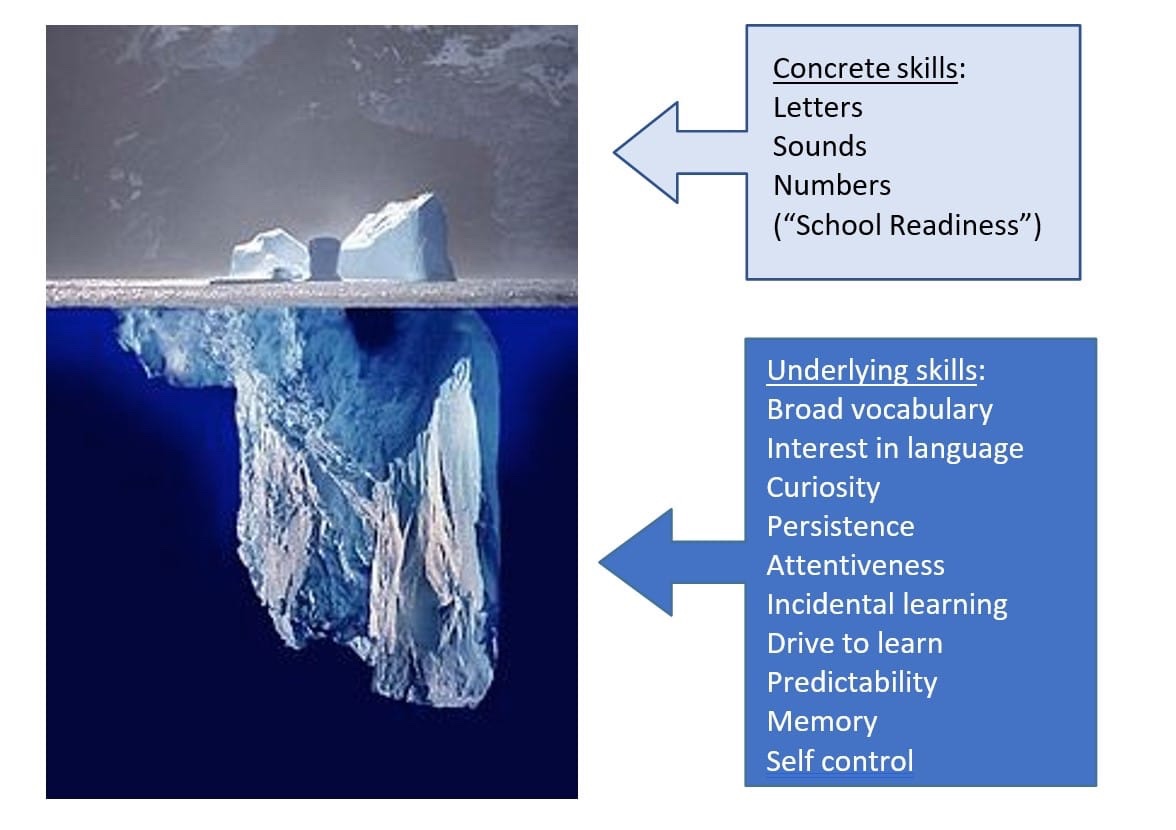
In an article on the blog of DEY (Defending the Early Years), Farran expressed her views about child development. She used the metaphor of an iceberg.
She wrote:
Years ago, few teachers believed that children should be taught to read in kindergarten; a more recent survey shows that 80% of kindergarten teachers now think children should know how to read before leaving the grade.
As recently as 1993 the great majority of kindergarten teachers did not believe an academic focus in preschool was important for children’s school success.
However, concern for the “fade out” of pre-kindergarten effects has led several researchers and policy makers to argue for a stronger academic focus in those classrooms, including the use of an intentional scripted, academically focused curriculum.
Not only do effects from pre-k classrooms fade, but also results from one study of the longitudinal effects of pre-k attendance conducted by my colleagues and me demonstrated that in the long run the effects turned negative.
A greater focus on academics for three- and four- year-olds is not the solution.
As an author of the recent paper on long term effects and as a primary investigator on the only randomized control trial of a statewide pre-k program with longitudinal data, and, finally, as a developmental psychologist whose career focused on young children’s development, I have thought extensively about what the causes of these unexpected effects might be.
I AM PROPOSING AN “ICEBERG MODEL OF EARLY DEVELOPMENTAL COMPETENCIES.”
The tip of the iceberg, the section floating above the surface, is composed of things that are easily measured.
These types of skills have recently been characterized as “constrained” skills meaning they are finite and definable.
All standard school readiness assessments focus on these types of skills.
But they do so because assessors believe that the skills represent deeper competencies.
They measure these skills somewhat like taking a finger-prick for evidence of the information the assessments provide into other more important characteristics of children.
BOTH THE FOCUS OF CURRENT PRE-K PROGRAMS AND THE PEDAGOGICAL STRATEGIES EMPLOYED FOCUS ALMOST EXCLUSIVELY ON THE TIP OF THE ICEBERG SKILLS.
Many who have been in early childhood for a long time testify to the changes in classrooms.
I believe these changes are accelerated by the process of subsuming preschool into the K-12 system.
In many states the department of education administers the pre-kindergarten program, and the program behaves like an additional grade level below kindergarten – the classrooms are open for the school day (5-6 hours a day) and the school calendar (9 months a year).
The classrooms are most often in elementary schools, where the push down from the K- 12 system is almost impossible to avoid.
Many of the elementary schools are older and unsuitable for younger children – no bathroom connected to the classroom, the requirement to have meals in the large cafeteria, and no appropriate playground.
These physical features mean that children spend a lot of time transitioning from the classroom, necessitating a high level of teacher control as children walk through the halls and endure long wait times.
Descriptions from a number of large studies of the instructional strategies used in current pre-k classrooms show them to be dominated by whole group instruction focused on basic skills (the tip of the iceberg).
TEACHERS TALK AT CHILDREN A MAJORITY OF THE TIME, SELDOM LISTENING TO CHILDREN, AND MULTI-TURN CONVERSATIONS ARE A RARE OCCURRENCE.
Learning opportunities that involve other than right-answer questions are almost never observed, and a high level of negative control from teachers characterizes many classrooms.
This content focus and the teaching strategies, I argue result in a detachment of the tip of the iceberg from the deeper skills under the surface.
Thus, children can score well on school readiness skills at the end of pre-k – especially on those related to literacy – but not maintain any advantage by the end of kindergarten when all children attain these skills with or without pre-k experience.
The tip of the iceberg skills no longer symbolizes those under the surface.
They are no longer the visible and measurable aspects of more important competencies.
Only when the deeper skills are enhanced should we expect continued progress based on early experiences.
A very different set of experiences likely facilitates the development of those deeper skills.
We have known for many years that the developmental period between four and six years is a critical one.
Neuroscience confirmed the importance of this period for the development of the pre-frontal cortex.
The pre-frontal cortex is involved in many of the skills described in the model as being below the surface.
Research does not provide good evidence for which experiences facilitate the development of important skills like curiosity, persistence, or working memory.
But research has demonstrated the importance of these kinds of skills for long term development.
For instance, some argue that early attention skills are more important than early academic skills as predictors of long-term school success including the likelihood of attending college.
In a large longitudinal study, researchers identified the importance of the development of internal self-control during the ages of four to six.
Some children with initially low self- control developed self-control during early childhood and had subsequent better outcomes via what the researchers called a “natural history change.”
Whether an intervention-induced change would yield the same positive outcomes is an open question.
So far, no early childhood curriculum has been able to bring about sustained changes in self-control or any of the below- the-surface skills listed above.
WHAT IS CLEAR IS THAT CHILDREN FROM MORE AFFLUENT HOMES ENTER KINDERGARTEN SCORING HIGHER ON SCHOOL READINESS SKILLS.
Moreover, they maintain that advantage across the school years.
But they did not learn those “readiness” skills from a didactic pre-k experience.
While these children may have had magnetic alphabet letters to play with, for example, parents did not sit them down in front of the refrigerator and force them to learn the letters.
Most of those tip-of-the-iceberg skills were learned through a variety of experiences and the opportunity to learn through interactions with adults and friends.
For these children, measuring the tip does provide information about the beneath the surface competencies that are so important.
Guidance may come from comparing the developmental contexts of families who are economically secure to the pre-k classroom context.
Children of economically secure families are more likely to succeed in school, more likely to matriculate in a two or four year college and more likely to graduate when they enter….
GOVERNMENTS IN MOST HIGHLY DEVELOPED COUNTRIES HEAVILY SUBSIDIZE THE CARE FOR YOUNG CHILDREN PRIOR TO SCHOOL AGE.
Nordic countries all provide a child supplement to parents, which most parents use to offset the modest cost of the government-subsidized group care, care that looks nothing like U.S. pre-k programs.
These programs stress different sorts of competencies in young children, capabilities like “participation” or the ability to be a functioning member of a group (not sitting “criss-cross applesauce” for 20-40 minutes during large group instruction).
The programs stress self-reliance and independence, the ability to make good decisions and to be responsible for one’s actions.
Most of these countries delay formal instruction in academic skills until children are six or seven. Their children do quite well in international comparisons in the later grades.
Concerns about the accelerating academic focus in early childcare education are being voiced by many.
I hope this “iceberg” model will provide a useful visual depiction of the danger of concentrating on basic skills instruction in pre-k.
I hope also that it will help people understand why getting early childhood right is so important and the imperative need to fix the childcare situation in the U.S. for families of poor children – in fact for all our children.
Pre-k is not the magic bullet policy makers hoped it would be. Quite the contrary. The reason it is not may lie with the unavoidable focus of the program when it becomes part of the K-12 system.
Denisha Jones is a lawyer, an early childhood educator, and a member of the board of DEY (Defending the Early Years). She writes here about the necessity of protecting young children from the resurgence of bad ideas. The worst of these bad ideas is standardized testing.
She writes:
As protectors of childhood, we have a duty to resist bad ideas, policies, and laws and be as vocal in our resistance as the proponents are in their insistence.
Though the effects of standardized testing have permeated certain aspects of childhood, young children typically are immune to mandated standardized testing.
When the testing accountability era began with No Child Left Behind, children below third grade escaped the yearly testing requirement.
This does not mean young children are not subject to many assessments as many schools give practice tests to first graders, but children in grades K-2 rarely take national standardized tests.
Five days into the new year, a proponent of standardized testing argues for beginning the NAEP (National Assessment of Education Progress) tests in kindergarten.
He argues that since advances in technology make it feasible to mass test young children on iPads and computers, we should collect more data in the early years.
Though many feel that NAEP is a good standardized test because it only tests a sample of students, even if this bad idea became the norm, it would only impact a sample of young children.
A THREAT TO SOME CHILDREN’S CHILDHOOD IS A THREAT TO ALL CHILDREN’S CHILDHOOD.
Testing children in kindergarten is a bad idea, period.
We do not need more tests to know what young children learn in school.
More tests lead to more scripted curriculums, teacher-led instruction, and less time to play, explore, and discover.
Nancy MacLean is an esteemed historian at Duke University, where she is the William H. Chafe Professor of History and Public Policy. She specializes in the study of race, gender, labor history and social movements in the United States. Her book Democracy in Chains: The Deep History ofthe Radical Right’s Stealth Plan for America is must reading. In this important paper, she examines the role of economist Milton Friedman in promoting school choice, segregation, and privatization. The abstract:
This paper traces the origins of today’s campaigns for school vouchers and other modes of public funding for private education to efforts by Milton Friedman beginning in 1955. It reveals that the endgame of the “school choice” enterprise for libertarians was not then— and is not now–to enhance education for all children; it was a strategy, ultimately, to offload the full cost of schooling onto parents as part of a larger quest to privatize public services and resources. Based on extensive original archival research, this paper shows how Friedman’s case for vouchers to promote “educational freedom” buttressed the case of Southern advocates of the policy of massive resistance to Brown v. Board of Education. His approach—supported by many other Mont Pelerin Society members and leading libertarians of the day –taught white supremacists a more sophisticated, and for more than a decade, court-proof way to preserve Jim Crow. All they had to do was cease overt focus on race and instead deploy a neoliberal language of personal liberty, government failure and the need for market competition in the provision of public education.
She describes the spread of ”school choice” legislation and writes:
A well-funded, laser-focused and integrated long game helped achieve these legislative triumphs. Indeed, it is difficult to find an institution on the American right that has not advocated “school choice.” Think tanks such as the Cato Institute and the Heritage Foundation, along with affiliates of the State Policy Network, make the case for it. Engines of legal and judicial change such as the Federalist Society and the Institute for Justice workshop the constitutional issues and litigate for it. The American Legislative Exchange Council (ALEC) produces templates of “model laws” for its overwhelmingly Republican members to introduce it in state legislatures. Fox News broadcasts the talking points. Organizing efforts including Americans for Prosperity drive calls and letters to elected officials. Deep-pocketed donors underwrite the work. The campaigners employ a common language of personal liberty and anti-government, pro-market catch phrases. They tout the benefits of parents gaining the “freedom to choose” to send their children to private schools. And they claim that breaking up the “government monopoly” will promote “competition” that will improve the overall quality of education.2
“School choice” sounds like it offers options. But as I will show, the whole concept, as first implemented in the U.S. South in the mid-1950s, aimed to deny the choice of equal, integrated education to Black families. Further, Milton Friedman, soon to become the best-known neoliberal economist in the world, abetted the push for private schooling that southern states used to evade the reach of Brown v. Board of Education, the Supreme Court’s unanimous 1954 ruling that the segregation of public education violated the constitutional right of Black children to equal protection of the laws. So, too, did other libertarians of the day, among them leading pioneers of the cause that today avidly pushes private schooling.3 Perhaps most tellingly, though, the ultimate purpose was not really to benefit parents and children, even the white ones who patronized the new segregation academies. For Friedman and the libertarians, school choice was and is a strategy to ultimately offload the burden of paying for education onto parents, thus harming the educational prospects of most youth. As we will see, Friedman himself hoped it would discourage low-income parents from having children in a form of economic social engineering reminiscent of eugenics. He predicted that once they had to pay the entire cost of schooling from their own earnings, they would make different reproductive decisions.4
Please read this thoughtful, well-researched and alarming study to understand the dark history of “school choice.” This is a case where history illuminates the future.
I am pleased to report that I was selected as ”Global Guru #1” by an organization that selects “global gurus” in different fields. I am happy to see my friends Deborah Meier, Andy Hargreaves, and Pasi Sahlberg on the same list. I’m honored to be in the company of such distinguished educators. In case you read the bio, there are two updates. I retired from active service at New York University on September 1, 2020. And the blog has received more than 39 million page views (not 32) since it started in 2012.
Whitney Kimball Coe, director of national programs for the Center for Rural Strategies, advises those who are outraged about the removal of MAUS from the eighth grade curriculum by the McMinn County School Board to support those in the South and rural areas who agree with them, instead of showering them with contempt and condescension. She was invited to appear on CNN to talk about the decision, and she had a sleepless night trying to find the right way to condemn the decision without condemning her neighbors.
Do they think we’re not outraged, too, here in East Tennessee? Do they think we can’t speak up and respond for ourselves? Because let me tell you, I lay awake the night before the CNN interview indulging my own outrage and constructing a commentary that would eviscerate all book ban supporters and signal to the rest of the world that I, too, am pissed off. It would feel good to give into the outrage, the indignation, the snark.
But I let the outrage pass over and through me because I live here. We live here. These are our people, our schools, our kids. We spend our days relying on the trust and goodwill of our neighbors to make a life here. Neil Gaiman doesn’t shop at the Food City downtown. Trevor Noah doesn’t volunteer with the local United Way. CNN isn’t interested in solutions journalism and outrage is where relationships go to die.
There’s no cure for opportunism. With each op-ed from another coastal publication, Tennessee becomes more alienated, and our public officials dig their heels in deeper. And those of us dissenting locally are left to bridge the gap, trying to figure out how to protect our hometown and organize for change.
As I lay awake, I remembered that the only side I’m on is the one that keeps the door open to a relationship, and one day, community transformation. When the rest of the world tires of tweeting, expounding and publishing op-eds about this ban, I’ll still be here: raising a family, living, working, organizing, and praying in a community that has my heart. I’ve got to be on the side of holding that together.…
The American Library Association says the number of attempts to ban school library books was 67% higher in September 2021 than in September 2020, fueled in large part by conservative activists organizing at a national level with an eye toward influencing local politics. This isn’t a McMinn County problem or a rural problem. We aren’t a novelty. We sure as hell shouldn’t be the scapegoats for deeper rifts in our national and global fabric.
If you must write about us, at least give a damn about us. Outrage is the quick and easy response if you’re not committed to the sum of us; that is, if you’re only committed to signaling which side you’re on and don’t really care about communities outside your bubble.
If you want to signal to the world that you’re on the side of solutions and repair, then write or tweet as a repairer of the breach.
Write about the donations that have poured into our local library these last days, both monetary and in the form of copies of the books! Look at the people who have been inspired to run for the school board. Talk about how one local parish is hosting a community-wide book discussion and conversation about the history of anti-Semitism in the Christian church. Celebrate Maus flying off bookshelves and selling out on Amazon. Find opportunities to deliver copies to kids in our community and around the world.
After reading her article, I went to the library website. I saw that every copy of MAUS had been checked out and had a hold on it when it was returned. I made a donation to the library. You could too.

 Diane Ravitch's blog