Archives for category: Education Reform

Joe Straus represented San Antonio in the Texas Legislature for fourteen years. He was Speaker of the House from 2009 to 2019.

He wrote in the Texas Monthly about the necessity of the state’s political leaders taking action against the crisis of gun violence. He believes that there is political will to take action. He believes that Texans want to see gun control. Let us hope.
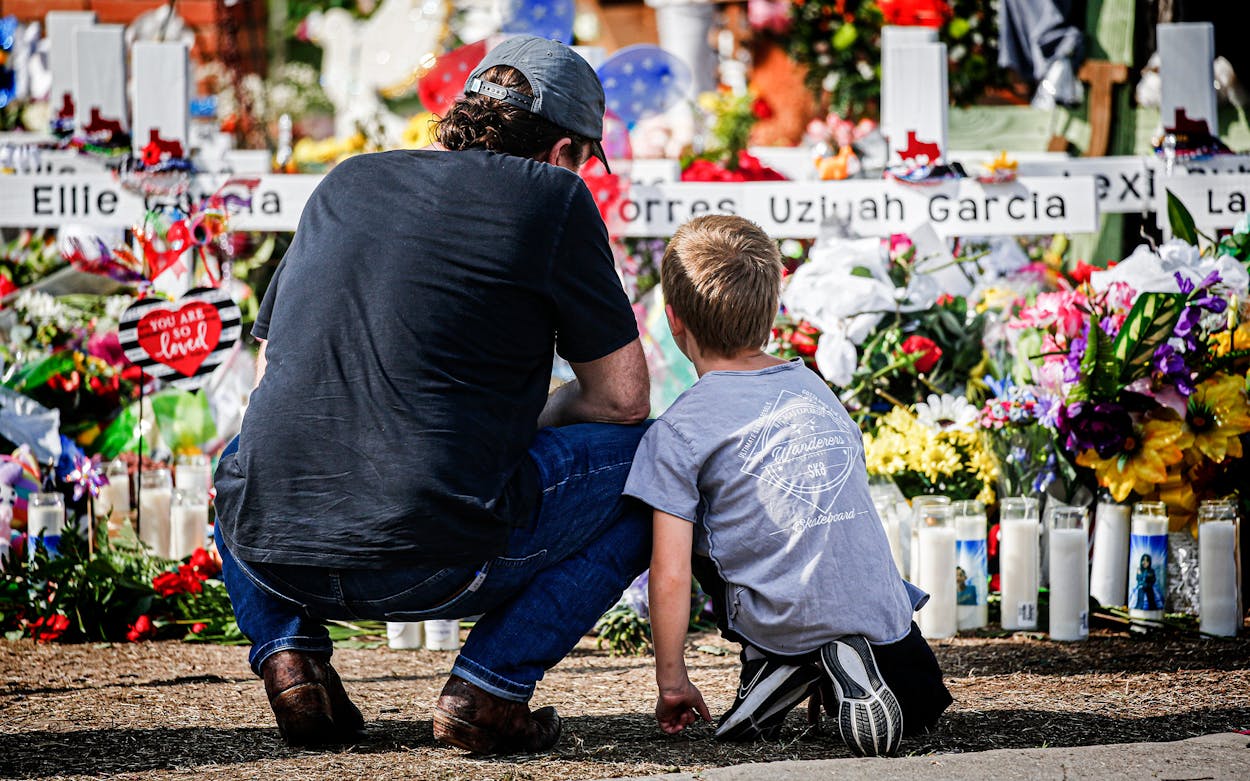
A man and a child pay their respects at a memorial outside Robb Elementary School to honor the victims killed in a school shooting in Uvalde on May 29, 2022.
A man and a child pay their respects at a memorial outside Robb Elementary School, in Uvalde, on May 29, 2022.Dario Lopez-Mills/AP

This tragic moment in Texas—when fear is overcoming students, parents, and educators, and when so many Texans are feeling hopeless about the state’s efforts to stop the next mass shooting—demands the leadership and the political courage to finally consider any solutions that will help prevent gun violence in our schools and elsewhere. 

All week, Texans’ grief over the loss of precious young lives in Uvalde has been compounded by anger and frustration that the state has not been able to stop another shooting tragedy. It’s not, I suspect, that Texans expect their government to provide absolute certainty that another mass shooting will not occur. Rather, Texans just want to see that this state is making its best efforts, regardless of political calculations.

It’s true that Texas has taken steps since the shooting at Santa Fe High School in 2018 to prevent such tragedies. The state invested hundreds of millions of dollars in threat-assessment training for educators, mental health training, additional counselors at campuses, and school infrastructure upgrades including alarm systems and metal detectors. While Texas has not historically been known for prioritizing mental health care, the state has made real progress in the past six years by investing in better care for more Texans, with one point of emphasis being early intervention for troubled children and teenagers.

However, there remains an unwillingness to give serious consideration to gun reforms that command broad-based, bipartisan support among Texans and other Americans. For example, June 2021 polling from the Texas Politics Project at the University of Texas at Austin showed that 71 percent of Texans supported background checks on all gun purchases. The project’s polling in October 2019 showed majority support for a nationwide ban on semiautomatic weapons. Many hunters and other law-abiding gun owners understand the need for restrictions as well. Sure, these provisions are less popular among the 3.3 percent of Texans who determine the outcome of Republican primaries, which basically have been proxies for the general election for the past 27 years. At some point, however, isn’t there a greater cause than assuaging primary voters? Those in public office have a duty to represent all of their constituents.

This may be the rare time when Texas would be wise to follow the lead of Florida. Since 2018, a “red flag” law in that state has been used nearly six thousand times to remove weapons from those who are deemed to be threats. Despite some encouraging talk about a red flag bill after the Santa Fe tragedy in 2018, the idea has not gained serious traction here. But it should be at the top of the list of ideas our elected leaders consider as part of a long-overdue look at meaningful gun safety. Texas should also take a long look at whether someone as young as eighteen should be allowed to purchase the types of exceptionally lethal weapons that the Uvalde shooter bought—and the requirements that ought to be met before such a purchase can be made. Is it good policy to make it harder for an eighteen-year-old to buy a beer, or get a driver’s license, than to acquire a military weapon and outgun law enforcement? 

Finally, given what we have learned about the fatal mistakes made by law enforcement during the shooting, the state should undertake a comprehensive review of the speed and effectiveness of law enforcement responses during mass shootings, so that we can clarify accountability and learn from mistakes.

Even in Washington, efforts have begun to find bipartisan compromise on gun legislation. I don’t know what will come of it, but I’m encouraged to see that our U.S. senator John Cornyn will be one of the leaders of those bipartisan talks.

As I argued after the 2019 shooting in El Paso, Texas can change the status quo if our elected leaders engage in a good-faith debate over gun safety. Now, like then, it is time for our legislators and our governor to listen to the fears and the concerns of Texans, as well as the views of experts who can provide serious, sober analysis of what will work, without the taint of politics. We are back at the same point where we were in 2019, but we don’t have to make the same choices. This moment calls for leaders willing to put politics aside and objectively consider every idea that might help prevent future tragedies—and they should start during a special legislative session this summer, before parents send their children back to school in August.

It’s been said that legislators act only when facing a crisis. Well, the epidemic of gun violence is a crisis by any measure. It’s past time to treat it like one.

Joe Straus represented San Antonio in the Texas House of Representatives for fourteen years, serving as Speaker of the House from 2009 to 2019.

Leonie Haimson urges every concerned New Yorker to call Governor Hochul and sign the class-size-reduction bill. If she does not sign within 30 days, the bill will die.

ACT NOW!

Whew! The long-awaited and much-needed class size bill was passed yesterday afternoon by the NY State Senate, 59 to 4, and late last night by the State Assembly. It calls for class size caps in NYC public schools of no more than 20 students in grades K-3; 23 students in 4th-8th grades; and 25 in high school academic classes, phased in over five years. If implemented well, it will bring a sea-change to our schools, and equity at last to NYC kids.

Our press release is here, along with quotes from AQE and the Ed Law Center, hailing the passage of this bill and thanking the key Legislators who made this happen. It is now up to us to ensure that the DOE’s class size reduction plan and its implementation are reasonable, effective, and responsive to parent and community concerns.

But the first step is to urge Gov. Hochul to sign the bill, so the planning can start NOW. Please call her today at 1-518-474-8390 or send her a message via her contact form here. Tell her: “Please sign A10498/S09460 now so that NYC students can benefit from the smaller classes that kids in the rest of the state already receive.”

Yes!!!

After years of rallying, protesting, and demanding class size reductions, the parents and teachers of New York won! The legislature passed a bill mandating a reduction in class sizes.

This is the single most powerful reform that will help students, especially the neediest students, who will benefit from smaller classes and more teacher attention.

Class size reduction matters more than school choice or teacher evaluation or other expensive but ineffective fads.

A special shout out to Leonie Haimson, the unpaid executive director of Class Size matters, who has fought this battle with all her time and energy for years.

I’m proud to say that I am a board member of Class Size Matters and Leonie is a board member of the Network for Public Education.

When the Network for Public Education met in Philadelphia April 30-May 1, I was surprised and delighted to encounter David Berliner. He had never attended one of our conferences, and he flew from the West Coast to do so. David Berliner is the most eminent education researcher in the United States, a giant in his field. He is now retired but continues to write and contribute to education studies and debates. His most recent book, which he edited with Carl Hermanns, is Public Education: Defending a Cornerstone of American Democracy. It contains 29 essays about the importance of public education, written by well-known scholars and educators.

I recently received this note from Dr. Berliner about his reaction to the NPE conference.

Dear Diane,

It was so nice to see you and Carol Burris at the annual meeting of our Network for Public Education. I know how hard you and others worked to make it a success. I write to tell you and Carol that it was exactly that for me.

As I think you know, I live pretty much by myself since my wife’s illness necessitated a move from Tempe to Oakland. Thus, I no longer have the same support group that I had in Arizona. Reading your posts, and NPE articles, is certainly edifying. Both sources of information do inform me, but they do more than that. They also signal me that there are many others who share our beliefs in the necessity for, and importance of, a successful system of public education.

My attendance at the recent annual meeting of NPE, in Philadelphia, was so very affirming of our common values. It reminded me that others with similar beliefs exist and are doing important work. I got to meet some of the published heroes of mine, whose work I often read, and with whom I share common purpose. But I also got to meet heroes I had not known about before. These folks often work at the local level, doing the hard work of keeping public schools public, decently funded, and building programs that improve the outcomes for America’s most impoverished youth. They do the hardest work, I think, and I was so happy to listen to them and know that we have so many like-minded folks on the ground, at the local level.

Everyone I met at the meetings I thought of as heroes trying their best to stop the onslaught of the privateers and our slide into plutocracy. I thought everyone I met believed, as I do, in words written by the late Paul Wellstone. I keep Wellstone’s words nearby to me when I work, as a reminder of what should be reflected in my own work. He said: “That all citizens will be given an equal start through a sound education is one of the most basic, promised rights of our democracy. Our chronic refusal as a nation to guarantee that right for all children, including poor children, is a national disgrace. It is rooted in a kind of moral blindness, or at least a failure of moral imagination, that we do not see that meeting the most basic needs of so many of our children condemns them to lives and futures of frustration, chronic underachievement, poverty, crime and violence. It is a failure which threatens our future as a nation of citizens called to a common purpose, allied with one another in a common enterprise, tied to one another by a common bond.”

At the recent NPE meetings I witnessed participants called to common purpose, allied to each other in a common enterprise: To support and enhance America’s systems of public education. We shared our common bond. It was so satisfying to be there. I already look forward to attending again next year.

David C. Berliner

Regents’ Professor Emeritus,

Arizona State University

Parents have pressed the New York Legislature for years to mandate smaller class sizes. They are close to achieving their goal.

State lawmakers have struck an agreement on bills that would extend mayoral control of the New York City school system for two years and mandate reductions in public school class size.

State Sen. John Liu of Queens, who chairs his chamber’s New York City education committee, and Assembly Education Chair Michael Benedetto confirmed the deal Tuesday morning.

“As you can imagine, there were many parties to the negotiation,” Liu said in an interview with Gothamist. “At the end of the day – or I should say at the end of the night – the Senate and Assembly concurred with this pair of bills.”

Legislative leaders reached the agreement late Monday, introducing a pair of bills that will be ready for a vote Thursday – the last day of the Legislature’s annual session in Albany. The two-year timeframe is less than what Mayor Eric Adams and Gov. Kathy Hochul were lobbying for and is designed to give parents more control over school governance

Class Size

If passed, the class size bill could dramatically shrink classes, a move many parents and educators say is the key to improving public school students’ academic and social growth.

The new bill would cap kindergarten through third grade classes at 20 students; fourth through eighth grade classes at 23 students; and high school classes at 25 students.

That’s compared to current caps for kindergarten at 25 students; first through sixth grade at 32 students; middle school classes at 30 (for Title I schools) or 33 students (for non-Title I schools); and high school classes at 34 students.

The reduction would be phased in starting this fall, and would have to be complete by 2027. If the city does not comply, money will be withheld.

“If enacted I think it will be a sea change for New York City students and their ability to learn,” said Leonie Haimson, executive director of the advocacy group Class Size Matters. “These are really, really big class size changes, but they’re within our grasp.”

Haimson has been advocating for Class size reduction for many years. She has led countless rallies and organized parent actions. This act is a tribute to the power of parents.

The same bill will renew mayoral control for two years. Mayor Eric Adams had hoped for more. After two decades off mayoral control, it has lost its luster.

Please sign up now for our Annual Parent Action Conference on Saturday June 4 from 4 PM to 6 PM EST, co-sponsored by NYC Kids PAC and held via Zoom.  

Invited keynote speakers include Congressman Jamaal Bowman, Sen. Robert Jackson and NYC Council Education Chair Rita Joseph.

We will also brief you on the proposed budget cuts to NYC schools, and what parents can do to prevent them from happening.

This will be followed by a choice of workshops on these important issues:

  • Reforming Fair Student Funding
  • Resources for parents navigating the special education system
  • How DOE puts your child’s privacy at risk
  • Literacy in NYC: How parents forced a change
  • The problems with charter schools
  • Parent organizing and advocacy

Please register now at Eventbrite here or at https://tinyurl.com/PACconference22  

A flyer you can download and share is here.

Hope to see you there!

thanks Leonie

PS Please keep those calls going to your Legislators about including requiring that class size be reduced in any agreement on Mayoral control; links to their contact info as well as a script is posted here.

The overwhelming majority of Americans, including gun owners, are sick of gun violence. They support gun control of various kinds. After the massacre of 20 elementary school children and six educators at the Sandy Hook school in Newtown, Connecticut, people thought that Congress would act to ban assault weapons or to demand restrictions on guns. But nothing happened. After the massacre at the Majory Stoneman Douglas High School in Parkland, Florida, people thought that Congress would act to stem the slaughter. But nothing happened.

Now a sort of public apathy has descended, even after the massacre of ten shoppers at the Tops grocery store in Buffalo, even after the slaughter of fourth-grade children and their teachers in Uvalde, Texas.

Nothing will happen, the public believes, because the Republican Party is owned by the National Rifle Association, which contributes about $70 million per election cycle to its allies.

Nothing will happen, they say, because there are 400 million+ guns already in circulation, and no amount of gun control will eliminate them.

But there is a solution. It is breathtakingly simple. It depends on the boldness of one person.

That one person actually could be any one of about fifty people with the resources to carry out the plan.

But for the sake of argument, let me arbitrarily choose just one of them: McKenzie Scott. (It might just as well be Michael Bloomberg or some other billionaire.)

Ms. Scott, you are a person who has shown by your frequent gifts to worthy organizations that you care about the future of our nation. You care about people. You care about justice and kindness and vulnerable people. You say you want to keep giving your money away until it is all gone.

Here is a worthy enterprise.

First, replace the NRA as the most important donor to the Republican Party. But only on the condition that those who take your money agree to strong and comprehensive gun control. Offer millions of dollars to every Republican member of Congress who agrees to vote to ban the purchase and criminalize the sale of military weapons to civilians. If the NRA controls fifty Republican senators with only $70 million, surely you could spend $500 million and buy most of their votes, which would save thousands of lives every year. A good deal for America at a bargain price for you. Even $1 billion a year might break the NRA stranglehold on the Republicans in Congress. You don’t need to win the votes of 50 Republican senators. Fifteen would be enough to break a filibuster.

Second, start a national buyback program for the most dangerous weapons: AR15s, Bushmasters, automatic and semi-automatic weapons and any other military-grade weapons. Be generous. Buy them for 10 times the purchase price. Buy other types of weapons, other than hunting rifles and single-shot pistols. Buy up as many of the 400 million guns in private possession as possible. Destroy them.

Third, use your vast resources to fund gun control lobbyists in every state that does not have gun control and make the same offer to pro-gun state legislators that you do to members of Congress. Buy their votes.

If this sounds cynical, who cares?

McKenzie Scott (or Michael Bloomberg) could spend a billion or two and dramatically reduce gun violence, simply by buying the votes of Republicans and buying back unusually lethal weapons. Their assets have a way of growing no matter how much they spend. When you have $40-65 billion, spending a billion or so to eliminate America’s gun culture is a bargain.

Any one of these billionaires could lift the curse of gun violence from our land, with the expenditure of one or two of their many billions.

This would be a great gift to America.

If this plan doesn’t work, then here is an alternative: organize nationally for a complete and total ban on the sale or possession of assault weapons, and any guns other than hunting rifles and single-shot handguns. Civilians should not be able to purchase military-grade weapons. We had a ban on the purchase or sale of assault weapons from 1994 to 2004. It included many exemptions. It did not buy back the weapons already purchased. We should do it again with far more ambitious goals.

My first choice: ban and criminalize the purchase, sale, or manufacture of assault weapons. Let the hunters keep their single-shot guns. No one should own a military grade weapon but the military. The Founders did not write the Second Amendment to protect killers but to protect a well-organized militia.

No more massacres in schools, churches, synagogues, mosques, shopping centers, music festivals or anywhere else.

The respected organization Human Rights Watch issued a damning report about the widespread violation of children’s rights when they were required to use online instruction. Without their knowledge or their parents’ consent, children in many countries were subject to surveillance by online tracking devices embedded in their online programs.

Governments of 49 of the world’s most populous countries harmed children’s rights by endorsing online learning products during Covid-19 school closures without adequately protecting children’s privacy, Human Rights Watch said in a report released today. The report was released simultaneously with publications by media organizations around the world that had early access to the Human Rights Watch findings and engaged in an independent collaborative investigation.

“‘How Dare They Peep into My Private Life?’: Children’s Rights Violations by Governments that Endorsed Online Learning during the Covid-19 Pandemic,” is grounded in technical and policy analysis conducted by Human Rights Watch on 164 education technology (EdTech) products endorsed by 49 countries. It includes an examination of 290 companies found to have collected, processed, or received children’s data since March 2021, and calls on governments to adopt modern child data protection laws to protect children online.

We think our kids are safe in school online. But many of them are being surveilled, and parents have often been kept in the dark. Kids are priceless, not products….

Of the 164 EdTech products reviewed, 146 (89 percent) appeared to engage in data practices that risked or infringed on children’s rights. These products monitored or had the capacity to monitor children, in most cases secretly and without the consent of children or their parents, in many cases harvesting personal data such as who they are, where they are, what they do in the classroom, who their family and friends are, and what kind of device their families could afford for them to use.

Most online learning platforms examined installed tracking technologies that trailed children outside of their virtual classrooms and across the internet, over time. Some invisibly tagged and fingerprinted children in ways that were impossible to avoid or erase – even if children, their parents, and teachers had been aware and had the desire to do so – without destroying the device.

Steven Singer is a teacher in Pennsylvania. He blogs at Gadfly on the Wall.

He writes:

I drove my daughter to school today.

She thanked me for the ride, I wished her a good day, and she toddled off to the middle school doors.

Her khaki pants needed ironing, her pony tail was coming loose and she hefted her backpack onto her shoulder like a sack of potatoes.

All I could do was smile wistfully.

Parents and guardians know that feeling – a little piece of your heart walking away from you.

Imagine what the parents of the 19 children who were killed yesterday at Robb Elementary School in Uvalde, Texas, might have felt.

I wonder if the parents of the two adults killed in the shooting gave a thought to their grown children during what may have seemed like just another busy day at the end of the academic year.

We’re all so preoccupied. We tend to forget that every goodbye could be our last.

This marks the 27th school shooting with injuries or deaths so far in 2022.

It comes just 10 days after a shooting at a Tops supermarket in Buffalo, N.Y., where 10 people were killed.

There’s hardly enough time anymore to mourn one disaster before the next one hits.

One would think we would have done something about these tragedies by now.

After all, they aren’t unpredictable. They aren’t inevitable. They’re man-made.

There have been 119 school shootings since 2018, according to Education Week, a publication that has been tracking such events for the last four years.

This only includes incidents that happen on K-12 school property or on a school bus or during a school sponsored event when classes are in session.

If we broaden our definition, there is much more gun violence in our communities every day.

According to The Gun Violence Archive, an independent data collection organization, there have been 212 mass shootings so far this year.

There were 693 mass shootings last year, 611 the year before and 417 the year before that.

Why don’t we do anything about this?

In Scotland 26 years ago, a gunman killed 16 kids and a teacher in Dunblane Primary School. The United Kingdom (UK) responded by enacting tight gun control legislation. There hasn’t been a school shooting in the UK since.

After 51 worshippers were killed in mass shootings at Christchurch and Canterbury in New Zealand in 2019, the government outlawed most military style semiautomatic weapons, assault rifles like AK15’s, and initiated a buyback program. There hasn’t been a mass shooting there since.

In Australia, following a 1996 mass shooting in which 35 people were killed in Tasmania, Australian states and territories banned several types of firearms and bought back hundreds of thousands of banned weapons from their owners. Gun homicides, suicides, and mass shootings are now much less common in the country.

This is not hard.

The rest of the world has cracked the code. Just not us.

Not the U.S.

PLEASE OPEN THE LINK AND READ THE REST OF THIS COMPELLING ARTICLE.

Mercedes Schneider reports that the National Rifle Association, which owns the Republican Party, issued a pathetic statement about something that happened somewhere that caused some real problems that cannot be mentioned. The NRA feels bad that this terrible thing happened. Since they plan to hold their annual meeting in Houston in a few days, it is embarrassing that this awful bad thing happened someplace not too far away to nameless people.