Archives for category: Education Reform

Stephen Dyer is a very insightful and reliable analyst of school issues in Ohio. He used to be a legislator. He reads bills and budgets. He keeps everyone informed about the intellectual fraud that perpetuates the diversion of public funds to failing charters and voucher schools. In this post, he dissects a recent paper by the Fordham Institute, which is an outspoken advocate of school privatization. Fordham, writes Dyer, said the quiet part out loud. A few years ago, Fordham funded a study by David Figlio on vouchers in Ohio that showed their negative effects, but they try to ignore their own study.

Dyer writes:

There’s been some news coverage today of Fordham’s latest foray into fantasy — a study they claim proves EdChoice vouchers are perfectly fine and dandy for kids and taxpayers.

However, tucked away in one of their “findings” is a kind of startling admission — that EdChoice forces local school districts to rely more on property taxes to pay for educating the students in public schools.

“Combined with the decrease in enrollments, this dynamic led to a 10-15 percent increase in local revenue per pupil.”

I’m sure the study’s author(s) had no idea what they had just done. But those of us who have been saying the same thing for years sure did. This is an admission that EdChoice means that students not taking EdChoice vouchers have to rely more on local, voter approved property taxes to pay for their educations — the exact thing that the Ohio Supreme Court ruled four different times made Ohio’s school funding system unconstitutional.

“The overreliance on local property taxes is the fatal flaw that until rectified will stand in the way of constitutional compliance,” ruled Justice Alice Robie Resnick in the 4th and final DeRolph decision in 2002.

So it was nice of Fordham to admit this. However, the report went on to spend a lot of time trying to minimize the potentially existential lawsuit Ohio’s voucher program faces, as well as mocking me and others as “Chicken Littles” (because those with a winning argument always use ad hominem attacks to strengthen their position).

The study blows minimal to zero impacts on student success into enormous justification for increasing taxpayer subsidies for private school tuitions. As Michigan State’s Josh Cowen put it: “First and most important: the study presents a ton of zero impacts and tiny effects. Mostly this is a #schoolvouchers report about statistical noise, packaged as a win.”

Exactly.

Take the information on segregation. The study compares the racial makeup of voucher students with the statewide racial makeup of Ohio students. The study’s author, Stephane Lavertu of Ohio State University (who taxpayers paid $132,968 in 2019 to educate students) was very careful to only compare the racial makeup of EdChoice recipients with public school students “statewide”.

Because he knows that EdChoice voucher students don’t come from every district. They come from majority-minority districts.

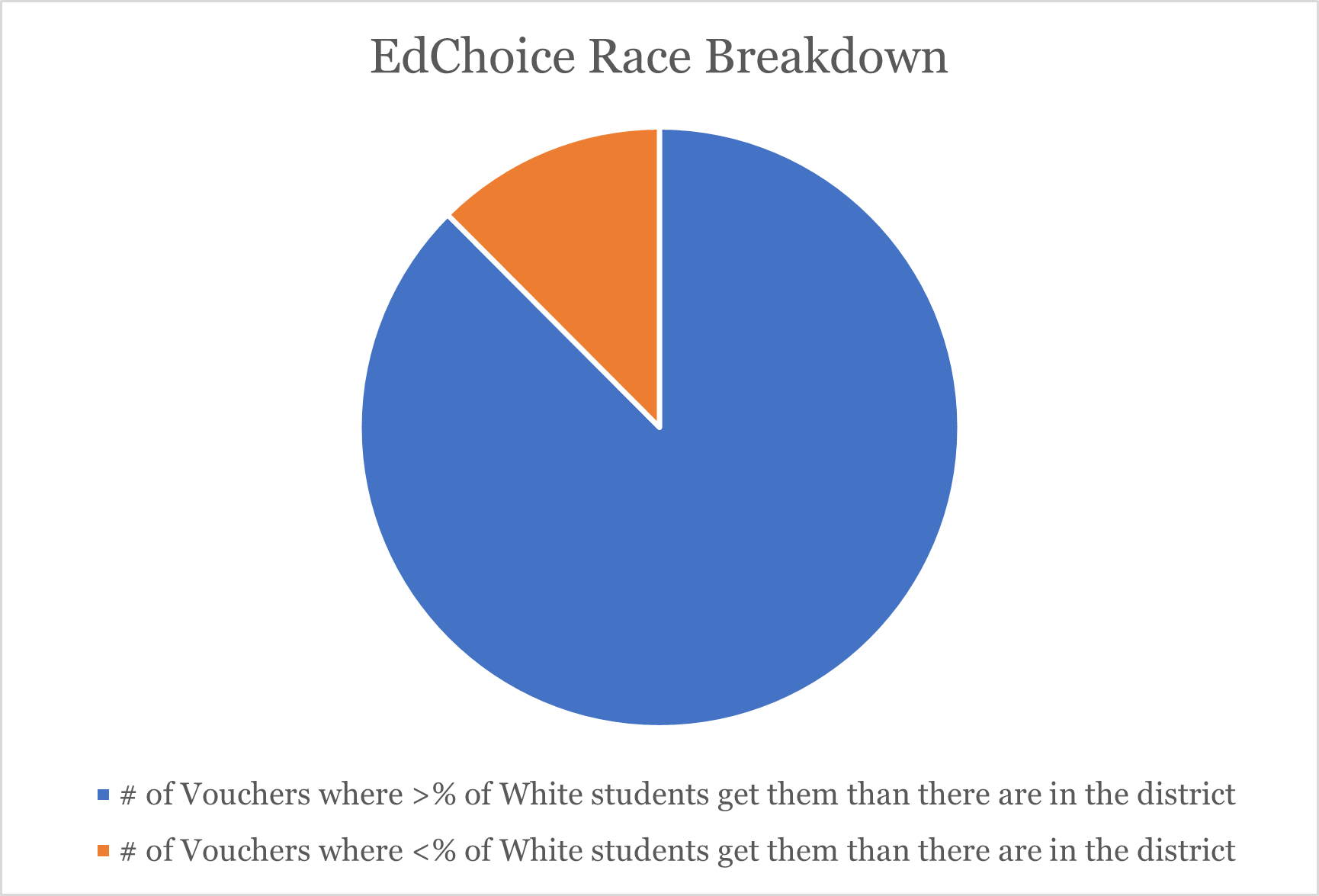
There are 95 districts that lose 10 students or more to EdChoice. In 76 of those districts, accounting for 87% of all vouchers given through the program, a higher percentage of white students take vouchers than there are in that district.

The average difference between white students taking vouchers and white students in those 76 districts was 76.2%. That means that in the districts where 87% of voucher students come from, voucher recipients are 76.2% more likely to be white than their public school counterparts.

My friends, that’s White Flight. Like, obvious White Flight.

Dear reader, do these data suggest — as Huffman wants you to think — that these segregation issues are “isolated examples”?

If 87% of voucher recipients are more likely to be white than the districts they come from, is that really “isolated”? Or is it “systemic”?

I mean in Huffman’s own district of Lima, Temple Christian takes 100% white voucher students. From a district that’s 35% white….

The vouchers worsen segregation. The students in voucher schools do worse on state tests than the public schools they left. What is more, “voucher students do worse on state tests the longer they take the voucher.”

A lose-lose, for students, for public schools, and for the state.

Nonetheless, despite failure, the state Teoublican legislature wants more vouchers and more failure!

Please open the link and keep reading this important post.

Donna Mace recently died, unexpectedly, and the public schools of the United States and Florida lost a dear friend.

Sandy Stenoff wrote this tribute to Donna, who taught elementary school students for 35 years, then became an outspoken activist for public schools and against the overuse of standardized testing. Of course, she was a BAT.

She concluded:

Donna Mace made the world a better place by being a force for good. She was a class act, approaching life’s challenges with courage, grace, humility, humor, and optimism, We all benefited from Donna’s wisdom, gained from her experience as a lifelong educator and a life well lived. She really was the best of us.

To the Mace family: Our thoughts are with you now and we send you love, gratitude, and a wish that your fondest memories will bring you peace and comfort.

I am sadened that we have lost Donna Mace. Many were inspired by her and will follow in her footsteps, never abandoning the struggle to do what is right for children. I hereby add her name to the honor roll, a list of distinguished fighters for public schools and children.

David Berliner and Carl Hermanns edited a book about the value and importance of public schools in a democratic society. Its title is Public Education: Defending a Cornerstone of American Democracy, and it was published by Teachers College Press. I was one of the contributors, along with other well-known figures in the field.

The book would be a terrific Christmas gift for an educator.

This review will give you a good look at the contents.

Public Education is a 346-page book containing 29 chapters penned by some of America’s most eminent scholars, including Diane Ravitch, Jennie Oakes, Sonia Nieto, H. Richard Milner, Deborah Meier, Ken Zeichner, Gloria Ladson-Billings, Michael Apple, William Ayers, and of course, co-editor David Berliner. The late Mike Rose has a chapter in the book as does Edward Fiske, the longtime New York Times education reporter and author of the ubiquitous Fiske Guide to Colleges.

While the themes of the book are quite varied, all the contributors to the book seem to agree that a child’s prospects in life, the quality of America’s public schools, and the country’s future as a democracy are all intimately intertwined. The importance of high-quality public education has been covered by Berliner previously in co-authored books such as The Manufactured Crisis (with Bruce Biddle, 1996) and 50 Myths and Lies that Threaten America’s Public Schools (with Gene Glass, 2014), and in well over a hundred articles.

However, in comparison with Berliner’s earlier works, this book has a stronger sense of urgency and a more dispiriting sense of disappointment in the ways in which federal and state governments have undermined, underfunded, and underappreciated the singular accomplishments of public education. In Berliner’s chapter on charter and voucher schools, for example, he uses the word scandalous over thirty times.

The very first sentence of the book’s introduction states, “The belief in the vital importance and central role of public education in the development of our country and the sustenance of our democracy runs deep.” When discussing the history and future of American public education, the specter of Horace Mann is always difficult to ignore. Indeed, more than half of the contributors explicitly discuss Mann’s ideas concerning the importance of a free education, sometimes in great detail. Even when he goes unnamed, Mann runs like a powerful current throughout these pages.
To offer a sense of the content and variety of the chapters, citations from four contributors follow.

Mark Weber
“Reform has become the core of the resistance to meaningful and sustained investment in schools. Education reformers are providing cover for those who fear that the United States might take its obligation to fund schools more seriously—starting with raising taxes on the wealthiest of its citizens.” (p. 205)
“A 2017 meta-analysis of merit pay experiments found ‘a modest, statistically significant, positive effect on student test scores (.053 standard deviations).’ This is the equivalent of moving a student at the 50th percentile in test scores to the 52nd percentile.” (p. 207)

Gloria Ladson-Billings
“Currently most major cities do not have enough white students attending their schools to adequately desegregate them.” (p. 227)
“The number of the most intensively segregated schools—with more than 90% of low-income students and students of color—more than doubled [from 2001 to 2014].” (p. 229)
“Beyond the crudeness of the per pupil expenditure measure is also the way ‘average daily attendance’ is derived. In Wisconsin, ADA is calculated on ONE day per year–September 15.” (p. 230)


Diane Ravitch

“After the Civil War, no state was admitted to the Union without an education clause in its constitution.” (p. 21)

“For many years, the term ‘school choice’ was stigmatized because of its association with advocacy for school segregation.” (p. 23)


Carol Burris

“The term public school is generally not viewed as a pejorative, which is why those who oppose public schools are so anxious to either exclude the term from the discourse, blur the definition, or hijack it for privatized systems.” (p. 236)

“We need to mind our words, being cognizant of how language has been used to shift the perception of privatized choice. Terms like privately-run charter schools and neighborhood public schools should replace public charter and traditional.” (p. 240)

As with any edited book, one chapter may seem nondescript while another may seem absolutely indispensable. For example, James Harvey’s chapter, “Education is our only political safety,” (pp. 214–225), a clearly written, tour-de-force about how education in the U.S. is funded, would be a perfect fit for an undergraduate foundations of education course.


Some of the book’s chapters are quite short and informal; others are fully realized, in-depth academic papers, replete with conclusions and recommendations. Most authors use APA bibliographic style, but a few use Chicago, and some chapters include no list of references at all. The chapters are divided into six “interrelated” parts that are so interrelated as to be indistinguishable from one another. Sections are identified not by titles but by Roman numerals, I–VI.

The divider pages indicating a transition to a “new part” often feature historical photos and text. For example, on p. 233, the divider page for Part V shows a picture of 16 very young child- employees of an oyster plant in a small town in Mississippi located on the Gulf of Mexico. The children depicted in the photo look to be between the ages of 5 and 8, and one of the 8-year-olds is struggling to hold another child-worker who appears to be around 2. The caption reads:

Before America had child labor laws and school attendance requirements….all [these children] worked from before daybreak until 5 p.m. for extremely low wages.”

Child Labor laws in the United States were ratified less than a century ago, in 1938. When children were liberated from the chains of illiteracy and the drudgery of working long hours for near-starvation pay, public schools emerged as welcoming, empowering institutions that offered the possibility of a better life. Rather than submit to a permanent sentence of indentured servitude, an American child—every American child—was suddenly given the opportunity to be treated as an equal among peers, regardless of race, religion, wealth, or family connections.

One can argue about the extent to which America has fallen short of its promises. But, powerful forces at work in the United States today are working to obliterate public schools and debunk the idea that every child deserves a fair chance. As noted repeatedly by the contributors to Public Education, if our public schools go down, our democracy seems likely to follow.


Author Biography
LAWRENCE BAINES, Ph.D., writes on educational policy and multisensory learning. He is the author of 13 books, including What’s a Parent to Do? How to Give your Child the Best Education (2022, Rowman & Littlefield). His homepage is http://www.lawrencebaines.com.

Roger Taney was the Supreme Court justice who wrote the Dred Scott decision, one of the worst decisions in the history of the Court. Its ruling upheld slavery. Taney’s bust will be replaced by a bust of Thurgood Marshall.

NPR wrote:

The House gave final passage to legislation to replace the bust of Roger Taney, the Supreme Court justice who wrote the Dred Scott decision, in the Capitol with one of Thurgood Marshall, the first Black person to serve on the high court.

The notorious 1857 Dred Scott decision upheld slavery and established that Black people were not U.S. citizens. The legislation, which passed Wednesday and now heads to President Biden’s desk, says the bust is “unsuitable for the honor of display to the many visitors to the Capitol.”

The statue of Taney sits at the entrance of the Old Supreme Court Chamber in the Capitol where the Supreme Court met from 1810 to 1860. Taney, the fifth chief justice, led the court from 1836 to 1864.

“While the removal of Chief Justice Roger Brooke Taney’s bust from the Capitol does not relieve the Congress of the historical wrongs it committed to protect the institution of slavery, it expresses Congress’s recognition of one of the most notorious wrongs to have ever taken place in one of its rooms, that of Chief Justice Roger Brooke Taney’s Dred Scott v. Sandford decision,” the legislation says.

“Taney’s ruling denied Black Americans citizenship, upheld slavery, and contributed, frankly, to the outbreak of the Civil War,” Rep. Steny Hoyer, D-Md., said on the U.S. House floor on Wednesday. “That’s why I and so many others advocated for his statue’s removal from the Maryland State House.”

Jeannie Kaplan is a former elected board member of the Denver Public Schools and a supporter of public schools. Alan Gottllieb is a journalist and a supporter of school choice.

They write:

A piece co-authored by the two of us will undoubtedly shock many people in the Denver education community because we frequently fall on opposite sides of the local education debate.

For example, Jeannie believes that the proliferation of charter schools is directly responsible for many of the challenges facing Denver Public Schools today. Alan sees charter schools as a net benefit to Denver’s families and students. Jeannie believes former superintendents Michael Bennet and Tom Boasberg did deep and permanent damage to DPS, with growing achievement gaps and too much emphasis placed on high-stakes testing. Alan counters that the district improved steadily, across all student groups, during their regimes.

But we, as Denver grandparents, are putting our differences aside for now because we agree on one key issue: DPS is seriously adrift, and it is time for the school board and the administration to get their acts together.

It’s irrelevant at this point to argue over which individual board members or district leaders are to blame for the current mess. The indisputable fact is that until the board can begin acting professionally, which includes providing clear direction to the superintendent, DPS will continue being a national embarrassment that gives the city as a whole a black eye.

No city in this country can hope to grow and thrive without at least a functioning public education system. Denver faces a host of challenges, to be sure, ranging from its failure to deal with the explosion in the number of people experiencing homelessness to crime to economic inequality.

But we believe that no issue is of greater consequence at this moment than the unraveling of DPS. To be sure, educators across the city are performing heroically on a daily basis. But given persistent dysfunction at the top, those educators are succeeding in spite of rather than because of district leadership.

Who could blame anyone a year after the current Denver school board took office for saying they’ve seen enough to have concluded the situation is hopeless with the current cast of characters in place?

There have been multiple instances of dysfunction, incompetence, and unseemly infighting. The board more often than not has proved unable to perform its core functions.

Combine this mess with the inept moves and general tone-deafness of Superintendent Alex Marrero and his team and what you’ve got is a school district in crisis, and distracted from addressing its most glaring issues.

But hope springs eternal. So, rather than despairing, we are going to suggest some ways out of the current morass.

One glimmer of hope is that we have a school board election coming up next November, in which three seats are up. Elections have a way of focusing incumbents’ attention. It gives them an opportunity to reflect upon, if not their shortcomings (that’s probably wishful thinking), at least their electoral vulnerabilities.

The public at large, as well as influential advocacy groups, need to make it crystal clear to the board that any incumbent who continues to feed the dysfunction without offering constructive solutions to the board and district’s issues will not be reelected.

They need to deliver those messages in stark terms beginning right now.

Next, individuals and groups on both sides of the Denver education ideological divide need to join forces, as we are doing here, to deliver a clear message to all board members, including those not up for reelection.

It’s a simple message:  Your behavior is unacceptable. You are not  serving our children. You are embarrassing yourselves and us. Get to work on what matters.

Surely there are enough shared interests that people passionate about public education can bridge their differences to deliver this message. It’s no exaggeration to say the future of the city hinges on its public education system improving, not spiraling into deep and permanent dysfunction.

Finally, Marrero needs to step forward and lead. This includes meeting one-on-one with his bosses, the seven board members, to tell them their behavior is making it all but impossible for him to get anything done.

Marrero has some public apologizing of his own to do as well. His mishandling of the school closure conversation last month left the district with no plan for addressing declining enrollment and related budget challenges. While some schools undoubtedly will have to close, it’s unclear how this will happen or when the decisions will be made. This uncertainty puts enormous stress on potentially affected communities.

Pressure on the district and board members over the lack of community closure conversations led six of seven board members to vote down Marrero’s ever-dwindling number of closure recommendations.

This provides a blueprint for how the citizens of Denver could force the board and the district to change course. Withering criticism from a diverse collection of voices could eventually prove too much for DPS to withstand.

People need to keep up the unrelenting pressure strategy across a host of issues. It is clear the board and the district aren’t going to fix themselves.

We’re going to have to show them the way. Or show them the door.

The effects of the pandemic show themselves in every survey of post-pandemic behavior, among students and adults. The pandemic isn’t over but the isolation and anxiety it produced had long-lasting effects.

Dorothy Siegel, Elise Cappella and Kristie Patten describe what they call “a better way” to help students with disabilities.

On December 1, 2022, New York City Schools Chancellor David Banks announced a path forward for transforming and rebuilding trust in the city’s programs serving students with disabilities. This plan includes the sustaining and scaling of four successful and innovative programs serving students with disabilities across the city, the creation of a new paid internship program for high school students in Occupational, Physical and Speech Therapy for students with IEPs, as well as the empowerment of families and community through a new advisory council that will make bold recommendations on reimagining special education in the New York City Public Schools.

This announcement demonstrates the city’s commitment to address the systemic and historic marginalization of students with IEPs, a marginalization that has disproportionately impacted the city’s Black and Brown students with IEPs.

A recent Chalkbeat article, “Public schools are NYC’s main youth mental health system. Where kids land often depends on what their parents can pay,” exposed to public view the growing number of New York City students with serious mental healthissues and behavioral problems that get in the way of their education. Because New York State has inadequately funded mental health services, the onus falls on local school districts, which don’t have the option to turn students away. “The entire state of New York has shifted the burden of mental health to the school districts,” said a social worker quoted in the article.

Under federal law, school districts must provide all students with disabilities, including those with mental health and behavioral problems, a “free and appropriate public education.” And many such students in New York City do receive a high-quality education with therapeutic supports in the public schools.

But serious inequities abound. As Chalkbeat noted, in the New York City public schools,

Black boys get classified with emotional disabilities at a far higher rate than other kids. In the 2020-2021 school year . . . Black students made up less than a quarter of students overall, yet they accounted for nearly half of students classified as having an emotional disability. White students, who made up 15% of all students in New York City public schools, accounted for just 8% of emotional disability classifications.”

As we can see, Black students, especially boys, are overwhelmingly overrepresented in the emotional disability classification. This matters because students with this classification have much worse outcomes than other students. As per Chalkbeat, in 2020-21 only 12% of students classified with an emotional disability received a Regents diploma in four years, compared to 73% of all New York City students.

For decades, New York City students who are classified with an emotional disability have found themselves on a path to highly segregated classrooms and schools, and, ultimately, limited life options. Neighborhood schools are not able to meet the needs of such challenging students, especially in inclusive settings. A recent report by NYU Research Alliance for NYC Schoolsstated that in 2016-17 only 33% of students with an emotional disability were served in an inclusive setting, compared to 66% of students with all disabilities. These young people often drop out and may fall into the juvenile justice system.

In the past few years, an increasing number of students with mental health and behavioral problems, no doubt exacerbated by two years of Covid, are showing up at the schoolhouse door. Of these, some find their way to private schools whose tuitions arepaid by the public school system – close to $1 billion in the last school year alone for students with autism, learning disabilities or mental health/behavioral issues.

Predictably, the overwhelming majority of these private school students are White and hail from more advantaged backgrounds. According to the Chalkbeat analysis, most students who are able to attend private schools on the public dime “live in just four of the richest and whitest districts,” including the Upper East Side and the Upper West Side of Manhattan and Park Slope in Brooklyn. As noted above, racially disparate classification is onemajor inequity in the system. But another is family wealth.

Clearly, New York State can and must do more, especially the restoration and rebuilding of mental health services for children and adolescents with mental health and behavioral issues.

But there is much that the New York City public school system can do as well, in particular at the beginning of a child’s educational journey. Students at risk of being classified with an emotional disability can and should be diverted from that drop-out/juvenile justice path onto a much better life path, as early as possible.

There IS a better way: The Path Program.

The New York City Department of Education (DOE), in close collaboration with researchers at New York University’s Steinhardt School of Culture, Education and Human Development (NYU), have developed a better way to educate these students: the Path program, which is based on the highly successful ASD Nest Program for autistic students. Path, like Nest, is a comprehensive, cohesive, collaborative, fully inclusive program that serves students at risk of an emotional disability (ED) classification. Path redirects these students onto a more hopeful path.

ASD Nest Program

The ASD Nest Program has developed over the past twenty years as a collaboration between the DoE and NYU. Launched in 2003, the DoE’s ASD Nest Program works with autisticstudents who are capable of doing grade-level academic work. The goal is to help these students develop competence in their academic, social and behavioral functioning, in order to realize their full, unique potential as independent and fulfilled adults.

In the 2022-23 school year, 69 New York City public schools are educating approximately 1,700 ASD students in 350+ integrated co-taught K-12 classrooms. The vast majority of Nest students stay in the program through twelfth grade, where 95% of Nest high schoolers graduate with a Regents diploma.

Path Program:

The Path program promotes the inclusion of students with emotional disabilities within community schools and strives to disrupt the historical segregation of Black and brown children in restrictive special education settings. The program employs many of the same evidence-based principles, practices, and structures developed for the Nest program, with the addition ofevidence-based trauma-informed and social-emotional learning strategies known to work well for students with this classification. Path classes are small co-taught integrated classes, with no more than four students classified with ED in each class, alongside twelve to twenty typically developing peers. Teachers provide the general education curriculum, using specialized supports and a variety of co-teaching models. With related services integrated into the day, Path classrooms incorporate supports typically provided by outside therapists to foster a safe environment in which Path students can comfortably interact with peers. Whole-class social, sensory, behavioral and academic strategies form a foundational level of support, consistent across all settings.

All school staff – teachers, therapists and administrators — receive high-quality pre- and in-service training and on-site support. Path staff meet weekly as a team to create comprehensive support plans for each student, which involve classroom and individual supports and family partnership.

The DoE piloted the model in one District 9 school in 2021-22 with a grant through the Fund for Public Schools. In 2022-23, the DoE opened four Path classrooms in three District 9 neighborhood schools: three kindergartens and one first grade class. Three more kindergarten classes will open this year in three other districts in Manhattan, Queens and Brooklyn, with the goal to eventually have Path programs in most NYC neighborhoods.

Path and Nest are two examples of the DoE’s “specialized programs,” differentiated program models for different disability categories. So far, the DoE has created specialized programs for students with autism (Nest and Horizon), emotional disabilities (Path), and intellectual disabilities (ACES). Importantly, all specialized programs – and their students — are fully integrated into their neighborhood school communities.

Over time, the ASD Nest Program has proven to be the program of choice for many, if not most, parents of autistic students, even those with the means to go to private school. The main admission requirement for Nest is an autism classification.

Similarly, Path is intended to level the playing field for Black and Brown students at risk of an emotional disability who don’t come from advantaged backgrounds. It is commendable that the DOE has chosen to invest in this research-based model – in some of the poorest community school districts in the city – to create inclusive pathways to school and life success.

With the chancellor’s commitment to the expansion of the ASD Nest and Path programs, the future looks much brighter for New York City’s students with significant disabilities.

Dorothy Siegel, Co-founder, ASD Nest Program

Elise Cappella, Professor of Applied Psychology, PI of NYU Path Program, NYU Steinhardt School

Kristie Patten, Professor, Department of Occupational Therapy,PI of NYU ASD Nest Support Project, Co-Investigator of NYU Path Program, NYU Steinhardt School
Ed Johnson is an Atlantan who acts as a watchdog for the Atlanta Public Schools. He is also a systems thinker, influenced by the seminal work of W. Edwards Deming.

He recently wrote about how the Atlanta pPublic Schools could help revitalize the city by thinking systematically instead of following its course of jumping from reform to reform.

His post begins:

Loopy APS is my mental model of interrelated causal factors exposed for all to see, question, and critique in a spirit of collaborative discourse. It began as a visual representation of my thinking about why Atlanta Public Schools cannot improve and why it can improve dumped out onto paper, static. The 2009 APS cheating scandal prompted doing so.

Then, during April 2017, by chance I discovered the cleverly named Loopy™ and promptly rendered my mental model in it. Hence the name Loopy APS.

Created by systems thinker Nicky Case, Loopy™ is “a tool for thinking in systems” and for simulating systems. It is highly effective and simple but not simplistic to use. If you can think, you can use Loopy™. It is freely available.

Loopy APS allowed seeing the dynamic behavior of a vicious causal loop that went unnoticed on paper. The vicious causal loop simulates interrelated factors influencing violence and crime in Atlanta to continually worsen amid a great deal of systemic instability.

It wasn’t clear at first why the vicious causal loop was in Loopy APS, as I did not knowingly model it. It was only after being able to see my thinking play out dynamically in Loopy APS did I notice it. So, to find out why, I ran Loopy APS, time and again, observing its behavior until a particular story became clear.

Reading from the snapshot image, in Figure 1, below, the story, told tersely, goes like this:

Greatly influenced by Partner Purposes, Atlanta BoE (Board of Education) and APS Superintendency provide for frustrating Authentic Education by employing SEL & Police (behavioristic practices) to favor inculcating routinized Teacher Learning and Student Leaning that obviate Wisdom, so as to obscure Democracy to allow Selfishness to flourish as Violence & Crimeto entangle Civil Society, while Atlanta BoE (Board of Education) and APS Superintendency are ever more greatly influenced by Partner Purposes.

Note the end of the story goes right back to its beginning. This makes the story a closed loop. Being a closed loop means every “thing” in the loop represents a causal factor that influences the behavior of every other “thing” or casual factor in the loop, including itself.

In other words, influence that goes around, comes around, whether directly or indirectly. Or, as Martin Luther King Jr tried to help us know and understand: “What affects one directly, affects all indirectly.”

Systems thinker Nick Chase did this short video honoring systems thinker Martin Luther King Jr. But, alas, I guess it takes one to know one, because being a systems thinker is not ordinarily ascribed to Dr. King. To many, he remains the guy who had a dream.

The overall, systemic behavior of a causal loop may be vicious or virtuous, or status quo-keeping. In the story above, pulled from Figure 1, it is vicious systemic behavior influencing violence and crime in Atlanta to continually worsen.

Now, given that story, the question becomes: What needs to change, so as to transform the closed loop of causal factors influencing violence and crime in Atlanta to continually worsen into one influencing violence and crime in Atlanta to continually lessen?

This question, of course, comes from recognizing that every vicious cycle holds the potential to reverse and become virtuous and, conversely, every virtuous cycle holds the potential to reverse and become vicious.

To follow Ed Johnson’s analysis, open the link and view his graphs and finish reading.

Retired teacher Christine Langhoff calls out the editorial board of The Boston Globe, which advocates for mayoral control of the schools, despite the wishes of the citizenry. Langhoff is right. Mayoral control is undemocratic, and it does not have a record of success. The mayor is not an educator. She or he may stack the leadership of the school system with cronies or—best case scenario—clueless business-school graduates. Mayoral control was tried and failed in Detroit and Chicago. New York City has had mayoral control since 2002 and that political arrangement has increased the number of charter schools, closed scores of schools, destabilized neighborhoods, and produced no notable improvements.

Langhoff writes:

Last year, 80% of Boston voters approved an elected school committee (a campaign that owes much of its organizing to a presence on Twitter, by the way). Now the process is underway, as the state would have to approve such a move.

This morning, the Boston Globe has published a disgusting editorial, calling for the abolition of any school board in the capital city. Reed Hastings would be proud. Who cares what citizens want, when the billionaires hellbent on privatization want something else?

There are certainly problems with the city’s current school governance system, in which the mayor appoints all members of the seven-person school committee. But if the city is to overhaul school governance, the way forward shouldn’t be to switch to a popularly elected school committee — an antiquated way of managing schools in the 21st century. Instead, Boston should get rid of the body and centralize control of the schools in the mayor’s office.” (Boston Globe)

And while the Supreme Court looks to originalism to undermine our rights, The Globe (or more likely the Barr Foundation, to whom the newspaper of record outsources its education coverage) would throw out centuries of history of governing public schools in Massachusetts:

Ending a school committee may seem radical, since local school board elections are so ingrained in American tradition. But the local school board, and its considerable power over the education of children in a geographic area, is a particularly North American phenomenon, and something of an accident of history. The colony of Massachusetts required towns to establish and pay for schools in 1647, in a law known as the Old Deluder Satan Act, and local control of schools — and local responsibility for funding them — has endured since.” (Boston Globe)

Funny, I doubt the same people would call for dissolving all school boards across the state, especially not in those wealthy towns where these writers likely live, and whose elected school boards they serve on.

Professor Maté Wierdl teaches college-level mathematics in Tennessee; he is a native-born Hungarian and travels there regularly. In this post, he reviews the teachers’ strike in Hungary, which has dragged on for more than a year.

Throughout the strike, the Hungarian government has shown its disdain for the teachers’ union and the teachers. American right-wingers love the growing authoritarianism of the Hungarian government, even inviting Hungarian President Victor Orban to speak at the annual meeting of CPAC, the conservative political action committee.

Wierdl writes:

Hungarian teachers have been openly protesting for almost a year now. The formal protests began in January. As a response, Orbán, Hungary’s Prime Minister, basically took away the teachers’ right to strike (they cannot skip their teaching obligations while they “strike”), and quite a few protesters have been fired from their jobs. Just this week, 8 teachers were fired since they protested during school hours.

Why the protests? I think Hungarian teachers used to have a pretty good job. But in recent years, their load increased a great deal, more testing was introduced and kids need to go to school more. I have to say, I see the US influence, which shouldn’t be a surprise to anyone after seeing in the news that Orbán was invited to the US to give the keynote address at CPAC, and then he paid a visit to Trump.

I have many teacher friends and they say the main issue is not just about money but the general worsening conditions of teachers, and as a result, there is a huge teacher shortage.

Though numbers don’t tell everything, they clearly indicate serious problems. For example, here is a chart showing teachers’ salaries relative to other college educated people’s salaries (I think most of the countries’ names are recognizable; EU22 is the EU average). Note how the US (Egyesült Államokin Hungarian) and Hungary are the last two

The next chart shows the mandatory classroom hours in several European countries. Hungary is at the top (meaning, most hours) and in fact, since there aren’t enough teachers, the average teaching load is close to 27 hours. (US teachers teach even more, like 6 classes per day which means a 30 hour load)

Below, I put together some reports of the protests in the international media in the last two months.

Bloomberg writes this about today’s (Dec 2) protests

Hundreds of Hungarian teachers joined a widening strike action across the nation’s school system following a government decision to fire more educators for protesting low pay.

Almost 700 teachers from 71 schools walked off the job on Friday, forcing several institutions to suspend classes, according to the Teacher for Teachers Facebook page, which compiles the information.

Thousands of students joined in solidarity, many of them placing black tape over their mouths. They decried what they called a hardline response by Prime Minister Viktor Orban’s government to silence teachers who earn among the lowest wages in the European Union.”

Nov 18

BUDAPEST, (Reuters) – Hungarian teachers, students and parents stepped up their protest calling for higher wages and education reforms on Friday, forming a 10-km (six-mile) human chain in central Budapest, with smaller rallies held across the country.

Teachers launched their “I want to teach” movement in September, calling for civil disobedience to demand higher wages for teachers and an adequate supply in the workforce. They are also protesting against restrictions on their right to strike.

Here is a video of the protests a few weeks earlier. As you can see many students support the teachers.

Oct 6:

Wednesday’s rally, which started with students forming a chain stretching for kilometers (miles) across Budapest in the morning grew into the biggest anti-government demonstration since nationalist Prime Minister Viktor Orban’s April re-election.

 Protesters carrying banners saying “Do not sack our teachers” and “For a glimpse of the future, look at the schools of the present” crammed a Budapest bridge near parliament, blocking traffic amid light police presence.

Earlier this year, the Florida legislature and Governor Ron DeSantis passed a bill that they called the Parental Right in Education law, but it is widely known as the “Don’t Say Gay” law. It forbids any recognition of gender identity in grades K-3, as well as careful scrutiny of any such instruction in higher grades to be sure that it is “age appropriate” (i.e., in the eye of the beholder). Gov. DeSantis boasted on election night that Florida is where “woke goes to die.” As you will read in the article below, the governor’s general counsel defined “woke” as the “belief there are systemic injustices in America society and the need to address them.”

Surely, doesn’t everyone agree that there are no “systemic injustices in American society,” and never was such a time or thing ever ever. Since they don’t exist, the reasoning goes, there is no need to address them. The state of Florida believes that it must be illegal to teach about any systemic injustices that exist now or might have existed in the past. This law is a denial of academic freedom, plain and simple.

It is a kind of poetic justice that the sponsor of this law–Rep. Joe Harding– was indicted for wire fraud and money laundering—for claiming $150,000 in COVID recovery funds from the Small Business Administration for two businesses he owned that had no employees and no revenues. He has resigned his seat in the legislature. Karma.

The Miami Herald reported:

Florida’s State Board of Education will meet next week to scrutinize whether 10 school districts — including Miami-Dade, Broward and Hillsborough counties — are carrying out the state’s parental rights law, which have become a political lightning rod in local school board meeting and national politics in recent years.

The Florida Department of Education put the districts on notice last month when it sent superintendents letters detailing the policies and procedures that each of their districts “may not comport with Florida law.”

The law, titled Parental Rights in Education, but which critics have dubbed “don’t say gay,” prohibits classroom instruction and discussions about sexual orientation and gender identity in grades K through 3 — and in older grades if they are not “age appropriate or developmentally appropriate.”

Many of the policies the state has flagged offer protections to LGBTQ students who confide personal information to school employee by requiring their consent to divulge aspect of their sexual orientation and gender identity to guardians and parents.

In letters sent Nov. 18, Senior Chancellor Jacob Oliva flagged a range of policies and procedures at the 10 school districts and requested a status update on those policies by Friday.

In addition to Miami-Dade, Broward and Hillsborough, letters were also sent to Alachua, Brevard, Duval, Indian River, Leon, Palm Beach and the Florida School for the Deaf and the Blind.

The State Board of Education will meet on Wednesday.

Some of the policies that were flagged by the state include “best practices” policies for school personnel to not disclose the sexual orientation or gender identity of students without their input or permission; policies that say all students should be referred to by the gender pronouns and name that is consistent with their gender identity, and rules that allow students to access locker rooms and restroom that are consistent with their gender identity.

The state has also raised questions about a “racial equity policy” at the Indian River County School District. The district’s policy says it is mean to confront “the institutional racism that results in predictably lower academic achievements for students of color than for their white peers.”

Gov. Ron DeSantis has targeted such policies as he declares Florida to be the state where “woke goes to die.” During a federal court trial last week, DeSantis’ general counsel Ryan Newman, said the term “woke” refers to the “belief there are systemic injustices in America society and the need to address them.”

In Miami-Dade, the state has zeroed in on policies that aim to support transgender and “gender expansive students” in sports, locker rooms, and manners that pertain to which pronouns students want to use and what private information they want to disclose. In Broward County, policies that aim to create a “safe space for LGBTQ+ students” have come under the microscope.

The state wants to hear the status of five policies, including one that says “it is never appropriate to divulge the sexual orientation of a student to a parent without the student’s consent.” And in Hillsborough County, the state is asking the district to provide an update on two policies: a “racial equity” policy that aim to increase academic achievement for “ALL students,” and LGBTQ policies that deal with “coming out and confidentiality.”

Read more at: https://www.miamiherald.com/news/local/education/article269802507.html#storylink=cpy