Archives for category: Education Reform

Retired teacher Karen Gaddis won a surprise victory last night for the Oklahoma legislature, flipping a seat that has been held by a Republican since the early 1990s.

Congratulations, Karen! Oklahoma will have a Teacher in the House!

We will take this country back, one seat at a time.

As readers of the blog know, our friend Phyllis Bush is fighting cancer with humor and determination.

In this post, she brings us up to date on her activities, her treatment, and the kindness of friends and strangers.

I heard about a product called the Amazon Alexa. I wanted to learn more, went to Amazon, and found this fabulous thread about two electronic devices, the Alexa and the Echo.

“Question: I have 2 children, one named Alexa and the other named Amazon. Will this present any problems?

A: My kids do not respond to voice commands, do yours?!? I am selling my kids on eBay and buying the Echo.
tomh

A: My daughter Siri loves it..
ACChapa

A: I was in the same boat. After much debate with the husband, we decided to adopt our children out to family members. We could not be more pleased with our decision. This product has literally changed our lives.
Tami

A: Don’t worry about it. Your children do not have voice command recognition features, so only the Echo will respond accordingly. I’m not sure if they have the voice command upgrade for children yet. I heard it’s still buggy and only works when you pay it. see less
Lionel C.

A: No. It will only matter if you name your third child Echo.
Ben’jammin

A: This isn’t really a problem because as a parent, you usually just go through the entire list of available names before getting to the right one anyway. They’re probably all in trouble, so it’s not really an issue.
PSW

A: You will finally get an answer when you call their name.
Bryan F.

A: Just replace your children with the echos will cost you less in the long run.
John

A: No, in the Alexa app you can choose a wake-word with the choices being “Alexa”, “Amazon”, and “Echo”.
Seth Hollander

A: Yes, but you can always just donate your old items. Goodwill takes children now, just make sure to use their convenient “after hours” drop off. Huge donation deduction for tax purposes but may be offset by not having dependents.
S. Harper

A: While all the answers are funny, the ones I find MOST hilarious are the ones who don’t think this is a joke and are trying to solve your issue. Lol

Michael Gerson was a speechwriter for President zgeorge W. Bush.

He does not admire Trump, to say the least.

Here, he offers advice on dealing with a president who is out of touch with reality, impulsive, uninformed, has no ability to steady or unite the nation, and is unfit to lead.

Wherever there is a bipartisan consensus for charter schools, the Koch brothers see the state as ripe for expanding vouchers. Now they are targeting Colorado, where they have developed a strategic plan for the state.

Leading Democrats, such as wealthy Congressman Jared Polis and former State Senator Michael Johnston, have led the charge for charters and schiool choice (both have announced they are running for the Democratic nomination for governor.) Polis has opened two charter schools and fiercely supports them as a member of the House Education Committee. Johnston, former TFA, introduced legislation in 2011 to make student test scores count for 50% of teachers’ evaluation. The law has been an abject failure, although Johnston claimed it would guarantee that Colorado had great teachers, great principals, great schools.

DFER and Stand for Children have been active in Colorado, laying the groundwork for the Koch brothers.

And now they arrive with a plan to defund public schools and call it “opportunity.”

“COLORADO SPRINGS — In a nondescript office building on the north side of this conservative enclave, more than a dozen volunteers spent hours making calls to educate voters about a new initiative that will allow parents to use taxpayer dollars to send children to private schools.

“At the same time, just miles down the road, the political network behind the effort gathered hundreds of its wealthiest donors at a posh mountainside resort to raise money to support the campaign to remake the education system.

“The confluence of policy and politics epitomized how the conservative billionaires Charles and David Koch flex their organization’s muscle and spread an ideological agenda in states across the nation.

“The value of this network cannot be overstated,” said Stacy Hock, a Koch donor and conservative education advocate in Texas. “The ability to stand on the shoulders of the giant that is this network to make yourself more impactful and strategic changes the game.”

The Koch brothers plot a conservative resistance movement in Colorado Springs strategy session
Koch network to Trump administration: “You are never going to win the war on drugs. Drugs won.”
The phone calls to middle-of-the-road voters and presentation to donors in Colorado last week were part of the Koch network’s six-figure campaign to promote school choice and education savings accounts, or ESAs.

“The effort in Colorado involves the Americans for Prosperity Foundation and the Libre Initiative, a group focused on Hispanic community outreach. Together the organizations are making calls and sending flyers to voters this summer, two of which promote ESAs as a way to “give families the freedom to select schools, classes and services that fit the unique needs of their kids….

“The Koch network considers Colorado an attractive state for its message because public charter schools are a bipartisan cause. In the 2017 session, lawmakers equalized funding for charter schools with district schools.

“EdChoice, a conservative education advocacy organization aligned with the Kochs, commissioned a survey in 2015 to introduce Colorado to the ESA issue, finding strong support when cast in favorable terms.”

CBS News aired a great segment on the importance of rural public schools. They are the heart of the community. CBS News went to an impoverished community in Appalachia and interviewed students and the principal, who is also the school bus driver. The small rural public school in Letcher County doesn’t need competition. Most of its students live below the poverty line, yet the school is one of the best in the state.

Nine million children across the nation attend rural schools.

Why does Betsy DeVos want to destroy them?

Hello, Senator Mitch McConnell. These are your constituents!

An earlier post this morning said that two young TFA had run a “successful” charter school in Chicago and were invited to open a charter in Indianapolis. They are both under 30.

Indianapolis: As School Board Plans to Close Public Schools, Interlopers Arrive to Open New Charters

A reader who knows the couple in Chicago sent this comment:

“They didn’t “stick with the school they started in Chicago” because they didn’t even start one there. Just an afterschool program for 100 students already enrolled in other charter schools. They applied to CPS in 2016 to start a charter school. But weren’t approved.”

Indiana has one of the nation’s largest voucher programs (34,000 students) and has been in operation long enough to collect four years of data.

The latest voucher study reached the conclusion that students who get vouchers fall behind in the first two years, notably in math, but eventually catch up to their public school peers.

But do they?

Steve Hinnefeld reported on the release of the study, but then had second thoughts.

He writes:

“The study, by Joe Waddington of the University of Kentucky and Mark Berends of the University of Notre Dame, was released Monday. Its findings were covered by National Public Radio, Chalkbeat, Education Week, the Indianapolis Star and the Fort Wayne Journal-Gazette. A headline in the Washington Post was typical: “School voucher recipients lose ground at first, then catch up to peers, studies find.”

“But the students who “catch up” are only a handful among voucher students included in the study. The study analyzed test scores for 3,913 students who received vouchers during the first four years of the Indiana program, from 2011-12 to 2014-15. But they had four years of test-score data for only about 5 percent of those students.

“The only students to produce four years of data were those who were in certain grades and received a voucher in the first year of the program. (Indiana gives standardized tests to students in grades 3-8, so those who were in sixth grade or higher in the first year of the program would have aged out of the annual tests in four years).

“By contrast, the researchers analyzed two or more years of data for over half the students in the study. So the finding that voucher students lost ground in the first and second year after moving to a private school seems considerably more solid.

“The study also includes data for 15 percent of voucher students who left their private school and returned to a public school. Those students, on average, had fallen further behind in math than the typical voucher student, and they also had lost ground in English/language arts.

“Here’s a possible interpretation: Maybe the voucher students who stayed in private schools for four years weren’t representative of all low-income students who received vouchers. Maybe they were disproportionately high-achieving or ambitious students who were more likely to make a go of it in private school.

“And the students who gave up or lost their vouchers and returned to public schools – maybe they left because their parents saw the private school wasn’t helping them and may have been hurting. Or maybe the private schools, which can set their enrollment standards, gave some of those students a nudge.

“Maybe the message isn’t that voucher students who stick with private schools do OK academically, but that voucher students who do OK academically are more likely to stick with private schools.

“If that’s the case, you can’t make a credible claim that voucher students will necessarily regain what they lost if they just persist in their private school. Some will, but others won’t.”

Thus, when you see a headline saying that voucher students lose ground but eventually catch up to their peers in public school, take a second look. Who persisted long enough to “catch up”?

Weren’t voucher schools supposed to “save poor kids from failing public schools”? There is no evidence for that assertion. If the kids are lucky, or work hard, they just might catch up to their peers in public schools.
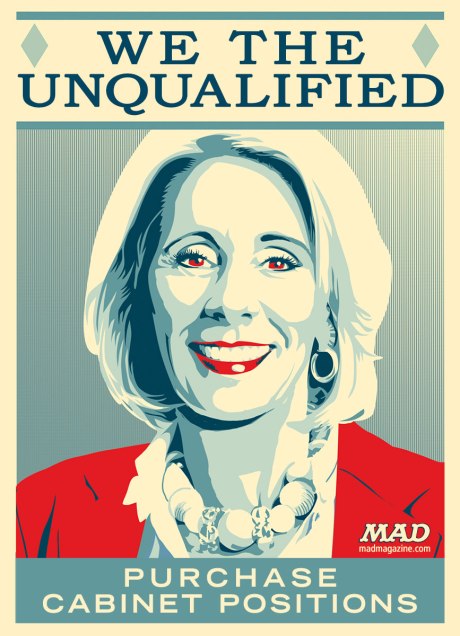
A reader sent me the link to this poster, which appears in the current issue of MAD Magazine. I don’t customarily engage in ridicule, but what DeVos is doing to the public schools of America, what she is doing to civil rights enforcement, and what she is doing to college students struggling to pay for their education is beyond ridiculous.

maddevos

Led by Massachusetts Attorney General Maura Healy, the state attorneys general in 19 states sued Betsy zdezvos, who is failing to protect the interests of college students who are preyed upon by for-profit colleges, like the defunct Trump University.

This Secretary has carved out a unique role as the defender of corporate interests against the rights of students. Her motto might as well be “Let the predators prey!” In her mind, “preyer” is always a good thing, and when the powerful prey on the weak, well, as Betsy would say, “That’s life. Get used to it.”

Mercedes Schneider blogged about it here.

The Washington Post reported:

“A group of 19 state attorneys general is suing Education Secretary Betsy DeVos for delaying an overhaul of rules to erase the federal student debt of borrowers defrauded by colleges.

“With no notice, with no opportunity for comment … the DeVos team is trying to cancel this rule,” Massachusetts Attorney General Maura Healey, who is leading the lawsuit, said on a call with reporters Thursday. “It is important that we take action where we see activity by the federal government, Secretary DeVos and the Department of Education, that is unsustainable, unfair and illegal.”

“The complaint, filed in U.S. District Court on Thursday, accuses the Education Department of violating federal law by halting updates to a regulation known as the borrower defense to repayment. The rule, which dates to the 1990s, wipes away federal loans for students whose colleges used illegal or deceptive tactics to get them to borrow money to attend. The Obama administration revised it last year to simplify the claims process and shift more of the cost of discharging loans onto schools.

“Before the changes could take effect July 1, DeVos suspended them last month and said she would convene a new rulemaking committee to rewrite the borrower defense regulation, reviving a process that took nearly two years to complete. Proponents of the revised rule were livid that DeVos made a unilateral decision without soliciting or receiving input from stakeholders or the public.”