Archives for category: Education Reform

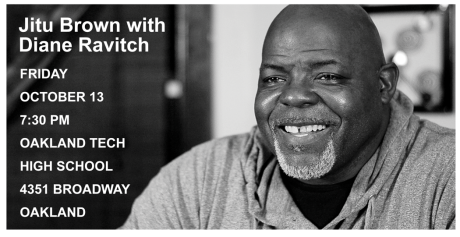
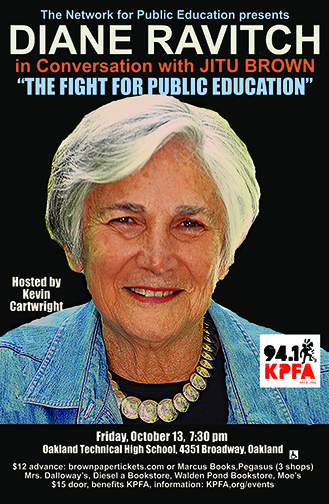
On Friday, October 13, join The Network for Public Education Action and KPFA radio for a critical conversation between Network for Public Education (NPE) President, Diane Ravitch and Network for Public Education (NPE) Action Board Member, Jitu Brown.

Diane Ravitch is the author of eleven books on education, including the best-selling Death and Life of the Great American School System, which sparked national resistance to corporate and market-based education “reform.” In addition to serving as President of NPE and NPE Action, Diane is a Research Professor at New York University and a historian of education.

Jitu Brown is a long-time community organizer born on Chicago’s south side. He is a product of Chicago’s public school system and a proud parent and husband. Jitu started volunteering for the Kenwood Oakland Community Organization (KOCO), the oldest black-led organizing community based organization in Chicago in 1991.

In his role as National Director for J4J, he leads an alliance of grassroots community, youth, and parent-led organizations in 23 cities across the country that demand community-driven alternatives to the privatization of and dismantling of public school systems. He has brought great energy and focus to the connection between the attacks on public education and the disempowerment of African American communities all across the country.

He was one of 12 parents, grandparents and community members who put their bodies on the line in a 34-day long hunger strike to save Walter H. Dyett High School in Chicago, the last open enrollment High School in the historic Bronzeville community.

Jitu and Diane will discuss U.S. Education Secretary Betsy DeVos’ continued attempt to dismantle and corporatize America’s public education system and the #WeChoose campaign, a national coalition composed of powerful education justice organizations. The #WeChoose campaign includes: Network for Public Education, BadAss Teachers Association, Alliance to Reclaim Our Schools, The Advancement Project, the Education Justice Network, Alliance for Education, Annenberg Institute for School Reform at Brown University, Dignity in Schools, Save Our Schools, Institute for Democratic Education in America and Journey for Justice Alliance, whose combined membership represents millions of Americans. Campaign members are joining forces to hold Congress and the Administration accountable in the upcoming education budget hearings.

Ravitch+Brown in Oakland-2

Picture1

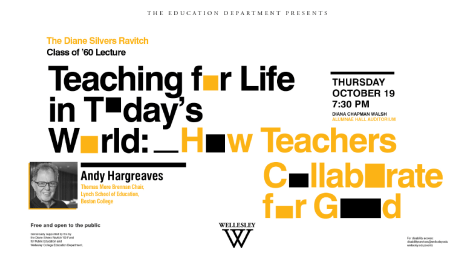
Andy Hargreaves is an internationally renowned expert on teaching and a proponent of teacher collaboration. He very kindly agreed to step in at the last moment when Linda Darling-Hammond, the originally scheduled speaker, fell ill and was unable to travel.

Andy Hargreaves is Thomas More Brennan Chair, Lynch School of Education, Boston College. He is a renowned scholar of international education, teaching, and education reform who consults with organizations and governments all over the world, Andy Hargreaves is author or editor of over 30 books. He will describe what teaching for life, not just for tests, skills, careers, or individual gain looks like in different communities internationally where teachers work together to fight for dignity, peace, and democracy, even in the most difficult circumstances. Drawing on examples from around the world, he will discuss how we can help teachers in the United States work together to teach for good in their communities.

Andy Hargreaves received the Grawemeyer Award in 2015 with his co-author Michael Fullan for their work on the transformative power of teacher collaboration.

We will miss Linda, but are so fortunate that Andy agreed to speak. It will be a great evening. It won’t be live-streamed, but the video will be posted on YouTube.

Screen Shot 2017-10-10 at 7.29.43 PM

The Alliance for Quality Education, a civil rights group in New York, has threatened to sue if the State University of New York charter committee passes a regulation allowing certain charter schools to self-certify their teachers with lowered standards.

AQE maintains that the changes in the original proposal require new hearings and a new comment period.

The chair of the committee says he plans to call a vote.

The state Board of Regents, which is supposed to be the ultimate education authority in the state, has e pressed concern about this end run around the state’s high standards for teachers.

The SUNY committee will create teachers unqualified to teach in public schools. At the same time, it insults the teacher certification programs at SUNY campuses across the state.

Paul Krugman has an ominous article about the Governor’s race in Virginia.

Dr. Ralph Northam, who is Lt. Governor, is running against GOP operative, Ed Gillespie, who is running as a white nationalist candidate.

Krugman writes:

Ed Gillespie, the G.O.P. candidate, is trying to pull off an upset by going full-on Trumpist, doing all he can — with assistance from the tweeter in chief — to mobilize the white nationalist vote. He’s accusing Ralph Northam, his Democratic opponent, of dishonoring the state’s Confederate heroes. (Funny how people who accuse their rivals of being unpatriotic worship men who engaged in armed rebellion against the United States.) He’s not only accused Northam of being soft on illegal immigration, but he’s insinuated that this somehow makes him an ally of a violent Central American gang.

These cynical ploys probably won’t change many minds in a state that disapproves strongly of Trump and all his works. But they might mobilize enough angry white voters to swing the election if Democrats don’t come out in equal force.

Whatever happens in Virginia, the consequences will be huge. If Gillespie pulls this off, all the worst impulses of the Trumpist G.O.P. will be empowered; you might think that things can’t get even worse, but yes, they can…

Folks, right now this is where the action is: Virginia is now the most important place on the U.S. political landscape — and what happens there could decide the fate of the nation.

Dr. Northam is a strong supporter of public schools. He is a graduate of Virginia’s public schools.

I just sent him a contribution. I hope you will too.

Betsy DeVos and family gave $100,000 to Gillespie to keep white nationalism strong. Don’t let them win.

You can also help flip the Virginia legislature from red to blue by supporting these 9 candidates with one gift.

Linda Darling-Hammond fell ill over the weekend and had to cancel her appearance at the annual Ravitch Lecture at Wellesley College on October 19 at 7:30 pm at Alumnae Hall.

We were extremely fortunate to persuade one of the world’s most eminent authorities on the teaching profession to speak that night. Professor Andy Hargreaves will talk about the future of the teaching profession, drawing on examples of successful and powerful collaborations among teachers around the world.

Teaching for Life in Today’s World: How Teachers Collaborate for Good

Andy Hargreaves is Thomas More Brennan Chair, Lynch School of Education, Boston College. He is a renowned scholar of international education, teaching, and education reform who consults with organizations and governments all over the world, Andy Hargreaves is author or editor of over 30 books. He will describe what teaching for life, not just for tests, skills, careers, or individual gain looks like in different communities internationally where teachers work together to fight for dignity, peace, and democracy, even in the most difficult circumstances. Drawing on examples from around the world, he will discuss how we can help teachers in the United States work together to teach for good in their communities.

Andy Hargreaves received the Grawemeyer Award in 2015 with his co-author Michael Fullan for their work on the transformative power of teacher collaboration.

Stephen Dyer, senior fellow at Innovation Ohio, writes that Ohio’s public schools overwhelmingly outperform its charter schools.

“Under Ohio law, school districts that score in the bottom 5 percent on the state’s “performance index score” are elligible to have charter schools open in those communities. Trouble is that 9 out of 10 charters currently score worse on the performance index score than the median district did to receive this “challenged school district” designation. http://bit.ly/2ybBV2b”

Calling Betsy DeVos! I know you are “not a numbers person,” but please don’t push failure.

The charter committee of the State University of New York will decide whether to lower standards for charter teachers. They would be ineligible to teach in public schools because of their inferior credentials. Ironically, setting a lower standard for them is a slap in the face to the SUNY campuses, where fully qualified teachers are prepared.

This email was sent out by The chief of staff for NYC Assemblymenber Deborah Glick:

Standing Up for Teachers

The SUNY Charter School Institute is one of two agencies in New York State that grants and oversees charters at schools. Earlier this summer, the Institute proposed a change to regulations that would allow charter schools to self-certify teachers. It is shocking that a proposal has been presented to the Trustees from within SUNY to abrogate the high standards for some seeking to be teachers. These changes in regulations would undermine the teaching profession throughout New York State. All New York Students deserve a highly qualified and fully certified teacher.

Imagine that we were presented with a complaint that a health care network couldn’t find enough licensed doctors to hire for their urgent care centers. Its solution is to request authority to establish its own training program, which provides substantially less instruction time and dispenses with all the qualifying exams. This is the medical equivalent of the SUNY Charter Schools Institute proposal. It is deleterious, deeply flawed, and unacceptable.

I have been informed that the full SUNY Board of Trustees does not plan to vote on this item, but rather will defer to a vote by only the Charter School Committee. It is my understanding that the committee intends on hearing this item at their October meeting. The public notice and agenda have not yet been posted, but the meeting will be on October 11th, at SUNY Global Center, 116 East 55th Street. Meetings are generally in the morning. You can check on the SUNY Board of Trustees website for announcements, or contact my office next week. Please plan to attend to make it clear to the committee that all children deserve a fully and properly certified teacher. There will not be an opportunity for public speaking.

I have spoken out against this proposal since it was announced. I submitted comments to the SUNY Charter Institute and also wrote letters to each of the members of the Board of Trustees. Additionally, I discussed this issue on Capitol Pressroom with Susan Arbetter, which you can listen to herr.

http://www.wcny.org/september-21-2017-asm-deborah-glick/

Let me know if you have any questions.

Best,
Sarah

Sarah M Sanchala
Chief of Staff
Assemblymember Deborah J. Glick
853 Broadway, Suite 2007
New York, NY 10003
phone: 212-674-5153
fax: 212-674-5530
sanchalas@assembly.state.ny.us

Michigan Attorney General Bill Schuette is a wholly owned subsidiary of the DeVos family. They have given him about $140,000. That’s real friendship. Now he is running for Governor of Michigan, to lock in the damage that rightwingers have inflicted on what was once a union-friendly State but is now completely controlled by the Greed Industry. Trump has already endorsed Schuette.

Schuette just released a ruling that will please Billionaire Betsy DeVos. No surprise. He decided that it is okay to keep privatizing the public schools of Detroit. It doesn’t matter that the charter sector in Detroit has not performed better than the struggling public s hoops. Detroit may be the next New Orleans, a playground for TFA and charter entrepreneurs.


BASIS Schools hit the top of all the high school ratings because its curriculum is so rigorous that many students drop out. That leaves only the creme de la creme in the school, and the folks who rank high schools go giddy at the BASIS results. Look at those scores! Look how many AP exams they passed! Why this should be the model for all schools, say its admirers.

Behind all that rigor and grit and weeding-out of average students is a sophisticated business operation.

BASIS is a very successful business. BASIS is big business. And all this profit wouldn’t be possible without the generosity of taxpayers!

Yoohyun Jung writes for Arizona Public Media:

“As the movement to create independent and innovative public schools spread across the country, Olga Block, an immigrant from the Czech Republic, wanted a more rigorous education for her daughter.

“Block decided to start her own school with the help of her American husband, Michael, a Stanford-educated economist. She would combine best of both worlds: the hands-on, slower-paced American learning environment and the rigorous European study habits Olga Block was used to back home.

“BASIS was essentially built on a mother’s love for her daughter,” said Bezanson, the BASIS.ed CEO.

“The Blocks, who remain managers at BASIS.ed, declined to be interviewed.

“The school opened in fall 1998, renting space at a synagogue in midtown Tucson. It was called Building Academic Success in School, or BASIS.

“Today, the BASIS network runs 24 charter schools in Arizona, Texas and Washington, D.C., and seven private schools in California, New York, Virginia, and Shenzhen and Guangzhou, China. It has plans to open more schools in the U.S. and overseas in the near future.

“As BASIS grew, so did its corporate structure. In 2009, Olga and Michael Block established a private limited liability company, BASIS.ed, to handle school operations. To manage the assets and equities of various private management arms that run the charter, private and international schools, the founders also established BASIS Educational Ventures.

“Such complex corporate structures, also common to other large charter networks, limit risk and maximize profit, said Gary Miron, an expert in charter school finance at Western Michigan University and fellow for the National Education Policy Center.

“It’s just amazing that they are public schools,” he said, “but they are really private in so many ways.”

“Before BASIS’ multi-tiered corporate structure emerged, IRS disclosure forms showed that in 2008, Olga Block earned $197,507 as the chief executive officer of BASIS, which then had two schools and just over 1,100 students. Michael Block earned $156,362 in various roles.

“That same year, the superintendent of the Tucson Unified School District, which served more than 56,000 students in more than 80 schools and programs, made just over $200,000.

“Tax filings from 2007 and 2008 also show that the founders paid family for work they did for BASIS: Olga Block’s two daughters and her sister, who lives in the Czech Republic, were paid for public relations material design and accounting. Michael’s son, Robert, was paid for technology services in other years.

“The founders’ relatives still occupy high-level management positions in various arms of the network. At least three of Olga and Michael Block’s children are on the BASIS payroll…

“Once BASIS transitioned to private management in 2009, few details about its schools’ finances remained public. Filings instead show millions in lump sums for management fees and leased employees, including teachers, all addressed to Michael Block, who until 2015 was a BASIS charter board member.

“For the 2014 tax year, the most recent tax filing publicly available, the nonprofit housing the network’s charter schools paid BASIS.ed $15.6 million in management fees and an additional $44.3 million for salaries and benefits. In exchange for the fees, BASIS.ed says it handles tasks such as hiring administrators and teachers and buying school supplies.”

It is these connections with “related parties” that raise ethical issues for many charter chains.

Demographics is an issue for BASIS:

“Because BASIS charter schools are public, they must serve every student picked from a lottery. But parents say students with disabilities or limited English skills often are pushed out later because they can’t get specialized services. Others are deterred from even applying.

“Data from the National Center for Education Statistics for the 2014-15 school year – the most recent available – shows only six English-language learners were enrolled at BASIS’ Arizona charter schools. But company spokesman Phil Handler says state data says differently: There were 28 – about 0.3 percent of all students enrolled in those schools, compared with the national average of 9.4 percent.

“A spokesman for the national statistics center said the data reflects how states administer English-language learner program funds and not necessarily the exact number of students enrolled.

“The average enrollment for students with disabilities was less than 2 percent across 15 BASIS charter schools for which data were available. That same year, 13 percent of all public school students in the U.S. received special education services.”

The academic demands are too hard for many students:

“The BASIS philosophy is that any child willing to work hard can succeed at a higher level.

“3rd graders can think critically, 6th graders can learn Physics, and High School students can read Critical Theory and Philosophy,” the network’s curriculum overview says.

“That philosophy sells, as evidenced by its steady enrollment growth. Politicians, educators and others have pointed to BASIS as a model for public education. And BASIS’ academic results are above average.

“To graduate, BASIS high school students must take at least eight college-level Advanced Placement courses and six AP exams. In 2016, BASIS students graduated with an average of 11.5 AP exams, according to the management company’s website, compared with a national average of about 1.8 among students who take AP exams. BASIS students also pass AP exams at much higher rates – about 84 percent, compared with the U.S. average of less than 58 percent.

“Students in kindergarten through fifth grades must earn 60 percent or higher in their final grades for every subject to move on to the next grade. Starting in sixth grade, students must pass comprehensive school exams for all subjects, despite widely accepted research that holding students back has no proven benefit.

“With the way the BASIS curriculum is set up, it makes no sense for a kid to move on to the next grade without having mastered the content of the previous one, Bezanson said. A student simply could not move on to precalculus without having passed algebra 2.

“That’s inhumane, setting the kid up for failure or setting up the school to be a joke,” he said.

“Parents and educators have said BASIS pushes out underperformers that way, saying the fear of a child being held back can serve as a strong motivation for parents to transfer a child out.”

With such a remarkable record, it is important to follow the money.
Since Facebook blocked Steven Singer’s post “School Choice Is a Lie,” some readers have posted it on their own Facebook pages. Facebook told Singer that his post violated “community standards.” What that community is and what those standards are was not explained.

Michael Elliott, filmmaker and public school activist, posted it at his FB page, shoot4education.

I hope you will do the same.

The algorithms can’t stop crowdsourcing.