Archives for category: Education Reform

“BACKPACK FULL OF CASH” IS THE INDEPENDENT DOCUMENTARY THAT FRIGHTENS CORPORATE REFORMERS.

IT WAS MADE BY PROFESSIONAL FILMMAKERS.

IT IS NARRATED BY MATT DAMON.

PUBLIC TELEVISION IS AFRAID TO SHOW IT (CAN YOU BELIEVE IT?).

IT IS A TRUE GRASSROOTS FILM, MADE BY FILMMAKERS WITH PASSION, AND SHOWN COMMUNITY BY COMMUNITY.

YOU CAN ARRANGE TO SEE IT IN YOUR COMMUNITY!

The photograph below is, from the left, filmmaker Vera Aronow; Nancy Carlsson-Paige (mother of Matt Damon and Professor Emeritus of Early Childhood Education at Lesley College); narrator Matt Damon; and filmmaker Sarah Mondale.

backpackfullofcash_title_CC_wboy

BACKPACK moving full speed ahead!

Clegg_Cheryl_MattDamon_NancyCarlssonPaige_SarahMondale_VeraAronow2_364A4086

BACKPACK in the spotlight, igniting conversations worldwide!
Have you heard? “Backpack Full of Cash” is moving full steam ahead––thanks in great part to your support! Recently, we attended a wonderful screening in Albany, NY, and a big event in Boston with Matt Damon, the film’s narrator, and his mother Dr. Nancy Carlsson-Paige, which drew a crowd estimated at 650. There have been multi-city screenings in New Zealand and an encore event in Canada this fall. Two recent screenings in Denver were sold out, and many others are planned in the months ahead. The film is also continuing its festival run, showing at the Heartland Film Festivalin Indianapolis and the Ellensburg Film Festival in Washington state.
There’s been a lot of positive press, although as you can imagine, there’s push back from advocates of school privatization. Just yesterday, The Hollywood Reporter published an interview with Jeanne Allen, founder of the Center for Education Reform who formerly worked for the Reagan administration and the Heritage Foundation, and who was interviewed for the film. Although she has yet to see “Backpack Full of Cash”, Allen attacks it, Matt Damon, and us, personally.  She also attacked our film today in The Boston Globe.
We stand by our reporting and believe Ms. Allen’s words are used in their proper context in BACKPACK. We regret that she doesn’t like her portrayal in a film that she hasn’t seen, but also appreciate that she’s kept the conversation going on the national level about the health of our public school system. Given the policy directives of the Trump administration and Education Secretary Betsy DeVos, we feel strongly that these discussions should be taking place in every school, library and community center across the country.
We spent five years making the film to generate deeper discourse on the state of public education — especially the consequences of privatization on public schools and the most vulnerable students who rely on them — and hope that future media attention will focus more on the issues.
Meanwhile, our grassroots screening campaign is catching fire. BACKPACK screenings are turning out to be a powerful tool for informing communities about what is happening in public education today. To find out more about how you can host a screening in your community, go to www.BackpackFullofCash.comand click on Host a Screening. Thanks for your ongoing support!
Sarah Mondale, Vera Aronow, and the BACKPACK team


SIGN UP TO HOST A SCREENING

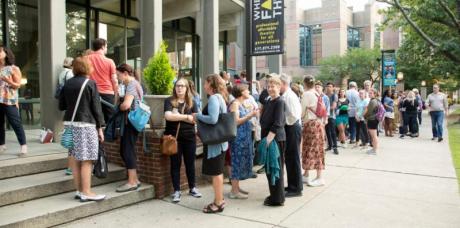
Clegg_Cheryl_Peoplegatheroutsidetheater3_364A4054

Starbucks is my favorite brand of coffee, but I won’t be buying it anymore.

I just learned that Starbucks supports the Washington Policy Center, a rightwing policy group in Washington State that supports right-to-work (for less) laws, opposes a $15-an-hour minimum wage, and supports charters and vouchers. Bear in mind that the Supreme Court of Washington State ruled that charter schools are not public schools and not entitled to public funding. The Washington Policy Center supports school privatization.

Its last event featured Nigel Farage, the British politician who led the movement for Britain to secede from the European Union, or Brexit.

WPC has invited Betsy DeVos as its keynote speaker at its annual dinner on October 13 in Bellevue. Her views on school privatization are the same as those of the Washington Policy Center.

Melissa Westbrook, community activist, contacted Starbucks for their response. The statement she received by Email confirmed that Starbucks sponsors the Washington Policy Center but had nothing to do with the choice of speaker. This is an irrelevant answer. Why is Starbucks supporting a rightwing policy center at all? Next year the speaker might be Scott Walker or Charles Koch.

Express your disappointment with this hashtag: #whyStarbucks. Or sign this petition.

Corporations that bill themselves as “progressive” should not support rightwing policy centers that promote school privatization.

Starbucks is free to support any cause it chooses, and I am free not to buy their coffee anymore.

Andy Borowitz writes humor for The New Yorker. Humor!!

He wrote here that DeVos insists Trump is no moron.

After all, he hired her.

And Rick Perry!

The more things change, the more they stay the same. Or worse.

The parents and citizens of Jackson, Mississippi, organized to save their public schoools from state takeover. They think that black people should have the same democratic rights as white people.

But the past is never really past.

The state stepped in to seize control and ousted the superintendent.

Fortuitously, Betsy DeVos just have Mississippi millions of dollars to open charter schools.

Sure looks like a conspiracy by mean-spirited whites people to disempower black people.

Are there educational geniuses at the State DepEtment of Education? No, they will bring in th white charter operators to take over, as they did in Tennessee. And failed.

Donna Ladd, a columnist in Jackson, Mississippi, says there is no question. It is a conspiracy.

http://www.jacksonfreepress.com/news/2017/sep/27/yep-jps-takeover-conspiracy-prove-me-wrong/

“The disrespect said it all, really. After the Mississippi Board of Education came back into the hearing room in the old Central High School, it not only declared an “emergency” in Jackson Public Schools, setting a “takeover” into motion, but it went a nasty step further.

“The board insulted the hard-working interim JPS superintendent, Freddrick Murray, who was present, by announcing that Dr. Margie Pulley would become the new superintendent. Huh. It’s one thing to argue, rightfully or wrongfully, that the State of Mississippi can run our largest urban district better than locals can. It’s another to take a spiteful swing at the administrator in the room who is trying to fix the problems. 


“That’s jackassery.

“But the State displayed that tone throughout the kangaroo court designed to wink-wink give the district a proper hearing. It claimed JPS hadn’t done enough to fix problems (that occurred under prior leadership) due to an audit that just came out Aug. 31, a couple weeks before, so they had to hurry before the fixes were in.

“It was the second such circus Jackson has faced in the past two years. The first was Rankin County white Republicans’ push to take over our airport because, you know, they want it—and its revenue potential.

“The predictability of all this takeover hoohaa isn’t lost on anyone who comprehends Mississippi’s history of racial dynamics, white flight and victim-blaming. The state has a long history of white folk running when too many people of color move too close and start owning and running stuff and enrolling kids in “our” schools.

“Don’t forget that Central High School, as well as others like Murrah, were jewels in the crown of white Jackson back before forced integration—in a time when white conservatives abundantly funded public schools and extracurricular activities with tax money for their own. But when the black kids came, suddenly they were bad ole “government schools,” as some old-time Central and Murrah grads call them now.

“The worst part fully hit me on a recent Delta road trip as I stood before the old Delta Democrat-Times offices in the once-thriving downtown Greenville, now across the street from a casino entrance with a whole lot more black people than white evident in the area near it. The old office where Hodding Carter Jr. won his Pulitzer for changing his segregationist views and challenging racists is abandoned with cracked windows and a historic marker.

“They flee and burn it all down behind them,” I told Todd angrily in the car. What I meant was the tragedy not just of so many white people rejecting a fully integrated life for their families, but how they then try to legislatively and politically ruin what’s left. They not only take their tax money, but they pass laws trying to keep public dollars from flowing to where they’re needed, including now-poor schools, and try to redirect it to institutions they control.

“It’s like they leave and never look back except to say (a) we don’t care how bad our actions make it and (b) if you manage to build it into something anyway, we’re going to come back and take it again, teeheehee.

“Now, if you don’t agree with that recounting of local history, feel free to start proving me wrong by staying put and investing time and resources in diverse communities rather than running to a cow pasture or a flood plain and trying to build your own white-run paradise. Until it gets too diverse, of course, and you load up the U-Haul to move further into rural Mississippi and start all over again, leaving dead malls and crumbling schools in your wake.”

When parents in Alachua County, Florida, heard that the for-profit chain Charter Schools USA was planning to move into their district, they organized to stop them. Led by Sue Legg, the education director of the state League of Women Voters, they created Parents Against Corporate Takeovers.

Good News! Charter Schools USA backed away and did not file its request. It may be back.

“Florida Charter Educational Foundation, backed by the for-profit Charter Schools USA, did not meet the Oct. 2 deadline to file an official application to open a charter school next academic year.

“A nonprofit organization did not file an official application to open a charter school in Alachua County by its Oct. 2 deadline after its draft proposal caused pushback among county residents.

“Florida Charter Educational Foundation, backed by the for-profit Charter Schools USA, submitted a draft application May 1 to open a 1,145-student charter school in southwest Alachua County in the 2018-2019 school year.

“Of Alachua County’s 14 charter schools, Micanopy Area Cooperative School has the most students this year, with 238 students.

“The draft led to a group of Alachua County residents forming a political action committee, Parents Against Corporate Takeovers, in July. It campaigned against Charter Schools USA, arguing that the charter school would deprive resources from the district’s traditional public schools without being held to the same standards as those schools.”

Parents, don’t let down your guard. Keep the corporate predators away.

Steven Singer writes here that Donald Trump is a very bad person. I think that is what bothers so many of us about him. Not just his boneheaded policies. Not just the terrible people that he puts in positions of responsibility. It is his lack of character. He is a mean, hardhearted man. He is selfish and amoral. He is a pretender. He has no heart. No soul. A very small brain (remember when he seemed surprised to learn that Frederick Douglass is not alive?). His upbringing must have been deficient. No one gets this mean without guidance.

Donald Trump is not just a bad President.

He’s a bad person.

No. That doesn’t go far enough.

He’s one of the worst people ever to hold public office in this country.

He’s a pathetic excuse for a person. A narcissistic and incurious fool.

Donald Trump is what happens when you spoil a child and he never has to prove his own worth.

He is the fruit of our worship of wealth and the ruling class. He is the lie of trickledown economics. He is what happens when you give someone all the rewards our society has to offer – just for showing up.

But he’s not a racist.

Not really. Not in the strictest sense. That would require some kind of commitment.

Nor is he a sexist. That would require ideology.

Trump doesn’t hate anyone. He doesn’t divide people up into categories. He just loves himself so much that his regard for anyone else seems lacking.

In Trumpland, there are only two personas – himself and everyone else.

But I don’t entirely agree with Singer. In my view, judging Trump by his words and actions, he is the textbook definition of a racist and a misogynist and a xenophobe. Remember when he mocked a reporter with a disability? That’s not just because of his narcissism. Maybe he is all of these hateful things because of his narcissism. But make no mistake: he has contempt for people who are not white, not male, not rich, not him.

Maybe someday we will look back on this era and laugh at our folly. How did this man become president? How would the Founding Fathers have anticipated such a low character? I recommend you read Federalist Paper #68, written by Alexander Hamilton, and you will see that the reason for the Electoral College was to create a mechanism to prevent the election of a person of low character who was a charlatan and a demagogue, especially one who owed his allegiance to the machinations of a hostile foreign power.

But now, it is hard to laugh at anything this fool does. People are suffering in Puerto Rico because of his indifference. Millions of people will lose health insurance because of him. Unions that provide protection for working people and a path to the middle class will be crushed because of him. We will suffer for many years because of his mean-spirited policies.

But we must not lose our sense of humor, because like all bullies, he can’t stand to be laughed at. Watch Saturday Night Live. Watch John Oliver. Watch Jimmy Kimmel.

Humor and art will be our sword and our shield against narcissism, stupidity, and meanness.

That, plus give as generously as you can to those individuals and groups that are fighting against his misguided rule and fighting to elect a House of Representatives in 2018 that will prevent him from funding and defunding what he chooses.

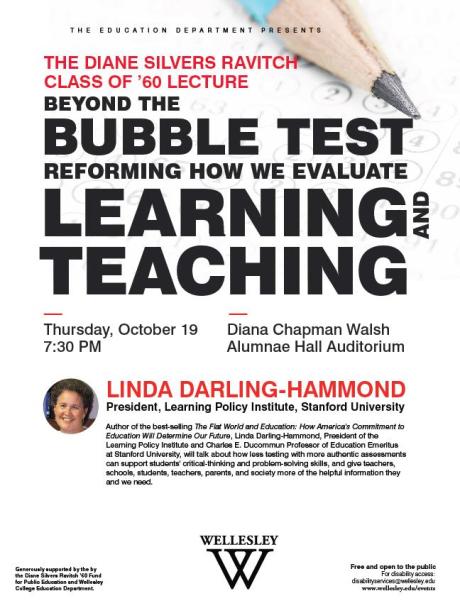
If you live within driving distance of Wellesley, Massachusetts, I hope you plan to attend Linda Darling-Hammond’s lecture on October 19.

I endowed an annual lecture series to bring the best thinking about education to the campus. The program will be live-streamed and available on videotape afterwards so it reaches the maximum number of people. So, if you live far from the Boston-Wellesley hub, you will have a chance to see and hear the lecture. Pasi Sahlberg gave the Ravitch lecture last year. With the collaboration of Professor Barbara Beatty of the Wellesley Department of Educarion, we will select the best thinkers in education each year.

This is my personal gift to my alma mater. My gift also includes funding for student research and internships.

After my death, there will be a Ravitch Professorship in the Department of Education devoted to Education and the Common Good.

For now, enjoy listening to one of the nation’s most thoughtful educators.

thumbnail

Jeff Bryant, writing for the Education Opportunity Network, analyzes the U.S. Department of Education’s recent award of $253 Million to the Failing Charter Industry. He is especially appalled by the funding of charters in New Mexico, whose state auditor has identified numerous frauds in the charter sector, and whose public schools are shamefully underfunded.

He writes:

“Previous targets for federal charter grants have resembled a “black hole” for taxpayer money with little tracking and accountability for how funds have been spent spent. In the past 26 years, the federal government has sent over $4 billion to charters, with the money often going to “ghost schools” that never opened or quickly failed.

“In 2015, charter skeptics denounced the stunning selection of Ohio for a $71 million federal chart grant, despite the state’s charter school program being one of the most reviled and ridiculed in the nation.

“This year’s list of state recipients raises eyebrows as well.

“One of the larger grants is going to Indiana, whose charter schools generally underperform the public schools in the state. Nearly half of the Hoosier state’s charters receive poor or failing grades, and the state recently closed one of its online charter schools after six straight years of failure.

“Another state recipient, Mississippi, won a federal grant that was curiously timed to coincide with the state’s decision, pending the governor’s approval, to take over the Jackson school district and likely hand control of the schools to a charter management group.”

(Coincidentally, Stephen Dyer just posted about Ohio’s scandal-plagued charter sector. He wrote that nearly one-third of the charters that received federal funding never opened or closed right after they got the money, I.e., they were “ghost schools.”)

Worst of all, writes Bryant, is the $22.5 Million that will be sent to New Mexico, which has high child poverty and perennially underfunded public schools, as well as a low-performing charter sector.

What possible reason is there to fund a parallel school system when the state refuses to fund its public schools?

“According to a state-based child advocacy group, per-pupil spending in the state is 7 percent lower in 2017 than it was in 2008. New Mexico is also “one of 19 states” that cut general aid for schools in 2017, with spending falling 1.7 percent. “Only seven states made deeper cuts than New Mexico.”

“New Mexico’s school funding situation has grown so dire, bond rating agency Moody’s Investors Service recently reduced the credit outlook for two-thirds of the school districts in the state, and parent and advocacy groups have sued the state for failing to meet constitutional obligations to provide education opportunities to all students.

“To fill a deficit gap in the state’s most recent budget, Republican Governor Susana Martinez tapped $46 million in local school district reserves while rejecting any proposed tax increases.

“Given the state’s grim education funding situation, it would seem foolhardy to ramp up a parallel system of charter schools that further stretches education dollars, but New Mexico has doubled-down on the charter money drain by tilting spending advantages to the sector.”

To make matters worse, charter schools are funded at a higher level than public schools, and the state’s three online charters operate for profit. Despite their funding advantage, the charters do not perform as well as public schools. There is seldom any penalty for failure.

The state auditor in New Mexico has called attention to frauds and scams that result from lack of oversight in the charter industry.

So the U.S. Department of Education under Betsy DeVos is now in the business of funding failure. Quality doesn’t matter. Ethics don’t matter. Undermining the educational opportunity of the majority of children doesn’t matter. For sure, money matters, but only when it is spent for privatization.

A few pundits predicted that DeVos would be unable to inflict harm on the nation’s public schools. They were wrong.

The New Yorker broke a story about how Ivanka and Don Jr. managed to avoid a criminal indictment. The very next day, the New York Post (owned by Rupert Murdoch) published an article “by” Ivanka offering advopice about the importance of technology in education. It seems that advocacy for ed tech is now part of her portfolio, as Middle East peace is a small part of husband Jared’s portfolio. The article was banal; the comments on it are hilarious.

The backstory: The New Yorker published a blockbuster revelation of a curious episode in the checkered history of the Trump family.

In 2012, Ivanka Trump and Donald Trump Jr. were under investigation by the Manhattan District Attorney’s Office for inflating the sales at the Trump Organization’s new Trump Soho condo-hotel. Sales were going poorlyand apparently they claimed that the condos were selling fast. In New York, that is not Legal. Trump senior’s personal lawyer Marc Kasowitz made a $25,000 campaign contribution to the District Attorney Cyrus Vance. Kasowitz had a private meeting with Vance. The investigation was closed. Vance returned the money.

“Ultimately, Vance overruled his own prosecutors. Three months after the meeting, he told them to drop the case. Kasowitz subsequently boasted to colleagues about representing the Trump children, according to two people. He said that the case was “really dangerous,” one person said, and that it was “amazing I got them off.” (Kasowitz denied making such a statement.)

“Vance defended his decision. “I did not at the time believe beyond a reasonable doubt that a crime had been committed,” he told us. “I had to make a call and I made the call, and I think I made the right call.”
Just before the 2012 meeting, Vance’s campaign had returned Kasowitz’s twenty-five-thousand-dollar contribution, in keeping with what Vance describes as standard practice when a donor has a case before his office. Kasowitz “had no influence, and his contributions had no influence whatsoever on my decision-making in the case,” Vance said.

“But, less than six months after the D.A.’s office dropped the case, Kasowitz made an even larger donation to Vance’s campaign, and helped raise more from others—eventually, a total of more than fifty thousand dollars. After being asked about these donations as part of the reporting for this article—more than four years after the fact—Vance said he now plans to give back Kasowitz’s second contribution, too. “I don’t want the money to be a millstone around anybody’s neck, including the office’s,” he said.

“Kasowitz told us that his donations to Vance were unrelated to the case. “I donated to Cy Vance’s campaign because I was and remain extremely impressed by him as a person of impeccable integrity, as a brilliant lawyer and as a public servant with creative ideas and tremendous ability,” Kasowitz wrote in an e-mailed statement. “I have never made a contribution to anyone’s campaign, including Cy Vance’s, as a ‘quid-pro-quo’ for anything.”

“Last year, the Times reported the existence of the criminal investigation into the Trump SoHo project. But the prosecutor’s focus on Ivanka and Donald, Jr., and the e-mail evidence against them, as well as Kasowitz’s involvement, and Vance’s decision to overrule his prosecutors, had not previously been made public. This account is based on interviews with twenty sources familiar with the investigation, court records, and other public documents. We were not able to review copies of the e-mails that were the focal point of the inquiry. We are relying on the accounts of multiple individuals who have seen them.”

Grifters.

Professor Ellie Bruecker of the University of Wisconsin at Madison completed a study of the fiscal impact of the statewide school vouchers in Wisconsin. It was published by the National Education Policy Center.

Here is the executive summary:

“Executive Summary

“In 1989, Wisconsin created the Milwaukee Parental Choice Program (MPCP), the nation’s first publicly funded private school voucher program. Over the next two decades, the Milwaukee program was steadily expanded, but remained the sole voucher program in the state. In 2011, Wisconsin added a voucher program in Racine (RPCP), and in 2013 it created the statewide Wisconsin Parental Choice Program (WPCP). Initially the statewide program was limited to 500 students and 25 schools in its first year and 1,000 students and 50 schools in its second. In 2015, the state legislature lifted the cap on participating schools and students, but limited student participation to a percentage of district enrollment—currently 2% for the 2017-18 school year. The cap will gradually increase by 1% each year until it is eliminated in 2026. Wisconsin Act 55 (2015) additionally amended the funding of the WPCP.

“Previously funding had been provided by a state general purpose revenue allocation; Act 55 generates voucher funding for incoming students by deducting the cost of a student’s voucher from the state aid allocated to the school district in which a student resides.

“As a result, the program now shifts millions of dollars from public school districts to private schools. The fiscal impact of the statewide voucher program, however, is not evenly distributed across Wisconsin’s public schools.

“This policy memo describes how the statewide Wisconsin Parental Choice Program alters the relative share of public education spending borne by the state and by local districts and estimates the differential fiscal impact of the program on Wisconsin school districts. The analysis finds that school districts could lose a substantial portion of their state aid as participation in the voucher program grows, and that small districts would be the most negatively affected.

“Currently, participation rates in the statewide program are low and students in some districts lack access to voucher schools. Nevertheless, this analysis finds that the majority of students currently eligible to participate in the program live within range of a voucher school and that, even given low participation rates, the program will have a significant effect on the fiscal support the state provides to local school districts. As more states enact or expand their voucher programs, the case of Wisconsin demonstrates that one-size-fits-all statewide programs have the potential to exacerbate funding disparities in the public system.”

You can read the report here .