Archives for category: Education Reform

Theresa Hanafin writes a feature each morning in the Boston Globe called “Fast Forward.” It summarizes the latest news and weather. She often starts with a story from the Old Farmers’ Almanac. Today’s anecdote: an editor of the San Francisco Examiner wrote a young Rudyard Kipling in 1889 to tell him that he didn’t know how to use the English language.

And here’s another joke:

While you were sleeping: Trump sarcastically joked about Russia’s attempts to undermine our democracy just before he and Putin were set to meet privately at the G-20 summit in Osaka. At a press conference before the meeting, a reporter asked Trump if he was going to warn Putin not to meddle in American elections again. “Yes, of course I will,” he replied. He then turned toward Putin with a smirk on his face and said, “Don’t meddle in the election, president. Don’t meddle in the election.” Putin smiled.

Why must our president be do obsequious to Putin?

Since 1987, The Concord Review (TCR) has sought and published more than 1,300 history research papers by high school
students from 41 countries in 121 quarterly issues. TCR.org. 

Over the course of these many years, Will Fitzhugh, the founder of TCR, has been turned down by every foundation while seeking funding for this worthy endeavor. In their drive for innovation, the nation’s philanthropies did not find merit in the idea of acknowledging the dedication of students who conduct primary historical research and who are recognized by having their work published.

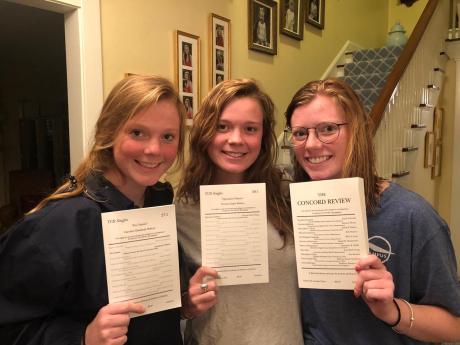
In different years,, three sisters from  Cincinnati, Ohio, won the journal’s highest honor: the Emerson Prize.

The girls attended Summit Country Day School.

Winners of the Emerson Prize: (left to right):
Caroline Elizabeth Walton, The Tudors, Volume 27, Number 1 {18,000 words)
Victoria Claire Walton, Operation Valkyrie, Volume 29, Number 1 (15,000 words)
Emily K. Walton, Mary Queen of Scots, Volume 24, Number 3 (13,200 words)

thumbnail


Fitzhugh wants high school students to read history, not textbooks, but actual history. He wants them to do research and write in-depth history essays. He publishes the best of them in TCR.

In addition, he offers these services:

TCR SERVICES
High School students planning to go to college should know that they will face reading lists of nonfiction books and be asked to write research papers. The vast majority of American public high school students are not asked to read a single complete nonfiction book or to write a term paper before graduation. But they suspect that the safe spaces of fiction readings and personal writing will not prepare them well enough for college. In many cases their teachers have neither the inclination nor the time to help them with History research papers, and while some students, such as many of those published in The Concord Review since 1987, have set up Independent Study programs which let them write such papers, others may want to make use of the services we offer to serious secondary students of History:
One: The National Writing Board [1998] provides a unique independent assessment service for the History research papers of high school students. Our reports by two Senior Readers now average five pages and may be sent to college admissions officers. Inquire at tcr.org/nwb.
Two: The TCR Summer Program [2014] offers a two-week course on the writing of serious History papers by secondary students, with three sessions in the United States, and one in Korea, in 2019. Contact: steven.lee@tcr.org (Manager of the TCR Summer Program). tcr.org/summer.
Three: The TCR Academic Coaching Service [2014] matches high school students working on a History research paper online with TCR Authors now at or recently graduated from Chicago, Columbia, Harvard, MIT, Princeton, Stanford and Yale. Personal advice and guidance from a successful older peer (many are Emerson Prize winners) can be inspiring and productive for secondary students struggling with serious term papers. Contact Jessica@tcr.org (Manager of the TCR Academic Coaches). tcr.org/coaches.
Four: The Concord Review [1987] can provide students with a fine variety of examples from the History research papers published by >1,300 high school students from 45 states and 40 other countries in 121 issues since 1987. This journal remains the only quarterly in the world for the academic History research papers of secondary students. These papers have served many students as useful models of research and writing to inspire and guide them in their own reading, research and writing. Find many examples at tcr.org/bookstore.


Open this link to discover the big surprise that Steven Singer’s students gave him on the last day of school.

It defines the term “psychic income.”

it explains the rewards that teachers may get that are never never never available to lawyers, hedge fund managers, even billionaires. Eli Broad will never win this prize. No member of the Walton Family will ever receive what Steven got from his eighth grade students on the last day of school.


This is a story about a high school in Missouri that should have been on the U.S. News list of the best high schools in America. The teachers are dedicated. Many of the kids are beating the odds against them. They are hard-working. They have grit and perseverance. They will make great contributions to society.

Ray Hartmann of the Riverfront Times tells an inspiring story of students, teachers, and administrators at Normandy High School who are succeeding despite the mainstream narrative that writes them off.

Ninety-seven percent of its students are black, and a stunning 92 percent of the 3,100 kids residing in the district’s 23 municipalities are poor enough to qualify for free and reduced student lunches. The median household income in the district is $30,100, and the median home value is $69,700.

Perhaps even more daunting…the district has a 40 percent “mobility rate.” That means, unlike your Claytons and Ladues, nearly half of the kids in the district are either homeless or moving between homes in the school year.

Many people look at these numbers, writes Hartmann, and think “failing school.” But when he visited, he saw a different story.

He saw teachers who care about students, and students who are proud of their school.

He attended graduation ceremonies and wrote about two students.

Meet Kayvion Calvert, one of the privileged few. Thanks to his own initiative — and to the fact that he went to a high school that cared about him and afforded him the chance to make the most of his abilities — Kayvion is off to Alabama A&M University to major in political science and minor in secondary education, with a résumé that’s almost ridiculously impressive.

He was class president as a senior, serving all four years in student government. He was also a four-year member of the school choir, a passion he pursued while singing in both the choir at his church and another one in the community, as well as acting in drama club productions.

Obviously, Kayvion Calvert is not your average kid. And, admittedly, maybe it helped that he didn’t come from just any public school district.

Then there’s Gabrielle Brown, Kayvion’s classmate. She was class valedictorian, with a GPA of 3.96. But, in fairness, she too was a bit privileged: Not only did her high school launch her to a college scholarship in computer science at the University of Missouri-St. Louis, but it provided an opportunity to supplement her high school studies in an associate degree program at St. Louis Community College-Florissant Valley.

So, in addition to graduating as class valedictorian, Gabrielle is already a member of the Phi Theta Kappa college honor society, which honors students at two-year colleges. She was also a member of the high school band. And she had an internship at Centene.

You could forgive Gabrielle if she were a little boastful about all this. But she’s not, deflecting credit to the fact that she was one of the fortunate ones who attended a high school that, in an email, she termed “a critical factor” in her success.

“At my school, you establish so many connections and develop so many relationships, you meet people from so many diverse backgrounds it’s honestly astonishing,” she wrote. “The people you meet don’t just fade out of your life, either. They are present and encourage you [to] continue on your road of success.

“When I was little, going to my elementary school as a child, they had programs to help children succeed. Whether the child was advanced or a little behind, they are capable of supporting children on a more personal level and really connect with them. They influenced me to become the person I am today, and I intend to continue giving back.”

That’s not your everyday loyalty from a high school student. But kids like Gabrielle and Kayvion didn’t go to your everyday privileged high school.

No, they graduated from Normandy. Yes, the same Normandy Schools Collaborative often presented as the symbol of all that’s wrong with public education in St. Louis and the nation.

Why isn’t this heroic school on the U.S. News list as one of the best high schools in the nation, instead of all those public schools in affluent neighborhoods and charter schools that cherrypick their students?


Ed Johnson lives in Atlanta and fights daily against the malignant competition and punishment inflicted on the children of Atlanta by the school board and superintendent. He shares the philosophy of W. Edwards Deming, who taught the importance of collaboration and teamwork.

He wrote this post and sent it to the school board:


Cyberattacks and competition
I have been under cyberattack for nearly a year, now.
First, it was attempted blackmail to “expose” me by making public an old username and password I used once to visit an “unsavory” website some 25 years ago.  I hear this blackmail tactic is quite common, and successful.
 
Well, blackmail didn’t work on me, so then came invading my computer and encrypting all personal files and holding the encrypted files hostage pending my paying the one bitcoin (~680 USD) ransom demand before I would be given the decryption key.
 
Well, holding my personal files hostage for ransom didn’t work on me, so then on 18 Dec 2018, there suddenly came a great flood of email notifications from subscription and online services all over the globe thanking me for having signed up.  Fraudulent signups continue to occur at the rate of around six or so per day.  The aim of the bountiful fraudulent signups seems to be the gamble that, in the fog of hurriedly unsubscribing the many services, one is bound to click on a Trojan Horse disguised as an “Unsubscribe” link.
 
Well, fraudulent subscriptions haven’t worked on me, so two days ago, this happened: My receiving notifications of Diane Ravitch blog posts had been blocked at wordpress.com, for crying out loud!
 
For the first time, I felt panicky.  No Diane Ravitch blog posts?!!  No, that can’t be!
 
But in the end that didn’t work on me, either.  Not for long, anyway.
 
So I remain a happy camper.
 
Even so, I guess we will always have some folk who have been taught and deeply conditioned to compete “by any means necessary” to win at the expense of others.
 
Atlanta Public Schools Leadership (APSL; school board and superintendent) are pretty good at teaching and conditioning people, even young children, to win at the expense of others, when winning and losing is not at all necessary, as with their Race2Read competition, for example.
 
Just think, the many children innocently and trustingly pour themselves into reading, wanting to do their best, to be helpful, to contribute, only to have the APSL adults turn on them and declare ten reading winner kids (“Top Student Readers”) and to tell the thousands of other children they are the reading loser kids, even if that is not the reality, at all.  Because they show they utterly fail to understand variation, the APSL adults create reading winners and reading losers out of the children, arbitrarily and capriciously, and ignorantly.
 
The currently serving APSL have always shown that everybody cooperating to achieve a common goal is an extremely foreign concept to them.  As their Race2Read competition exemplifies, the APSL would rather have children, students, schools, parents and community members, and even school bus drivers, competing than cooperating and collaborating.
 
How unfortunate, here in the twenty-first century, some among the APSL keep practicing the regressive belief that competition motivates people and boosts morale and improves quality, as does, for example, school board member Cynthia Briscoe Brown opining in a school board meeting here (at 1:22:30 thru 1:24:56) that the new “Elite Bus Driver” program is a way of “boosting morale” among school bus drivers.
 
Now, tell me, what parents would want an inferior, second-rate school bus driver at the wheel of the school bus transporting their children?  Or an inferior, second-rate mechanic having worked on the school bus?  What might parents think or do if they knew the majority of both school bus drivers and school bus mechanics have been told, and have come to believe, they are the inferior, second-rate ones?
 
Intentions hold no water, here.  Again, we are in the twenty-first century and the APSL should be progressing into it, not regressing back out of it, by way of behaviorism and Taylorism.
 
One dimension along which the APSL should have already progressed further into this century is that of recognizing the unethical and immoral nature of arbitrary and capricious competition—such as the Race2Read competition and the Elite Bus Driver program—and simply not do it.
 
So, how many children made Race2Read competition losers will grow up to transfer, unconsciously, their learned reading loser position in life into a selfish coding and hacking practice of “winning” by cyberattacking others?
 
What?  Did someone just say such a matter can’t be measured so therefore can’t happen?
 
Really?

 
Ed Johnson
Advocate for Quality in Public Education
Atlanta GA | (404) 505-8176 | edwjohnson@aol.com


Andy Spears explains how the Tennessee Legislature came to pass vouchers, after rejecting them multiple times. 

There was a popular new governor promoting an unpopular idea. And there was money. DeVos money. Dark Money. Lots of it. And aides to Governor Bill Lee who had previously worked for DeVos’s American Federation for Children (and Vouchers).

Now there’s an FBI investigation of the deal that went down to get this bill passed.

Good grief, if the FBI investigates every rigged vote for vouchers, bypassing voters, they will have no time to investigate major crimes.

Ed Johnson of Atlanta offers his reading list, to add to mine:


In addition to the titles Diane Ravitch lists, below, include these:


Andrea Gabor, After the Education Wars: How Smart Schools Upend the Business of Reform


Caitlin Rosenthal, Accounting for Slavery: Masters and Management


Cathy O’Neal, Weapons of Math Destruction: How Big Data Increases Inequality and Threatens Democracy


Diane Ravitch, Reign of Error: The Hoax of the Privatization Movement and the Danger to America’s Public Schools


Shani Robinson and Anna Simonton, None of the Above: The Untold Story of the Atlanta Public Schools Cheating Scandal, Corporate Greed, and the Criminalization of Educators


Happy summer reading!

My List of Books for Summer Reading

The biggest battle in the fight against privatization has been to persuade the Democratic Party that it had been hoaxed by Republicans into adopting the Republican agenda. According to this article in The Washington Post, Democratic support for charter schools has evaporated, at least among the candidates.

The title of the article is “Democrats abandon charter schools as ‘reform’ agenda falls from favor.” No one has more egg on their faces than the editorial board of the Washington Post, which loves charter schools and defends them at every turn.

Until 1993, Democrats supported equity and federal funding for public schools, while Republicans supported choice, testing, competition, and accountability.

Then Bill Clinton embraced charter schools, testing, standards, and accountability. Then came NCLB and it was endorsed by Ted Kennedy and the entire Democratic Party.

Then the Obama Race to the Top gave total support to the Bush NCLB approach of charters, testing, and harsh accountability, and Arne Duncan spent seven years parroting the Republican line that the best way to improve schools was to get tough on teachers, make tests harder, and open more charter schools.

According to the Washington Post, the Democratic love affair with charters is over. 

The steady drumbeat of scandals and the vivid advocacy of Betsy DeVos have killed the Democrats’ charter love. 

Suddenly, the Democratic candidates for president  seem to have realized that school choice is a Republican issue. Supporting the public schools that nearly 90% of all students attend is a Democratic issue.

This is awkward for Democrats like Governor Jared Polis of Governor and Senator Michael Bennett of Colorado and Senator Cory Booker of New Jersey, and Governor Andrew Cuomo of New York, all fans of charters.

Democrats have long backed charter schools as a politically safe way to give kids at low-performing schools more options. Many supported merit pay for the best teachers and holding schools accountable for test scores.

The presidential contest is proof that’s no longer the case.

If the candidates say anything about charter schools, it’s negative. Education initiatives boosted by the Bush and Obama administrations are nowhere to be found in candidate platforms.

Instead, the Democratic candidates are pitching billions of dollars in new federal spending for schools and higher pay for teachers, with few of the strings attached that marked the Obama-era approach to education.

It adds up to a sea change in Democratic thinking on education, back to a more traditional Democratic approach emphasizing funding for education and support for teachers and local schools. Mostly gone is the assumption that teachers and schools are not doing enough to serve low-performing children and that government must tighten requirements and impose consequences if results do not improve.

As a senator, Joe Biden said private school vouchers might help improve public schools. As vice president, he was atop an administration that made support for charter schools a requirement to access federal grant funding. But when asked about charters — privately run, publicly funded schools — during a recent forum with the American Federation of Teachers, Biden sounded a negative note.

“The bottom line is it siphons off money for our public schools, which are already in enough trouble,” he said….

Bernie Sanders thus far is the only candidate to call for an end to federal funding of charter schools. The safe position for Democrats is to oppose “for-profit” charters, while ignoring the fact that many “nonprofit charters” are operated by for-profit management corporations.

The story continues:

It’s an unsettling development for advocates of the structural changes that have fallen out of favor, and a sharp turn from where many Democrats were just a few years ago. Former presidents George W. Bush and Barack Obama had pushed a bipartisan drive for accountability, and charter schools were the answer for Democrats who opposed private school vouchers but wanted to offer other options to children — often children of color from low-income families — assigned to low-performing schools. They were important to some civil rights leaders and became a central plank in the drive for school accountability….

The American Federation of Teachers has been hosting candidate forums throughout the country, inviting contenders to spend a day with teachers and then answering questions town hall-style.

At the town hall with Biden last month, AFT President Randi Weingarten was so warm and complimentary that it left some with the impression she was laying the groundwork for an endorsement.

“Vice President Joe Biden was our north star in the last administration,” she said. “We didn’t always get along with the Obama administration positions on education, but we had a go-to guy who always listened to us.” She added: “He’s with us because he is us.”

During the Obama administration, the National Education Association was so angry it called forEducation Secretary Arne Duncan to resign, and the other big teachers union, the AFT, came close…

The shift underway has Democrats who support charter schools and related policies nervous. Democrats for Education Reform is circulating results of a poll that show support for charter schools is higher among African American Democrats than whites. But overall, the poll found just 37 percent of Democratic primary voters have a favorable view of charters.

Some like-minded Democrats are working on something they call the Kids New Deal, hoping to find a candidate to support it. The centerpiece of the proposal is to make children a “protected class” under the law, which would make it easier for them to file lawsuits challenging, for instance, tenure for teachers, on the grounds that it hurts children.

“The goal here is to outflank the teachers unions from the left and not from the right,” said Ben Austin, a longtime education restructuring advocate.

DFER is the hedge fund managers group created to persuade Democrats to act like Republicans and support privatization. It offered big money for candidates who swallowed their line. DFER was condemned by the state Democratic Party in both California and Colorado as a front for Wall Street and corporate interests.

 Ben Austin is one of California’s most aggressive charter school proponents, having run the faux Parent Revolution, whose goal was to convert public schools to charter schools. He spent millions of dollars from Gates, Waltons, and other billionaires, but converted only one or two public schools. If he is behind the “Kids New Deal,”’it is probably another billionaire-funded privatization vehicle.

The great news in this article is that those who have warned Democrats to return to their roots and stop acting like Republicans have won the debate.
In no particular order.

These are books I enjoyed and learned from.

Anand Giridharadas, Winners Take All: The Elite Charade of Changing the World

Rucker Johnson, Children of the Dream: Why Integration Works

Noliwe Rooks, Cutting School:  Privatization,  Segregation, and the End of Public Education
Richard Rothstein, The Color of Law: A Forgotten History of How Our Government Segregated America 
Gordon Lafer, The One Percent Solution: How Corporations Are Remaking America One State at a Time
Nancy McLean, Democracy in Chains: The Deep History of the Radical Right’s Stealth Plan for America
Daniel Koretz, The Testing Charade: Pretending to Make Schools Better
Yong Zhao, What Works May Hurt—Side Effects in Education
Pasi Sahlberg and William Doyle, Let the Children Play: How More Play Will Save Our Schools and Help Children Thrive
Eve Ewing, Ghosts in the Schoolyard: Racism and School Closings on Chicago’s South Side
Sent from my iPad


I saw this item first as a Tweet, retweeted by Trump himself.

It reminded me of my first visit to the Soviet Union, back in the 1980s.

One of the high points was a viewing of Lenin’s Tomb.

His body was in a glass casket.

The young man showing us around said in a low voice that he had so much was in him that if they put a wick on his head and lit it, he would burn forever.

A candle!