There’s a crucial election on June 25 in Colorado for an open seat on the state school board.
Carol Burris, executive director of the Network for Public Education, gives her personal endorsement to Kathy Gebhardt. She has worked with Kathy and knows that she has the experience to be an excellent member of the state school board. Her opponent has no qualifications for the seat other than having worked for the charter lobby. Less than 20% of the children in the state attend charter schools but the charter lobby wants to control education policy for the all students, especially so they can keep on expanding the charter sector and opposing accountability and transparency for charters (while insisting on accountability and transparency for public schools).
Burris writes:
The Colorado charter lobby is worried. It may be about to lose its rubber stamp through its majority on the state board. That is because Kathy Gebhardt is running for the Colorado State Board of Education. No one is more qualified to serve. Kathy is an education attorney with expertise in school finance, a long-time school board member, and has served on both state and national school board organizations. All five of her children attended public schools.
I met Kathy when we worked together on the National Education Policy Center’s Schools of Opportunity Project, which honored public high schools that did an outstanding job providing students with excellent and equitable opportunities. Kathy is a smart, serious professional with a kind heart who cares deeply about all children.
From her well of kindness and devotion to equity, she took a courageous stand. As a School Board member, she joined the majority decision to deny an Ascent Classical charter school connected with the Hillsdale College Barney Charter School initiative from opening in her district. The poorly prepared application from Ascent sought waivers from nearly all district requirements, including protections against discrimination based on LGBTQ status and disabilities.
The charter school lobby, like the NRA, is known for its staunch opposition to reforms and regulations. It is not above using NRA tactics to put down challenges to protect its privilege. The lobby and its billionaire supporters view every reasonable denial of a charter school as an attack. This is why Kathy was perceived as a threat despite her track record of supporting high-quality, truly public charter schools that cater to unmet community needs.
In this Forbes article, Peter Greene explains how they put forth an unqualified candidate, a consultant who worked for the Waltons and whose clients include Jeb Bush’s Chiefs for Change, the National Alliance of Charter Schools, and PIE, a network of “reform” organizations.
When the unqualified Marisol Rodriguez jumped in the race at the last minute, dark money flooded the race. Negative ads against Kathy making ridiculous accusations started flooding mailboxes.
Kathy needs your help. Voting has begun by mail and will continue until June 25. She also needs funds to help get her message out and reply to the barrage of dark money-funded deception. Please give here up to the personal legal limit of $450 if you can. And if you know anyone who lives in Congressional District 2 (Joe Neguse’s district), tell them to vote for Kathy Gebhardt for State School Board.
Jon Valant and Nicolas Zerbino of the prestigious nonpartisan Brookings Institution examined the Arizona voucher program and were surprised to find that it was a giveaway to the richest families in the state.
Voucher advocates did not like their findings and tried to discredit their analysis.
In May, we released a short Brookings report showing which families are most likely to get voucher funding through Arizona’s now-universal Empowerment Scholarship Account (ESA) program. The analysis isn’t complicated, and the results couldn’t be much clearer. A highly disproportionate share of Arizona’s ESA recipients come from the state’s wealthiest and most educated areas. That’s an important finding, even beyond Arizona, since this program is at the forefront of a wave of universal voucher initiatives that’s currently sweeping across red states (and some purple states). What happens with Arizona’s program could foreshadow what’s to come in many parts of the country.
These universal (or near-universal) programs are much more threatening to public education systems than the smaller, more targeted voucher programs that preceded them. They raise concerns about fundamental issues such as civil rights protections and the separation of church and state. Early research and reporting points to ballooning state budgets, wasteful spending, and tuition increases from opportunistic private schools. Meanwhile, hardly anything in the academic literature suggests that universal ESA programs will improve student performance. And yet, the push to remake the U.S. education system in the form of universal school voucher programs continues.
Having entered the fray with our own analysis of a universal ESA program, we’ve gotten a close look at the information environment surrounding these recent initiatives. Suffice to say, it isn’t healthy, at least if we hope for a functional policymaking process. A network of pro-voucher interest groups, think tanks, funders, and politicians are filling an information vacuum with misleading data, faulty or disingenuous arguments, and advocacy that masquerades as research.
Here, we’ll respond to four critiques we’ve heard from that crowd. Part of our goal is to show why their specific critiques of our work are baseless, misleading, or just kind of odd. In doing so, we also hope to illuminate how dangerous the information environment surrounding universal ESAs has become now that many state leaders are dragging their education systems into uncharted territory based on little more than ideology, political calculation, and a fingers-crossed hope that the voucher advocates aren’t leading them astray.
Here are the critiques:
Critique 1: We got our analysis wrong because someone else found something different
Our main results are probably best summarized by Figure 1, below, which appeared in our original post.
FIGURE 1
The Arizona ZCTAs (ZIP codes, basically) with the lowest poverty rates have the highest share of school-age children who received an ESA. The ZCTAs with the highest poverty rates have the lowest rates of ESA take-up. It’s an extremely straightforward analysis, and we provide a detailed description of what we did in the piece.
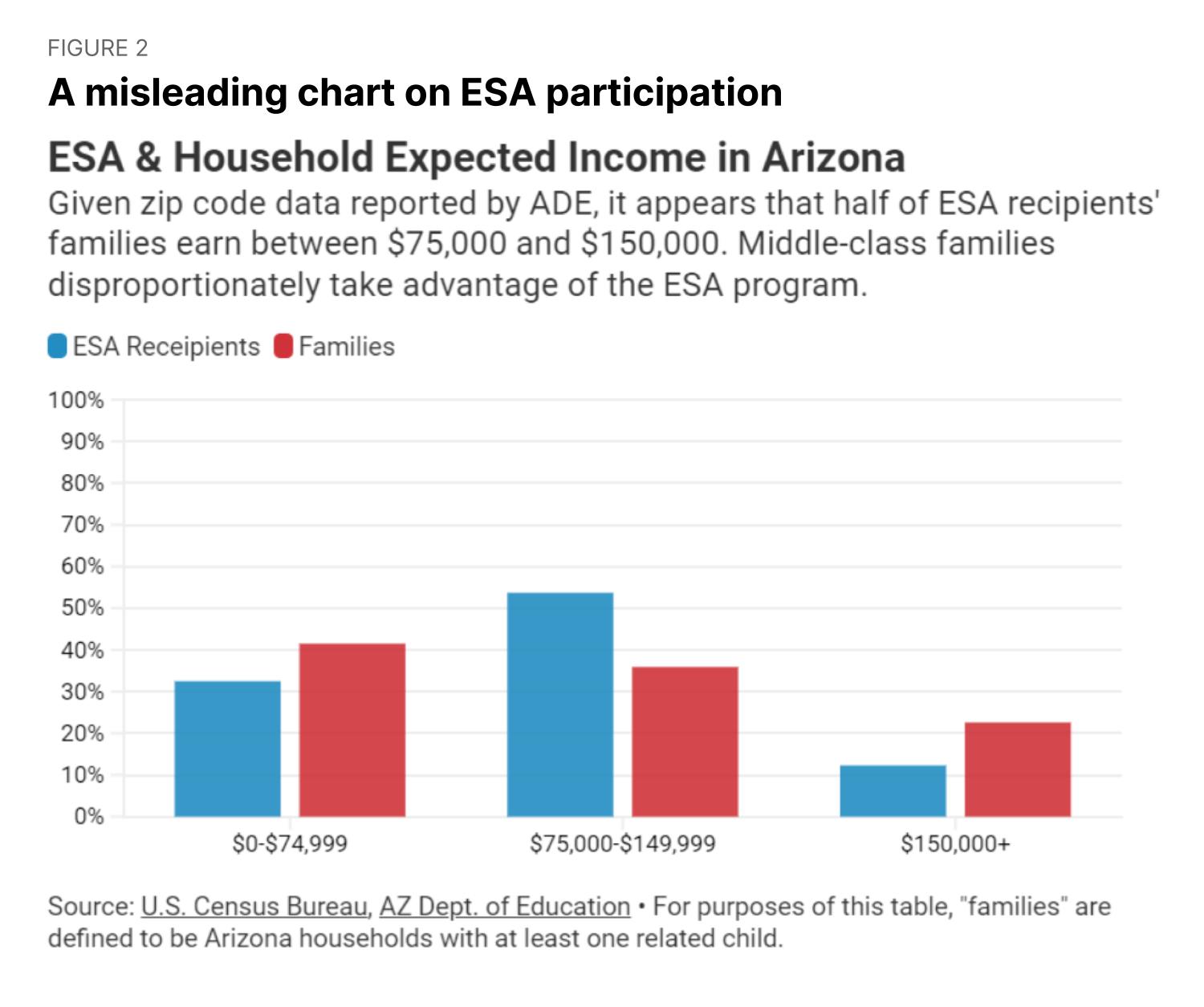
Before we published our post, an organization called the Common Sense Institute (CSI) of Arizona—a “non-partisan research organization” with several staff members from former governor Doug Ducey’s administration—looked into a similar question. CSI’s chart, below, tells a completely different story from our chart.
CSI makes it look like relatively few wealthy families in Arizona get ESAs. So, why the discrepancy?
It’s because CSI presented an apples-to-oranges comparison that’s bound to tell that story. The data issue is subtle, but they present ZIP code-level data for ESA recipients (blue bars, on the left) and household-level data for families (red bars, on the right). Many households in Arizona make $150,000 or more, so the far-right, red bar is quite tall. However, few ZIP codes have enough households earning more than $150,000 that the median household income rises above that threshold. As a result, many ESA recipients who earn more than $150,000 aren’t included in the $150,000+ category in this chart. Instead, these households—which earn more than $150,000 themselves but live in ZIP codes where the median income is below $150,000—are included in one of the other blue bars.
Maybe that’s an innocent mistake, but it’s certainly not an accurate representation of which Arizona residents are getting ESAs.
Critique 2: We didn’t place Arizona’s ESA program in the proper context of its other school choice programs
Education Next published an article from Jason Bedrick of the Heritage Foundation that accuses us of omitting key context that, if presented, would markedly change the takeaways from our analysis. Bedrick points out that Arizona’s universal ESA program exists alongside several tax-credit scholarship programs (true) and that families are prohibited from participating in the ESA and tax-credit scholarships simultaneously (also true). He then shares a few numbers, does some hand-waving, and concludes that our “fatally flawed” analysis is deeply misleading because of this omission.
Curiously, Bedrick doesn’t show the relative size of the ESA and tax-credit scholarship programs in Arizona. Here’s the obvious chart to illustrate that comparison—one that EdNext maybe could have requested before publishing yet another round of Heritage Foundation talking points on ESAs:
FIGURE 3
These tax-credit scholarship (TCS) programs are small relative to a large-and-growing universal ESA program that’s projected to exceed $900 million this year. On top of that, most TCS dollars are going to recipients above 185% of the federal poverty level—the threshold for reduced-price lunch eligibility. (One note: the most recent numbers available for the ESA program come from FY24, while the most recent numbers available for TCS programs come from FY23.)
In other words, this critique—which really isn’t about the universal ESA program we analyzed in the first place—doesn’t even point to context that meaningfully changes the interpretation of our data.
It’s important to emphasize, too, that our analysis was primarily about the high-income households that are obtaining a disproportionate share of Arizona’s ESAs. In that post, we tried to present data in the most straightforward, defensible way possible. If our goal had been to present the most damning data possible, there’s more we’d have said.
Here’s a doozy of an example. According to U.S. Census Bureau data, Arizona has 300 ZCTAs with at least 250 children under age 18. (The other 60 ZCTAs are smaller, which makes them difficult to analyze.) Of those 300 ZCTAs, the one with the single-highest take-up rate for ESAs (236 of every 1,000 children) is the one with the single-highest median household income (about $173,000).
Critique 3: Arizona’s ESA program is too new to assess who will participate
Maybe the most peculiar response we’ve seen is from Mike McShane of EdChoice, who published an op-ed in Forbes.
McShane appeals to Everett M. Rogers’ “diffusion of innovation” theory, which suggests that new technologies and ideas are adopted sequentially by different groups (from early adopters to laggards). McShane asserts that we should expect wealthier and more educated families to be the early adopters of a universal ESA program. He implores us to “think of the first people to own a personal computer, or a cell phone. They started with tech nerds and the wealthy, and eventually worked their way to everyone else.”
Let’s play a game of “one of these things is not like the others” with personal computers, cell phones, and a universal ESA program. Yes, we’d expect wealthier families to be the first to buy computers and cell phones. Those things cost a lot of money. A universal ESA program gives you money. We might expect poorer families—with fewer resources and potentially worse public-school options—to jump first at that opportunity. Even the usual dynamic of uneven information diffusion is complicated in this context, as the ESA program was available to families with children in low-rated schools long before it became universal.
Regardless, there’s reason for concern that vouchers will be more exclusively adopted by the wealthy over time. Jason Fontana and Jennifer Jennings studied the early implementation of a universal ESA account in Iowa. They found that private schools responded to ESA eligibility by increasing their tuition. If this response continues to play out, we might see desirable private schools becoming unaffordable to low-income families that cannot cover a growing gap between the value of their voucher and cost of enrollment. In the long term, this creates a risk of extreme stratification across the public and private sectors.
Chile may provide a glimpse of that potential future. In a 2006 paper in the “Journal of Public Economics”, Chang-Tai Hsieh and Miguel Urquiola analyzed a universal voucher program in Chile. They found suggestive evidence that “the main effect of unrestricted school choice was an exodus of ‘middle-class’ students from the public sector… [which] had a major effect on academic outcomes in the public sector.” These patterns, along with widening achievement gaps between rich and poor, led Chile to drastically modify that program.
Critique 4: We’re targeting ESA programs when the real villains are public schools
A fourth set of critiques presents more conceptual arguments about education reform. Perhaps the most data-infused of these comes from The Goldwater Institute, which notes that Arizona spends a great deal of money to “subsidize public school instruction” for wealthy families. It accuses us (and/or others) of a double standard in how we object to using government funds to pay for wealthy students’ private schooling but not public schooling.
We think this critique reveals just how far the rhetoric surrounding universal ESAs has drifted from Americans’ traditionally held views about education. Americans have long accepted—in fact, embraced—a double standard for public and private schools. Our public education system, with all its flaws, has been a foundational institution for supporting the country’s economic, social, and democratic well-being. Americans have found a rough consensus on how to approach K-12 education: provide free public schooling to everyone (including the wealthy!), allow families to pay for private education if they’d like to opt out of the public system, and maybe create a few opt-out opportunities via school choice policy for those unable to pay.
We’ve entered a period in which conservative lawmakers are confronted with legacy-defining decisions about whether to abandon that long tradition and embrace universal vouchers at the risk of kneecapping their states’ public education systems. Worse, they’re doing it in a polluted information environment that has plenty of loud voices but hardly any credible research to guide or support their decision-making. Now that a few states—including Arizona—have taken that risky leap of faith, the least we can ask of other state leaders is to wait and see what happens
Peter Greene asks and answers a curious question: Why would anyone spend more half a million dollars to win a race for the State Board of Education in Colorado? The money is not coming from the candidate’s bank account. It is coming from unnamed people in the powerful charter school lobby. Right now, the state board has a 5-4 pro-charter majority. One of the five charter supporters is stepping down due to term limits. The charter industry can’t take the risk that someone they don’t control might flip the majority out of their hands.
More than 15% of students in Colorado attend charter schools, one of the highest ratios in the nation. For some reason, the lobbyists representing that small minority of students think they should control the state school board, not people who want to represent the interests of 100% of the state’s students.
As background, be aware that the charter industry fights any effort to require accountability and transparency. They say that any law that requires them to be more accountable or transparent is “an attack” on their right to exist. There used to be a saying that was universally accepted: with public money, there must be public accountability and transparency. But not for the charter industry.
In Colorado, the charter industry has the support of Democratic Governor Jared Polis. He is good on many issues, but not on charter schools. Many years ago, when charter schools presented themselves as “innovative” alternatives to stodgy public schools, Polis sponsored two charters himself and became a charter zealot. Even when it became clear that the charter idea was a Trojan Horse for vouchers and that its backers were right wingers like the Walton family and Betsy DeVos, Polis remained loyal to the original hoax.
An ordinarily quiet primary in Colorado finds a Democrat challenged by a candidate with an extraordinary influx of money apparently from charter school backers.
Marisol Rodriguez is in many ways a conventional Democratic candidate. Her website expresses support for LGBTQIA+ students. She’s endorsed by Moms Demand Action For Gun Sense In America, and the Colorado Blueflower Fund, a fund that supports pro-choice women as candidates. Kathy Gebhardt, the other Democratic candidate, is also endorsed by the Blueflower Fund and Moms Demand Action, as well as the Colorado Education Association, Colorado Working Families, Boulder Progressives, and over 65 elected officials.
Rodriguez is running against Gebhardt for a seat on the state board of education, a race she entered at the last minute. The race will be decisive; the GOP candidate has disappeared from the race, so the Democratic primary winner will run unopposed in the general election.
Gebhardt has served on a local school board as well as the state and national association of school board directors, rising to leadership positions in each. She’s an education attorney (the lead education attorney on Colorado’s school finance litigation) whose five children all attended public schools. Asked for her relevant experience by Boulder Weekly, Rodriguez listed parent of two current students and education consultant.
Besides a major difference in experience, one other difference separates the two. Gebhardt was generally accepting of charter schools while she was a board member, but she drew a hard line against a proposed classical charter, linked to Hillsdale College’s charter program, that would not include non-discrimination protections for gender identity and expression. She told me “charters don’t play well with others.” While Rodriguez has stayed quiet on the subject of charter schools, her allegiance is not hard to discern.
Some of that consulting work appears to have been with the Colorado League of Charter Schools. A February meeting of that board shows her discussing some aspects of CLCS strategic planning.
It is no surprise to find Republicans in Colorado supporting charter schools; this is, after all, the state where the GOP issued a “call to action” that “all Colorado parents should be aiming to remove their kids from public education.”
Support from CLCS is more than vocal. The Rodriguez campaign has received at least $569,594 from Progressives Supporting Teachers and Students. PSTS filed with the state as a non-profit on May 21, 2024; on May 23 CLCS donated $125,000 to the group according to Tracer (Colorado’s campaign finance tracker).
It appears that CLCS created and funded Progressives Supporting Teachers and Students for this election.
The $569,594 are listed on Tracer as PSTS’s only expenditures as of the beginning of June. They consistent entirely of payments for Rodriguez-supporting consultant and professional services to 40 North Advocacy and The Tyson Organization (Tracer shows that CLCS has employed both before). The money has paid for video advertising, digital advertising, phone calling, newspaper advertising, and multiple direct mailings.
When he wrote the article, Greene could not discern who put up the money. No doubt, the usual anti-public school rightwingers with a few pseudo-liberals like Bill Gates or their front groups.
It is typical of the charter industry to name its lobbying group with a deceptive name, so of course they name themselves “Progressives Supporting Parents and Teachers,” when in reality they are “Highly Paid Consultants Advancing the Charter Industry.” Or, HPCACI.
There is nothing “progressive” about the charter industry. They are not more successful, on average, than public schools. They are a foot in the door for vouchers. They are beloved by rightwingers who see them as the first nail in the coffin for public schools. They claim to be “public schools,” but resist the accountability and transparency required of real public schools. Their lobbyists in Washington and in the states are funded by billionaires who want to privatize everything. They swamp state and local school board races with out-of-state dark money, making it hard for regular people to compete.
Will the charter lobby buy that crucial seat on the Colorado State board of Education? The Democratic primary for the State Board of Education is June 25.
For years, Pennsylvania has funded a large number of cybercharters. Hundreds of millions of taxpayer funding flows to cybercharters annually. For years, the state has known the very poor educational results of these online charter schools. Yet the state continues to fund them. Why?
PDE has released 2022-2023 school performance data Here’s what those ubiquitous cyber charter ads (that your tax dollars pay for) don’t tell you: Entries in red are 20 percentage points or more below statewide averages.
In the past few years, Republican-controlled states have established or expanded expensive voucher programs. The so-called “wall of separation” between church and state—a phrase coined by Thomas Jefferson—is crumbling. Republicans and the 6-3 conservative majority on the Supreme Court are taking a sledgehammer to that wall, to make sure that public money underwrites tuition at private and religious schools. Public schools enroll the vast majority of American K-12 students, from 80-90%. They are being stripped of resources so that a small minority can go private.
Billions in taxpayer dollars are being used to pay tuition at religious schools throughout the country, as state voucher programs expand dramatically and the line separating public education and religion fades.
School vouchers can be used at almost any private school, but the vast majority of the money is being directed to religious schools, according to a Washington Post examination of the nation’s largest voucher programs.
Vouchers, government money that covers education costs for families outside the public schools, vary by state but offer up to $16,000 per student per year, and in many cases fully cover the cost of tuition at private schools. In some schools, a large share of the student body is benefiting from a voucher, meaning a significant portion of the school’s funding is coming directly from the government.
In just five states with expansive programs, more than 700,000 students benefited from vouchers this school year. (Those same states had a total of about 935,000 private school students in 2021, the most recent year for which data are available.) An additional 200,000 were subsidized in the rest of the country, according to tracking by EdChoice, a voucher advocacy group. That suggests a substantial share of about 4.7 million students attending private school nationwide are benefiting from vouchers — a number that is expected to grow.
The programs, popular with conservatives, are rapidly growing in GOP-run states, with a total of 29 states plus D.C. operating some sort of voucher system. Eight states created or expanded voucher programs last year, and this year, Alabama, Georgia and Missouri have approved or expanded voucher-type programs. Some recently enacted plans are just starting to take effect or will be phased in over the next few years…
In Ohio, the GOP legislature last year significantly expanded its voucher program to make almost every student eligible for thousands of dollars to attend private school. As a result, more than 150,000 students are paying tuition with vouchers this year — up from about 61,000 in 2020. About 91 percent of this year’s voucher recipients attend religious schools, the Post analysis found. When vouchers for students with autism and other disabilities — who typically seek specific services — are removed from the list, the portion going toward religious education rises to 98 percent. (Unless otherwise noted, the Post calculations exclude schools for students with disabilities.)
In Wisconsin, 96 percent of about 55,000 vouchers given this school year went toward religious schools, The Post found. In Indiana, 98 percent of vouchers go to religious schools. (Indiana state data only specifies the number of vouchers for schools with at least 10 recipients.) In Florida, several programs combine to make every student in the state eligible for vouchers, with more than 400,000 participating this year. At least 82 percent of students attend religious schools, The Post found. Florida is first in the nation in both the number of enrolled students and total cost of the voucher program — more than $3 billion this year.
And in Arizona, more than 75,000 students are benefiting from the Empowerment Scholarship Program, which pays for any educational expense. In 2022-2023, three-fourths of the money — about $229 million — went to 184 vendors. Most of that money went for tuition, 87 percent of it to religious schools.
Arizona also has an older voucher program, funded by tax credits, which last year subsidized tuition for at least 30,000 students. (The state tracks only the number of scholarships given, and one student can receive multiple scholarships.) Since this program was created in 1998, 19 of the 20 schools that received the most money were religious, according to a state report. Those 19 schools received about 96 percent of the $767 million spent between 1998 and 2023 at the top 20 schools.
Tom Ultican, retired teacher of physics and mathematics, writes here about the recent decision by local officials to open a PUBLIC SCHOOL in New Orleans. This is a symptom of the failure of the “all-charter” idea.
He writes:
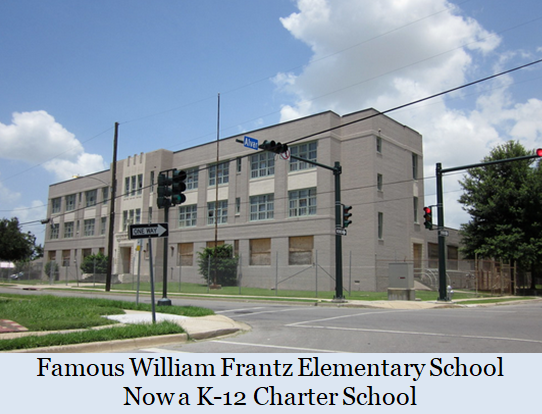
New Orleans Public Schools, aka Orleans Parish School District (OPSD), became America’s first and only all charter school district in 2017. After hurricane Katrina, the state took over all but five schools in the city. When management was transferred to charter organizations in 2017, OPSD officially became an all charter district. This August, the city will open district-operated Leah Chase K-8 School, ending the all charter legacy.
According to Superintendent Avis Williams, the infrastructure required for the district to run Leah Chase will make it easier to open future district-run schools. OPSD will become both a charter school authorizer and regular school district. There is hope that New Orleans, Louisiana (NOLA) is pulling out of an abyss and tending towards a healthy public school system….
All-Charter NOLA Doomed from the Beginning
Public investment in education is widely viewed as the key to America’s success. Since the 19thcentury, communities have developed around local public schools. This opportunity was taken from NOLA neighborhoods…
Louisiana’s state takeover law required schools scoring below average to be closed. If this were real, half of the schools in the state would be closed every year. Instead, arbitrary state performance scores based on testing data, attendance, dropout rates and graduation rates were established. Similar ratings are used to evaluate NOLA charter schools. The nature of privatized schools and testing results led to almost half of the charter schools created being closed.
The NOLA school enrollment system allows parents to research the 100 schools and apply for up to eight of them. The algorithm selects the school from one of the eight if space is available. It is not uncommon for students to ride a bus past schools within walking distance of their homes. This complicated system is driving segregation.
For many education professionals, this system looked like a sure failure from the beginning. Communities could not develop around their schools and the schools would not be stable; important aspects of quality public education….
The All Charter District is a Failure
In 2021, Secretary of Education Miguel Cardona visited OPSD. He heard first-hand the growing disillusionment with the all charter system. Four of the six parents told him they wanted to go back to neighborhood schools. Parents complained about Teach for America, placing unqualified teachers in schools and the One App process for not offering school choice.
Senator Bouie wrote a two-page paper, “A Moral Imperative and Case For Action”, stating: “After spending 6 Billion dollars of tax payers’ money to become the only all-Charter system in the State, a staggering 73% of our children are not functioning at grade level, compared to 63% in 2005, when the State took control of over 100 of our schools.”
He also shared:
“In other words, fellow citizens, this 15-year flawed experiment has yielded no best practices identified to improve student and school performance, no State protocol for Charter Law Compliance, and no student performance improvement. It has, however, yielded other devastating consequences for our children and our community.”
He mentioned the 26,000 students between the ages of 16 and 24 who went missing. The privatized charter school system was unable to account for them which is expected and natural for a public school district.
Bouieu “They are transported past a neighborhood school to attend a failing school across town”and eliminating the ineffective One App central enrollment system claiming, “It has created inequities by Race and Class and admissions by chance (lottery) and not choice.”
Raynard Sanders who has over forty years of experience in teaching, education administration and community development, said the charter experiment has “been a total disaster in every area.”He asserted NOLA had “the worst test scores since 2006, the lowest ACT scores, and the lowest NAEP (National Assessment of Educational Progress) scores.”
Based on a 2015 study by the Center for Popular Democracy, Sanders declared, “Charter schools have no accountability and, fiscally, charter schools in New Orleans have more fraud than existed in the OPSD (Orleans Parish School District).” The fraud claim was used by the state in 2003 against OPSD to begin taking schools.
Loyola University Law Professor Bill Quigley stated, “NOLA reforms have created a set of schools that are highly stratified by race, class, and educational advantage; this impacts the assignment to schools and discipline in the schools to which students are assigned.”
He contended, “There is also growing evidence that the reforms have come at the expense of the city’s most disadvantaged children, who often disappear from school entirely and, thus, are no longer included in the data.”
Professor of Economics, Doug Harris, and his team at Tulane University are contracted to study school performance in New Orleans. Harris claims schools have improved since Hurricane Katrina. However Professor Bruce Baker of Rutgers University disagrees. He noted that the school system is not only smaller but less impoverished. Many of the poorest families left and never returned. So the slightly improved testing results are not real evidence of school improvement.
The latest testing data from 2023 saw NOLA public schools receive failing grades but based on Louisiana’s new progress indicator, the district received a C, meaning an F for assessments and an A in growth.
In a letter to the editor, former OPSD superintendent, Barbara Ferguson, stated:
“The state took over 107 of New Orleans’ 120 public schools and turned them into charter schools. Last year, 56 of New Orleans’ 68 public schools had scores below the state average. Thus, after nearly 20 years, over 80% of New Orleans schools remain below the state average. This charter school experiment has been a failure.”
Final Words
In 2006, with the school board out of the road and RSD in charge, philanthropists Bill Gates, Eli Broad and others were ready to help.
Naomi Klein’s 2007 book, The Shock Doctrine, labeled these school reforms, a prime example of “disaster capitalism”, which she described as “orchestrated raids on the public sphere in the wake of catastrophic events, combined with the treatment of disasters as exciting market opportunities.” She also observed, “In sharp contrast to the glacial pace with which the levees were repaired and the electricity grid brought back online, the auctioning-off of New Orleans’ school system took place with military speed and precision.”
Desires of New Orleans residents were ignored. Neoliberal billionaires were in charge. In all the excitement, few noticed that these oligarchs had no understanding of how public education functions. They threw away 200 years of public school development and replaced it with an experiment. The mostly black residents in the city were stripped of their rights.
Thousands of experienced black educators were fired and replaced by mostly white Teach For America teachers with 5 weeks of training. Instead of stable public schools, people were forced into unstable charter schools. Instead of professional administration, market forces drove the bus!
Clearly, the all charter school system is a failure.
The Center for Budget and Policy Priorities is a nonpartisan, nonprofit research organization in D.C. Its reports are widely respected. Earlier this week it released a scathing report about the damage that vouchers do to American education. Vouchers subsidize the tuition of 10% or less of students, mostly in religious schools, while defunding the schools that enroll nearly 90% of all students.
Joanna Lefebvre wrote for the Center:
During this year’s legislative sessions, at least one in three states are considering or have enacted school voucher expansions alongside broad, untargeted property tax cuts. Over half of states have already enacted deep personal and corporate income tax cuts in the last three years. These policies will result in under-resourced public schools, worse student outcomes, and, over time, weaker communities.
Research suggests property tax cuts result in disproportionately less funding for districts serving large numbers of students of color and that school funding matters more for these students’ life outcomes because of historical and systemic racial discrimination. States wishing to ensure a quality education for all children should instead invest in public schools, reject K-12 voucher programs, and pursue only targeted property tax relief.
Property tax cuts reduce funding for public education at its source. Revenue from local property taxes accounted for over 36 percent of public education funding in the 2020-2021 school year, the most recent year for which national data are available. States have a long history of weaponizing this policy design, using their property tax codes to limit education funding for Black and brown students. For example, California’s infamous 1978 Proposition 13, which limited property taxes to 1 percent of a home’s purchase price, passed with primary support from white property owners amid a campaign of thinly veiled racism and xenophobia about paying for “other” people’s children to go to school.
Vouchers Divert Money from Public Schools and Get Worse Academic Outcomes
K-12 vouchers also siphon funding away from public schools. Voucher programs can take many forms, but all use public dollars to subsidize private school tuition. Some voucher programs defund public education directly by siphoning off funding that otherwise would have gone to public schools. Others do so indirectly by reducing revenue available for all public services, including education.
Modern school vouchers have their roots in similar programs created after Brown v. Board of Educationto perpetuate segregation and exacerbate inequities. This vision can be seen in today’s programs, where most vouchers go to families with high incomes. Although data on the race and ethnicity of voucher recipients themselves is scarce, white students make up 65 percent of private school enrollment in the U.S. but only 45 percent of public school enrollment. Defunding public schools through vouchers and property tax cuts exacerbates inequities in educational outcomes, which often fall along lines of race and class due to the persisting effects of slavery and segregation.
A trend has emerged of states proposing or enacting school voucher programs while simultaneously cutting, limiting, or proposing to eliminate property taxes.Florida, Texas, and Idaho are leading examples of this trend.
Florida: This year, a Republican representative introduced a bill to study eliminating Florida’s property tax system. Property taxes generated $14 billion in the 2020-2021 school year (the most recent for which data are available), equivalent to almost 40 percent of Florida’s K-12 education funding. Meanwhile, the legislature passed a budget in early March that includes about $4 billion for private school vouchers, a significant portion of the $29 billion appropriated for K-12 education.
Texas: Last year, Governor Greg Abbott called two special legislative sessions and spent seven months lobbying lawmakers to pass a school voucher system without success. The voucher proposal would have cost Texas school districts up to $2.28 billion. However, the legislature approved over $18 billion worth of property tax cuts, with 66 percent of benefits accruing to families making more than $100,000, putting pressure on future education budgets.
Idaho: Last year, Idaho’s legislature passed property tax cuts totaling $355 million, equivalent to over half of property tax revenue for schools. Although some of this funding was replaced with general fund revenue to repair the state’s abysmal school facilities, the overall reduction in revenue jeopardizes the state’s long-term ability to fund education. Meanwhile, this year, the legislature tried and failed to pass a school voucher bill that would have cost the state over $170 million.
Broad property tax cuts and caps will not address housing affordability. Property values have risen by about 37 percent since the beginning of the COVID-19 pandemic, and some proponents of property tax cuts argue they will help make housing more affordable. However, most of the proposals being debated would do little to help while stripping resources from public education. Instead of broad property tax cuts or caps, states should adopt “circuit breaker” policies that respond to residents’ ability to pay without limiting revenue-raising capacity.
States should raise revenue equitably and invest in robust public schools. Research suggests the education attainment gap between children from low-income families and those from higher-income families can be eliminated with increased funding for public schools. Raising revenue to invest in public education and resisting calls to dismantle it through school vouchers and property tax cuts is critical to enabling thriving communities with broadly shared opportunity.
States are defunding public education by reducing revenue available for schools through property taxes and by diverting public dollars to private schools.
Stephen Dyer, former state legislator in Ohio, wrote in his blog “Tenth Period” that the 85% of Ohio’s children who attend public schools are being shortchanged by the state. First the state went overboard for charter schools, including for-profit charters and virtual charters and experienced a long list of money-wasting scandals. Then the state Republicans began expanding vouchers, despite a major evaluation showing that low-income students lost ground academically by using vouchers. As the state lowered the restrictions on access to vouchers, they turned into a subsidy for private school tuition.
He writes:
Since 1975, the percentage of the state budget going to Ohio’s public school students has dropped from 40% to barely 20% this year — a record low.
This is stunning, stunning data. But the Ohio General Assembly and Gov. Mike DeWine today are committing the smallest share of the state’s budget to educate Ohio’s public school kids in the last 50 years. And it’s not really close.
What’s going on here?
Simple: Ohio’s leaders have spent the last 3+ decades investing more and more money into privately run charter schools and, especially recently, have exploded their commitment to subsidize wealthy Ohioans’ private school tuitions. This has come at the expense of the 85% of Ohio students who attend the state’s public school districts.
Look at this school year, for example. In the budget, the state commits a little more than $11 billion to primary and secondary education. That represents 26.6% of the state’s $41.5 billion annual expenditure. However, this year, charter schools are expected to be paid $1.3 billion and private school tuition subsidies will soar to $1.02 billion (to give you an idea of what kind of explosion this has been, when I left the Ohio House in 2010, Ohio spent about $75 million on these tuition subsidies). So if you subtract that combined $2.32 billion that’s no longer going to kids in public school districts, now Ohio’s committing $8.7 billion to educate the 1.6 million kids in Ohio’s public school districts. That’s a 21.1% commitment of the state’s budget.
Some perspective:
That $8.7 billion is about what the state was sending to kids in public school districts in 1997, adjusted for inflation.
The 21.1% commitment currently being sent to kids in public school districts is by far the lowest commitment the state has ever made to its public school students — about 7% lower than the previous record (last year’s 22.2%) and 20% lower than the previous record for low spending in the pre-privatization era.
The voucher expenditure alone now drops state commitment to public school kids by nearly 10%.
The commitment to all students, including vouchers and charters, represents the fifth-lowest commitment since 1975. Only four years surrounding the initial filing of the state’s school funding lawsuit in 1991 were lower. The lowest commitment ever on record was 1992 at 25.2% of the state budget. Don’t worry, though. Next year, the projected commitment to all Ohio students will be 25.3% of the state budget.
What is clear now is that every single new dollar (plus a few more) that’s been spent on K-12 education since 1997 has gone to fund privately run charter schools and subsidize private school tuitions mostly for parents whose kids already attend private school.
What’s even more amazing is that even if charters and vouchers never existed and all that revenue was going to fund the educations of only Ohio’s public school students, the state is still spending a smaller percentage of its budget on K-12 education than at any but 4 out of the last 50 years. And next year it’s less than all but 1 of those last 50 years.
Ohio’s current leaders have essentially divested from Ohio’s greatest resource — its children and future — for the last 30 years.
Please open the link and finish reading the post. Ohio has also slashed funding for public higher education.
Does this disinvestment in children and higher education make any sense? Who benefits?
In Ohio, as in every other state, most children go to public schools. You would think that their elected officials would work hard to ensure that their district’s public schools are well-funded. In red states like Ohio, you would be wrong. Safe in their gerrymandered districts, Republicans are shoveling money to charters and vouchers, not public schools. Their generosity to nonpublic schools ignores the long list of scandals associated with charters, as well as their poor performance. Nor are Republicans concerned by the lack of accountability of voucher schools, not to mention their discriminatory practices.
On Tuesday, the Ohio Capital Journal’s Susan Tebben reported: “Ohio House Democrats have laid out a plethora of bills targeting the education system in the state, impacting everything from teacher pay to oversight of private school vouchers and the overall funding of the public school system…’Our principles are pretty clear on that front,’ said House Minority Whip Dani Isaacsohn, D-Cincinnati. ‘There is no better investment we can make in the future of our state than investing in the education of our students, and that every kid, no matter which corner of the state they grow up in, deserves a world class education.’
There is a problem, however, blocking most pro-public school legislation. Only 32 of 99 Ohio House members are Democrats, and in the Ohio Senate, only 7 Democrats serve in a body of 33 members. Due to gerrymandering, the Ohio Supreme Court rejected the district maps that are being used today, but the Court did not enforce its ruling. This means that, except in the state budget where compromises sometimes are demanded, most of the Democratic priorities languish. In the recent budget, the legislature enacted a second stage of the three-budget, phase-in of a new public school funding formula, but it was accompanied by a universal private school tuition voucher expansion.
Here, according to Tebben, is what has happened to a bill to prioritize and protect the new public school funding formula:
“At the top of the (Democrats’) list is House Bill 10, which seeks to hold legislators to the six year phase-in plan that was assigned to the Fair School Funding Plan, legislation that funds public schools based less on property values and more on the needs of individual school districts. HB 10 is a bipartisan bill which simply ‘expresses the intent of the General Assembly to continue phasing in the school financing system,’ which was inserted in the 2021 budget bill, ‘until that system is fully implemented and funded,’ according to the language of the bill. The bill was introduced in February 2023 and quickly referred to the House Finance Committee, but has not seen activity since.”
Ohio’s gerrymandered Republican supermajority won’t commit to the eventual full funding of the state’s public school system because, they say, revenue projections are unsure in the context of growing privatization and years of cutting taxes in budget after budget.
Ohio’s gerrymandered Republican legislators instead operate ideologically and far to the right. After Governor Mike DeWine vetoed a bill to deny medical care for transgender youths last winter, legislators immediately overrode the veto. Far-right bills from the American Legislative Exchange Council and other bill mills, and bills endorsed by the extremist but powerful Columbus lobby, the Center for Christian Virtue, now housed in the building it purchased across the street from the Statehouse, dominate legislative deliberation and get lots of press.
One person who takes credit for the rapid advance of vouchers, which send public dollars to private and religious schools, is named Corey De Angelis. You probably never heard of him. He works for Betsy DeVos. He hates public schools, although he is a product of public schools. The taxpayers paid for his free education, but now he wants to divert money from public schools to private ones. We now know that most vouchers are claimed by families whose children are already enrolled in private schools. The voucher is a subsidy for them. Frequently, the school hikes its tuition by the amount of the voucher. Why does Corey hate public schools? It’s a puzzlement.
Carol Burris, executive director of the Network for Public Education, wrote this post:
Corey De Angelis works for Betsy De Vos’s American Federation for Children, which pays him to travel the country hawking ESA vouchers. He directs its PAC to destroy candidates who oppose vouchers.
De Angelis obsessively hates teacher unions, calls public schools “government schools,” believes that telling the truth is, at best, a suggestion, and has dubbed himself the “school choice evangelist.”
During a recent interview at the Heritage Foundation, De Angelis defined public schools like this: “failing unionized indoctrination centers that we call schools.” His contempt for public education was apparent from beginning to end. Here is a clip from that interview and NPE’s response on his mission to destroy our public schools.




 Diane Ravitch's blog