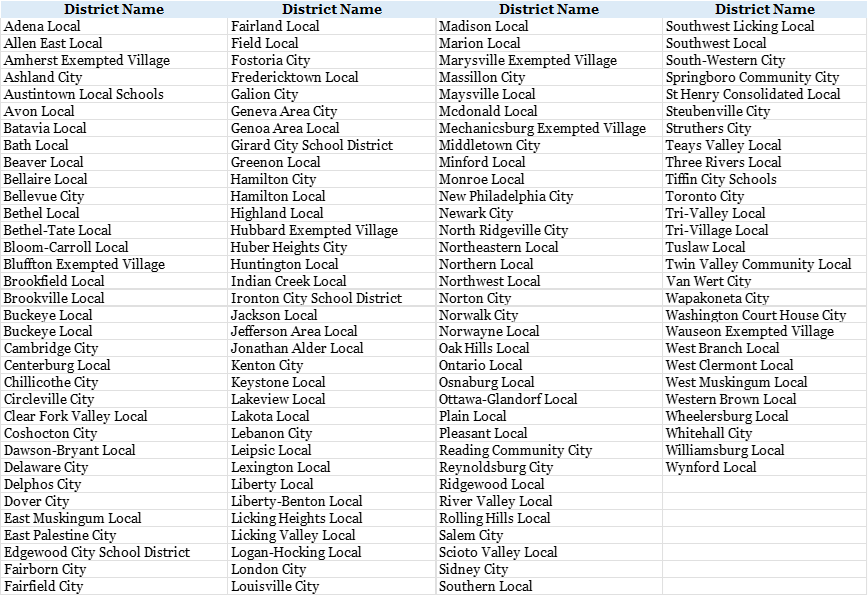
For years, Pennsylvania has funded a large number of cybercharters. Hundreds of millions of taxpayer funding flows to cybercharters annually. For years, the state has known the very poor educational results of these online charter schools. Yet the state continues to fund them. Why?
PDE has released 2022-2023 school performance data Here’s what those ubiquitous cyber charter ads (that your tax dollars pay for) don’t tell you: Entries in red are 20 percentage points or more below statewide averages.
In the past few years, Republican-controlled states have established or expanded expensive voucher programs. The so-called “wall of separation” between church and state—a phrase coined by Thomas Jefferson—is crumbling. Republicans and the 6-3 conservative majority on the Supreme Court are taking a sledgehammer to that wall, to make sure that public money underwrites tuition at private and religious schools. Public schools enroll the vast majority of American K-12 students, from 80-90%. They are being stripped of resources so that a small minority can go private.
Billions in taxpayer dollars are being used to pay tuition at religious schools throughout the country, as state voucher programs expand dramatically and the line separating public education and religion fades.
School vouchers can be used at almost any private school, but the vast majority of the money is being directed to religious schools, according to a Washington Post examination of the nation’s largest voucher programs.
Vouchers, government money that covers education costs for families outside the public schools, vary by state but offer up to $16,000 per student per year, and in many cases fully cover the cost of tuition at private schools. In some schools, a large share of the student body is benefiting from a voucher, meaning a significant portion of the school’s funding is coming directly from the government.
In just five states with expansive programs, more than 700,000 students benefited from vouchers this school year. (Those same states had a total of about 935,000 private school students in 2021, the most recent year for which data are available.) An additional 200,000 were subsidized in the rest of the country, according to tracking by EdChoice, a voucher advocacy group. That suggests a substantial share of about 4.7 million students attending private school nationwide are benefiting from vouchers — a number that is expected to grow.
The programs, popular with conservatives, are rapidly growing in GOP-run states, with a total of 29 states plus D.C. operating some sort of voucher system. Eight states created or expanded voucher programs last year, and this year, Alabama, Georgia and Missouri have approved or expanded voucher-type programs. Some recently enacted plans are just starting to take effect or will be phased in over the next few years…
In Ohio, the GOP legislature last year significantly expanded its voucher program to make almost every student eligible for thousands of dollars to attend private school. As a result, more than 150,000 students are paying tuition with vouchers this year — up from about 61,000 in 2020. About 91 percent of this year’s voucher recipients attend religious schools, the Post analysis found. When vouchers for students with autism and other disabilities — who typically seek specific services — are removed from the list, the portion going toward religious education rises to 98 percent. (Unless otherwise noted, the Post calculations exclude schools for students with disabilities.)
In Wisconsin, 96 percent of about 55,000 vouchers given this school year went toward religious schools, The Post found. In Indiana, 98 percent of vouchers go to religious schools. (Indiana state data only specifies the number of vouchers for schools with at least 10 recipients.) In Florida, several programs combine to make every student in the state eligible for vouchers, with more than 400,000 participating this year. At least 82 percent of students attend religious schools, The Post found. Florida is first in the nation in both the number of enrolled students and total cost of the voucher program — more than $3 billion this year.
And in Arizona, more than 75,000 students are benefiting from the Empowerment Scholarship Program, which pays for any educational expense. In 2022-2023, three-fourths of the money — about $229 million — went to 184 vendors. Most of that money went for tuition, 87 percent of it to religious schools.
Arizona also has an older voucher program, funded by tax credits, which last year subsidized tuition for at least 30,000 students. (The state tracks only the number of scholarships given, and one student can receive multiple scholarships.) Since this program was created in 1998, 19 of the 20 schools that received the most money were religious, according to a state report. Those 19 schools received about 96 percent of the $767 million spent between 1998 and 2023 at the top 20 schools.
Tom Ultican, retired teacher of physics and mathematics, writes here about the recent decision by local officials to open a PUBLIC SCHOOL in New Orleans. This is a symptom of the failure of the “all-charter” idea.
He writes:
New Orleans Public Schools, aka Orleans Parish School District (OPSD), became America’s first and only all charter school district in 2017. After hurricane Katrina, the state took over all but five schools in the city. When management was transferred to charter organizations in 2017, OPSD officially became an all charter district. This August, the city will open district-operated Leah Chase K-8 School, ending the all charter legacy.
According to Superintendent Avis Williams, the infrastructure required for the district to run Leah Chase will make it easier to open future district-run schools. OPSD will become both a charter school authorizer and regular school district. There is hope that New Orleans, Louisiana (NOLA) is pulling out of an abyss and tending towards a healthy public school system….
All-Charter NOLA Doomed from the Beginning
Public investment in education is widely viewed as the key to America’s success. Since the 19thcentury, communities have developed around local public schools. This opportunity was taken from NOLA neighborhoods…
Louisiana’s state takeover law required schools scoring below average to be closed. If this were real, half of the schools in the state would be closed every year. Instead, arbitrary state performance scores based on testing data, attendance, dropout rates and graduation rates were established. Similar ratings are used to evaluate NOLA charter schools. The nature of privatized schools and testing results led to almost half of the charter schools created being closed.
The NOLA school enrollment system allows parents to research the 100 schools and apply for up to eight of them. The algorithm selects the school from one of the eight if space is available. It is not uncommon for students to ride a bus past schools within walking distance of their homes. This complicated system is driving segregation.
For many education professionals, this system looked like a sure failure from the beginning. Communities could not develop around their schools and the schools would not be stable; important aspects of quality public education….
The All Charter District is a Failure
In 2021, Secretary of Education Miguel Cardona visited OPSD. He heard first-hand the growing disillusionment with the all charter system. Four of the six parents told him they wanted to go back to neighborhood schools. Parents complained about Teach for America, placing unqualified teachers in schools and the One App process for not offering school choice.
Senator Bouie wrote a two-page paper, “A Moral Imperative and Case For Action”, stating: “After spending 6 Billion dollars of tax payers’ money to become the only all-Charter system in the State, a staggering 73% of our children are not functioning at grade level, compared to 63% in 2005, when the State took control of over 100 of our schools.”
He also shared:
“In other words, fellow citizens, this 15-year flawed experiment has yielded no best practices identified to improve student and school performance, no State protocol for Charter Law Compliance, and no student performance improvement. It has, however, yielded other devastating consequences for our children and our community.”
He mentioned the 26,000 students between the ages of 16 and 24 who went missing. The privatized charter school system was unable to account for them which is expected and natural for a public school district.
Bouieu “They are transported past a neighborhood school to attend a failing school across town”and eliminating the ineffective One App central enrollment system claiming, “It has created inequities by Race and Class and admissions by chance (lottery) and not choice.”
Raynard Sanders who has over forty years of experience in teaching, education administration and community development, said the charter experiment has “been a total disaster in every area.”He asserted NOLA had “the worst test scores since 2006, the lowest ACT scores, and the lowest NAEP (National Assessment of Educational Progress) scores.”
Based on a 2015 study by the Center for Popular Democracy, Sanders declared, “Charter schools have no accountability and, fiscally, charter schools in New Orleans have more fraud than existed in the OPSD (Orleans Parish School District).” The fraud claim was used by the state in 2003 against OPSD to begin taking schools.
Loyola University Law Professor Bill Quigley stated, “NOLA reforms have created a set of schools that are highly stratified by race, class, and educational advantage; this impacts the assignment to schools and discipline in the schools to which students are assigned.”
He contended, “There is also growing evidence that the reforms have come at the expense of the city’s most disadvantaged children, who often disappear from school entirely and, thus, are no longer included in the data.”
Professor of Economics, Doug Harris, and his team at Tulane University are contracted to study school performance in New Orleans. Harris claims schools have improved since Hurricane Katrina. However Professor Bruce Baker of Rutgers University disagrees. He noted that the school system is not only smaller but less impoverished. Many of the poorest families left and never returned. So the slightly improved testing results are not real evidence of school improvement.
The latest testing data from 2023 saw NOLA public schools receive failing grades but based on Louisiana’s new progress indicator, the district received a C, meaning an F for assessments and an A in growth.
In a letter to the editor, former OPSD superintendent, Barbara Ferguson, stated:
“The state took over 107 of New Orleans’ 120 public schools and turned them into charter schools. Last year, 56 of New Orleans’ 68 public schools had scores below the state average. Thus, after nearly 20 years, over 80% of New Orleans schools remain below the state average. This charter school experiment has been a failure.”
Final Words
In 2006, with the school board out of the road and RSD in charge, philanthropists Bill Gates, Eli Broad and others were ready to help.
Naomi Klein’s 2007 book, The Shock Doctrine, labeled these school reforms, a prime example of “disaster capitalism”, which she described as “orchestrated raids on the public sphere in the wake of catastrophic events, combined with the treatment of disasters as exciting market opportunities.” She also observed, “In sharp contrast to the glacial pace with which the levees were repaired and the electricity grid brought back online, the auctioning-off of New Orleans’ school system took place with military speed and precision.”
Desires of New Orleans residents were ignored. Neoliberal billionaires were in charge. In all the excitement, few noticed that these oligarchs had no understanding of how public education functions. They threw away 200 years of public school development and replaced it with an experiment. The mostly black residents in the city were stripped of their rights.
Thousands of experienced black educators were fired and replaced by mostly white Teach For America teachers with 5 weeks of training. Instead of stable public schools, people were forced into unstable charter schools. Instead of professional administration, market forces drove the bus!
Clearly, the all charter school system is a failure.
The Center for Budget and Policy Priorities is a nonpartisan, nonprofit research organization in D.C. Its reports are widely respected. Earlier this week it released a scathing report about the damage that vouchers do to American education. Vouchers subsidize the tuition of 10% or less of students, mostly in religious schools, while defunding the schools that enroll nearly 90% of all students.
Joanna Lefebvre wrote for the Center:
During this year’s legislative sessions, at least one in three states are considering or have enacted school voucher expansions alongside broad, untargeted property tax cuts. Over half of states have already enacted deep personal and corporate income tax cuts in the last three years. These policies will result in under-resourced public schools, worse student outcomes, and, over time, weaker communities.
Research suggests property tax cuts result in disproportionately less funding for districts serving large numbers of students of color and that school funding matters more for these students’ life outcomes because of historical and systemic racial discrimination. States wishing to ensure a quality education for all children should instead invest in public schools, reject K-12 voucher programs, and pursue only targeted property tax relief.
Property tax cuts reduce funding for public education at its source. Revenue from local property taxes accounted for over 36 percent of public education funding in the 2020-2021 school year, the most recent year for which national data are available. States have a long history of weaponizing this policy design, using their property tax codes to limit education funding for Black and brown students. For example, California’s infamous 1978 Proposition 13, which limited property taxes to 1 percent of a home’s purchase price, passed with primary support from white property owners amid a campaign of thinly veiled racism and xenophobia about paying for “other” people’s children to go to school.
Vouchers Divert Money from Public Schools and Get Worse Academic Outcomes
K-12 vouchers also siphon funding away from public schools. Voucher programs can take many forms, but all use public dollars to subsidize private school tuition. Some voucher programs defund public education directly by siphoning off funding that otherwise would have gone to public schools. Others do so indirectly by reducing revenue available for all public services, including education.
Modern school vouchers have their roots in similar programs created after Brown v. Board of Educationto perpetuate segregation and exacerbate inequities. This vision can be seen in today’s programs, where most vouchers go to families with high incomes. Although data on the race and ethnicity of voucher recipients themselves is scarce, white students make up 65 percent of private school enrollment in the U.S. but only 45 percent of public school enrollment. Defunding public schools through vouchers and property tax cuts exacerbates inequities in educational outcomes, which often fall along lines of race and class due to the persisting effects of slavery and segregation.
A trend has emerged of states proposing or enacting school voucher programs while simultaneously cutting, limiting, or proposing to eliminate property taxes.Florida, Texas, and Idaho are leading examples of this trend.
Florida: This year, a Republican representative introduced a bill to study eliminating Florida’s property tax system. Property taxes generated $14 billion in the 2020-2021 school year (the most recent for which data are available), equivalent to almost 40 percent of Florida’s K-12 education funding. Meanwhile, the legislature passed a budget in early March that includes about $4 billion for private school vouchers, a significant portion of the $29 billion appropriated for K-12 education.
Texas: Last year, Governor Greg Abbott called two special legislative sessions and spent seven months lobbying lawmakers to pass a school voucher system without success. The voucher proposal would have cost Texas school districts up to $2.28 billion. However, the legislature approved over $18 billion worth of property tax cuts, with 66 percent of benefits accruing to families making more than $100,000, putting pressure on future education budgets.
Idaho: Last year, Idaho’s legislature passed property tax cuts totaling $355 million, equivalent to over half of property tax revenue for schools. Although some of this funding was replaced with general fund revenue to repair the state’s abysmal school facilities, the overall reduction in revenue jeopardizes the state’s long-term ability to fund education. Meanwhile, this year, the legislature tried and failed to pass a school voucher bill that would have cost the state over $170 million.
Broad property tax cuts and caps will not address housing affordability. Property values have risen by about 37 percent since the beginning of the COVID-19 pandemic, and some proponents of property tax cuts argue they will help make housing more affordable. However, most of the proposals being debated would do little to help while stripping resources from public education. Instead of broad property tax cuts or caps, states should adopt “circuit breaker” policies that respond to residents’ ability to pay without limiting revenue-raising capacity.
States should raise revenue equitably and invest in robust public schools. Research suggests the education attainment gap between children from low-income families and those from higher-income families can be eliminated with increased funding for public schools. Raising revenue to invest in public education and resisting calls to dismantle it through school vouchers and property tax cuts is critical to enabling thriving communities with broadly shared opportunity.
States are defunding public education by reducing revenue available for schools through property taxes and by diverting public dollars to private schools.
Stephen Dyer, former state legislator in Ohio, wrote in his blog “Tenth Period” that the 85% of Ohio’s children who attend public schools are being shortchanged by the state. First the state went overboard for charter schools, including for-profit charters and virtual charters and experienced a long list of money-wasting scandals. Then the state Republicans began expanding vouchers, despite a major evaluation showing that low-income students lost ground academically by using vouchers. As the state lowered the restrictions on access to vouchers, they turned into a subsidy for private school tuition.
He writes:
Since 1975, the percentage of the state budget going to Ohio’s public school students has dropped from 40% to barely 20% this year — a record low.
This is stunning, stunning data. But the Ohio General Assembly and Gov. Mike DeWine today are committing the smallest share of the state’s budget to educate Ohio’s public school kids in the last 50 years. And it’s not really close.
What’s going on here?
Simple: Ohio’s leaders have spent the last 3+ decades investing more and more money into privately run charter schools and, especially recently, have exploded their commitment to subsidize wealthy Ohioans’ private school tuitions. This has come at the expense of the 85% of Ohio students who attend the state’s public school districts.
Look at this school year, for example. In the budget, the state commits a little more than $11 billion to primary and secondary education. That represents 26.6% of the state’s $41.5 billion annual expenditure. However, this year, charter schools are expected to be paid $1.3 billion and private school tuition subsidies will soar to $1.02 billion (to give you an idea of what kind of explosion this has been, when I left the Ohio House in 2010, Ohio spent about $75 million on these tuition subsidies). So if you subtract that combined $2.32 billion that’s no longer going to kids in public school districts, now Ohio’s committing $8.7 billion to educate the 1.6 million kids in Ohio’s public school districts. That’s a 21.1% commitment of the state’s budget.
Some perspective:
That $8.7 billion is about what the state was sending to kids in public school districts in 1997, adjusted for inflation.
The 21.1% commitment currently being sent to kids in public school districts is by far the lowest commitment the state has ever made to its public school students — about 7% lower than the previous record (last year’s 22.2%) and 20% lower than the previous record for low spending in the pre-privatization era.
The voucher expenditure alone now drops state commitment to public school kids by nearly 10%.
The commitment to all students, including vouchers and charters, represents the fifth-lowest commitment since 1975. Only four years surrounding the initial filing of the state’s school funding lawsuit in 1991 were lower. The lowest commitment ever on record was 1992 at 25.2% of the state budget. Don’t worry, though. Next year, the projected commitment to all Ohio students will be 25.3% of the state budget.
What is clear now is that every single new dollar (plus a few more) that’s been spent on K-12 education since 1997 has gone to fund privately run charter schools and subsidize private school tuitions mostly for parents whose kids already attend private school.
What’s even more amazing is that even if charters and vouchers never existed and all that revenue was going to fund the educations of only Ohio’s public school students, the state is still spending a smaller percentage of its budget on K-12 education than at any but 4 out of the last 50 years. And next year it’s less than all but 1 of those last 50 years.
Ohio’s current leaders have essentially divested from Ohio’s greatest resource — its children and future — for the last 30 years.
Please open the link and finish reading the post. Ohio has also slashed funding for public higher education.
Does this disinvestment in children and higher education make any sense? Who benefits?
In Ohio, as in every other state, most children go to public schools. You would think that their elected officials would work hard to ensure that their district’s public schools are well-funded. In red states like Ohio, you would be wrong. Safe in their gerrymandered districts, Republicans are shoveling money to charters and vouchers, not public schools. Their generosity to nonpublic schools ignores the long list of scandals associated with charters, as well as their poor performance. Nor are Republicans concerned by the lack of accountability of voucher schools, not to mention their discriminatory practices.
On Tuesday, the Ohio Capital Journal’s Susan Tebben reported: “Ohio House Democrats have laid out a plethora of bills targeting the education system in the state, impacting everything from teacher pay to oversight of private school vouchers and the overall funding of the public school system…’Our principles are pretty clear on that front,’ said House Minority Whip Dani Isaacsohn, D-Cincinnati. ‘There is no better investment we can make in the future of our state than investing in the education of our students, and that every kid, no matter which corner of the state they grow up in, deserves a world class education.’
There is a problem, however, blocking most pro-public school legislation. Only 32 of 99 Ohio House members are Democrats, and in the Ohio Senate, only 7 Democrats serve in a body of 33 members. Due to gerrymandering, the Ohio Supreme Court rejected the district maps that are being used today, but the Court did not enforce its ruling. This means that, except in the state budget where compromises sometimes are demanded, most of the Democratic priorities languish. In the recent budget, the legislature enacted a second stage of the three-budget, phase-in of a new public school funding formula, but it was accompanied by a universal private school tuition voucher expansion.
Here, according to Tebben, is what has happened to a bill to prioritize and protect the new public school funding formula:
“At the top of the (Democrats’) list is House Bill 10, which seeks to hold legislators to the six year phase-in plan that was assigned to the Fair School Funding Plan, legislation that funds public schools based less on property values and more on the needs of individual school districts. HB 10 is a bipartisan bill which simply ‘expresses the intent of the General Assembly to continue phasing in the school financing system,’ which was inserted in the 2021 budget bill, ‘until that system is fully implemented and funded,’ according to the language of the bill. The bill was introduced in February 2023 and quickly referred to the House Finance Committee, but has not seen activity since.”
Ohio’s gerrymandered Republican supermajority won’t commit to the eventual full funding of the state’s public school system because, they say, revenue projections are unsure in the context of growing privatization and years of cutting taxes in budget after budget.
Ohio’s gerrymandered Republican legislators instead operate ideologically and far to the right. After Governor Mike DeWine vetoed a bill to deny medical care for transgender youths last winter, legislators immediately overrode the veto. Far-right bills from the American Legislative Exchange Council and other bill mills, and bills endorsed by the extremist but powerful Columbus lobby, the Center for Christian Virtue, now housed in the building it purchased across the street from the Statehouse, dominate legislative deliberation and get lots of press.
One person who takes credit for the rapid advance of vouchers, which send public dollars to private and religious schools, is named Corey De Angelis. You probably never heard of him. He works for Betsy DeVos. He hates public schools, although he is a product of public schools. The taxpayers paid for his free education, but now he wants to divert money from public schools to private ones. We now know that most vouchers are claimed by families whose children are already enrolled in private schools. The voucher is a subsidy for them. Frequently, the school hikes its tuition by the amount of the voucher. Why does Corey hate public schools? It’s a puzzlement.
Carol Burris, executive director of the Network for Public Education, wrote this post:
Corey De Angelis works for Betsy De Vos’s American Federation for Children, which pays him to travel the country hawking ESA vouchers. He directs its PAC to destroy candidates who oppose vouchers.
De Angelis obsessively hates teacher unions, calls public schools “government schools,” believes that telling the truth is, at best, a suggestion, and has dubbed himself the “school choice evangelist.”
During a recent interview at the Heritage Foundation, De Angelis defined public schools like this: “failing unionized indoctrination centers that we call schools.” His contempt for public education was apparent from beginning to end. Here is a clip from that interview and NPE’s response on his mission to destroy our public schools.
Texas has one of the most extreme Republican parties in the nation, and it’s worth watching what happens there. Being a native Texan, I care about my home state. It’s hard to believe this is the same state that elected Ann Richardson as governor. The far-right has taken over the state.
The party primaries were held last Tuesday, and there was an internal war among the Republicans. Governor Abbott—who competes with Ron DeSantis for title of meanest governor—decided to defeat every rural Republican who opposed schoool vouchers. With the help of billionaires from on-state and out-of-state, Abbott targeted those who voted against vouchers. He won most, but not all, of the contests.
My friends in Texas were encouraged because they believe that some of the Republican seats might flip to Democrats because the GOP candidate is so extreme. Governor Abbott crowed about his victories. He now has enough votes to get vouchers for his evangelical friends and his billionaire donors.
The insiders I trust tell me that some Republicans who voted for vouchers are likely to switch sides because they know that vouchers will hurt their rural communities.
Chris Tomlinson, columnist for The Houston Chronicle, put the elections in perspective. He contends that big money is most effective in low-turnout elections. But when voters show up, they can defeat big money:
Gov. Greg Abbott declared victory Tuesday in his campaign to defeat Republican lawmakers who oppose public financing for religious schools. Texas House Speaker Dade Phelan declared victory in his fight against big-moneyed outsiders trying to oust him from his hometown seat.
The lesson from the runoffs is that well-financed culture warriors will win low-turnout elections, while reasonable Republicans can defeat anti-democratic activists if voters show up.
Abbott and Lt. Gov. Dan Patrick went on a jihad against rural Republican lawmakers who recognized that school vouchers would damage small-county economies where public schools are the largest employers.
The governor deployed $6 million from Pennsylvania billionaire gambler Jeff Yass to betray loyal, conservative Republicans. On Tuesday, Abbott’s challengers defeated four incumbents to receive the GOP nomination for the November general election.
If all his chosen candidates win, the Texas House could pass a school voucher bill with a two-vote majority. However, turnout in those races was low, proving that Abbott could motivate the party base with campaign spending but not mainstream Republican voters.
Phelan’s victory in Beaumont suggests Abbott’s candidates are not guaranteed victory in November. Outsider financiers turned the GOP runoff for House District 21 into the most expensive in Texas history. Self-respecting voters turned out for their hometown hero to fight the barbarians at the gate, and Phelan won
A similar dynamic played out in the Republican runoff of Congressional District 23, which stretches from San Antonio through Uvalde to Eagle Pass. Rep. Tony Gonzales defeated the “AK Guy” Brandon Herrera, who had the support of Matt Gaetz, the controversial Florida congressman.
A higher turnout was the deciding factor in Phelan’s and Gonzales’s victories. But that’s only by comparison. Phelan’s runoff saw a 20% turnout of registered voters, compared to less than 10% for the others.
Attorney General Ken Paxton, who expended enormous energy to punish Phelan for impeaching him, cried foul Tuesday night. He accused Democrats of voting in the Republican primary to keep Phelan in office.
I know many ticket-splitters who vote in the Republican primary because those are often the most important races. Only ideologues vote strictly along party lines.
I’ll be interested to see what happens in the high-turnout presidential election in November. Can Democrats use school vouchers to make inroads with reasonable Republicans? The Gonzales and Phelan races suggest they can, especially as the GOP becomes more dogmatic.
As a footnote, the Texas Republican Party wants to change party rules so that Democrats can’t vote in the GOP primaries, only the faithful. That will keep the party pure and drive out dissenters and centrists.
Indiana started small with vouchers. They were supposed to “save poor kids from failing schools.” But it was the old camel’s-nose-under-the-tent routine. The real goal of voucher advocates was not to help poor kids escape “failing schools,” but to subsidize upper-middle-class and wealthy families who already had children in private schools.
And although 87% of Indiana’s students are enrolled in public schools, the Republican governor and legislature continue to expand the voucher program.
A new state report described the voucher expansion. Mind you, no one claims that students are getting a better education in nonpublic schools, just that are getting public money to subsidize the costs.
Enrollment in Indiana’s private-school voucher program surged to 70,095 students in 2023-24. That’s a 31 percent increase compared to the previous year, the largest ever jump in a single year.
The state paid $439 million in tuition grants to private parochial or non-religious schools — 40 percent more than in 2022-23, according to a new state report.
The jump in voucher use comes after nearly every Indiana family became eligible to receive a voucher. A 2023 law repealed most requirements for students, such as previous enrollment in a public school, and it allows upper-income families to use public money to help pay for a private-school education. A family of four making $222,000 qualified for the Choice Scholarship Program in the recent school year.
The program’s expansion is a direct result of the Indiana Statehouse Republican supermajority’s efforts to expand policies that allow families to choose what they believe is the best school, or type of school, for their children.
Researcher R. Joseph Waddington, who studies Indiana’s school choice systems, said the monumental growth is not surprising.
“Without question, a lot of the enrollment growth in the voucher program is a result of that increase in income eligibility,” said Waddington, the director of Program Evaluation and Research at University of Notre Dame.
The number of families who earn more than $200,000 a year and receive vouchers increased nearly tenfold. The report does not detail how many of these families were already attending a private school and became eligible for a voucher in the past year.
“But there is growth in other parts of the program as well, even for lower income families,” Waddington said.
The number of participating families earning less than $100,000 grew by 14 percent from year to year. [Note that the increase for this group was 14%, compared to a ten-fold increase for families earning over $200,000 a year.]
Kindergarten student participation grew by 4 percent — the most of all grades. That increase is directly tied to the repealing of the previous eligibility requirements, according to the report.
This year, 6 percent of all Indiana public and private-school students received a voucher, according to the report. Traditional public schools make up nearly 87 percent of enrollment — about half a percentage point less than the previous year….
As Indiana has expanded its voucher program to more high-income families, critics also contend that the state is paying tuition for students who would have attended private school without a voucher.
The report shows roughly 67.5 percent of students using a voucher have no record of prior attendance at an Indiana public school in 2023-24 — an increase of around almost 4 percentage points from the previous year.
Thomas Ultican, retired teacher of advanced mathematics and physics, reports on a new book by literacy scholars, The book, he concludes, demolishes the hype associated with “the science of reading.” Ultican believes that states should not mandate how to teach reading. I agree. Legislators are not teaching professionals or literacy experts. They should not require teachers to follow their orders.
Ultican writes:
Two eminent professors of instruction and literacy teamed up to write “Fact-Checking the Science of Reading.” P. David Pearson of UC Berkeley and Robert J. Tierney of University of British Columbia are Emeritus Professors with high reputation in their respective countries.
In the introduction, they inform us that Emily Hanford’s 2022 “Sold a Story” podcasts motivated them to write. In particular, they noted:
“A consistent misinterpretation of the relevant research findings; and
“A mean-spirited tone in her rhetoric, which bordered on personal attacks directed against the folks Hanford considered to be key players in what she called the Balanced Literacy approach to teaching early reading.” (Page XIV)…
After reviewing their findings, Ultican concludes:
SoR advocates say when teaching reading, the “settled science” of phonics “first and fast”, should be applied. They are working to make it against the law to disagree, claiming other forms of instruction cause child harm. SoR reading theory may have some holes but their political power is unquestioned and global. Laws mandating SoR have been enacted in 40 US states, UK, Canada, Australia, New Zealand and other English-speaking countries. These rules limit teacher autonomy and attempt to make reading a scripted subject. (Page XII)
The Orwellian labeled science of reading (SoR) is not based on sound science. It more accurately should be called “How to Use Anecdotes to Sell Reading Products.” In 1997, congress passed legislation, calling for a reading study. From Jump Street, establishment of the National Reading Panel (NRP) was a doomed effort. The panel was given limited time for the study (18 months) which was a massive undertaking, conducted by twenty-one unpaid volunteers. NRP fundamentally did a meta-analysis in five reading domains, ignoring 10 other important reading domains. In other words, they did not review everything and there was no new research. They simply searched for reading studies and averaged the results to give us “the science of reading.”
SoR’s real motivation is to sell products, not helping children struggling to read. Scholars like Pearson and Tierney are ignored and swept away by a podcaster with no credentials.
For the sake of the future, we must stop legally mandating SoR as a solution to a fraudulent“reading crisis” and put our trust in education professionals.