Archives for category: Education Industry

Don’t believe the hype about charter ”success.” As the Network for Public Education has documented in several reports, the failure and closure rate of charter schools is high. in Philadelphia, the district has battled to close two low-performing charter schools for years and only now is on the cusp of regaining their students.

A state panel on Tuesday upheld the Philadelphia school board’s decision not to renew two charter schools, setting a course for ASPIRA Olney High School and ASPIRA Stetson Middle School to return to district control later this year.

The move comes nearly six years after the Philadelphia School District’s charter schools office first recommended that the district cut ties with ASPIRA Olney and Stetson for academic, operational, and financial reasons. The school board eventually voted against renewing the charters in 2019 over strong objections from the powerful Hispanic nonprofit that has run them since 2010 and 2011.

The charter nonrenewals mark the first time the district will take back control of schools it had turned over under the Renaissance Schools initiative, a school-turnaround approach launched in 2010 that the district has backed away from in recent years. (In 2016, Scholar Academies abruptly surrendered control of Kenderton Elementary, citing the high cost of educating its large special-education population; the district took back Kenderton and still runs it.)

ASPIRA officials said they plan to file court paperwork to overturn Tuesday’s ruling of the Charter Appeals Board, which voted 4-1 in both the Olney and Stetson cases. Among those voting in favor was Jennifer Faustman, CEO of the Belmont Charter Network in Philadelphia. Tom Killion, a former Republican state senator from Delaware County, was the lone no vote

Olney, a high school that enrolls more than 1,700 students at Front and Duncannon, and Stetson, which educates 860 students in grades 5 through 8 on B Street in Kensington, will remain open in their current buildings, district and board officials emphasized. Students’ educations will not be interrupted

The old School Reform Commission gave struggling Olney and Stetson to ASPIRA as part of its Renaissance initiative that tapped outside providers to run schools. According to a hearing officer’s report, while ASPIRA made progress in improving the schools’ climates, it didn’t live up to the academic promises it made and had financial shortcomings, too.

ASPIRA has fought to maintain control of the schools, which have been in limbo since their charters expired more than five years ago. In 2019, the company sued the School District, accusing it of unlawfully delaying charter renewal decisions to pressure the company into agreeing to conditions like enrollment caps.

A federal judge ruled in favor of the district last year, determining that while ASPIRA was selected to manage the two schools, there was no contract between the company and the district.

ASPIRA, which manages a total of five charter schools in the city, including a cyber charter, has also faced scrutiny from state officials. It was the subject of an auditor general’s report in 2018 that highlighted significant increases in payments the charters made to ASPIRA as an example of flaws in Pennsylvania’s charter school law.

It has taken the district six years to regain control of these two charters, whose charters were not renewed. And the charters are again appealing the decision to turn over their students and buildings to the district.
When a bright young man or woman gets an idea to replace experienced educators with inexperienced tyros and is quickly funded by billionaire foundations, you can guess that the ultimate goal is privatization. For one thing, the enterprise rests on a base claim that “our schools are failing,” and that experience is irrelevant and probably harmful.

Tom Ultican recounts the origin story of one such organization: New Leaders for New Schools.

The idea was so spot-on that the organization attracted millions of dollars from the plutocrats of privatization: Eli Broad, Bill Gates, the Walton Family Foundation, and many more.

Where are the miracle schools led by New Leaders? That’s a hard question to answer.

What Ultican demonstrates is the continuing relevance of New Leaders for New Schools. One of its illustrious graduates was behind the recent decision by the board of the Oakland Unified School District to resume closing schools, despite overwhelming opposition by students, parents, and educators.

Paul Bowers, previously the education journalist for the Charleston, South Carolina, Post & Courier, writes his own blog. In this post, he calls on the state legislators not to pass voucher legislation that would predictably defund the state’s already underfunded public schools. South Carolina has a large budget surplus and one of the lowest tax rates in the nation. Governor Henry McMaster announced that the surplus would be used to lower taxes instead of funding public schools and other public services.

Paul wrote the members of the S.C. Senate Education Committee in opposition to Senate Bill 935, which is an attempt to divert public school funding to private schools.

Senators Massey, Jackson, Hutto, Rice, and Talley:

I write to you as a South Carolinian and parent of 3 public school students asking you to scrap Senate Bill 935, the so-called “Put Parents in Charge Act,” which would redirect public funds to private schools via the creation of Education Savings Accounts.

Every few years, South Carolina teachers and parents have to band together to fight the latest iteration of the school voucher meme, which has spread virally across the states thanks to millions upon millions of dollars of dark-money political contributions, astroturfed special-interest groups, and a network of libertarian billionaires’ pet thinktanks. We fought this idea when New York real estate investor Howard Rich tried to buy a voucher law here in the early 2000s, and we’re fighting it again now that ALEC, Palmetto Promise, and the like are trying to ram the same idea through the Statehouse in Year of Our Lord 2022. There is truly nothing new under the sun.

As the educator Steve Nuzum has pointed out several times this year, the bill you will be considering in a subcommittee meeting on Feb. 16is largely copied from a piece of “model legislation” churned out by the American Legislative Exchange Council, a right-wing bill mill. I posit that we have enough terrible ideas to go around in this state without borrowing worse ones.

If enacted, this bill would be an obvious violation of the South Carolina Constitution, Article XI, Section 4, which states:

No money shall be paid from public funds nor shall the credit of the State or any of its political subdivisions be used for the direct benefit of any religious or other private educational institution.

Now, I am sure our attorney general would happily defend such an act against the inevitable lawsuits that would follow. I am no legal scholar, but I think it’s reasonable to assume he would employ some of the same arguments used to defend Gov. Henry McMaster when, in the thick of a global pandemic, he tried diverting $32 million worth of federal emergency funding from public schools to private schools. Notably, he lost that fight.

So, I suppose you and your colleagues in the General Assembly could enact this law, and you could win the legal battle that follows. Stranger things have happened. But the question remains whether you should go down this road.

I say no, you should not.

South Carolina’s most reactionary politicians have been clamoring for public divestment from the school system ever since radical Black Republicans created a free public school system for all in the Constitution of 1868. White supremacists clawed back at the notion of public goods with the Jim Crow Constitution of 1895; the Interposition Resolution of 1956; and the cavalcade of privatization laws, segregation academies, and district-level resegregation efforts that have continued without ceasing since Brown v. Board of Education was decided in 1954.

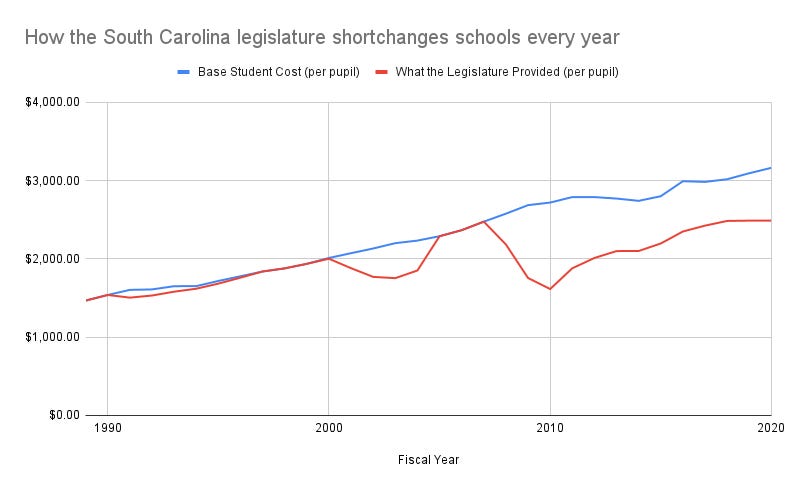
Data compiled by Steve Nuzum, via S.C. Revenue and Fiscal Affairs Office

As a matter of policy, you and your colleagues in the General Assembly have been steadily defunding public education since the start of the Great Recession. You have broken your own promises as outlined in the Education Finance Act and are currently under-funding the Base Student Cost by about a half-billion dollars per year. The results have been disastrous: Our teachers are underpaid and quitting by the thousands, classroom sizes have ballooned, our rural schools are in physical shambles, and a system of separate and unequal education along racial and economic lines has returned with a vengeance.

It is difficult to predict how much money public schools would lose as a result of Education Savings Accounts, which would allow public funds to “follow” individual students to private schools. Our state’s Revenue and Fiscal Affairs Office has tried to guess, though. According to a fiscal impact summary published in December, the ESA program could divert as much as $35 million to private schools within the first year it takes effect, depending how many families participate in the program. By 2026, they estimated the program could cost the state as much as $2.9 billion. Compounded by the General Assembly’s ongoing policy of public disinvestment, this could constitute a death blow to public schools.

The bill is built on a few faulty premises, including the underlying assumption that private schools could or would serve South Carolina students better. The authors of the bill also seem to believe that our state’s private schools could handle a sudden influx of new enrollment while accommodating students’ learning, transportation, and health needs. These are dicey propositions at best.

S. 935 is a direct attack on the notion of education as a public good. Its authors would leave us all to fend for ourselves as atomized individuals, cut loose from mutual obligations that once tied us together. For a certain type of doctrinaire conservative, this may sound like a dream scenario. For the rest of us living in the real state of South Carolina, it is a nightmare come true.

Regards,

Paul Bowers

North Charleston, S.C.

A friend of public schools in Missouri sent the following excerpt of a report by the League report by the state League of Women Voters.

EDUCATION

Senate Education Committee Votes Out Bills

The committee voted out all bills heard thus far this session on February 10, including:

SB 869 (Koenig) to revise the law specifying payments to charter schools and shift more local school funds to charter schools. The League opposes this, based on our position on charter schools and support for public school funding.

SB 650 (Eigel) to allow charter schools to be sponsored by outside entities (other than the local school board) and operate in many districts around the state. Sen. Eigel also offered a proposed SCS version that would add several other provisions, including moving school board elections to the November election, adding restrictions on approval of debt service levies, preventing schools from requiring face masks, and preventing school districts from requiring students or staff to have COVID vaccinations. The League opposes the bill.

House Elementary & Secondary Education Committee

The committee met on February 8 and heard HB 2428 (Dogan) to impose restrictions on instruction relating to race and history. The bill authorizes lawsuits against school employees for violations of the new requirements in the bill. The League opposes the bill.

As soon as he was elected NYC mayor in 2003, Michael Bloomberg asked the Legislature to give him full control of the schools. The Legislature, wowed by the billionaire mayor with a reputation for business acumen, gave him what he wanted. He promptly renamed the Board of Education, and turned it into the Department of Education, no longer an independent agency but a branch of city government, like the Fire Department or the Department of Sanitation. It’s previous governing board, called the Board of Education for more than 150 years, was dubbed the Panel on Educational Priorities. The PEP had a majority appointed by the mayor, who served at his pleasure. He could fire them at will. Bloomberg used his power to reorganize the entire school system four times, to close scores of schools, especially large high schools, to open hundreds of small schools and charter schools.

The old Board of Education had a public relations department of three people, whose main job was to write press releases. Under Bloomberg’s control, more than 20 people joined the PR department, and they existed to glorify and exalt every action or decision by the mayor and his chancellor.

This authoritarian structure has remained in place for almost 20 years. No mayor wants to give up control of the schools. The schools continue to be plagued with problems, not surprisingly. Mayoral control solved nothing, despite years of extravagant (and illusory) claims about a “New York City miracle.” Academics wrote books about the glories of mayoral control, now forgotten. The “miracle” faded away.

Parent leaders wrote a demand to restore democratic governance, which appeared in the Gotham Gazette.

On February 15, San Francisco will hold a recall election for three members of its school board. Big contributions are pouring in from the pro-charter plutocrats.

The pro-recall campaign has collected nearly $2 million. The anti-recall campaign has raised a small fraction of that, about $30,000.

Arthur Rock, a California billionaire who has given many millions to Teach for America and charter schools, has given $399,500 to support the recall.

If you set aside the pandemic and the renaming of schools and look at the long term, one of the major issues facing San Francisco Unified School District, and other districts around the country, is the rise of charter schools.

Charter school proponents, led by the likes of Michael Bloomberg and Betsy DeVos, are in essence trying to privatize public education. They want to create a market system where parents get vouchers and can send their kids to private schools or public charters (which typically do not have unionized teachers), starving the public-school system of money.

We all know the outcome: The charters and private schools, which set their own admission policies, will take the students who have the most advantages and need the least help. The public schools will wind up having to educate, with far less money, the most vulnerable populations, who will wind up will lower-quality schools—and economic inequality will get worse, which is fine with the billionaires.

Rock is a big charter-school and voucher proponent.

Again, set aside the pandemic for a moment. The current members of the SF School Board who are facing a recall have been dubious, at best, about charter schools. That may mean a lot more to Rock and his pals that whether Lincoln High School gets a new name.

The Mayor has endorsed the recall. If the recall passes, she gets to choose the new members. If the recall succeeds, the path will open for more charter schools.

Denis Smith wrote the following post on the website of the Ohio Coalition for Equity and Adequacy of School Funding, founded by former state official William Phillis.

The Charter School and Voucher Wars Continue: A Tale of Two Cities, or Maybe Three
Denis Smith, retired school administrator and ODE Charter School Office consultant, discusses school privatization in 3 C’s—Columbus, Charleston and Concord.
Privatization of public education is a plague spreading faster than the COVID-19 virus. It is disabling the education of school children in public school districts across the state and nation. Legislators and governors throughout the nation are enabling this plague with tax funds.

The charter school and voucher wars continue: A tale of two cities, or maybe three


“It was the best of times, it was the worst of times, it was the age of wisdom, it was the age of foolishness,” Charles Dickens famously wrote. But if a latter-day Dickens were writing today, the tale might be about foolishness and not wisdom in the misuse of public funds. And the setting would not be two, but three cities, state capitals whose names, interestingly enough, all begin with the letter C. 
Certainly the times aren’t exactly Dickensian, but there is nevertheless the distraction of a raging global pandemic. Moreover, since today’s tale deals with recent events in these state capitals, that means we must relate a tale not of wisdom but of foolishness in the legislatures that sit in Charleston, West Virginia; Concord, New Hampshire; and Columbus, Ohio. The three states are alike in that they show a trifecta government in place, where both houses of the legislature and the governor’s office are under Republican control.
Which means that when the topic is the privatization of public education, where state funds are used in violation of state constitutional language to support private and religious schools and tax dollars are siphoned away from neighborhood public schools, there is no wisdom to be found on the front or back benches of these legislatures, only foolishness.
Or maybe that foolishness disguises deliberate, reckless behavior that enables a legislative wrecking crew intent on destroying public education, constitutional norms notwithstanding.
Let’s start with developments in Charleston, West Virginia. 

On Dec. 20, a circuit judge issued an injunction temporarily halting the opening of the first charter schools in the Mountain State. In that action, Kanawha County Circuit Court Judge Jennifer Bailey ruled that the creation of an unelected body, the West Virginia Professional Charter Board, violated the state constitution because an independent school district cannot be created within an existing county school district without the consent of the voters in the district or the county school board’s elected board of education. The judge’s action is expected to be appealed to the West Virginia Supreme Court.
Note that the judge is merely asking the legislature — and inevitably appellate courts, to honor the principle of seeking the consent of the governed, as called for in the state’s constitution.
Meanwhile, in another state capital that begins with the letter C, opposition to legislation that would support vouchers in New Hampshire drew 600 people to Concord, and after thousands of citizens had contacted their representatives in defense of their public schools.

As a result of stiffening opposition from communities who see their school systems strapped for revenue following a series of tax cuts to state businesses, the New Hampshire legislature on Jan. 6 tabled House Bill 607, a new voucher bill that would greatly benefit private and religious schools. This action, taken at the very beginning of the legislative session, was in part a result of six lawsuits against the state “for avoiding its constitutional mandate to fund an adequate education.” Interestingly enough, the first in that series of lawsuits challenging the adequacy of state funding for public education in New Hampshire occurred in 1993, at the very time the landmark DeRolph v Ohio school funding case was winding its way through courts in the Buckeye State. 
Like the situation in the Mountain State, with its charter-loving legislature poised to further damage poor county school systems in a low-wealth state, we await further developments from the Granite State, where the legislature, like the situation in West Virginia, works hand-in-hand with a Republican governor to further undermine public education.
Which brings us to the charter and voucher war situation in the third letter C capital, Columbus.
Parallel with the anti-voucher developments in Concord, New Hampshire’s capital, the pushback against educational vouchers in Columbus also picked up steam on Jan. 4, when 100 school districts joined in a lawsuit against the state of Ohio for violating the constitutional requirement to fund an adequate system of public education. The emphasis here is on the word system, as that term is used in the singular form.
At issue is a huge expansion of the voucher program, or EdChoice, as it is commonly known. Since the establishment of the Cleveland Voucher Program in 1996, Republicans have schemed to expand what they call school choice, and what others argue is instead code language for school privatization and public school destabilization, a sure way to destroy public employee unions. 
Critics have long contended about the hypocrisy of Republicans who have long fashioned themselves as the party of strict constructionism when it comes to constitutional issues. In particular, the coalition of Ohio districts contend that the language in Article VI, Section 2 is abundantly clear: “The General Assembly … shall secure a thorough and efficient system of common schools throughout the state …”
William Phillis, a former deputy state superintendent of schools and long-time leader of the public school advocacy group, Ohio Coalition for Equity and Adequacy of School Funding, argues that there is no ambiguity in the meaning of that part of the Ohio Constitution. He wrote recently:
“The definitions of key words are taken from Noah Webster’s American Dictionary of the English Language, published in 1828.
System: an assemblage of things adjusted into a regular whole. The State is responsible for a system, not systems.
Therefore, the State is responsible for a (i.e.) one high-quality system of schools belonging to all. Private schools constitute a grouping of schools for which the State has no responsibility and is constitutionally forbidden to support.”

The lawsuit filed by Ohio school districts against the legislature for creating systems (note the use of the plural form here) of schools by using public funds to support private and religious schools in violation of the state constitution has received national attention. That is in addition to the privatization and voucher moves being engineered in the other two state capitals.
If only. Yes, if only the charter school and voucher-loving Ohio legislature could learn something from fellow legislators in the Granite State of New Hampshire and from a county judge in West Virginia. It starts by reading – and accepting – clear constitutional language, an exercise that Republicans (used to) call strict constructionism.
Those who value public services and the need for strict constructionism in following the letter of the law as written in state constitutions need to follow the drama found in this tale of three cities, Charleston, Concord, and Columbus. But if these hypocrisy-filled legislators continue their rampage of privatization unchecked, it will indeed be the worst of times, an age not of wisdom but of foolishness.
And you can add recklessness to that.
It was Mark Twain, the sage of Hannibal and Hartford — yet another state capital — who supposedly said that “no man’s life, liberty, or property are safe while the legislature is in session.” He knew what he was talking about.
To be continued. 

https://ohiocapitaljournal.com/2022/01/21/the-charter-school-and-voucher-wars-continue-a-tale-of-two-cities-or-maybe-three/

https://vouchershurtohio.com/8-lies-about-private-school-vouchers/Like us on Facebook: https://www.facebook.com/OhioEandA

William L. Phillis | Ohio Coalition for Equity & Adequacy of School Funding | 614.228.6540 |ohioeanda@sbcglobal.nethttp://ohiocoalition.org

The Governor and the leader of the Oklahoma State Senate are enthusiastic about a voucher bill but the Speaker of the House said the bill won’t get a hearing.

It seems that rural districts don’t want vouchers. This has been the case in Texas, where rural Republicans have repeatedly joined with urban Democrats to kill vouchers. Pastors for Texas Children organized against vouchers in their state, and so did Pastors for Oklahoma Children.

OKLAHOMA CITY (AP) — A proposal endorsed by Oklahoma’s governor and Senate leader to allow public school funding to follow students to private schools or home schools won’t be heard in the House, Speaker Charles McCall said Thursday.

“I don’t plan to hear that bill this year, and I’ve communicated that,” McCall, R-Atoka, told reporters at a legislative forum hosted by The Associated Press and the Oklahoma Press Association.

“That topic is just not on the radar or the minds of our members as a priority,” McCall said. “It’s never been discussed in our caucus retreat as a priority of our members.”

The proposal is a priority for Senate President Pro Tempore Greg Treat, and Gov. Kevin Stitt endorsed the idea Monday in his State of the State address to the Legislature, saying it would make the state a national leader in school choice.

“We know education is not one-size-fits-all, and I pledge to support any legislation that gives parents more school choice, because in Oklahoma, we need to fund students, not systems,” Stitt said Monday.

But the idea has faced bipartisan opposition in the Legislature, particularly from members who represent rural districts where there are few private school options for students.

“It’s a bit of geographical issue,” said McCall, whose district in southeast Oklahoma includes towns like Atoka, Davis, Mannsville and Tishomingo. “He (Treat) is a suburban Oklahoma guy. I’m a rural Oklahoman. We see things through the lens of our individual districts.”

Margaret Renkl, a contributing opinion writer for the New York Times, wrote recently about the cultural controversies that are roiling the state of Tennessee. Everyone by now knows about the removal of MAUS from the eighth-grade curriculum in McMinn County. But book-banning and censorship are not limited to Tennessee, or even to the South, nor are they new. What is far more dangerous in Tennessee, she writes, is the “existential threat” to the future of public schools posed by Republican Governor Bill Lee and a like-minded legislature.

She wrote:

NASHVILLE — Tennessee school boards, you may have heard, have been busy lately striking long-beloved, award-winning classic literature from their social studies and language arts curriculums. The Williamson County School Board recently took a hard look at more than 30 texts, restricting the use of seven and striking one altogether: “Walk Two Moons,” a Newbery Medal-winning, middle-grade book by Sharon Creech that follows the story of a 13-year-old girl whose mother is missing. According to the group Moms for Liberty, who lodged the formal “reconsideration request” that caused the school board to take up the issue, “Walk Two Moons” is inappropriate for fourth-grade readers because it features “stick figures hanging, cursing and miscarriage, hysterectomy/stillborn and screaming during labor.”

Well, may God save all American children from the knowledge that women in labor are apt to scream.

The media didn’t pay much attention to Williamson County because the outrage over MAUS made international news. She notes that the American Library Association’s list of books that are challenged includes some that offend parents who are not southerners.

She continues:

Still, it is possible to trust that the parents in McMinn County are acting in what they believe is the best interest of their children, and also to recognize that these parents are being manipulated by toxic and dangerous political forces operating at the state and national levels. Here in Tennessee, book bans are just a small but highly visible part of a much larger effort to privatize public schools and turn them into conservative propaganda centers. This crusade is playing out in ways that transcend local school board decisions, and in fact are designed to wrest control away from them altogether.

I don’t mean simply the law, passed last year, that limits how racism is taught in public schools across the state. I’m talking about an array of bills being debated in the Tennessee General Assembly right now. One would purge books considered “obscene or harmful to minors” from school libraries across the state. Another would ban teaching materials that “promote, normalize, support or address lesbian, gay, bisexual or transgender (LGBT) issues or lifestyles.” Yet another would prevent school districts from receiving state funding for undocumented students.

Most of all I’m talking about Gov. Bill Lee’s announcement, in his State of the State address last week, that he has approached Hillsdale College, a Christian institution in Michigan, to open 50 charter schools in Tennessee — Mr. Lee reportedly requested 100— that would follow a curriculum designed to make kids “informed patriots.” Not informed citizens; informed patriots, as conservative Christians define that polarizing term.

“What strikes me as the unusual takeaway is that the governor is intentionally wheeling the state into this very ideologically loaded and electorally loaded civics education,” said Adam Laats, the author of “Fundamentalist U: Keeping the American Faith in Higher Education,” in an interview with The Tennessean.

That’s not surprising at all if you know anything about the Tennessee Republican Party, which is in lock step with right-wing oligarchs funding their campaigns. The fact that so many of these challenged books have been in the literary canon for decades is a dead giveaway that the new bans are a response to contemporary political forces whose true motivation has nothing to do with books. What they really want is to destroy public education. As Christopher Leonard, the author of “Kochland: The Secret History of Koch Industries and Corporate Power in America,” notes in an interview with Jennifer Berkshire and Jack Schneider for the “Have You Heard” podcast: “The ultimate goal is to dismantle the public education system entirely and replace it with a privately run education system.” (Read a transcript of the full interview here.)

The real tragedy in Tennessee, and across the red states, is this existential threat to public education, which is the very foundation of a functioning democracy. And that’s where our outrage should lie — not at school boards whose decisions are formed by parental concerns that simply differ from our own. [emphasis added]

Governor Bill Lee has made his education views clear: He is a supporter of vouchers and charter schools. His voucher legislation has been held up in the courts on appeal, and voucher opponents are fearful that the highest court will support vouchers, which has become dear to the heart of Republicans everywhere.

In Governor Lee’s budget message, he proclaimed his intention to expand charter schools in the state. He also promised to let parents know which books their children are exposed to, in the classrooms and in school libraries.

The Nashville Tennessean reported that Lee has already planned a partnership with the far-right fundamentalist Hillsdale College in Hillsdale, Michigan, to open charter schools across the state. Lee originally asked Hillsdale to start 100 charters but apparently the College felt it could handle only 50. Hillsdale is one of the few colleges that has never accepted any form of federal aid, not even scholarships, to protect its independence and religious teachings.

Hillsdale has established 21 charter schools across the nation to spread its ultra-conservative political and religious values and views.

The college was founded by Baptists and has preserved its Christian identity, which it has infused with intellectual, cultural and political conservatism, said Adam Laats, a history professor at Binghamton University and an expert on institutions like Hillsdale. 

The college has positioned itself as “a sort of libertarian or ‘fusionist,’ is what the nerds call it, type of conservative alignment,” said Laats, author of “Fundamentalist U: Keeping the American Faith in Higher Education..” 

In addition to the charter schools it helps establish, Hillsdale has produced, “The Hillsdale 1776 Curriculum,” that includes lesson plans for teachers...

Partnerships between states and colleges and universities for K-12 education initiatives is common, Laats said. But he said there seems to be unique elements with the prospective Tennessee-Hillsdale partnership.

“What strikes me as the unusual takeaway is that the governor is intentionally wheeling the state into this very ideologically loaded and electorally loaded civics education,” Laats said. 

The college promotes conservative Christian values and has close ties with former President Donald Trump’s administration. Some Hillsdale alumni served in the Trump administration.

The school is popularly known for rejecting federal government financial aid, meaning it is not subject to some federal regulations that many colleges and universities are.

Hillsdale has a statue of Ronald Reagan on its Michigan campus, and Governor Lee quoted Reagan, talking about teaching the basics and “true” American history.

Ronald Reagan is a graduate of public schools in Illinois.

Perhaps the new Hillsdale charters could be referred to as the MAGA chain.

We know how poorly the all-charter Achievement School District performed in Tennessee. Why would Governor Lee expect different results? The rumor is that he plans to plant the Hillsdale charters in rural communities, which is odd since rural communities typically have one schoolhouse that is a much-loved part of the community.