Archives for category: Disruption

This is a remarkable investigative article in the Missouri Independent by Annelise Hanshaw about the Herzog Foundation, which is spending its fortune on eliminating public schools and spreading “Christ-centered” schools.

Every state should have a journal like the Missouri Independent to sponsor independent investigative journalism.

The article contains some remarkable graphics about the linkages among rightwing groups, the foundation and the Republican Party. I won’t reproduce them, so please open the link and read the article and see the graphics. And read the story in full.

Hanshaw writes:

The headquarters of the Herzog Foundation sits on the edge of Smithville, in an 18,000-square-foot stone and glass building on a corner lot across the street from a cornfield on a gravel-lined highway.

Few Missourians have likely heard of the Stanley M. Herzog Charitable Foundation, or the organization’s namesake. But the unassuming locale masks what has been described as the “epicenter of the school-choice movement.”

Stan Herzog’s political largesse bankrolled a generation of conservative candidates and causes in Missouri, pouring through a constellation of political action committees and nonprofits. When he died in 2019, he set aside $300 million to start a foundation dedicated to expanding the reach of Christian education.

That mission kicked into overdrive in 2021, when Missouri lawmakers created a tax credit to support scholarships to help low-income students and those with disabilities attend private schools. Since then, a subsidiary of the Herzog Foundation has distributed almost half of the scholarships in the state.

And while the foundation thrives in Missouri, it also spreads its message nationwide.

It champions rallies across the country, holds workshops and bankrolls Christian-school-building packages. Former U.S. Secretary of Education Betsy DeVos spoke at the Herzog Foundation’s launch, and former U.S. Secretary of State Mike Pompeo gave a presentation at the foundation’s headquarters this February.

The foundation is barred from direct electoral activity because it is a charity, but businesses and political entities connected to Herzog continue pouring money into campaigns — spending more than $3.6 million on campaigns for state office since Herzog’s 2019 death , according to Missouri Ethics Commission filings.

It’s a recipe that gives the Herzog Foundation considerable stature in Missouri politics, as the push to expand Herzog’s education agenda continues to pick up steam.

“As far as education goes in Republican Party politics, they’re one of the major influencers in the state,” said Jean Evans, American Federation for Children’s Missouri state lead [Betsy DeVos’s organization].

“The Herzog family has been prolific donors to the Republican Party for a long time,” Evans added. “Stan Herzog passed away, but they’ve continued to support candidates and political causes. And now the Herzog Foundation is involved.”

But the foundation is not without its critics, who claim its real goal is the destruction of public education in Missouri and across the country.

“Herzog and other groups like Herzog have made it their goal to funnel money from taxpayers to private institutions,” said Rep. Maggie Nurrenbern, a Clay County Democrat who is running for a seat in the Missouri Senate.

“We’re going to continue to see more legislation pushed by groups like Herzog to dismantle public schools as we know them,” she said…

Herzog laid the groundwork for the Herzog Foundation in 2016, but it didn’t launch until after his death, when he set aside nearly $325 million for his mission, giving entrusted parties 20 years to spend his endowment.

Leading the foundation is Todd Graves, a former U.S. attorney and chairman of the Missouri Republican Party whose brother is U.S. Rep. Sam Graves.

Kristen Blanchard Ansley is the secretary and treasurer. She is a former executive director of the Missouri Republican Party, and over the years has been involved in numerous PACs and nonprofits that poured Herzog’s money into state and local campaigns.

In December 2021, the leaders of the Stanley M. Herzog Charitable Foundation established another nonprofit called the Herzog Tomorrow Foundation. It was created specifically to distribute tax dollars set aside by Missourians under the new scholarship program created by lawmakers.

The program works by allowing Missourians — both individuals and businesses — to donate to educational assistance organizations in return for a tax credit equal to the donation, as long as it’s 50% or less of their tax burden.

When the General Assembly passed legislation in 2021 to create the program, the fiscal note indicated that the tax credits would take up to $75 million from the state’s general revenue annually.

Herzog Tomorrow Foundation’s application to participate in the program says its goal is to “catalyze and accelerate the development of quality Christ-centered K-12 education.”

It is allowed to take a percentage of the scholarship funds to cover administrative costs: 10% of the first $250,000, 8% of the next $500,000 and 3% of funds raised thereafter.

But the administrative fees don’t appear to be the motivating factor for becoming an educational assistance organization. According to Chris Vas, scholarship director at Herzog Tomorrow Foundation, the organization donated $800,000 back to the program “to ensure that every eligible student who applied for a scholarship received one….”

Of the 1,313 students with scholarships in the first year, Herzog Tomorrow Foundation handled 598 of them, according to the treasurer’s office.

Vas testified in a House committee hearing in March that the foundation raised $3.1 million from 165 donors.

He said 20% of scholarship recipients had an individualized education plan, an accommodation plan and set of goals for students with disabilities. An additional 60% qualified for free or reduced lunch, and the rest were from families with incomes below 200% the free or reduced lunch threshold.

The foundation partnered with 80 schools statewide, of which 65 had a religious affiliation.

Influence

In the Stanley M. Herzog Charitable Foundation’s 2020 tax filing, the organization’s attorney stated that the foundation did not “attempt to influence any national, state or local legislation” and did not “participate or intervene in any political campaign.”

Vas said in an email that the foundation also “does not play any role in the legislative process.”

But while the foundation is prohibited from interfering in politics, Herzog’s money has long helped bankroll a web of politically active nonprofits and political action committees — most of which are tied to the foundation’s current leadership team.

Graves, in addition to being partner of a law firm that represented former Missouri Gov. Eric Greitens, Tea Party Patriots and witnesses in the federal January 6 probe, serves on three committees led by Leonard Leo, a Federalist Society co-chair that former president Donald Trump enlisted to help choose conservative judges.

Many of the political nonprofits and PACs funded with Herzog’s money list Graves’ law firm as their address.

[Open the link and see the graphic here identifying the connections.]

Ansley is a board member of Cornerstone 1791, which also goes by “Liberty Alliance USA.” Vas serves as Cornerstone 1791’s executive director.

Cornerstone 1791 has spent a majority of its expenditures paying Robidoux Services LLC. In 2020, it spent nearly $250,000 for “management, operations and consulting services.”

Robidoux Services has no online presence. Graves is its registered agent, and its office is the Graves Garrett LLC office, according to the business’s paperwork. Vas did not respond to a question asking what Robidoux Services is.

Other expenditures include a $1,105 contribution to “Don’t Tread on MO PAC,” a political action committee with Vas as treasurer, and $1,075 to “Excelsior PAC,” which Vas became treasurer of two years later.

In October 2022, Excelsior PAC spent $15,000 on mailers opposing state Rep. Ashley Aune. Axiom Strategies created the mailing, designing an image of Aune riding a bicycle with U.S. Rep. Alexandria Ocasio-Cortez.

“Radical liberal Ashley Aune wants to bring AOC-style politics to Jefferson City,” the postcard says.

Aune told The Independent her Platte County seat was eyed by Republicans as a district that could turn red.

“I was really surprised because it was just so far-fetched and kind of funny,” she said, recalling when she saw the postcard. “It’s not lost on me that A.O.C. and I are two Hispanic-identifying women, and we were being demonized.”

Ansley, Vas and Elliot also sit on the board of the Missouri Alliance for Freedom, a political nonprofit that has spent $770,000 since 2017, and American Democracy Alliance, a nonprofit that mostly donates to other nonprofits connected to Herzog.

Last year, a political action committee called “Let’s Go Brandon” poured money into the county executive race in Jefferson County to defeat former state Sen. Paul Wieland.

Wieland had drawn the ire of Graves when he vocally opposed his nomination for the University of Missouri Board of Curators a year earlier. And the money Let’s Go Brandon spent attacking Wieland came from an attorney who has long been close to Graves named Michael Ketchmark and Herzog Contracting Corporation.

Vas served as treasurer of Let’s Go Brandon while also working as the Herzog Foundation’s content director. He did not answer The Independent’s question asking why his PAC campaigned against Wieland.

He is also treasurer of Don’t Tread on Missouri PAC and Excelsior PAC.

Herzog companies have contributed $2.16 million to Missouri committees since 2017, when the state established campaign contribution limits….

[Open the link and see the graphic here to see Herzog’s contributions.]

At the end of 2021, the Herzog Foundation had nearly $364 million in assets, up $7.4 million from the previous year.

Although Stan Herzog gave 20 years to spend his endowment, investment income should sustain the foundation beyond that timeline.

With a resume of training events, awards, podcasts and speaker series — the foundation is likely expanding its programs.

The Herzog Tomorrow Foundation, the nonprofit that distributes Missourians’ tax dollars as an educational assistance organization, filed a business name with the secretary of state: “American Christian Education Alliance.”

In January, the nonprofit applied for two trademarks. The trademark registration is intended to cover “charitable fundraising” and “financial administration of education grant programs developed for students seeking a Christian education.”

Vas said ACE Alliance is a “project of the Herzog Tomorrow Foundation.”

“Its focus is to build a nationwide coalition of Christian education supporters,” he said.

Even before Missouri’s tax credit program was implemented, lawmakers were considering expanding it. While those efforts stalled, proponents are expected to try again when the legislature reconvenes in January.

“The MOScholars program has allowed low-income students and students with (individualized education plans) to attend the school of their dreams. We are extremely proud to participate in the program and help the next generation achieve the education that they deserve,” Vas said. “Our only hope is that we can help more kids in the future.”
Robert Hubbell wrote about two women who refused to be intimidated by the MAGA cult: Ruby Freeman and her daughter Shaye Moss. Despite death threats and harassments, they stood their ground. Guiliani will appeal the verdict.

He writes:

Jury Awards Ruby Freemen and Shaye Moss $148 million in damages against Rudy Giuliani for defamation.

The damages award of $148 million against Rudy Giuliani encapsulates the madness, frustration, and perseverance that define the lives of millions of activists during the American era of The Big Lie. It is tempting to characterize Giuliani’s defamation of Ruby Freeman and Shaye Moss and their hard-won victory as a metaphor for Trump’s political arc over the last seven years.

But what happened to Freeman and Moss is not a metaphor. It is the cold, hard reality that slaps each of us in the face every day as we are assaulted by lies heaped upon lies. Not everyone is a direct victim of the lies like Freeman and Moss, but we are all victims, nonetheless.

The point of the lies is not (only) to injure Trump’s enemies, it is to erode trust in the system until there are no guardrails left—hoping to create chaos in which the most depraved believe they have an advantage over those still ruled by conscience, decency, and fealty to the rule of law.

Trump and his enablers tell outlandish lies because they know that media outlets will dutifully repeat the lies in headlines and news alerts, reserving tepid skepticism for paragraphs buried deep in their coverage. 

Direct victims like Freeman and Moss are viewed as expendable collateral damage. Their names and addresses are shared in dark corners of the web so Trump’s followers can make threats even he dares not voice (in public).

The full weight of Trump’s malevolent organization was directed at Freeman and Moss. But they did not buckle. Two women who were motivated to help fellow Georgians vote in a free and fair election stood their ground. 

Their reputations were smeared by the sitting President of the United States, the Georgia legislature, Fox News, One America Network, Steve Bannon, Rudy Giuliani, and millions of users on Twitter, Facebook, and other social media platforms. 

A preacher and a rap star’s publicist teamed up to urge them to falsely confess to non-existent crimes—saying it was the only way to stop the ugly death threats. The FBI’s unhelpful response was to advise them to “Move out of your homes.”Despite tens of thousands of vile threats, no one was arrested, investigated, charged with crimes, or sued for defamation.

At least not at first.

But the guardrails held. Because Ruby Freeman and Shaye Moss stood their ground. 

Because they stood their ground, Democrats on the January 6 Committee allowed them to tell their story to the nation.

Because they stood their ground, the rap star’s publicist and the preacher were indicted in Fulton County, Georgia for “solicitation of false statements and influencing witnesses.

Because they stood their ground, the former president was indicted for lying about the 2020 election. The indictment specifically alleged that the former president was responsible for the campaign to smear Freeman and Moss—lies that were part of his conspiracy to defraud the United States. (See indictment, ¶ 26.)

Then, Freeman and Moss sued Rudy Giuliani for defamation. He did his best to derail and delegitimize the civil claim for damages. But he failed. The guardrails held. All because Ruby Freeman and Shaye Moss stood their ground.

Two women who wanted to help people vote in Georgia stood their ground against fancy lawyers and paid liars, a depraved president and corrupt legislators, and a news ecosystem determined to sell as much soap for as long as possible by repeating the baseless claims about Freeman and Moss.

Two women who stood their ground. That is all it took for the guardrails to hold.

It was not easy. Their stance took courage and faith. They suffered mightily. But they persevered. They are heroes of American democracy.

There can be nothing more hopeful than their example—and their victory—to remind us of the power within each of us to maintain the guardrails of democracy. Those who sow chaos in the hope that the most depraved among us will win by brute force are wrong.

People are drawn to those who promote conscience, decency, and fealty to the rule of law—especially during times of turbulence and distress.

Ruby Freeman and Shaye Moss prevailed over Giuliani (and Trump) the moment they reported for work on November 3, 2020—because they joined tens of thousands of other Americans in becoming the guardrails of democracy that ensured a free and fair election.


Concluding Thoughts.

Every American who is taking action to defend democracy is like Ruby Freeman and Shaye Moss. The work may not seem glamorous. But counting ballots in Georgia on November 3, 2020, was tedious work—until it became a nation-defining moment that tipped the balance of a contested election.

We will never know which letter, text, door knock, or donation will become a tipping point. But some of them surely will. Indeed, because a tipping point always sits atop every action that preceded it, every letter, text, door knock, or donation contributes to the tipping point. Like Ruby Freeman and Shaye Moss, you are part of the guardrails of democracy.


S

Chalkbeat reports that the Chicago school board wants to de-emphasize school choice and reinvigorate neighborhood schools. Chicago has been through a quarter-century of school choice, and leaders believe it’s time for a change.

Chalkbeat says:

Chicago school leaders want to move away from the district’s system of school choice — in which families apply to a myriad of charter, magnet, test-in, or other district-run programs — according to a resolution the Board of Education will vote on this week.

The move puts in motion Mayor Brandon Johnson’s campaign promise to reinvigorate Chicago Public Schools’ neighborhood schools. On the campaign trail, Johnson likened the city’s school choice system to a “Hunger Games scenario” that forces competition for resources and ultimately harms schools, particularly those where students are zoned based on their address.

District leaders’ goals include ensuring “fully-resourced neighborhood schools, prioritizing schools and communities most harmed by structural racism, past inequitable policies and disinvestment,” the resolution, which was released Tuesday, said.

The board wants to pursue that policy goal — and several others — as part of the district’s five-year strategic plan, which will be finalized this summer. In an interview with reporters on Tuesday, CPS CEO Pedro Martinez, Board President Jianan Shi, and Board Vice President Elizabeth Todd-Breland declined to specify changes or say how far they want to move away from the choice system. That’s because they want to collect community feedback on how far the district should go, which would be outlined in a final five-year strategic plan this summer, they said.

The board is expected to vote Thursday on the resolution, which doesn’t create or get rid of any policies; rather, it formalizes and publicizes the district’s goals.

The district wants to “transition away from privatization and admissions/enrollment policies and approaches that further stratification and inequity in CPS and drive student enrollment away from neighborhood schools,” the resolution says.

This marks the first time the board has formally stated it wants to move away from selective admissions and enrollment policies. It says the school choice system, as it exists today, “reinforces, rather than disrupts, cycles of inequity” and must be replaced with “anti-racist processes and initiatives that eliminate all forms of racial oppression.”

Some selective enrollment and magnet schools lack the diversity of the city, enrolling larger shares of white and Asian American students, while others remain largely segregated by race and class.

Martinez said it is painful to hear of students traveling far distances to attend school, or when parents ask if they should get their 4-year-old child tested for gifted programs. He said he can “scream as loud as I can” about all that he believes neighborhood schools can offer to families versus highly sought-after magnet or selective enrollment schools — but “it’s not going to be enough.”

“We see this as an opportunity to, again, build trust, because I want to keep calling that out — that is a huge challenge for us,” Martinez said.

The board will scrutinize charter schools carefully when they apply for renewal.

A complicating factor in the board’s action is that the board is about to make a major change from a mayoral-appointed board to an elected board.

The board’s policy priorities come less than a year before Chicago will for the first time elect school board members. State law currently says 10 members will be elected and the mayor is to appoint another 11. That shift is one reason the board is focused on getting a lot of community feedback on their vision, so new board members “understand this is the direction that the district is moving in,” Shi said.

Political shifts, such as this transition to an elected school board, could upend what the current board wants to do, said Jack Schneider, an education policy expert and professor at the University of Massachusetts at Amherst.

No wonder Jeb Bush wrote an opinion article defending his so-called reforms, especially high-stakes standardized testing.

The Republican-controlled Legislature is moving to dismantle the structure that Bush created when he was governor. Some legislators wanted to cancel recess but the outcry from parents made them drop that idea.

Leslie Postal of The Orlando Sentinel, one of the best education writers in the nation, writes here about the seismic changes in Florida:

The Florida Senate backed away Tuesday from plans to end the state’s recess requirement after objections from “recess moms” but moved ahead with proposals to scrap key, and controversial, parts of the Republican education agenda.


The Senate’s fiscal policy committee agreed by an 18-0 vote to end policies ushered in by former Gov. Jeb Bush more than 20 years ago. Those include requirements that high school students pass two exams to graduate and that third graders pass a reading test to move on to fourth grade.


Under the bill approved by the GOP-dominated committee, students would no longer have to pass an Algebra 1 and a language arts exam to earn high school diplomas. But the 10th-grade language arts exam would count as 30% of a student’s final grade in 10th-grade English classes, just as the algebra exam already counts as 30% of the final grade in Algebra 1 classes.


The bill also would allow third graders who failed the state reading test to be promoted to fourth grade, if that is what their parents thought was best.

Jeb Bush’s allies objected to the changes and said they would water down standards. It’s not yet clear whether DeSantis will go along. Moms for Liberty also objected.

But Republicans in the Senate have pushed and supported the measures, and two committees have now approved them.


Senate President Senate President Kathleen Passidomo introduced the proposals in a memo she sent to senators last month that was titled “Learn Local – Cutting Red Tape, Supporting Neighborhood Public Schools.”


The idea, she said, was that after the Legislature expanded school choice (HB 1) earlier this year, making many more children eligible for private school scholarships, it should look in its 2024 session to remove regulations on public schools, which serve the bulk of the state’s students.


In the memo, she called the ideas “bold,” “controversial” and, she conceded, ones that might “not make it across the finish line.”


Many of the Senate’s suggestions have broad support from school superintendents, administrators, teachers and parents.

Representatives from the Broward, Orange and Seminole county school districts all showed their support Tuesday, for example.


Simon noted that Florida’s new standardized test, FAST, is a “progress-monitoring” exam given several times a year starting in pre-Kindergarten.
“We’re able to find those students much earlier on in the process,” he said, making the current third-grade rule unnecessary.

Recently, I have read alarming articles about state universities eliminating majors in the humanities as a cost-cutting measure while expanding departments that grant degrees in computer science, business, and other job-related fields. Just last week, The Atlantic published an article about the downsizing of foreign languages, linguistics, and other majors at the University of West Virginia, even though the state has a surplus of nearly $2 billion. Other universities are cutting majors in history, the arts, and political science in favor of majors that enhance immediate employability.

Gayle Greene, professor emerita at Scripps College in Claremont, California, contends that such actions are short-sighted. Today—in a world of disinformation, fake news, and Artigiani intelligence—we need the humanitities more than ever so we can discern and weigh facts and reality. In this essay , she shows how tech titans like Bill Gates have encouraged the destructive trend of favoring job-ready degrees.

Greene writes:

“College is remade as tech majors surge and humanities dwindle,” announces Nick Anderson in the Washington Post, May 2023. “Remade” is an understatement, when more students today are majoring in computer science than in all the humanities– English, history, philosophy, languages, the arts— combined. And what for? In the past year, tech has laid off more than 200,000 workers, with more layoffs predicted.


There was a chorus of Cassandras warning against this remake: do not whittle education down to preparation for jobs that might not exist in a decade; do not sacrifice the humanities to STEM. But the hype was so loud, it drowned out the warnings. The STEM skills shortage was broadcast by business leaders, lobbyists, politicians, think tanks, media, and especially by Bill Gates, who spread the word far and wide. He announced to Congress, in 2008, “U.S. companies face a severe shortfall of scientists and engineers with expertise to develop the next generation of breakthroughs.” Obama echoed him in his 2012 State of the Union Address: “I hear from many business leaders who want to hire in the U.S. but can’t find workers with the right skills.” Obama reiterated the message in his 2011, 2013, and 2016 State of the Union Addresses, announcing, in 2013 a competition “to redesign America’s high schools,” rewarding those developing STEM classes to deliver “the skills today’s employers are looking for to fill jobs right now and in the future.”


The hype was hot air. “If a shortage did exist, wages would be rising” rather than staying flat as they have “for the past 16 years,” wrote Ron Hira et al in USA Today, 2014. Obama might have heeded him or Andrew Hacker, Ben Tarnoff, Matt Bruenig, Michael Teitelbaum, Gerald Coles, Walter Hickey, Michael Anft, who raised similar alarms. Or Paul Krugman, who warned, “the belief that America suffers from a severe ‘skills gap’ is one of those things that everyone important knows must be true, because everyone they know says it’s true”; it’s “a zombie idea… that should have been killed by evidence, but refuses to die.”


When an idea persists against all evidence, you have to ask: who profits? A 2012 Microsoft publication warned that the U.S. faces “a substantial and increasing shortage of individuals with the skills needed to fill the jobs the private sector is creating”—even though, in the summer of 2014, Microsoft laid off about 18,000 workers. Other companies,Boeing, IBM, Symantec, were also laying off thousands, sometimes rehiring them at lower salaries, even as they lamented the “lack of qualified applicants,” wrote Hacker.


The problem for a company like Microsoft has not been a lack of skilled workers, but that U.S. tech workers expect to be well paid. Foreign tech workers in the U.S. make about 57% what their U.S. counterparts make. Hence the tech industry’s push for easier immigration policies and H-1B visas, visas that allow U.S. businesses to temporarily employ foreign workers in specialty work like IT. If we don’t ease up on immigration policies, Gates told Congress in 2008, “American companies simply will not have the talent they need to innovate and compete.” Hence Gates’spush for coding and computer classes in schools and colleges. “Nothing would make programming cheaper than making millions more programmers,” wrote Tarnoff, “and where better to develop this workforce than America’s schools.”


The STEM skills shortage was the PR of an industry wanting a large pool of workers ready to work for less, an industry with enormous lobbying power. The campaign has been so successful that now hundreds of thousands of trained workers are newly unemployed in a market flooded by as many as qualified as they. It’s succeeded in bending higher education to its purposes, re-directing it to training for jobs, with tech jobs the most hyped–even though tech comprise less than 8% of the economy. Colleges and universities direct resources that way, private donors pour enormous sums that way, and students follow the money and the buzz, whatever their interests and talents. Humanities enrollments have plummeted, courses, programs, departments have been gutted, and tenured faculty let go.


But what even the most dire of Cassandras failed to see, even those working in AI, was the seismic upheaval AI was about to create.


*******

Obama might have been more cautious about dismantling an educational system that’s served the U.S. so well, a system widely believed to have been the engine of this country’s power and productivity. The U.S. still has the universities that rank highest internationally and have world-wide draw, in spite of the assaults higher education has lately endured. But he went ahead and based his educational policies on the vision of a technocrat (Gates’ word for himself) who sees the purpose of education as making a workforce that will allow U.S. industries “to compete in the global economy,” as Gates said in Waiting for Superman, 2010, a public-school-bashing documentary film he funded and starred in. Obama turned his education department over to the Gates foundation, as Lindsey Layton documented in the Washington Post, 2014: “top players in Obama’s Education Department who shaped theadministration’s policies came either straight from the Gates Foundation in 2009 or from organizations that received heavy funding from the foundation.”


With K-12, Obama uncritically adopted No Child Left Behind (NCLB), the test and assess regime George W. Bush inflicted on public schools in 2002 in the name of “reform”—even though NCLB was an acknowledged disaster by the time Obama took office. Schools could be closed if test scores declined— many were closed, especially in underprivileged areas, where kids don’t test well—which left teachers no choice but to teach to the test and strip curricula of subjects not tested, including literature, history, philosophy, the arts, languages, social sciences. The panic about test scores made a boondoggle for new ventures supplying materials for test- prepping, test-administering, test-scoring, and assessing. In fact, what test scores most reliably measure is how well kids take tests, which penalizes students from disadvantaged backgrounds and makes a mockery of claims that testing levels the playing field, the rationale for so-called reform.


Obama tightened the screws on Bush’s program, requiring states to agree to certain conditions to qualify for federal funding, each of them high on the Gates agenda. States had to agree to make room for more charter schools, and they did—more charters were founded on Obama’s watch than Bush’s. Gates claims that charters will create “choice” and “competition” and incentivize teachers to raise test scores. In fact they have not raised test scores, though they have succeeded in routing public funding to private interests, as they were meant to. States also had to agree to adopt a standardized curriculum. This came in the form of the Common Core State Standards, Gates’ brainchild, which wedded teaching even more closely to testing, assessing, and technology, since standardized material is easily computer-administered and scored. The Common Core has reduced reading and writing to decontextualized skills — “find the main point,” “identify the figures of speech”— which has been a major turnoff for kids. The moaning we hear lately about declining test scores is beside the point: the point is that kids are massively alienated from school because “drill, kill, bubble fill” is all they’re fed.


Gates has admitted that transforming K-12 is harder than he’d anticipated: “We really haven’t changed outcomes” (i.e. test scores). But he should not underestimate his impact. His perpetuation of the broken-public-schools narrative, his attack on teachers and tenure, his imposition of mechanization and measurement on an enterprise he knows nothing about, have driven teachers out of the profession in record numbers, with few lining up to take their places. Teachers have written and spoken against the Common Core, forming advocacy groups to resist it, and tens of thousands of parents have opted their kids out of testing— but the machine rolls on. The foundation “has influence everywhere, in absolutely every branch of education…federal, state, local,” with politicians, journalists, administrators, think tanks, summarizes Tom Loveless of the Brookings Institute.


Higher education has been harder to get hold of, on account of the respect it commands throughout the world. But harping on its failures to meet market needs has done much to skew it the Gates way. “The [Gates] foundation wants nothing less than to overhaul higher education, changing how it is delivered, financed, and regulated,” wrote Marc Parry, Kelly Field, and Becky Supiano, in a brilliant expose, “The Gates Effect.” It “would like college to be cheaper, more accessible, and more targeted towards the specific skills desired by employers. Instead of a broad education where a college student might take courses across a range of subjects, the new model has students demonstrating ‘competencies’ by passing tests in specific areas, and receiving a certificate upon completion.” Thefoundation “hasn’t just jumped on the bandwagon,” the authors conclude; “it has worked to build that bandwagon.”


And its stranglehold on mainstream media is murderous. As with K-12, “Gates buys up everyone and engineers the appearance of a consensus,” writes Diane Ravitch. Ravitch was in the first Bush education department and a proponent of No Child Left Behind, but turned against it when she realized its purpose was to route public resources to private interests; she has been a powerful advocate for public schools ever since. As with K-12, “the foundation has bought the research, bought the evaluations, bought the advocacy groups, and bought the media to report on what the foundation is doing. It has lavished support on education journals, while also saturating them with ads and ‘sponsored’ articles.” As with K-12, this creates the sense of a hue and cry from many quarters, of widespread agreement that higher education is broken, resists change, resists innovation, needs technology, needs to produce more STEM workers.


​**********

Fifty years ago, the humanities had a “national mandate,” writes Nathan Heller in a widely read New Yorker article, “The End of the English Major,” February 2023. The liberal arts had pride of place. Now the mandate has moved to STEM, with more than a little push from business interests keen to transform higher education to job preparation and right-wing anti-education agendas.


In 2013, Obama’s administration produced a “Scorecard,” an online tool to show “folks” where they can get “the most bang for the buck,” as he promised in his 2013 State of the Union address. The Scorecard has Gates’ fingerprints all over it. It ranks colleges according to number of graduates, speed to graduation, starting salaries, time taken to pay back student loans—which makes a college rise higher in the rankings for graduating a hedge fund manager than a teacher. And higher education has cooperated, inviting managerial administrators in to make education “more like business,” lean, mean, and cost effective. They’ve stripped away courses and programs with no “real world” value and cut back in areas they deem inessential— like teaching, which has been turned over to part-timers or online programs, while tenured faculty are let go, and with them, tenure. Administrators hire more administrators, offices and functionaries proliferate, and academia is saddled with a top-heavy bureaucracy that drains resources. Then along comes a pandemic that cuts into college enrolments and devalues any enterprise without immediate utilitarian value—and here we are. The humanities are beyond crisis; they’re “on life support,” writes James Engell, Harvard Magazine, February.


And the STEM bandwagon rolls on, powered by Gates lobbying, onto the floor of Congress, where the Higher Education Act, the federal law governing crucial policies such as accreditation and standards that qualify colleges for financial aid, is overdue for reauthorization. In May 2019, the Gates foundation established a new lobbying group, “Commission on the Value of Postsecondary Education,” to make sure Congress understands the “value” of postsecondary education, “value” defined in terms of graduates’ salaries and social mobility. Prior to this lobbying group, the foundation exerted its influence from behind the scenes, but launching a 501c (4) nonprofit enables them to “talk directly with legislators about laws,”explains Nick Tampio. In May 2021, the Commission published a 117-page report, Equitable Value: Promoting Economic Mobility and Social Justice through Postsecondary Education, which spells out elaborate systems of measurement and assessment to make sureschools render dollar for dollar return on investment. The foundation is now in a position to assure that federal funding gets routed to majors leading to jobs Gates sees as vital to the economy.


*********

In 2018, Benjamin Schmidt cautioned against remaking higher ed to meet alleged market needs because nobody could predict what jobs would look like in ten years. Now, with AI to do the work of many humans, we might ask what jobs will look like in ten months. In March, Goldman Sachs released a report estimating that “generative AI may expose 300 million jobs to automation,” work that “might be reduced or replaced by AI systems,” summarizes Benj Rfestfd in Ars Technica. An insider, “Scott,” comments on a NYT article, March 28, on likely effects of GPT (“generative pre-trained transformers” that produce human-like text and images):


As a software entrepreneur who is part of a think tank that studies AI, I can tell you that GPT is not overhyped… it impacts every job from manufacturing to knowledge work, and with some imagination even agriculture, food production and restaurants… People are focusing on a single job? You should start thinking of entire professions, industries and companies (thousands of which GPT will put out of business this year). Our politics are not ready for the disruption, deflation and unemployment.


“We have summoned an alien intelligence,” write Yuval Harari, Tristan Harris, and Aza Raskin in the NYT in March. Our first contact with AI, they note, the relatively simple manipulation of attention by social media, was catastrophic: it “increased societal polarization, undermined our mental health and unraveled democracy.” What comes next is anybody’s guess, but a lot of people are worried, including more than a thousand tech leaders and researchers who signed an open letter in March calling for a six-month moratorium on the development of GPT, citing its “profound risks to society and humanity.”


“It’s a completely different form of intelligence,” says Geoffrey Hinton, the “godfather of AI,” who resigned from Google so he could speak freely; and it’s likely to be “much more intelligent than us in the future.” It has the capacity to flood the internet with fake images and misinformation so convincing that we may “not be able to know what is true anymore”—which is dire for democracy. There are calls for regulation, including from Sam Altman, CEO of Open AI, the company that created GPT-4: “the current worries I have are of disinformation problems, economic shocks, or something else at a level far beyond anything we’re prepared for.”


Meanwhile the titans, Google, Amazon, Microsoft, Meta, are out of the gate, racing for the spoils.


​*********

How to deal with an alien intelligence that’s faster and smarter than we are? Killing the humanities has left us a bit understaffed in this department. By eliminating subjects that might teach us about ourselves and our fellow beings, we’re exacerbating the problems confronting society. Misinformation and conspiracy fantasies flourish, racism and hate crimes are on the rise, along with mortality rates, not only from Covid but “deaths of despair.” Quality of life in the U.S. has plummeted.


Many people fear that the STEM craze may be turning out graduates ignorant of the past and their world, ill equipped for the challenges of an increasingly uncertain future. Spending one’s college years mastering the practical skills of a specialized field does not cultivate a broad understanding of the world. Minds need to be developed all around, if they are to “understand human behavior” and achieve “emotional intelligence and mental balance”— the capacities Yuval Harari says young people most need as they face dizzying change. They’ll need, above all, ”the ability to keep changing,” qualities of adaptability and versatility cultivated by the kind of education we’ve trashed.


“Major in being human,” David Brooks advises young people who are wondering where to turn with AI threatening to steal their futures. Ask yourself, “which classes will give me the skills that machines will not replicate, making me more distinctly human?” Gravitate toward classes that will help you develop “distinctly human skills… that unleash your creativity, that give you a chance to exercise and hone your imaginative powers.” That would be the humanities, small, discussion-based classes where students learn about the past and creations of their kind, about what humankind has been and might be; where they learn to articulate their positions and see that others have positions too, that they can disagree yet get along—which goes a way toward learning to live in society. Find the human, urges Douglas Rushkoff in Team Human, and find the others who can help us resist the anti-human agenda and “restore the social connections that make us fully functioning humans.”


The stakes are high. A 2020 study, “The Role of Education in Taming Authoritarian Attitudes,” found that in all the countries surveyed, higher education correlated with resistance to authoritarianism, but it made the greatest difference in the United States, on account of our unique system of general education based in the liberal arts. Yet this is the system we’re letting go. Authoritarianism thrives on misinformation, on simplistic, us-them thinking. Democracy requires that people deal with complexity, think, question, interpret, inquire, sort out information from misinformation, push back against agendas being pushed on us, take nothing on authority. It requires that people know how to read their world, interpret, evaluate, inquire, consider context and consequences, and know how to seek sources other than social or corporate media. Decoding has a longer shelf life than the coding Gates is pushing. It’s crucial to democracy –and to employability, it turns out, since skills alone become rapidly obsolete.


To disinvest in the humanities is to disinvest in the human, to give up on the hope of a livable world and more humane future. Which is why it’s urgent to resuscitate the humanities and not outsource our humanity to Hal.

##################

Gayle Greene is Professor Emerita, Scripps College, Claremont, CA. Her most recent book is Immeasurable Outcomes: Teaching Shakespeare in the Age of the Algorithm (Johns Hopkins UP, 2023), which makes a case for the humanities by actually showing what goes on in a small discussion class.

Gaylegreene.org

The Center for Budget and Policy Priorities in D.C. issues reports on high-profile issues. This one should be in the hands of every legislator, school board member, and policymaker. It succinctly explains why states should not authorize vouchers.

Iris Hinh and Whitney Tucker wrote this report, which was published in June 2023. One conclusion is clear: vouchers inflict damage on public schools, attended by the vast majority of children, while helping affluent families. After this report appeared, Hinh joined the staff of the Senate Health, Education, Labor and Pensions Committee as an education policy advisor.

Hinh and Tucker write:

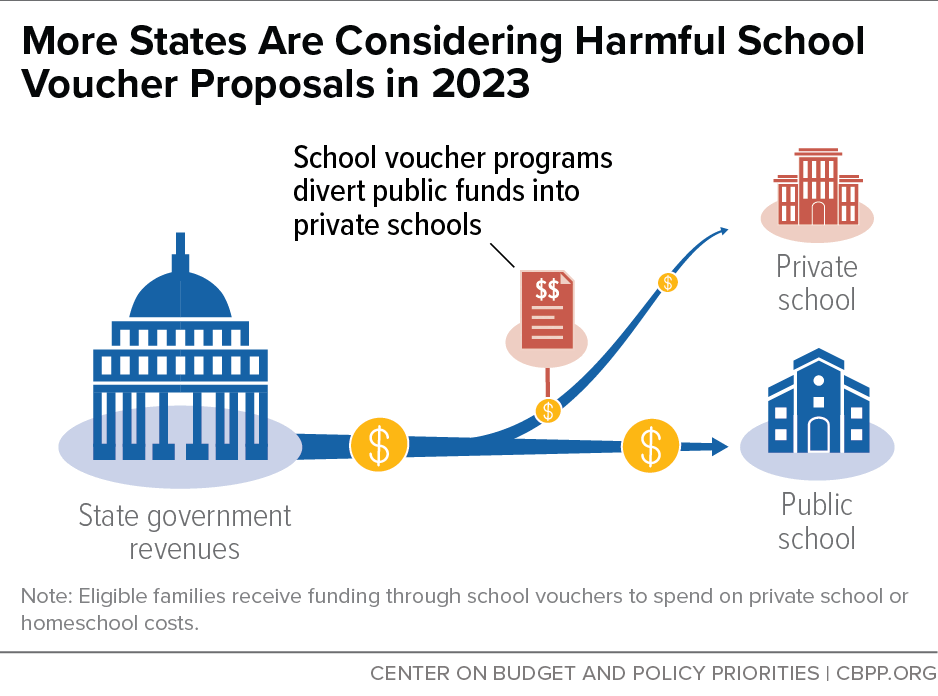
K-12 school vouchers are typically funded through state revenues and give families a set amount of money per eligible student to cover a portion of private school tuition. These vouchers divert money away from public schools, sometimes by directly re-routing education funding to private schools, and other times indirectly by making it harder to pay teachers, buy new textbooks, and provide quality after-school programming. The support for public schools is high: families overwhelmingly support their schools, and many teachers and other advocates for public education oppose vouchers.[1]

In the past few months, state lawmakers have expanded and created a record number of school voucher programs with little to no limits on eligibility. This will deplete available state revenues for public education and other critical services and do little to expand opportunity for students.

Regardless of whether school vouchers directly or indirectly divert funding from public schools to private education, state K-12 funding formulas depend on some metric of student count to allocate per-pupil funding. Some school districts can absorb some of the cuts with layoffs and reduced spending on textbooks and supplies. But fixed expenses such as air conditioning, school buses, and building maintenance can lead to funding shortfalls and layoffs.

In early 2023, these states created or expanded their school voucher policies:

  • Nebraska passed the state’s first voucher program, a K-12 tuition tax credit initially capped at $25 million annually, though the cap could rise to $100 million a year depending on demand for tax credits. Individuals and businesses can donate up to half of their taxes owed (with a maximum of $100,000); donations are funneled to scholarship granting organizations (SGOs), which pay private school tuition and other eligible expenses on behalf of students and their families. The tax credits reduce tax liability and thus, decrease the state revenues available for investments in public services, including public schools. Public school advocates are planning to challenge the bill on the 2024 ballot.
  • ArkansasLEARNS Act created, among other harmful policies for public education and teachers, an education savings account (ESA) program, which will phase in universal eligibility by the 2025-2026 school year and provide state-funded vouchers for families to use toward private school tuition and several other allowable expenses (like homeschooling, exam fees, and tutoring).
  • Florida broadened eligibility requirements to make its existing ESA program available to all students (rather than only students with disabilities or those from low-income families), with an estimated cost of $4 billion in the first year of implementation.
  • Iowa created an ESA that is initially targeted to families with lower incomes. But it will expand over time to include all students by the 2025-2026 school year and cost over $340 million per year when fully in effect.
  • South Carolina expanded the state ESA, lifting household income eligibility to 400 percent of the federal poverty level beginning in 2026-2027, but placing a 15,000-student cap on the program.
  • Utah created an ESA starting in the 2024-2025 school year that is available to all students but gives priority to students based on their household’s income.

Other states should not follow the paths of these states. For one, school vouchers primarily benefit wealthier students, families, and businesses. States with existing voucher programs — Arizona, Missouri, New Hampshire, and Wisconsin — have reported that most families who benefitted were already covering the costs of private schools and homeschooling prior to the voucher becoming available.

Wealthy people and companies also benefit when vouchers take the newer form of K-12 tuition tax credits. People and companies who donate to SGOs are allowed to opt out of paying tax to fund public needs and instead fund tuition scholarships at private K-12 schools. This tax incentive can provide state credits — up to 100 percent of the donation — to families with incomes over $200,000 and even allows businesses to profit from claiming federal expense deductions and avoiding capital gains tax.

Vouchers can also increase the likelihood that students experience discrimination and harm. Private schools are not required to offer the same federal civil rights protections for students as public schools. In fact, many voucher bills explicitly require families to waive students’ protections and rights under the federal Individuals with Disabilities Education Act for educational services that students with disabilities may need to learn.

Further, vouchers do not necessarily expand opportunities for students with the greatest needs. Students from families with low incomes often face barriers to navigating the voucher application and private school admission processes. Smaller, rural areas often rely on their local public schools as community hubs and primary sources of employment. Private schools can more easily push students out without recourse based on how they style their hair, what they wear, test scores, and subjective disciplinary action.

Voucher costs often grow beyond what is projected and thus, reduce overall revenues for other state spending. A recent study of school voucher programsin seven states shows how state voucher spending from 2008 to 2019 increased by hundreds of millions of dollars annually, while K-12 spending for public education declined despite public school enrollment increases. Arizona became the first state to implement a universal voucher program in 2022, and as of mid-March 2023, the ESA program is expected to cost the state at least $345 million more than initial projections for the first year. New Hampshire’s voucher program was estimated to cost $130,000 in 2021 and it now costs $14.7 million. And a few private schools in Iowa are already raising tuition only a few months after the new voucher program passed in January of this year.

Some state lawmakers understood the great cost at the expense of public services and stopped multiple school voucher bills this year. For example, 16 House Republicans broke with their party to defeat Georgia’s universal voucher proposal in the final hours of session. And Idaho Senate Republicans raised concerns about the long-term cost of a universal ESA bill, which also applied to subsequent voucher bills.

As some states continue to debate school vouchers during legislative sessions, state lawmakers should understand that their actions now and in the future will have large fiscal and harmful consequences for public education and student opportunities.

Another state that did NOT pass vouchers was Texas, even though Governor Greg Abbott called four special sessions of the legislature. Rural Republicans refused both bribes and threats and voted against vouchers because they wanted to protect their community schools.

More States Are Considering Harmful School Voucher Proposals in 2023

The graph above appeared in an earlier version of this report, published in March 2023.

The National Education Policy Center published this valuable analysis of the difference between “education savings accounts” and vouchers.

Termed “education savings accounts” (ESAs) these vouchers on steroids were the subject of 79 percent of the 111 voucher-related bills introduced in state legislatures in 2023. Five states enacted new ESAs (AR, IA, MT, SC, and UT). In addition, four states expanded existing ESA programs (FL,IN, NH,TN).

In most ways, ESAs are similar to traditional vouchers that parents have used for decades to pay for private schools at public expense. It’s just that they go a step farther, permitting parents to use the funds not just for private school tuition but for other education-related expenses such as school uniforms, homeschool curricula, and gym memberships.

In a recent article in the Brown Center Chalkboard, a publication of The Brookings Institution, a Washington, DC-based think tank, NEPC fellow Joshua Cowen of Michigan State University writes that he already sees signs that ESAs are following in the footsteps of traditional vouchers, which studies suggest lead to a flood of new providers, many of which quickly close, as well as tuition hikes at existing voucher schools.

“Unfortunately, the voucher research literature suggests that even with new schools opening, there simply are not enough effective private schools to go around,” he writes. “This might explain the dismal academic results over the last decade—and suggests a very real risk in today’s ESA initiatives if they produce large increases in private school enrollment.”

Drawing upon past research on traditional vouchers, Cowen predicts that ESAs will lead to lower student achievement. Evidence on traditional vouchers’ impact on rates of high school graduation and college enrollment is more mixed—but when positive effects were found, they were associated with students spending all four years of high school in a private school. However, private high schools that accept vouchers often experience high rates of churn. In Milwaukee, which Cowen has studied, 20 percent of voucher students left private schools annually. Academic improvements occurred once students returned to public schools.

Voucher advocates disappointed with academic results have blamed over-regulation for the poor outcomes.

Yet Cowen writes that “the only empirical evidence of the effects of accountability on a voucher program found that once voucher schools were required to use the same testing and reporting requirements as their public counterparts, voucher performance improved substantially.”

He added: “The lack of accountability is already raising problems in newer programs. In Arizona, for example, families had a number of questionable expenses approved, and in North Carolina, some private schools are claiming more vouchers than students actually enrolled.”

Unlike earlier traditional voucher programs, today’s vouchers are more likely to be universally available rather than to be offered to certain populations-such as students from low-income families.

“How these new, expanded programs will function is perhaps the key open question for research moving forward,” Cowen writes.

Data from traditional voucher programs has indicated that the larger the program, the worse the results tend to be. In the best case, that’s because there are too few effective private schools to serve expanded voucher programs; in the worst case, there are inherent limits to the choices parents can make when vouchers allow private schools to choose their students as well.

For example, private schools that accept vouchers may implement admissions criteria that screen out students with disabilities, students with low test scores, or emerging bilinguals.

Voucher-accepting schools are also permitted to refuse to accept LGBTQ+ students or families, and to fire or refuse to hire LGBTQ+ staff.

“[I]t remains to be seen how the new expansion of private school choice programs will ultimately affect educational opportunity,” Cowen writes. “But research on traditional vouchers suggests extreme caution when expecting new, favorable results simply because parents of children outside of public school can now spend public dollars on costs beyond tuition.”

Heather Cox Richardson wrote a compelling piece about the challenges we face in the year leading up to the 2024 election. The media keeps warning us about ominous polls, about the dangers of Trump, about Biden potentially losing this or that demographic. Trump seems to be driven by two goals: 1) to stay out of prison (as president, he could pardon himself for federal crimes, not state convictions); and 2) the chance to wreak vengeance on his enemies.

Richardson wrote:

Yesterday, David Roberts of the energy and politics newsletter Volts noted that a Washington Post article illustrated how right-wing extremism is accomplishing its goal of destroying faith in democracy. Examining how “in a swing Wisconsin county, everyone is tired of politics,” the article revealed how right-wing extremism has sucked up so much media oxygen that people have tuned out, making them unaware that Biden and the Democrats are doing their best to deliver precisely what those in the article claim to want: compromise, access to abortion, affordable health care, and gun safety. 

One person interviewed said, “I can’t really speak to anything [Biden] has done because I’ve tuned it out, like a lot of people have. We’re so tired of the us-against-them politics.” Roberts points out that “both sides” are not extremists, but many Americans have no idea that the Democrats are actually trying to govern, including by reaching across the aisle. Roberts notes that the media focus on the right wing enables the right wing to define our politics. That, in turn, serves the radical right by destroying Americans’ faith in our democratic government. 

Former Republican National Committee chair Michael Steele echoed that observation this morning when he wrote, “We need to stop the false equivalency BS between Biden and Trump. Only one acts with the intention to do real harm.”

Indeed, as David Kurtz of Talking Points Memoputs it, “the gathering storm of Trump 2.0 is upon us,” and Trump and his people are telling us exactly what a second Trump term would look like. Yesterday, Trump echoed his “vermin” post of the other day, saying: “2024 is our final battle. With you at my side, we will demolish the Deep State, we will expel the warmongers from our government, we will drive out the globalists, we will cast out the Communists, Marxists, and Fascists, we will throw off the sick political class that hates our Country, we will rout the Fake News Media, we will evict Joe Biden from the White House, and we will FINISH THE JOB ONCE AND FOR ALL!”   

Trump’s open swing toward authoritarianism should be disqualifying even for Republicans—can you imagine Ronald Reagan talking this way?—but MAGA Republicans are lining up behind him. Last week the Texas legislature passed a bill to seize immigration authority from the federal government in what is a clear violation of the U.S. Constitution, and yesterday, Texas governor Greg Abbott announced that he was “proud to endorse” Trump for president because of his proposed border policies (which include the deportation of 10 million people).

House speaker Mike Johnson (R-LA) has also endorsed Trump, and on Friday he announced he was ordering the release of more than 40,000 hours of tapes from the January 6, 2021, attack on the U.S. Capitol, answering the demands of far-right congress members who insist the tapes will prove there was no such attack despite the conclusion of the House committee investigating the attack that Trump criminally conspired to overturn the lawful results of the 2020 presidential election and refused to stop his supporters from attacking the Capitol. 

Trump loyalist Senator Mike Lee (R-UT) promptly spread a debunked conspiracy theory that one of the attackers shown in the tapes, Kevin Lyons, was actually a law enforcement officer hiding a badge. Lyons—who was not, in fact, a police officer—was carrying a vape and a photo he stole from then–House speaker Nancy Pelosi’s office and is now serving a 51-month prison sentence. (Former representative Liz Cheney (R-WY) tweeted: “Hey [Mike Lee]—heads up. A nutball conspiracy theorist appears to be posting from your account.”)

Both E.J. Dionne of the Washington Post and Will Bunch of the Philadelphia Inquirer noted yesterday that MAGA Republicans have no policies for addressing inflation or relations with China or gun safety; instead, they have coalesced only around the belief that officials in “the administrative state” thwarted Trump in his first term and that a second term will be about revenge on his enemies and smashing American liberalism. 

MIke Davis, one of the men under consideration for attorney general, told a podcast host in September that he would “unleash hell on Washington, D.C.,” getting rid of career politicians, indicting President Joe Biden “and every other scumball, sleazeball Biden,” and helping pardon those found guilty of crimes associated with the January 6th attack on the U.S. Capitol. “We’re gonna deport a lot of people, 10 million people and growing—anchor babies, their parents, their grandparents,” Davis said. “We’re gonna put kids in cages. It’s gonna be glorious. We’re gonna detain a lot of people in the D.C. gulag and Gitmo.”

In the Washington Post, Josh Dawsey talked to former Trump officials who do not believe Trump should be anywhere near the presidency, and yet they either fear for their safety if they oppose him or despair that nothing they say seems to matter. John F. Kelly, Trump’s longest-serving chief of staff, told Dawsey that it is beyond his comprehension that Trump has the support he does. 

“I came out and told people the awful things he said about wounded soldiers, and it didn’t have half a day’s bounce. You had his attorney general Bill Barr come out, and not a half a day’s bounce. If anything, his numbers go up. It might even move the needle in the wrong direction. I think we’re in a dangerous zone in our country,” Kelly said.  

Part of the attraction of right-wing figures is they offer easy solutions to the complicated issues of the modern world. Argentina has inflation over 140%, and 40% of its people live in poverty. Yesterday, voters elected as president far-right libertarian Javier Milei, who is known as “El Loco” (The Madman). Milei wants to legalize the sale of organs, denies climate change, and wielded a chainsaw on the campaign trail to show he would cut down the state and “exterminate” inflation. Both Trump and Brazil’s Jair Bolsonaro, two far-right former presidents who launched attacks against their own governments, congratulated him. 

In 1959, President Dwight D. Eisenhower took on the question of authoritarianism. Robert J. Biggs, a terminally ill World War II veteran, wrote to Eisenhower, asking him to cut through the confusion of the postwar years. “We wait for someone to speak for us and back him completely if the statement is made in truth,” Biggs wrote. Eisenhower responded at length. While unity was imperative in the military, he said, “in a democracy debate is the breath of life. This is to me what Lincoln meant by government ‘of the people, by the people, and for the people.’” 

Dictators, Eisenhower wrote, “make one contribution to their people which leads them to tend to support such systems—freedom from the necessity of informing themselves and making up their own minds concerning these tremendous complex and difficult questions.” 

Once again, liberal democracy is under attack, but it is notable—to me, anyway, as I watch to see how the public conversation is changing—that more and more people are stepping up to defend it. In the New York Times today, legal scholar Cass Sunstein warned that “[o]n the left, some people insist that liberalism is exhausted and dying, and unable to handle the problems posed by entrenched inequalities, corporate power and environmental degradation. On the right, some people think that liberalism is responsible for the collapse of traditional values, rampant criminality, disrespect for authority and widespread immorality.”

Sunstein went on to defend liberalism in a 34-point description, but his first point was the most important: “Liberals believe in six things,” he wrote: “freedom, human rights, pluralism, security, the rule of law and democracy,” including fact-based debate and accountability of elected officials to the people.

Back in the day, Republicans believed in deregulating business and keeping them free of government pressures, demands, and mandates.

Not so in Florida, where Governor Ron DeSantis wreaked his vengeance on Disney by ousting the board that controlled Disney’s self-governing district and putting his own hand-picked team in charge. About 10% of employees have quit, complaining of low morale. The hand-picked pal of DeSantis, Glen Gilzean, who runs the Governor’s board, claims that morale has never been higher. Gilzean was formerly CEO of the Central Florida Urban League. He’s paid $400,000 a year to run the district board.

DeSantis controls the Legislature, the state’s Supreme Court, the State Board of Education, the state board of higher education, the state board of K-12 education, and now the Disney district. He has unilaterally removed elected district prosecutors whom he thought were too liberal. He has intervened into local school board elections and backed his preferred candidates.

Fortune magazine took a close look at the Disney empire in Florida, now controlled by an angry little Governor.

Fortune wrote:

Disney on Tuesday released a study showing its economic impact in Florida at $40.3 billion as it battles Florida Gov. Ron DeSantis and his appointees over their takeover of the district that governs the entertainment company’s massive resort in central Florida.

Disney accounted for 263,000 jobs in Florida, more than three times the actual workforce at Walt Disney World, according to the study conducted by Oxford Economics and commissioned by Disney, covering fiscal year 2022. Besides direct employment and spending, the study attributed the company’s multibillion-dollar impact to indirect influences, such as supply chain and employees’ spending.

The jobs include Disney employees as well as jobs supported by visitor spending off Disney World property. In central Florida, Disney directly accounts for one in 8 jobs, and for every direct job at Disney World, another 1.7 jobs are supported across Florida, Oxford Economics said.

The time period in the study is before the takeover earlier this year of Disney World’s governing district by DeSantis and his appointees after Disney publicly opposed a state law banning classroom lessons on sexual orientation and gender identity in early grades. The law was championed by DeSantis, who is running for the 2024 GOP presidential nomination.

Disney officials in the past year have said the company plans to invest an additional $17 billion over the next decade in central Florida, including potentially adding another 13,000 jobs. However, the company has shown a willingness to pull back investing in the Sunshine State. Earlier this year, Disney scrapped plans to relocate 2,000 employees from Southern California to work in digital technology, finance and product development, an investment estimated at $1 billion.

Disney World already has four theme parks, more than 25 hotels, two water parks and a shopping and dining district on 25,000 acres (10,117 hectares) outside Orlando, Florida.

Disney is battling DeSantis and his appointees in federal and state courts over the takeover of what was formally called the Reedy Creek Improvement District but was renamed the Central Florida Tourism Oversight District after DeSantis appointees gained control. The district was created by the Florida Legislature in 1967 to handle municipal services like firefighting, road repairs and waste hauling, and it was controlled by Disney supporters until earlier this year.

Before control of the district changed hands from Disney allies to DeSantis appointees, the Disney supporters on its board signed agreements with Disney shifting control over design and construction at Disney World to the company. The new DeSantis appointees said the “eleventh-hour deals” neutered their powers, and the district sued the company in state court in Orlando to have the contracts voided. Disney has filed counterclaims, which include asking the state court to declare the agreements valid and enforceable.

Disney also has sued DeSantis, a state agency and DeSantis appointees on the district’s board in federal court in Tallahassee, saying the company’s free speech rights were violated when the governor and Republican lawmakers targeted it for expressing opposition to the law dubbed “Don’t Say Gay” by its critics.

What kind of Governor goes to war with the biggest employer in his state? What kind of Governor takes control of that employer’s domain? Is DeSantis a socialist?

Dan Rather and Elliott Kirschner write on their blog Steady about the dangers of another Trump presidency. Trump 2.0, they predict, will mean the end of democracy. They call it “a horrific sequel.” Trump has pledged to turn the Department of Justice into a partisan tool to punish his enemies, both Republicans and Democrats. He will politicize the career civil service and stock it with Trump loyalists. He will use the Insurrection Act to mobilize the military to shut down demonstrations and protests. His plan, Project 2025, lays out a radical plan to redesign the federal role into an instrument of Trump’s vengeance and egotism.

Rather and Kirschner write:

Lately, much of the attention of the Washington establishment, and the media ecosystem that feeds it, has been focused on debating (or diminishing) the electoral prospects of President Biden. There is no shortage of diving boards from which to plunge into the punditry.

One jumping-off point is a series of polls that show Biden in dire straits. These are accompanied by the predictable news reports that quote Democratic “elected officials,” “party leaders,” “campaign strategists,” or even “people close to Biden,” who decline to go on the record when they echo the prevailing wisdom that he is in trouble.

Then there is a rash of third-party candidates threatening to further splinter an already fractured electorate. For example, West Virginia Senator Joe Manchin’s decision not to seek reelection is being framed as both an omen of Biden’s weakness and a threat, because Manchin could represent yet another possible rival for the presidency. Meanwhile, the decisive victories of Democrats across multiple state elections last week have already disappeared in the news cycle’s rearview mirror.

At this point in the campaign season, it is typical for an incumbent president to face this level of scrutiny, second-guessing, and soul searching. Usually, the opposition party is far from deciding on a nominee, and horse race coverage of the current occupant of the Oval Office is catnip for pundits looking for things on which to opine. Furthermore, it is easier to judge an incumbent than a challenger, because we have a lot of data points for how the former would perform in the job of president of the United States — a role without parallel in the world.

But all of these conventions should be thrown out the door for 2024. For starters, while there is a pantomime of a primary campaign going on for the Republican nomination, it has about as much uncertainty as a Harlem Globetrotters game. There is a frontrunner so far ahead that he feels no need to even show up for the debates. And he has paid no price for skipping them. Furthermore, we don’t have to guess what it would be like to have him as president. We’ve already lived through that nightmare once.

But here is where things get even more grim. If Trump were to be reelected, it would be worse, much worse, than the first time. That’s not idle speculation or fantastical conjecture. Trump’s not hiding the truth that he would end American democracy.

We’ve already seen how lies about the 2020 election have become a litmus test for Republican elected officials — including the new speaker of the House. And a recent Washington Post report details how Trump and his allies plan to use the Department of Justice to go after his political rivals, in the kind of revenge politics one finds in dictatorships. Then, in an interview with the Spanish language news service Univision, Trump doubled down on weaponizing the DOJ to attack his opponents.

In a Veterans Day rant in New Hampshire, Trump called upon the authoritarian playbook of dehumanizing political opponents. He railed against “the radical left thugs that live like vermin within the confines of our country” and added, “The threat from outside forces is far less sinister, dangerous and grave than the threat from within.”

Of course, Trump has always been a master of projection. His eagerness to weaponize the DOJ stems from his misplaced sense of victimhood — his belief that he has been targeted with his numerous indictments. The legal jeopardy he faces stems from his attempts to tear down American democracy once. In his rage, he promises to escalate. That has been his playbook in business and politics.

Trump is who he is. And that means it is all the more important for the press not to normalize this election. Yes, there will be polls. And yes, there is a horse race. And yes, reporters can and should cover Biden and his policies with objectivity, to the extent humanly possible. But there should be no diminishing what the other candidate intends to do if he regains the White House. There should be no acceptance of the fact that large swaths of one of our two major political parties are denying the results of a free and fair election.

Recently, reporters are becoming bolder in demanding Republicans state that the 2020 election wasn’t stolen. That is a positive trend and should be followed up with questions about Trump’s attacks on democracy and the rule of law.

This is not simply an election between a Democrat and a Republican or an incumbent and a challenger. This is not primarily about weighing polls and voter enthusiasm in battleground states. This should not be reduced to comparing advertising dollars or voter registration numbers. This is about a vote that will decide the future of our nation in ways unlike any since the Civil War.

Trump isn’t hiding his intentions. There is no excuse for minimizing the threat he poses. What’s at stake in the upcoming election is the continuity of America’s precarious experiment in democracy.