Archives for category: Disruption

Yesterday was a day jam-packed with news, which Heather Cox Richardson puts into perspective. We can look forward to–or dread– four years of non-stop lying and bragging and insulting and threatening by Convicted Felon Trump. Among other crazy things he said yesterday, he claimed that Hezbollah terrorists were part of the Jan 6 mob that stormed the U.S. Capitol. Were they carrying Trump banners? Will he pardon them?

She writes:

Today, President Joe Biden signed proclamations that create the Chuckwalla National Monument and the Sáttítla Highlands National Monument, protecting 848,000 acres (about 3,430 square kilometers) of land in southern California’s Eastern Coachella Valley. Under the 1906 Antiquities Act, the president can designate national monuments to protect areas of “scientific, cultural, ecological, and historic importance.”

Yesterday, Biden protected the East Coast, the West Coast, the eastern Gulf of Mexico, and Alaska’s Northern Bering Sea—an area that makes up about 625 million acres or 2.5 million square kilometers—from oil and natural gas drilling. While there is currently little interest among oil companies in drilling in those areas, the new designation will protect them into the future. Noting that nearly 40% of Americans live in coastal communities, Biden said the minimal fossil fuel potential was not worth the risks that drilling would bring to the fishing and tourist industries and to environmental and public health.

The White House noted that Biden and Vice President Kamala Harris have “conserved more lands and waters”—more than 670 million acres of them—and have “deployed more clean energy, and made more progress in cutting climate pollution and advancing environmental justice than any previous administration.” At the same time, oil and gas production is at an all-time high, demonstrating that land protection and energy production can coexist.

While oil executives blasted Biden’s proclamation protecting the coastal waters, Democratic lawmakers on the newly protected coasts cheered his action, recognizing that oil spills devastate the tourism and fishing on which their constituents depend: the 2010 Deepwater Horizon oil spill in the Gulf of Mexico, for example, killed 11 people, closed 32,000 square miles (82,880 square kilometers) of the Gulf of Mexico to fishing, and has cost more than $65 billion in compensation alone.

Biden protected the oceans under the 1953 Outer Continental Shelf Lands Act, which enables presidents to withdraw federal waters from future oil and gas leasing and development but does not say that future presidents can revoke that protection to put those waters back into development, meaning that Trump—who similarly protected coastal waters when he was president—will have a hard time overturning Biden’s action.

Nonetheless, Trump’s spokesperson Karoline Leavitt called Biden’s decision “disgraceful” and claimed it was “designed to exact political revenge on the American people who gave President Trump a mandate to increase drilling and lower gas prices. Rest assured, Joe Biden will fail, and we will drill, baby, drill.”

Journalist Wes Siler, who writes about the outdoors, environment, and the law, notes that there is a major effort underway among Republicans to privatize public lands to benefit oil and gas industries, as well as other extractive industries, just as Project 2025 outlined. Melinda Taylor, senior lecturer at the University of Texas at Austin Law School, told Bloomberg Law in November: “Project 2025 is a ‘wish list’ for the oil and gas and mining industries and private developers. It promotes opening up more of our federal land to energy development, rolling back protections on federal lands, and selling off more land to private developers.”

In September, Siler wrote in Outside that politicians in Utah have designed a lawsuit to put in front of the Supreme Court. It argues that all the land in Utah currently in the hands of the Bureau of Land Management—18.5 million acres—should be transferred to the control of the state of Utah.

Those eager to get their hands on the land use the word “unappropriated lands” from the 1862 Homestead Act to claim that the federal government is holding the land “without any designated purpose.”

But, as Siler notes, in 2023, BLM-managed land supported 783,000 jobs and produced $201 billion in economic output, and in Utah alone the use of BLM land created more than 36,000 jobs and $6.7 billion in economic output as more than 15 million people visited the state’s public lands. Utah realized hundreds of millions of dollars in taxes on that activity, and while it’s true that states cannot tax federal government lands—as lawmakers say—the government pays the state in lieu of taxes: $128.7 million in 2021.

Transferring that land to the state would sacrifice these funds, and because the state constitution requires the state both to balance its budget and to realize profits from state land, that transfer would facilitate the land’s sale to private interests.

Twelve states have now joined Utah’s lawsuit, arguing that federal control of “unappropriated” land within states impinges on state sovereignty, and they are asking the Supreme Court to take up the case as part of its original jurisdiction. As Siler noted in a May article in Outside, Chief Justice John Roberts has expressed an eagerness to revisit the legality of the Antiquities Act the presidents use to protect land—as Biden did today—suggesting he would be willing to side with the states against the federal government. Project 2025 also calls for Congress to repeal the Antiquities Act.

In Wes Siler’s Newsletter yesterday, Siler noted that the new rules package adopted for the 119th Congress makes it easier to transfer public lands to state control. The rules strip away the need to justify the cost of such a transfer and to offset it with budget cuts or increased revenue elsewhere.

In a press conference today, Trump said he would rescind Biden’s policies and “put it back on day one,” and complained that the 625 million acres Biden protected feels “like the whole ocean,” although the Pacific Ocean alone is almost 38 billion acres more than Biden protected.

Also today, Trump announced that a developer from Dubai, DAMAC Properties, will invest at least $20 billion in the U.S. to create new data centers that support artificial intelligence and cloud services. Trump claimed that the company’s chief executive officer, Hussain Sajwani, is investing in the U.S. “because of the fact that he was very inspired by the election,” but DAMAC has been connected to Trump for a while.

Sajwani attended Trump’s first inauguration, and a company tied to chair and current board member of DAMAC Farooq Arjomand paid $600,000 to the key witness for the House Republicans seeking to dig up dirt on President Biden. That man was Alexander Smirnov, who in December 2024 pleaded guilty to lying to the FBI when he claimed Biden had taken bribes from the Ukrainian company Burisma.

Data centers are notoriously high users of energy. They consume 10 to 50 times as much energy per floor space as does a typical commercial office building, which might have something to do with why Trump’s team is so eager to increase American energy production even as it is already at an all-time high. Trump has promised companies that invest a billion or more dollars in the U.S. that they will get expedited approvals and permits, including those covering environmental concerns.

But if the larger story of this moment is the plunder of our public resources for private interests, Trump’s press conference in general seemed to have a different theme. It was what CNN perhaps euphemistically called “wide ranging,” as he abandoned his “America First” isolationism to suggest using force against China as well as U.S. allies Denmark, Panama, Mexico, and Canada, which would destabilize the globe by rejecting the central principle of the North Atlantic Treaty Organization (NATO) that countries must respect each other’s sovereignty. He wildly suggested that the Iran-backed Lebanese paramilitary group Hezbollah was part of the January 6, 2021, attack on the U.S. Capitol and that his people were part of the negotiations for the return of the Israeli hostages.

Trump’s performance was reminiscent of his off-the-wall press conferences during the worst of the coronavirus pandemic, which tanked his popularity enough to get his team to stop him from doing them. Trump might have chosen to speak today to keep attention away from the arrival of the casket carrying former president Jimmy Carter to Washington, D.C., where it was transported by horse-drawn caisson to the Capitol, where Carter will lie in state in the Rotunda until his Thursday funeral at Washington National Cathedral. The snow and frigid weather were not enough to keep mourners away, and Trump has already expressed frustration that Carter’s death will mean that flags will be at half-staff for his own inauguration.

But he also might have been trying to demonstrate that the transition from Biden’s administration to his own is taking his time and energy in order to add heft to the argument his lawyers made yesterday. They demanded that Attorney General Merrick Garland prevent the public release of special counsel Jack Smith’s report about his investigation into Trump’s attempt to overturn the results of the 2020 presidential election because making Trump respond to the media frenzy the report will stir up would take his attention away from the presidential transition.

Trump managed to defang most of the legal cases against him by being elected president, but he apparently still fears the release of Smith’s report. Today, Judge Aileen Cannon, whom he appointed to the bench and who dismissed the charges against Trump in his retention of classified documents, issued an order preventing the Department of Justice from releasing the report. Constitutional law professor Laurence Tribe noted that the order “has no legal basis and ought to be reversed quickly—but these days nobody can be confident that law will matter.”

The presidential immunity on which Trump apparently is relying has also failed to protect him from being sentenced in the election interference case in which a Manhattan jury found him guilty of 34 felonies. In Civil Discourse, legal analyst Joyce White Vance explained that Trump wants to stop the sentencing process because it triggers a thirty-day period for Trump to appeal. “Once the appeal is concluded,” she explains, “the conviction is final.” Trump was apparently hoping to hold off that process and buy four years to come up with a way out of a permanent designation as a felon.It didn’t work. Today, appeals court judge Ellen Gesmer rejected his attempt to stop the sentencing. It will go forward on Friday as planned.

The preceding post was reported by ProPublica, an absolutely essential journalistic enterprise that serves the public interest.

Please read Peter Greene’s take on the same story. He adds additional research and his professional experience as a veteran teacher.

Greene writes:

Call it a zombie school, one more piece of predictable detritus washed up on the wave of voucher laws. Here’s an instructive tale.

ARCHES Academy was a charter school operating in Apache Junction, Arizona. But in March of 2024, the state board that oversees Arizona charters voted unanimously to shut the place down. Mind you, the board in Arizona is pretty charter friendly, but ARCHES had so many problems. Under 50 students were left at a K-8 school dinged for soooo many problems.

Chartered in 2020, promising a “holistic” approach that grouped students by ability rather than age, then put on an Assessment Consent Agreement in 2023. Financial mismanagement. Poor record-keeping. IRS violations. Violations of state and federal law. Academic results in the basement. State rating of D. Founder and principal Michelle Edwards told the board “Mistakes were made and compounded over time.” So, general incompetence rather than active fraudster work.

So ARCHES the charter school was shut down, because charters still have to answer to the state for their performance and competence.

But you know who doesn’t have any oversight at all in Arizona?

Private schools that accept taxpayer-funded vouchers.

So Edwards simply re-launched her school as the Title of Liberty (a name taken from a verse in the Book of Mormon). Some of her pitch was visible in a piece in The Arizona Beehive, a Mormon-flavored newsmagazine, in the summer of 2024.

As changes happen in the public education system, many families who belong to The Church of Jesus Christ of Latter-day Saints have become more concerned about the potential influence of conflicting ideologies expressed in their children’s classrooms.

In the article, Edwards addresses her own concerns.

Principal Michelle Edwards, an early childhood specialist, has been in the education system for many years. The academy is a culmination of a dream of hers. “I recently had one student who was really struggling,” says Michelle, “and I couldn’t tell her about her divine abilities, that she’s a child of God, or who her father in heaven is.”

The article promises a Personal Learning Plan and notes that if tuition is an issue, the school will help parents apply for the Arizona ESA voucher to cover costs.

What the article doesn’t mention is that Edwards just had the school, under another name and as a charter, shut down by the state. But then, nobody, not even the state itself, told anyone.

Edwards’s new school went heavily with the religious pitch, with the website announcing “Christ-centered, constitutionally-based, education for all….”

Why doesn’t Arizona have anything in place to help apparently well-meaning folks like Edwards get into the education biz? Why doesn’t it exert even the slightest bit of oversight of the vendors cashing in on taxpayer-funded vouchers? I suspect it hints at what programs like Arizona’s voucher extravaganza are really about– and it’s not about a robust, choice-filled education environment. It’s about defunding and dismantling public education (and the tax burdens that go with it). But you can’t just tell folks, “We’re going to end public education.” So instead, hand them a pittance of a voucher and announce that you’re giving them freedom! And after that, you’ve washed your hands of them. The wealthy can still afford a top-notch education for their kids, and if Those People end up wasting their kids time in sub-prime, fraudulent, or incompetent pop up schools, well, that’s their problem.

If folks like the Arizona voucher crowd were serious about choice, they would provide transparency and oversight, rather than letting any shmoe rent a storefront and call it a school. But Arizona isn’t serious about choice. It’s serious about dismantling public education. It’s serious about getting public tax dollars into private hands and funding religious groups. And people like the families at Title of Liberty and even Edwards herself will just keep paying the price.

Today is the fourth anniversary of the worst act of insurrection in our nation’s history. Urged on by President Donald Trump, who insisted that he actually won the election of 2020, a large mob stormed the United States Capitol in hopes of stopping the certification of the election of Joe Biden.

To be clear, Trump is a world-class liar and a very sore loser. He simply refused to admit that he lost the election, fair and square. Biden won the electoral vote and the popular vote. Trump’s lawyer challenged the voting results in multiple states. They filed more than 60 lawsuits, appealed twice to the U.S. Supreme Court, and lost every time. They lost in courts where the judge was appointed by Trump, as well as by other Presidents.

Still, he refused to concede his loss. He spent the past four years claiming that he had been cheated, even though he never produced a scintilla of evidence to support his lies. Several of his lawyers were disciplined or disbarred. His personal lawyer Rudy Giuliani was disbarred and also fined $148 million for defaming two election workers in Georgia. Although he had declared that he is bankrupt, Giuliani continues to turn over his assets to the women he defamed. Trump cannot pardon civil judgments, so Giuliani is likely to lose not only his law license but all of his assets.

Yet Trump survived, having persuaded his faithful base that he had been cheated in 2020, despite his lack of evidence and multiple indictments and convictions.

History will say this about Trump:

He was the first President who refused to participate in the peaceful transfer of power to the winner of the election.

He was the first President to inspire an insurrection against the government.

He will be the first convicted felon ever to serve as President.

His insurrection and his name will live forever in infamy.

Quite an ignominious legacy.

To read an excellent article by Robert Reich on the same topic, open this link.

Scott Tomlinson, opinion writer for The Houston Chronicle, predicts that MAGA voters, especially in Texas, are soon to have an unwelcome surprise, thanks to the DOGE commission of Elon and Vivek. They voted for deep budget cuts. They voted to downsize the federal government, aka the “Deep State.”

He writes:

President-elect Donald Trump’s coalition splintered over visas for specially skilled workers in recent weeks, which turned especially ugly on Twitter, now known as X.

Elon Musk told critics of the program, including Steve Bannon and Tucker Carlson, to “Take a big step back and FUCK YOURSELF in the face. I will go to war on this issue the likes of which you cannot possibly comprehend.”

Solving the immigration crisis is relatively easy compared to balancing the budget, which Musk is supposed to be focusing on. When Trump voters find out what must be cut or whose taxes must rise to stop deficit spending, they’ll start grabbing pitchforks.

U.S. politicians from both parties have unintentionally experimented with the global economy. By running up huge deficits, they tested Modern Monetary Theory, an idea put forward by the left.

MMT was a hot topic during the Obama administration, with proponents arguing that economic powerhouses like the United States don’t have to worry about deficits. Governments can print as much money as they want through borrowing as long as inflation doesn’t rise.

Oops.

Conventional macroeconomic theory recommends governments spend money, cut taxes and raise deficits during recessions. When the economy grows, governments should spend less, raise taxes and build surpluses. Governments should act as economic shock absorbers. We’re good at spending but not taxing.

Musk promises to cut federal spending by a third, or $2 trillion. The Texas Legislature ranks 10th in the nation for dependency on the federal government to pay for state spending, according to economists at Wallet Hub. 

Federal funds pay for a third of the state budget, the Legislative Budget Board reports.

Imagine what would happen to Texas if the Legislature had to come up with $30 billion to make up for federal spending cuts?

Every dollar the federal government spends has a champion somewhere. If Musk tries to cut popular programs, the backlash over H1-B visas will seem like a walk in the park.

.

In a recent issue of The New Yorker, physician Dhruv Khullar writes about what happened to the practice of medicine when private equity began buying up hospitals and group practices. The result of privatization of healthcare was not surprising: the desire for profit became more important that the drive to improve patients’ health. Private equity was very successful in squeezing handsome profits out of community hospitals, but all too often those hospitals went bankrupt, leaving the communities without a hospital. Dr. Khullar says we are now in “the Gilded Age” of medicine, where wealth and corporate power are in charge.

Dr. Khullar is a physician and associate professor of health policy and economics at Weill Cornell Medical College.

Dr. Khullar wrote:

In 2010, a private-equity firm called Cerberus Capital Management, which is named for the three-headed dog that is said to guard the underworld, bought six Catholic hospitals in Massachusetts and christened the chain Steward Health Care. The state’s attorney general blessed the deal on multiple conditions, including that, during a five-year review period, the hospitals stayed open and their workers stayed employed. A few months after the period ended, however, Steward started selling the land on which the hospitals stood. A $1.25-billion-dollar deal, in 2016, helped to finance more acquisitions. Many facilities, asked to pay rent on land they’d previously owned, struggled.

According to a recent report published by Massachusetts Senator Ed Markey’s office, which covers the period between 2017 and 2024, some Steward facilities had to forgo key investments in staffing, surgical equipment, elevator repairs, and even clean linens. Patients increasingly languished in emergency rooms; many left without receiving care; and mortality rates for common conditions climbed sharply. (Steward has argued that its death rates were better than expected, given the underlying health status of the patients it cared for.) A hospital in Florida developed a bat infestation, and another, in Texas, was cited for placing potentially suicidal patients in rooms with materials with which they could hang themselves. Employees at Steward’s Carney Hospital, in Massachusetts, began calling their workplace “Carnage” hospital. (Cerberus’s ownership ended in 2020, and the firm claims that the quality issues at Steward are “overwhelmingly related to the post-Cerberus ownership period.”)

In May, Steward filed for bankruptcy. It has closed two hospitals and plans to sell thirty-one others. Steward’s C.E.O., Ralph de la Torre, who in 2011 purchased a forty-million-dollar superyacht, was subpoenaed by a Senate committee but failed to show up; he was held in contempt of Congress and resigned from his position. (De la Torre, in turn, sued the committee for violating his right against self-incrimination.) Nonetheless, Cerberus realized a profit of seven hundred and ninety million dollars from its investment in Steward. Meanwhile, in some places in the U.S., private-equity firms now own more than half of all medical practices within certain specialties. “We are being picked clean by private equity,” a New Jersey-based radiologist said at a recent meeting of the American Medical Association. “There are people who don’t know where their next paycheck is even going to come from because their groups have been flipped so often.”

2024 was arguably the year that the mortal dangers of corporate medicine finally became undeniable and inescapable. A study published in JAMA found that, after hospitals were acquired by private-equity firms, Medicare patients were more likely to suffer falls and contract bloodstream infections; another study found that if private equity acquired a nursing home its residents became eleven per cent more likely to die. Although private-equity firms often argue that they infuse hospitals with capital, a recent analysis found that hospital assets tend to decrease after acquisition. Yet P.E. now oversees nearly a third of staffing in U.S. emergency departments and owns more than four hundred and fifty hospitals. In some of them, patients were “forced to sleep in hallways, and doctors who spoke out were threatened with termination,” according to Jonathan Jones, a former president of the American Academy of Emergency Medicine.

Erin Fuse Brown, a professor at the Brown University School of Public Health, told me that private-equity firms have learned that they “don’t have to make things better or make them more efficient. You can just change one small thing and make a ton more money.” They are hardly the only corporations to learn this lesson. Increasingly, health insurers, private hospitals, and even nonprofits are behaving as though they aim first to extract revenue, and only second to care for people. Patients often are viewed less as humans in need of care than consumers who generate profit.

In 1873, Mark Twain co-wrote the novel “The Gilded Age: A Tale of Today,” which satirized an era that was marked by inequality, greed, and moral decay but was painted in a veneer of abundance and progress. Industrialists made fortunes in oil, steel, and shipping even as millions suffered poverty and exploitation. Today, health care is where the money is. New technologies and treatments sustain the impression that patients have never been healthier, but corporations and conglomerates wield immense power at the expense of the people they’re meant to serve. Welcome to the Gilded Age of medicine.

In recent years, health-care corporations have embraced an approach that can only be described as gamification. In the U.S., all seniors over sixty-five are entitled to health insurance through Medicare, and, for several decades, private companies have offered plans through programs such as Medicare Advantage. The government pays insurance companies a fixed sum based partly on how sick those patients are. The sicker the patients, the bigger the potential payments. But who’s to say, really, how sick a patient is? Let the games begin.

This year, the health-news site STAT revealed that UnitedHealth, the country’s largest private insurer, had set up dashboards for practices to compete on how many conditions they could diagnose in patients. Doctors who completed the most appointments with seniors in Medicare Advantage were eligible for ten-thousand-dollar bonuses, and patients were offered seventy-five-dollar gift cards for getting checkups at which their medical histories could be recorded. At the height of the covid-19 pandemic, an e-mail sent to one practice told clinicians that documenting chronic illnesses was the “#1 priority.”

Insurance companies have even started to scour medical records for possible diagnoses, and to send nurses to patients’ homes to perform “health-risk assessments.” These strategies rack up so many additional diagnoses that, in 2023 alone, the federal government made $7.5 billion in “overpayments” to insurers, according to the U.S. Office of the Inspector General. Insurers are “pouring tremendous resources into developing the capacity to code patients in a way that nets more money from Medicare,” Donald Berwick, a former head of the Center for Medicare & Medicaid Services, told me. “That’s taxpayer money being siphoned away from people who need it.”

Berwick said that his own physician’s practice had recently been acquired by UnitedHealth. One day, he asked his doctor, “Anything different now?”

“Two things,” the doctor replied. “I have to see more patients each day. And my patients have new diagnoses that I didn’t put there.” Many patients with atrial fibrillation, for example, were now coded as having another condition known as “hypercoagulable state”—which was technically accurate, but didn’t change patients’ care in any way. It did, however, generate higher payments from Medicare. Ask not what your insurer can do for you—ask how much revenue you can generate for your insurer.

The insurance companies in Medicare Advantage tend to argue that they’re simply recording diagnoses, not making them up; that they offer vision and dental benefits that traditional Medicare doesn’t offer; and that they rein in unnecessary care, such as by requiring prior authorization for certain tests and procedures. But according to the Medicare Payment Advisory Commission, a nonpartisan agency that counsels Congress, private Medicare Advantage plans will cost the federal government eighty billion dollars more per year than if those patients had been in the traditional Medicare program. “You might as well flush most of that eighty billion dollars down the toilet,” Berwick told me.

On December 4th, after I drafted this piece, Brian Thompson, the C.E.O. of UnitedHealthcare, was fatally shot in midtown Manhattan. In the days that followed, the public response was not just one of shock but also of frustration and even rage against the health-insurance industry. Someone posted in a subreddit for nurses, “Honestly, I’m not wishing anyone harm, but when you’ve spent so much time and made so much money by increasing the suffering of the humanity around you, it’s hard for me to summon empathy that you died.” The comedian Bill Burr compared C.E.O.s like Thompson to gangsters. “It’s a dirty game,” he said. “Health care—dirty game.” I was saddened by the callousness of these comments. Thompson had become a symbol of a broken system; people who devalued his life, it seemed to me, were engaging in a version of the dehumanizing behavior that they found objectionable within the health-care industry.

Please open the link to finish reading the article.

Heather Cox Richardson recalls the days of bipartisan consensus around the goals of liberal democracy, in which government protected the rights of individuals. By today’s MAGA standards, President Dwight D. Eisenhower would be considered a dangerous leftwinger.

She wrote on her blog, “Letters from an American”:

Cas Mudde, a political scientist who specializes in extremism and democracy, observed yesterday on Bluesky that “the fight against the far right is secondary to the fight to strengthen liberal democracy.” That’s a smart observation.

During World War II, when the United States led the defense of democracy against fascism, and after it, when the U.S. stood against communism, members of both major political parties celebrated American liberal democracy. Democratic presidents Franklin Delano Roosevelt and Harry Truman and Republican president Dwight D. Eisenhower made it a point to emphasize the importance of the rule of law and people’s right to choose their government, as well as how much more effectively democracies managed their economies and how much fairer those economies were than those in which authoritarians and their cronies pocketed most of a country’s wealth.

Those mid-twentieth-century presidents helped to construct a “liberal consensus” in which Americans rallied behind a democratic government that regulated business, provided a basic social safety net, promoted infrastructure, and protected civil rights. That government was so widely popular that political scientists in the 1960s posited that politicians should stop trying to court voters by defending its broadly accepted principles. Instead, they should put together coalitions of interest groups that could win elections.

As traditional Republicans and Democrats moved away from a defense of democracy, the power to define the U.S. government fell to a small faction of “Movement Conservatives” who were determined to undermine the liberal consensus. Big-business Republicans who hated regulations and taxes joined with racist former Democrats and patriarchal white evangelicals who wanted to reinforce traditional race and gender hierarchies to insist that the government had grown far too big and was crushing individual Americans.

In their telling, a government that prevented businessmen from abusing their workers, made sure widows and orphans didn’t have to eat from garbage cans, built the interstate highways, and enforced equal rights was destroying the individualism that made America great, and they argued that such a government was a small step from communism. They looked at government protection of equal rights for racial, ethnic, gender, and religious minorities, as well as women, and argued that those protections both cost tax dollars to pay for the bureaucrats who enforced equal rights and undermined a man’s ability to act as he wished in his place of business, in society, and in his home. The government of the liberal consensus was, they claimed, a redistribution of wealth from hardworking taxpayers—usually white and male—to undeserving marginalized Americans.

When voters elected Ronald Reagan in 1980, the Movement Conservatives’ image of the American government became more and more prevalent, although Americans never stopped liking the reality of the post–World War II government that served the needs of ordinary Americans. That image fed forty years of cuts to the post–World War II government, including sweeping cuts to regulations and to taxes on the wealthy and on corporations, always with the argument that a large government was destroying American individualism.

It was this image of government as a behemoth undermining individual Americans that Donald Trump rode to the presidency in 2016 with his promises to “drain the swamp” of Washington, D.C., and it is this image that is leading Trump voters to cheer on billionaires Elon Musk and Vivek Ramaswamy as they vow to cut services on which Americans depend in order to cut regulations and taxes once again for the very wealthy and corporations.

But that image of the American government is not the one on which the nation was founded.

Liberal democracy was the product of a moment in the 1600s in which European thinkers rethought old ideas about human society to emphasize the importance of the individual and his (it was almost always a “him” in those days) rights. Men like John Locke rejected the idea that God had appointed kings and noblemen to rule over subjects by virtue of their family lineage, and began to explore the idea that since government was a social compact to enable men to live together in peace, it should rest not on birth or wealth or religion, all of which were arbitrary, but on natural laws that men could figure out through their own experiences.

The Founders of what would become the United States rested their philosophy on an idea that came from Locke’s observations: that individuals had the right to freedom, or “liberty,” including the right to consent to the government under which they lived. “We hold these truths to be self-evident,” Thomas Jefferson wrote, “that all men are created equal, that they are endowed by their Creator with certain unalienable Rights, that among these are Life, Liberty and the pursuit of Happiness,” and that “to secure these rights, governments are instituted among men, deriving their just powers from the consent of the governed.”

In the early years of the American nation, defending the rights of individuals meant keeping the government small so that it could not crush a man through taxation or involuntary service to the government or arbitrary restrictions. The Bill of Rights—the first ten amendments to the Constitution—explicitly prohibited the government from engaging in actions that would hamper individual freedom.

But in the middle of the nineteenth century, Republican president Abraham Lincoln began the process of adjusting American liberalism to the conditions of the modern world. While the Founders had focused on protecting individual rights from an overreaching government, Lincoln realized that maintaining the rights of individuals required government action.

To protect individual opportunity, Lincoln argued, the government must work to guarantee that all men—not just rich white men—were equal before the law and had equal access to resources, including education. To keep the rich from taking over the nation, he said, the government must keep the economic playing field between rich and poor level, dramatically expand opportunity, and develop the economy.

Under Lincoln, Republicans reenvisioned liberalism. They reworked the Founders’ initial stand against a strong government, memorialized by the Framers in the Bill of Rights, into an active government designed to protect individuals by guaranteeing equal access to resources and equality before the law for white men and Black men alike. They enlisted the power of the federal government to turn the ideas of the Declaration of Independence into reality.

Under Republican president Theodore Roosevelt, progressives at the turn of the twentieth century would continue this reworking of American liberalism to address the extraordinary concentrations of wealth and power made possible by industrialization. In that era, corrupt industrialists increased their profits by abusing their workers, adulterating milk with formaldehyde and painting candies with lead paint, dumping toxic waste into neighborhoods, and paying legislators to let them do whatever they wished.

Those concerned about the survival of liberal democracy worried that individuals were not actually free when their lives were controlled by the corporations that poisoned their food and water while making it impossible for individuals to get an education or make enough money ever to become independent.

To restore the rights of individuals, progressives of both parties reversed the idea that liberalism required a small government. They insisted that individuals needed a big government to protect them from the excesses and powerful industrialists of the modern world. Under the new governmental system that Theodore Roosevelt pioneered, the government cleaned up the sewage systems and tenements in cities, protected public lands, invested in public health and education, raised taxes, and called for universal health insurance, all to protect the ability of individuals to live freely without being crushed by outside influences.

Reformers sought, as Roosevelt said, to return to “an economic system under which each man shall be guaranteed the opportunity to show the best that there is in him.”

It is that system of government’s protection of the individual in the face of the stresses of the modern world that Franklin Delano Roosevelt, Harry Truman, Dwight Eisenhower, and the presidents who followed them until 1981 embraced. The post–World War II liberal consensus was the American recognition that protecting the rights of individuals in the modern era required not a weak government but a strong one.

When Movement Conservatives convinced followers to redefine “liberal” as an epithet rather than a reflection of the nation’s quest to defend the rights of individuals—which was quite deliberate—they undermined the central principle of the United States of America. In its place, they resurrected the ideology of the world the American Founders rejected, a world in which an impoverished majority suffers under the rule of a powerful few.

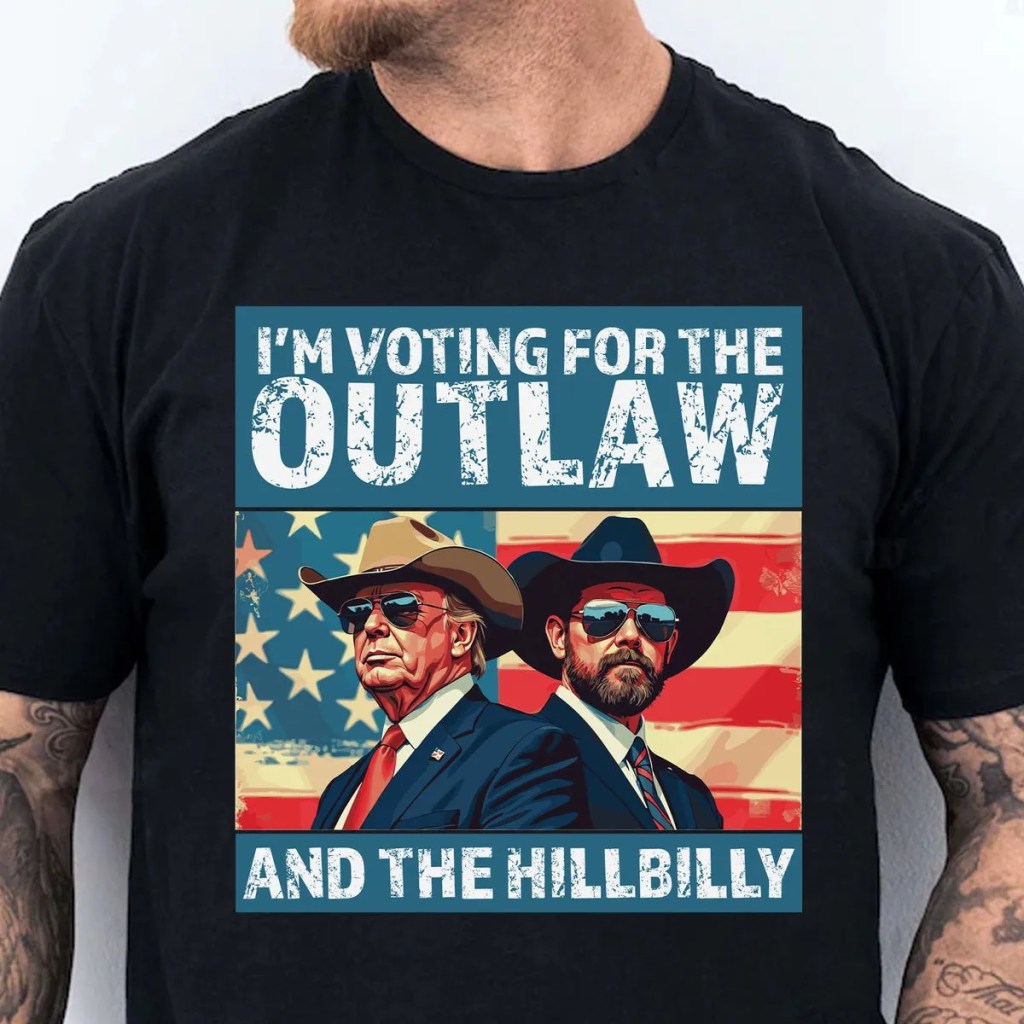
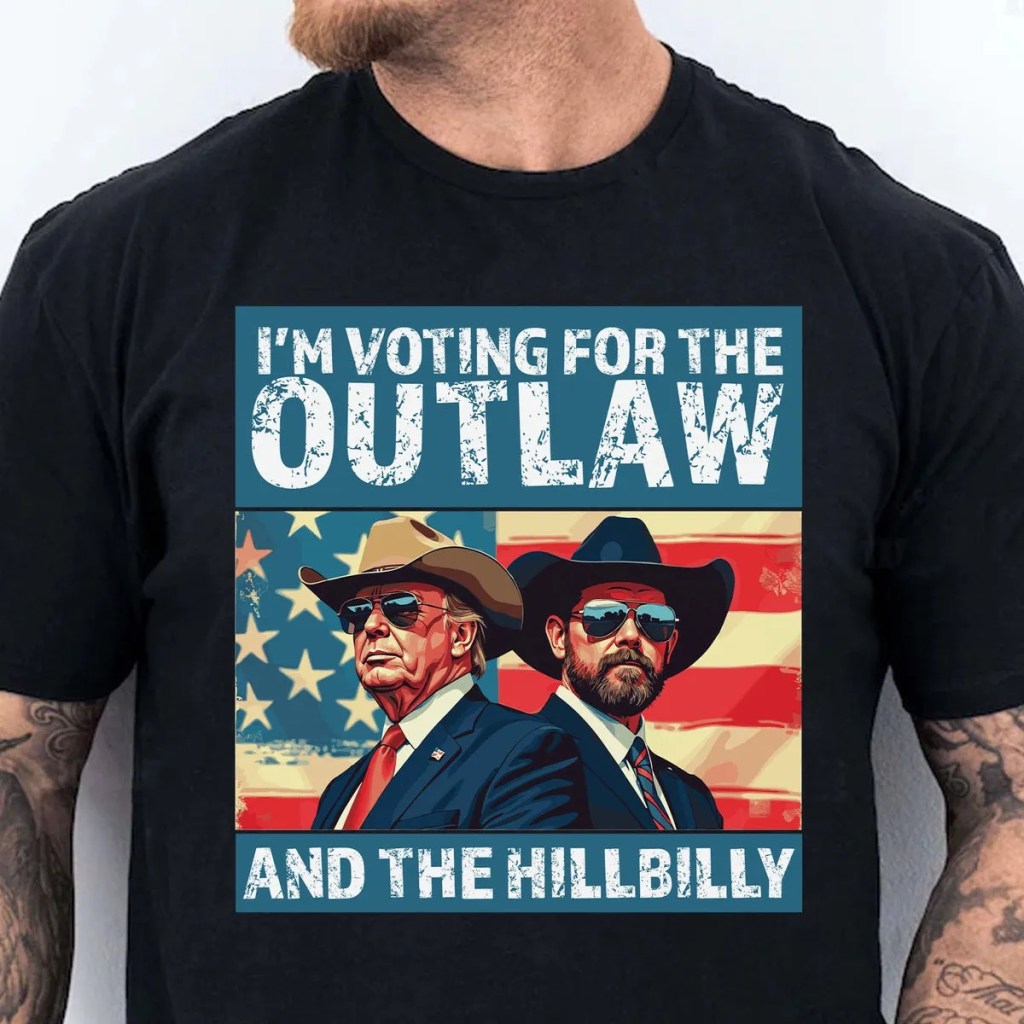
In the post at 9 a.m today, Joyce Vance included a photo of a T-shirt of Trump and Vance, billed as “the Outlaw and the Hillbilly.” Now, that’s clever marketing!

An Outlaw is often an admirable figure in westerns. He’s a folk hero. He’s the guy who goes up against the Establishment. He’s the Sundance Kid, he’s Robin Hood, he’s the handsome guy who gets the girl, he’s a lot of characters who live on the fringes of society and stand up for the little guy.

This is not Donald Trump. He is reverse Robin Hood. He steals from the poor and fattens the bank accounts of the rich. He doesn’t defend the helpless damsel, he sexually asssults her, then laughs about it and defames her. He does not stand outside society on its fringes, he owns the biggest, gaudiest mansion and installs solid gold toilet seats. Far from being handsome and buff, he is an obese old man with thinning hair and sagging jowls. He is a coward who dodged the draft five times yet pretends to be a tough guy.

As for J.D. Vance, he was once a hillbilly but that was long, long ago. Now he plays a hillbilly. He is a graduate of Yale Law School who made millions of dollars in the financial sector, where his patron was Peter Thiel, the woman-hating billionaire.

Not an Outlaw! Just a womanizing convicted felon who is a superb liar, braggart, and bully.

Not a Hillbilly! Just another far-cat who attached himself to super-rich patrons.

Trump passed one piece of legislation in his first term: a big tax cut for his billionaire buddies, corporations, and himself.

We know what his priorities are. Ego. Money. Power. Control.

He’s already forgotten about the people who voted for him. They can’t do anything for him any more. He won’t lower the price of food or gasoline or home insurance. He might take away their Social Security or Medicaid. He might cut programs they rely on.

He will take care of the people rich enough to belong to Mar-a-Lago.

Joyce Vance is a veteran federal prosecutor; she was the U.S. Attorney for the Northern district of Alabama from 2009-2017. She writes a blog called “Civil Discourse with Joyce Vance.” She usually writes about the law, the justice system, and Trump’s efforts to avoid accountability for his misdeeds. But in this post, she addresses the root cause of his appeal: low-information voters who are hoodwinked by his lies and believe he will fight for them. Ha. Not funny.

She writes:

It’s no wonder that Project 2025 calls for putting an end to the Department of Education. Trump’s electoral success depended on so-called low-information voters, members of the electorate who couldn’t or didn’t distinguish between the tough talk and tough guy image the candidate portrayed and the reality of the policies that come with his win. That’s often true for MAGA candidates, who are inexplicably able to attract the voters who are harmed by the policies they subsequently pass, as with tax cuts for the extremely wealthy and the working-class voters who didn’t benefit from them, but made them possible.

The Washington Post had this story today about the hopes of low-income voters who went for Trump in 2024, like a single mom who said she sometimes has to choose between buying toilet paper and milk and told reporters, “He is more attuned to the needs of everyone instead of just the rich … I think he knows it’s the poor people that got him elected, so I think Trump is going to do more to help us.” So far, that’s not looking good.

This very predictable reporting about voters suffering from buyers’ remorse is emerging even before Trump takes office. These people hope he won’t do exactly what he said he would during the campaign and has been focused on during his transition with programs like the Department of Government Efficiency, Elon Musk’s DOGE—cut government spending that they depend on. Whether it’s low-income people, mixed-status immigrant families, people who rely on Social Security, or parents with immune-compromised kids who rely on immunized classrooms, people voted against their own self-interest and are now facing that reality.

There are no do-overs in presidential elections. Successful disinformation campaigns or campaigns where image trumps consequences have lasting effects.

But spin, or disinformation—however you want to characterize it—designed to redirect voters away from focusing on bad facts about candidates can work, and this past election proved it. This T-shirt ad that the algorithm fed me earlier this week is an example of how Trump’s criminal conviction was sold to voters: the mythical outlaw, not the corrupt criminal. It’s hard to believe Americans fell for that, but they did, giving Trump a pass and letting him cultivate an image that was one step further out there than Sarah Palin’s maverick. 

Voters who lack the backbone of a solid education in civics can be manipulated. That takes us to Trump’s plans for the Department of Education.

Stepping on education and staunching the flow of information is a key goal for any authoritarian. Remember when Trump told an evangelical group during the campaign that if they voted in 2024 it would be the last time they had to vote? That’s something that Americans, hopefully, will not fall for, because the 2026 midterms will be key. If guardrails are going to be rebuilt, that’s where an important part of it will happen. And while we’re all burned out from the last election, this next one will matter; we will need to reengage, because a big Democratic win could staunch the bleeding from unfettered acquiescence by the legislative branch to Trump, who currently commands majorities in both chambers. That means the provision of accurate information and accurate analysis of that information to voters who will put it to use is important. But what does that look like in a country that voted for Trump?

One thing that is clear from the ease with which Trump seems to have stripped so many voters of their common sense is the need to restore civics education in this country. That’s a long-term plan and a big topic that we need to take on over time, but it’s not too early for us to begin to think about what we can do in the coming year ahead of the midterms. For one thing, if it’s right for you, even if it’s a stretch, consider running or seeking appointment to a school board. Republicans got the jump on Democrats in this arena. It’s time to catch up. Or, if that’s not in your lane, make the time to show up at school board meetings and demand civics education in our schools. Progress in this area will take time, but we can all set a good example and encourage people around us to do a better job of understanding what matters in government. Ironically, if 2017 is any indication, people caught off guard (although who knows how) by some of the worst excesses Trump is likely to engage in will be ready to be better informed and reengage in democracy. Capturing that moment will be important.

One of the goals of Project 2025 is terminating the Department of Education. There is growing Republican support for that plan at the state level by leaders who want to restore state control (much like conservatives sought restoration of abortion policy to the hands of red state officials in Dobbs). Enter Trump’s nominee to head the Department, Linda McMahon, who ran the Small Business Administration (SBA) for him from 2017 to 2019.

Trump’s appointment of the professional wrestling magnate has drawn little comment as the media has focused on Matt Gaetz, Pete Hegseth, and others. Suffice it to say she does not appear to possess much of a background in public education. She was on the Connecticut Board of Education for one year, but there has been reporting she received that appointment after lying about having a degree in education. When that report came to light while McMahon was running, unsuccessfully, for a Connecticut Senate seat, she said that “she mistakenly thought her degree was in education because she did a semester of student teaching, and that she had written to the governor’s office the previous year to correct the error after another newspaper noticed the mistake.” (I, too, did some student teaching in college, but I was always clear my degree was in political science and international relations.)

McMahon is a longtime Trump ally and financial backer, apparently key qualifications for the job. After two years at the SBA, she stepped aside to run Trump’s America First Action PAC. Other qualifications: Yahoo News reported that “Donald Trump’s nominee for education secretary was once pile-driven by a 7ft wrestler and feigned being drugged unconscious while her husband cheated on her.” Yahoo went on to recount that “Mr. Trump served as a sponsor and host for WWE events in Atlantic City in the late 1980s and years later appeared in the ring himself, when he took a razor to the head of Ms. McMahon’s scandal-ridden husband, Vince, as the wrestling boss wailed. In 2013, WWE inducted Mr. Trump into its hall of fame.” 

The National Education Association ran an editorial opposing McMahon’s confirmation. They called her “unqualified” and wrote that she “spent years pushing policies that would defund and destroy public schools.” That sounds like a good fit if your agenda involves destroying the Department of Education. Start at the top.

NEA President Becky Pringle said, “McMahon’s only mission is to eliminate the Department of Education and take away taxpayer dollars from public schools, where 90% of students – and 95% of students with disabilities – learn, and give them to unaccountable and discriminatory private schools.”

So while we begin to think about ways to repair democracy, medium-term goals like winning midterm elections, and long-term goals like restoring civics education, spare a moment for some short-term plans: write to your senators about McMahon’s nomination. It’s flying largely under the radar screen, and it should not be. Do not obey in advance, and do not make it easy for Trump to destroy democratic institutions like the Department of Education with the complicity of your state and federal elected officials. We have a lot of work to do when it comes to public education. We have to insist that free, publicly funded, high-quality education is available to every child. Our engagement as citizens is everything. Let’s get to work.

We’re in this together,

Joyce

Open the link to see the illustrations.

Several days ago, Elon Musk tweeted his endorsement of an extremist political party in Germany, the AfD, which is known for its xenophobic and hateful views. A number of pundits said he had thrown his support to a Neo-Nazi party. J.D. Vance soon added his praise of the extremist party.

Cynthia Miller-Idriss, a scholar of extremism, wrote at the MSNBC website, about the alarm bells that Musk and Vance set off.

She wrote:

Alarm bells sounded last week when Vice President-elect JD Vance and Trump adviser Elon Musk praised the far-right German party Alternative for Deutschland (AfD), just weeks before that country’s snap national elections are scheduled to take place.

“Only the AfD can save Germany,” Musk posted on X, prompting backlash from conservative and mainstream German leaders and the global Jewish community about a key Trump adviser’s endorsement of a party that has flirted with Nazi and white supremacist slogans and espoused dehumanizing and hateful rhetoric against immigrants and Muslims. In the wake of the criticism, Musk doubled down, writing the next day that “AfD is the only hope for Germany.”

Make no mistake: It is extremely dangerous to have an American vice president-elect and a core Trump adviser voice support for the AfD, therefore normalizing very extreme political positions.

Vance’s more tacit endorsement for AfD came in the form of a post responding to claims that AfD is dangerous. “It’s so dangerous for people to control their borders,” Vance tweeted sarcastically Saturday, implying support for the party’s anti-immigration positions. “So so dangerous. The dangerous level is off the charts.”

Make no mistake: It is extremely dangerous to have an American vice president-elect and a core Trump adviser voice support for the AfD, therefore normalizing very extreme political positions. The AfD has called for mass deportations, argued that children with disabilities should be removed from regular schools, and runs social media ads blaming immigrants for crimeand sexual violence. One anti-immigrant ad run by the AfD showed the belly of a pregnant white woman with the phrase “New Germans? We’ll make them ourselves.” Another campaign billboard used a 19th century painting of a slave market — depicting a nude, white woman having her teeth inspected by turban-clad, brown men — to warn that Europe could become “Eurabia,” a reference to a conspiracy theory favored by white supremacists.

To finish reading, open the link.

Trump’s advisers are showing their hand awfully early. Know them by those they admire.

Did you see Trump’s bizarre Christmas message? He made outlandish claims, lied, and threatened the sovereignty of other nations. Heather Cox Richardson puts his boasts into perspective. All in all, the prospects are alarming.

Trump is first and foremost an entertainer. He spent many evenings watching wrestling matches. And he had that big role on The Apprentice, which gave him a fake persona as a tough manager. He is not noted for his knowledge of domestic or foreign policy. He clearly knows nothing about history. His understanding of the Constitution seems to be hearsay. Read this post and tell me: is he ignorant, stupid, or senile?

She writes:

It is starting to seem like the best way to interpret social media posts from President-elect Donald Trump is through the lens of professional wrestling. Never a true athletic competition—although it certainly required athletic training—until the 1980s, professional wrestling depended on “kayfabe,” the shared agreement among audience and actors that they would pretend the carefully constructed script and act were real.

But as Abraham Josephine Reisman explained in the New York Times last year, Vince and Linda McMahon pushed to move professional wrestling into entertainment to avoid health regulations and the taxes imposed on actual sporting events. That shift damaged the profession until in the mid-1990s, wrestlers and promoters began to mix the fake world of wrestling with reality, bringing real-life tensions to the ring in what might or might not have been real. “Suddenly,” Reisman wrote, “the fun of the match had everything to do with decoding it.”

Nothing was off-limits, and the more outrageous the storylines, the better. “[F]ans would give it their full attention because they couldn’t always figure out if what they were seeing was real or not.” This “neokayfabe” “rests on a slippery, ever-wobbling jumble of truths, half-truths, and outright falsehoods, all delivered with the utmost passion and commitment.”

Reisman concluded that producers and consumers of neokayfabe “tend to lose the ability to distinguish between what’s real and what isn’t.” In that, they echo the world identified by German-American historian and philosopher Hannah Arendt in her 1951 The Origins of Totalitarianism. “The ideal subject of totalitarian rule is not the convinced Nazi or the convinced Communist,” she wrote, “but people for whom the distinction between fact and fiction…and the distinction between true and false no longer exist.”

Yesterday, on Christmas and the first night of Hanukkah, Trump posted a “Merry Christmas to all” message that went on to claim falsely that Chinese soldiers are operating the Panama Canal, that President Joe Biden “has absolutely no idea what he’s doing.” The heart of his message, though, was that the U.S. should take over both the Panama Canal and Canada, and that Greenland, which is a self-governing territory of Denmark, “is needed by the United States for National Security purposes,” and that “the people of Greenland…want the U.S. to be there, and we will!”

Trump’s sudden pronouncements threatening three other countries—he has been quiet about Mexico since its president pushed back on his early threats—have media outlets scrambling to explain what he’s up to. They have explained that this might be a way for him to demonstrate that his “America First” ideology, which has always embraced isolation, will actually wield power against other countries; or suggested that his claim against Panama is part of a strategy to counter China; or pointed out that global warming has sparked competition to gain an advantage in the Arctic.

The new focus on threatening other countries, virtually never mentioned during the 2024 campaign, has driven out of the news Trump’s actual campaign promise. Trump ran on the promise that he would lower prices, especially of groceries. Yet in mid-December he suggested in an interview with Time magazine that he doesn’t really expect to lower prices. That promise seems to have been part of a performance to attract voters, abandoned now with a new performance that may or may not be real.

There is also little coverage of the larger implications of Trump’s threats to invade other countries. Central to the rules-based international order constructed in the decades after World War II is that countries must respect each other’s sovereignty. Between 1942 and 1945, forty-seven nations signed the Declaration by United Nations, the treaty that formalized the alliance that stood against the fascist Axis powers. That treaty declared the different countries would not sign separate peace agreements with Germany, Italy, or Japan.

They would work together to create a world based on the 1941 Atlantic Charter, which called for the territorial integrity of nations and the restoration of self-government to countries where it had been lost, and for global cooperation for economic and social progress. In 1945, delegates from fifty nations met in San Francisco to establish a permanent forum for international cooperation.

What emerged was the United Nations, whose charter states that the organization is designed “to maintain international peace and security” by working together to stop “acts of aggression or other breaches of the peace,” and to settle international disputes without resort to war. “The Organization is based on the principle of sovereign equality of all its Members,” the charter reads. “All members shall refrain…from the threat or use of force against the territorial integrity or political independence of any state, or in any other manner inconsistent with the Purposes of the United Nations,” it reads.

Russian president Vladimir Putin is eager to tear down the international rules-based order established by the United Nations and protected by organizations like the North Atlantic Treaty Organization (NATO). His invasion of neighboring countries—Georgia in 2008, then Ukraine in 2014 and again in 2022—demonstrates his desire to return the world to a time in which bigger countries could gobble up smaller ones, the ideology that after the invention of modern weaponry meant world wars.

On Christmas Day, Russia fired more than 70 missiles and more than 100 drones at Ukraine, targeting its energy infrastructure. The Ukrainian forces shot down more than 50 of the missiles, but the attack damaged power plants, cutting electricity to different regions. Just two years ago, Ukraine began to celebrate Christmas on December 25, following the Gregorian calendar rather than the less accurate Julian calendar still favored by the Russian Orthodox Church for religious holidays. Ukraine president Volodymyr Zelensky said the change would allow Ukrainians to “abandon the Russian heritage” of celebrating Christmas in January.

Also yesterday, an undersea power cable connecting Finland and Estonia failed, following a series of cuts to telecommunications cables in the Baltic Sea in November. Today, Finland seized an oil tanker it believes cut the cables yesterday, noting that the tanker may be part of Russia’s “shadow fleet” that is waging a shadow campaign against NATO nations at the same time that it is evading sanctions against Russia.

In a joint statement today, the European Commission, which is the government of the European Union, “strongly condemn[ed]” the attacks on Europe’s critical infrastructure and said it would be proposing further sanctions to target the Russia’s shadow fleet, “which threatens security and the environment, while funding Russia’s war budget.” It emphasized Europe’s commitment to international cooperation.

Also yesterday, an Azerbaijan Airlines jet traveling from the Azerbaijan capital of Baku on its way to Chechnya crashed near Aktau, Kazakhstan, killing at least 38 of the 67 people on board. Nailia Bagirova and Gleb Stolyarov of Reuters reported today that a preliminary investigation by Azerbaijan officials suggests that Russian air defenses shot the plane down.

Newsweek’s Maya Mehrara reported that on Russian media last night, a propagandist close to Putin cheered on Trump’s demand for Greenland. “This is especially interesting because it drives a wedge between him and Europe, it undermines the world architecture, and opens up certain opportunities for our foreign policy,” nationalist political scientist Sergey Mikheyev said.

Mikheyev supports Russia’s attempt to conquer Ukraine and has called for Russia to add to its “empire” not only Finland and Poland, but also Alaska, Hawaii, and California. Last night he explained that Trump’s approach would undermine the rules-based order that has shaped the world since World War II. If Trump “really wants to stop the third world war,” he said, “the way out is simple: dividing up the world into spheres of influence.”

Mehrara noted that academic Stanislav Tkachenko said that Russia should “thank Donald Trump, who is teaching us a new diplomatic language.” He continued: “That is, to say it like it is. Maybe we won’t carve up the world like an apple, but we can certainly outline the parts of the world where our interests cannot be questioned.”

But yesterday in Georgia’s capital, Tbilisi, Armenians and Azerbaijanis joined the protesters who are filling the streets to protest the government’s attempt to tie Georgia more closely to Putin’s Russia. They hope to turn Georgia toward Europe instead.

And President Joe Biden issued a statement concerning Russia’s Christmas bombardment of Ukraine to cut heat and electricity for Ukrainians in the dead of winter. “Let me be clear,” he said, “the Ukrainian people deserve to live in peace and safety, and the United States and the international community must continue to stand with Ukraine until it triumphs over Russia’s aggression.”