Archives for category: Disruption

Heather Cox Richardson recalls the days of bipartisan consensus around the goals of liberal democracy, in which government protected the rights of individuals. By today’s MAGA standards, President Dwight D. Eisenhower would be considered a dangerous leftwinger.

She wrote on her blog, “Letters from an American”:

Cas Mudde, a political scientist who specializes in extremism and democracy, observed yesterday on Bluesky that “the fight against the far right is secondary to the fight to strengthen liberal democracy.” That’s a smart observation.

During World War II, when the United States led the defense of democracy against fascism, and after it, when the U.S. stood against communism, members of both major political parties celebrated American liberal democracy. Democratic presidents Franklin Delano Roosevelt and Harry Truman and Republican president Dwight D. Eisenhower made it a point to emphasize the importance of the rule of law and people’s right to choose their government, as well as how much more effectively democracies managed their economies and how much fairer those economies were than those in which authoritarians and their cronies pocketed most of a country’s wealth.

Those mid-twentieth-century presidents helped to construct a “liberal consensus” in which Americans rallied behind a democratic government that regulated business, provided a basic social safety net, promoted infrastructure, and protected civil rights. That government was so widely popular that political scientists in the 1960s posited that politicians should stop trying to court voters by defending its broadly accepted principles. Instead, they should put together coalitions of interest groups that could win elections.

As traditional Republicans and Democrats moved away from a defense of democracy, the power to define the U.S. government fell to a small faction of “Movement Conservatives” who were determined to undermine the liberal consensus. Big-business Republicans who hated regulations and taxes joined with racist former Democrats and patriarchal white evangelicals who wanted to reinforce traditional race and gender hierarchies to insist that the government had grown far too big and was crushing individual Americans.

In their telling, a government that prevented businessmen from abusing their workers, made sure widows and orphans didn’t have to eat from garbage cans, built the interstate highways, and enforced equal rights was destroying the individualism that made America great, and they argued that such a government was a small step from communism. They looked at government protection of equal rights for racial, ethnic, gender, and religious minorities, as well as women, and argued that those protections both cost tax dollars to pay for the bureaucrats who enforced equal rights and undermined a man’s ability to act as he wished in his place of business, in society, and in his home. The government of the liberal consensus was, they claimed, a redistribution of wealth from hardworking taxpayers—usually white and male—to undeserving marginalized Americans.

When voters elected Ronald Reagan in 1980, the Movement Conservatives’ image of the American government became more and more prevalent, although Americans never stopped liking the reality of the post–World War II government that served the needs of ordinary Americans. That image fed forty years of cuts to the post–World War II government, including sweeping cuts to regulations and to taxes on the wealthy and on corporations, always with the argument that a large government was destroying American individualism.

It was this image of government as a behemoth undermining individual Americans that Donald Trump rode to the presidency in 2016 with his promises to “drain the swamp” of Washington, D.C., and it is this image that is leading Trump voters to cheer on billionaires Elon Musk and Vivek Ramaswamy as they vow to cut services on which Americans depend in order to cut regulations and taxes once again for the very wealthy and corporations.

But that image of the American government is not the one on which the nation was founded.

Liberal democracy was the product of a moment in the 1600s in which European thinkers rethought old ideas about human society to emphasize the importance of the individual and his (it was almost always a “him” in those days) rights. Men like John Locke rejected the idea that God had appointed kings and noblemen to rule over subjects by virtue of their family lineage, and began to explore the idea that since government was a social compact to enable men to live together in peace, it should rest not on birth or wealth or religion, all of which were arbitrary, but on natural laws that men could figure out through their own experiences.

The Founders of what would become the United States rested their philosophy on an idea that came from Locke’s observations: that individuals had the right to freedom, or “liberty,” including the right to consent to the government under which they lived. “We hold these truths to be self-evident,” Thomas Jefferson wrote, “that all men are created equal, that they are endowed by their Creator with certain unalienable Rights, that among these are Life, Liberty and the pursuit of Happiness,” and that “to secure these rights, governments are instituted among men, deriving their just powers from the consent of the governed.”

In the early years of the American nation, defending the rights of individuals meant keeping the government small so that it could not crush a man through taxation or involuntary service to the government or arbitrary restrictions. The Bill of Rights—the first ten amendments to the Constitution—explicitly prohibited the government from engaging in actions that would hamper individual freedom.

But in the middle of the nineteenth century, Republican president Abraham Lincoln began the process of adjusting American liberalism to the conditions of the modern world. While the Founders had focused on protecting individual rights from an overreaching government, Lincoln realized that maintaining the rights of individuals required government action.

To protect individual opportunity, Lincoln argued, the government must work to guarantee that all men—not just rich white men—were equal before the law and had equal access to resources, including education. To keep the rich from taking over the nation, he said, the government must keep the economic playing field between rich and poor level, dramatically expand opportunity, and develop the economy.

Under Lincoln, Republicans reenvisioned liberalism. They reworked the Founders’ initial stand against a strong government, memorialized by the Framers in the Bill of Rights, into an active government designed to protect individuals by guaranteeing equal access to resources and equality before the law for white men and Black men alike. They enlisted the power of the federal government to turn the ideas of the Declaration of Independence into reality.

Under Republican president Theodore Roosevelt, progressives at the turn of the twentieth century would continue this reworking of American liberalism to address the extraordinary concentrations of wealth and power made possible by industrialization. In that era, corrupt industrialists increased their profits by abusing their workers, adulterating milk with formaldehyde and painting candies with lead paint, dumping toxic waste into neighborhoods, and paying legislators to let them do whatever they wished.

Those concerned about the survival of liberal democracy worried that individuals were not actually free when their lives were controlled by the corporations that poisoned their food and water while making it impossible for individuals to get an education or make enough money ever to become independent.

To restore the rights of individuals, progressives of both parties reversed the idea that liberalism required a small government. They insisted that individuals needed a big government to protect them from the excesses and powerful industrialists of the modern world. Under the new governmental system that Theodore Roosevelt pioneered, the government cleaned up the sewage systems and tenements in cities, protected public lands, invested in public health and education, raised taxes, and called for universal health insurance, all to protect the ability of individuals to live freely without being crushed by outside influences.

Reformers sought, as Roosevelt said, to return to “an economic system under which each man shall be guaranteed the opportunity to show the best that there is in him.”

It is that system of government’s protection of the individual in the face of the stresses of the modern world that Franklin Delano Roosevelt, Harry Truman, Dwight Eisenhower, and the presidents who followed them until 1981 embraced. The post–World War II liberal consensus was the American recognition that protecting the rights of individuals in the modern era required not a weak government but a strong one.

When Movement Conservatives convinced followers to redefine “liberal” as an epithet rather than a reflection of the nation’s quest to defend the rights of individuals—which was quite deliberate—they undermined the central principle of the United States of America. In its place, they resurrected the ideology of the world the American Founders rejected, a world in which an impoverished majority suffers under the rule of a powerful few.
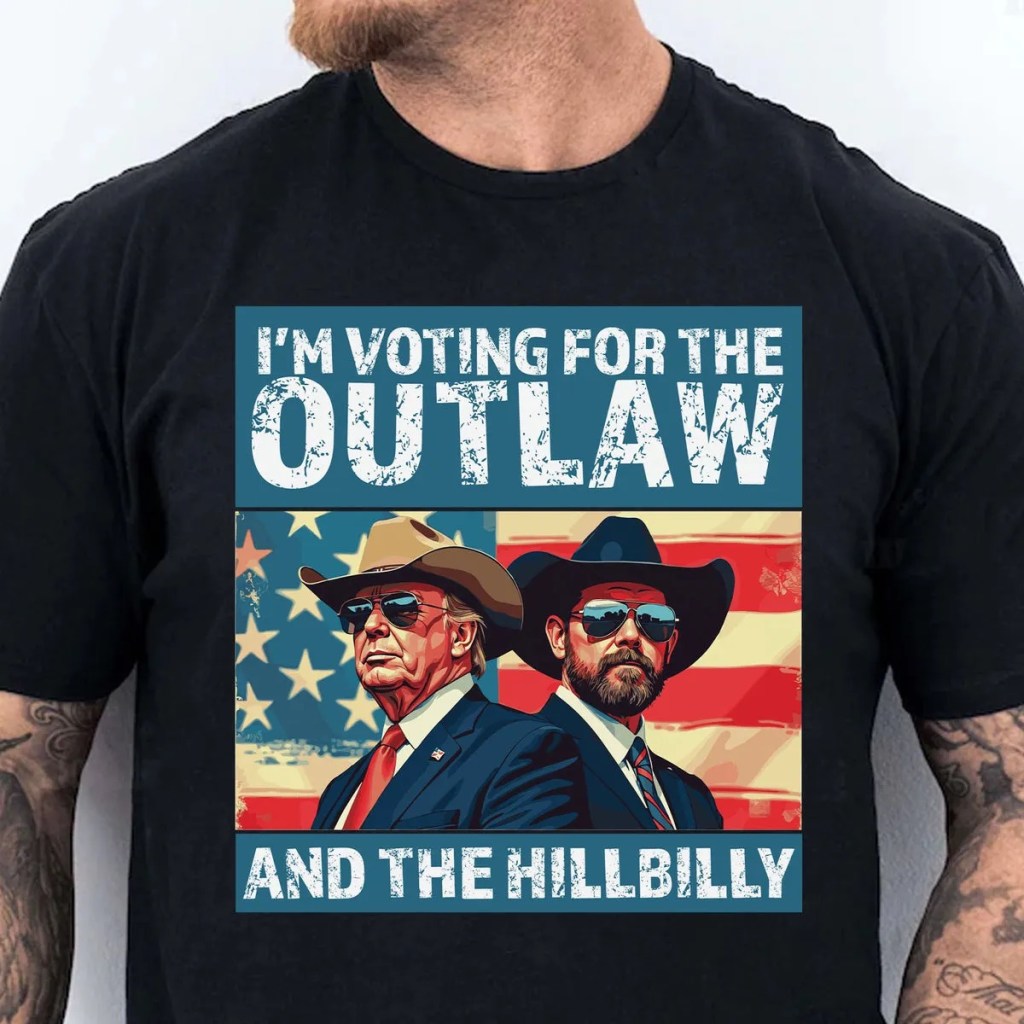
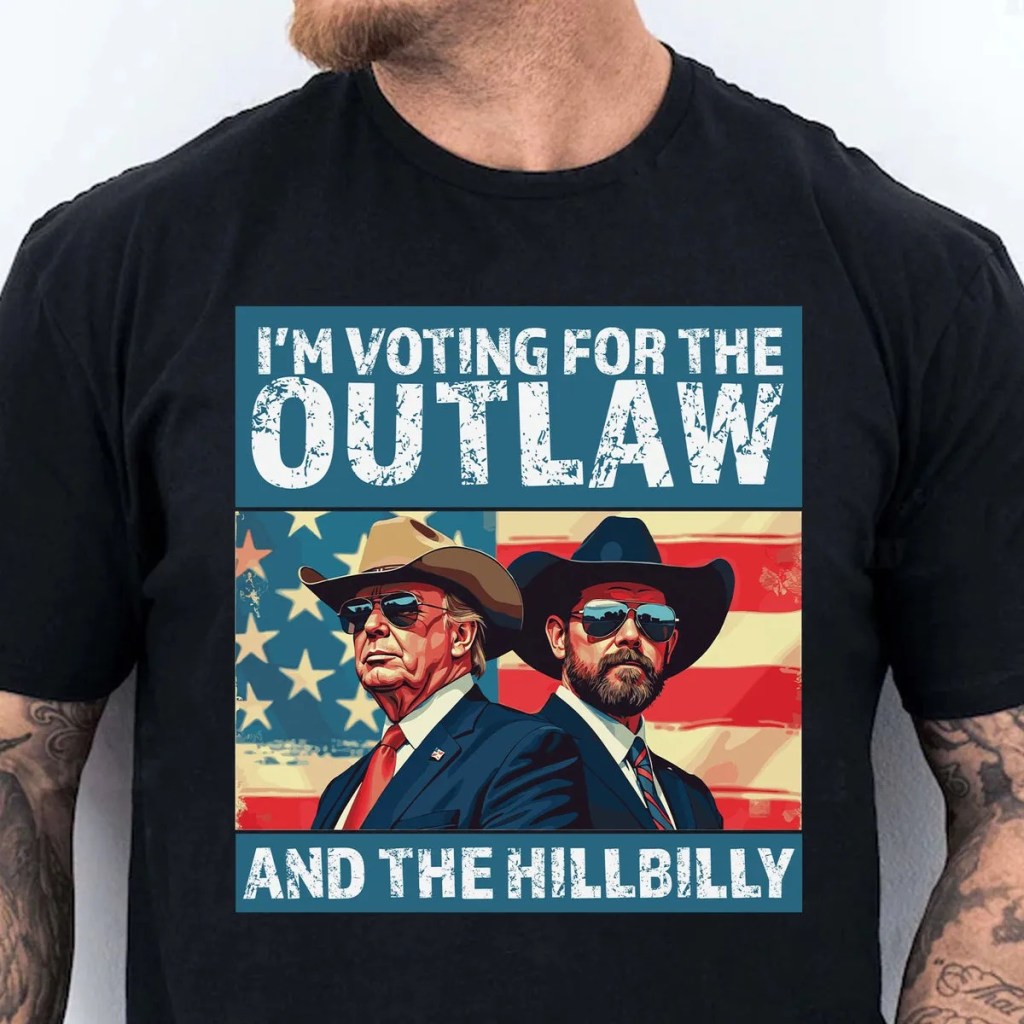
In the post at 9 a.m today, Joyce Vance included a photo of a T-shirt of Trump and Vance, billed as “the Outlaw and the Hillbilly.” Now, that’s clever marketing!

An Outlaw is often an admirable figure in westerns. He’s a folk hero. He’s the guy who goes up against the Establishment. He’s the Sundance Kid, he’s Robin Hood, he’s the handsome guy who gets the girl, he’s a lot of characters who live on the fringes of society and stand up for the little guy.

This is not Donald Trump. He is reverse Robin Hood. He steals from the poor and fattens the bank accounts of the rich. He doesn’t defend the helpless damsel, he sexually asssults her, then laughs about it and defames her. He does not stand outside society on its fringes, he owns the biggest, gaudiest mansion and installs solid gold toilet seats. Far from being handsome and buff, he is an obese old man with thinning hair and sagging jowls. He is a coward who dodged the draft five times yet pretends to be a tough guy.

As for J.D. Vance, he was once a hillbilly but that was long, long ago. Now he plays a hillbilly. He is a graduate of Yale Law School who made millions of dollars in the financial sector, where his patron was Peter Thiel, the woman-hating billionaire.

Not an Outlaw! Just a womanizing convicted felon who is a superb liar, braggart, and bully.

Not a Hillbilly! Just another far-cat who attached himself to super-rich patrons.

Trump passed one piece of legislation in his first term: a big tax cut for his billionaire buddies, corporations, and himself.

We know what his priorities are. Ego. Money. Power. Control.

He’s already forgotten about the people who voted for him. They can’t do anything for him any more. He won’t lower the price of food or gasoline or home insurance. He might take away their Social Security or Medicaid. He might cut programs they rely on.

He will take care of the people rich enough to belong to Mar-a-Lago.

Joyce Vance is a veteran federal prosecutor; she was the U.S. Attorney for the Northern district of Alabama from 2009-2017. She writes a blog called “Civil Discourse with Joyce Vance.” She usually writes about the law, the justice system, and Trump’s efforts to avoid accountability for his misdeeds. But in this post, she addresses the root cause of his appeal: low-information voters who are hoodwinked by his lies and believe he will fight for them. Ha. Not funny.

She writes:

It’s no wonder that Project 2025 calls for putting an end to the Department of Education. Trump’s electoral success depended on so-called low-information voters, members of the electorate who couldn’t or didn’t distinguish between the tough talk and tough guy image the candidate portrayed and the reality of the policies that come with his win. That’s often true for MAGA candidates, who are inexplicably able to attract the voters who are harmed by the policies they subsequently pass, as with tax cuts for the extremely wealthy and the working-class voters who didn’t benefit from them, but made them possible.

The Washington Post had this story today about the hopes of low-income voters who went for Trump in 2024, like a single mom who said she sometimes has to choose between buying toilet paper and milk and told reporters, “He is more attuned to the needs of everyone instead of just the rich … I think he knows it’s the poor people that got him elected, so I think Trump is going to do more to help us.” So far, that’s not looking good.

This very predictable reporting about voters suffering from buyers’ remorse is emerging even before Trump takes office. These people hope he won’t do exactly what he said he would during the campaign and has been focused on during his transition with programs like the Department of Government Efficiency, Elon Musk’s DOGE—cut government spending that they depend on. Whether it’s low-income people, mixed-status immigrant families, people who rely on Social Security, or parents with immune-compromised kids who rely on immunized classrooms, people voted against their own self-interest and are now facing that reality.

There are no do-overs in presidential elections. Successful disinformation campaigns or campaigns where image trumps consequences have lasting effects.

But spin, or disinformation—however you want to characterize it—designed to redirect voters away from focusing on bad facts about candidates can work, and this past election proved it. This T-shirt ad that the algorithm fed me earlier this week is an example of how Trump’s criminal conviction was sold to voters: the mythical outlaw, not the corrupt criminal. It’s hard to believe Americans fell for that, but they did, giving Trump a pass and letting him cultivate an image that was one step further out there than Sarah Palin’s maverick. 

Voters who lack the backbone of a solid education in civics can be manipulated. That takes us to Trump’s plans for the Department of Education.

Stepping on education and staunching the flow of information is a key goal for any authoritarian. Remember when Trump told an evangelical group during the campaign that if they voted in 2024 it would be the last time they had to vote? That’s something that Americans, hopefully, will not fall for, because the 2026 midterms will be key. If guardrails are going to be rebuilt, that’s where an important part of it will happen. And while we’re all burned out from the last election, this next one will matter; we will need to reengage, because a big Democratic win could staunch the bleeding from unfettered acquiescence by the legislative branch to Trump, who currently commands majorities in both chambers. That means the provision of accurate information and accurate analysis of that information to voters who will put it to use is important. But what does that look like in a country that voted for Trump?

One thing that is clear from the ease with which Trump seems to have stripped so many voters of their common sense is the need to restore civics education in this country. That’s a long-term plan and a big topic that we need to take on over time, but it’s not too early for us to begin to think about what we can do in the coming year ahead of the midterms. For one thing, if it’s right for you, even if it’s a stretch, consider running or seeking appointment to a school board. Republicans got the jump on Democrats in this arena. It’s time to catch up. Or, if that’s not in your lane, make the time to show up at school board meetings and demand civics education in our schools. Progress in this area will take time, but we can all set a good example and encourage people around us to do a better job of understanding what matters in government. Ironically, if 2017 is any indication, people caught off guard (although who knows how) by some of the worst excesses Trump is likely to engage in will be ready to be better informed and reengage in democracy. Capturing that moment will be important.

One of the goals of Project 2025 is terminating the Department of Education. There is growing Republican support for that plan at the state level by leaders who want to restore state control (much like conservatives sought restoration of abortion policy to the hands of red state officials in Dobbs). Enter Trump’s nominee to head the Department, Linda McMahon, who ran the Small Business Administration (SBA) for him from 2017 to 2019.

Trump’s appointment of the professional wrestling magnate has drawn little comment as the media has focused on Matt Gaetz, Pete Hegseth, and others. Suffice it to say she does not appear to possess much of a background in public education. She was on the Connecticut Board of Education for one year, but there has been reporting she received that appointment after lying about having a degree in education. When that report came to light while McMahon was running, unsuccessfully, for a Connecticut Senate seat, she said that “she mistakenly thought her degree was in education because she did a semester of student teaching, and that she had written to the governor’s office the previous year to correct the error after another newspaper noticed the mistake.” (I, too, did some student teaching in college, but I was always clear my degree was in political science and international relations.)

McMahon is a longtime Trump ally and financial backer, apparently key qualifications for the job. After two years at the SBA, she stepped aside to run Trump’s America First Action PAC. Other qualifications: Yahoo News reported that “Donald Trump’s nominee for education secretary was once pile-driven by a 7ft wrestler and feigned being drugged unconscious while her husband cheated on her.” Yahoo went on to recount that “Mr. Trump served as a sponsor and host for WWE events in Atlantic City in the late 1980s and years later appeared in the ring himself, when he took a razor to the head of Ms. McMahon’s scandal-ridden husband, Vince, as the wrestling boss wailed. In 2013, WWE inducted Mr. Trump into its hall of fame.” 

The National Education Association ran an editorial opposing McMahon’s confirmation. They called her “unqualified” and wrote that she “spent years pushing policies that would defund and destroy public schools.” That sounds like a good fit if your agenda involves destroying the Department of Education. Start at the top.

NEA President Becky Pringle said, “McMahon’s only mission is to eliminate the Department of Education and take away taxpayer dollars from public schools, where 90% of students – and 95% of students with disabilities – learn, and give them to unaccountable and discriminatory private schools.”

So while we begin to think about ways to repair democracy, medium-term goals like winning midterm elections, and long-term goals like restoring civics education, spare a moment for some short-term plans: write to your senators about McMahon’s nomination. It’s flying largely under the radar screen, and it should not be. Do not obey in advance, and do not make it easy for Trump to destroy democratic institutions like the Department of Education with the complicity of your state and federal elected officials. We have a lot of work to do when it comes to public education. We have to insist that free, publicly funded, high-quality education is available to every child. Our engagement as citizens is everything. Let’s get to work.

We’re in this together,

Joyce

Open the link to see the illustrations.

Several days ago, Elon Musk tweeted his endorsement of an extremist political party in Germany, the AfD, which is known for its xenophobic and hateful views. A number of pundits said he had thrown his support to a Neo-Nazi party. J.D. Vance soon added his praise of the extremist party.

Cynthia Miller-Idriss, a scholar of extremism, wrote at the MSNBC website, about the alarm bells that Musk and Vance set off.

She wrote:

Alarm bells sounded last week when Vice President-elect JD Vance and Trump adviser Elon Musk praised the far-right German party Alternative for Deutschland (AfD), just weeks before that country’s snap national elections are scheduled to take place.

“Only the AfD can save Germany,” Musk posted on X, prompting backlash from conservative and mainstream German leaders and the global Jewish community about a key Trump adviser’s endorsement of a party that has flirted with Nazi and white supremacist slogans and espoused dehumanizing and hateful rhetoric against immigrants and Muslims. In the wake of the criticism, Musk doubled down, writing the next day that “AfD is the only hope for Germany.”

Make no mistake: It is extremely dangerous to have an American vice president-elect and a core Trump adviser voice support for the AfD, therefore normalizing very extreme political positions.

Vance’s more tacit endorsement for AfD came in the form of a post responding to claims that AfD is dangerous. “It’s so dangerous for people to control their borders,” Vance tweeted sarcastically Saturday, implying support for the party’s anti-immigration positions. “So so dangerous. The dangerous level is off the charts.”

Make no mistake: It is extremely dangerous to have an American vice president-elect and a core Trump adviser voice support for the AfD, therefore normalizing very extreme political positions. The AfD has called for mass deportations, argued that children with disabilities should be removed from regular schools, and runs social media ads blaming immigrants for crimeand sexual violence. One anti-immigrant ad run by the AfD showed the belly of a pregnant white woman with the phrase “New Germans? We’ll make them ourselves.” Another campaign billboard used a 19th century painting of a slave market — depicting a nude, white woman having her teeth inspected by turban-clad, brown men — to warn that Europe could become “Eurabia,” a reference to a conspiracy theory favored by white supremacists.

To finish reading, open the link.

Trump’s advisers are showing their hand awfully early. Know them by those they admire.

Did you see Trump’s bizarre Christmas message? He made outlandish claims, lied, and threatened the sovereignty of other nations. Heather Cox Richardson puts his boasts into perspective. All in all, the prospects are alarming.

Trump is first and foremost an entertainer. He spent many evenings watching wrestling matches. And he had that big role on The Apprentice, which gave him a fake persona as a tough manager. He is not noted for his knowledge of domestic or foreign policy. He clearly knows nothing about history. His understanding of the Constitution seems to be hearsay. Read this post and tell me: is he ignorant, stupid, or senile?

She writes:

It is starting to seem like the best way to interpret social media posts from President-elect Donald Trump is through the lens of professional wrestling. Never a true athletic competition—although it certainly required athletic training—until the 1980s, professional wrestling depended on “kayfabe,” the shared agreement among audience and actors that they would pretend the carefully constructed script and act were real.

But as Abraham Josephine Reisman explained in the New York Times last year, Vince and Linda McMahon pushed to move professional wrestling into entertainment to avoid health regulations and the taxes imposed on actual sporting events. That shift damaged the profession until in the mid-1990s, wrestlers and promoters began to mix the fake world of wrestling with reality, bringing real-life tensions to the ring in what might or might not have been real. “Suddenly,” Reisman wrote, “the fun of the match had everything to do with decoding it.”

Nothing was off-limits, and the more outrageous the storylines, the better. “[F]ans would give it their full attention because they couldn’t always figure out if what they were seeing was real or not.” This “neokayfabe” “rests on a slippery, ever-wobbling jumble of truths, half-truths, and outright falsehoods, all delivered with the utmost passion and commitment.”

Reisman concluded that producers and consumers of neokayfabe “tend to lose the ability to distinguish between what’s real and what isn’t.” In that, they echo the world identified by German-American historian and philosopher Hannah Arendt in her 1951 The Origins of Totalitarianism. “The ideal subject of totalitarian rule is not the convinced Nazi or the convinced Communist,” she wrote, “but people for whom the distinction between fact and fiction…and the distinction between true and false no longer exist.”

Yesterday, on Christmas and the first night of Hanukkah, Trump posted a “Merry Christmas to all” message that went on to claim falsely that Chinese soldiers are operating the Panama Canal, that President Joe Biden “has absolutely no idea what he’s doing.” The heart of his message, though, was that the U.S. should take over both the Panama Canal and Canada, and that Greenland, which is a self-governing territory of Denmark, “is needed by the United States for National Security purposes,” and that “the people of Greenland…want the U.S. to be there, and we will!”

Trump’s sudden pronouncements threatening three other countries—he has been quiet about Mexico since its president pushed back on his early threats—have media outlets scrambling to explain what he’s up to. They have explained that this might be a way for him to demonstrate that his “America First” ideology, which has always embraced isolation, will actually wield power against other countries; or suggested that his claim against Panama is part of a strategy to counter China; or pointed out that global warming has sparked competition to gain an advantage in the Arctic.

The new focus on threatening other countries, virtually never mentioned during the 2024 campaign, has driven out of the news Trump’s actual campaign promise. Trump ran on the promise that he would lower prices, especially of groceries. Yet in mid-December he suggested in an interview with Time magazine that he doesn’t really expect to lower prices. That promise seems to have been part of a performance to attract voters, abandoned now with a new performance that may or may not be real.

There is also little coverage of the larger implications of Trump’s threats to invade other countries. Central to the rules-based international order constructed in the decades after World War II is that countries must respect each other’s sovereignty. Between 1942 and 1945, forty-seven nations signed the Declaration by United Nations, the treaty that formalized the alliance that stood against the fascist Axis powers. That treaty declared the different countries would not sign separate peace agreements with Germany, Italy, or Japan.

They would work together to create a world based on the 1941 Atlantic Charter, which called for the territorial integrity of nations and the restoration of self-government to countries where it had been lost, and for global cooperation for economic and social progress. In 1945, delegates from fifty nations met in San Francisco to establish a permanent forum for international cooperation.

What emerged was the United Nations, whose charter states that the organization is designed “to maintain international peace and security” by working together to stop “acts of aggression or other breaches of the peace,” and to settle international disputes without resort to war. “The Organization is based on the principle of sovereign equality of all its Members,” the charter reads. “All members shall refrain…from the threat or use of force against the territorial integrity or political independence of any state, or in any other manner inconsistent with the Purposes of the United Nations,” it reads.

Russian president Vladimir Putin is eager to tear down the international rules-based order established by the United Nations and protected by organizations like the North Atlantic Treaty Organization (NATO). His invasion of neighboring countries—Georgia in 2008, then Ukraine in 2014 and again in 2022—demonstrates his desire to return the world to a time in which bigger countries could gobble up smaller ones, the ideology that after the invention of modern weaponry meant world wars.

On Christmas Day, Russia fired more than 70 missiles and more than 100 drones at Ukraine, targeting its energy infrastructure. The Ukrainian forces shot down more than 50 of the missiles, but the attack damaged power plants, cutting electricity to different regions. Just two years ago, Ukraine began to celebrate Christmas on December 25, following the Gregorian calendar rather than the less accurate Julian calendar still favored by the Russian Orthodox Church for religious holidays. Ukraine president Volodymyr Zelensky said the change would allow Ukrainians to “abandon the Russian heritage” of celebrating Christmas in January.

Also yesterday, an undersea power cable connecting Finland and Estonia failed, following a series of cuts to telecommunications cables in the Baltic Sea in November. Today, Finland seized an oil tanker it believes cut the cables yesterday, noting that the tanker may be part of Russia’s “shadow fleet” that is waging a shadow campaign against NATO nations at the same time that it is evading sanctions against Russia.

In a joint statement today, the European Commission, which is the government of the European Union, “strongly condemn[ed]” the attacks on Europe’s critical infrastructure and said it would be proposing further sanctions to target the Russia’s shadow fleet, “which threatens security and the environment, while funding Russia’s war budget.” It emphasized Europe’s commitment to international cooperation.

Also yesterday, an Azerbaijan Airlines jet traveling from the Azerbaijan capital of Baku on its way to Chechnya crashed near Aktau, Kazakhstan, killing at least 38 of the 67 people on board. Nailia Bagirova and Gleb Stolyarov of Reuters reported today that a preliminary investigation by Azerbaijan officials suggests that Russian air defenses shot the plane down.

Newsweek’s Maya Mehrara reported that on Russian media last night, a propagandist close to Putin cheered on Trump’s demand for Greenland. “This is especially interesting because it drives a wedge between him and Europe, it undermines the world architecture, and opens up certain opportunities for our foreign policy,” nationalist political scientist Sergey Mikheyev said.

Mikheyev supports Russia’s attempt to conquer Ukraine and has called for Russia to add to its “empire” not only Finland and Poland, but also Alaska, Hawaii, and California. Last night he explained that Trump’s approach would undermine the rules-based order that has shaped the world since World War II. If Trump “really wants to stop the third world war,” he said, “the way out is simple: dividing up the world into spheres of influence.”

Mehrara noted that academic Stanislav Tkachenko said that Russia should “thank Donald Trump, who is teaching us a new diplomatic language.” He continued: “That is, to say it like it is. Maybe we won’t carve up the world like an apple, but we can certainly outline the parts of the world where our interests cannot be questioned.”

But yesterday in Georgia’s capital, Tbilisi, Armenians and Azerbaijanis joined the protesters who are filling the streets to protest the government’s attempt to tie Georgia more closely to Putin’s Russia. They hope to turn Georgia toward Europe instead.

And President Joe Biden issued a statement concerning Russia’s Christmas bombardment of Ukraine to cut heat and electricity for Ukrainians in the dead of winter. “Let me be clear,” he said, “the Ukrainian people deserve to live in peace and safety, and the United States and the international community must continue to stand with Ukraine until it triumphs over Russia’s aggression.”

Tom Loveless has been analyzing international tests for many years. Before his retirement, he directed the Brown Center on Education Policy at the Brookings Institution. Previously he was a professor at the John F. Kennedy School at Harvard University. And before that, he taught sixth grade in the public schools of California.

The news from TIMSS is that scores fell. Was the decline an after effect of the pandemic? We don’t know. There is much speculation but no certain answers.

Loveless writes:

The Trends in International Mathematics and Science Study (TIMSS) is given every four years in 4th and 8th grade math and science.  Seventy-two countries participated in 2023.  Scores are typically released in December of the year following test administration.International assessments are complicated by the sheer scope of the enterprise, including the fact that schools in the Northern and Southern Hemispheres have different school calendars. The 2023 scores were released on December 4, 2024.

U.S. scores fell sharply from 2019 to 2023, with the declines reaching conventional levels of statistical significance in math, but not science, at both grade levels. Comparing pre- and post-pandemic scores on the same test heightened interest in what the 2023 TMSS would show.  TIMSS scores are only one data point, but the 2023 results reinforce other trends evident in the other two assessments that are designed to produce valid estimates of achievement at the national level: the National Assessment of Educational Progress (NAEP) and the Programme for International Student Assessment (PISA).

Two trends stand out.

1. Larger negative effects in math than in other subjects. The most prominent explanation is that learning math is more dependent on formal instruction in schools.   

2. Gaps increased between higher and lower scoring groups along several demographic dimensions, including race, ethnicity, socioeconomic status, and the 90th and 10th percentiles (high and low achievers).Note that many of the gaps began widening before the pandemic, but Covid seemed to exacerbate thetrends.       

 In addition to the gaps that continued to widen, a gap that had disappeared in earlier TIMSS assessments suddenly re-appeared, the gap between male and female scores. In 8th grade math, for example, U.S. score differences by gender were statistically significant in 1999 and 2003, fell short of significance from 2007-2019, then widened substantially in 2023. The 14-point scale score difference recorded in 2023 (males, 495, and females, 481) is the largest U.S. gender gap in 8th grade math since TIMSS began in 1995.

The re-emergence of the gender gap is unique to TIMSS. Results of the 2024 NAEP are scheduled for release on January 29, 2025. We will see if NAEP confirms or contradicts the trends discussed here. There are reasons to believe NAEP will offer a more optimistic snapshot of U.S. achievement. First, the scores were collected a year after TIMSS, allowing for an additional year of pandemic recovery. Second, state assessments administered in 2024 have generally shown improvement, albeit at a slower pace than many hoped for or expected.                                                                                                                                                                                                          

The Network for Public Education announces the winners of the non-prestigious “Coal in the Stocking” Award for 2024.

This is an award given to those who have done the most damage to our public schools.

They should feel ashamed and humiliated for gaining this recognition of their odious and undemocratic behavior.

They hurt children and communities. They hurt the future of our great nation.

Open the link to see the names of the winners.

Ashton Pittman is the news editor of the Mississippi Free Press and a fine writer. I get my news about Mississippi by reading MFT, reported by people who live there. Pittman describes in this article why he debated whether to leave Twitter. When Musk bought Twitter, he knew it was going to be bad. He had spent years building up a following there and didn’t want to give it up. He investigated other social media platforms, but they weren’t right.

Then came the 2024 election, and Twitter turned into a political platform that favored Trump, where nasty trolls and bots created a toxic atmosphere.

Ashton joined BlueSky and very quickly gained a large number of followers close to what he (and the Mississippi Free Press) had had on Twitter.

He writes:

For a long time, it seemed like nothing was going to replace Twitter, even as it further devolved into a hellscape that seemed as if it were overrun by the trolls of 4chan, the neo-Nazis of Stormfront and the dullest AI bots Chat GPT ever powered. Twitter transformed into X, a place where racism, misogyny, homophobia and especially transphobia run rampant under the guise of “free speech,” but where using the word “cisgender” can get your account restrictedbecause Musk (who has described his very-much-alive transgender daughter as “dead”) considers it a slur.

I had really wanted one of the Twitter alternatives to take off, but one of the biggest impediments was the lack of buy-in from major journalists, publications, celebrities and other figures who could draw audiences away. A familiar pattern developed: People would leave X in hopes of joining another platform, then come back. 

Then came the election. Twitter turned into a Trump propaganda site. And Ashton was done.

But you know what I really enjoy about BlueSky? It doesn’t pigeonhole me. On other platforms, particularly X, you choose one facet of yourself and that’s the following you get, and the algorithm recommends you based on that. On BlueSky, I get to be a Mississippi journalist whose news stories draw engagement from people who care about news, but I also get to be a film photographer whose posts about my black-and-white film adventures spark conversations, too. None of us is just one thing, no matter what some lousy algorithm thinks, and it’s affirming to be able to build communities around shared interests beyond just news and politics. Social media should be social, not anti-social….

My experience as a journalist on BlueSky has reminded me that my job is to provide good information to those who want it, not to argue with trolls and validate attention-seeking behavior from the worst people on the internet. My desire to reach a diverse audience does not have to entail subjecting myself to constant abuse. I am not obligated to stay on a platform where Nazi trolls with 1488 in their usernames and cartoon frogs as their profile images regularly hurl the word “fagg-t” at me and issue veiled threats. I do not have to entertain the endless stream of incels who think “soy boy” is some sort of profound insult. I do not have to accept being under the thumb of an algorithm that prioritizes crypto scams, AI bots and conspiracy theorists over my voice.

And you know what? You don’t either.

Some of the smarter people among us have said that BlueSky is an echo chamber. Well, right now, it’s a place where I hear the echoes of artists, writers, cinephiles, scientists and neighbors caring about their neighbors. And that’s a hell of a lot better than being trapped in a chamber that’s increasingly filled with the echoes of Adolf Hitler.

So farewell, Twitter. I’m off to bluer skies.

Heather Cox Richardson ably sums up the Republicans’ irresponsibility yesterday, as they tried to rewrite the events of January 6 and cowered at the feet of Elon Musk.

Loudermilk was himself involved in the story of that day after video turned up of him giving a tour of the Capitol on January 5 despite its being closed because of Covid. During his tour, participants took photos of things that are not usually of interest to visitors: stairwells, for example. Since then, he has been eager to turn the tables against those investigating the events of January 6.

Yesterday, Representative Barry Loudermilk (R-GA) released an “Interim Report on the Failures and Politicization of the January 6th Select Committee.” As the title suggests, the report seeks to rewrite what happened on January 6, 2021, when rioters encouraged by former president Donald Trump attacked the U.S. Capitol. Loudermilk chairs a subcommittee on oversight that sits within the Committee on House Administration. The larger committee—House Administration—oversees the daily operations of the House of Representatives, including the Capitol Police. Under that charge, former House speaker Kevin McCarthy permitted MAGA Republicans to investigate security failures at the Capitol on January 6.

Loudermilk turned the committee’s investigation of security failures into an attack on the House Select Committee to Investigate the January 6th Attack on the U.S. Capitol, more commonly known as the January 6th Committee. Yesterday’s report singled out former representative Liz Cheney (R-WY), who has taken a strong stand against Trump’s fitness for office after his behavior that day, as the primary villain of the select committee. In his press release concerning the interim report, Loudermilk said that Cheney “should be investigated for potential criminal witness tampering,” and the report itself claimed that “numerous federal laws were likely broken by Liz Cheney” and that the FBI should investigate that alleged criminality.

The report seeks to exonerate Trump and those who participated in the events of January 6 while demonizing those who are standing against him, rewriting the reality of what happened on January 6 with a version that portrays Trump as a persecuted victim.

Trump’s team picked up the story and turned it even darker. At 2:11 this morning, Trump’s social media account posted: “Liz Cheney could be in a lot of trouble based on the evidence obtained by the subcommittee, which states that ‘numerous federal laws were likely broken by Liz Cheney, and these violations should be investigated by the FBI.’ Thank you to Congressman Barry Loudermilk on a job well done.”

To this, conservative writer David Frum responded: “After his successful consolidation of power, the Leader prepares show trials for those who resisted his failed first [violent attempt to overthrow the government].”

Liz Cheney also responded. “January 6th showed Donald Trump for who [he] really is—a cruel and vindictive man who allowed violent attacks to continue against our Capitol and law enforcement officers while he watched television and refused for hours to instruct his supporters to stand down and leave.” She pointed out that the January 6th committee’s report was based on evidence that came primarily from Republican witnesses, “including many of the most senior officials from Trump’s own White House, campaign and Administration,” and that the Department of Justice reached the similar conclusions after its own investigation.

Loudermilk’s report “intentionally disregards the truth and the Select Committee’s tremendous weight of evidence, and instead fabricates lies and defamatory allegations in an attempt to cover up what Donald Trump did,” Cheney wrote. “Their allegations do not reflect a review of the actual evidence, and are a malicious and cowardly assault on the truth. No reputable lawyer, legislator or judge would take this seriously.”

CNN aired clips today of Republican lawmakers blaming Trump for the events of January 6.

Last night, Trump also filed a civil lawsuit against pollster J. Ann Selzer, her polling company, the Des Moines Register, and its parent company Gannett over Selzer’s November 2 poll showing Harris in the lead for the election. Calling it “brazen election interference,” the suit alleges that the poll violated the Iowa Consumer Fraud Act. Robert Corn-Revere, chief counsel for the Foundation for Individual Rights and Expression, told Brian Stelter, Katelyn Polantz, Hadas Gold, and Paula Reid of CNN: “This absurd lawsuit is a direct assault on the First Amendment. Newspapers and polling firms are not engaged in ‘deceptive practices’ just because they publish stories and poll results President-elect Donald Trump doesn’t like. Getting a poll wrong is not election interference or fraud.”

Conservative former representative Joe Walsh (R-IL) wrote: “Trump is suing a pollster and calling for an investigation of [Liz Cheney]. Don’t you dare tell me he’s not an authoritarian. And don’t you dare look the other way. Donald Trump is un-American. The resistance to him from Americans must be steadfast & fierce.”

This afternoon, Trump’s authoritarian aspirations smashed against reality.

The determination of the MAGA extremists in the House to put poison pills in appropriations measures over the past year meant that the Republicans have been unable to pass the necessary appropriations bills for 2024 (not a typo), forcing the government to operate with continuing resolutions. On September 25, Congress passed a continuing resolution that would fund the government through December 20, this Friday. Without funding, the government will begin to shut down…right before the holidays.

At the same time, a farm bill, which Congress usually passes every five years and which outlines the country’s agriculture and food policies including supplemental nutrition (formerly known as food stamps), expired in 2023 and has been continued through temporary extensions.

Last night, news broke that congressional leaders had struck a bipartisan deal to keep the government from shutting down. The proposed 1,500-page measure extended the farm bill for a year and provided about $100 billion in disaster relief as well as about $10 billion in assistance for farmers. It also raised congressional salaries and kicked the government funding deadline through March 14. It seemed like a last-minute reprieve from a holiday government shutdown.

But MAGA Republicans immediately opposed the measure. “It’s a total dumpster fire. I think it’s garbage,” said Representative Eric Burlison (R-MO). They are talking publicly about ditching Johnson and voting for someone else for House speaker.

Trump’s sidekick Elon Musk also opposed the bill. Chad Pergram of the Fox News Channel reported that House speaker Mike Johnson explained on the Fox News Channel that he is on a text chain with Musk and Vivek Ramaswamy, both of whom are unelected appointees to Trump’s proposed “Department of Government Efficiency” charged with cutting the U.S. budget.

Johnson said he explained to Musk that the measure would need Democratic votes to pass, and then they could bring Trump in roaring back with the America First agenda. Apparently, Musk was unconvinced: shortly after noon, he posted, “Any member of the House or Senate who votes for this outrageous spending bill deserves to be voted out in 2 years!” Later, he added: “No bills should be passed Congress [sic] until Jan 20, when [Trump] takes office.”

This blueprint would shut down the United States government for a month, but Musk—who, again, does not answer to any constituents—seems untroubled. ″‘Shutting down’ the government (which doesn’t actually shut down critical functions btw) is infinitely better than passing a horrible bill,” he tweeted.

Pergram reported that Musk’s threats sent Republicans scrambling, and Musk tweeted: “Your elected representatives have heard you and now the terrible bill is dead. The voice of the people has triumphed! VOX POPULI VOX DEI.”

But Trump and Vice President–elect J.D. Vance seem to recognize that shutting down the government before the holidays is likely to be unpopular. They issued their own statement against the measure, calling instead for “a streamlined bill that doesn’t give Chuck Schumer and the Democrats everything they want.”

Then Trump and Vance went on to bring up something not currently on the table: the debt ceiling. The debt ceiling is a holdover from World War I, when Congress stopped trying to micromanage the Treasury and instead simply gave it a ceiling for borrowing money. In the last decades, Congress has appropriated more money than the country brings in, thus banging up against the debt ceiling. If it is not raised, the United States will default on its debt, and so Congress routinely raises the ceiling…as long as a Republican president is in office. If a Democrat is in office, Republicans fight bitterly against what they say is profligate spending.

The debt ceiling is not currently an issue, but Trump and Vance made it central to their statement, perhaps hoping people would confuse the appropriations bill with the debt ceiling. ”Increasing the debt ceiling is not great but we’d rather do it on Biden’s watch. If Democrats won’t cooperate on the debt ceiling now”—again, it is the Republicans who threaten to force the country into default—“what makes anyone think they would do it in June during our administration. Let’s have this debate now.”

Senator Chris Murphy (D-CT) explained: “Remember what this is all about: Trump wants Democrats to agree to raise the debt ceiling so he can pass his massive corporate and billionaire tax cut without a problem. Shorter version: tax cut for billionaires or the government shuts down for Christmas.”

President and Dr. Biden are in Delaware today, honoring the memory of Biden’s first wife, Neilia, and his one-year-old daughter Naomi, who were killed in a car accident 52 years ago today, but White House press secretary Karine Jean-Pierre issued a statement saying:

“Republicans need to stop playing politics with this bipartisan agreement or they will hurt hardworking Americans and create instability across the country. President-elect Trump and Vice President–elect Vance ordered Republicans to shut down the government and they are threatening to do just that—while undermining communities recovering from disasters, farmers and ranchers, and community health centers. Triggering a damaging government shutdown would hurt families who are gathering to meet with their loved ones and endanger the basic services Americans from veterans to Social Security recipients rely on. A deal is a deal. Republicans should keep their word.”

Josh Marshall of Talking Points Memo pointed out the relationship between Trump’s authoritarianism and today’s chaos on Capitol Hill. Trump elevated Musk to the center of power, Marshall observes, and now is following in his wake. Musk, Marshall writes, “is erratic, volatile, impulsive, mercurial,” and he “introduces a huge source of unpredictability and chaos into the presidency that for once Trump doesn’t control.”

Ron Filipkowski of MeidasNews captured the day’s jockeying among Trump’s budding authoritarians and warring Republican factions over whether elected officials should fund the United States government. He posted: “The owner of a car company is controlling the House of Representatives from a social media app.”

Richardson refers to Musk as “Trump’s sidekick.” It might be more accurate to refer to Trump as “Musk’s sidekick.” Musk is setting the agenda, Trump is obeying. The only other time in our history when a President ceded his authority was when Woodrow Wilson had a massive stroke and his wife filled in.

Carol Burris, executive director of the Betwork for Public Education, describes the devastating advance of privatization in West Virginia. In 2019, the teachers of West Virginia banded together and went on strike, closing down every school in the state.

Burris writes:

West Virginia is closing its public schools. Seven schools will close in the next few years due to declining enrollment. These schools will join the 53 that closed in the past five years, and there are an additional 25 that counties have proposed or approved to close.

These numbers are not small in the context of West Virginia. The National Center for Education Statistics reported only 643 public schools with enrollment in the state in 2023-2024.

West Virginia’s population and student enrollment were in decline. In 2015, there were 277,452 students in West Virginia public schools. By 2020, enrollment was down to 253,930. In 2021, however, the drop seemed to level off—the public schools lost only 1,100 students the next year.

And then school privatization began.

In 2019, the legislature passed a charter law. It was cautious. Three charter schools were allowed to open as pilot schools under the control of districts, but none opened.

And then greed kicked in. The for-profit operators wanted to open schools in the state. In 2021, the legislature expanded the number of charters to ten a year, not including online schools, which they then approved. The authority to approve them was given to a politically appointed state board.

Six charter schools were rapidly approved, five of which are open.

Three of those five are run by for-profit corporations. In 2023-2024, those three for-profit-run charters enrolled 87% of the charter school students in the state. 

Charter schools in West Virginia operate on the “money follows the child” system, depleting school district budgets. That money accounts for a whopping 99% of state per-pupil funding, even though most charter students (70%) attend low-cost, low-quality online schools run by for-profits.

To add insult to injury to the state’s public schools, the U.S. Department of Education, under Secretary Cardona, awarded $12.2 million to the state’s charter board to open new charter schools or expand existing ones in West Virginia.

Over $905,000 was given to open a “classical” academy run by the notorious for-profit ACCEL. ACCEL already operates two of the state’s five charter schools. The new school will be operated on a sweeps contract, violating 2022 CSP regulations. Three of the existing five charter schools would be given funds to expand.

I registered a complaint with the U.S. Department of Education regarding West Virginia’s violation of its own regulations. I have not received a response. 

If that were not enough, this fall, the West Virginia legislature passed a law allowing charter schools to access the state building fund—giving them their own privileged funding stream.

In 2022, the same year that the law to expand charter schools was enacted, the state passed a voucher law called the Hope Scholarship, heralded by Ed Choice as one of the most expansive voucher laws in the country. That law gives vouchers to fund homeschooling, private schooling, tutoring, and “enrichment” activities for students who do not attend a public or charter school.

The scholarship is worth 100% of the average per-pupil state funding. There are no income limits. Beginning in 2026, any student, including a private school student or home-schooled student who has never attended public school, can apply.

In 2023-2024, West Virginians used a voucher. In 2024-2025, the number jumped to 10,000.

Let’s do the math.

During the 2021-2022 school year, there were 252,830 students in public schools. That was the year before charters and the voucher law. In 2023-2024, that number dropped to 243,560. 

Just when West Virginia enrollment had begun to stabilize, 2,277 students were siphoned off along with funding to charter schools, and 6,000 students received vouchers. In West Virginia, privatization through charter schools and vouchers is now the primary source of public school enrollment and funding decline.

As charter schools continue to expand, thanks in part to the federal Charter School Program, and vouchers become accessible to 100% of students in the state, school closings will accelerate. 

For the right-wing Libertarians who run education policy for the Republican Party, this is not a bug; this is the main feature.