Reader QUIKWRIT warns that the United States may no longer be a democracy, because of Supreme Court decisions that favor economic elites.
ALREADY AN OLIGARCHY
After researching government laws passed since Citizens United, Princeton University researcher Martin Gilens and Northwestern University researcher Benjamin Page documented that the U.S. is no longer a representative republic because the government does not represent the interests of the majority of the country’s citizens, but is instead ruled by the rich and powerful. The researchers analyzed 1,800 U.S. policies enacted over a period of two decades and compared the laws and regulations that were passed to those favored by average Americans to those favored by wealthy Americans and corporations, and here’s what the research revealed: “EVEN WHEN A MAJORITY OF CITIZENS DISAGREES WITH ECONOMIC ELITES OR WITH ORGANIZED SPECIAL INTERESTS, ORDINARY CITIZENS GENERALLY LOSE.”
America has become an oligarchy because of the Supreme Court. Today’s Roberts Court will live in the same odious infamy as the Taney Court whose 1857 Dred Scott ruling declared that human beings are mere property, which lit the fuse to the ruinous Civil War from which America has yet to recover. In its 2010 Citizens United ruling, the infamous odious Roberts Court ruled that mere property is equal to a human being, leading to corporations being given the “human right” to pour unlimited dollars into America’s political system, putting government up for sale to the highest bidder and corrupting the system to the extent that our nation has become an oligarchy.
Today, America has the best government that money can buy and has become an oligarchy, serving the interests of corporations and billionaires, thanks to the corrupt, infamous, odious Roberts Court.
LOOPHOLE IN CITIZENS UNITED
The U.S. Supreme Court left open a loophole in its Citizens United decision: The Court’s ruling says that if a significant risk of quid pro quo corruption can be shown to exist because of allowing corporations and wealthy individuals to contribute unlimited amounts of money to a super PAC , regulations can be instituted to limit the amount of money that corporations and the wealthy can contribute to super PACs.
With this loophole in mind, in the upcoming November elections there is an initiative on the ballot in Maine that, if passed, will limit to $5,000 the amount of money that can be contributed to super PACs because the evidence that has accumulated since the 2010 SpeechNow ruling clearly shows that allowing corporations and wealthy individuals to contribute unlimited amounts of money to super PACs has led to quid pro quo legislation and regulatory changes. SpeechNow is the March 26, 2010, DC Circuit Court ruling which applied Citizens United to super PACs, allowing unlimited contributions to super PACs.
While limiting super PAC contributions by corporations and wealthy people to $5,000, the Maine initiative sets no limits on how much money a super PAC can accept overall.
But by limiting the contributions from just one or a few super wealthy contributors and spreading the contributions out among the general populace, the risk is greatly reduced that politicians receiving money from a super PAC would be likely to engage in quid pro quo actions that serve only one or a few contributors to the super PAC because the contributions would reflect the interests of a wide range of individual contributors.
The Maine initiative is being bitterly opposed by corporations and the wealthy because it greatly reduces their ability to buy politicians, legislation, and regulatory escape.
If the Maine initiative survives the attacks from the Special Interest groups and is approved by Maine voters, the initiative will immediately be challenged in court — but the challenge will go to a new court: The Court of Appeals.
The Court of Appeals can agree with the evidence from the Maine Initiative and can rule that the unlimited contributions to super PACs by corporations and the wealthy has demonstrably caused quid pro quo lawmaking and regulatory changes.
The case would then proceed up to the U.S. Supreme Court where the Justices would be able to rule that risk of quid pro quo is such that contributions to super PACs can be limited by the Maine initiative. Such a ruling would trigger nationwide challenges to unlimited super PAC contributions, as well as triggering similar initiatives and laws in many states.
Unfortunately, even though the Maine initiative could begin the process that restores the core of our nation’s republic, the Democratic Party has its attention focused elsewhere and on other issues. Yet, the voices that typically champion such issues as the Maine initiative don’t even seem to be aware of the initiative. Why is that?
Passage of the Maine initiative can be the beginning of the end of super PACS buying legislators and laws. I hope that the voters of Maine pass this important initiative.
In my household, there was a vigorous debate about whether Kamala Harris should sit for an interview with Bret Baier of FOX News. Was it wise to enter the Lion’s den? I thought it was a great idea; Mary did not. From what I have read, it was a debate, not an interview, as Baier turned his questions into MAGA talking points.
Heather Cox Richardson watched the debate and believes that Kamala was dominant, even though Baier repeatedly interrupted her, spoke over her, and didn’t let her finish her answers to his questions.
Two Fox News Channel interviews bracketed today: one this morning with Republican presidential candidate Donald Trump in front of an audience of hand-picked Republican women in Georgia, the other by Democratic presidential candidate Vice President Kamala Harris with host Bret Baier. Together, the two were a performance of dominance.
FNC billed Trump’s so-called town hall as a chance for female voters, a demographic that is swinging heavily to Harris, to ask Trump about issues they care about. But Hadas Gold and Liam Reilly of CNN reported that FNC had packed the audience with Trump supporters. The first question came from the president of the Fulton County Republican Women, though she was not identified as such. FNC then edited the broadcast to cut out remarks in which the attendees expressed support for Trump.
It seems unlikely that Trump attracted any new voters by speaking to an audience of loyalists audibly cheering him on.
After Trump refused to debate her again, Harris voluntarily moved into his right-wing territory, agreeing to an interview with FNC host Bret Baier. In that interview, Baier reframed right-wing talking points as questions, essentially giving Trump a second shot at a debate. Baier kept talking over the vice president’s attempts to answer—even putting out a hand to interrupt her—in a stark contrast to FNC’s deference to Trump. Harris asked him to let her reply, and then answered his questions, sometimes testily, usually turning them into opportunities to contrast her own candidacy and record with Trump’s.
Control of the interview changed abruptly when Harris called out Trump for referring to the “enemy within” and talking about using the American military against those he considers enemies. Baier used that opportunity to show a clip of Trump saying he wasn’t threatening anyone, but the clip was edited to remove his threats against “sick,” “evil,” “dangerous” “Marxists and communists and fascists” including Representative Adam Schiff (D-CA) and “the Pelosis”—presumably former House speaker Nancy Pelosi (D-CA) and her husband, who was attacked by a man with a hammer in 2022 by a man who wanted to force Nancy Pelosi to renounce the investigation into the 2016 Trump campaign’s ties to Russia.
Harris had had enough propaganda.
“Bret, I’m sorry, and with all due respect, that clip was not what he has been saying about the enemy within that he has repeated when he’s speaking about the American people. That’s not what you just showed…. You and I both know that he’s talked about turning the American military on the American people. He has talked about going after people who are engaged in peaceful protest. He has talked about locking people up because they disagree with him. This is a democracy. And in a democracy, the president of the United States in the United States of America should be… able to handle criticism without saying he’d lock people up for doing it. And this is what is at stake, which is why you have someone like the former chairman of the Joint Chiefs of Staff saying what Mark Milley has said about Donald Trump being a threat to the United States of America.”
Simply by going on the right-wing network, Harris was demonstrating dominance. Then, by answering as thoroughly as she did, she undercut the right-wing narrative that she is stupid and inarticulate. By calling out the FNC for deliberately misleading its viewers, she took command. Baier, rather than Harris, was the one doing the post-interview spinning.
Writer Peter Wehner, who worked for presidents Ronald Reagan, George H.W. Bush, and George W. Bush, wrote: “Bret Baier has rarely looked as bad (or tendentious) as he did in his interview with Kamala Harris. On the flip side, this was one of her best interviews. She dominated Bret. All in all it was quite a bad day for MAGA world’s most important media outlet.”
In between the two FNC events were two others that also told a story, this one about how the Republican Party’s descent into MAGA is creating a new political coalition to defend American principles.
Trump held a town hall with undecided Latino voters moderated by Mexican journalist Enrique Acevedo for Univision. Members of the audience asked excellent questions: how would he bring down household costs, who would take the jobs left behind by undocumented workers if Trump deported them and how much would that drive up food costs, why Trump took so long to stop the January 6 rioters, if he had caused deaths during the pandemic by misleading Americans, and if he agrees with his wife, Melania, about protecting abortion rights.
But Trump did not answer the questions, instead regurgitating his usual talking points. He promised to produce more oil and gas, called undocumented immigrants criminals, repeated the lie about Haitian migrants eating pets, and, after notably referring to the January 6 rioters as “we” and law enforcement officers as “the others,” called January 6 “a day of love.” The audience did not appear convinced.
Meanwhile, Vice President Harris joined more than 100 Republicans in Pennsylvania, near the spot where George Washington and more than 2,000 Continental soldiers crossed the Delaware River on Christmas night 1776 to surprise a garrison of British soldiers at Trenton, New Jersey, where they won a strategic victory.
Harris noted that those gathered were also near Philadelphia, where in 1787 delegates from across the country gathered to write and sign the U.S. Constitution.
“That work was not easy. The founders often disagreed. Often quite passionately. But in the end, the Constitution of the United States laid out the foundations of our democracy, including the rule of law, that there would be checks and balances, that we would have free and fair elections and a peaceful transfer of power. And these principles and traditions have sustained our nation for over two centuries, sustained because generations of Americans, from all backgrounds, from all beliefs, have cherished them, upheld them, and defended them.
“And now, the baton is in our hands,” she said. [A]t stake in this race are the democratic ideals that our founders and generations of Americans before us have fought for. At stake in this election is the Constitution of the United States…its very self.”
Harris welcomed the Republicans in the crowd, saying that everyone there shared a core belief: “That we must put country before party.” The crowd chanted, “USA, USA, USA.”
Harris noted that many of the Republicans on stage had taken the same oath to the Constitution that she had. “We here know the Constitution is not a relic from our past, but determines whether we are a country where the people can speak freely, and even criticize the president, without fear of being thrown in jail, or targeted by the military. Where the people can worship as they choose without the government interfering. Where you can vote without fear that your vote will be thrown away. All this and more depends on whether or not our leaders honor their oath to the Constitution.”
Trump, she pointed out, tried to overturn the will of the people expressed in a free and fair election, has vowed to use the military to go after any American who doesn’t support him, and has called for the “termination” of the Constitution. “It is clear,” she said, “Donald Trump is increasingly unstable and unhinged, and he is seeking unchecked power.” Trump, she said, “must never again stand behind the seal of the President of the United States.”
“And to those who are watching,” she said, “if you share that view, no matter your party, no matter who you voted for last time: There is a place for you in this campaign. The coalition we have built has room for everyone who is ready to turn the page on the chaos and instability of Donald Trump.”
“I pledge to you to be a President for all Americans. And I take that pledge seriously.”
She reiterated her promise to appoint a Republican to her cabinet and to establish a Council on Bipartisan Solutions to strengthen the middle class, secure the border, defend our freedoms, and maintain the nation’s leadership in the world. She noted that the country needs a healthy two-party system, and described how the Senate Intelligence Committee left partisanship at the door. It “was “country over party in action,” when she sat on the committee, she said, “[s]o I know it can be done.”
“[O]ur campaign is not a fight against something,” she said. “It is a fight for something. It is a fight for the fundamental principles upon which we were founded, It is a fight for a new generation of leadership that is optimistic about what we can achieve together—Republicans, Democrats, and independents who want to move past the politics of division and blame and get things done on behalf of the American people.
“[W]e are all here together this beautiful afternoon because we love our country…and we know the deep privilege and pride that comes with being an American and the duty that comes along with it…. Imperfect though we may be, America is still that ‘shining city upon a hill’ that inspires people around the world. And I do believe it is one of the highest forms of patriotism to fight for the ideals of our country.”
“So, to people from across Pennsylvania, and across our nation, let us together stand up for the rule of law, for our democratic ideals, and for the Constitution of the United States. And in twenty days, we have the power to chart a New Way Forward, one that is worthy of this magnificent country that we are all blessed to call home.”
As we have seen over the past two years, Trump has used his legal team to delay, delay, delay, with the hope of eventually getting a sympathetic judge who will dismiss the case against him. That is what happened in Florida, where Trump-appointed District Court Judge Aileen Cannon threw out the entire case about Trump’s theft of documents. The reason: She believes that Special Counsel Jack Smith’s appointment was unconstitutional. She is the first federal judge to reach this conclusion. Many other judges and legal scholars have reached the opposite conclusion and found the appointment of special counsels to be constitutional. Her decision has been appealed by prosecutors.
Yesterday, Obama-appointed District Court Judge Tanya Chutkan dismissed most of Trump’s requests to “discover” more government documents that might show that his actions on January 6, 2021, were necessary.
In a significant legal setback for Donald Trump, U.S. District Judge Tanya Chutkan issued a detailed ruling on his latest discovery requests in the 2020 election subversion case, dismissing most of his demands as speculative and unsupported by law. Trump had sought to compel the federal government to search for and produce a broad array of documents related to election interference, cybersecurity threats, and law enforcement actions connected to the January 6th attack on the U.S. Capitol.
In this article, we will succinctly analyze Judge Chutkan’s latest ruling and its implications on Trump’s election interference case. To read our full analysis below, please join as a paid subscriber to support our work.
Let’s get into it:
The ruling, issued today (October 16, 2024), addressed two key motions filed by Trump’s defense team: a Motion to Compel Discovery and a Motion for an Order Regarding the Scope of the Prosecution Team. In these motions, Trump’s lawyers asked the court to force the federal government to search nine government agencies for information across 14 categories, including classified intelligence assessments and communications about foreign election interference. Trump’s defense argued that this information would support his claim that his actions were based on legitimate concerns about election security.
Judge Chutkan, however, found that Trump’s requests were largely unsupported by the law. She pointed out that under both Brady v. Maryland and Federal Rule of Criminal Procedure 16, defendants bear the burden of demonstrating that the requested materials are material to their defense. “Speculation” that the government might possess favorable evidence is not enough to justify an expansive search, Chutkan noted, and Trump had failed to show that the requested documents were likely to yield new, non-cumulative evidence.
For example, Trump sought all drafts and communications related to the 2020 Election Intelligence Community Assessment (ICA), claiming that these documents would help demonstrate his “good faith” concerns about foreign interference. But Chutkan rejected this request, noting that Trump did not claim to have been aware of these drafts at the time of his indicted actions. Without showing that this information could have influenced his state of mind, Trump could not meet the standard of materiality required for discovery.
Judge Chutkan also denied Trump’s request for communications and drafts of the Cybersecurity and Infrastructure Security Agency (CISA) statement, which had described the 2020 election as “the most secure in American history.” Trump argued that earlier versions of the statement might show narrower language that would support his defense, but the court found this request speculative and irrelevant to Trump’s intent at the time.
Trump did win a limited victory in his request for certain “discrete, identified” documents, which Judge Chutkan ruled the government must produce. However, these documents represented only a small portion of Trump’s overall requests. The ruling emphasizes that Trump’s legal strategy cannot rely on vague or speculative claims of what might be found in government records.
Chutkan’s ruling further solidifies the challenges Trump faces as he prepares his defense in the federal criminal case. Trump’s argument that his state of mind was shaped by legitimate concerns about election integrity appears increasingly difficult to substantiate, as the court continues to limit the scope of discovery to concrete and relevant evidence.
Judge Chutkan’s Conclusion and Order
This ruling follows a pattern in which courts have resisted attempts by Trump’s legal team to broaden the scope of discovery in various legal challenges. Chutkan’s decision reiterates the principle that discovery is not an unlimited right and must be grounded in specific, demonstrable need.
With the court setting an October 30 deadline for any further motions to compel discovery, the Trump defense team will need to reconsider their approach as the case moves toward trial. Judge Chutkan’s decision is another indication that Trump’s claims, both inside and outside the courtroom, face serious judicial scrutiny.
One reaction to my last post, “Kamala Harris Will Win the Popular Vote,” has been some variation of a smug suggestion that I take a civics class because the next president will be decided by the Electoral College. Another has been a bit less condescending, something like, “Sure, but what matters is the Electoral College.”
I have a respectful suggestion for anyone who had those kinds of reactions (other than “read the post”). I ask you to consider what it means that we collectively shrug off such an anti-democratic structure as “just the way it is.”
Because when we do that, we align ourselves with those who in their times scoffed at the abolitionists, the Radical Republicans, the suffragists, the modern civil rights movement, and those who called for the direct election of senators and “one person, one vote” in legislative districts. All of these people had the courage in their own time to call out the ways in which American elections were legal but not legitimate, either by universal standards of democracy or even by the Declaration of Independence’s central claim – that governments depend on the consent of the governed, legitimately ascertained.
Legal but not Legitimate
All democracies have to be prepared to deal with the question of what to do when something may be legal, but is plainly not legitimate, as when anti-democratic actors compete in democratic elections. Emerging out of the rubble of World War II, the leaders of the European democracies were freshly aware of the catastrophic damage done by fascist and totalitarian communist regimes that came to power through putatively democratic processes, and fashioned constitutions and laws to safeguard against anti-democratic hijacking.
We have confronted the same challenge twice. In the aftermath of the War of Rebellion (aka the Civil War), Congress enacted several measures designed to safeguard democratic freedoms for all, including the Civil Rights Act of 1866, Section 3 of the 14th Amendment (the Insurrection Clause), and the Enforcement Acts (1870 – 1871). And nearly a century later, in response to Jim Crow and racist terrorism that effectively prevented African Americans from voting, Congress passed the Voting Rights Act (1965).¹
Unlike in Europe, however, America’s anti-democratic faction maintained enough social and political power to thwart or undermine both of these efforts. The MAGA faction, now firmly in control of the Republican Party, as well as the state governments in which half of America lives, as well as the Supreme Court, following in the footsteps of its Jim Crow and Confederate predecessors, deploys “states’ rights” to exempt its antidemocratic actions from scrutiny, and further whitewashes these actions’ fundamental illegitimacy through its control of the Supreme Court.
When we treat all of this as “just the way it is,” we revert to the kind of learned helplessness that Martin Luther King, Jr. warned against in his Letter from a Birmingham Jail:
“We should never forget that everything Adolf Hitler did in Germany was ‘legal’ and everything the Hungarian freedom fighters did in Hungary was ‘illegal.’ It was ‘illegal’ to aid and comfort a Jew in Hitler’s Germany.”
Today, we have lost the clarity we had 57 years ago when the VRA passed. Because we’ve given up on expecting our most important national institutions to do what is right, and because we’ve given up on expecting active democratic citizenship from ourselves and each other, our “democracy” has shriveled to the point that the outcome of partisan bloodsport now passes for the consent of the governed.
In America, this century of accelerating democratic crisis has been supercharged by the exploitation of the anti-democratic features of our Constitution and traditions. Consider that:
In two of the last six presidential elections (one third!) the results of the Electoral College overturned the popular vote, and in one instance (2000), that result depended not only on the Electoral College but on five partisan Supreme Court justices swooping in to prevent all the ballots in Florida from being counted.
Five of the six Republicans on the Supreme Court were confirmed by senators representing less than half of the US population.
Republicans have held the Senate majority for five of the last twelve Congresses despite representing a majority of the US population only once in that span.
Minority Rule
The typical response to objections about the anti-majoritarian features of the Constitution, or our present system more generally, hearken back to the original reasoning for checks and balances. Those features were meant to prevent the rule of the mob, or frequent lurches that disrupt the need of citizens to have a set of consistent laws that they can rely on. That’s captured in the (likely apocryphal) quote attributed to George Washington that “We pour legislation into the senatorial saucer to cool it.”
With that in mind, let’s begin by looking at an idea that most readily agree to, which is the need for the system to protect the rights of those in minority groups. I think we would all agree, for example, that preventing any group of people from voting, or any other right generally enjoyed, is indefensible. Unfortunately, that foundational precept has been rhetorically hijacked to contend that the system must protect minorityinterests.
Thus, especially over the last twenty years, our system has proved less the sturdy bulwark on behalf of the rights of minority groups and more the driving force on behalf of the very much minority interests of plutocrats and theocrats than at any time since the end of Reconstruction.
Let’s look at just how much this is the case, as reflected in our foundational institutions.
The Senate
Let’s begin with the “saucer,” which, if it was meant to be chilling in 1789, has become positively cryogenic since.
As the next graph shows, Republicans have held Senate majorities in five of the last twelve Congresses, despite representing a majority of the population only once, in the 109th Congress (2005-2006).²
Let’s consider two “best case” scenarios for 2025, based on a 50-50 Senate in 2025, in which either Harris or Trump is president.³ The difference between the red and blue bars visually represents the democracy gap in the US Senate. Note that if Harris is president, the 50 senators needed to pass a continuing resolution or confirm judges will represent nearly as much of the population as Senate rules envisioned would constitute the supermajority necessary to break a filibuster – while if Trump is president, he will be able to do the same with senators who represent a minority of the population – just barely enough to block cloture, if they represented the same proportion of senators.
The Supreme Court
Since the founding, 116 jurists have been confirmed to the Supreme Court. Only five were confirmed by senators representing less than half of the US population – Clarence Thomas, Sam Alito, Neil Gorsuch, Brett Kavanaugh and Amy Coney Barrett. The following graph shows how far off from representing democratic legitimacy the present Roberts Court is from even the SCOTUS that delivered Bush vs Gore. And, of course, depending on how you measure it, either three or five of them were nominated by presidents who did not win a majority of the popular vote themselves.⁴
Barack Obama and Kamala Harris have both talked with patriotic pride about how theirs is a “story that could only be written in America.”
But, thanks to the Electoral College, so too is Donald Trump’s a story that could only be written in America. Absent the Electoral College, he could not have become president, nor could he persist for so long as such an asphyxiating, toxic cloud over all of our politics. Indeed, Trump stands the original justification for the Electoral College on its head. The founders felt an Electoral College representing the most responsible Americans might be needed someday as a check against popular passions which might someday elect an antidemocratic demagogue. In reality, it has done the opposite – installing an antidemocratic demagogue the people rejected.
But it’s even worse than that. Reimagine November 3rd, 2020, without an Electoral College. By the next day, Biden would have been seen as the winner, ahead by millions of votes. None of what followed would have happened, as there would have been no serious ways for Trump to have questioned the outcome in any other than the most outlandish terms. No bullying calls to Brad Raffenperger to find 11,780 votes; no Stop the Steal rally, no riot on the Capitol grounds, because that ministerial procedure would not even be a thing.
In other words, the Electoral College process was the precondition for January 6th because of how long it delays the peaceful transfer of power, and because of how many democratically frivolous opportunities it offers bad faith losers to corrode public confidence in the election and even organize violent resistance.
Indeed, whatever the outcome on November 5th, 2024 the fact that Harris will all but inevitably win the popular vote by a comfortable margin – and yet it will still be as “close” as it was in 2016 and 2020 in key states – all but guarantees a rerun of 2020’s post election confusion and crisis.
We spend an exhausting amount of time and effort asking what it says about the American people that Donald Trump became president and could be again, searching for answers almost exclusively in the individual psychology, morality, or life circumstances of the individual people who vote for him, when we should be asking what it says about the American systemthat continues to produce these outcomes. Especially when for the last twenty years or more the American people routinely insist that the system is not serving them and that they have no confidence in it in general, and the Electoral College in particular.
Notably, dissatisfaction with the Electoral College was bipartisan until 2016, when Republican voters realized its “benefits.” Now, a bitmore than 70 percent of Democrats and Independents want to “amend the Constitution to base the presidential winner on the popular vote.”
But, as long as systematic reform is so easily swatted away merely by embarrassing those who would wish otherwise as being too naive or insufficiently “realistic,” we’ll bounce around the room like a Roomba, with serial diversions like “Democrats need a better message.”
This is as true now as it was in the 1960’s when James Baldwin wrote:
“Not everything that is faced can be changed, but nothing can be changed until it is faced.”
Which is why I would rather count myself with those who, in their times, had to acknowledge that enslavement, the disenfranchisement of women, the indirect election of senators, egregious gerrymandering, and Jim Crow were legal – but never conceded that they were legitimate.
Footnotes:
1. Section 5 of the Voting Rights Act required covered jurisdictions to preclear changes to their voting laws, even if those changes were to be made by elected representatives. Section 5 was essential because we understood that without preclearance, the racist faction legally in control of the machinery of the state in those jurisdictions would continue to use their illegitimate authority to deny Black people their citizenship rights. We understood the need to take aggressive, facially anti-democratic actions to prevent “democratically” elected state governments from enacting new laws or rules to continue to disenfranchise African Americans. In other words, we rejected that faction’s claim to the benefit of the doubt that it was acting in democratic good faith. Moreover, it did not occur to anyone at the time to consider the enactment of the Voting Rights Act as intended to give one party or the other an advantage in future elections.
2
Percent of the population is computed as the share of each Republican senator’s state of the United States population. For example, the population of Texas is 9.2 percent of the US population. Since both Texas senators are Republicans that would count as 9.2 percent in this calculation. If only one senator was Republican, that would count as 4.6 percent of the population. Using this method, if states were of equal population, the number of senators would equal the percent of the US population.
3
By “best case” I mean that Democrats hold their current seats except West Virginia. In order to compute the percentages of the population represented by senators, the procedure is to begin with the smallest states until the number of indicated votes are reached.
4
Gorsuch, Kavanaugh and Coney Barrett were nominated by Trump, who lost the popular vote. Roberts and Alito were nominated by George W Bush who reached the White House after losing the popular vote in 2000, but who won the popular vote in 2004, the term in which he nominated Roberts and Alito.
I follow whatever is posted by the Meidas brothers. They do a great job of pulling together clips from the campaign, to show you what’s happening.
This series of clips is an eye opener. It’s frankly disgusting to see the racist, anti-immigrant appeals that Trump and his surrogates deliver to the voters.
We used to pride ourselves on being a nation of immigrants. Now Trump wants us to see immigrants as murderers, rapists, and criminals.
He says he will invoke a law passed in 1798 to round-up millions of immigrants and deport them. Is this The Final Solution?
Can he be elected by serving up a steady diet of hatred and fear?
Colorado voters, beware! On the November 5 ballot: an amendment to the State Constitution to protect school choice.
If you want to support public schools and a raid on the state’s treasury by privatizers, defeat it!
This proposed amendment is weird. Ever since the founding of this nation, states have had explicit pledges in their constitution to protect public schools, open to all. Colorado’s state Constitution includes such language as well as language explicitly rejecting public funding for religious schools.
Article 9, Section 2 of the Constitution says:
Section 2. Establishment and maintenance of public schools. The general assembly shall, as soon as practicable, provide for the establishment and maintenance of a thorough and uniform system of free public schools throughout the state, wherein all residents of the state, between the ages of six and twenty-one years, may be educated gratuitously.
Article 8, Section 7 of the Constitution says:
Section 7. Aid to private schools, churches, sectarian purpose, forbidden. Neither the general assembly, nor any county, city, town, township, school district or other public corporation, shall ever make any appropriation, or pay from any public fund or moneys whatever, anything in aid of any church or sectarian society, or for any sectarian purpose, or to help support or sustain any school, academy, seminary, college, university or other literary or scientific institution, controlled by any church or sectarian denomination whatsoever; nor shall any grant or donation of land, money or other personal property, ever be made by the state, or any such public corporation to any church, or for any sectarian purpose.
Now, the privatizers want to cancel that language and replace it with language chartering what was previously forbidden.
On November 5, 2024, Colorado voters will weigh in on a hot topic in education today: school choice. Amendment 80 would make the concept of “school choice” a guaranteed right in the Colorado constitution. The text of the amendment reads as follows:
(1) PURPOSE AND FINDINGS. THE PEOPLE OF THE STATE OF COLORADO HEREBY FIND AND DECLARE THAT ALL CHILDREN HAVE THE RIGHT TO EQUAL OPPORTUNITY TO ACCESS A QUALITY EDUCATION; THAT PARENTS HAVE THE RIGHT TO DIRECT THE EDUCATION OF THEIR CHILDREN; AND THAT SCHOOL CHOICE INCLUDES NEIGHBORHOOD, CHARTER, PRIVATE, AND HOME SCHOOLS, OPEN ENROLLMENT OPTIONS, AND FUTURE INNOVATIONS IN EDUCATION. (2) EACH K-12 CHILD HAS THE RIGHT TO SCHOOL CHOICE.
According to University of Southern California Professor Guilbert Hentschke, “school choice has become a catch-all label describing many different programs that offer students and their families alternatives to publicly provided schools.” Since school choice covers many options, it can be confusing, and it is often the “subject of fierce debate in various state legislatures across the United States.” The critical distinction to make regarding school choice is often whether it affects public or private schools.
School choice has been the mantra for voucher-systems currently enacted in at least twenty states. School choice with voucher-type legislation entails using taxpayer dollars for education savings accounts, opportunity scholarships, tax credits, or actual vouchers so families can choose any type of schooling for their child — private, public or home schooling. This idea represents an emphasis on “funding students instead of funding school systems.”
The focus on school choice has resulted in increased enrollment in charter schools, private schools, and home schooling. At the same time, the school choice movement has also created instability, competition, ideological curricula, resource inequities, increased segregation, loss of community, and reduced funding for public neighborhood schools. In Colorado, of all eligible school-age children, about 76% attend public schools, 15% attend charter schools, 8 percent are in private schools, and 1% are homeschooled.
Advance Colorado is the conservative think tank organization that developed the language for Amendment 80, and they coordinated the expensive signature gathering to secure approval for the measure, originally titled Initiative 138. The backers acknowledge that parents already have the right in state statute to “send their kids to a neighborhood school, charter school, private school, home school, or across district lines.”
Advance Colorado’s solution to the “problem” of legislators promoting charter accountability is to put “the right to school choice in the Colorado Constitution” which they assert will give school choice “legal advantages a normal statute does not have.” Over fifty highly paid lobbyists were assigned to kill the charter accountability bill which was publicly opposed by Governor Polis, and was defeated in the House committee.
Even though Advance Colorado states its goal is to protect the charter schools from future legislative interference, Amendment 80 encompasses “private and home schooling” options. Including “private schools as a guaranteed right” is a plan promulgated by Americans for Prosperity and other conservative think tanks in several red states where voucher bills have been passed or expanded. Fields said he thinks “parents should be in charge of education,” adding “I think it’s easier when they have resources to send their kid to the school that they want to.”
Colorado State board of education members Lisa Escárcega and Kathy Plomer wrote in a September 11 op-ed that Amendment 80 is “not just about school choice.” They cautioned that “Amendment 80, brought by wealthy, in and out-of-state organizations, is part of a nationally coordinated master plan to go around voters in states where voucher proponents have been unsuccessful in passing state voucher laws.” They pointed out that in Colorado, “voters turned down three education voucher ballot initiatives in the 1990s.Voucher and private school proponents then tried the legislative route. The Colorado legislature has turned down any type of voucher or education savings account 18 times just since 2016.” While the amendment doesn’t mention vouchers, the state board members expressed their concern that “If parents have a right to send their children to private schools, then shouldn’t the state pay for it?”
Using public taxpayer dollars for children to attend private schools or for home schooling is not legal in Colorado, nor is it currently popular. (They can get some indirect support.) Kevin Welner of the National Education Policy Center stated that “it would be hard to persuade voters or politicians that Colorado should join the ranks of states that provide taxpayer subsidies for private schools or homeschooling.”
Even though Fields insists this amendment “is not paving the way for a voucher program in Colorado,” the far-right conservative groups providing the money to promote Amendment 80 have tried to enact vouchers in Colorado for years.
Vouchers are not necessarily an effective system to improve student learning and according to recent research, they can hinder state budgets significantly. Josh Cowen, senior fellow at the Education Law Center, pointed to decades of evidence showing private school vouchers have led to some of the steepest declines in student achievement on record. He added that measures similar to Amendment 80 passed in Arizona, Florida and Ohio have led to serious budget cuts.
Who is funding this effort to enshrine “school choice” in the state constitution?
In an op-ed about Advance Colorado last year, Colorado Newsline editor Quentin Young wrote that “Coloradans don’t know who’s supplying its money or their true motivations, because nonprofits don’t have to disclose their donors.” Advance Colorado is the same “dark money group” that gathered signatures for Initiative 108, which would have forced over $3 billion in cuts to services to citizens.
Advance Colorado started as “Unite for Colorado” in 2019, which bankrolled almost every major Republican effort in Colorado in 2020. Unite for Colorado spent over $17 million in 2020 on Republican candidates, and they have “become the most important fundraising entity for conservatives and for Republicans,” said Dick Wadhams, a former chairman of the Colorado GOP. Unite for Colorado changed its name to Advance Colorado Action in 2021 due to questionable conflicts over its spending practices, which are still in litigation.
As a “dark money group,” Advance Colorado receives grants from many sources, most of which are unknown, yet there is evidence that connects Advance Colorado to several conservative organizations. There are also reports that tie the group to Phillip Anschutz, Colorado’s richest billionaire. According to Cause IQ, between 2020-2023, over $28 million was funneled to Unite Colorado/Advance Colorado from the Colorado Stronger Alliance.
Colorado Dawn was formed in 2021 to “support organizations who further the efforts to educate the public about western values and economics,” and it has received over $3 million from Unite Colorado (Advance Colorado). Tax records from the Colorado Dawn’s 2022 990’s list state Board of Education member Steve Durham as chairman, Senator Paul Lundeen as Vice-chairman, and Michael Fields as Treasurer. Lundeen announced in 2022 his hopes that Colorado would enact a voucher program after the Supreme Court “cleared the way for public dollars in a Maine tuition assistance program to flow to private religious schools.” The Colorado Secretary of State’s office indicates that Colorado Dawn spent over $1.3 million to collect signatures for Amendment 80.
On Sept 13, 2024, the CEA announced its opposition to Amendment 80 at a press conference in Denver. A coalition of various representatives from across the state, the National Education Association, and the ACLU described their main reasons for opposing Amendment 80.
The speakers at the press conference emphasized that the amendment is unnecessary because school choice is already protected in law and has been for 30 years. In addition, they stated that the amendment opens the door to taking money from public schools to fund private schools. Speakers stressed that funding private schools would drain money away from rural public schools, private schools pose significant civil rights concerns, and they don’t belong in the Constitution.
In interviews with Chalkbeat, several education experts weighed in on the wording in Amendment 80, indicating it could create years of “litigation” order to interpret the amendment’s misleading language, which Kristi Burton Brown also acknowledged in her interview with KOA radio.
Currently, the following groups are opposing the measure: ACLU of Colorado, AFT Colorado, Colorado Fiscal Institute, CEA, The Colorado Association of School Executives (CASE), AFSCME, Advocates for Public Education Policy, Business and Professional Women of Colorado, Colorado Immigrant Rights Coalition, League of Women Voters Colorado, Soul 2 Soul Sisters, Bell Policy Center, Colorado PTA, One Colorado, United for a New Economy, Colorado Democratic Party, American Association of University Women, Colorado WINS, Colorado AFL-CIO, Stand for Children, and New Era Colorado Action Fund.
Colorado voters will need to decide which rationale they support regarding this school choice amendment. Will they agree with Advance Colorado that a constitutional amendment is necessary to ensure that the legislature will not update current charter school laws? Or will they believe that Colorado does not need to go the route of other states and create a pathway to use public funding for private and home schools?
************************************
Mike DeGuire, Ph.D., has been a teacher, district level reading coordinator, and a principal in the Denver metro area for most of his education career.
No matter what the problem, the cause is always IMMIGRANTS, in the minds of Trump and Vance. The answer to the problem, to them, is always the same: Round up and expel the immigrants!
Greg Olear wonders about their fixation and concludes that it’s fascistic. Are housing prices going up because of immigrants? How many do they want to deport? 25 million? 13 million? 11 million? What about Trump’s idea of building new cities on empty federal lands? Where are those federal lands?
“O, what a happy, contented land this would be if only we could expel the immigrants!” They say. once they are gone, middle-class Americans could occupy the immigrants’ palatial estates. Housing crisis solved.
At the VP debate…, Margaret Brennan addressed “the top contributor to inflation, the high cost of housing and rent,” asking the candidates, Tim Walz and JD Vance, what they’d do about the “shortage of more than 4 million homes in the United States… [that] contributes to the high housing crisis.”
It’s not all bad news. The homeownership rate is not, as I feared watching the debate, in freefall. On the contrary, it’s in the same two-thirds-give-or-take range it’s occupied for my entire lifetime, as this Federal Reserve chart shows:
The decennial census of 1890 was the first to ask basic housing questions and, in particular, whether one owned or rented. The census data since 1890 show three distinct eras of homeownership in America.
In the 1890-1940 period, the homeownership rate fluctuated in the 43- to 48-percent range. From 1890 to 1920, the homeownership rate fell as immigration and urbanization offset the rise in income. Income growth increased the homeownership rate during the 1920s, but the Depression more than wiped out this gain so that the rate had fallen to a low of 43.6 percent by 1940.
During the 1940-1960 period, the homeownership rate rose by over 18 percentage points, from 43.6 to 61.9 percent. This remarkable transformation was facilitated by higher incomes, a large percentage of households being in prime homebuying age groups, the FHA-led revolution in mortgage financing, the GI bill of rights, improved interurban transportation, and development of large-scale housing subdivisions with affordable houses.
For the middle class, homeownership is a critical metric. We don’t want too many Americans living in rentals owned by private equity firms, and at the mercy of rapacious Wall Street speculators.
But that’s only part of the picture. There is a shortage of housing—and the gap is a lot more than the number Brennan suggested. According to a study by the National Low Income Housing Coalition, the U.S. real estate market is plagued by
a shortage of 7.3 million rental homes affordable and available to renters with extremely low incomes—that is, incomes at or below either the federal poverty guideline or 30% of their area median income, whichever is greater. Only 34 affordable and available rental homes exist for every 100 extremely low-income renter households. Extremely low-income renters face a shortage in every state and major metropolitan area. Among states, the supply of affordable and available rental homes ranges from 14 affordable and available homes for every 100 extremely low-income renter households in Nevada to 57 in South Dakota. In 12 of the 50 largest metropolitan areas in the country, the absolute shortage of affordable and available homes for extremely low-income renters exceeds 100,000 units.
Households throughout the country, particularly those with the lowest incomes, are struggling with the high cost of housing because of decades of underbuilding, high construction costs, and the resulting shortage of homes for sale and for rent, all combined with inadequately funded housing assistance.
So, yes, this is a big problem.
In the debate, Tim Walz proposed rolling out a down-payment assistance plan similar in concept to the GI Bill that helped increase the homeownership rate after the Second World War, as well as incentivizing new construction—boilerplate New Deal-style solutions that will almost certainly work, if Congress could be swayed to vote for them.
But it was JD Vance’s answer to Brennan’s question that gave me pause. The Ohio Senator and eyeliner enthusiast expounded on Donald Trump’s concepts of a plan to tackle the national housing crisis. There were two proposals, if we can call them that, the Republican VP nominee advanced, both of them bone-chilling.
Let’s look at them more closely:
1. Mass deportation of tens of millions of “illegal aliens” to create more housing inventory
“We don’t want to blame immigrants for higher housing prices,” Vance said. “But we do want to blame Kamala Harris for letting in millions of illegal aliens into this country, which does drive up costs, Tim. Twenty-five million illegal aliens competing with Americans for scarce homes is one of the most significant drivers of home prices in the country. It’s why we have massive increases in home prices that have happened right alongside massive increases in illegal alien, alien populations under Kamala Harris’s leadership.”
First—and I only say this because a lot of people who watched the debate are probably unaware of how the federal government works: as Vice President, Kamala Harris has zero authority to do fuck-all. She can break a tie in the Senate, and she can succeed the President Biden if he croaks. That is the comprehensive and unabridged list of her constitutional powers. Can she suggest? Sure. Can she propose? Absolutely. But POTUS is under no obligation to listen to her at all, let alone act on what she says. One can mount an argument that Biden is responsible for the housing crisis, but the idea that Harris is to blame is objectively untrue. So, yeah, Vance lied.
Second: it is troubling to me that the alleged number of “illegal aliens” in the United States seems to rise every time Trump opens his mouth. It was 15 million, then 18 million, then 22. Now it’s 25 million, Vance says. Bear in mind that the total U.S. population is something like 333,000,000. Thus, Couchfucker claims that 7.5 percent of the residents of this country—about one in 13—is here illegally, which is preposterous. The actual number, according to Pew Research, is closer to 11 million:
Are Trump/Vance and their surrogates exaggerating the undocumented population to play up the MAGA fear of a border invasion? Or—and this is the scary part—is that how many U.S. residents they intend to round up and deport? Because, like, 25 million is more people than just those here illegally. A lot more. Over twice as many.
But you gotta give the MAGA braintrust credit. Displacing one thirteenth of the entire U.S. population would indeed make available a lot of housing. The Trump/Vance plan would absolutely work. We know it would work, because that’s literally what the Nazis did in Poland in 1939.
In her incredible and horrifying book The Rape of Europa: The Fate of Europe’s Treasures in the Third Reich and the Second World War, Lynn H. Nicholas explains Hitler’s attitude toward the Poles:
In an extraordinary speech to his highest commanders, delivered on August 22 [1939] just after he had agreed to sign the Russian treaty, Hitler had urged his forces to “act brutally…be harsh and remorseless,” and had encouraged them to “kill without pity or mercy all men, women and children of Polish descent or language” in the coming “invasion and extermination of Poland.”
For Poland was to become Germany’s creature totally. Its culture and peoples were to be eliminated and replaced by Hitler’s “New Order.” The Nazis were only too eager to put their racial theories into actual practice in a place where resistance could be countered with total brutality. They believed without any qualms that Slavs, Christian or otherwise, were so inferior they could not be considered human. They, along with the Jews, were the “degenerate art” of the human race.
The Nazis rounded up anyone they considered undesirable and sent them to the concentration camps, and then they took their suddenly vacant homes—and everything in those homes—for themselves. Housing crisis solved!
I trust that by this point, we’ve all heard enough of Trump’s dehumanizing invective about immigrants—a hateful and fascistic theme of his campaigning since he came down the escalator in 2015—to make pointing out its similarly to stuff Hitler said about the Jews unnecessary. In spirit, Donald is a Nazi.
After the debate, CBS showed a graphic comparing the two housing proposals. Walz: “$25,000 Down Payment Assistance; Tax Incentives for Builders.” Vance: “Changing Regulations & Making Federal Land Available; Mass Deportation to Ease Demand.”
This led the attorney who goes by NYC Southpaw to remark on BlueSky: “This is one that I genuinely think will be printed in history books one day to show how insane American media culture has become. CBS News presenting ethnic cleansing as a housing policy to be compared with home construction tax incentives.”
And if Donald’s housing policy being eerily reminiscent of the Third Reich’s weren’t bad enough, when we consider that Hitler modeled the Nazi conquest of Poland on what the United States did to the Native Americans in the 19th century, that makes the second part of the MAGA plan seem even more ominous:
2. Building new cities on federal land.
“Well,” Vance said, “what Donald Trump has said is we have a lot of federal lands that aren’t being used for anything. They’re not being used for national parks. They’re not being used. And they could be places where we build a lot of housing. And I do think that we should be opening up building in this country. We have a lot of land that could be used. We have a lot of Americans that need homes. We should be kicking out illegal immigrants who are competing for those homes, and we should be building more homes for the American citizens who deserve to be here.”
A former celebrity real estate developer and TV personality, Trump has a long history of outlining audacious new initiatives that are heavy on imagery and light on details. The latest offerings come with a few explanations for how they will be executed.
Trump says he would host a contest for the public to design and then build “Freedom Cities” on a small portion of federal land to “reopen the frontier, reignite American imagination, and give hundreds of thousands of young people and other people, all hardworking families, a new shot at home ownership and in fact, the American Dream.”
(A contest? Everything is a reality show with this ass-clown.)
calls for the creation of new tech-controlled sovereign cities that would essentially act as miniature countries. These independent territories can be created in one of two ways.
The first is called Voice. This route entails using the political system to take over existing city governments through elections. Y Combinator CEO Garry Tan is currently trying the “voice” method in San Francisco, where he is spearheading a tech-funded campaign to capture control of City Hall. (How do I know this is a Network State project? Because Tan has described his project as such.)
The second method is called Exit. The “exit” method involves finding a bare piece of land that can be built up into a new tech city, ideally with tax breaks or other exemptions from “host governments.”
Próspera, on the island of Roatan in Honduras, is an example of this: a tech-run Special Economic Zone where certain rules don’t apply. Próspera has become a mecca for unregulated gene therapy experiments.
And then there’s our local version: California Forever. This proposed tech city in Solano County was supposed to go to voters for approval on November’s ballot, but it has been delayed due to massive community opposition. California Forever denies being a Network State project, but [libertarian tech bro Marc] Andreessen is one of its investors.
In addition, Balaji Srinivasan—the main evangelist of the Network State idea—has strongly suggested that California Forever is a Network State project. (Note: Srinivasan has clearly derived his ideas from J.D. Vance associate Curtis Yarvin, who calls these tech-governed dictatorships “patchworks” or “realms” rather than network states.)
This is an important detail because Andreessen, Srinivasan and Thiel are working closely together to make the Network State a reality.
Peter Thiel, of course, is the very same Sauron-like billionaire who funded JD Vance’s Senate campaign, and before that, his venture capital enterprise. We can safely assume that Vance is nothing more than his whoremaster’s mouthpiece.
To me, this “freedom city” proposal looks less like a solution to the dearth of low-income housing and more like the 21st century version of a medieval stronghold, where well-to-do residents can simply wall off the starving, unhoused hoi polloi: out of sight, out of mind.
Furthermore, the creation of new “network states” run by MAGA puppets would inevitably lead to the creation of new actual states—further gerrymandering the Senate to establish a more permanent minoritarian rule.
Then there’s this vague “federal land” suggestion. Here is a map of all extant federal land:
Most is in Alaska, or in the Western states. The sections in brown are managed by the Bureau of Indian Affairs. Is “federal land” a euphemism for “American Indian reservations?” Donald Trump, remember, hung in the Oval Office a portrait of Andrew Jackson—maniacal conqueror of Native lands, driving force behind the Indian Removal Act of 1830, author of the Trail of Tears, and arguably the most anti-Native American president in U.S. history. Is confiscating more Native American territory how Donald Sr. plans to Make America Great Again?
These MAGA proposals are not just bad policy. They are dangerous, they are Hitlerian, and if implemented, they are sure to bring woe upon tens of millions of human beings.
“That’s never going to happen,” the non-MAGA Trump voters insist. To which I reply: That’s what the Germans said in the 1930s. The only difference is that the Germans in the 1930s didn’t have the Germans in the 1930s as a precedent to learn from.
Heather Cox Richardson pulls together the signs of Trump’s descent into unapologetic fascism. He offers no agenda or policies for the future, but focuses instead of who he will punish. Immigrants, he insists, are the biggest problem facing the nation. He promises to restore the U.S. to its imagined glory of white male Christian supremacy. If elected, he will call out the National Guard or the military to round up not only immigrants but his political enemies. He is a dangerous man. He is increasingly paranoid, determined to punish his enemies. Will he imprison Harris, Biden, Clinton, Obama, Newsom, and others who have opposed him?
She writes:
“He is the most dangerous person ever. I had suspicions when I talked to you about his mental decline and so forth, but now I realize he’s a total fascist. He is now the most dangerous person to this country…a fascist to the core.”
This is how former chairman of the Joint Chiefs of Staff Mark Milley, the nation’s highest-ranking military officer and the primary military advisor to the president, the secretary of defense, and the National Security Council, described former president Donald Trump to veteran journalist Bob Woodward. Trump appointed Milley to that position.
Since he announced his presidential candidacy in June 2015 by calling Mexican immigrants rapists and criminals, Trump has trafficked in racist anti-immigrant stories. But since the September 10 presidential debate when he drew ridicule for his outburst regurgitating the lie that legal Haitian migrants in Springfield, Ohio, were eating their white neighbors’ pets, Trump has used increasingly fascist rhetoric. By this weekend, he had fully embraced the idea that the United States is being overrun by Black and Brown criminals and that they, along with their Democratic accomplices, must be rounded up, deported, or executed, with the help of the military.
Myah Ward of Politico noted on October 12 that Trump’s speeches have escalated to the point that he now promises that he alone can save the country from those people he calls “animals,” “stone cold killers,” the “worst people,” and the “enemy from within.” He falsely claims Vice President Kamala Harris “has imported an army of illegal alien gang members and migrant criminals from the dungeons of the third world…from prisons and jails and insane asylums and mental institutions, and she has had them resettled beautifully into your community to prey upon innocent American citizens.”
Trump’s behavior is Authoritarianism 101. In a 1951 book called The True Believer, political philosopher Eric Hoffer noted that demagogues appeal to a disaffected population whose members feel they have lost the power they previously held, that they have been displaced either religiously, economically, culturally, or politically. Such people are willing to follow a leader who promises to return them to their former positions of prominence and thus to make the nation great again.
But to cement their loyalty, the leader has to give them someone to hate. Who that is doesn’t really matter: the group simply has to be blamed for all the troubles the leader’s supporters are suffering. Trump has kept his base firmly behind him by demonizing immigrants, the media, and, increasingly, Democrats, deflecting his own shortcomings by blaming these groups for undermining him.
According to Hoffer, there’s a psychological trick to the way this rhetoric works that makes loyalty to such a leader get stronger as that leader’s behavior deteriorates. People who sign on to the idea that they are standing with their leader against an enemy begin to attack their opponents, and in order to justify their attacks, they have to convince themselves that that enemy is not good-intentioned, as they are, but evil. And the worse they behave, the more they have to believe their enemies deserve to be treated badly.
According to Hoffer, so long as they are unified against an enemy, true believers will support their leader no matter how outrageous his behavior gets. Indeed, their loyalty will only grow stronger as his behavior becomes more and more extreme. Turning against him would force them to own their own part in his attacks on those former enemies they would now have to recognize as ordinary human beings like themselves.
At a MAGA rally in Aurora, Colorado, on October 11, Trump added to this formula his determination to use the federal government to attack those he calls enemies. Standing on a stage with a backdrop that read, “DEPORT ILLEGALS NOW” and “END MIGRANT CRIME,” he insisted that the city had been taken over by Venezuelan gangs and proposed a federal program he called “Operation Aurora” to remove those immigrants he insists are members of “savage gangs.” When Trump said, “We have to live with these animals, but we won’t live with them for long,” a person in the crowd shouted: “Kill them!”
Officials in Aurora emphatically deny Trump’s claim that the city is a “war zone.” Republican mayor Mike Coffman said that Aurora is “not a city overrun by Venezuelan gangs” and that such statements are “grossly exaggerated.” While there have been incidents, they “were limited to several apartment complexes in this city of more than 400,000 residents.” The chief of the Aurora police agreed that the city is “not by any means overtaken by Venezuelan gangs.”
In Aurora, Trump also promised to “invoke the Alien Enemies Act of 1798.” As legal analyst Asha Rangappa explains, the Alien Enemies Act authorizes the government to round up, detain, and deport foreign nationals of a country with which the U.S. is at war. But it is virtually certain Trump didn’t come up with the idea to use that law on his own, raising the question of who really will be in charge of policy in a second Trump administration.
Trump aide Stephen Miller seems the likely candidate to run immigration policy. He has promised to begin a project of “denaturalization,” that is, stripping naturalized citizens of their citizenship. He, too, spoke at Aurora, leading the audience in booing photos that were allegedly of migrant criminals.
Before Miller spoke, a host from Right Side Broadcasting used the dehumanizing language associated with genocide, saying of migrants: “These people, they are so evil. They are not your run-of-the-mill criminal. They are people that are Satanic. They are involved in human sacrifice. They are raping men, women, and children—especially underaged children.” Trump added the old trope of a population carrying disease, saying that immigrants are “very very very sick with highly contagious disease, and they’re let into our country to infect our country.”
Trump promised the audience in Aurora that he would “liberate Colorado. I will give you back your freedom and your life.”
On Saturday, October 12, Trump held a rally in Coachella, California, where temperatures near 100 degrees Fahrenheit (38 degrees Celsius) sparked heat-related illnesses in his audience as he spoke for about 80 minutes in the apocalyptic vein he has adopted lately. After the rally, shuttle buses failed to arrive to take attendees back to their cars, leaving them stranded.
And on Sunday, October 13, Trump made the full leap to authoritarianism, calling for using the federal government not only against immigrants, but also against his political opponents. After weeks of complaining about the “enemy within,” Trump suggested that those who oppose him in the 2024 election are the nation’s most serious problem.
He told Fox News Channel host Maria Bartiromo that even more troubling for the forthcoming election than immigrants “is the enemy from within…we have some very bad people, we have some sick people, radical left lunatics…. And it should be easily handled by, if necessary, by National Guard, or if really necessary, by the military.”
Trump’s campaign seems to be deliberately pushing the comparisons to historic American fascism by announcing that Trump will hold a rally at New York City’s Madison Square Garden on October 27, an echo of a February 1939 rally held there by American Nazis in honor of President George Washington’s birthday. More than 20,000 people showed up for the “true Americanism” event, held on a stage that featured a huge portrait of Washington in his Continental Army uniform flanked by swastikas.
Trump’s full-throated embrace of Nazi “race science” and fascism is deadly dangerous, but there is something notable about Trump’s recent rallies that undermines his claims that he is winning the 2024 election. Trump is not holding these rallies in the swing states he needs to win but rather is holding them in states—Colorado, California, New York—that he is almost certain to lose by a lot.
Longtime Republican operative Matthew Bartlett told Matt Dixon and Allan Smith of NBC News: “This does not seem like a campaign putting their candidate in critical vote-rich or swing vote locations—it seems more like a candidate who wants his campaign to put on rallies for optics and vibes.”
Trump seems eager to demonstrate that he is a strongman, a dominant candidate, when in fact he has refused another debate with Democratic presidential candidate Kamala Harris and backed out of an interview with 60 Minutes. He has refused to release a medical report although his mental acuity is a topic of concern as he rambles through speeches and seems entirely untethered from reality. And as Harris turns out larger numbers for her rallies in swing states than he does, he appears to be turning bloodthirsty in Democratic areas.
Today, Harris told a rally of her own in North Carolina: “[Trump] is not being transparent…. He refuses to release his medical records. I’ve done it. Every other presidential candidate in the modern era has done it. He is unwilling to do a 60 Minutes interview like every other major party candidate has done for more than half a century. He is unwilling to meet for a second debate…. It makes you wonder, why does his staff want him to hide away?… Are they afraid that people will see that he is too weak and unstable to lead America? Is that what’s going on?”
“For these reasons and so many more,” she said, “it is time to turn the page.”
A man named Matthew D. Taylor (@TaylorMatthewD) writes on Twitter about a violent cult called the New Apostolic Reformation. NAR held a rally on Friday on the mall in Washington, DC. It was called the Million women March but it was decidedly anti-feminist. Its members and followers are passionately pro-Trump. The last speech of the day came from a leader who prophesied the election of Trump and described Kamala Harris to Jezebel. The tweets quote the Biblical passage in which Jezebel is thrown out of a window to the ground, where she is trampled by Jehu’s horse, then consumed by hungry dogs.
An illustration shows a pack of dogs consuming the body of a woman of color.
Thom Hartmann writes that Jill Stein is determined to help elect Trump, as she did in 2020. Her votes in swing states were enough to give Trump the electoral college. She’s pushing the same strategy now, aiming to tip the balance in crucial states towards Trump. As Hartmann points out, Stein has a relationship with Putin. NBC noticed that she sat Putin’s head table with Mike Flynn in 2015. Cozy. Why is a Green Party leader dining with Vlad?
Hartmann writes:
Jill Stein doesn’t give, as the old saying goes, a flying f*ck about democracy. Instead, she’s all about how famous she can become and how much money she can grift off her repeated presidential campaigns. It’s a damn dangerous game.
Fresh off her 2016 political quacksalvery, in which she handed that year’s election to Donald Trump, this professional grifter — who’s been doing real damage to the Green Party for over a decade — is trying to get Trump back into the White House.
As her Wisconsin campaign manager, Pete Karas, told Politico:
“We need to teach Democrats a lesson.”
Arguably, Democrats have already learned that lesson.
In 2016, Hillary Clinton lost Wisconsin to Trump by 22,748 votes; Stein carried 31,072 votes. In Michigan the story was similar: Clinton lost to Trump by 10,704 votes while Stein carried 51,463. Ditto for Pennsylvania, where Trump won by 44,292 votes and Stein pulled in 49,941 votes.
Had Clinton carried those three states she would have become president.
Those slim margins may be a distant memory, however, given how hard Stein is pounding on Wisconsin, Michigan, and Pennsylvania Democrats against President Biden’s unfortunate support of Israel’s brutal bombing campaign in Gaza. As Newsweek reported last week:
“In Michigan, a battleground state where the Greens are campaigning hard, and which has a large Arab American community, 40 percent of Muslim voters backed Stein versus just 12 percent for Harris and 18 percent for Trump, according to a late August poll by the Council on American-Islamic Relations (CAIR).
“Michigan has more than 200,000 Muslim voters and 300,000 with Middle Eastern or North African ancestry. Biden won there in 2020 by 154,000 votes, while Trump carried the state with a victory margin of just 10,700—or 0.23 percent—in 2016.
“In Wisconsin, the CAIR poll showed Stein on 44 percent and Harris on 29 percent, while she also leads the Democrat candidate among Muslims voters in Arizona.”
I moderated the 2012 presidential debate between Stein and Libertarian Gary Johnson; she and Johnson both had the smell of cheap political hustlers to me then, a feeling that’s only been reinforced in the years since.
Stein certainly hasn’t done much to advance the stated goals of the Green Party. Back in the day, it was the Greens leading the charge against climate change and in favor of instant runoff voting, having considerable success with the latter.
David Cobb, a Texas environmental attorney, ran on the Green ticket in 2004 and was a regular on my radio program that year. He explicitly told people listening to my show in swing states to vote for John Kerry instead of him, calling it his “safe states” strategy.
He refused to campaign or even appear in battleground states, a statement of both high integrity and real patriotism.
Stein has neither. This is her third run for president (Howie Hawkins was the Green candidate in 2020 and was not on the ballot in most swing states.)
Instead, she’s bragging about how she’s going to hand the 2024 election to Donald Trump. Presumably, since her dinner with Putin, she’ll be spared the imprisonment that Trump says he’s preparing for the rest of us in politics and the media. As Stein boasted to Newsweek:
“Third Way found that, based on polling averages in battleground states, the 2020 margin of victory for Democrats would be lost in four states — Georgia, Michigan, North Carolina and Wisconsin — because of third party support.
“So they can’t win. There’s a fair amount of data now that suggests the Democrats have lost. Unless they give up their genocide.
“We’re doing outreach all the time to a lot of different groups, but it’s really been the Muslim Americans and Arab Americans who have really taken this campaign on like it’s theirs — like they have enormous ownership over this.”
Running for president and keeping an iron grip on the once-noble Green Party has become Stein’s singular mission. And she’s killing the Party — and its once-sterling reputation — in the process. As Alexandria Ocasio Cortez said:
“If you run for years in a row, and your party has not grown, has not added city council seats, down ballot seats and state electives, that’s bad leadership. And that to me is what’s upsetting.”
“As of July 2024, a mere 143 officeholders in the United States are affiliated with the Green Party. None of them are in statewide or federal offices. In fact, no Green Party candidate has ever won federal office. And Stein’s reign has been a period of indisputable decline, during which time the party’s membership—which peaked in 2004 at 319,000 registered members—has fallen to 234,000 today.”
Stein brought along a Fox “News” film crew when she crashed the 2016 Democratic National Convention in Philadelphia, cementing her reputation as a hustler who’ll hook up with anybody who’ll provide her with fame or fortune.
There are, apparently, no Democrats in America clean or pure or virginal enough for Stein; as Rothpletz reports, she even attacked Bernie Sanders for being a “DC insider” and “corrupted” by corporate money.
Stein is working hard to win the votes of disaffected Muslims in Michigan and Wisconsin, among other swing states, and could well deny Harris the White House this year just like she so proudly did to Clinton in 2016.
The unfortunate reality is that our system of democracy — created way back in 1789 — essentially requires a two-party system because we have first-past-the-post, winner-take-all elections. The result is that third parties alwaystear votes away from the major party with which they are most closely philosophically aligned.
And the Electoral College, by creating swing states, amplifies the problem.
Most other advanced democracies use a parliamentary or proportional representation system where the party that gets, for example, 12 percent of the votes gets 12 percent of the seats in Parliament. This allows for multiple parties and a more vibrant democracy.
However, it wasn’t until the year the Civil War started, 1861, that British philosopher John Stuart Mill published a how-to manual for multi-party parliamentary democracies in his book Considerations On Representative Government.
It was so widely distributed and read that nearly all of the world’s democracies today — all of them countries that became democracies after the late 1860s — use variations on Mill’s proportional representation parliamentary system.
The result for those nations is a plethora of parties representing a broad range of perspectives and priorities, all able to participate in the daily governance of their nation. Nobody gets shut out.
Governing becomes an exercise in coalition building, and nobody is excluded. If you want to get something done politically, you have to pull together a coalition of parties to agree with your policy.
Most European countries, for example, have political parties represented in their parliaments that range from the far left to the extreme right, with many across the spectrum of the middle. There’s even room for single issue parties; for example, several in Europe focus almost exclusively on the environment or immigration.
The result is typically an honest and wide-ranging discussion across society about the topics of the day, rather than a stilted debate among only two parties.
It’s how the Greens became part of today’s governing coalition in Germany, for example, and are able to influence the energy future of that nation. And because of that political diversity in the debates, the decisions made tend to be reasonably progressive: look at the politics and lifestyles in most European nations.
But until America adopts proportional representation nationwide (which would require a constitutional amendment) or instant runoff voting (which could be done by law), a vote for a third-party candidate will always damage the party most closely aligned with it. Jill Stein understands this well, but chooses to ignore (or to intentionally exploit) its consequences.
The Green Party — that I safely voted for in 2000 when I lived in non-swing-state Vermont — deserves a candidate who’ll work to produce real change rather than simply run repeated vanity campaigns that cripple our admittedly flawed electoral system.
It’s time to say “good bye” to Jill Stein and rescue — and then improve — our democratic republic.


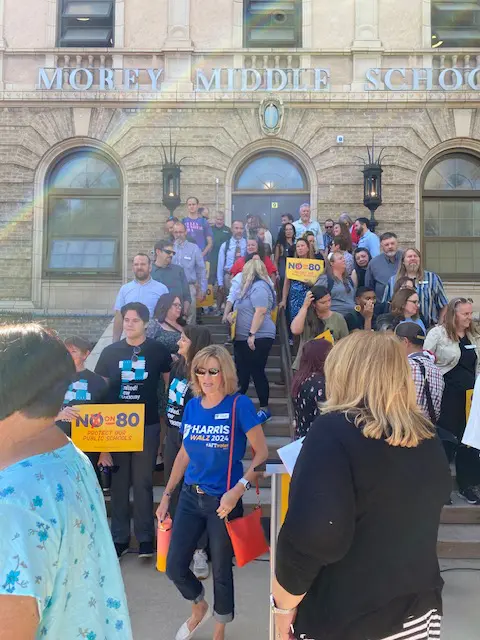


 Diane Ravitch's blog