Donald Trump’s serial depredations and violations of the law and Constitution inspired a retired educator to write a new Declaration of Indepence, tailored to a new age.
Whereas the people of these United States of America have given their lives in defense of our country, let not the federal usurper attempt to crown himself king and return to the time of George III.
Our populace will rise up and demand a return to the rule of law and civil discourse on issues confronting us. Have no kingly proclamations discourage us from following the traditions and norms of our 249 years. We do not live in the time of the divine right of kings. Our government derives from the will of the people and our rights cannot be dissolved by a false monarch. The strength of our democracy always lies with the hopes of our populace.
In all of our country’s existence we have never faced such an evil. We are not accustomed to a fraud who would besmirch our constitution and attempt to rule with his own pronouncements. He has divided us into many differing camps and beliefs with his lies that he will continue to separate us.
His claims that we are being invaded by groups of nefarious cutthroats that are bent on taking over our country are untrue. He will then be able to declare martial law and use all of the levers of government to suppress all protest activities. Now is the time for all good men and women to come to the aid of their country.
He has not complied with the laws and disregards our judiciary.
He has enriched himself by accepting emoluments from foreign countries, princes and oligarchs.
He has deliberately favored states that voted for him and disavowed those who did not.
He has supported taxes that would enrich the wealthy and deprive the poor.
He has endeavored to make judges bend to his will.
He has plundered our economy and dissolved our relationship with our allies.
He has abducted our people in public places- schools, places of worship, and public buildings.
He has threatened our institutions of higher learning if they did not bend to his will.
He has erected a multitude of new offices in the federal government to dispose of thousands of dedicated public servants.
He has restricted the entry into our country of the brightest young people in the world.
He has aligned himself with our enemies and supports their tyranny.
He has installed a health secretary who is destroying our health system and our capability to do health research.
He has encouraged and pardoned 1500 people who tried to overthrow our government.
His sycophants mock our populace and threaten to jail them if they are not compliant with his wishes.
He is, at this time, transporting armies of masked hoodlums to complete the works of death, desolation and tyranny, already begun with circumstances of cruelty, perfidy, scarcely paralleled in the most barbarous ages, and totally unworthy as the head of a civilized nation.
At every stage of these oppressions, we have petitioned for redress of these grievances. We have asked in a most civilized manner. Our petitions have been answered in only the most desultory and vengeful actions. A president whose character is marked by every act which may define a tyrant is not fit to be the leader of our country.
We have been warning our legislative representatives of the danger of these usurpations. They are fearful of his retributions both political and personal. We have entered the justice system in the highest court of the land to create estoppel. Their decisions do not seem to impede the leader’s desire to remake our democracy into an autocracy. The monied interests have formed a choral group for the president. Their support and their largesse have given him impetus to continue his cruelty. No inhabitants of our land are safe from his reach. Children of any age have felt his sting and have been spirited away.
We, therefore, the people of the United States of America, in Assembly, appealing to the Supreme Judge of the world, and the populace, solemnly publish and declare, that these United States of America are and have a right that our allegiance to the current regime will be absolved if the governing bodies of our federal legislature refuse to restrain the president from his policy of revenge and destruction of our country. And for the support of this Declaration, with a firm reliance on the protection of divine providence, we mutually pledge to each other our lives, our fortunes and our sacred honor.
Attest.
Signed by Order and in behalf of the American People
The Department of Political Science at the University of Gothenburg in Gothenburg, Sweden, publishes an annual report on the state of democracy around the world. In the recently published report, the authors made clear that democracy in the world is in retreat. Nowhere has it declined as dramatically as in the United States.
A special section of the report is focused on the United States. Under Trump, democracy in the USA is under attack. The President has centralized power in his office. The Republican-dominated Congress has ceded almost all of its Constitutional powers to Trump. The word “almost” may be an overstatement, as it’s difficult to remember an issue when Congress said no to a Presidential power grab.
The V-DEM report begins its special section about the “autocratization” of power in the United States:
*Under Trump’s presidency, the level of democracy in the USA has fallen back to the same level as in 1965.
Yet the situation is fundamentally different than during the Civil Rights era. In 2025, the derailment of democracy is marked by executive overreach undermining the rule of law, along with far-reaching suppression and intimidation of media and dissenting voices.
*The speed with which American democracy is currently dismantled is unprecedented in modern history.
*Legislative Constraints – the worst affected aspect of democracy – is losing one-third of its value in 2025 and reaching its lowest point in over 100 years.
*Civil Rights and Equality before the Law are also rapidly declining, falling to late 1960s levels.
*Freedom of Expression is now at its lowest level since the end of WWII.
*Electoral components of democracy remain stable. Election-specific indicators are re-assessed only in electoral years, and the 2025 scores are based on the quality of the 2024 elections.
The scale and speed of autocratization under the Trump administration are unprecedented in modern times. Within one year, the USA’s LDI score has declined by 24%; its world rank dropped from 20th to 51st place out of 179 nations. The level of democracy on the LDI is dwindling to 1965 level – the year that most regard as the start of a real, modern democracy in the USA.
Yet the deficiencies of American democracy today are fundamentally different from that of the Civil Rights era. As the V-Dem data and other evidence below show, the autocratization now is marked by executive overreach, alongside attacks on the press, academia, civilliberties, and dissenting voices.
The Most Dramatic Decline in American History
In 2023, the USA scored 0.79 on the LDI – shortly before the 2024 election year when first deteriorations were registered. The scores plummeted to 0.57 in 2025 (Figure 22). With such a sharp drop on the LDI, the level of democracy at the end of 2025 is back to the 1965 level. Symbolically, that is the year that most analysts consider the USA began its transition to a real democracy.
Democracy in the USA is now at its worst in 60 years. We are not alone in this assessment. Professor Steven Levitsky at Harvard University says the regime in the USA is now some type of authoritarianism. The Century Foundation argues that “American democracy is already collapsing…”
By magnitude of decline on the LDI, the 2025 plunge is the largest one-year drop in American history going back to 1789 – that is, in the entire period covered by V-Dem data. Only Trump 1.0 compares, when the LDI in the USA fell from 0.85 to 0.73 in four years, bringing the country back to its 1976 level and far below the regional average (Figure 22). American democracy survived Trump 1.0 but did not recover fully.
One notable shift is the transformation of the Republican Party to endorsing a far-right, nationalist, and anti-pluralist agenda. Nationalist, anti-liberal, far-right parties and leaders have largely driven the “third waveof autocratization.” Yet the USA stands out as the only case where such movement seized control over one party in a rigid two-party system.
Please open the link and read the report to review the sources and to understand how dramatically democracy has been undercut during the first year of Trump’s second term.
The Founding Fathers thought they had written a Constitution that would prevent the rise of tyranny. They were wrong.
Jennifer Rubin was a columnist for The Washington Post who departed when publisher Jeff Bezos bent his knee to Trump. Rubin, a journalist and lawyer, knows that Trump is a dangerous demagogue. She says in this piece that Republicans complain privately about Trump but refuse to stand up to him. They will pay for their cowardice in November, as they have in every special election since Trump returned.
Republicans made a calculated bet that by indulging Donald Trump’s ill-conceived and cruel schemes (e.g., unleashing ICE on cities, tariffs, wars with Venezuela and Iran, slashing healthcare to pay for tax cuts for the rich), the country would somehow stumble through. They figured congressional Republicans would share in any successes but somehow avoid any blame when things (inevitably) went haywire. Politics rarely works out that way.
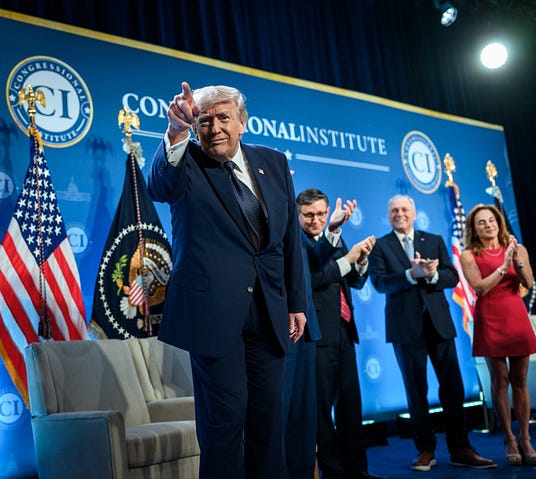
(Credit: Office of Speaker Mike Johnson)
Through Trump’s Iran War, shutdown of the Department of Homeland Security, futile effort to pass a Jim Crow-style voter suppression act (the so-called SAVE Act), and inflation-aggravating tariff scheme, Republicans are discovering they are tied at the hip with Trump. Refusing to deviate from his dictates, they will bear the brunt of his serial failures.
Whether the Iran War ends this month or months from now, Republicans cannot escape responsibility for the massive expenditure of taxpayer dollars, loss of life, rise in energy costs, regional instability, and damage to alliances Trump has wrought. Congressional Republicans refused to invoke the War Powers Act — or even to conduct meaningful oversight hearings — and applauded a senseless, unconstitutional war. Now they seem prepared to rubber-stamp a preposterous demand for $200B more in war spending. Republicans will have no place to hide come November when voters come looking for politicians to blame.
The latest CBS/You Gov poll has nothing but horrendous news for the Iran war cheerleaders: 90 percent say the war will make gas prices higher in the short term, 58 percent over the long term; 63 percent predict it will weaken the economy (a plurality assume we will be in a recession); a plurality of 49 percent think the war makes us less safe; and 57 percent say the war is going badly. Some 62 percent disapprove of how Trump is handling the war. Perhaps Republicans should have fulfilled their constitutional obligations rather than contenting themselves with sitting on the sidelines.
Meanwhile, Trump’s web of lies about immigrants and voting fraud have entangled him and Republicans in a political knot. Trump’s lie about mass voting fraud drove him to insist on the unpassable voter suppression SAVE Act. He then made that a precondition for any deal to resume DHS funding. Even to Republicans, this made no sense.
When Senator John Thune (R-SD) initially recommended that Trump agree to Democrats’ proposal to pass a DHS funding bill that would pay for TSA, FEMA, and the Coast Guard (leaving ICE funding for later negotiations), Trump rebuffed him. By Monday night, however, Trump was considering a deal to do just that, namely to fund the rest of DHS and handle funding for ICE in reconciliation.
What happened between his refusal to relent on funding and his capitulation? Trump trotted out another senseless and entirely performative maneuver: deploying ICE to airports. ICE agents, untrained for any TSA duties, stood around with virtually nothing to do (reminding one of the National Guard deployed to D.C., who largely loiter around metro stations). This underscores Republicans’ responsibility for bollixing up air travel, Trump’s feebleness in resolving messes of his own making, and the dangerous transformation of ICE into a roving street militia Trump deploys to intimidate and harass Americans.
All the ICE/airport stunt accomplished was to trigger a robust blowback from Democrats and civil society groups, demonstrating once again Trump’s talent in supercharging the Resistance. Deploring Trump’s use of ICE as his “personal dystopian police force,” Public Citizen observed: “The confluence of authoritarian overreach of this moment is striking.” The ACLU likewise condemned using ICE at airports “despite their lack of training for airport security and interactions, and their clear track record of abusing their power, including through using excessive force against citizens and immigrants alike.” (Unsurprisingly, this venture, the ACLU noted, was the first time a president “sent armed ICE agents to airports to replace trained security agents and instill fear in families and other travelers.”)
Trump’s compounding calamities have fractured Republicans internally. Cultists demand perfect fidelity to Trump on the war abroad and bullying at home; others fret that a war betrays their America First ideology and the SAVE Act is a legislative cul-de-sac that now compounds the DHS shutdown disaster. (MAGA provocateur Sen. Mike Lee of Utah has become a chief enabler of Trump’s destructive schemes, “sparking a wave of mostly private animosity from GOP colleagues who believe his plan to push through legislation overhauling how federal elections are conducted is ill-conceived and potentially harmful to the party’s chances in the midterms,” Politico reports.)
Republicans fret privately that the Trump reign of chaos, coupled with the highly unpopular war, spells doom for them in November. One is tempted to ask about the private Republican hand-wringing:
What did Republicans think would happen when they fully empowered a delusional narcissist, one who is so clearly ignorant of government and keen to pursue his own wealth and power, the country be damned?
Some dim-witted MAGA Republicans remain true believers and actually think Trump’s antics will pay off. Others know Trump is nuts and recognize the party is headed for disaster, but lack the courage to say so. They are banking that they will survive the blue wave coming in November to fight another day. Their lack of patriotism may be galling, but their self-preservation strategy looks increasingly daft.
The damage Trump and his flunkies have inflicted on our democracy will reverberate for years to come. American families may take years to recover from the economic hits. It is a small consolation that MAGA lawmakers and right-wing media stooges, who have chosen the route of cowardly compliance over constitutional duty and self-serving propaganda over truth-telling, will shoulder much of the blame. History in the long run and voters in the near term will hold Republicans fully accountable for the blunders they countenanced.
The Contrarian is reader-supported. To receive new posts, enable our work, help with litigation, and keep this opposition movement engaged, please join the fight by becoming a paid subscriber.
Thank you for being part of The Contrarian. Share this piece to help spread the word.
Paul Krugman, Nobel-Prize winning economist, writes about shady speculation in the oil futures market. He says it’s not just insider trading, it’s treason.
Over the weekend Donald Trump threatened dire vengeance on Iran unless its government opened the Strait of Hormuz within 48 hours, a deadline that would expire Monday evening in Washington. Specifically, he announced that the U.S. would begin bombing power plants — plants that supply electricity to Iran’s civilian population — unless the Strait was cleared.
But at 7:05 AM Monday Trump called the whole thing off — for five days, he said, but many people are assuming that the threatened action, which would have been a massive war crime, is now off the table.
The reason for the about-face, he claimed, was that the U.S. was engaged in productive negotiations with Iranian officials — although this seems to have come as news to the Iranians, who denied that any such negotiations are taking place. Sad to say, in this case, as I tried to explain yesterday, the fanatical, brutal Iranian regime is more credible than the president of the United States. Is he lying or living in a fantasy world? Neither possibility is comforting.
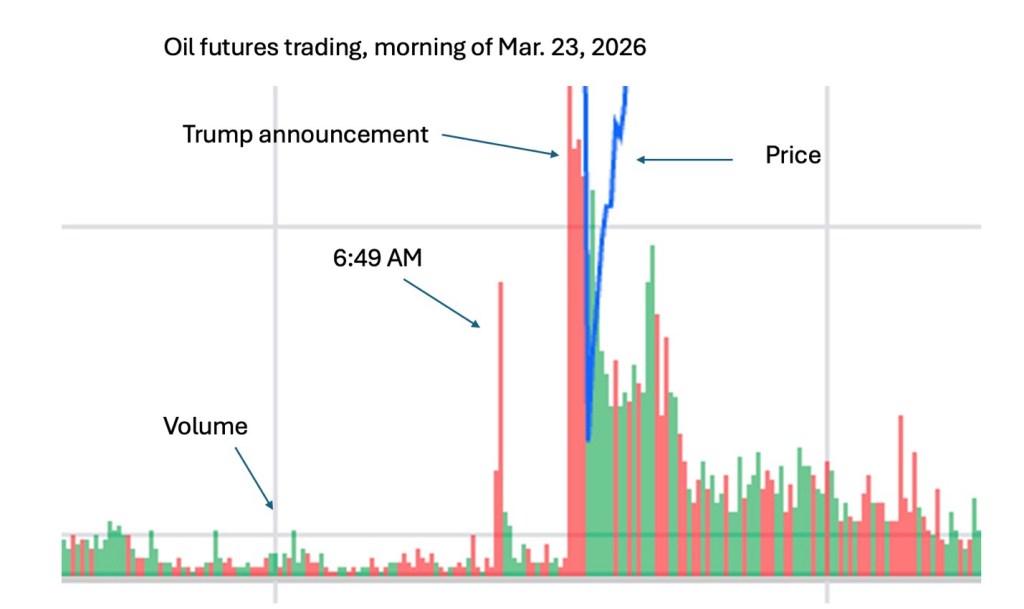
But in any case, Trump’s sudden climb-down was startling. Who could have seen this coming? The answer is, the person or people who bought large quantities of stock market futures and sold large quantities of oil futures around 15 minutes before Trump’s announcement. As CNBC reports,
At around 6:50 a.m. in New York, S&P 500 e-Mini futures trading on the CME recorded a sharp and isolated jump in volume, breaking from an otherwise subdued premarket backdrop. With thin liquidity typical of early trading hours, the sudden burst stood out as one of the largest volume moments of the session up to that point. A similar pattern was observed in oil markets. West Texas Intermediate May futures also saw a noticeable pickup in trading activity at roughly the same time, with a distinct volume spike interrupting otherwise quiet conditions.
This “sharp and isolated jump in volume” — which you can see for the oil futures market in the chart at the top of this post — was especially bizarre because there were no major news items — no major publicly available news items — to drive sudden big market transactions. The story would be baffling, except that there’s an obvious explanation: Somebody close to Trump knew what he was about to do, and exploited that inside information to make huge, instant profits.
This wasn’t the first time something like this has happened under Trump. There were large, suspicious moves in the prediction market Polymarket before previous attacks on Iran and Venezuela. But this front-running of U.S. policy was really large: the Financial Times estimates the sales of oil futures in that magic minute Monday morning at about $580 million, and that doesn’t count the purchases of stock futures.
When officers of a company or people close to them exploit confidential information for personal financial gain, that’s insider trading — which is illegal. But we have another word for situations in which people with access to confidential information regarding national security — such as plans to bomb or not to bomb another country — exploit that information for profit. That word is “treason.”
Why is profiting from insider information about national security decisions effectively a form of treason? First, it’s hard to think of a more fundamental principle for officials we entrust with important decisions, especially those that involve national security, that they or people they know should not be allowed to exploit their positions for personal gain.
Second, financial trading based on what should be closely held secrets reveals information to current or potential foreign adversaries. To exaggerate a bit, but only a bit, who needs to bribe agents within the government, or recruit them with honey traps, when you can infer the same information by keeping track of transactions on futures markets?
Finally, there isn’t that big a gap between using knowledge of national secrets to make lucrative financial trades and simply selling those secrets to the highest bidder. Once you’re breached the line that says you shouldn’t profit personally from access to information that is or should be highly classified, the line between trading based on state secrets and selling those secrets directly is a blurry one.
In fact, I’d very much like to know exactly who was making those trades yesterday morning. Were they people directly in the know, or billionaires/traders who paid people in the know for tips?
I’m sure we’ll find out once Kash Patel’s FBI carries out its careful, no-holds-barred investigation.
For the humor-impaired, that was a joke. However, I do believe that the culprits will be easy to determine once Democrats are back in power, and they must apply the full force of law to the people responsible.
One question that may be harder to resolve is the extent to which the possibility of insider trading may actually have influenced policy. Are decisions about war and peace in part serving the cause of market manipulation rather than the national interest? If you dismiss this as unthinkable, you just haven’t been paying attention.
There’s a broader lesson here: You can’t trust a corrupt government to protect national security. And our government is now utterly corrupt: It’s hard to find a single senior official, from the president on down, who treats public office as a grave responsibility rather than an opportunity for personal self-aggrandizement and profit.
Among other things, deeply corrupt governments tend to be very bad at waging war, no matter how much they may exalt “warrior ethos” and “lethality.” When we do a post-mortem on how the Iran debacle happened, arrogant ignorance may still get top billing. But grotesque venality will come a close second.
Former KGB agent Vladimir Putin was hand-picked by Boris Yeltsin as his successor. Yeltsin was a drunk, and he miscalculated badly in picking Putin. Instead of building democratic norms and institutions, Putin embarked on a long-term plan to restore the USSR. After serving as president of Russia from 2000-2008, he was succeeded by a puppet (Dimitri Medvedev), then resumed the presidency in 2012. The national legislature extended his term to 2036. Anyone who seriously threatens him ends up in prison or dead.
In a startling development, one of Putin’s most strident sycophants abruptly turned against him. Ilya Remeslo, a lawyer, was known as a reliable lapdog for Putin. He regularly testified in trials against Alexei Navalny.
For years, Ilya Remeslo was a reliable pro-Kremlin operator, going after critics of the regime and smearing independent journalists, bloggers and opposition politicians.
Then the 42-year-old lawyer abruptly turned on the country’s most powerful man. Late on Tuesday, Remeslo posted a manifesto to his 90,000 Telegram followers titled: “Five reasons why I stopped supporting Vladimir Putin.”
In it, he accused the “illegitimate” Russian president of waging a “failing war” in Ukraine that had caused millions of casualties and wrecked the economy, and argued that Putin’s more than two decades in power illustrated how “absolute power corrupts”, calling on him to step aside….
Doubling down on his earlier remarks, he told the Guardian on Wednesday from his flat in St Petersburg: “Vladimir Putin should resign and be put on trial as a war criminal. His personalised, corrupt system is doomed to collapse, as we’re seeing now with the war in Ukraine and elsewhere.
“The army isn’t advancing in Ukraine, and the war is going nowhere. There are massive losses. We are fighting over tiny territories that will ultimately give Russia nothing.”
He went on to criticise Putin’s authoritarian rule, the state of the economy and Moscow’s recent push to shut down internet access. “This man [Putin] has destroyed everything he could lay his hands on. The country is literally falling apart,” Remeslo said.
Please open the link and finish reading this fascinating article.
Adam Kinzinger is the Republican Congressman who was brave enough to say that Trump inspired an insurrection on January 6, 2021. He was brave enough, with Liz Cheney, to join the January 6 Committee investigating the insurrection. Both Kinzinger and Cheney were reviled by other Republicans for daring to question Trump’s lies.
On his blog, he speaks out with independence and courage. In this one, he describes the Pentagon’s splurge on delicacies and luxury items:
For years we have heard the same talking point from the Trump administration and its allies: government waste is the problem. The answer, they said, was to slash programs, dismantle agencies, and create flashy new outfits like the so-called fake agency Department of Government Efficiency — DOGE — to root out fraud and save taxpayer money. The pitch was simple. Government was bloated, and adults were finally back in charge.
But the reality looks very different.
According to a watchdog analysis, the Department of Defense spent $93.4 billion on grants and contracts in September 2025 alone, with nearly half of that money spent in the final five business days of the fiscal year.
Anyone who has worked inside government understands that the end of the fiscal year can become a mad scramble to spend money before it disappears, but the scale of what happened here raises serious questions about priorities.
Some of the spending is almost comical if it weren’t real taxpayer dollars. The Pentagon spent $6.9 million on lobster tail, $2 million on Alaskan king crab, $15.1 million on ribeye steak, and $1 million on salmon in September alone. There were 272 orders of doughnuts totaling $139,224, along with $124,000 for ice cream machines and $12,000 for fruit basket stands.
That same spending spree included $60,000 for Herman Miller recliners, a $98,000 Steinway piano for the Air Force chief of staff’s home, and millions spent on electronics like Apple and Samsung devices. Even more staggering, the Defense Department spent $3.5 billion on cable television services.
At the same time Americans were struggling with rising grocery costs, borrowing money just to buy food, and falling behind on car payments, the Pentagon was filling shopping carts with lobster and ribeye.
What makes this particularly jarring is that this administration simultaneously dismantled programs that actually matter to people around the world. Under the banner of eliminating waste, they gutted much of the United States Agency for International Development. For decades, USAID helped prevent famine, stabilized fragile regions, and projected American compassion and leadership around the globe.
That money fed starving people.
But apparently feeding the world was wasteful. Lobster for the Pentagon was not.
I spent years in uniform flying the RC-26B surveillance aircraft with the Air Force. It wasn’t glamorous. It wasn’t flashy. But it was effective. The aircraft supported counter-terrorism missions and provided intelligence that helped protect American troops on the ground.
In 2023, the program was cancelled.
Why? Because the Air Force didn’t want to spend about $20 million a year to keep it going.
Think about that for a moment. The entire annual cost of a program that directly supported operational missions was less than what the Pentagon spent on lobster tail in a single month. Programs that actually protect American lives were eliminated in the name of efficiency, while luxury purchases and end-of-year spending binges rolled on.
This is the fundamental problem with the politics of “waste.” The loudest critics of government spending are often the least interested in actually fixing it. They are interested in headlines and ideological targets. Programs that help poor people or foreign populations are easy political punching bags. Quiet spending inside the defense bureaucracy is not.
Now, a quick aside. Yearly budgeting and spending can be difficult. Let’s just take my personal Congressional budget per year of around $1.3 million. That covered everything from salaries, new printers, paper, and correspondence, to travel. If I went over my budget for the year, I was personally on the hook for the overspending. So naturally, we saved a lot of expenses for the end of the fiscal year so that we could make sure we stayed within the allowance. Some end of year splurging is understood, but this amount from DOD? Simply insane.
Real fiscal responsibility is not about cutting programs that feed the hungry or abandoning alliances that stabilize the world. It’s about making serious choices about priorities.
If the government wants to talk about waste, we should start with the billions spent on furniture, electronics, luxury food, and end-of-year spending sprees that do little to strengthen national security.
Because the truth is simple.
We didn’t stop feeding the world to save money.
We stopped feeding the world so someone else could buy lobster.
Heather Cox Richardson pulled together the extraordinary events of the past few days. She is the master of the question, “Make it all make sense,” even when it doesn’t. Her commentaries are wildly popular. She has about 3 million subscribers on Substack and an equal number who follow her on Facebook.
President Donald J. Trump is behaving more and more erratically these days, seeming to think he can dictate to other countries.
This morning, Trump told Barak Ravid and Zachary Basu of Axios that he needs to be involved personally in choosing the next leader of Iran. Speaking of Iranian politicians who are preparing to announce a new leader, Trump told the reporters: “They are wasting their time. Khamenei’s son is a lightweight. I have to be involved in the appointment, like with Delcy [Rodríguez] in Venezuela.”
Foreign affairs journalist Olga Nesterova of ONEST reported that in a call with Israel’s Channel 12 this morning, Trump called Israel’s president Isaac Herzog “a disgrace” and demanded Herzog pardon Prime Minister Benjamin Netanyahu “today” because Trump doesn’t want Netanyahu distracted from the war with Iran. Trump said Herzog had “promised” him “five times” to pardon the prime minister, and he appeared to threaten Herzog when he added: “Tell him I’m exposing him.”
In a statement, Herzog noted that “Israel is a sovereign state governed by the rule of law” and said the pardon is being dealt with by the Justice Ministry, as the law requires. After its ruling, Hertzog’s office said, he will examine the issue according to the law and “without any influence from external or internal pressures of any kind.”
In a conversation today with Dasha Burns of Politico, Trump insisted that “[p]eople are loving what’s happening” and said: “Cuba’s going to fall, too.”
The most astonishing example of Trump’s international aggression came from White House press secretary Karoline Leavitt. Although Trump initially said he attacked Iran to keep it from acquiring nuclear weapons, Leavitt yesterday explained that Trump joined Israel in a military attack on Iran because Trump had “a feeling based on fact” that Iran was going to attack the United States.
Trump’s assertion of power globally contrasts with increasing setbacks at home.
Since the Supreme Court struck down the tariffs Trump imposed under the International Emergency Economic Powers Act (IEEPA) as unconstitutional, the administration has tried to slow walk repaying the $130 billion the government collected under those tariffs. But yesterday, Judge Richard Eaton of the U.S. Court of International Trade ruled that companies that paid the tariffs are entitled to a refund.
After the Supreme Court’s decision, Trump immediately imposed new tariffs of 15% on all global trade, using as justification Section 122 of the Trade Act of 1974. As Lindsay Whitehurst and Paul Wiseman of the Associated Press noted, this is awkward because the Department of Justice under Trump argued in court last year that Trump had to use the IEEPA because Section 122 did “not have any obvious application” in fighting trade deficits.
Today the Democratic attorneys general of more than twenty states filed a lawsuit to stop the new tariffs imposed under Section 122. “Once again, President Trump is ignoring the law and the Constitution to effectively raise taxes on consumers and small businesses,” New York Attorney General Letitia James said in a statement Thursday.
The Department of Justice has also quietly backed away from Trump’s demand that it investigate whether former president Joe Biden broke the law by using an autopen to sign presidential documents. Yesterday, Michael S. Schmidt, Devlin Barrett, and Alan Feuer reported in the New York Times that prosecutors in the U.S. attorney’s office in Washington, D.C., “were never quite clear what crime, if any, had been committed by the Biden administration’s use of the autopen.”
They concluded there was no credible case to make against Biden. The journalists noted that “the failed inquiry has only added to the sense among many federal investigators that Mr. Trump has become increasingly erratic in his desire to use the criminal justice system to punish his political adversaries for behavior that comes nowhere close to being criminal.”
Trump had been so invested in his attacks on Biden over his quite ordinary use of an autopen that he replaced a White House picture of Biden with one of an autopen, so the prosecutors’ shelving that investigation has to sting. Likely even more painful, though, is today’s news that Trump’s hand-picked National Capital Planning Commission has put off a vote to approve the ballroom Trump is proposing to replace the East Wing of the White House that he suddenly tore down last October.
At a Medal of Honor ceremony on Monday, Trump called attention to his ballroom and boasted: “I built many a ballroom. I believe it’s going to be the most beautiful ballroom anywhere in the world.” But the American people do not share Trump’s vision. The chair of the commission said “significant public input” has caused him to delay the vote until April 2. Jonathan Edwards and Dan Diamond of the Washington Post say that of the more than 35,000 comments the commission received, more than 97% were opposed to Trump’s plans for the ballroom.
But perhaps the biggest setback for the Trump administration showed in the testimony of now-former secretary of homeland security Kristi Noem before Congress this week. There, days after Trump launched a major military operation in the Middle East without consulting Congress, angry lawmakers of both parties exposed the lawlessness and corruption taking place in the department under Noem’s direction. But their stance was about more than Noem: her lawlessness and corruption represented the larger lawlessness and corruption of the Trump administration.
Noem testified before the Senate Judiciary Committee on Tuesday and the House Judiciary Committee on Wednesday. In both chambers, Democrats jumped right to a central feature of the way in which Noem and the administration are setting up the idea that anyone who opposes the actions of the Trump administration is participating in “domestic terrorism.”
They tried to get Noem to walk back her statements that Renee Good and Alex Pretti, both shot and killed by federal agents acting under her authority in Minnesota, were “domestic terrorists.” Noem refused to do so. She has not actually called them “domestic terrorists” but has said they were engaged in “domestic terrorism,” a distinction that reveals the administration’s attempt to criminalize political opposition. Rachel Levinson-Waldman of the Brennan Center explained that “[t]o actually be called a ‘domestic terrorist, an individual must commit one or more of 51 underlying ‘federal crimes of terrorism,’” which involve nuclear or chemical weapons, plastic explosives, air piracy, and so on. Good and Pretti, and the many others administration officials have accused, do not fit that description. But on September 25, 2025, Trump’s NSPM-7 memo claimed that those opposing administration policies are part of “criminal and terroristic conspiracies” and that those who participate in them are engaging in “domestic terrorism.”
Noem refused to back away from the idea that Trump’s opponents are engaging in “criminal and terroristic conspiracies” by, for example, opposing the behavior of federal agents from Immigration and Customs Enforcement (ICE) and Border Patrol. Leaving that definition behind would undermine the administration’s entire domestic stance.
Democrats slammed Noem for her handling of detentions and deportations, ignoring court orders, and detaining U.S. citizens. In the House, Jamie Raskin of Maryland, the top Democrat on the committee, said she “turned our government against our people, and…turned our people against our government.”
Republicans also called Noem out. Noem’s poor handling of the Federal Emergency Management Agency (FEMA) has left North Carolina still suffering after terrible storms in 2024, and Senator Thom Tillis (R-NC) went after her.
He highlighted a letter from the inspector general for the Department of Homeland Security (DHS), who said the department’s leaders have “systematically obstructed” the work of him and his staff. He identified eleven instances in which the department had refused to provide records and information. In a criminal investigation with national security implications, the department would permit him to access a database only if he revealed details of the investigation of individuals who might be related to the investigation.
Tillis said: “Does anybody have any idea how bad it has to be for the [Office of Inspector General] in this agency to come out and do this publicly? That is stonewalling, that’s a failure of leadership, and that is why I’ve called for your resignation.”
Lawmakers also focused on the corruption in DHS, which now commands more than $150 billion thanks to the Republicans’ One Big Beautiful Bill Act. Lawmakers referred to a November 2025 ProPublica story in which reporters traced a $220 million contract for an ad campaign featuring Noem. The contract went first to a brand new small company organized by a Republican operative just days before winning the contract, and then to a subcontractor, Strategy Group, owned by Noem’s former spokesperson’s husband and closely associated with Noem’s advisor and reputed affair partner Corey Lewandowski.
Noem insisted she had nothing to do with the contract award and claimed Trump had signed off on the ad campaign. About the contract, Representative Joe Neguse (D-CO) commented in apparent disbelief: “You want the American people to believe that this is all above board, that $143 million of taxpayer money just happened to go to this one company that doesn’t have a headquarters, doesn’t have a website, has never done work for the federal government before, and is registered apparently or attached to a residence from a political operative, and of course one of the subcontractors of that contract, as you know, is a political firm that’s tied to, to you back when you were governor of South Dakota?”
Since Noem’s testimony, the Strategy Group released a statement saying it received only $226,137.17 for its work on the ad campaign.
Also under scrutiny was Noem’s purchase of a private plane with a luxurious bedroom in it, which brought up questions about whether, as is widely reported, she is having a sexual relationship with a subordinate. She refused to answer, and insisted Lewandowski had had no role in approving contracts. Joshua Kaplan and Justin Elliott of ProPublica promptly fact-checked her: in fact, Lewandowski has signed off on a number of contracts.
Lawmakers’ indictment of Noem for her extreme partisanship, disregard of the law, corruption, and lying condemned similar behavior from the administration in general. Today Trump told Steve Holland and Ted Hesson of Reuters that he “never knew anything about” Noem’s $220 million ad campaign, suggesting she lied to Congress under oath. This afternoon, just before she went on stage to speak, Trump announced by social media post that he was replacing Noem with Senator Markwayne Mullin of Oklahoma.
This is an assertion of power the president does not have: he can nominate Mullin, but the Senate must confirm or reject his appointment.
Apparently unaware she was fired, Noem proceeded to give a speech in which she recited a false quotation from George Orwell, the writer who devoted much of his work to the importance of manipulating language to facilitate authoritarianism, a fitting end to Noem’s career in the Trump administration.
But Noem is not likely to disappear from the news. Illinois governor J.B. Pritzker recorded a video saying: “Hey, Kristi Noem, don’t let the door hit you on the way out. Here’s your legacy: corruption and chaos. Parents and children tear-gassed. Moms and nurses, U.S. citizens getting shot in the face. Now that you’re gone, don’t think you get to just walk away. I guarantee you, you will still be held accountable.”
Senator Ron Wyden (D-OR) was more direct: “Turns out lawlessness is not a winning strategy,” he posted. “See you at Nuremberg 2.0.”
As many of you know, I was born and raised in Texas. I grew up in Houston, third of eight children. I went to public schools, then to college in Massachusetts. I have never stopped being a Texan. I live in Brooklyn now but a part of my heart will always be in Texas. So I keep a close watch over developments in my home state.
The victories of James Talarico for Senate and Gina Hinojosa for Governor put Texas Democrats in a good position to turn Texas blue.
Gina Hinojosa coasted to victory in the Democratic primary over seven opponents. Soon after the polls closed, she had 61% of the vote. She will face incumbent Greg Abbot in November.
Talarico won the primary by 52.8% to Crockett’s 45.9%.
(Full disclosure: I contributed to all three campaigns.)
Talarico was a member of the state legislature. He has studied theology and is working towards a Master of Divinity at the Austin Presbyterian Seminary. He hopes to win independents and Trump voters with his deep religious faith and his rhetoric of love and reconciliation.
Under Governor Greg Abbot–now seeking his fourth term–Texas became an extreme MAGA state. Abbot echoes whatever Trump says , or says it first. Abbot is mean and has a stone heart.
Gina Hinojosa swept the Democratic primary for Governor. She is smart, articulate, beautiful, and Hispanic. One of the reasons that Democrats have not won a statewide office since 1994 is low turnout and growing Hispanic support for Trump. Gina was a featured speaker at the last conference of the Network for Public Education in Columbus, Ohio, and she was wonderful! As she explains in her PBS interview, strengthening neighborhood public schools is her top priority.
The Republicans running for Senate will compete in a May run-off. Jon Cornyn, the incumbent, is a reliable vote for Trump but not really MAGA. He seems like a moderate Republican who votes with Trump to protect his hide. Cornyn is running for his fifth term.
His opponent Ken Paxton is Attorney General of Texas, and it’s fair to say that he’s been scarred by scandals. His wife is a state senator. He cheated on her. Some of his staff blew the whistle on him and said he took payoffs from men he was investigating. The Republican House impeached him; the Republican Senate cleared him, thanks to generous donations by hard-right MAGA billionaires.
Paxton and Cornyn will have a runoff in May.
Talarico will be a strong candidate for the Senate. Hinojosa will be a strong candidate against Abbot, if Texans are sufficiently sick of pay-to-play politics.
The outcome will depend on turnout. Right now, Texas is run by a handful of oil billionaires. They want low taxes and minimal public services. They are Christian nationalists who love money and power.
If Talarico can attract the support of non-MAGA Republicans and if Gina can bring Hispanic voters to the polls, Texas will flip blue.
See Gina Hinojosa speaking at the Network for Public Education conference in April 2025, before the Republican-dominated Texas legislature passed vouchers. The passage of vouchers happened only after Governor Abbot primaried anti-voucher Republicans with the millions given him by billionaire Jeff Yass, the richest man in Pennsylvania.
See Talarico on how the worst people quote Dr. Martin Luther King Jr. on MLK Day and then violate his teachings every other day of the year.
Talarico on Christian nationalists, who–he says–are “more committed to the love of power than to the power of love.”
I love these two and will support them both. There will be a tidal wave of money pouring into Texas Republican coffers from other states to try to stop these two exciting Democrats!
Republicans on the House Iversifgt Conmittee called former Secretary of State Hillary Clinton to testify. She asked for an open public hearing, but they refused.
She roasted them for failing to call for the testimony of those who are named in the Epstein Files and in widely circulated photographs. They have not invited testimony from Donald Trump, Melania Trump, Howard Lutnick, or Elon Musk.
Here is her statement:
Mr. Chairman, Ranking Member, Members of the Committee… as a former Senator, I have respect for legislative oversight and I expect its exercise, as do the American people, to be principled and fearless in pursuit of truth and accountability.
As we all know, however, too often Congressional investigations are partisan political theater, which is an abdication of duty and an insult to the American people.
The Committee justified its subpoena to me based on its assumption that I have information regarding the investigations into the criminal activities of Jeffrey Epstein and Ghislaine Maxwell. Let me be as clear as I can. I do not.
As I stated in my sworn declaration on January 13, I had no idea about their criminal activities. I do not recall ever encountering Mr. Epstein. I never flew on his plane or visited his island, homes or offices. I have nothing to add to that.
Like every decent person, I have been horrified by what we have learned about their crimes. It’s unfathomable that Mr. Epstein initially got a slap on the wrist in 2008, which allowed him to continue his predatory practices for another decade.
Mr. Chairman, your investigation is supposed to be assessing the federal government’s handling of the investigations and prosecutions of Epstein and his crimes. You subpoenaed eight law enforcement officials, all of whom ran the Department of Justice or directed the FBI when Epstein’s crimes were investigated and prosecuted. Of those eight, only one appeared before the Committee. Five of the six former attorneys general were allowed to submit brief statements stating they had no information to provide.
You have held zero public hearings, refused to allow the media to attend them, including today, despite espousing the need for transparency on dozens of occasions.
You have made little effort to call the people who show up most prominently in the Epstein files. And when you did, not a single Republican Member showed up for Les Wexner’s deposition.
This institutional failure is designed to protect one political party and one public official, rather than to seek truth and justice for the victims and survivors, as well as the public who also want to get to the bottom of this matter. My heart breaks for the survivors. And I am furious on their behalf.
I have spent my life advocating for women and girls. I have worked hard to stop the terrible abuses so many women and girls face here and around the world, including human trafficking, forced labor, and sexual slavery. For too long, these have been largely invisible crimes or not treated as crimes at all. But the survivors are real and they are entitled to better.
In Southeast Asia, I met girls as young as twelve years old who were forced into prostitution and raped repeatedly. Some were dying of AIDS. In Eastern Europe, I met mothers who told me how they lost daughters to trafficking and did not know where to turn. In settings around the world, I met survivors trying to rebuild their lives and help rescue others – with little support from people in power, who too often turned a blind eye and a cold shoulder.
If you are new to this issue, let me tell you: Jeffrey Epstein was a heinous individual, but he’s far from alone. This is not a one-off tabloid sensation or a political scandal. It’s a global scourge with an unimaginable human toll.
My work combatting sex trafficking goes back to my days as First Lady. I worked to pass the first federal legislation against trafficking and was proud that my husband signed the Trafficking Victims Protection Act, which increased support for survivors and gave prosecutors better tools for going after traffickers.
As Secretary of State, I appointed a former federal prosecutor, Lou CdeBaca, to ramp up our global antitrafficking efforts. I oversaw nearly 170 anti-trafficking programs in 70 nations and directly pressed foreign leaders to crack down on trafficking networks in their countries. Every year we published a global report to shine a light on abuses. The findings of those reports triggered sanctions on countries failing to make progress, so they became a powerful diplomatic tool to drive concrete action.
I insisted that the United States be included in the report for the first time ever in 2011. Because we must hold ourselves not just to the same standard as the rest of the world but to an even higher one. Sex trafficking and modern slavery should have no place in America. None.
Infuriatingly, the Trump Administration gutted the Trafficking in Persons Office at the State Department, cutting more than 70 percent of the career civil and foreign service experts who worked so hard to prevent trafficking crimes. The annual trafficking report, required by law, was delayed for months. The message from the Trump Administration to the American people and the world could not be clearer: combatting human trafficking is no longer an American priority under the Trump White House.
That is a tragedy. It’s a scandal. It deserves vigorous investigation and oversight.
A committee endeavoring to stopping human trafficking would seek to understand what specific steps are needed to fix a system that allowed Epstein to get away with his crimes in 2008.
A committee run by elected officials with a commitment to transparency would ensure the full release of all the files.
It would ensure that the lawful redactions of those files protected the victims and survivors, not powerful men and political allies.
It would get to the bottom of reports that DOJ withheld FBI interviews in which a survivor accuses President Trump of heinous crimes.
It would subpoena anyone who asked on which night there would be the “wildest party” on Epstein’s island.
It would demand testimony from prosecutors in Florida and New York about why they gave Epstein a sweetheart deal and chose not to pursue others who may have been implicated.
It would demand that Secretary Rubio and Attorney General Bondi testify about why this administration is abandoning survivors and playing into the hands of traffickers.
It would seek out officers on the front lines of this fight and ask them what support they need.
It would put forth legislation to provide more resources and force this administration to act.
But that’s not happening.
Instead, you have compelled me to testify, fully aware that I have no knowledge that would assist your investigation, in order to distract attention from President Trump’s actions and to cover them up despite legitimate calls for answers.
If this Committee is serious about learning the truth about Epstein’s trafficking crimes, it would not rely on press gaggles to get answers from our current president on his involvement; it would ask him directly under oath about the tens of thousands of times he shows up in the Epstein files.
If the majority was serious, it would not waste time on fishing expeditions.
There is too much that needs to be done.
What is being held back? Who is being protected? And why the cover-up?
My challenge to you, Mr. Chairman, Members of the Committee, is the same challenge I put to myself throughout my long service to this nation. How to be worthy of the trust the American people have given you.
They expect statesmanship, not gamesmanship. Leading, not grandstanding. They expect you to use your power to get to the truth and to do more to help survivors of Epstein’s crimes as well as the millions more who are victims of sex trafficking.

 Diane Ravitch's blog