Tom Ultican is a retired teacher of advanced mathematics and physics. Before joining the teaching profession, he worked in the corporate sector.
He writes here about a shoddy piece of research on charter schools in Denver.
Ultican writes:
Another education study financed by Arnold Ventures and the Walton Family Foundation blurs education reality. Their 2022 model did not pass the laugh test so “researchers” from the University of Colorado Denver tried again. Unfortunately their claims still confuse correlation with causation. This error seems purposeful.
The study of school reform in Denver was conducted by the Center for Education Policy Analysis (CEPA). They state, “For the past three years CEPA has partnered with the Center on Reinventing Public Education to consider a paradigm-shifting approach to family and community engagement efforts in school districts.” It is a study apparently to justify and promote the portfolio model of school management, a system first proposed in 2009 by the founder of the Center for Reinventing Public Education (CRPE), Paul Hill.
In their 2022 study, this same team also used state testing data from years 2004/5 through 2018/19. They explained that the first 4-years of the research employed pre-reform data and the final 10-years were from the portfolio model reform period. The authors reported, “During the study period, the district opened 65 new schools, and closed, replaced, and restarted over 35 others.” (Page 7)
The National Education Policy Center contracted with Robert Shand to review the 2022 Denver study. Dr. Shand is Assistant Professor of Education Policy and Leadership at American University and an affiliated researcher with the Center for Benefit-Cost Studies of Education at Teachers College, Columbia University. Shand also did a review of the new 2024 study.
In his 2022 review, Shand agreed that the test scores for Denver Public Schools had gone up but he noted a few reasons why claiming these gains were because of the portfolio model was unreasonable:
Demographics shifting to a larger percentage of white students in Denver coincided with the reforms.
Per-student revenues increased in Denver by 22% but only 13% across Colorado.
Student-to-teacher ratio in Denver dropped from 17.9 to 14.9.
DPS was already showing academic improvement before implementation of the portfolio reforms.
Black and Hispanic/Latinx students were growing at approximately 0.06 standard deviations per year pre-reform and 0.03-0.04 standard deviations per year post-reform. (Page 7)
“While the new report does convincingly demonstrate that the gains are not significantly due to changing demographics, it fails to address other critiques of the prior study, including (1) that the portfolio model was undertheorized, with unclear mechanisms of action and insufficient attention to potential drawbacks; and (2) that circumstances, events, and resources besides the portfolio reform and student demographics were changing concurrently with the reform. Additionally, the report’s sweeping conclusion—that Denver’s reform is the most effective in U.S. history—is unsupported. The improved outcomes in Denver during this time period are impressive, but the authors seem overly determined to cite a package of favored reforms as the cause.” (Page 3)
While Shand agrees that demographic changes are not the whole reason for the improved test scores, they are a significant input. The chart above from USAFacts.org shows the typically higher scoring groups Asians and Whites going from 54.2% of the population to 58.9% in the 14 years from 2005 to 2019. During the same period, the Hispanic and Black population shrunk from 42.9% to 38.1% which resulted in a 9.5% shift in the population from a lower scoring to a higher scoring racial mix.
An even bigger impact on the scoring in Denver was the change in economic circumstances. Standardized testing is useless because the results are dependent on one variable, family wealth. Statisticians assign r values between -1 and +1 to results tested. Plus 1 signifies certainty, zero shows no influence and -1 indicates certainty in the opposite direction of expectations. The only input ever found with more than 0.3 r-value is family wealth at 0.9 r-value. The median family income in Denver is up significantly.
Two sources show how strongly Denver’s family income has grown. Neilsberg research shares that between 2010 and 2020 the median income grew from $61,394 to $82,335, a 25% growth. City-Data states:
“The median household income in Denver, CO in 2022 was $88,213, which was about the same as the median annual income of $89,302 across the entire state of Colorado. Compared to the median income of $39,500 in 2000 this represents an increase of 55.2%”
This kind of wealth growth over the 14 years the Denver researchers studied was bound to have a significant impact on testing results, but they ignored it. Add this to the 9% greater revenue for Denver schools and three less students per teacher compared to the rest of the state and of course Denver’s student made comparative testing gains.
Professor Shand mentions the damage caused by school turnaround efforts and closing schools noting the research indicates these are especially harmful events for students in low income or marginalized neighborhoods. (Page 6 and 7) Shand concluded:
“In sum, this report provides some additional supporting evidence in favor of the tentative conclusion that Denver’s portfolio reform was positive. Importantly, the report also grossly exaggerates both the magnitude of the success and certainty behind the evidence for it. The findings should thus be interpreted with extreme caution. (Page 8)
He is being nice. He should have concluded that this report is school choice propaganda.
About the Report Authors
The lead author, Parker Baxter, is Director of the Center for Education Policy Analysis at the University Of Colorado Denver School Of Public Affairs. He previously was Director of Knowledge at the National Association of Charter School Authorizers. Parker is also a Senior Research Affiliate at the CRPE, where he worked on the District-Charter Collaboration Compact Project and the Portfolio School District Project. He is a former alumnus of Teach for America.
Anna Nicotera is a Senior Researcher at Basis Policy Research specializing in quantitative and qualitative applied research methods. She worked six years as Senior Director, Research and Evaluation for the National Alliance for Public Charter Schools. Nicotera was a Graduate Research Assistant at the National Center on School Choice, Vanderbilt University for four years.
David Stuit holds a Ph.D. in Leadership and Policy Studies from Vanderbilt University. He is a former Emerging Education Policy Scholar at the Thomas B. Fordham Institute, fellow at the Friedman Foundation for Educational Choice (Rebranded EdChoice), and member of the American Enterprise Institute’s K–12 working group. He began his career as a classroom teacher in Denver, Colorado.
Expecting an unbiased piece of research from this group is like learning about the dangers of smoking from Phillip-Morris.
Jan Resseger lives in Ohio. Before retiring, Jan staffed advocacy and programming to support public education justice in the national setting of the United Church of Christ—working to improve the public schools that serve 50 million of our children; reduce standardized testing; ensure attention to vast opportunity gaps; advocate for schools that welcome all children; and speak for the public role of public education. Jan chaired the National Council of Churches Committee on Public Education for a dozen of those years.
I suppose many of us think about the classes we wish we had signed up for in college. Right now, as somebody who believes public schools are among our nation’s most important and most threatened public institutions, I wish that in addition to enrolling in The Philosophy of Education, I had also taken a class in political philosophy—or at least Political Science 101. How have groups like the Heritage Foundation, the Lynde and Harry Bradley Foundation, Betsy DeVos’s American Federation of Children and their proxies like Moms for Liberty managed to discredit public schooling and at the same time spawn an explosion of vouchers, which, according to the editors of last year’s excellent analysis, The School Voucher Illusion: Exposing the Pretense of Equity, are failing to serve our society’s poorest children even as they are destroying the institution of public schooling?
Here are that book’s conclusions: “As currently structured, voucher policies in the United States are unlikely to help the students they claim to support. Instead, these policies have often served as a facade for the far less popular reality of funding relatively advantaged (and largely White) families, many of whom already attended—or would attend—private schools without subsidies. Although vouchers are presented as helping parents choose schools, often the arrangements permit the private schools to do the choosing… Advocacy that began with a focus on equity must not become a justification for increasing inequity. Today’s voucher policies have, by design, created growing financial commitments of taxpayer money to serve a constituency of the relatively advantaged that is redefining their subsidies as rights—often in jurisdictions where neighborhood public schools do not have the resources they need.” (The School Voucher Illusion: Exposing the Pretense of Equity, p. 290)
As I watch the wave of school privatization washing across conservative states and read about universal school choice as one of the priorities of presidential candidate Donald Trump as well as a goal of the Heritage Foundation’s Project 2025, I find myself wishing I had a better grasp of how our society has gone off the rails. I wonder what I would have learned about the difference between democracy and extreme individualism in that political theory class I missed, and I find myself trying to catch up by reading—for example—on the difference between a society defined by individualist consumerism and a society defined by citizenship.
Back in 1984, the late political theorist Benjamin Barber published Strong Democracy, a book defining the principles our federal and state constitutions and laws are presumed to protect: “Strong democracy … rests on the idea of a self-governing community of citizens who are united less by homogeneous interests than by civic education and who are made capable of common purpose and mutual action by virtue of their civic attitudes and participatory institutions rather than their altruism or their good nature. Strong democracy is consonant with—indeed depends upon—the politics of conflict, the sociology of pluralism, and the separation of private and public realms of action… The theory of strong democracy… envisions… politics as… the way that human beings with variable but malleable natures and with competing but overlapping interests can contrive to live together communally not only to their mutual advantage but also to the advantage of their mutuality… It seeks to create a public language that will help reformulate private interests in terms susceptible to public accommodation… and it aims at understanding individuals not as abstract persons but as citizens, so that commonality and equality rather than separateness are the defining traits of human society.” (Strong Democracy, pp 117-119)
In that same book, Barber describes the consumer as a representative of extreme individualism—the opposite of the public citizen: “The modern consumer is the… last in a long train of models that depict man as a greedy, self-interested, acquisitive survivor who is capable nonetheless of the most self-denying deferrals of gratification for the sake of ultimate material satisfaction. The consumer is a creature of great reason devoted to small ends… He uses the gift of choice to multiply his options in and to transform the material conditions of the world, but never to transform himself or to create a world of mutuality with his fellow humans.” (Strong Democracy, p. 22)
Two decades later, Barber published Consumed, in which he explores in far more detail the danger of a society defined by consumerism rather than strong democracy. As his case study he contrasts parent-consumers who prioritize personal choice to shape their children’s education and parent-citizens: “Through vouchers we are able as individuals, through private choosing, to shape institutions and policies that are useful to our own interests but corrupting to the public goods that give private choosing its meaning. I want a school system where my kid gets the very best; you want a school system where your kid is not slowed down by those less gifted or less adequately prepared; she wants a school system where children whose ‘disadvantaged backgrounds’ (often kids of color) won’t stand in the way of her daughter’s learning; he (a person of color) wants a school system where he has the maximum choice to move his kid out of ‘failing schools’ and into successful ones. What do we get? The incomplete satisfaction of those private wants through a fragmented system in which individuals secede from the public realm, undermining the public system to which we can subscribe in common. Of course no one really wants a country defined by deep educational injustice and the surrender of a public and civic pedagogy whose absence will ultimately impact even our own private choices… Yet aggregating our private choices as educational consumers in fact yields an inegalitarian and highly segmented society in which the least advantaged are further disadvantaged as the wealthy retreat ever further from the public sector. As citizens, we would never consciously select such an outcome, but in practice what is good for ‘me,’ the educational consumer, turns out to be a disaster for ‘us’ as citizens and civic educators—and thus for me the denizen of an American commons (or what’s left of it).” (Consumed, p. 132)
Barber concludes: “It is the peculiar toxicity of privatization ideology that it rationalizes corrosive private choosing as a surrogate for the public good. It enthuses about consumers as the new citizens who can do more with their dollars… than they ever did with their votes. It associates the privileged market sector with liberty as private choice while it condemns democratic government as coercive.” (Consumed, p. 143) “The consumer’s republic is quite simply an oxymoron… Public liberty demands public institutions that permit citizens to address the public consequences of private market choices… Asking what “I want’ and asking what ‘we as a community to which I belong need’ are two different questions, though neither is altruistic and both involve ‘my’ interests: the first is ideally answered by the market; the second must be answered by democratic politics.” “Citizens cannot be understood as mere consumers because individual desire is not the same thing as common ground and public goods are always something more than an aggregation of private wants…. (W)hat is public cannot be determined by consulting or aggregating private desires.” (Consumed, p. 126)
So that is today’s lesson from the political philosophy class I was never able to fit into my schedule in college: “Freedom is not just about standing alone and saying no. As a usable ideal, it turns out to be a public rather than a private notion… (N)owadays, the idea that only private persons are free, and that only personal choices of the kind consumers make count as autonomous, turns out to be an assault not on tyranny but on democracy. It challenges not the illegitimate power by which tyrants once ruled us but the legitimate power by which we try to rule ourselves in common. Where once this notion of liberty challenged corrupt power, today it undermines legitimate power… It forgets the very meaning of the social contract, a covenant in which individuals agree to give up unsecured private liberty in exchange for the blessings of public liberty and common security.” (Consumed, pp.119-123)
Before the election of 2020, Joe Biden made some exciting promises to educators. He said publicly at a televised event in Pittsburgh that he would get rid of the onerous federal testing mandate. And he pledged to stop funding charter schools. The U.S. Department of Education hands out $440 million every year to create new charter schools or to expand existing charter schools. The Network for Public Education has published studies that document the wastefulness of the federal Charter Schools Program’s’ extravant funding but it survives nonetheless, because of Democratic choice fans like Speaker Hakeem Jeffries, Senator Michael Bennett, and Senator Corey Booker.
President Biden did not keep his promises. He didn’t even try.
He could have chosen a leader for the U.S. Department of Education who would fight to fulfill his promises. He didn’t.
Cardona did not take aim at the onerous federal testing program that is a remnant of George W. Bush’s failed No Child Left Behind law. NCLB was enacted in 2002. Twenty-two years ago. Does anyone believe that “no child was left behind”? Did the billions of dollars spent on annual testing of every single student in grades 3-8 has lift achievement to new heights and close achievement gaps? No. Dr
Instead, he chose Miguel Cardona, the State Commissioner of Connecticut, an amiable man who never says or does anything controversial. He did not repeat any of Biden’s promises.
Did Secretary Cardona propose any revision of the law? True, it went from NCLB to the equally ludicrous “Every Student Succeeds Act” in 2015. But has every student succeeded just because the law got a new name? No. What did Secretary Cardona propose? Nothing.
During Secretary Cardona’s tenure, there was an explosion in manufactured hostility towards public schools and their teachers, led by rightwing groups like “Moms for Liberty.” And these groups loudly demanded censorship of books in school libraries. Under the guise of “parental rights,” small numbers of very aggressive people made absurd claims about public schools: that teachers were “grooming” children to be gay or transgender; that school nurses were performing surgery in their offices to change boys into girls; that schools kept litter boxes for students who identified as cats; that public schools were “indoctrinating” students into radical views about race, gender, and American history. Teachers were fired for daring to teach “banned books” or accurate history about racism.
All of this was crazy stuff, spun out of whole cloth. Just plain nuts.
While our public schools were reeling from the barrage of lies about them, who were their defenders? The unions, for sure. PEN International. The American Library Association. Publishers. But where was the U.S. Department of Education? I honestly don’t know. It was a time when a strong and forceful voice was needed to stand up to the censors and bullies. I didn’t hear it. Did anyone else?
President Biden pledged to support public schools and to end federal favoritism for privately-managed charter schools. That didn’t happen. Rather than challenging the powerful charter school lobby, Secretary Cardona accepted its invitation to be the keynote speaker at the annual meeting of the National Association of Public Charter Schools in 2021.
The federal Charter Schools Program gets $440 million every year to open new charter schools or to fund the expansion of charter chains. The Biden administration didn’t try to kill the appropriation, but it did enact regulations for CSP, a striking achievement. But it then ignored its own regulations, funding segregated charter schools that the regulations forbade.
Probably the worst example of a charter school that received a large federal grant despite its failure to comply with the Department’s regulations was the Cincinnati Classical Academy.
Last year, the U.S. Department of Education gave $2 million to the Cincinnati Classical Academy, a charter school created by Hillsdale College, the far-right institution closely aligned with former (and future) President Trump. The school claimed in its application that it intended to provide quality education for needy minority students, but in fact the school serves an overwhelmingly white, affluent population.
The Network for Public Education was all over this $2 million grant because it was such a flagrant violation of the Department’s own regulations.
Carol Burris, the executive director of NPE, wrote a letter that was cosigned by more than a dozen local education and civil rights groups in Cincinnati. The letter was sent a year ago, with hopes that the Departnent would recall the grant because of false and misleading information in its grant application.
The Department did nothing. No action was taken.
Please read the letter:
December 4, 2023
The Honorable Miguel Cardona Secretary
U.S. Department of Education 400 Maryland Avenue, SW Washington, D.C. 20202
Dear Secretary Cardona:
We write to express our deep concern regarding the two Charter School Programs awards given to Cincinnati Classical Academy (CCA), a Hillsdale member charter school. CCA received a $100,000 planning grant from Ohio’s State Entities grant in 2021-2022, and in 2023, a Developer grant directly from your Department in the amount of $1,991,846. This letter provides evidence that the application submitted to your Department contained false and misleading information on which the award was based.
Further, after reading the three application reviewers’ notes, it is apparent that no attempt was made to fact check the application. Instead, the reviewers ignored what should have been obvious redflags, as we explain below.
A detailed summary of the false and misleading information presented in the application is also provided. We ask you to investigate the awardee Cincinnati Classical Academy’s application and claims and terminate the grant based on that review.
Evidence of the Intent to Mislead the Department Regarding the Purpose of the Grant
Throughout the application, the charter school repeats that it is worthy of the grant because CCA exists to provide a high-quality alternative for disadvantaged students in Cincinnati’s public schools. The first two objectives, as stated in the application, are as follows: (1) help to close the achievement gap for economically disadvantaged students in southwestern Ohio; (2) continue to provide a proven and tuition- free charter school option to underserved children and families in an area where limited options for quality schools exist.
To make its case, the application cites demographic information for the city of Cincinnati, which, according to the application, is 41.37% African American/Black, 53.3% white, and has a high poverty rate. Helping students escape poverty and serving underserved students continue as themes throughout the application, justifying the grant.
However, as the table below shows, the school is not serving the underserved students of the area but rather a population that is dramatically whiter and wealthier than not only the city of Cincinnati but the entire County of Hamilton.
The table below provides the 2022-2023 school year demographic distribution of students in the Cincinnati School District public schools, all Hamilton County Schools, all charter schools in Hamilton County, and the applicant—Cincinnati Classical Academy. School enrollment was 452. The demographics of CCA do not reflect either Cincinnati School District public schools or the schools of Hamilton County, which the charter school purports to serve.
Yet, it never provided a demographic breakdown of its students for its first or second year; it only gave a demographic breakdown of the population of Cincinnati. Nor did it acknowledge the under-enrollment of disadvantaged students or put forth a plan to address it. None of its goals and objectives address the lack of diversity and under-enrollment of underserved students. Even more concerning is that the three reviewers never noted the absence of demographic information and instead parroted the application’s assertion that the school was in a high-needs area.
The applicant certainly knew the disproportionate enrollment of wealthier white students in the charter school when it submitted its application in July of 2023. According to the application, 98.2% of the 2022- 23 students were returning in 2023-2024; therefore, the applicant also knew that the school’s demographics would remain stable. It was merely adding a grade level to accommodate its present sixth- grade class.
In summary, although the applicant stated its mission to be closing the achievement gap and serving disadvantaged students, the applicant knew that its student body made the serious fulfillmentof that mission impossible. We also believe this disproportionality in enrollment is by design, as explained below.
Location of Cincinnati Classical Academy
The applicant states the following regarding the location of the charter school: “The location within a diverse neighborhood with access to direct route highways to all areas of the city has allowed CCA to provide a high-quality tuition-free classical education model to adiverse student population, including student’s [sic] representative of urban intergenerational poverty and those experiencing social and economic deprivation during childhood and adolescence.”
Although the school’s mailing address gives the impression that the school is located in Cincinnati, the school is located in Reading, Ohio, a city that is an inner suburb of the Cincinnati metropolitan area.
According to the latest census, 84.8% of Reading residents are white,7.7% are Black, and 10.6% live in poverty5. The village of Evendale that abuts the school property is also predominantly white and has a poverty rate of 2.8%,6 significantly below the Cincinnati rate of 24.7%7, which is nearly twice the national rate.
The location of the school was a deliberate choice. According to theschool’s website, the charter school had sought to locate the school in the former Catholic school facility since 2020.
From the website:
The new school has had interest in the property since 2020, but at that time Ohio law allowed public community schools [charter schools] to locate only in“challenged” school districts. That did not include Reading. In a surprise turn of events, Ohio H.B. 110 removed this restriction starting July 1, 2021.
“We were elated. We contacted the parish immediately to explore their interest,” Hartings said. “We were so fortunate to find a community that shares our values and goals, and that embraced the kind of school we are offering. The campus means a lot to the community, which has several generations of memories there.”8
According to the submitted application, the charter school gives preference to resident children of the Reading Community School District, as required by Ohio State law. Therefore, the placement of the charter school in a “non-challenged “school district would likely result in a student population that was whiter and wealthier than the population described in the application.
Forward Face of the Cincinnati Classical Charter Academy
The forward face of a charter school is its website. From a school’s website, parents glean its philosophy and culture. What is featured on CCA’s website provides insight into the families the school wishes to attract. The applicant claims it seeks a “diverse student population,including student’s [sic] representative of urban intergenerational poverty and those experiencing social and economic deprivation during childhood and adolescence.”
The CCA website, however, describes the school as providing “a tuition-free, classical liberal arts education” in “partnership with Hillsdale College,” a private Christian college, with no forward mention that the school is a charter school. The featured slide deck zooms in on the Christian cross on the school building. Although there is information on the school’s catered lunch program, it does not mention any provision for free or reduced-price lunches. Nowhere on the website does the school provide information in Spanish or other languages or indicate that it is inviting either socio-economically or racially diverse students.
In pictures of classrooms and hallways, the student body shows few students of color and no faculty of color. An image of the gymnasium shows a crucifix displayed on the wall, which we have been advised violates the law and the terms of the grant. A review of the school’svirtual tour features white students and a white faculty and administration.
Inaccuracies in the Application
Throughout the application, the applicant touts the first-year achievement results on state tests provided on page 759 of the application in Appendix G15. The applicant claims, “These results were achieved with
The Department reviewers never questioned why the school never included demographic information. Instead, reviewers parroted back what the applicant said as if it were fact. A simple visit to the school website would have revealed the school for what it is. The lack of fact-checking by reviewers solicited from the charter community has been an ongoing concern.
a diverse student population that evidences the appeal of the Hillsdale K-12 classical education model to families from diverse cultural and socioeconomic backgrounds,” a claim which is clearly an over- exaggeration.
The school’s proficiency rates on page 759 do not match those listedon the state website.9 For example, the Ohio Education Department lists CCA’s 6th grade proficiency for the 2022-23 year as 76.9% and mathematics as 43.4%. These same rates are included in the school’s annual report.
Yet, the application lists the rates of the same grade level as 92% and70%, respectively. Inflated rates are given in the application for every grade level in the school.
To further make its case, it compares the school’s ratings to those of what it refers to as underperforming public schools in an underserved target area. It begins with the performance of the Cincinnati Public Schools and continues with schools in a five-mile radius. None of the schools listed in that five-mile radius are part of the Cincinnati Public School system. It should also be noted that the names of the schools it lists for the Reading School District are incorrect, and there are three, not four, schools in that district.
Conclusion
To be blunt, CCA is designed to attract an elite student body whose families seek a private school experience paid for by taxpayers. Its videos, website, and literature, which include showcasing the cross on the top of the building and a crucifix in the gymnasium, are designed to attract white Christian middle- class families from the diverse districts in the area.
The application does not report or explain its lack of diversity. Instead, it masquerades as an equity initiative. The application does not present a plan to become more diverse but instead funding to expand a grade level each year.
While it is true the charter school’s proficiency rates exceed the state, that is hardly surprising given that nearly half of all Ohio publicschool students are economically disadvantaged compared to less than17% of CCA.
Therefore, we ask that the grant to CCA be terminated and, based on the false and misleading information that the school provided, that allmoney be returned to the Department and no further money bedisbursed.
Respectfully submitted,
The Network for Public Education
With:
Greg Landsman, Ohio Congressional District 1
Catherine Ingram, Ohio Senator District 9
Child Wellness Fund, Inc.
Cleveland Heights Teachers Union
Erase the Space
Public Education Partners- Ohio
Cincinnati Federationof Teachers
Cincinnati Mennonite Fellowship
Bold New Democracy
Dani Isaacsohn, Ohio State Representative District 24
Cecil Thomas, Ohio Representative District 25
Sedrick Denson, OhioState Representative District 26
Rachel Baker, Ohio State Representative District 27
JessicaMiranda, Ohio State RepresentativeDistrict 28
Ohio PTA
Ohio Education Association
Ohio Federation of Teachers
Cincinnati NAACP
Heights Coalition for Public Education
Honesty for Ohio Education
Northeast Democratic Club
Northeast Ohio Friends of Public Education
Ohio Coalition for Equity and Adequacy of School Funding
Thirteen years ago, Republican Governor Scott Walker and the legislature of Wisconsin enacted Act 10, which banned collective bargaining for public employees, except for public safety employees. Teachers, social workers, and other public employees were outraged. They encircled the State Capitol for days. Walker became a star, and his sponsors, the Koch brothers, were happy.
A Dane County judge on Monday sent ripples through Wisconsin’s political landscape, overturning a 13-year-old law that banned most collective bargaining among public employees, consequently decimating the size and power of employee unions and turning then-Republican Gov. Scott Walker into a nationally known political figure.
But there’s been a revival of hope in Wisconsin:
The effort to overturn Act 10 began in November 2023 when several unions representing public employees filed the lawsuit, citing a “dire situation” in workplaces with issues including low pay, staffing shortages and poor working conditions.
In July, Dane County Circuit Judge Jacob Frost ruled provisions of Act 10 unconstitutional and denied a motion filed by the Republican-controlled Legislature to dismiss the case.
The lawsuit argued the 2011 law violated equal protection guarantees in the Wisconsin Constitution by dividing public employees into two classes: “general” and “public safety” employees. Public safety employees are exempt from the collective bargaining limitations imposed on “general” public employees.
Repeat after me: The school choice movement began in response to the Brown Decision of 1954.
School choice was a euphemism for using public dollars to fund segregation academies for whites, to enable them to escape anticipated desegregated schools.
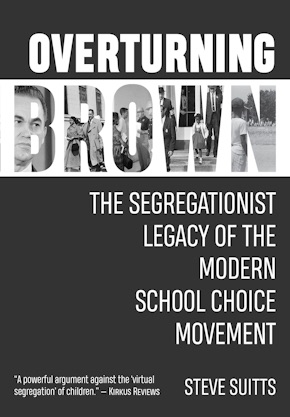
Steve Suitts wrote an excellent book about the history of school choice, called Overturning Brown: The Segregationist Legacy of the Modern School Chhoice Movement.
On May 14, the final day for submitting new bills in the Mississippi Legislature, a bold new package of them landed on the desks of Mississippi lawmakers. The plans called for the creation of a voucher program that paid for students to attend private schools.
A few weeks later, in the heat of mid-June, the governor urged lawmakers to support the $40 million program, promising it “will bear the sound fruit of progress for a hundred years after this generation is gone.” Public school support would continue, he assured. But vouchers would “strengthen the total educational effort” by giving children “the right to choose the educational environment they desire.”
It was 1964.
Key backers of the move included a group of white segregationists that had formed after the U.S. Supreme Court ruled state-mandated public school segregation unconstitutional.
Across the South, courts had already rejected or limited similar voucher plans in Alabama, Louisiana, Virginia and Arkansas. But Mississippi lawmakers plowed forward anyway and adopted the program. For several years, the state funneled money to white families eager for their children to attend new private academies opening as the first Black children arrived in previously all-white public schools.
Now, 60 years later, ProPublica has found that many of these private schools, known as “segregation academies,” still operate across the South — and many are once again benefiting from public dollars. Earlier this week, ProPublica reported that in North Carolina alone, 39 of them have received tens of millions in voucher money. In Mississippi, we identified 20 schools that likely opened as segregation academies and have received almost $10 million over the past six years from the state’s tax credit donation program.
“The origins of private schools receiving public funds were with the segregation academies,” said Steve Suitts, a historian and the author of “Overturning Brown: The Segregationist Legacy of the Modern School Choice Movement.”
Most private schools receiving money from the voucher-style programs exploding across the country aren’t segregation academies. But where the academies operate, especially in rural areas, they often foster racial separation in schools and, as a result, across entire communities.
Despite the passage of decades, most segregation academies across Mississippi remain vastly white — far more so than the counties where they operate, federal private school surveys show. Mississippi is the state with the highest percentage of Black residents.
At 15 of the 20 academies benefiting from the tax credit program, student bodies were at least 85% white as of the last federal private school survey, for the 2021-22 school year. And among the 20, enrollments at five were more than 60 percentage points whiter than their communities. Another 11 were at least 30 percentage points whiter.
In 1964, the White Citizens’ Council was among those pushing for the voucher plan. The pro-segregation group was founded in the Mississippi Delta town of Indianola in the 1950s by Robert “Tut” Patterson, who sought to “save our schools if possible” from integration and “if that failed, to develop a system of private schools for our children.”
For Patterson, it was personal. His family, including a young daughter who would start school that fall, lived on what he called a “plantation” with 35 Black families. As he later told an interviewer, “We took care of them. We practically lived with them. We loved them. We tended to them, but I didn’t want to mingle my children with them.”
Vouchers. This is the education idea that Republicans have been pushing for 30 years. This is the policy that is now universal in half a dozen red states. This is the main policy idea of the next Trump regime.
Writing in his blog Curmudgucation, Peter Greene reviews Kevin Huffman’s career as a big Reform honcho and his latest advice about what the federal government should do to make schools better. Peter noted that none of Huffman’s ventures has been successful, which makes a fine example of someone who has mastered the art of “failing upward.”
Peter Greene writes:
A few weeks ago, Kevin Huffman was in the pages of the Washington Post, bemoaning the lack of education discussion during the Presidential campaign and offering thoughts about What America Needs To Do Next. Nobody needs to read it. Really.
Kevin Huffman is a long-time reformster; in fact Kevin Huffman, as the Tennessee Grand High Commissioner of Education, represents a reformster milestone. Huffman’s career path took him to Swarthmore, which led to a Teach For America posting, which led to law school, which led to practicing education law in DC, which led back to TFA, first as general counsel and later as various VP executive titly things. Then, a few years later, Governor Bill Haslam tapped him for Tennessee Educational Poobahdom. Which made him the first TFA temp to get to run an entire state’s education system.
Once in charge, he made his reformy mark. (I will mention, because someone always brings it up, that he was for a brief while married to Michelle Rhee). He chimed in with Arne Duncan to claim that low-achieving students, including those with learning disabilities, just needed to be tested harder. And as a super buddy of charter schools, he took $3.4 million dollars away from Nashville city schools because their board didn’t approve the charter that he had personally shepherded through the process.
He became one of Jeb Bush’s Chiefs for Change.Huffman was a loyal Common Core warrior and was right at the front of the line to hand the feds the Race to the Top keys to Tennessee education in exchange for a NCLB waiver. Huffman never met a reformster idea he didn’t like (evaluation to root out bad teachers, performance based pay, charters)
Huffman also recruited Chris Barbicfrom Houston to come run the Achievement School District. The ASD was an attempt to see if New Orleans style public-to-private education conversion could be implemented without the fortuitous advent of a hurricane. Could human beings deliver that kind of destruction without the assistance of nature and create a network of business investment opportunities private charter schools?
The Achievement School District was created to catapult the bottom 5% of schools in Tennessee straight to the top 25% in the state. In doing so, we dramatically expand our students’ life and career options, engage parents and community members in new and exciting ways, and ensure a bright future for the state of Tennessee.
Let’s just be real: achieving results in neighborhood schools is harder than in a choice environment. I have seen this firsthand at YES Prep and now as the superintendent of the ASD. As a charter school founder, I did my fair share of chest pounding over great results. I’ve learned that getting these same results in a zoned neighborhood school environment is much harder.
Failing so consistently that a little more than a week after Huffman’s WaPo op-ed, Chalkbeat reported that research by Brown’s Annenberg Institute found that the ASD “generally worsened high school test scores.” It also didn’t help on ACT scores and “data related to attendance, chronic absenteeism, and disciplinary actions wasn’t encouraging, either.” Researchers found neither short-term nor long-term gains for students, and Tennessee legislators seem to finally be getting the idea that the ASD is junk.
But the guy who created it is still failing upward, having passed through the reform-pushing City Fund and now working as CEO of Accelerate, one more educational consulting fix-it shop operated by people with lots in the reformy funding universe (the board includes John White and Janice Jackson). They’re particularly keyed in to tutoring and individualized instruction, both computerized.
So what advice does the chief with no actual edu-wins to his name have to offer? Well, he thinks that George W. Bush was swell, and remember, reading and math scores wet up in the early days of No Child Left Behind. Folks like Monty Neill of Fairtest have since pointed out that these gains were only on the state Big Standardized Test. I was in the classroom at the time, and I can tell you exactly why test scores went up initially– because once the tests were rolled out we could learn how to teach to the test, and after a few years we had collected all the test prep gains we were going to get.
Huffman likes the “gains” in race to the Top testing which, again, reflect teachers learning how to game the new PARCC and SBA tests.
But, Huffman complains, by the end of the Obama administration, the feds were giving in to demands for more local control and pre-COVID test scores were already dipping, then “following the academic wreckage covid-19 left behind, heavy deferral to the states on spending and policy has left us with massive learning gaps and no national plan for closing them.”
It takes a person whose educational “experience” is almost entirely outside the classroom to believe that the Big Standardized Test is a useful measure of learning that should be the centerpiece of education policy rather than understanding that BS Testing is the most toxic force to be unleashed on education in the last couple of decades.
Huffman argues we need “strong national leadership around education policy,” which makes sense only if such leadership is guided by an actual understanding of teaching and learning and schooling, but history suggests that isn’t happening any time ever. But, he asserts, everyone wants “the best basic education for their children.” I don’t know what to do with that “basic” in there.
How do we get it?
For starters, the next president should issue a national call for all states and all groups of students to surpass pre-pandemic learning levels in reading and math by 2030 — and direct the Education Department to report on each state’s progress.
God, one of my least favorite forms of management– management by insistence. This is like sales managers who issue increased sales targets with helpful directives like “sell more.” But worse, this is demanding that schools focus more intently on the wrong damn target– test scores.
Huffman also wants the feds to replace ESSA (too weak) with “a return to nationwide education goals” along with accountability measures. And also, grants for states that “pursue ambitious education reform” as, one assumes, defined by the feds.
In other words, Huffman would like to rewind to 2002 and start NCLB/CCSS/RTTT all over again, and I guess we can say that keeping on with something that hasn’t worked yet is on brand for Huffman. But man– it all didn’t work the first time, and not just “didn’t work” but “did more harm than good.”
But he has some specifics that he wants the feds to enforce this time. One is phonics-based learning and I don’t have time to get into the reading wars other than to say that any time someone says “if we just use X, every student will learn Y” they are wrong.
He also wants the feds to boost high-dosage tutoring, which coincidentally is one of the foci of his present gig. High-dosage tutoring is hard and expensive to scale up, with the research support very narrow and specific. He also wants more CTE (fine).
Bottom line, Huffman wants presidents not to abdicate their “responsibility to push school districts toward success,” a sentiment in line with the reformster notion that everything wrong with education is the fault of lazy educators who have to be coerced into doing their jobs (and certainly not treated like partners in the education world).
The federal standards and BS Testocrats had their shot, and they failed hard. In many ways, their failures are still haunting the public school system. Huffman is a poster child for the Teach For America crowd who visited a classroom for a couple of years and parleyed that into “education expert” on their resume, going on to promote and support an array of ill-advised policies flavored with a barely-concealed disdain for the people who have actually made education and teaching a career. They should not get a do-over. They cannot be taken seriously, even if they manage to be platformed by major media outlets.
CBS News in Detroit reported on the latest study by the Network for Public Education, which showed that more than one-third of charter schools close within the first five years. The NPE study is based on federal data. Most charter schools in Michigan operate for-profit. Please open the link to see the video.
(CBS DETROIT) — A new national report finds that more than one in four charter schools fail in their first five years. And by year 15, nearly half have closed. The numbers are even more stark in Michigan charter schools.
The state’s population is dropping, and traditional public schools are closing as well, but at about half the rate of Michigan’s charter schools.
“I’ve kind of looked at Michigan as the wild Midwest of the charter sector,” said Mitchell Robinson, an associate professor at Michigan State University and a member of the Michigan State Board of Education.
He said he wasn’t surprised by the report’s findings.
“When we treat education like banks and dollar stores and dry cleaners and McDonald’s franchises, that’s the kind of results we’re going to get.”
Robinson said charter schools popping up and closing soon after hurt students, teachers, and other schools, sometimes creating public school deserts.
“There are parts of Detroit where kids have to travel up to two hours a day to get to a school because charter schools have come in, public schools have closed, then the charter school closes, then there’s no school at all,” he said.
The report by the Network for Public Education analyzed charter school closures across the country from 1998 to 2022. They found Michigan faces its particular challenges as charter schools here have less oversight and can be big money makers.
“Seventy percent of the charter schools in Michigan are run by for-profit entities. That is the highest percentage in the nation,” said Carol Burris, the Executive Director of the Network for Public Education.
She said every charter school in Michigan must have an authorizer that oversees it, and that authorizer receives up to three percent of the state money that goes to the school.
“Now 3% doesn’t sound like a lot, but it really is,” said Burris. “One case in point, Walker Charter Academy; it’s a National Heritage Charter Academy school. It received about $7.8 million last year in state funding, so 3% of that is $234,000. Now Grand Valley is its authorizer; they have 62 charter schools. You start doing the math; you’re talking about between $10 million and $14 million a year. That’s a lot of money.”
The President of the Michigan Charter School Association was not impressed:
“I’m not sure I understand their assumptions or their basic premises because their conclusions don’t align,” said Dan Quisenberry, the President of Michigan’s Charter School Association.
Perhaps you remember “Waiting for ‘Superman,'” the overhyped documentary from 2010 that made the audacious claim that public schools were failing due to “bad teachers”and that the only sane alternative was charter schools. The documentary was funded by the Gates Foundation, with the obvious purpose of smearing public schools and promoting charter schools. I reviewed the film in the New York review of Books, in a review called “The Myth of Charter Schools.” Among other flaws in the film, I pointed out that it misused and distorted NAEP data to paint a horrifying picture of public schools. I concluded it was dishonest propaganda on behalf of the privatizers.
One of the amazing, miraculous charter schools featured in the film was a residential boarding school in D.C. called SEED.
If the name of this unusual charter boarding school seems vaguely familiar, that may be because back in 2010, they were one of the charter schools lovingly lionized by the documentary hit piece, “Waiting for Superman.”
“Waiting for Superman” was a big hit, popularizing the neo-liberal narrative that public schools were failing because public school teachers were lazy incompetents. Every damn newspaper in the country jumped on the narrative. Roger Ebert jumped on. Oprah jumped on. NPR wondered why it didn’t get an Oscar (maybe, they posit, it was because one big emotional scene was made up). It helped sustain the celebrity brand of Michelle Rhee (the Kim Kardashian of education, famous despite having not accomplished anything). It was a slanted hatchet job that helped bolster the neoliberal case for Common Core and charter schools and test-centric education and heavy-handed “evaluation” of teachers.
And it boosted the profile of SEED, the DC charter whose secret sauce for student achievement is that it “takes them away from their home environments for five days a week and gives them a host of supporting services.”
According to the WaPo piece, reported by Lauren Lumpkin, audits of the school suggest a variety of mistreatment of students with special needs.
SEED underreported the number of students it expelled last year. It couldn’t produce records of services it was supposed to have provided for some students with disabilities (most likely explanation–those services were never provided). Federal law says that before you expel a student with an IEP, you have meetings to decide if the misbehavior is a feature of their disability, or if their misbehavior stems from requirements of the IEP that are not being provided.
These have the fancy name of “manifestation determination” which just means the school needs to ask– is the student acting out because that’s what her special situation makes her do, or because the Individualized Education Program that’s supposed to help deal with that special situation is not being actually done. For absurd example– is the student repeatedly late to her class on the second floor because she’s in a wheelchair? Does her IEP call for elevator transport to the second floor, and there’s no elevator in the building? Then maybe don’t suspend her for chronic lateness.
Founded in 1998, SEED enrolls about 250 students, which seems to preclude any sort of “just lost the details in the crowd” defense. But as Lumpkin reports, questions arose.
But after receiving complaints about discipline, understaffing and compliance with federal law, the city’s charter oversight agency started an audit of the school in July. One complaint claimed school officials had manipulated attendance data and were not recording suspensions.
The audit’s findings sparked scathing commentary from charter board members and questions about SEED D.C.’s practices.
“I’m the parent of a special-needs child, and I’ve got to tell you, reading what was happening in these pages, it’s like a parent’s worst nightmare,” charter board member Nick Rodriguez told SEED D.C. leaders. “I sincerely hope that you will take that seriously as you think about what needs to happen going forward.”
Lumpkin reports that this is not their first round of problems. A 2023 audit found a high number of expulsions and suspensions compared to other charters– five times higher. A cynical person might conclude that SEED addressed the problem by just not reporting the full numbers. Inaccurate data, missed deadlines, skipping legal requirements–that’s a multi-year pattern for the school.
The school is now on a “notice of concern,” a step on the road to losing its charter and being closed down (or I suppose they could just switch over to a private voucher-accepting school).
The whole sad story of the many students who have been ill-served by SEED is one more reminder that there are no miracles in education, and no miracle schools, either.
It’s hard to notice something that is invisible, but it is indeed obvious that there has been no discussion of education in the Presidential campaign.
It’s not as if education is unimportant: education is a path to a better life and to a better society. It is the road to progress.
The differences between the two candidates are like night and day. Trump supports dismantling public education and giving out vouchers. Harris is committed to funding schools and universities.
Project 2025 displays Trump’s goals: to eliminate the Department of Education, to turn the programs it funds (Title 1, IDEA for students with disabilities) and turn them into unrestricted block grants to states, which allows states to siphon off their funding for other purposes. At the same time that the Trump apparat wants to kill the Ed Department, it wants (contradictorily) to impose mandates on schools to stop the teaching of so-called critical race theory, to censor books, and to impose rightwing ideology on the nation’s schools.
It’s too bad that the future of education never came up in either of the high-profile debates. The American people should know that Kamala Harris wants to strengthen America’s schools, colleges, and universities, and that Donald Trump wants to destroy them.
I don’t live in Florida, but the amendment I will watch closely is #4. That’s the amendment to roll back Florida’s harsh six-week ban on abortion. Very few, if any, women know that they are pregnant at the six-week mark. A six-week ban is, in reality, a total ban. Under this ban, women will die; young girls will be forced to become mothers. People like Ron DeSantis are not pro-life.
VOTE YES TO REPEAL THE SIX-WEEK BAN.
VOTE YES TO REPEAL THE BAN.
This is how Scott Maxwell is voting on state referenda:
Florida’s Constitutional amendments can be confusing, often by design.
So I’m going to try to break down the six amendments on this year’s ballot as simply as possible. I’ll give you the arguments for and against each one, tell you some of the supporters and opponents and share how I’m voting. Do whatever you want. It’s your constitution.
This would take school board races, which are now nonpartisan affairs, and turn them into partisan contests with closed primaries. The idea was backed by Republican state legislators — and one Democrat, Sen. Linda Stewart of Orlando — who believe partisanship should play a bigger and more transparent role in school issues. Opponents, including the League of Women Voters, say injecting more partisanship into school board races is a rotten idea and note that the closed primary system will prevent many of you from casting votes.
Vote yes: If you want more partisanship and party involvement in local school races, as well as closed primaries.
Vote no: If you think candidates should appeal to voters based on their platforms and credentials rather than their party affiliation.
How I’m voting: No. I think this is the worst amendment on this year’s ballot. The last thing our schools need is more politics and partisanship.
Amendment 2: Put hunting and fishing in the Constitution
This would add language to the Florida Constitution that says hunting and fishing is a constitutionally protected right. Hunting and fishing is already legal in Florida. Existing statutes even declare them as “preserved” activities. And no state has banned hunting and fishing. But advocates say they just want to be super-duper sure. Opponents say this is like asking voters to pass a constitutional amendment protecting the right to golf or play tennis. The Florida Bar Journal also published a lengthy piece that said this proposal could have unintended consequences, such as prohibiting local beach communities from closing stretches of beach to protect turtle eggs, for instance, if someone claimed that turtle protection got in the way of their “constitutional right to fish.”
Vote yes: If you want to enshrine hunting and fishing protections in the Florida Constitution.
Vote no: If you don’t.
How I’m voting: No. This one seems unnecessary and potentially fraught with unintended legal consequences.
This would basically treat marijuana like cigarettes and booze, making the substance legal but subject to strict government regulation. Advocates note that marijuana is a natural substance, already widely used and argue that legalization would make it safer. Some law enforcement chiefs say it would also stop wasting their time. Opponents, including Gov. Ron DeSantis and the Florida Chamber of Commerce, dispute the drug’s safety, say this amendment would primarily benefit a few large companies and generally argue that communities that allow marijuana are unpleasant.
Vote yes: If you want to legalize marijuana.
Vote no: If you don’t.
How I’m voting: I’ve been torn on this one. I don’t think marijuana is as harmless as some advocates claim and know companies like Trulieve hope to make billions off legalization. But I also believe adults should have the ability to make their own decisions and can’t make a good case for why alcohol and carcinogenic cigarettes should be legal and why this naturally grown plant shouldn’t be. So I ultimately decided yes, agreeing with the Sentinel editorial board’s summary: “We’re not going to pretend that legalizing recreational marijuana would be a 100% beneficial experience for Florida. But it does make sense — far more sense than the current situation, where some people use medical pot with no fear of prosecution while others still face arrest, jail steep fines or a lifelong criminal record for possessing it.”
Amendment 4: Prohibit Tallahassee-imposed restrictions on abortion
This is the abortion amendment. And it’s pretty simple. It would prohibit state lawmakers from imposing any laws that place restrictions on abortion “before viability” beyond what federal law says while preserving requirements for parental notification. Citizens placed this initiative on the ballot to combat Florida’s new restrictions, which are some of the strictest in the nation, banning abortion after 15 weeks without exceptions for rape or incest and effectively banning most abortions after six weeks. Supporters, including some doctors, say Florida’s law puts women’s lives in danger, is heartlessly cruel to victims of sexual crimes and that abortion decisions should be made by women and their doctors, not politicians. Opponents, including the governor and GOP lawmakers, generally oppose abortion and say they should have the right to decide what medical procedures pregnant women can undergo.
Vote yes: If you think Florida’s existing ban on abortions without many exceptions is too extreme.
Vote no: If you are opposed to abortion under most any circumstances and trust state politicians to make the rules.
How I’m voting: Yes. I believe thoughtful people can have different opinions on abortion. But Florida’s current laws are extreme and dangerous.
Amendment 5: Adjust homestead exemptions for inflation
State lawmakers want to offer homeowners a tiny tax break — maybe $10 a year — but force local governments to pay for it. This one’s a bit complicated. It would take half of the $50,000 homestead exemption homeowners get and tie it to inflation. So if inflation rose by 2.5% one year, your homestead exemption would be worth $50,625 the next, representing an increase of 2.5% on $25,000. Clear as mud, right? Opponents say this is political trickery, since state lawmakers aren’t offering to cut state taxes. They want to force local governments to take the hit. And the Florida League of Cities argues that tiny savings for homeowners would have a huge collective impact on local governments. The Tampa Bay Times editorial board supports this plan. The Orlando Sentinel and Sun Sentinel oppose, noting this tax break would elude many Floridians, namely renters.
Vote yes: If you want to slightly increase the tax exemption homeowners get every year and decrease what local governments collect for services like fire and police.
Vote no: If you think the exemption is fine the way it is.
How I’m voting: No. I don’t really care much about this one either way. Sure, I’d like a few extra bucks. But this seems like political theater; a way for state lawmakers to say they provided a tiny tax break without cutting any of their own spending. If state lawmakers want to cut taxes, they should cut the taxes they collect.
This would end the law that allows candidates for statewide office to use public money to finance their campaigns. Forty years ago, Floridians voted to create this program, hoping it would help grassroots candidates compete with politicians who suck up gobs of special-interest money. But now, thanks to political committees that can take unlimited donations, the candidates who take the most special interest money also collect the most tax dollars. Ron DeSantis set the record in 2022, collecting the most money ever from deep-pocketed donors and the most from taxpayers (more than $7 million). Supporters of this repeal include Florida legislators. Opponents include the League of Women Voters and the Sentinel editorial board.
Vote yes: If you don’t believe taxpayers should finance political campaigns.
Vote no: If you like the idea of tax dollars paying for campaigns and believe lesser-funded candidates deserve help, even if their better-funded opponents get more of it.
How I’m voting: Yes. Unlike my newspaper’s editorial board, I believe this subsidies-for-politicians program was a noble idea that has been warped beyond sense or salvation. It could’ve been fixed by requiring subsidy recipients to limit all their other contributions. But lawmakers have consistently refused such reforms.
Want more info?
Check out the League of Women Voters’ great voter-info site at Vote411.org




 Diane Ravitch's blog